Ochsner Health:
Enhancing the
Population Health
Strategy
Team: Lowe Co.
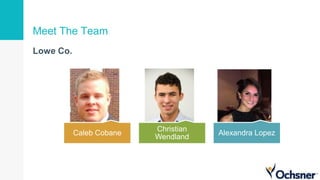
Meet The Team
Lowe Co.
Caleb Cobane
Christian
Wendland
Alexandra Lopez
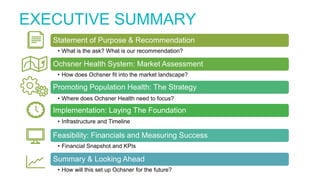
EXECUTIVE SUMMARY
Statement of Purpose & Recommendation
• What is the ask? What is our recommendation?
Ochsner Health System: Market Assessment
• How does Ochsner fit into the market landscape?
Implementation: Laying The Foundation
• Infrastructure and Timeline
Promoting Population Health: The Strategy
• Where does Ochsner Health need to focus?
Feasibility: Financials and Measuring Success
• Financial Snapshot and KPIs
Summary & Looking Ahead
• How will this set up Ochsner for the future?
STATEMENT OF PURPOSE &
RECOMMENDATION
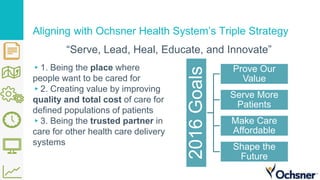
Aligning with Ochsner Health System’s Triple Strategy
▸1. Being the place where
people want to be cared for
▸2. Creating value by improving
quality and total cost of care for
defined populations of patients
▸3. Being the trusted partner in
care for other health care delivery
systems
2016Goals
Prove Our
Value
Serve More
Patients
Make Care
Affordable
Shape the
Future
“Serve, Lead, Heal, Educate, and Innovate”
Ochsner Has Robust Population Health Tactics
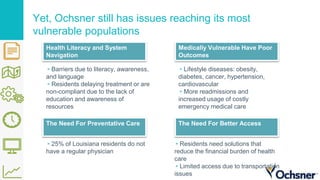
Yet, Ochsner still has issues reaching its most
vulnerable populations
▹Lifestyle diseases: obesity,
diabetes, cancer, hypertension,
cardiovascular
▹More readmissions and
increased usage of costly
emergency medical care
▹Barriers due to literacy, awareness,
and language
▹Residents delaying treatment or are
non-compliant due to the lack of
education and awareness of
resources
The Need For Better Access
Medically Vulnerable Have Poor
Outcomes
Health Literacy and System
Navigation
The Need For Preventative Care
▹Residents need solutions that
reduce the financial burden of health
care
▹Limited access due to transportation
issues
▹25% of Louisiana residents do not
have a regular physician
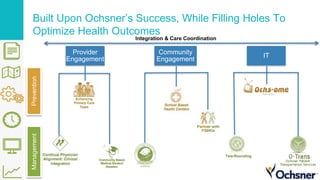
Built Upon Ochsner’s Success, While Filling Holes To
Optimize Health Outcomes
Provider
Engagement
Community
Engagement
IT
PreventionManagement
Integration & Care Coordination
OCHSNER HEALTH SYSTEM:
MARKET ASSESSMENT
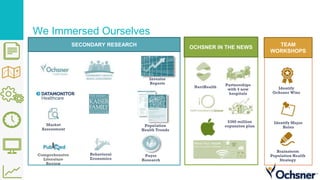
We Immersed Ourselves
SECONDARY RESEARCH
Market
Assessment
Comprehensive
Literature
Review
Population
Health Trends
Payer
Research
Investor
Reports
PROPRIETARY
WORKSHOPS
TEAM
WORKSHOPS
Identify
Ochsner Wins
Identify Major
Holes
Brainstorm
Population Health
Strategy
PROPRIETARY
WORKSHOPS
OCHSNER IN THE NEWS
NaviHealth
$360 million
expansion plan
Partnerships
with 4 new
hospitals
Behavioral
Economics
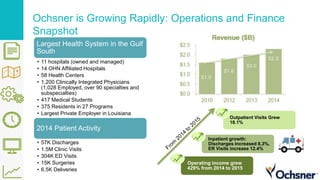
Ochsner is Growing Rapidly: Operations and Finance
Snapshot
Largest Health System in the Gulf
South
• 11 hospitals (owned and managed)
• 14 OHN Affiliated Hospitals
• 58 Health Centers
• 1,200 Clinically Integrated Physicians
(1,028 Employed, over 90 specialties and
subspecialties)
• 417 Medical Students
• 375 Residents in 27 Programs
• Largest Private Employer in Louisiana
2014 Patient Activity
• 57K Discharges
• 1.5M Clinic Visits
• 304K ED Visits
• 15K Surgeries
• 6.5K Deliveries
Operating income grew
429% from 2014 to 2015
Inpatient growth:
Discharges increased 8.3%,
ER Visits increase 12.4%
Outpatient Visits Grew
18.1%
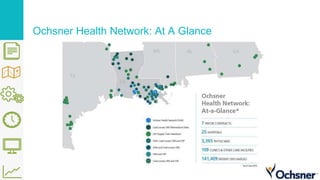
Ochsner Health Network: At A Glance
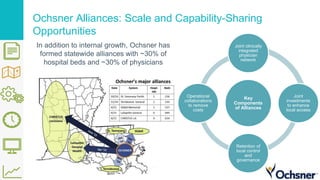
Ochsner Alliances: Scale and Capability-Sharing
Opportunities
In addition to internal growth, Ochsner has
formed statewide alliances with ~30% of
hospital beds and ~30% of physicians
Key
Components
of Alliances
Joint clinically
integrated
physician
network
Joint
investments
to enhance
local access
Retention of
local control
and
governance
Operational
collaborations
to remove
costs
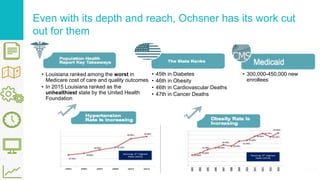
Even with its depth and reach, Ochsner has its work cut
out for them
• Louisiana ranked among the worst in
Medicare cost of care and quality outcomes
• In 2015 Louisiana ranked as the
unhealthiest state by the United Health
Foundation
• 45th in Diabetes
• 46th in Obesity
• 46th in Cardiovascular Deaths
• 47th in Cancer Deaths
• 300,000-450,000 new
enrollees
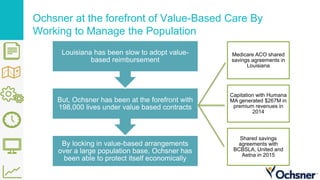
Ochsner at the forefront of Value-Based Care By
Working to Manage the Population
By locking in value-based arrangements
over a large population base, Ochsner has
been able to protect itself economically
But, Ochsner has been at the forefront with
198,000 lives under value based contracts
Louisiana has been slow to adopt value-
based reimbursement
Medicare ACO shared
savings agreements in
Louisiana
Capitation with Humana
MA generated $267M in
premium revenues in
2014
Shared savings
agreements with
BCBSLA, United and
Aetna in 2015
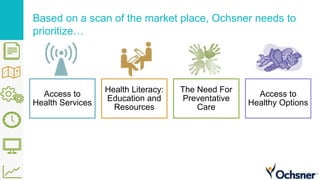
Based on a scan of the market place, Ochsner needs to
prioritize…
Access to
Health Services
Health Literacy:
Education and
Resources
The Need For
Preventative
Care
Access to
Healthy Options
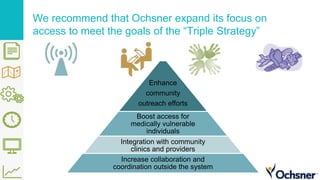
We recommend that Ochsner expand its focus on
access to meet the goals of the “Triple Strategy”
Enhance
community
outreach efforts
Boost access for
medically vulnerable
individuals
Integration with community
clinics and providers
Increase collaboration and
coordination outside the system
PRIORITIZING POPULATION HEALTH:
THREE PRONG STRATEGY
Built Upon Ochsner’s Success, While Filling Holes To
Optimize Health Outcomes
Provider
Engagement
Community
Engagement
IT
PreventionManagement
Integration & Care Coordination
Built Upon Ochsner’s Success, While Filling Holes To
Optimize Health Outcomes
Provider
Engagement
Community
Engagement
IT
PreventionManagement
Integration & Care Coordination
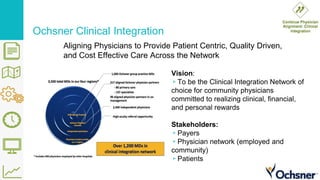
Ochsner Clinical Integration
Vision:
▹To be the Clinical Integration Network of
choice for community physicians
committed to realizing clinical, financial,
and personal rewards
Stakeholders:
▹Payers
▹Physician network (employed and
community)
▹Patients
Aligning Physicians to Provide Patient Centric, Quality Driven,
and Cost Effective Care Across the Network
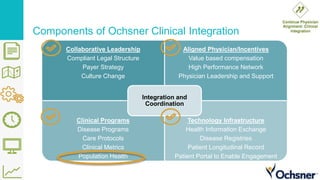
Components of Ochsner Clinical Integration
Collaborative Leadership
Compliant Legal Structure
Payer Strategy
Culture Change
Aligned Physician/Incentives
Value based compensation
High Performance Network
Physician Leadership and Support
Clinical Programs
Disease Programs
Care Protocols
Clinical Metrics
Population Health
Technology Infrastructure
Health Information Exchange
Disease Registries
Patient Longitudinal Record
Patient Portal to Enable Engagement
Integration and
Coordination
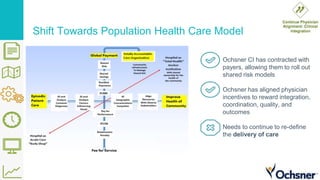
Shift Towards Population Health Care Model
Ochsner CI has contracted with
payers, allowing them to roll out
shared risk models
Ochsner has aligned physician
incentives to reward integration,
coordination, quality, and
outcomes
Needs to continue to re-define
the delivery of care
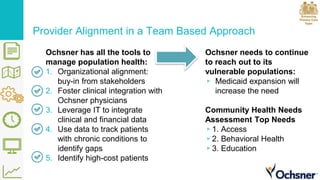
Provider Alignment in a Team Based Approach
Ochsner has all the tools to
manage population health:
1. Organizational alignment:
buy-in from stakeholders
2. Foster clinical integration with
Ochsner physicians
3. Leverage IT to integrate
clinical and financial data
4. Use data to track patients
with chronic conditions to
identify gaps
5. Identify high-cost patients
Ochsner needs to continue
to reach out to its
vulnerable populations:
▹ Medicaid expansion will
increase the need
Community Health Needs
Assessment Top Needs
▹1. Access
▹2. Behavioral Health
▹3. Education
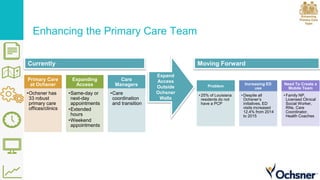
Enhancing the Primary Care Team
Expand
Access
Outside
Ochsner
Walls
Primary Care
at Ochsner
•Ochsner has
33 robust
primary care
offices/clinics
Expanding
Access
•Same-day or
next-day
appointments
•Extended
hours
•Weekend
appointments
Care
Managers
•Care
coordination
and transition
Problem
• 25% of Louisiana
residents do not
have a PCP
Increasing ED
use
• Despite all
Ochsner’s
initiatives, ED
visits increased
12.4% from 2014
to 2015
Need To Create a
Mobile Team
• Family NP,
Licensed Clinical
Social Worker,
RNs, Care
Coordinator,
Health Coaches
Currently Moving Forward
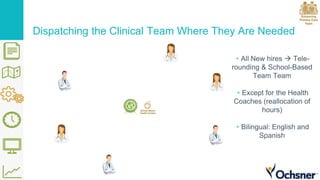
Dispatching the Clinical Team Where They Are Needed
▹All New hires  Tele-
rounding & School-Based
Team Team
▹Except for the Health
Coaches (reallocation of
hours)
▹Bilingual: English and
Spanish
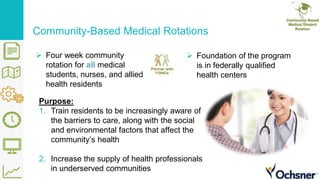
Community-Based Medical Rotations
Purpose:
1. Train residents to be increasingly aware of
the barriers to care, along with the social
and environmental factors that affect the
community’s health
2. Increase the supply of health professionals
in underserved communities
 Foundation of the program
is in federally qualified
health centers
 Four week community
rotation for all medical
students, nurses, and allied
health residents
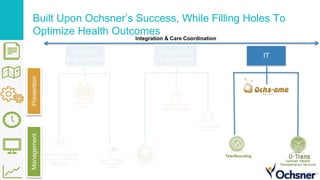
Built Upon Ochsner’s Success, While Filling Holes To
Optimize Health Outcomes
Provider
Engagement
Community
Engagement
IT
PreventionManagement
Integration & Care Coordination
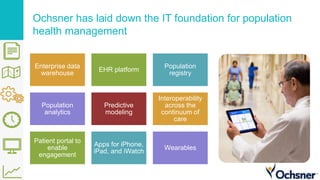
Ochsner has laid down the IT foundation for population
health management
Enterprise data
warehouse
EHR platform
Population
registry
Population
analytics
Predictive
modeling
Interoperability
across the
continuum of
care
Patient portal to
enable
engagement
Apps for iPhone,
iPad, and iWatch
Wearables
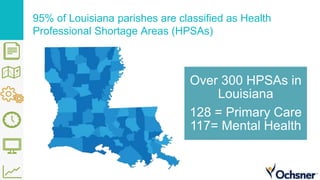
Over 300 HPSAs in
Louisiana
128 = Primary Care
117= Mental Health
95% of Louisiana parishes are classified as Health
Professional Shortage Areas (HPSAs)
Telemedicine: Reach Further, Faster, Cheaper
17 of the 20 most
common diagnoses
in urgent care can
be treated by video.
Louisiana
Telehealth Access
Act of 2014
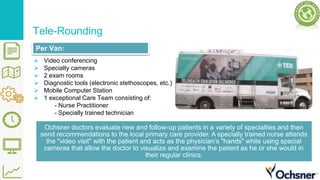
Tele-Rounding
 Video conferencing
 Specialty cameras
 2 exam rooms
 Diagnostic tools (electronic stethoscopes, etc.)
 Mobile Computer Station
 1 exceptional Care Team consisting of:
- Nurse Practitioner
- Specially trained technician
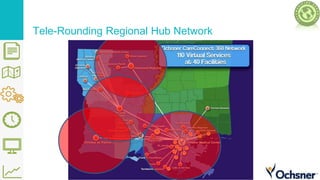
Ochsner doctors evaluate new and follow-up patients in a variety of specialties and then
send recommendations to the local primary care provider. A specially trained nurse attends
the "video visit" with the patient and acts as the physician’s "hands" while using special
cameras that allow the doctor to visualize and examine the patient as he or she would in
their regular clinics.
Per Van:
Tele-Rounding Regional Hub Network
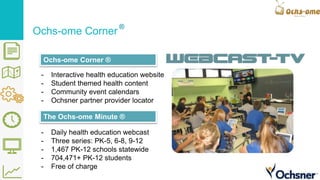
- Daily health education webcast
- Three series: PK-5, 6-8, 9-12
- 1,467 PK-12 schools statewide
- 704,471+ PK-12 students
- Free of charge
- Interactive health education website
- Student themed health content
- Community event calendars
- Ochsner partner provider locator
Ochs-ome Corner
Ochs-ome Corner ®
The Ochs-ome Minute ®
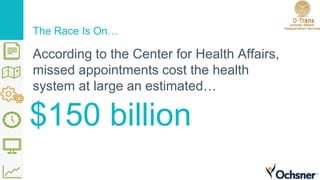
The Race Is On…
$150 billion
According to the Center for Health Affairs,
missed appointments cost the health
system at large an estimated…
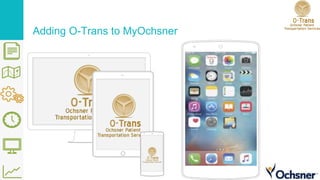
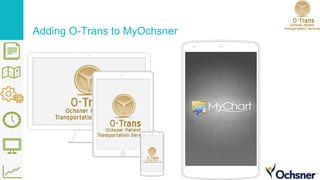
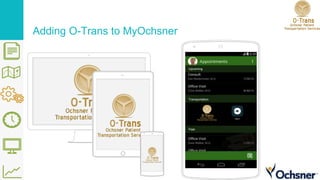
Adding O-Trans to MyOchsner
Transportation
Upcoming
Past
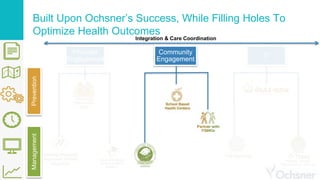
Built Upon Ochsner’s Success, While Filling Holes To
Optimize Health Outcomes
Provider
Engagement
Community
Engagement
IT
PreventionManagement
Integration & Care Coordination
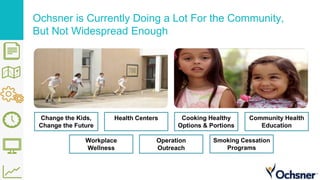
Ochsner is Currently Doing a Lot For the Community,
But Not Widespread Enough
Change the Kids,
Change the Future
Health Centers Cooking Healthy
Options & Portions
Community Health
Education
Workplace
Wellness
Operation
Outreach
Smoking Cessation
Programs
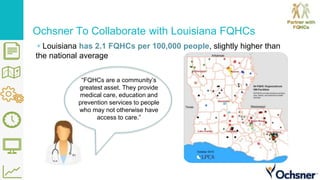
Ochsner To Collaborate with Louisiana FQHCs
▹Louisiana has 2.1 FQHCs per 100,000 people, slightly higher than
the national average
“FQHCs are a community’s
greatest asset. They provide
medical care, education and
prevention services to people
who may not otherwise have
access to care.”
Partnering with FQHCs to Promote Population Health
Expand the Ochsner Footprint:
Areas for Collaboration
Refer patients
for diagnostic
and specialty
care within
Ochsner
network
Patient
Navigation:
follow-up and
care
coordination
Alignment of
Incentives:
Partnerships
can yield
higher shared
savings rates
(ex. reducing
unnecessary
ER visits)
▹For example, nurse case managers at
FQHCs can receive information on when
their patient was admitted/discharged from
the hospital
▹Allows for follow-up with the patient to
make an appointment to continue care
▹Can manage disease and reduce
unnecessary ER visits
Expanding the Reach of CHOP-In-a-Box
What is it?
 CHOP In-a-Box is a deliverable, easily replicable kit
of supplies and tools that teach students healthy
eating options through an 8-week appetizing course
Make healthy eating a habit
 Empower students with nutrition knowledge and the
confidence to prepare healthy meals
 Health coaches attend first and last meeting
Establish Additional School Based Health Centers in
Areas of High Need
Orleans Parish
 Highest rate of diabetes for those aged 6-17 in the Ochsner
service area
Reduce
Uncompensated
Care
Provide Medical
Home for Youth
without One
Lower
Readmission
Rates and Fewer
ER Visits
Bring preventative care directly to youth
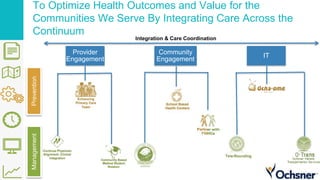
To Optimize Health Outcomes and Value for the
Communities We Serve By Integrating Care Across the
Continuum
Provider
Engagement
Community
Engagement
IT
PreventionManagement
Integration & Care Coordination
IMPLEMENTATION:
LAYING THE FOUNDATION
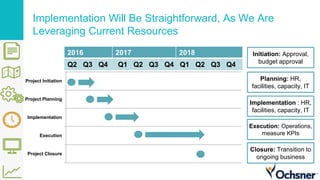
Implementation Will Be Straightforward, As We Are
Leveraging Current Resources
Q2 Q3 Q4 Q1 Q2 Q3 Q4 Q1 Q2 Q3 Q4
2016 2017 2018
Project Initiation
Project Planning
Implementation
Execution
Project Closure
Initiation: Approval,
budget approval
Planning: HR,
facilities, capacity, IT
Implementation : HR,
facilities, capacity, IT
Execution: Operations,
measure KPIs
Closure: Transition to
ongoing business
MEASURING SUCCESS AND
FINANCIAL FEASIBILITY
Snapshot of Financials: Working Smarter To Make
Capital Work Harder
$29,924,791
3 Year Portfolio NPV
7.5%
IRR
1.0%,1.5%,2.5% System 3-Year
No-Show Rate Reduction
Targeted Statewide OP Market
Share Expansion
Resulting IP Volume Upticks
Drivers
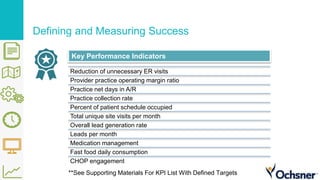
Defining and Measuring Success
Reduction of unnecessary ER visits
Provider practice operating margin ratio
Practice net days in A/R
Practice collection rate
Percent of patient schedule occupied
Total unique site visits per month
Overall lead generation rate
Leads per month
Medication management
Fast food daily consumption
CHOP engagement
Key Performance Indicators
**See Supporting Materials For KPI List With Defined Targets
SUMMARY & LOOKING AHEAD
Building off of Ochsner Population Health Foundation:
Investing Today To Reap The Rewards Tomorrow
▹Continue to build stronger collaboration—
hospitals, physicians, insurers
▹Fight fragmentation of the delivery system and
build connectivity with FQHCs and other community
entities
▹Be proactive to re-define the delivery of care and
expand outside the Ochsner walls
▹Extend Ochsner’s reach to serve the most
vulnerable patients at an affordable cost
Prove Our Value
Serve More Patients
Make Care Affordable
Shape the Future
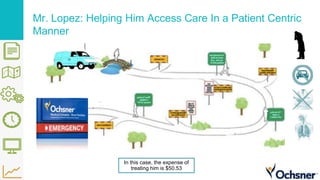
Mr. Lopez: Helping Him Access Care In a Patient Centric
Manner
This will cost Ochsner
$1233
Mr. Lopez: Helping Him Access Care In a Patient Centric
Manner
In this case, the expense of
treating him is $50.53
Thank you.
Any questions?

Johns Hopkins 2016 MHA Case Competition

  • 1.
    Ochsner Health: Enhancing the PopulationHealth Strategy Team: Lowe Co.
  • 2.
    Meet The Team LoweCo. Caleb Cobane Christian Wendland Alexandra Lopez
  • 3.
    EXECUTIVE SUMMARY Statement ofPurpose & Recommendation • What is the ask? What is our recommendation? Ochsner Health System: Market Assessment • How does Ochsner fit into the market landscape? Implementation: Laying The Foundation • Infrastructure and Timeline Promoting Population Health: The Strategy • Where does Ochsner Health need to focus? Feasibility: Financials and Measuring Success • Financial Snapshot and KPIs Summary & Looking Ahead • How will this set up Ochsner for the future?
  • 4.
    STATEMENT OF PURPOSE& RECOMMENDATION
  • 5.
    Aligning with OchsnerHealth System’s Triple Strategy ▸1. Being the place where people want to be cared for ▸2. Creating value by improving quality and total cost of care for defined populations of patients ▸3. Being the trusted partner in care for other health care delivery systems 2016Goals Prove Our Value Serve More Patients Make Care Affordable Shape the Future “Serve, Lead, Heal, Educate, and Innovate”
  • 6.
    Ochsner Has RobustPopulation Health Tactics
  • 7.
    Yet, Ochsner stillhas issues reaching its most vulnerable populations ▹Lifestyle diseases: obesity, diabetes, cancer, hypertension, cardiovascular ▹More readmissions and increased usage of costly emergency medical care ▹Barriers due to literacy, awareness, and language ▹Residents delaying treatment or are non-compliant due to the lack of education and awareness of resources The Need For Better Access Medically Vulnerable Have Poor Outcomes Health Literacy and System Navigation The Need For Preventative Care ▹Residents need solutions that reduce the financial burden of health care ▹Limited access due to transportation issues ▹25% of Louisiana residents do not have a regular physician
  • 8.
    Built Upon Ochsner’sSuccess, While Filling Holes To Optimize Health Outcomes Provider Engagement Community Engagement IT PreventionManagement Integration & Care Coordination
  • 9.
  • 10.
    We Immersed Ourselves SECONDARYRESEARCH Market Assessment Comprehensive Literature Review Population Health Trends Payer Research Investor Reports PROPRIETARY WORKSHOPS TEAM WORKSHOPS Identify Ochsner Wins Identify Major Holes Brainstorm Population Health Strategy PROPRIETARY WORKSHOPS OCHSNER IN THE NEWS NaviHealth $360 million expansion plan Partnerships with 4 new hospitals Behavioral Economics
  • 11.
    Ochsner is GrowingRapidly: Operations and Finance Snapshot Largest Health System in the Gulf South • 11 hospitals (owned and managed) • 14 OHN Affiliated Hospitals • 58 Health Centers • 1,200 Clinically Integrated Physicians (1,028 Employed, over 90 specialties and subspecialties) • 417 Medical Students • 375 Residents in 27 Programs • Largest Private Employer in Louisiana 2014 Patient Activity • 57K Discharges • 1.5M Clinic Visits • 304K ED Visits • 15K Surgeries • 6.5K Deliveries Operating income grew 429% from 2014 to 2015 Inpatient growth: Discharges increased 8.3%, ER Visits increase 12.4% Outpatient Visits Grew 18.1%
  • 12.
  • 13.
    Ochsner Alliances: Scaleand Capability-Sharing Opportunities In addition to internal growth, Ochsner has formed statewide alliances with ~30% of hospital beds and ~30% of physicians Key Components of Alliances Joint clinically integrated physician network Joint investments to enhance local access Retention of local control and governance Operational collaborations to remove costs
  • 14.
    Even with itsdepth and reach, Ochsner has its work cut out for them • Louisiana ranked among the worst in Medicare cost of care and quality outcomes • In 2015 Louisiana ranked as the unhealthiest state by the United Health Foundation • 45th in Diabetes • 46th in Obesity • 46th in Cardiovascular Deaths • 47th in Cancer Deaths • 300,000-450,000 new enrollees
  • 15.
    Ochsner at theforefront of Value-Based Care By Working to Manage the Population By locking in value-based arrangements over a large population base, Ochsner has been able to protect itself economically But, Ochsner has been at the forefront with 198,000 lives under value based contracts Louisiana has been slow to adopt value- based reimbursement Medicare ACO shared savings agreements in Louisiana Capitation with Humana MA generated $267M in premium revenues in 2014 Shared savings agreements with BCBSLA, United and Aetna in 2015
  • 16.
    Based on ascan of the market place, Ochsner needs to prioritize… Access to Health Services Health Literacy: Education and Resources The Need For Preventative Care Access to Healthy Options
  • 17.
    We recommend thatOchsner expand its focus on access to meet the goals of the “Triple Strategy” Enhance community outreach efforts Boost access for medically vulnerable individuals Integration with community clinics and providers Increase collaboration and coordination outside the system
  • 18.
  • 19.
    Built Upon Ochsner’sSuccess, While Filling Holes To Optimize Health Outcomes Provider Engagement Community Engagement IT PreventionManagement Integration & Care Coordination
  • 20.
    Built Upon Ochsner’sSuccess, While Filling Holes To Optimize Health Outcomes Provider Engagement Community Engagement IT PreventionManagement Integration & Care Coordination
  • 21.
    Ochsner Clinical Integration Vision: ▹Tobe the Clinical Integration Network of choice for community physicians committed to realizing clinical, financial, and personal rewards Stakeholders: ▹Payers ▹Physician network (employed and community) ▹Patients Aligning Physicians to Provide Patient Centric, Quality Driven, and Cost Effective Care Across the Network
  • 22.
    Components of OchsnerClinical Integration Collaborative Leadership Compliant Legal Structure Payer Strategy Culture Change Aligned Physician/Incentives Value based compensation High Performance Network Physician Leadership and Support Clinical Programs Disease Programs Care Protocols Clinical Metrics Population Health Technology Infrastructure Health Information Exchange Disease Registries Patient Longitudinal Record Patient Portal to Enable Engagement Integration and Coordination
  • 23.
    Shift Towards PopulationHealth Care Model Ochsner CI has contracted with payers, allowing them to roll out shared risk models Ochsner has aligned physician incentives to reward integration, coordination, quality, and outcomes Needs to continue to re-define the delivery of care
  • 24.
    Provider Alignment ina Team Based Approach Ochsner has all the tools to manage population health: 1. Organizational alignment: buy-in from stakeholders 2. Foster clinical integration with Ochsner physicians 3. Leverage IT to integrate clinical and financial data 4. Use data to track patients with chronic conditions to identify gaps 5. Identify high-cost patients Ochsner needs to continue to reach out to its vulnerable populations: ▹ Medicaid expansion will increase the need Community Health Needs Assessment Top Needs ▹1. Access ▹2. Behavioral Health ▹3. Education
  • 25.
    Enhancing the PrimaryCare Team Expand Access Outside Ochsner Walls Primary Care at Ochsner •Ochsner has 33 robust primary care offices/clinics Expanding Access •Same-day or next-day appointments •Extended hours •Weekend appointments Care Managers •Care coordination and transition Problem • 25% of Louisiana residents do not have a PCP Increasing ED use • Despite all Ochsner’s initiatives, ED visits increased 12.4% from 2014 to 2015 Need To Create a Mobile Team • Family NP, Licensed Clinical Social Worker, RNs, Care Coordinator, Health Coaches Currently Moving Forward
  • 26.
    Dispatching the ClinicalTeam Where They Are Needed ▹All New hires  Tele- rounding & School-Based Team Team ▹Except for the Health Coaches (reallocation of hours) ▹Bilingual: English and Spanish
  • 27.
    Community-Based Medical Rotations Purpose: 1.Train residents to be increasingly aware of the barriers to care, along with the social and environmental factors that affect the community’s health 2. Increase the supply of health professionals in underserved communities  Foundation of the program is in federally qualified health centers  Four week community rotation for all medical students, nurses, and allied health residents
  • 28.
    Built Upon Ochsner’sSuccess, While Filling Holes To Optimize Health Outcomes Provider Engagement Community Engagement IT PreventionManagement Integration & Care Coordination
  • 29.
    Ochsner has laiddown the IT foundation for population health management Enterprise data warehouse EHR platform Population registry Population analytics Predictive modeling Interoperability across the continuum of care Patient portal to enable engagement Apps for iPhone, iPad, and iWatch Wearables
  • 30.
    Over 300 HPSAsin Louisiana 128 = Primary Care 117= Mental Health 95% of Louisiana parishes are classified as Health Professional Shortage Areas (HPSAs)
  • 31.
    Telemedicine: Reach Further,Faster, Cheaper 17 of the 20 most common diagnoses in urgent care can be treated by video. Louisiana Telehealth Access Act of 2014
  • 32.
    Tele-Rounding  Video conferencing Specialty cameras  2 exam rooms  Diagnostic tools (electronic stethoscopes, etc.)  Mobile Computer Station  1 exceptional Care Team consisting of: - Nurse Practitioner - Specially trained technician Ochsner doctors evaluate new and follow-up patients in a variety of specialties and then send recommendations to the local primary care provider. A specially trained nurse attends the "video visit" with the patient and acts as the physician’s "hands" while using special cameras that allow the doctor to visualize and examine the patient as he or she would in their regular clinics. Per Van:
  • 33.
  • 34.
    - Daily healtheducation webcast - Three series: PK-5, 6-8, 9-12 - 1,467 PK-12 schools statewide - 704,471+ PK-12 students - Free of charge - Interactive health education website - Student themed health content - Community event calendars - Ochsner partner provider locator Ochs-ome Corner Ochs-ome Corner ® The Ochs-ome Minute ®
  • 35.
    The Race IsOn… $150 billion According to the Center for Health Affairs, missed appointments cost the health system at large an estimated…
  • 36.
  • 37.
  • 38.
    Adding O-Trans toMyOchsner Transportation Upcoming Past
  • 39.
    Built Upon Ochsner’sSuccess, While Filling Holes To Optimize Health Outcomes Provider Engagement Community Engagement IT PreventionManagement Integration & Care Coordination
  • 40.
    Ochsner is CurrentlyDoing a Lot For the Community, But Not Widespread Enough Change the Kids, Change the Future Health Centers Cooking Healthy Options & Portions Community Health Education Workplace Wellness Operation Outreach Smoking Cessation Programs
  • 41.
    Ochsner To Collaboratewith Louisiana FQHCs ▹Louisiana has 2.1 FQHCs per 100,000 people, slightly higher than the national average “FQHCs are a community’s greatest asset. They provide medical care, education and prevention services to people who may not otherwise have access to care.”
  • 42.
    Partnering with FQHCsto Promote Population Health Expand the Ochsner Footprint: Areas for Collaboration Refer patients for diagnostic and specialty care within Ochsner network Patient Navigation: follow-up and care coordination Alignment of Incentives: Partnerships can yield higher shared savings rates (ex. reducing unnecessary ER visits) ▹For example, nurse case managers at FQHCs can receive information on when their patient was admitted/discharged from the hospital ▹Allows for follow-up with the patient to make an appointment to continue care ▹Can manage disease and reduce unnecessary ER visits
  • 43.
    Expanding the Reachof CHOP-In-a-Box What is it?  CHOP In-a-Box is a deliverable, easily replicable kit of supplies and tools that teach students healthy eating options through an 8-week appetizing course Make healthy eating a habit  Empower students with nutrition knowledge and the confidence to prepare healthy meals  Health coaches attend first and last meeting
  • 44.
    Establish Additional SchoolBased Health Centers in Areas of High Need Orleans Parish  Highest rate of diabetes for those aged 6-17 in the Ochsner service area Reduce Uncompensated Care Provide Medical Home for Youth without One Lower Readmission Rates and Fewer ER Visits Bring preventative care directly to youth
  • 45.
    To Optimize HealthOutcomes and Value for the Communities We Serve By Integrating Care Across the Continuum Provider Engagement Community Engagement IT PreventionManagement Integration & Care Coordination
  • 46.
  • 47.
    Implementation Will BeStraightforward, As We Are Leveraging Current Resources Q2 Q3 Q4 Q1 Q2 Q3 Q4 Q1 Q2 Q3 Q4 2016 2017 2018 Project Initiation Project Planning Implementation Execution Project Closure Initiation: Approval, budget approval Planning: HR, facilities, capacity, IT Implementation : HR, facilities, capacity, IT Execution: Operations, measure KPIs Closure: Transition to ongoing business
  • 48.
  • 49.
    Snapshot of Financials:Working Smarter To Make Capital Work Harder $29,924,791 3 Year Portfolio NPV 7.5% IRR 1.0%,1.5%,2.5% System 3-Year No-Show Rate Reduction Targeted Statewide OP Market Share Expansion Resulting IP Volume Upticks Drivers
  • 50.
    Defining and MeasuringSuccess Reduction of unnecessary ER visits Provider practice operating margin ratio Practice net days in A/R Practice collection rate Percent of patient schedule occupied Total unique site visits per month Overall lead generation rate Leads per month Medication management Fast food daily consumption CHOP engagement Key Performance Indicators **See Supporting Materials For KPI List With Defined Targets
  • 51.
  • 52.
    Building off ofOchsner Population Health Foundation: Investing Today To Reap The Rewards Tomorrow ▹Continue to build stronger collaboration— hospitals, physicians, insurers ▹Fight fragmentation of the delivery system and build connectivity with FQHCs and other community entities ▹Be proactive to re-define the delivery of care and expand outside the Ochsner walls ▹Extend Ochsner’s reach to serve the most vulnerable patients at an affordable cost Prove Our Value Serve More Patients Make Care Affordable Shape the Future
  • 53.
    Mr. Lopez: HelpingHim Access Care In a Patient Centric Manner This will cost Ochsner $1233
  • 54.
    Mr. Lopez: HelpingHim Access Care In a Patient Centric Manner In this case, the expense of treating him is $50.53
  • 55.

Editor's Notes

  • #3 Allie – Team leader Caleb and I Associates
  • #6 Highlight the four on the right Commitment to providing the highest quality care at an affordable cost
  • #7 Tools in place: Good representation of the challenges of the recommendations that fit into their existing model Registry Quality Metrics CHF Telehealth, COPD program, Diabetes Boot Camp Expanded hours Take care clinics Health coaches Complex Care Managers Transition Navigators Pursuit of value ED avoidance program Generic drugs Post acute network Clinical integration network
  • #8 According to the recent Community Health Needs Assessment (CHNA)
  • #9 Highlight management and prevention of disease onset Don’t go into each strategy just yet Going to pass it off to our team leader Allie to take us through market assessment multi-faceted approach that included a coordinated care model, a strategy to engage community organizations, and a proposal to involve physicians and insurers while incorporating elements of data analytics to monitor progress. Team based approach: in the primary care offices, some in the ED, diabetic education. RNs, RDs (obesity) APNs (cheaper), Case workers, community health worker (obese themselves) Pilot this model in a big busy practice Community health workers, getting in the schools Higher incentives for primary care FQHCs: get enhanced rate for primary care. You rent them space on your campus. People come to your ED, you take care of them, and you refer them to the fqhc. Sometimes they want support, but it might not cost anything. HPSA: enhanced rates All Federally Qualified Health Centers and those Rural Health Clinics that provide access to care regardless of ability to pay receive automatic facility HPSA designation.
  • #11 Ochsner in the news: NaviHealth: Ochsner Health System, one of the nation’s leading non-profit, academic, multi-specialty delivery systems, will implement naviHealth’s RightCare software to help optimize care transitions, reduce avoidable readmissions, cut unnecessary length of stay, and improve the overall post-acute care experience for patients. Ochsner Health System, one of the nation’s leading non-profit, academic, multi-specialty delivery systems, will implement naviHealth’s RightCare software to help optimize care transitions, reduce avoidable readmissions, cut unnecessary length of stay, and improve the overall post-acute care experience for patients. Over the last 18 months, Ochsner has announced partnerships with 4 separate hospitals and health centers Ochsner Apple HealthKIt Thanks to seamless and secure sharing of health information, patients, and medical care teams at Ochsner work as partners in the healthcare process. Apps for iPhone, iPad, and Apple Watch provide doctors, nurses, and patients with tools to communicate transparently inside and outside of Ochsner facilities. Ochsner unveiled a $360 million expansion plan. The project will include expansions across the system’s north, west, and south campuses, with completion dates in 2019. Ochsner Health System has launched an innovation accelerator called iO to create health innovations as well as support and partner with companies working to revolutionize patient-centered care. Wear Your Health: On July 30, Ochsner Health System, GE Healthcare and The Idea Village launched the “Wear Your Health” challenge that seeks to identify wearable technology concepts and mobile application solutions that can transform healthcare outcomes by addressing behavior management in patients with chronic disease.
  • #12 Pull in anything? Here are five things to know about Ochsner's financial results for the first half of 2015. 1. The system reported revenue of $1.3 billion in the six-month period that ended June 30, up from revenue of $1.1 billion in the same period of last year. 2. Ochsner reported operating income of $42.9 million for the first half of 2015, up from $8.1 million in the same period of 2014.   3. During the first six months of 2014, the system saw patient discharges increase 8.3 percent, while emergency room visits increased 12.4 percent and outpatient visits grew 18.1 percent. 4. The system reported expenses of $1.2 billion for the six-month period that ended June 30, up from $1.1 billion in the same period of last year. 5. Ochsner ended the first half of 2015 with a net surplus of $50.6 million, compared to a net surplus of $39.3 million in the same period of 2014.
  • #14 http://reconstrategy.com/2015/10/the-ochsner-health-network-has-ochsner-gone-a-hospital-too-far/
  • #15 Top issues for Ochsner health Obesity Diabetes Cancer Hypertension Cardiovascular disease
  • #16 http://reconstrategy.com/2015/10/the-ochsner-health-network-has-ochsner-gone-a-hospital-too-far/
  • #20 multi-faceted approach that included a coordinated care model, a strategy to engage community organizations, and a proposal to involve physicians and insurers while incorporating elements of data analytics to monitor progress. Team based approach: in the primary care offices, some in the ED, diabetic education. RNs, RDs (obesity) APNs (cheaper), Case workers, community health worker (obese themselves) Pilot this model in a big busy practice Community health workers, getting in the schools Higher incentives for primary care FQHCs: get enhanced rate for primary care. You rent them space on your campus. People come to your ED, you take care of them, and you refer them to the fqhc. Sometimes they want support, but it might not cost anything. HPSA: enhanced rates All Federally Qualified Health Centers and those Rural Health Clinics that provide access to care regardless of ability to pay receive automatic facility HPSA designation.
  • #21 multi-faceted approach that included a coordinated care model, a strategy to engage community organizations, and a proposal to involve physicians and insurers while incorporating elements of data analytics to monitor progress. Team based approach: in the primary care offices, some in the ED, diabetic education. RNs, RDs (obesity) APNs (cheaper), Case workers, community health worker (obese themselves) Pilot this model in a big busy practice Community health workers, getting in the schools Higher incentives for primary care FQHCs: get enhanced rate for primary care. You rent them space on your campus. People come to your ED, you take care of them, and you refer them to the fqhc. Sometimes they want support, but it might not cost anything. HPSA: enhanced rates All Federally Qualified Health Centers and those Rural Health Clinics that provide access to care regardless of ability to pay receive automatic facility HPSA designation.
  • #22 Multi-faceted approach that included a coordinated care model, a strategy to engage community organizations, and a proposal to involve physicians and insurers while incorporating elements of data analytics to monitor progress. Source: http://www.amga.org/docs/Meetings/AC/2015/Handouts/Genzer_Smith_corrected.pdf Analytics: physician profiling, quality reporting, risk management, utilization and cost Patient care mgmt: admission, readmission reduction, ED avoidance, high risk medications, cost containment Payer: value based contracting, shared savings opportunity, documentation excellence Care coordination center: program, Care gap management
  • #23 Payer Strategy: Coordinated Care Shared Savings Programs Bundled/Global Payments Value-Based Reimbursement Rewards Integration, Coordination, Quality, Outcomes, and Efficiency Relationships: In terms of our physician relationships, most of our admissions come from community rather than employed physicians. In addition to our capitated lives, we are one of the new accountable care organizations (ACOs) that started January 1, 2013, adding another 22,000 seniors to our network. Our organization is also self-insured for all of our employees and we are involved in a clinically integrated network as well. Like many of our peers, we are focused on affiliating with community physicians, and we are looking to an accountable care model to help us align our employed and community physicians to create value. We also are introducing panel bonuses to our primary care doctors. We are teaching them to look beyond today’s 25 patients and recognize that they are responsible for about 2,000 patients. We’re incenting them accordingly and providing them with teams and tools to better manage the health of their patient populations. Our approach to the use of technology in primary care is transformational.
  • #24 In many respects, finding the right information technology solutions is less of a challenge than re-defining the delivery of care. For us, creating a synchronized strategy to align all physicians around population management is the big challenge. In terms of our physician relationships, most of our admissions come from community rather than employed physicians. In addition to our capitated lives, we are one of the new accountable care organizations (ACOs) that started January 1, 2013, adding another 22,000 seniors to our network. Our organization is also self-insured for all of our employees and we are involved in a clinically integrated network as well. Like many of our peers, we are focused on affiliating with community physicians, and we are looking to an accountable care model to help us align our employed and community physicians to create value.
  • #25 Alignment Bonuses to primary care doctors Align for value with community physicians Physician leadership and engagement (committees) IT (high-speed internet, EHR, registry) Care coordination/patient experience (practice coordinator, performance improvement) Quality/efficiency performance (HEDIS, hospital quality metrics)
  • #26 Alignment Bonuses to primary care doctors Align for value with community physicians Physician leadership and engagement (committees) IT (high-speed internet, EHR, registry) Care coordination/patient experience (practice coordinator, performance improvement) Quality/efficiency performance (HEDIS, hospital quality metrics)
  • #27 Ochsner currently has 14 health coaches. Reallocate their hours with the van to be at schools 3-6pm
  • #28 Graduate Medicate Education that is community based. Primary care medicine at the grassroots community level. Innovative community-based model for medical residents. Enhances their skills and broaden their perspectives serving diverse, vulnerable populations. Central Objective: Expose residents to community resources and services available to the patient pop and to interact outside of the clinic setting. Additionally, increase the supply of health professionals working in medically underserved communities. . Where – The foundation of the program is in federally qualified health centers Residents will also work in private practice settings of physicians who are committed to distressed communities. Residents experience the conditions that their patients live and work, and over time appreciate the social and structural influences that affect their health. Other examples, salvation army and working with homelessness. St. Charles Parish Hospital – rural. Counseling and housing centers – mental health agencies. Population Health Certification Program – must work out program structure with affiliated universities Builds on residents knowledge of community medicine and ability to critically understand and discuss issues of homelessness, food Insecurity, mental health, racial Inequalities, Uninsured and Underinsured, Educational Limitations, Unemployment, Abuse and Neglect, Teen Pregnancy, and Substance Abuse.
  • #29 multi-faceted approach that included a coordinated care model, a strategy to engage community organizations, and a proposal to involve physicians and insurers while incorporating elements of data analytics to monitor progress. Team based approach: in the primary care offices, some in the ED, diabetic education. RNs, RDs (obesity) APNs (cheaper), Case workers, community health worker (obese themselves) Pilot this model in a big busy practice Community health workers, getting in the schools Higher incentives for primary care FQHCs: get enhanced rate for primary care. You rent them space on your campus. People come to your ED, you take care of them, and you refer them to the fqhc. Sometimes they want support, but it might not cost anything. HPSA: enhanced rates All Federally Qualified Health Centers and those Rural Health Clinics that provide access to care regardless of ability to pay receive automatic facility HPSA designation.
  • #31 Source: U.S. Department of Health and Human Services CMS provides a 10% bonus payment for Medicare services Qualifiers: PCPs, Psychiatrists, NPs, CNS, and PAs
  • #32 Source: Doctor on Demand La. R.S. 40:1300.401 http://www.modernhealthcare.com/article/20150221/MAGAZINE/302219981 http://www.lexology.com/library/detail.aspx?g=bcc596da-ee14-475e-8017-ca6b13f098de
  • #34 Question: what are we going to do to ensure safety for our mobile staff?
  • #35 2) http://www.coweninstitute.com/wp-content/uploads/2012/03/SPELA-2012-web-final-3-6-12.pdf
  • #36 https://www.advisory.com/research/imaging-performance-partnership/the-reading-room/2016/02/medstar-and-uber
  • #40 multi-faceted approach that included a coordinated care model, a strategy to engage community organizations, and a proposal to involve physicians and insurers while incorporating elements of data analytics to monitor progress. Team based approach: in the primary care offices, some in the ED, diabetic education. RNs, RDs (obesity) APNs (cheaper), Case workers, community health worker (obese themselves) Pilot this model in a big busy practice Community health workers, getting in the schools Higher incentives for primary care FQHCs: get enhanced rate for primary care. You rent them space on your campus. People come to your ED, you take care of them, and you refer them to the fqhc. Sometimes they want support, but it might not cost anything. HPSA: enhanced rates All Federally Qualified Health Centers and those Rural Health Clinics that provide access to care regardless of ability to pay receive automatic facility HPSA designation.
  • #41 Change the Kids, Change the Future™: only in Jefferson Parish In order to reduce chronic disease in our community, we need to change the choices and behaviors of our children and their families through exercise, nutrition and promotion of preventative health behaviors. The program focuses on nutrition, exercise and healthy eating habits, all of which set the stage for children's ongoing behavior. Ochsner has partnered with Jefferson Parish Public Schools to improve the health and wellness of students, teacher and staff. Science Education/ Health Centers Free books to promote literacy Childhood obesity CHOP Ochsner’s CHOP (Cooking up Healthy Options and Portions) is a cooking program that was designed to teach middle school students to prepare healthy meals, and feel more confident in the kitchen. Community Health Education Safe sitter, medical library Workplace Wellness Many businesses recognize the importance of a healthy workplace for multiple reasons: decreased absenteeism, decreased healthcare costs and, more importantly, happier, more productive employees. For employees, the ability to obtain information and health screenings at work is convenient, combating the age-old reason we all give for not taking care of ourselves: we don't have the time. Operation Outreach Operation Outreach is a tool to help harness that potential and direct it into meaningful volunteer opportunities for Ochsner employees which directly benefit the community. Smoking Cessation Programs
  • #42 Yet, Louisiana is above the national average for adults who do not have a regular doctor. Increase the collaboration between FQHCs and Hospitals: Leaders representing both Eastbank and Westbank regions discussed the need for FQHCs and hospitals to work together to refer patients for diagnostic and specialty care in hospitals, and then follow up with patients upon discharge with primary care and care coordination in local FQHC settings. Leaders believed that there is a need to increase the number of FQHCs in order to reduce the use of the emergency room in communities. USA average: 1.92/100,000 people Louisiana: 2.1/100,000 people
  • #43 All Federally Qualified Health Centers and those Rural Health Clinics that provide access to care regardless of ability to pay receive automatic facility HPSA designation. FQHCs: get enhanced rate for primary care. You rent them space on your campus. People come to your ED, you take care of them, and you refer them to the fqhc. Sometimes they want support, but it might not cost anything. One method of collaboration we have seen work successfully involves hospitals assisting with funding for capital needs and helping build more FQHC clinics by donating lease space. Some hospitals have found value in placing an FQHC clinic near or on their hospital campus to ensure patients are appropriately seen in a primary care setting and not in the emergency room (ER) or inpatient setting. "When forming collaborations, it is important for each agency to understand 'what is in it for them,'" said Margaret Brennan, president and CEO of Community Health Centers in Florida, in an interview with the authors of this column. "To stay true to the mission, and to understand that together, we will all be contributing to improving access to services and health outcomes for those that need it most in our community." According to Ms. Brennan, there is no dedicated taxing district money for healthcare, so her community leveraged county government funding to support FQHC and specialty care expansion. They also used disproportionate share hospital funds to support efforts. The county government donates lease space and seed funding for FQHC expansion projects. In her community, hospitals found value in FQHCs as they are keeping unnecessary or inappropriate visits out of the ER and inpatient setting.
  • #44 Target; communities with the low levels of food security. Rational: Much higher rates of fast food restaurants than grocery stores relative to the state and nation. Food security is a major issue. Contributor to obesity and overall awareness of healthy options. Begins with access. The need was identified in the CNHA. https://www.ochsner.org/giving/community-outreach/the-chop-after-school-program/
  • #45 Strategic Approach of the three community engagement initiatives - MOVE UPSTREAM  Jefferson Parish School district and Orleans parish both part of Westbank community Orleans Parish school district reports the highest rate of diabetes, short‐term complications for those aged 6 to 17 years old for the Ochsner Medical Center study area (42.41); nearly double the national rate of 23.89. Reduce uncompensated care costs for hospitals in the Westbank community by expanding the School Based Health Model of preventative care. Reduces uncompensated care by improving population health and the proportion of the hospital’s catchment that enrolls in health coverage. Develop school‐based behavioral health services and screening for youth. Funds available through Medicaid/Bayou Health. Partnership with the Health Department, and the public school system to address the problem. Our care teams will consist of mental health, and medical providers, in addition to the community health coordinator. They will provide include extensive preventative care: immunizations, physicals, chronic care monitoring, screenings and reproductive health care services. Current Team Structure: Full time registered nurse Social worker Nurse Practitioner Part time physician *Community Health Coordinator 4 examination rooms Laboratory Immunizations – blood work, all services free. Education of high risk activities is key. Able to take walk-ins; available for students, teachers, and staff. Currently have two - Bonnabel High School in Kenner and John Ehret High School in Marrero Will offer Reproductive health care (HIV/STI testing and counseling) Birth control counseling General medical health services (acute and chronic care – asthma and diabetes) Mental health services Community Health services education and outreach
  • #46 Nine different initiatives better integration and care coordination and reaching the people that need it most Add executive summary here – take Ochsner one step closer to reaching its mission of… multi-faceted approach that included a coordinated care model, a strategy to engage community organizations, and a proposal to involve physicians and insurers while incorporating elements of data analytics to monitor progress. Team based approach: in the primary care offices, some in the ED, diabetic education. RNs, RDs (obesity) APNs (cheaper), Case workers, community health worker (obese themselves) Pilot this model in a big busy practice Community health workers, getting in the schoolsh Higher incentives for primary care FQHCs: get enhanced rate for primary care. You rent them space on your campus. People come to your ED, you take care of them, and you refer them to the fqhc. Sometimes they want support, but it might not cost anything. HPSA: enhanced rates All Federally Qualified Health Centers and those Rural Health Clinics that provide access to care regardless of ability to pay receive automatic facility HPSA designation.
  • #48 Implementation is feasible – mostly personnel, no major construction. These are the things we want to do, the measures we want to meet, measuring all the time Touch on the fact that we’re leveraging what we’ve got and using it more efficiently to generate better outcomes for our patient population
  • #50 1) http://content.healthaffairs.org/content/28/1/w17.full
  • #51 1) http://content.healthaffairs.org/content/28/1/w17.full
  • #53 We’re making the investment to see a healthier patient population far beyond 3 years. Our projections incorporate an uptick in a lot of services, by engaging these people who have not been engaged before. Access for the medically vulnerable, but in doing that we’re also reaching more lives. IT front, a lot in schools. We’re engaging these children to leave h Ochsner has laid the groundwork: Built a culture of quality Driving change through strategic planning Shifting the paradigm to the value proposition Has a vision for the future
  • #54 Provider and Payer alignment Mr. Lopez is a Latino resident outside of New Orleans He is a Medicare enrollee Mr. Lopez has a upper respiratory tract infection Like 25% of those in his population does not have a regular provider The most common place to receive care is in a community clinic, where 38% of people access care The next most common place is the ER, were 25% seek care
  • #55 Provider and Payer alignment Mr. Lopez is a Latino resident outside of New Orleans He is a Medicare enrollee Mr. Lopez has a upper respiratory tract infection Like 25% of those in his population does not have a regular provider The most common place to receive care is in a community clinic, where 38% of people access care The next most common place is the ER, were 25% seek care