
File Management in C
What is a File?

• A file is a collection of related data that a
computers treats as a single unit.
• Computers store files to secondary storage so
that the contents of files remain permanently
when a computer shuts down.
• When a computer reads a file, it copies the
file from the storage device to memory;
when it writes to a file, it transfers data from
memory to the storage device.
Files
• File – place on disc where group of related data is
stored
– E.g. your C programs, executables

• Basic file operations
–
–
–
–
–

Naming
Opening
Reading
Writing
Closing
Filename
• String of characters that make up a valid filename for OS

• May contain two parts
– Primary
– Optional period with extension

• Examples: a.out, prog.c, temp, text.out
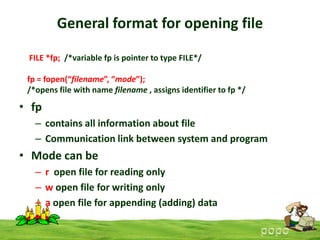
General format for opening file
FILE *fp; /*variable fp is pointer to type FILE*/

fp = fopen(“filename”, “mode”);
/*opens file with name filename , assigns identifier to fp */

• fp
– contains all information about file
– Communication link between system and program

• Mode can be
– r open file for reading only
– w open file for writing only
– a open file for appending (adding) data
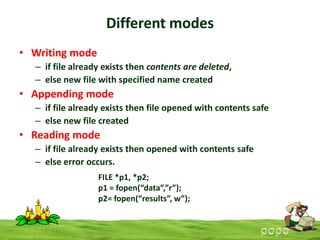
Different modes
• Writing mode
– if file already exists then contents are deleted,
– else new file with specified name created

• Appending mode
– if file already exists then file opened with contents safe
– else new file created

• Reading mode
– if file already exists then opened with contents safe
– else error occurs.
FILE *p1, *p2;
p1 = fopen(“data”,”r”);
p2= fopen(“results”, w”);
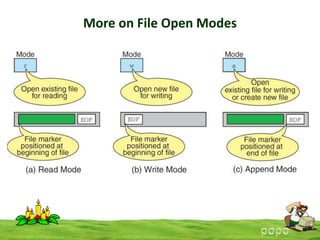
More on File Open Modes
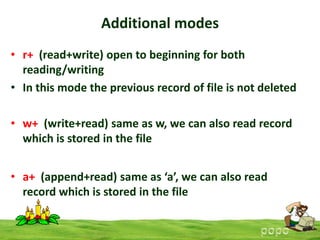
Additional modes
• r+ (read+write) open to beginning for both
reading/writing
• In this mode the previous record of file is not deleted
• w+ (write+read) same as w, we can also read record
which is stored in the file
• a+ (append+read) same as ‘a’, we can also read
record which is stored in the file
Closing a file
• File must be closed as soon as all operations on it
completed
• Ensures
– All outstanding information associated with file flushed
out from buffers
– All links to file broken
– Accidental misuse of file prevented

• If want to change mode of file, then first close and
open again
Closing a file
Syntax: fclose(file_pointer);

Example:
FILE *p1, *p2;
p1 = fopen(“INPUT.txt”, “r”);
p2 =fopen(“OUTPUT.txt”, “w”);
……..
……..
fclose(p1);
fclose(p2);

• pointer can be reused after closing
Input/Output operations on files
• C provides several different functions for
reading/writing
•
•
•
•
•
•

getc() – read a character from the file
putc() – write a character into the file
getw() – read integer from the file
putw() – write integer into the file
fprintf() – write set of data values into the file
fscanf() – read set of data values from the file
getc() and putc()
• handle one character at a time like getchar() and
putchar()
• syntax: putc(c,fp1);
– c : a character variable
– fp1 : pointer to file opened with mode w

• syntax: c = getc(fp2);
– c : a character variable
– fp2 : pointer to file opened with mode r

• file pointer moves by one character position after every
getc() and putc()
• getc() returns end-of-file marker EOF when file end
reached
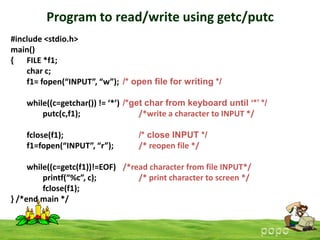
Program to read/write using getc/putc
#include <stdio.h>
main()
{ FILE *f1;
char c;
f1= fopen(“INPUT”, “w”); /* open file for writing */
while((c=getchar()) != ‘*’) /*get char from keyboard until ‘*’ */
putc(c,f1);
/*write a character to INPUT */
fclose(f1);
f1=fopen(“INPUT”, “r”);

/* close INPUT */
/* reopen file */

while((c=getc(f1))!=EOF) /*read character from file INPUT*/
printf(“%c”, c);
/* print character to screen */
fclose(f1);
} /*end main */
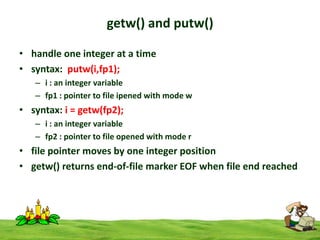
getw() and putw()
• handle one integer at a time
• syntax: putw(i,fp1);
– i : an integer variable
– fp1 : pointer to file ipened with mode w

• syntax: i = getw(fp2);
– i : an integer variable
– fp2 : pointer to file opened with mode r

• file pointer moves by one integer position
• getw() returns end-of-file marker EOF when file end reached
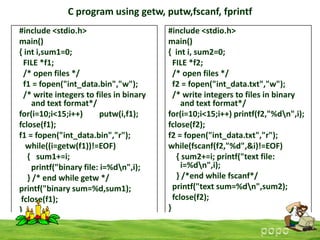
C program using getw, putw,fscanf, fprintf
#include <stdio.h>
main()
{ int i,sum1=0;
FILE *f1;
/* open files */
f1 = fopen("int_data.bin","w");
/* write integers to files in binary
and text format*/
for(i=10;i<15;i++)
putw(i,f1);
fclose(f1);
f1 = fopen("int_data.bin","r");
while((i=getw(f1))!=EOF)
{ sum1+=i;
printf("binary file: i=%dn",i);
} /* end while getw */
printf("binary sum=%d,sum1);
fclose(f1);
}

#include <stdio.h>
main()
{ int i, sum2=0;
FILE *f2;
/* open files */
f2 = fopen("int_data.txt","w");
/* write integers to files in binary
and text format*/
for(i=10;i<15;i++) printf(f2,"%dn",i);
fclose(f2);
f2 = fopen("int_data.txt","r");
while(fscanf(f2,"%d",&i)!=EOF)
{ sum2+=i; printf("text file:
i=%dn",i);
} /*end while fscanf*/
printf("text sum=%dn",sum2);
fclose(f2);
}
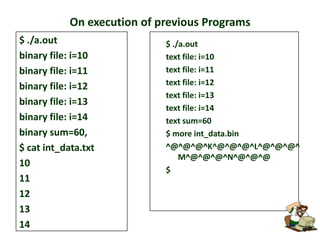
On execution of previous Programs
$ ./a.out
binary file: i=10
binary file: i=11
binary file: i=12
binary file: i=13
binary file: i=14
binary sum=60,
$ cat int_data.txt
10
11
12
13
14

$ ./a.out
text file: i=10
text file: i=11
text file: i=12
text file: i=13
text file: i=14
text sum=60
$ more int_data.bin
^@^@^@^K^@^@^@^L^@^@^@^
M^@^@^@^N^@^@^@
$
fscanf() and fprintf()
• similar to scanf() and printf()
• in addition provide file-pointer
• given the following
– file-pointer f1 (points to file opened in write mode)
– file-pointer f2 (points to file opened in read mode)
– integer variable i
– float variable f
• Example:
fprintf(f1, “%d %fn”, i, f);
fprintf(stdout, “%f n”, f); /*note: stdout refers to screen */
fscanf(f2, “%d %f”, &i, &f);

• fscanf returns EOF when end-of-file reached
Random access to files
• how to jump to a given position (byte number) in a file
without reading all the previous data?
• fseek (file-pointer, offset, position);
• position: 0 (beginning), 1 (current), 2 (end)
• offset: number of locations to move from position
Example: fseek(fp,-m, 1); /* move back by m bytes from current
position */
fseek(fp,m,0); /* move to (m+1)th byte in file */
fseek(fp, -10, 2); /* what is this? */

• ftell(fp) returns current byte position in file
• rewind(fp) resets position to start of file
Random access to files
•
•
•
•
•
•
•
•
•
•
•
•
•
•
•
•
•
•
•
•
•
•

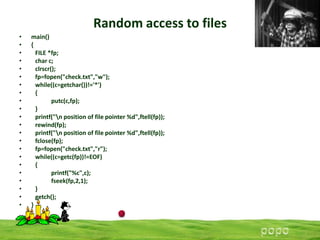
main()
{
FILE *fp;
char c;
clrscr();
fp=fopen("check.txt","w");
while((c=getchar())!='*')
{
putc(c,fp);
}
printf("n position of file pointer %d",ftell(fp));
rewind(fp);
printf("n position of file pointer %d",ftell(fp));
fclose(fp);
fp=fopen("check.txt","r");
while((c=getc(fp))!=EOF)
{
printf("%c",c);
fseek(fp,2,1);
}
getch();
}
1file handling

1file handling

  • 1.
  • 2.
    What is aFile? • A file is a collection of related data that a computers treats as a single unit. • Computers store files to secondary storage so that the contents of files remain permanently when a computer shuts down. • When a computer reads a file, it copies the file from the storage device to memory; when it writes to a file, it transfers data from memory to the storage device.
  • 3.
    Files • File –place on disc where group of related data is stored – E.g. your C programs, executables • Basic file operations – – – – – Naming Opening Reading Writing Closing
  • 4.
    Filename • String ofcharacters that make up a valid filename for OS • May contain two parts – Primary – Optional period with extension • Examples: a.out, prog.c, temp, text.out
  • 5.
    General format foropening file FILE *fp; /*variable fp is pointer to type FILE*/ fp = fopen(“filename”, “mode”); /*opens file with name filename , assigns identifier to fp */ • fp – contains all information about file – Communication link between system and program • Mode can be – r open file for reading only – w open file for writing only – a open file for appending (adding) data
  • 6.
    Different modes • Writingmode – if file already exists then contents are deleted, – else new file with specified name created • Appending mode – if file already exists then file opened with contents safe – else new file created • Reading mode – if file already exists then opened with contents safe – else error occurs. FILE *p1, *p2; p1 = fopen(“data”,”r”); p2= fopen(“results”, w”);
  • 7.
    More on FileOpen Modes
  • 8.
    Additional modes • r+(read+write) open to beginning for both reading/writing • In this mode the previous record of file is not deleted • w+ (write+read) same as w, we can also read record which is stored in the file • a+ (append+read) same as ‘a’, we can also read record which is stored in the file
  • 9.
    Closing a file •File must be closed as soon as all operations on it completed • Ensures – All outstanding information associated with file flushed out from buffers – All links to file broken – Accidental misuse of file prevented • If want to change mode of file, then first close and open again
  • 10.
    Closing a file Syntax:fclose(file_pointer); Example: FILE *p1, *p2; p1 = fopen(“INPUT.txt”, “r”); p2 =fopen(“OUTPUT.txt”, “w”); …….. …….. fclose(p1); fclose(p2); • pointer can be reused after closing
  • 11.
    Input/Output operations onfiles • C provides several different functions for reading/writing • • • • • • getc() – read a character from the file putc() – write a character into the file getw() – read integer from the file putw() – write integer into the file fprintf() – write set of data values into the file fscanf() – read set of data values from the file
  • 12.
    getc() and putc() •handle one character at a time like getchar() and putchar() • syntax: putc(c,fp1); – c : a character variable – fp1 : pointer to file opened with mode w • syntax: c = getc(fp2); – c : a character variable – fp2 : pointer to file opened with mode r • file pointer moves by one character position after every getc() and putc() • getc() returns end-of-file marker EOF when file end reached
  • 13.
    Program to read/writeusing getc/putc #include <stdio.h> main() { FILE *f1; char c; f1= fopen(“INPUT”, “w”); /* open file for writing */ while((c=getchar()) != ‘*’) /*get char from keyboard until ‘*’ */ putc(c,f1); /*write a character to INPUT */ fclose(f1); f1=fopen(“INPUT”, “r”); /* close INPUT */ /* reopen file */ while((c=getc(f1))!=EOF) /*read character from file INPUT*/ printf(“%c”, c); /* print character to screen */ fclose(f1); } /*end main */
  • 14.
    getw() and putw() •handle one integer at a time • syntax: putw(i,fp1); – i : an integer variable – fp1 : pointer to file ipened with mode w • syntax: i = getw(fp2); – i : an integer variable – fp2 : pointer to file opened with mode r • file pointer moves by one integer position • getw() returns end-of-file marker EOF when file end reached
  • 15.
    C program usinggetw, putw,fscanf, fprintf #include <stdio.h> main() { int i,sum1=0; FILE *f1; /* open files */ f1 = fopen("int_data.bin","w"); /* write integers to files in binary and text format*/ for(i=10;i<15;i++) putw(i,f1); fclose(f1); f1 = fopen("int_data.bin","r"); while((i=getw(f1))!=EOF) { sum1+=i; printf("binary file: i=%dn",i); } /* end while getw */ printf("binary sum=%d,sum1); fclose(f1); } #include <stdio.h> main() { int i, sum2=0; FILE *f2; /* open files */ f2 = fopen("int_data.txt","w"); /* write integers to files in binary and text format*/ for(i=10;i<15;i++) printf(f2,"%dn",i); fclose(f2); f2 = fopen("int_data.txt","r"); while(fscanf(f2,"%d",&i)!=EOF) { sum2+=i; printf("text file: i=%dn",i); } /*end while fscanf*/ printf("text sum=%dn",sum2); fclose(f2); }
  • 16.
    On execution ofprevious Programs $ ./a.out binary file: i=10 binary file: i=11 binary file: i=12 binary file: i=13 binary file: i=14 binary sum=60, $ cat int_data.txt 10 11 12 13 14 $ ./a.out text file: i=10 text file: i=11 text file: i=12 text file: i=13 text file: i=14 text sum=60 $ more int_data.bin ^@^@^@^K^@^@^@^L^@^@^@^ M^@^@^@^N^@^@^@ $
  • 17.
    fscanf() and fprintf() •similar to scanf() and printf() • in addition provide file-pointer • given the following – file-pointer f1 (points to file opened in write mode) – file-pointer f2 (points to file opened in read mode) – integer variable i – float variable f • Example: fprintf(f1, “%d %fn”, i, f); fprintf(stdout, “%f n”, f); /*note: stdout refers to screen */ fscanf(f2, “%d %f”, &i, &f); • fscanf returns EOF when end-of-file reached
  • 18.
    Random access tofiles • how to jump to a given position (byte number) in a file without reading all the previous data? • fseek (file-pointer, offset, position); • position: 0 (beginning), 1 (current), 2 (end) • offset: number of locations to move from position Example: fseek(fp,-m, 1); /* move back by m bytes from current position */ fseek(fp,m,0); /* move to (m+1)th byte in file */ fseek(fp, -10, 2); /* what is this? */ • ftell(fp) returns current byte position in file • rewind(fp) resets position to start of file
  • 19.
    Random access tofiles • • • • • • • • • • • • • • • • • • • • • • main() { FILE *fp; char c; clrscr(); fp=fopen("check.txt","w"); while((c=getchar())!='*') { putc(c,fp); } printf("n position of file pointer %d",ftell(fp)); rewind(fp); printf("n position of file pointer %d",ftell(fp)); fclose(fp); fp=fopen("check.txt","r"); while((c=getc(fp))!=EOF) { printf("%c",c); fseek(fp,2,1); } getch(); }