
 Introduction
 Evolution
 Characteristics
 Structure of program
 Input/output statements
 Command line arguments
 Escape sequences
12/11/2015
Session-1/Dr.M.karthika
2
Dennis M. Ritchie
 C language is one of the most popular
computer language
 structured ,
 low level ,
 machine dependent language
12/11/2015Session-1/Dr.M.karthika 4
 C programming language was developed in
1972 by Dennis Ritchie at bell laboratories of
AT&T(American Telephone & Telegraph),
located in U.S.A.
 It was developed to be used in UNIX
Operating system.
 It inherits many features of previous
languages such as B and BPCL.
12/11/2015Session-1/Dr.M.karthika 5
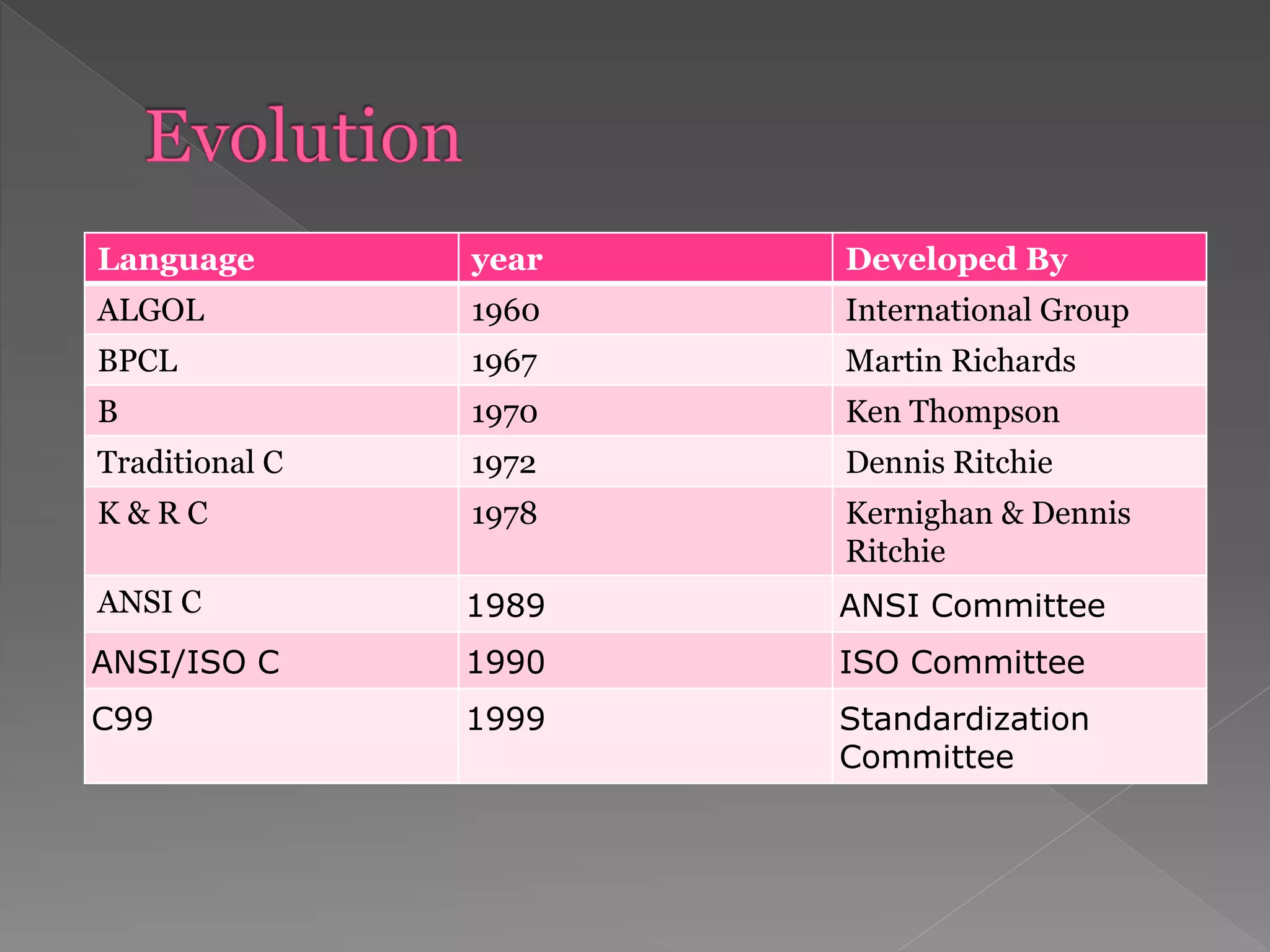
Language year Developed By
ALGOL 1960 International Group
BPCL 1967 Martin Richards
B 1970 Ken Thompson
Traditional C 1972 Dennis Ritchie
K & R C 1978 Kernighan & Dennis
Ritchie
ANSI C 1989 ANSI Committee
ANSI/ISO C 1990 ISO Committee
C99 1999 Standardization
Committee
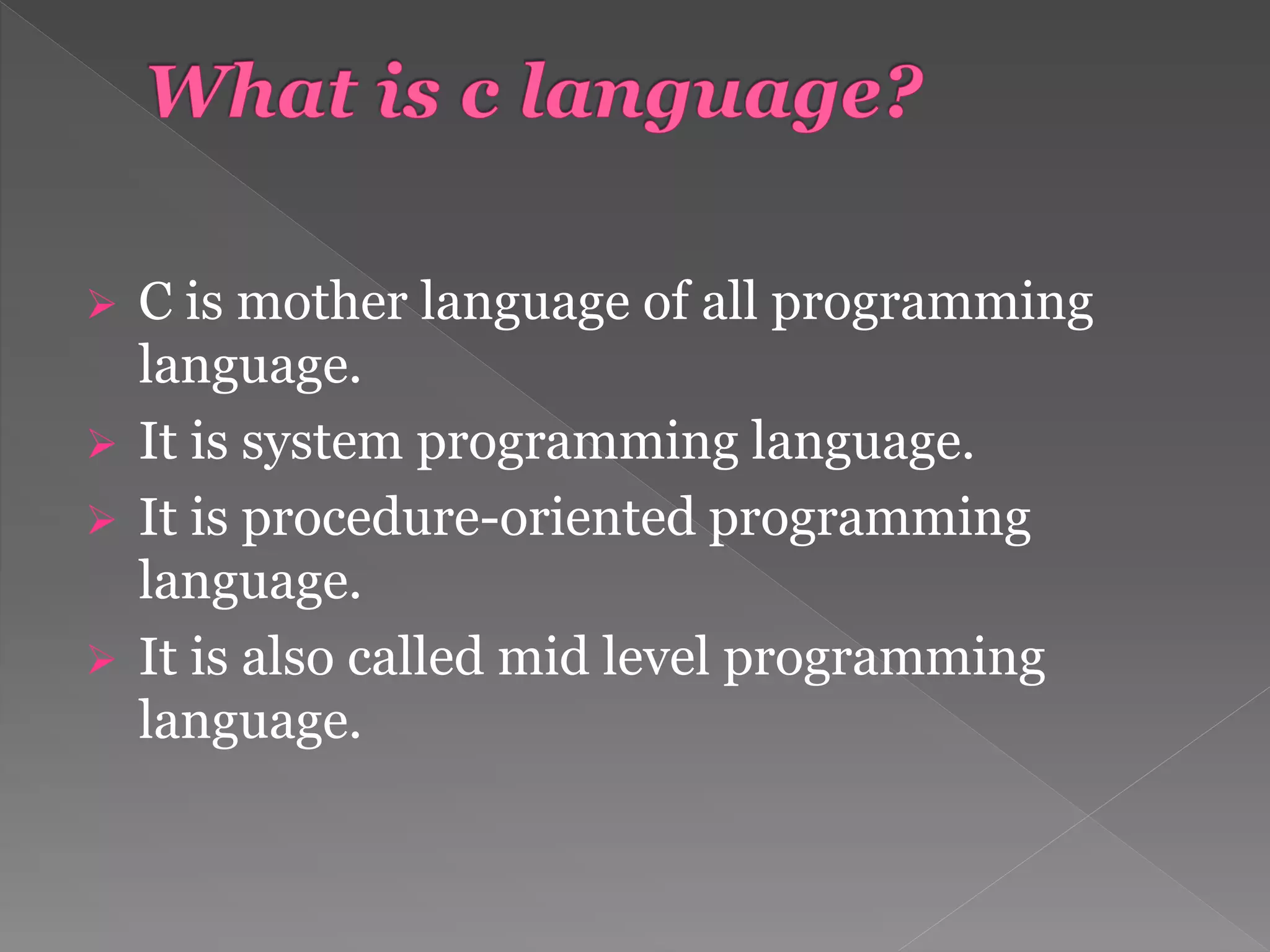
 C is mother language of all programming
language.
 It is system programming language.
 It is procedure-oriented programming
language.
 It is also called mid level programming
language.
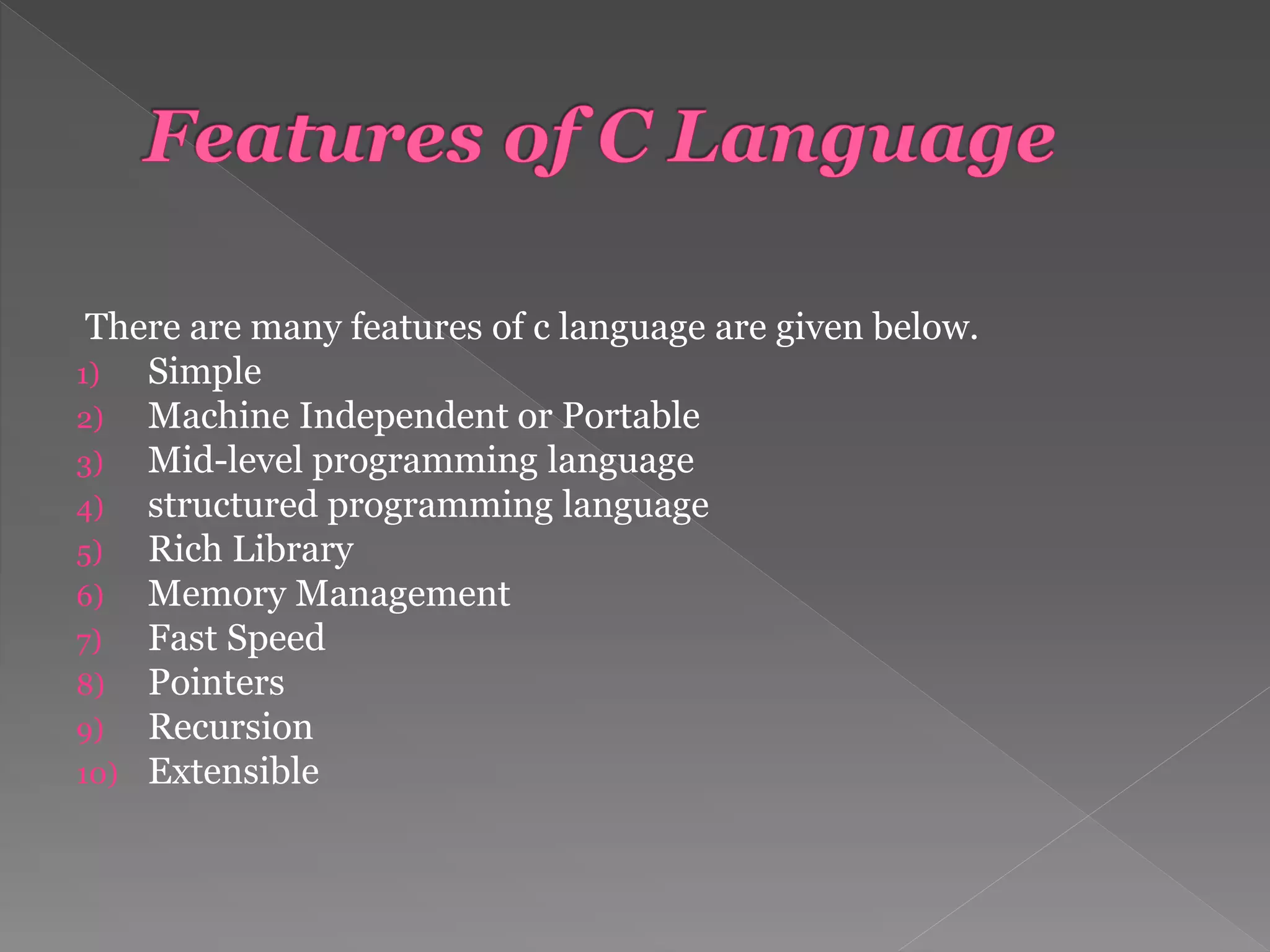
There are many features of c language are given below.
1) Simple
2) Machine Independent or Portable
3) Mid-level programming language
4) structured programming language
5) Rich Library
6) Memory Management
7) Fast Speed
8) Pointers
9) Recursion
10) Extensible
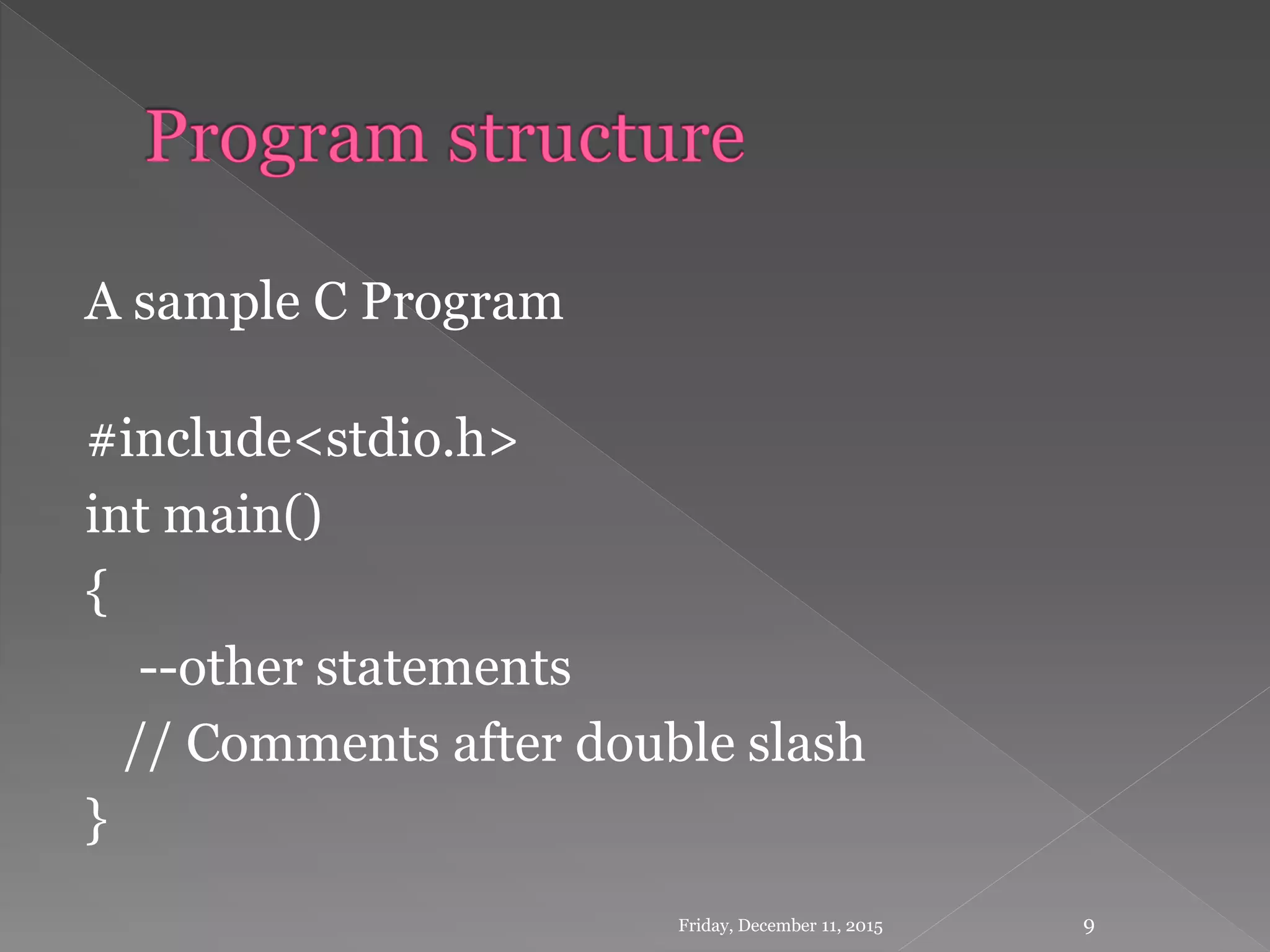
A sample C Program
#include<stdio.h>
int main()
{
--other statements
// Comments after double slash
}
Friday, December 11, 2015 9
 Type a program
 Save it
 Compile the program – This will generate an
exe file (executable)
 Run the program (Actually the exe created out
of compilation will run and not the .c file)
 In different compiler we have different option
for compiling and running. We give only the
concepts.
Friday, December 11, 2015 10
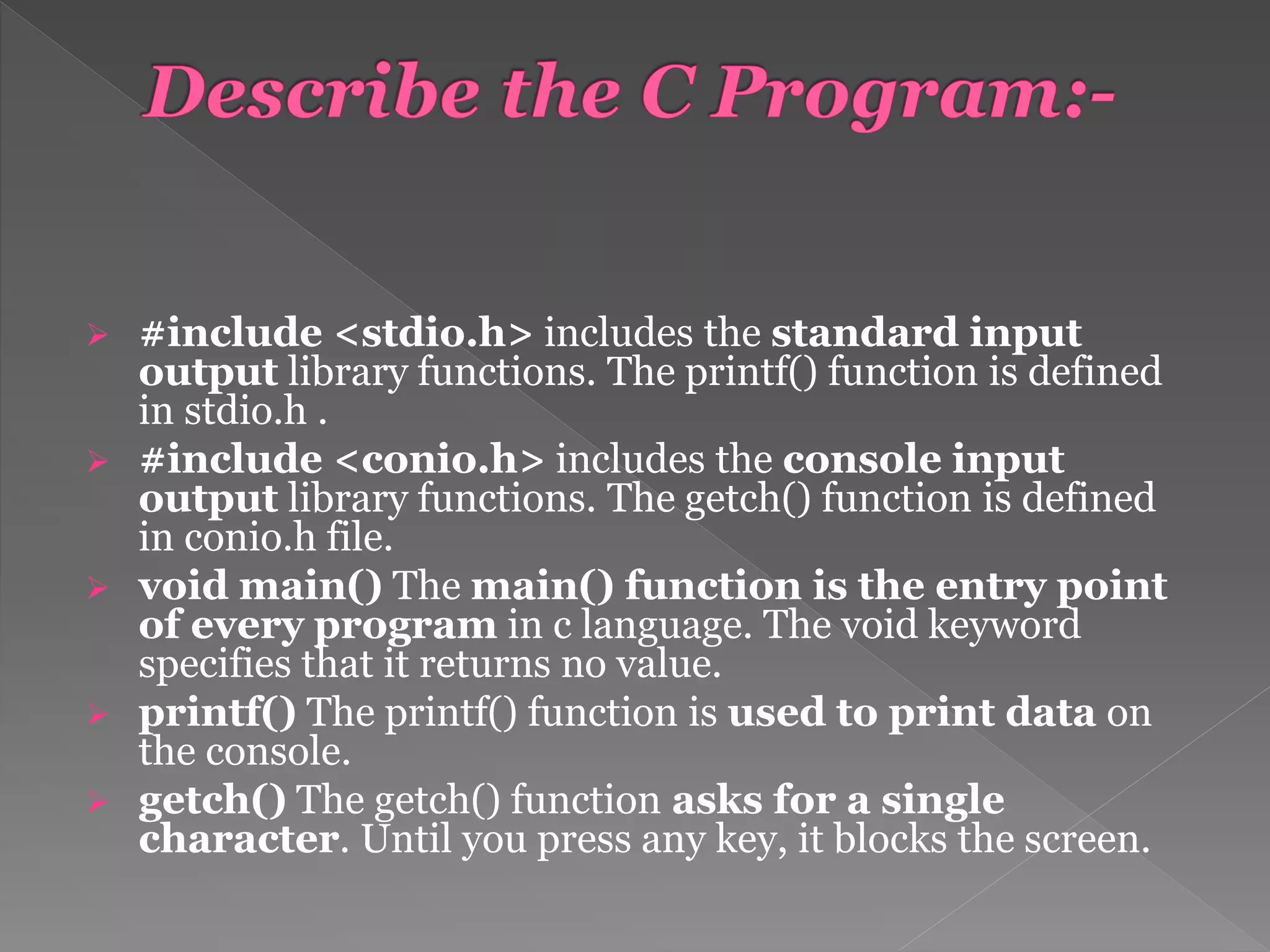
 #include <stdio.h> includes the standard input
output library functions.
 The printf() function is defined in stdio.h .
 #include <conio.h> includes the console input
output library functions.
 The getch() function is defined in conio.h file.
 void main() The main() function is the entry point
of every program in c language.
 The void keyword specifies that it returns no value.
 printf() The printf() function is used to print data on
the console.
 getch() The getch() function asks for a single
character. Until you press any key, it blocks the screen.
 The files that are specified in the include section
is called as header file
 These are precompiled files that has some
functions defined in them
 We can call those functions in our program by
supplying parameters
 Header file is given an extension .h
 C Source file is given an extension .c
 This is the entry point of a program
 When a file is executed, the start point is the
main function
 From main function the flow goes as per the
programmers choice.
 There may or may not be other functions
written by user in a program
 Main function is compulsory for any C program
 #include <stdio.h> includes the standard input
output library functions. The printf() function is defined
in stdio.h .
 #include <conio.h> includes the console input
output library functions. The getch() function is defined
in conio.h file.
 void main() The main() function is the entry point
of every program in c language. The void keyword
specifies that it returns no value.
 printf() The printf() function is used to print data on
the console.
 getch() The getch() function asks for a single
character. Until you press any key, it blocks the screen.
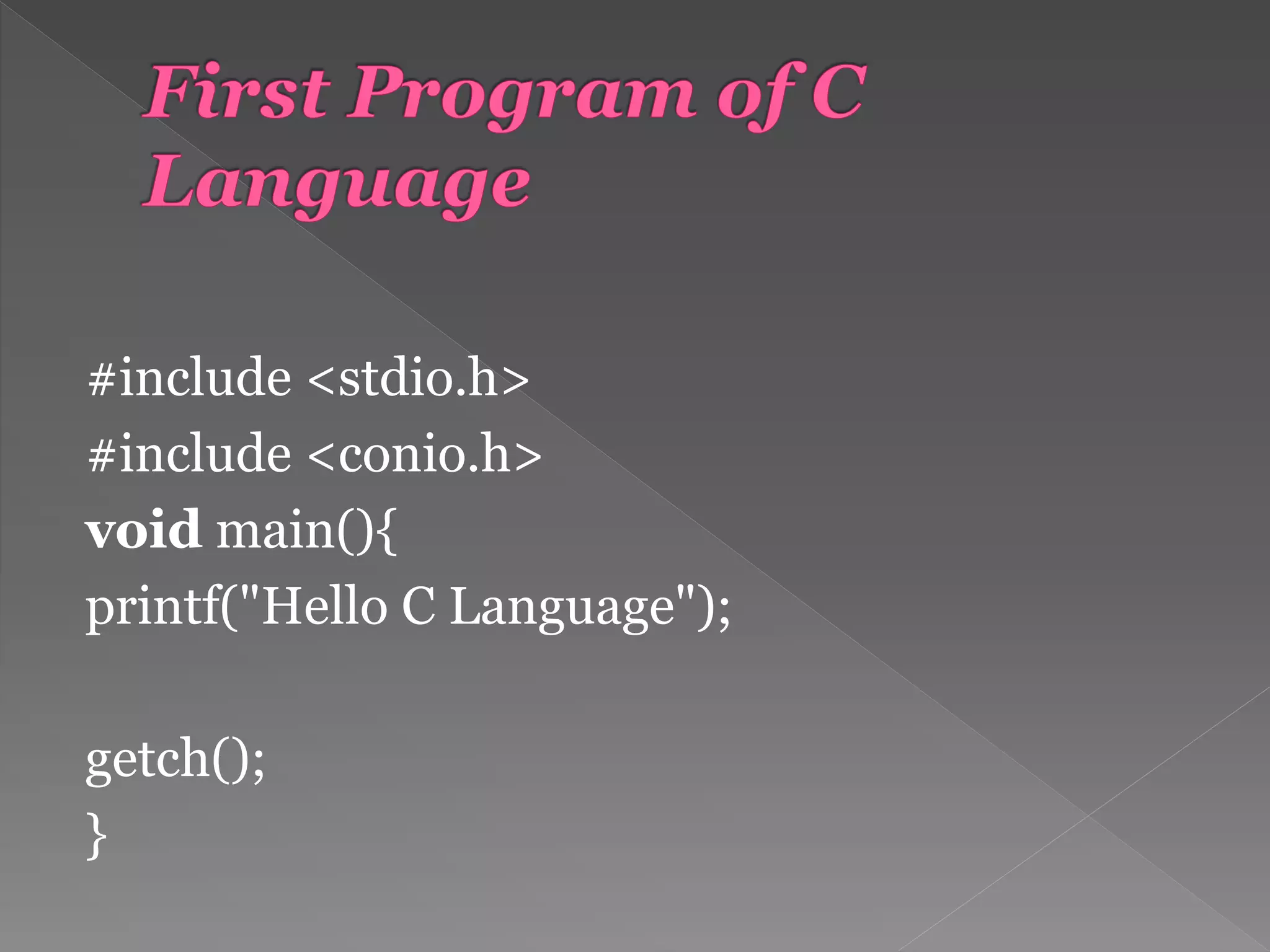
#include <stdio.h>
#include <conio.h>
void main(){
printf("Hello C Language");
getch();
}
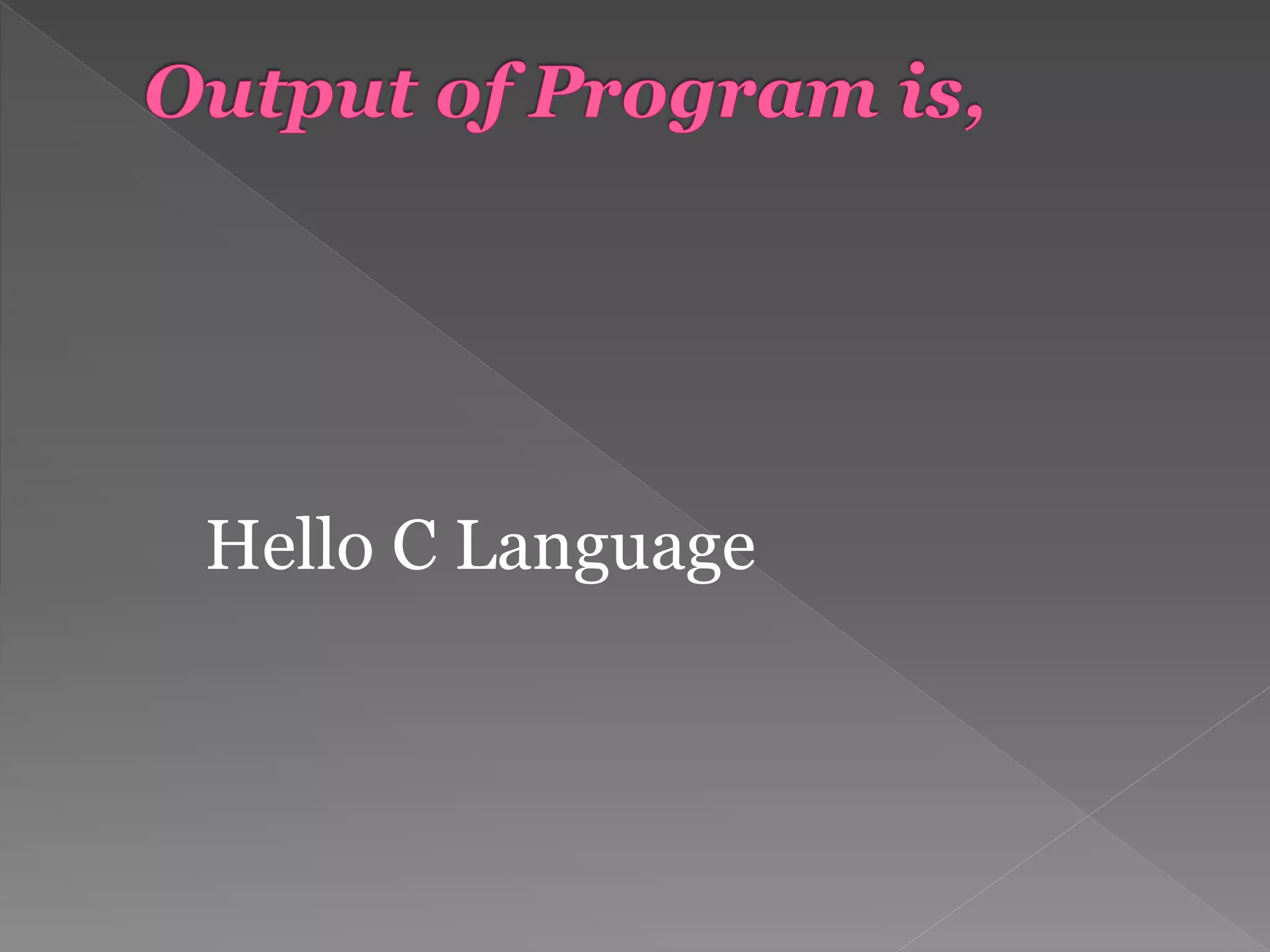
Hello C Language
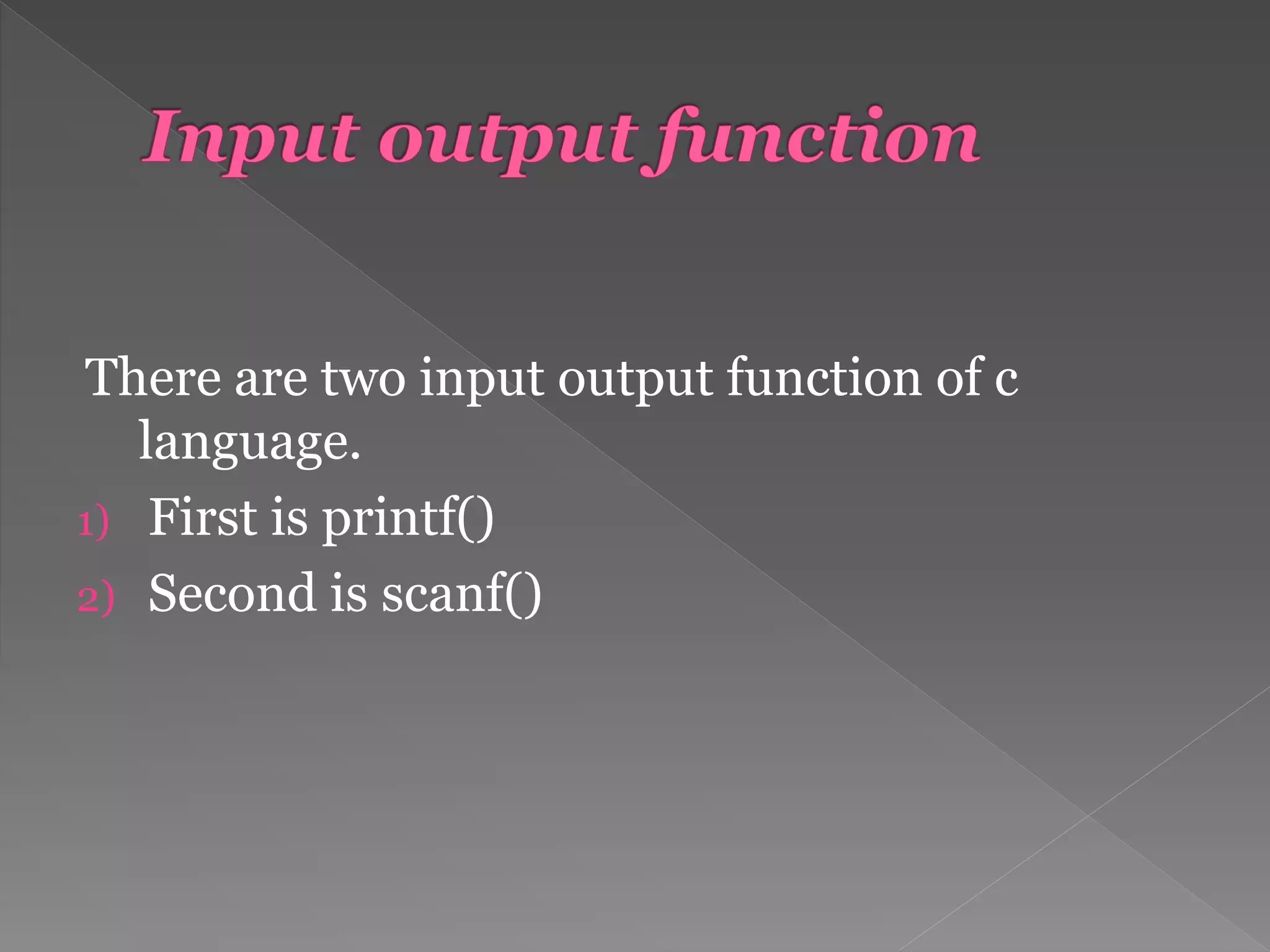
There are two input output function of c
language.
1) First is printf()
2) Second is scanf()
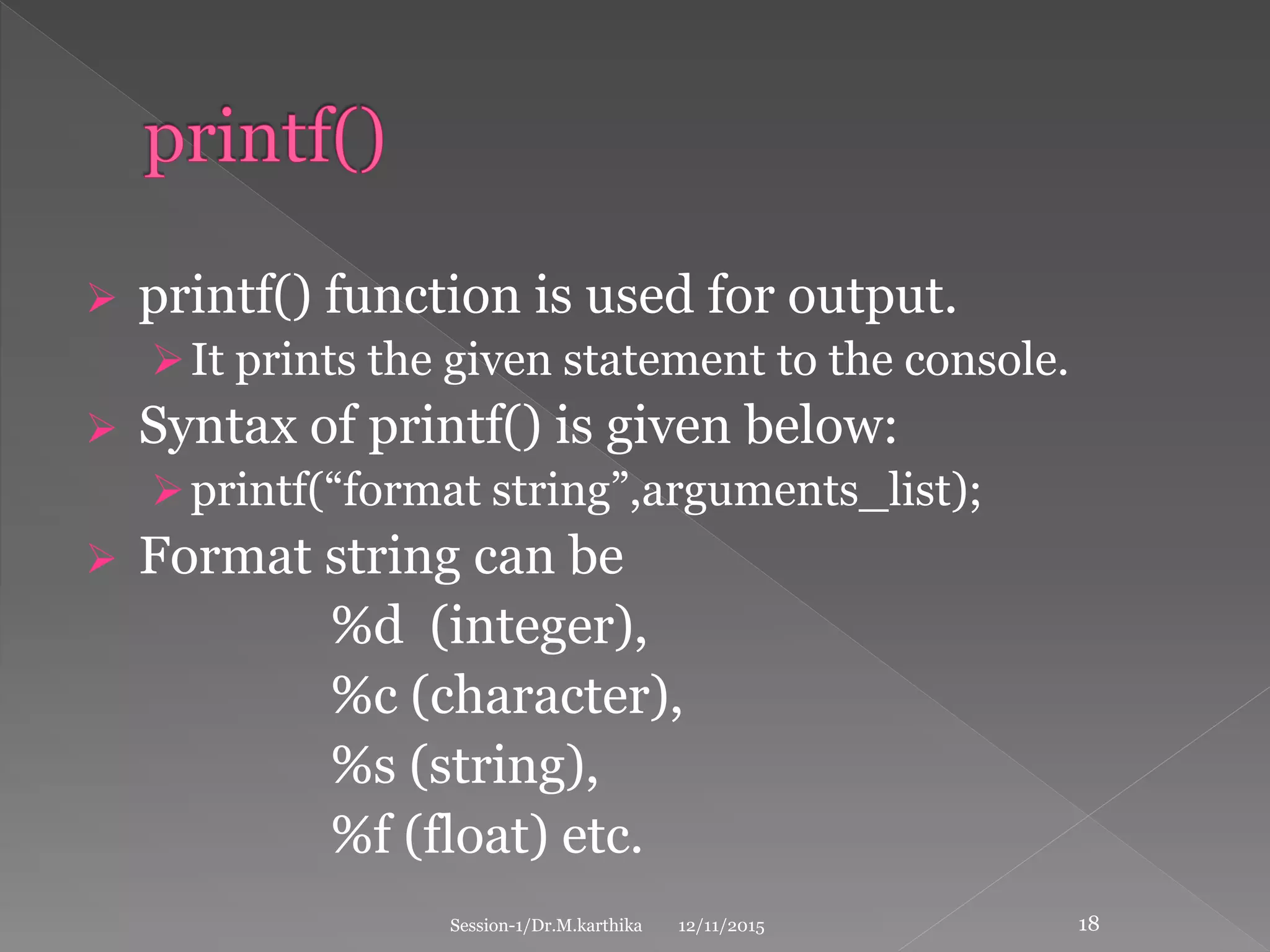
 printf() function is used for output.
It prints the given statement to the console.
 Syntax of printf() is given below:
printf(“format string”,arguments_list);
 Format string can be
%d (integer),
%c (character),
%s (string),
%f (float) etc.
12/11/2015Session-1/Dr.M.karthika 18
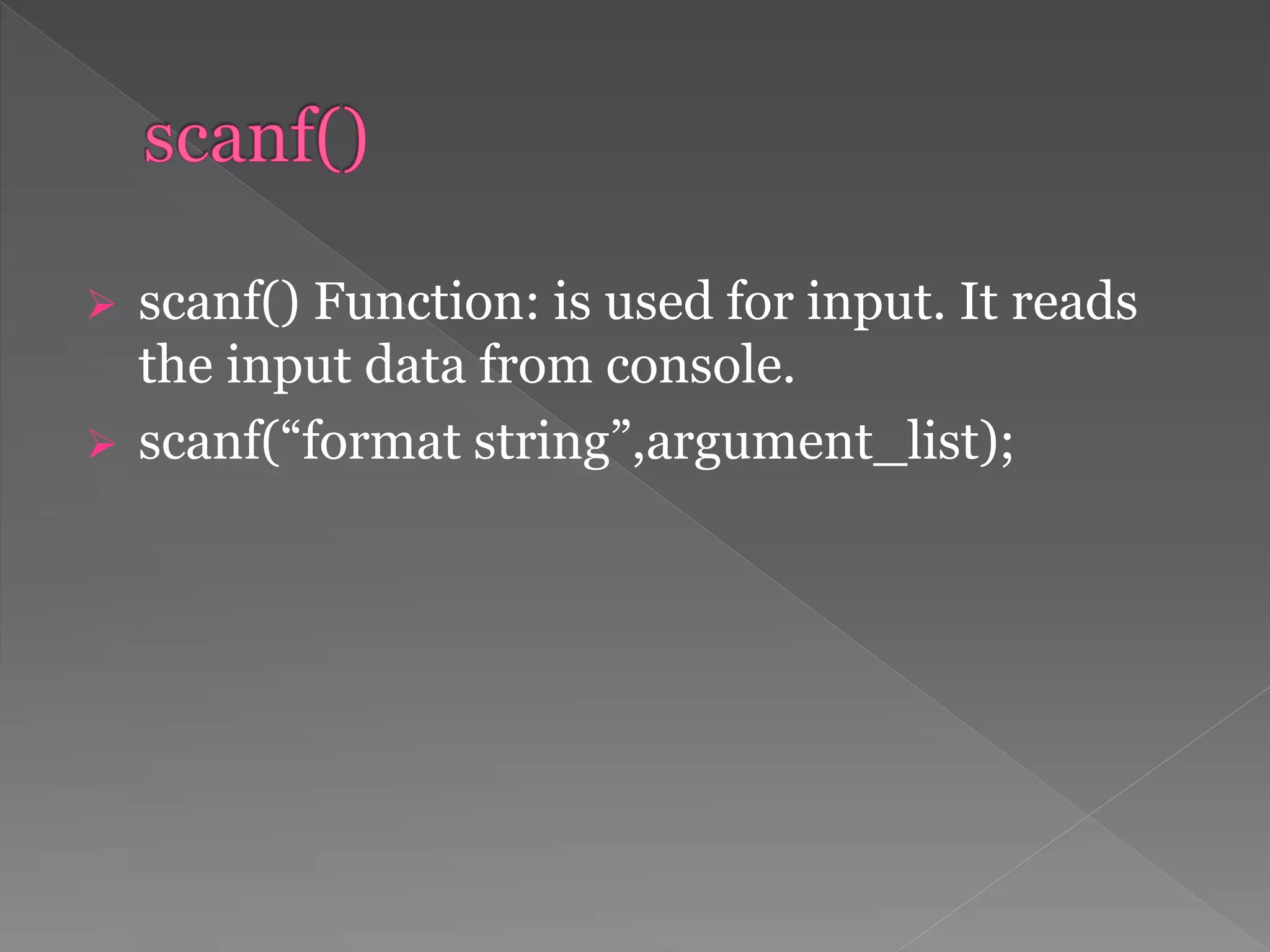
 scanf() Function: is used for input. It reads
the input data from console.
 scanf(“format string”,argument_list);
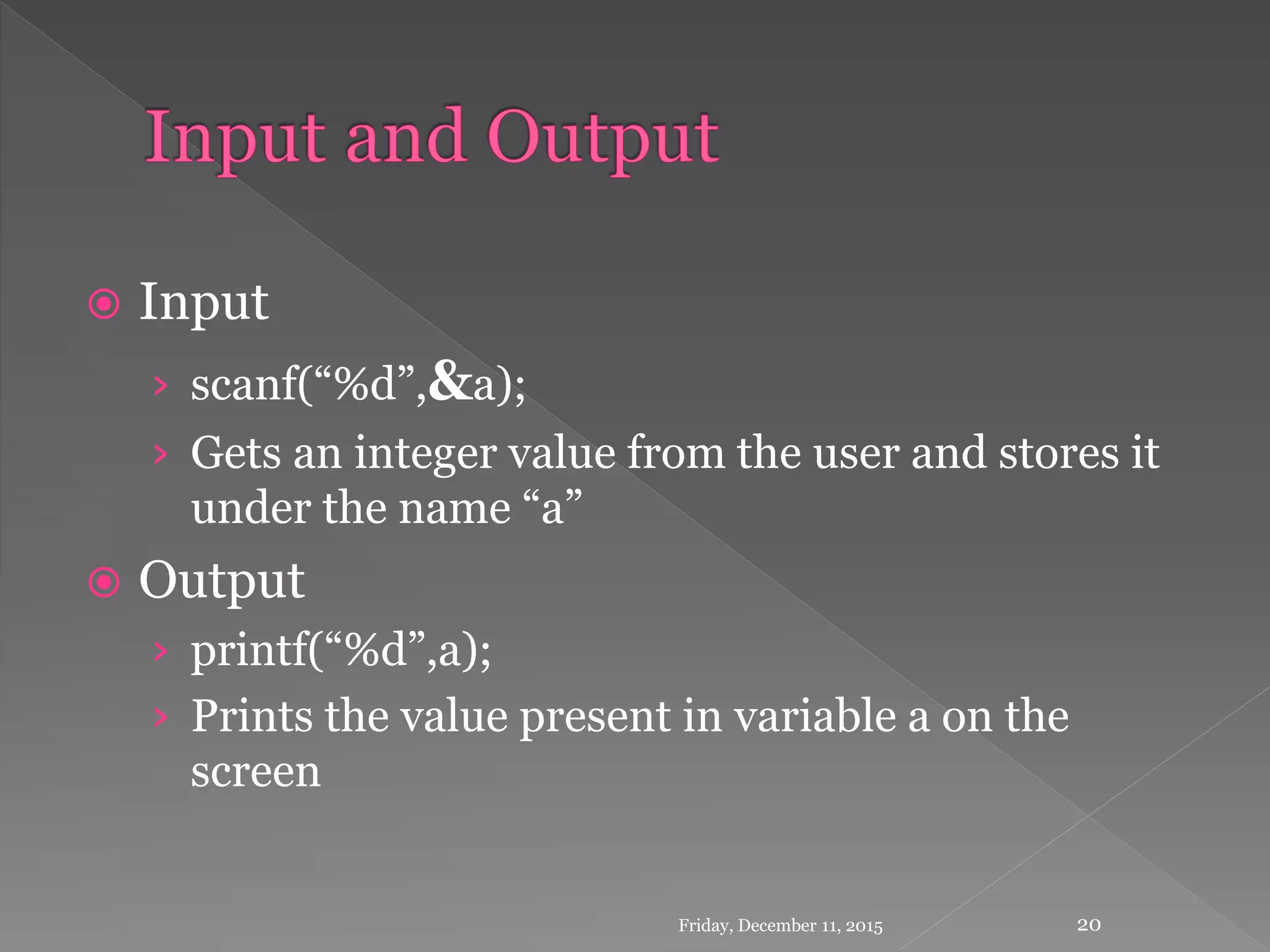
 Input
› scanf(“%d”,&a);
› Gets an integer value from the user and stores it
under the name “a”
 Output
› printf(“%d”,a);
› Prints the value present in variable a on the
screen
Friday, December 11, 2015 20
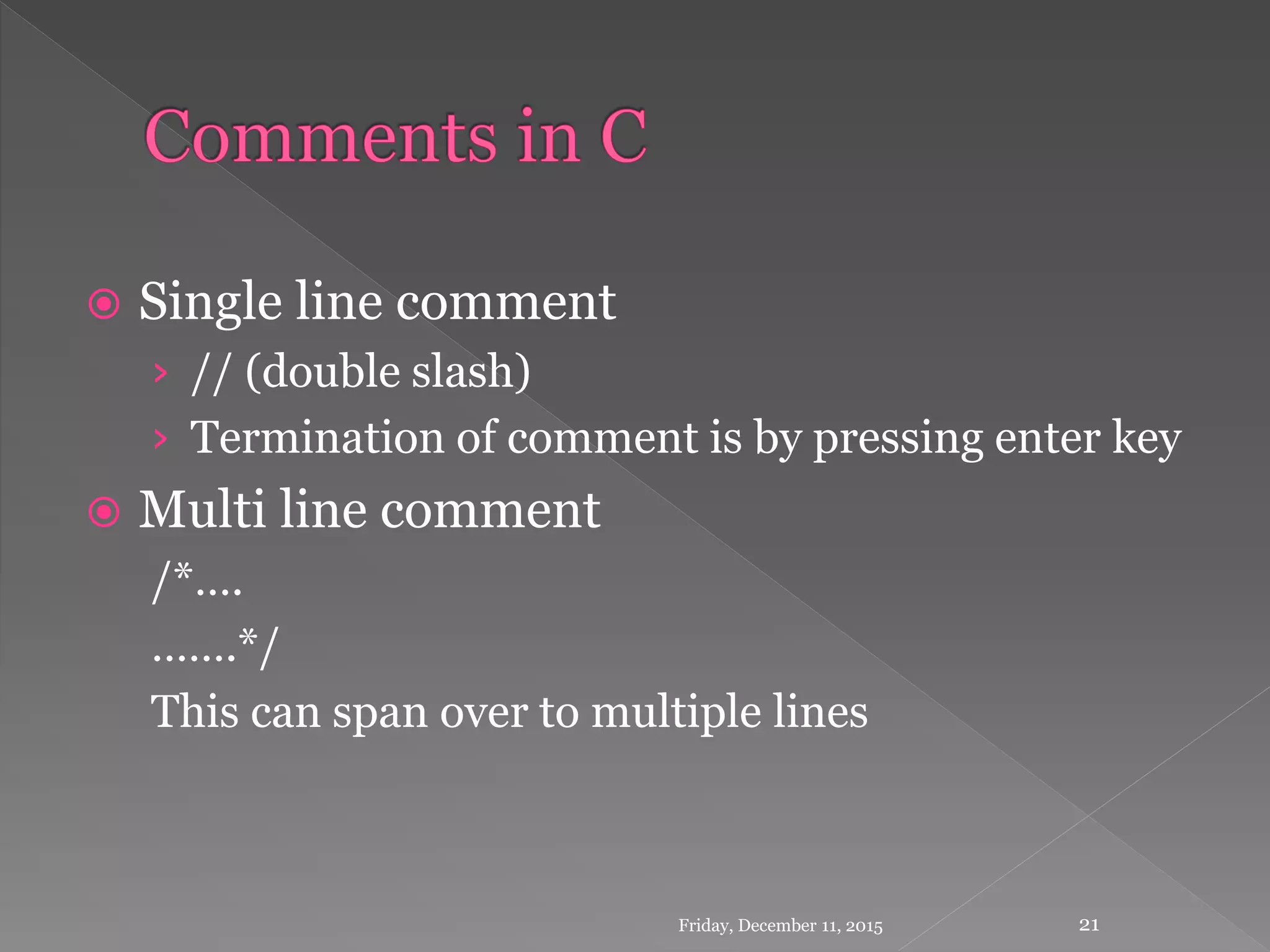
 Single line comment
› // (double slash)
› Termination of comment is by pressing enter key
 Multi line comment
/*….
…….*/
This can span over to multiple lines
Friday, December 11, 2015 21
12/11/2015Session-1/Dr.M.karthika 22
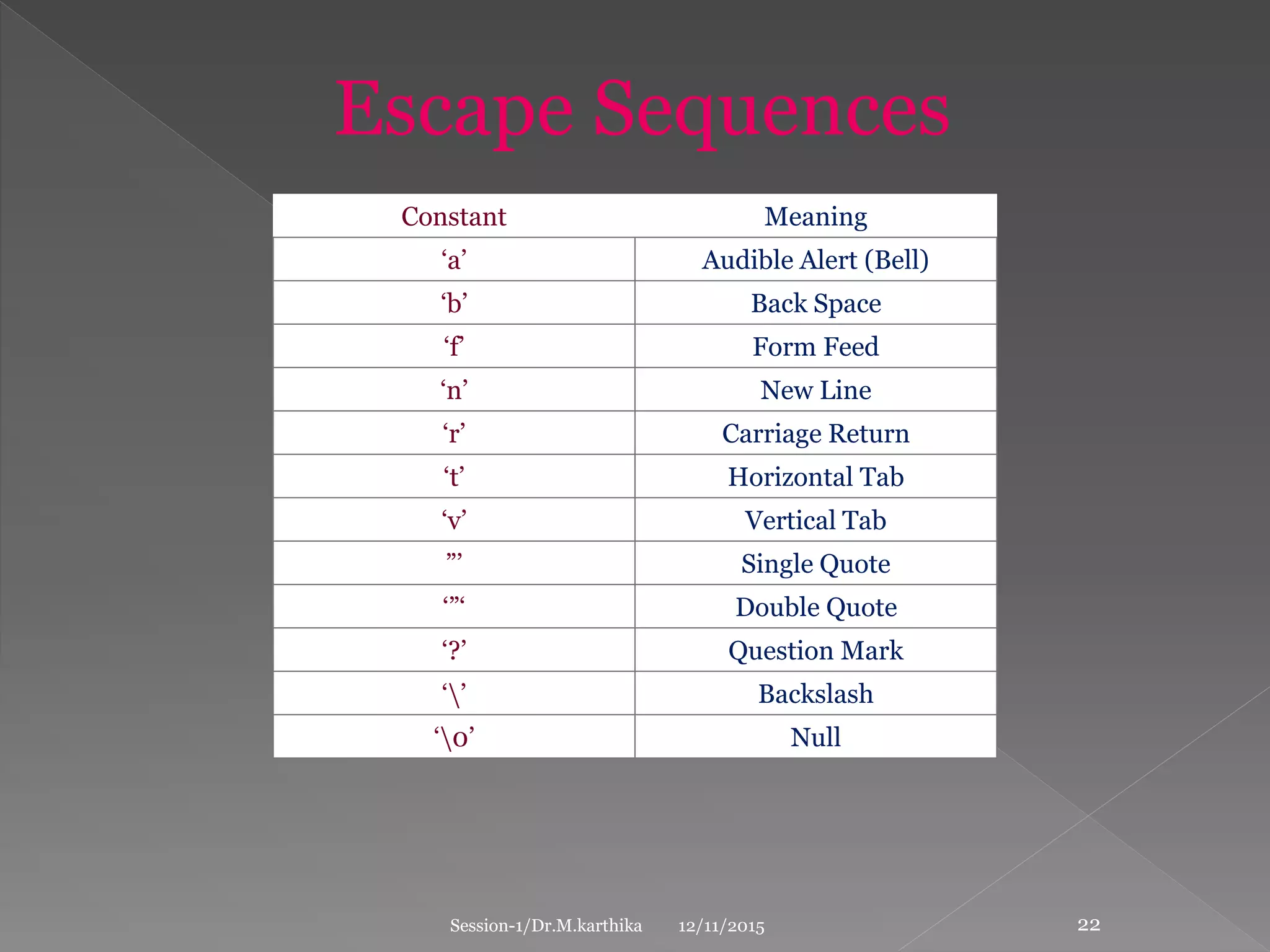
Constant Meaning
‘a’ Audible Alert (Bell)
‘b’ Back Space
‘f’ Form Feed
‘n’ New Line
‘r’ Carriage Return
‘t’ Horizontal Tab
‘v’ Vertical Tab
”’ Single Quote
‘”‘ Double Quote
‘?’ Question Mark
‘’ Backslash
‘0’ Null
Escape Sequences
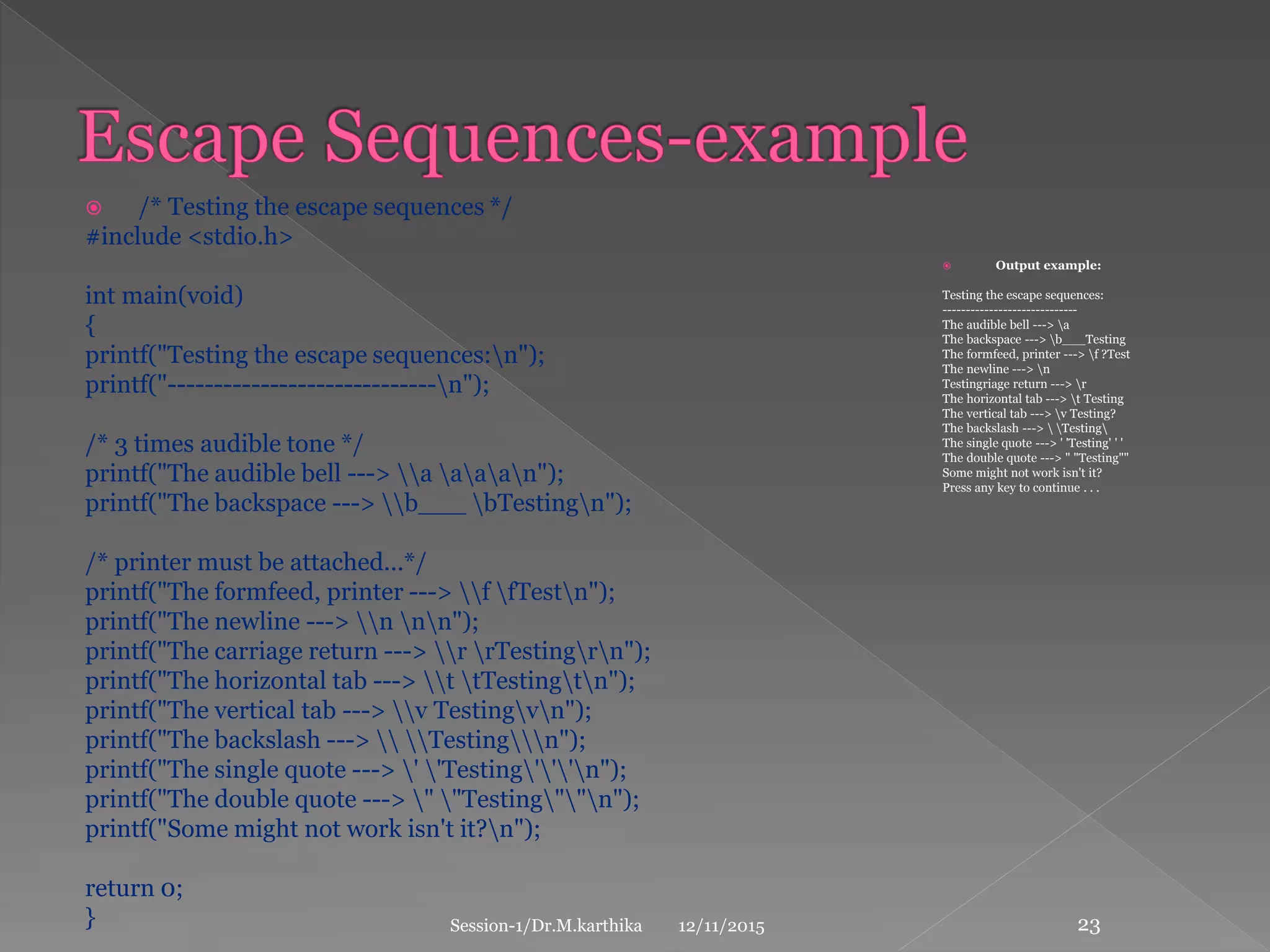
 /* Testing the escape sequences */
#include <stdio.h>
int main(void)
{
printf("Testing the escape sequences:n");
printf("-----------------------------n");
/* 3 times audible tone */
printf("The audible bell ---> a aaan");
printf("The backspace ---> b___ bTestingn");
/* printer must be attached...*/
printf("The formfeed, printer ---> f fTestn");
printf("The newline ---> n nn");
printf("The carriage return ---> r rTestingrn");
printf("The horizontal tab ---> t tTestingtn");
printf("The vertical tab ---> v Testingvn");
printf("The backslash --->  Testingn");
printf("The single quote ---> ' 'Testing'''n");
printf("The double quote ---> " "Testing""n");
printf("Some might not work isn't it?n");
return 0;
}
 Output example:
Testing the escape sequences:
-----------------------------
The audible bell ---> a
The backspace ---> b___Testing
The formfeed, printer ---> f ?Test
The newline ---> n
Testingriage return ---> r
The horizontal tab ---> t Testing
The vertical tab ---> v Testing?
The backslash --->  Testing
The single quote ---> ' 'Testing' ' '
The double quote ---> " "Testing""
Some might not work isn't it?
Press any key to continue . . .
12/11/2015Session-1/Dr.M.karthika 23
12/11/2015Session-1/Dr.M.karthika 24
12/11/2015Session-1/Dr.M.karthika 25

C basics

  • 2.
     Introduction  Evolution Characteristics  Structure of program  Input/output statements  Command line arguments  Escape sequences 12/11/2015 Session-1/Dr.M.karthika 2
  • 3.
  • 4.
     C languageis one of the most popular computer language  structured ,  low level ,  machine dependent language 12/11/2015Session-1/Dr.M.karthika 4
  • 5.
     C programminglanguage was developed in 1972 by Dennis Ritchie at bell laboratories of AT&T(American Telephone & Telegraph), located in U.S.A.  It was developed to be used in UNIX Operating system.  It inherits many features of previous languages such as B and BPCL. 12/11/2015Session-1/Dr.M.karthika 5
  • 6.
    Language year DevelopedBy ALGOL 1960 International Group BPCL 1967 Martin Richards B 1970 Ken Thompson Traditional C 1972 Dennis Ritchie K & R C 1978 Kernighan & Dennis Ritchie ANSI C 1989 ANSI Committee ANSI/ISO C 1990 ISO Committee C99 1999 Standardization Committee
  • 7.
     C ismother language of all programming language.  It is system programming language.  It is procedure-oriented programming language.  It is also called mid level programming language.
  • 8.
    There are manyfeatures of c language are given below. 1) Simple 2) Machine Independent or Portable 3) Mid-level programming language 4) structured programming language 5) Rich Library 6) Memory Management 7) Fast Speed 8) Pointers 9) Recursion 10) Extensible
  • 9.
    A sample CProgram #include<stdio.h> int main() { --other statements // Comments after double slash } Friday, December 11, 2015 9
  • 10.
     Type aprogram  Save it  Compile the program – This will generate an exe file (executable)  Run the program (Actually the exe created out of compilation will run and not the .c file)  In different compiler we have different option for compiling and running. We give only the concepts. Friday, December 11, 2015 10
  • 11.
     #include <stdio.h>includes the standard input output library functions.  The printf() function is defined in stdio.h .  #include <conio.h> includes the console input output library functions.  The getch() function is defined in conio.h file.  void main() The main() function is the entry point of every program in c language.  The void keyword specifies that it returns no value.  printf() The printf() function is used to print data on the console.  getch() The getch() function asks for a single character. Until you press any key, it blocks the screen.
  • 12.
     The filesthat are specified in the include section is called as header file  These are precompiled files that has some functions defined in them  We can call those functions in our program by supplying parameters  Header file is given an extension .h  C Source file is given an extension .c
  • 13.
     This isthe entry point of a program  When a file is executed, the start point is the main function  From main function the flow goes as per the programmers choice.  There may or may not be other functions written by user in a program  Main function is compulsory for any C program
  • 14.
     #include <stdio.h>includes the standard input output library functions. The printf() function is defined in stdio.h .  #include <conio.h> includes the console input output library functions. The getch() function is defined in conio.h file.  void main() The main() function is the entry point of every program in c language. The void keyword specifies that it returns no value.  printf() The printf() function is used to print data on the console.  getch() The getch() function asks for a single character. Until you press any key, it blocks the screen.
  • 15.
    #include <stdio.h> #include <conio.h> voidmain(){ printf("Hello C Language"); getch(); }
  • 16.
  • 17.
    There are twoinput output function of c language. 1) First is printf() 2) Second is scanf()
  • 18.
     printf() functionis used for output. It prints the given statement to the console.  Syntax of printf() is given below: printf(“format string”,arguments_list);  Format string can be %d (integer), %c (character), %s (string), %f (float) etc. 12/11/2015Session-1/Dr.M.karthika 18
  • 19.
     scanf() Function:is used for input. It reads the input data from console.  scanf(“format string”,argument_list);
  • 20.
     Input › scanf(“%d”,&a); ›Gets an integer value from the user and stores it under the name “a”  Output › printf(“%d”,a); › Prints the value present in variable a on the screen Friday, December 11, 2015 20
  • 21.
     Single linecomment › // (double slash) › Termination of comment is by pressing enter key  Multi line comment /*…. …….*/ This can span over to multiple lines Friday, December 11, 2015 21
  • 22.
    12/11/2015Session-1/Dr.M.karthika 22 Constant Meaning ‘a’Audible Alert (Bell) ‘b’ Back Space ‘f’ Form Feed ‘n’ New Line ‘r’ Carriage Return ‘t’ Horizontal Tab ‘v’ Vertical Tab ”’ Single Quote ‘”‘ Double Quote ‘?’ Question Mark ‘’ Backslash ‘0’ Null Escape Sequences
  • 23.
     /* Testingthe escape sequences */ #include <stdio.h> int main(void) { printf("Testing the escape sequences:n"); printf("-----------------------------n"); /* 3 times audible tone */ printf("The audible bell ---> a aaan"); printf("The backspace ---> b___ bTestingn"); /* printer must be attached...*/ printf("The formfeed, printer ---> f fTestn"); printf("The newline ---> n nn"); printf("The carriage return ---> r rTestingrn"); printf("The horizontal tab ---> t tTestingtn"); printf("The vertical tab ---> v Testingvn"); printf("The backslash ---> Testingn"); printf("The single quote ---> ' 'Testing'''n"); printf("The double quote ---> " "Testing""n"); printf("Some might not work isn't it?n"); return 0; }  Output example: Testing the escape sequences: ----------------------------- The audible bell ---> a The backspace ---> b___Testing The formfeed, printer ---> f ?Test The newline ---> n Testingriage return ---> r The horizontal tab ---> t Testing The vertical tab ---> v Testing? The backslash ---> Testing The single quote ---> ' 'Testing' ' ' The double quote ---> " "Testing"" Some might not work isn't it? Press any key to continue . . . 12/11/2015Session-1/Dr.M.karthika 23
  • 24.
  • 25.

Editor's Notes

  • #21 Format specifiers %d is the format specifier. This informs to the compiler that the incoming value is an integer value. Other data types can be specified as follows: %c – character %f – float %lf – double %s – character array (string) Printf and scanf are defined under the header file stdio.h