Flame ionization detector
(FID)
Done by:
Aya Ali
Malak Al-Ghamdi
Supervised by:
Dr. Haya Al-Johar
Outline
 Introduction
 Operating principle of FID
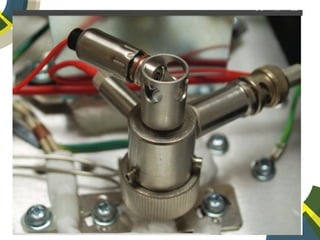
 Description of FID
 Applications of FID
 Advantages of FID
 Disadvantages of FID
 Sensitivity of FID
Operating principle:
Ionization detectors interact with solutes eluted
from gas chromatography (GC) columns to
produce a current that varies in proportion to the
amount of solute present. FID is sensitive to
molecules that are ionized in a hydrogen–air
flame, including most carbon-containing
compounds
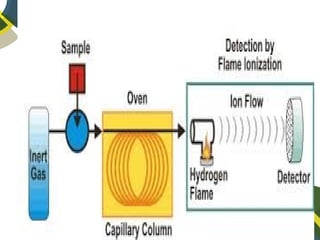
The flame ionization detector passes sample
and carrier gas from the column
through a hydrogen-air flame. The hydrogen-air
flame alone creates few ions,
but when an organic compound is burned there
is an increase in ions produced.
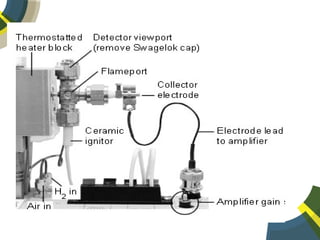
A polarizing voltage attracts these ions to a
collector located near the flame. The
current produced is proportional to the amount
of sample being burned. This
current is sensed by an electrometer, converted
to digital form, and sent to an
output device.
Detector performance characteristics
(sensitivity, minimum detectable
quantity, linearity, and selectivity)
FID is
A mass flow sensitive detector
that for organic compounds the
intensity of the signal is proportional to
the mass flow of carbon.
Applications
FID responds only to substances that
produce charged ions when burned in a
hydrogen/air flame.
does not respond to water, or permanent
gases
.
he FID responds only to substances that
produce charged ions when burned in a
hydrogen/air flame.
 Cost: Inexpensive to acquire and
operate.
 Low maintenance requirements: Apart
from cleaning or replacing the FID jet,
these detectors require no maintenance.
 Rugged construction: FIDs are relatively
resistant to misuse.
 Linearity and detection ranges: FIDs can
measure organic substance
concentration at very low and very high
levels, having a linear response of 10^6.
Advantages
Disadvantages
 Flame ionization detectors cannot
detect inorganic substances.
 FID flame oxidizes all compounds that
pass through it.
 destroys sample.
 It requires additional Gases and
controllers.
For this reason, FIDs tend to be the last
in a detector train and also cannot be
used for preparatory work.
Sensitivity
The FID exhibits a high
sensitivity (10-13g/s),large
linear.
Thank you

Fid ppt(2)

  • 1.
    Flame ionization detector (FID) Doneby: Aya Ali Malak Al-Ghamdi Supervised by: Dr. Haya Al-Johar
  • 2.
    Outline  Introduction  Operatingprinciple of FID  Description of FID  Applications of FID  Advantages of FID  Disadvantages of FID  Sensitivity of FID
  • 3.
    Operating principle: Ionization detectorsinteract with solutes eluted from gas chromatography (GC) columns to produce a current that varies in proportion to the amount of solute present. FID is sensitive to molecules that are ionized in a hydrogen–air flame, including most carbon-containing compounds
  • 6.
    The flame ionizationdetector passes sample and carrier gas from the column through a hydrogen-air flame. The hydrogen-air flame alone creates few ions, but when an organic compound is burned there is an increase in ions produced. A polarizing voltage attracts these ions to a collector located near the flame. The current produced is proportional to the amount of sample being burned. This current is sensed by an electrometer, converted to digital form, and sent to an output device.
  • 7.
    Detector performance characteristics (sensitivity,minimum detectable quantity, linearity, and selectivity) FID is A mass flow sensitive detector that for organic compounds the intensity of the signal is proportional to the mass flow of carbon.
  • 8.
    Applications FID responds onlyto substances that produce charged ions when burned in a hydrogen/air flame. does not respond to water, or permanent gases .
  • 9.
    he FID respondsonly to substances that produce charged ions when burned in a hydrogen/air flame.
  • 10.
     Cost: Inexpensiveto acquire and operate.  Low maintenance requirements: Apart from cleaning or replacing the FID jet, these detectors require no maintenance.  Rugged construction: FIDs are relatively resistant to misuse.  Linearity and detection ranges: FIDs can measure organic substance concentration at very low and very high levels, having a linear response of 10^6. Advantages
  • 11.
    Disadvantages  Flame ionizationdetectors cannot detect inorganic substances.  FID flame oxidizes all compounds that pass through it.  destroys sample.  It requires additional Gases and controllers. For this reason, FIDs tend to be the last in a detector train and also cannot be used for preparatory work.
  • 12.
    Sensitivity The FID exhibitsa high sensitivity (10-13g/s),large linear.
  • 13.