GAS CHROMATOGRAPHY
AND
IT’S DETECTORS
PREPARED BY:
Krupali Antala
Er. no.:-150821202001
GUIDED BY:
Dr. Falguni Tandel
Assistant professor
Dept. of Quality Assurance
Parul institute of pharmacy
PARUL INSTITUTE OF PHARMACY
DEPARTMENT OF PHARMACEUTICS
LIMDA, WAGHODIA, VADODARA 1
ā— Introduction
ā— Types of Chromatography
ā— Schematic diagram of gas chromatography
ā— Requirement
ā— Types of detector
ā— Detectors
ā— Reference
2
ļ‚ž Chromatography is a separation technique
based on the different interactions of
compounds with two phases, a mobile phase
and a stationary phase, as the compounds
travel through a supporting medium.
3
ā— The mobile phase is a gas called carrier gas.
ā— The stationary phase can be either a solid adsorbent or a liquid
coated or bonded on a solid support or on wall of column.
ā— If stationary phase is solid: GSC – Gas-Solid Chromatography.
ā— If stationary phase is liquid: GLC – Gas-Liquid
chromatography.
ā— In GSC, separation is based upon relative adsorption of sample
components on solid.
ā— In GLC, separation can be based on either relative solubility of
sample components in stationary phase or combination of
relative solubility in stationary phase and adsorption on solid
support of stationary phase.
ā— The sample used in GC separation must be a gas or be capable
of being converted to a gas at temperature of column.
ā— GC provides both qualitative and quantitative analytical
information
4
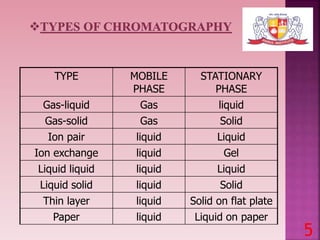
TYPE MOBILE
PHASE
STATIONARY
PHASE
Gas-liquid Gas liquid
Gas-solid Gas Solid
Ion pair liquid Liquid
Ion exchange liquid Gel
Liquid liquid liquid Liquid
Liquid solid liquid Solid
Thin layer liquid Solid on flat plate
Paper liquid Liquid on paper
5
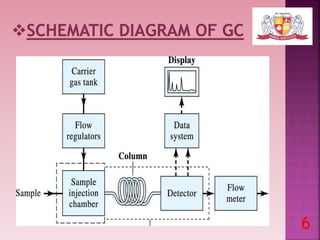
6
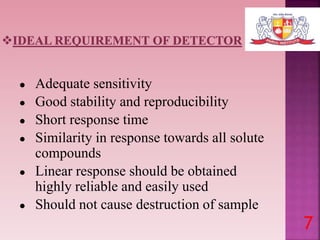
ā— Adequate sensitivity
ā— Good stability and reproducibility
ā— Short response time
ā— Similarity in response towards all solute
compounds
ā— Linear response should be obtained
highly reliable and easily used
ā— Should not cause destruction of sample
7
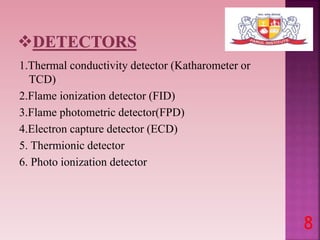
1.Thermal conductivity detector (Katharometer or
TCD)
2.Flame ionization detector (FID)
3.Flame photometric detector(FPD)
4.Electron capture detector (ECD)
5. Thermionic detector
6. Photo ionization detector
8
9
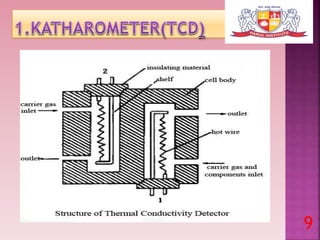
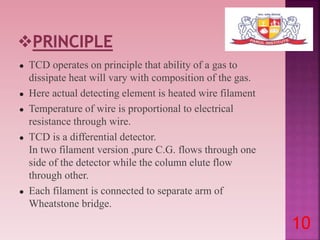
ā— TCD operates on principle that ability of a gas to
dissipate heat will vary with composition of the gas.
ā— Here actual detecting element is heated wire filament
ā— Temperature of wire is proportional to electrical
resistance through wire.
ā— TCD is a differential detector.
In two filament version ,pure C.G. flows through one
side of the detector while the column elute flow
through other.
ā— Each filament is connected to separate arm of
Wheatstone bridge.
10
11
ā— Non destructive. So sample can be reused.
ā— TCD is a rugged detector which can take a good
deal of maltreatment and continue to function well.
12
ā— TCD is an universal detector. It detects most
compounds including hydrocarbon and
inorganic salt.
ā— Has unique capacity to detect water and can
detect water level below that detectable by
Karl Fischer titration.
ā— For determination of water in ketonic
solvents and other solvents contaminated
with water.
13
14
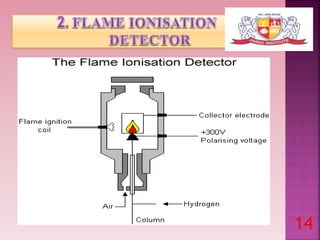
ā— The elute coming from the column is combined with hydrogen
(the fuel) and air (the oxidant) to form a combustible mixture.
ā— The ignited mixture forms a flame which provides sufficient
energy to ionize organic compound of eluate.
ā— The low temperature of air-hydrogen flame is sufficient to
ionize only carbon containing compound and not other
compound.
ā— The gaseous cations so formed are attracted to a negative
collector electrode and repelled by a positive repeller electrode.
ā— Upon striking collector electrode, positive ions cause a current
to flow in external circuit. it is also called as mass sensitive
detector as it depends on mass of carbon present in compound.
15
ā— The current is amplified and recorded. The current
flowing through the circuit is proportional to the no.
of ions striking the collector, which in turn
proportional to the conc. of ionizable sample
components that enter the flame
ā— Carrier gas:He,N2, Ne, Ar, Xe
16
ā— 1000 times more sensitive than TCD
ā— Less noise level
ā— Easy to use and strong enough for
operations
17
ā— Sample is destroyed
ā— It does not respond to most inorganic
compound like N2,O2, CO2 and water.
ā— It’s response to organic compound
decrease as the no. of O2, N2, S and X in
compound increase.
18
ā— Used in belladonna alkaloids.
ā— Chlorpheneramine
maleate,phenylpropanalamine HCL in cold
tablet, capsules and ampoules.
ā— Drug in biological fluid like determination
of chlorpropamide, tolbutamide and
codeine in plasma.
19
20
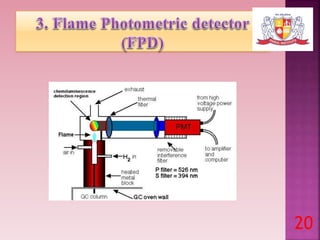
ā— FPD uses a hydrogen-air flame as does FID, but rather
that measure ionization, FPD uses photomultiplier
tube to measure radiation emitted in flame by sample
component.
ā— FPD can be made selective for compounds which
contain a single element by monitoring only the
emitted radiation at the wavelength characteristic for
that particular element.
ā— So appropriate optical filters are placed between the
flame and the PM tube to isolate these wavelength.
N2 is used as a carrier gas. N2/O2are used in ratio 4:1.21
ā— Pesticides residue analysis
ā— To determine cannabin and Ī”9-
tetrahydrocannabinol in blood after
conversion to diethyl PO4 ester.
ā— Determine S/P containing drugs like
penicillin's, cephalosporins, phenothiazines
and sulphonamides.
ā— Analysis of environmental samples such as
those containing pollutant S compounds.
22
23
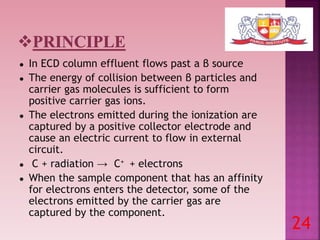
ā— In ECD column effluent flows past a β source
ā— The energy of collision between β particles and
carrier gas molecules is sufficient to form
positive carrier gas ions.
ā— The electrons emitted during the ionization are
captured by a positive collector electrode and
cause an electric current to flow in external
circuit.
ā— C + radiation → C+ + electrons
ā— When the sample component that has an affinity
for electrons enters the detector, some of the
electrons emitted by the carrier gas are
captured by the component.
24
ā— The resulting decreased current flow in external
circuit is used to indicate the presence of sample
component.
ā— ECD is selective for compounds that capture
electrons
ā— Beta source:63Ni,55Fe,tritium
ā— Carrier gas:mixture of CH4 with He,N
ā— or Ar is added to the column effluent prior to
reaching the beta source.
25
ā— Used as X and P detector
ā— Determination of insecticides in environment and
biological system.
ā— Determination of organ metallic compound.
ā— Selective determination of submicron levels of
drug level in biological specimen like blood,
urine and tissues.
ā— Compound which do not have high electron
affinities are derivatives usually with
polyhalogenated group to confer electron
capturing properties on molecules.
ā— E.g. trifluroacetyl, pentafluropropionyl and
heptaflurobutyryl.
26
27
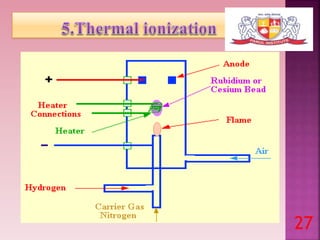
ā— Thermal ionization of an alkali metal salt
occurs by the flame.
ā— This is done by suspending a salt-coated wire
in the flame or placing a cylinder filled with
salt as a compressed disc of salt on the top
of the flame jet.
ā— Flame containing alkali metal atoms elicits
an enhanced response for organic compound
containing N2, P, S or halogen.
ā— Salt tends to reduce the response to carbon
relative to ordinary FID.
28
ā— Analysis of N2 drugs and their metabolites.
ā— Used for analysis of pesticides.
ā— Analysis of lidocaine in plasma and
anticonvulsant in blood.
29
ā— Less stable
ā— Gradual depletion of alkali metal salt and a
ā— concomitant change in noise and sensitivity.
30
 It induces ionization via photons emitted by an UV
lamp.
 Detectors uses a photon energy of 10-2 eV emitted
as a Lyman alpha line.
 Compound with ionization potential of less than
10-2 eve will absorb the UV radiation and be
converted into the positive ions.
 An electron field is set up in the detector by 2
charged electrodes, the cathode becoming the
collector electrode for the ions
31
ā— It is non destructive so that it can be used in series
with other detectors. Disadvantage
ā— Because of ionization potential limitation
compound like H2O, SO2, saturated H.C. smaller
than hexane, CHCl3, CHCl2 & acetonitrile are not
detected.
32
ā— It is considered as ā€œUniversal detectorā€.
ā— Compounds with ionization potential less
than 10-2 eve are detected by the PID.
ā— It’s response is proportional to no. of H.C.
(for H.C. of greater than 5 carbons)
33
ā— Skoog.D.A, Holler.F.J, Crouch.S.R, Instrumental
Analysis, Indian third edition reprint 2009, printed
by india Saurabh printers Pvt.Ltd. 865-875
ā— Munsoon.J.W, Pharmaceutical analysis modern
method, part b.
ā— www.slideshare.net/gopinathkarnam/gas-
chromatography-24600103
34
35

My presentation

  • 1.
    GAS CHROMATOGRAPHY AND IT’S DETECTORS PREPAREDBY: Krupali Antala Er. no.:-150821202001 GUIDED BY: Dr. Falguni Tandel Assistant professor Dept. of Quality Assurance Parul institute of pharmacy PARUL INSTITUTE OF PHARMACY DEPARTMENT OF PHARMACEUTICS LIMDA, WAGHODIA, VADODARA 1
  • 2.
    ā— Introduction ā— Typesof Chromatography ā— Schematic diagram of gas chromatography ā— Requirement ā— Types of detector ā— Detectors ā— Reference 2
  • 3.
    ļ‚ž Chromatography isa separation technique based on the different interactions of compounds with two phases, a mobile phase and a stationary phase, as the compounds travel through a supporting medium. 3
  • 4.
    ā— The mobilephase is a gas called carrier gas. ā— The stationary phase can be either a solid adsorbent or a liquid coated or bonded on a solid support or on wall of column. ā— If stationary phase is solid: GSC – Gas-Solid Chromatography. ā— If stationary phase is liquid: GLC – Gas-Liquid chromatography. ā— In GSC, separation is based upon relative adsorption of sample components on solid. ā— In GLC, separation can be based on either relative solubility of sample components in stationary phase or combination of relative solubility in stationary phase and adsorption on solid support of stationary phase. ā— The sample used in GC separation must be a gas or be capable of being converted to a gas at temperature of column. ā— GC provides both qualitative and quantitative analytical information 4
  • 5.
    TYPE MOBILE PHASE STATIONARY PHASE Gas-liquid Gasliquid Gas-solid Gas Solid Ion pair liquid Liquid Ion exchange liquid Gel Liquid liquid liquid Liquid Liquid solid liquid Solid Thin layer liquid Solid on flat plate Paper liquid Liquid on paper 5
  • 6.
  • 7.
    ā— Adequate sensitivity ā—Good stability and reproducibility ā— Short response time ā— Similarity in response towards all solute compounds ā— Linear response should be obtained highly reliable and easily used ā— Should not cause destruction of sample 7
  • 8.
    1.Thermal conductivity detector(Katharometer or TCD) 2.Flame ionization detector (FID) 3.Flame photometric detector(FPD) 4.Electron capture detector (ECD) 5. Thermionic detector 6. Photo ionization detector 8
  • 9.
  • 10.
    ā— TCD operateson principle that ability of a gas to dissipate heat will vary with composition of the gas. ā— Here actual detecting element is heated wire filament ā— Temperature of wire is proportional to electrical resistance through wire. ā— TCD is a differential detector. In two filament version ,pure C.G. flows through one side of the detector while the column elute flow through other. ā— Each filament is connected to separate arm of Wheatstone bridge. 10
  • 11.
  • 12.
    ā— Non destructive.So sample can be reused. ā— TCD is a rugged detector which can take a good deal of maltreatment and continue to function well. 12
  • 13.
    ā— TCD isan universal detector. It detects most compounds including hydrocarbon and inorganic salt. ā— Has unique capacity to detect water and can detect water level below that detectable by Karl Fischer titration. ā— For determination of water in ketonic solvents and other solvents contaminated with water. 13
  • 14.
  • 15.
    ā— The elutecoming from the column is combined with hydrogen (the fuel) and air (the oxidant) to form a combustible mixture. ā— The ignited mixture forms a flame which provides sufficient energy to ionize organic compound of eluate. ā— The low temperature of air-hydrogen flame is sufficient to ionize only carbon containing compound and not other compound. ā— The gaseous cations so formed are attracted to a negative collector electrode and repelled by a positive repeller electrode. ā— Upon striking collector electrode, positive ions cause a current to flow in external circuit. it is also called as mass sensitive detector as it depends on mass of carbon present in compound. 15
  • 16.
    ā— The currentis amplified and recorded. The current flowing through the circuit is proportional to the no. of ions striking the collector, which in turn proportional to the conc. of ionizable sample components that enter the flame ā— Carrier gas:He,N2, Ne, Ar, Xe 16
  • 17.
    ā— 1000 timesmore sensitive than TCD ā— Less noise level ā— Easy to use and strong enough for operations 17
  • 18.
    ā— Sample isdestroyed ā— It does not respond to most inorganic compound like N2,O2, CO2 and water. ā— It’s response to organic compound decrease as the no. of O2, N2, S and X in compound increase. 18
  • 19.
    ā— Used inbelladonna alkaloids. ā— Chlorpheneramine maleate,phenylpropanalamine HCL in cold tablet, capsules and ampoules. ā— Drug in biological fluid like determination of chlorpropamide, tolbutamide and codeine in plasma. 19
  • 20.
  • 21.
    ā— FPD usesa hydrogen-air flame as does FID, but rather that measure ionization, FPD uses photomultiplier tube to measure radiation emitted in flame by sample component. ā— FPD can be made selective for compounds which contain a single element by monitoring only the emitted radiation at the wavelength characteristic for that particular element. ā— So appropriate optical filters are placed between the flame and the PM tube to isolate these wavelength. N2 is used as a carrier gas. N2/O2are used in ratio 4:1.21
  • 22.
    ā— Pesticides residueanalysis ā— To determine cannabin and Ī”9- tetrahydrocannabinol in blood after conversion to diethyl PO4 ester. ā— Determine S/P containing drugs like penicillin's, cephalosporins, phenothiazines and sulphonamides. ā— Analysis of environmental samples such as those containing pollutant S compounds. 22
  • 23.
  • 24.
    ā— In ECDcolumn effluent flows past a β source ā— The energy of collision between β particles and carrier gas molecules is sufficient to form positive carrier gas ions. ā— The electrons emitted during the ionization are captured by a positive collector electrode and cause an electric current to flow in external circuit. ā— C + radiation → C+ + electrons ā— When the sample component that has an affinity for electrons enters the detector, some of the electrons emitted by the carrier gas are captured by the component. 24
  • 25.
    ā— The resultingdecreased current flow in external circuit is used to indicate the presence of sample component. ā— ECD is selective for compounds that capture electrons ā— Beta source:63Ni,55Fe,tritium ā— Carrier gas:mixture of CH4 with He,N ā— or Ar is added to the column effluent prior to reaching the beta source. 25
  • 26.
    ā— Used asX and P detector ā— Determination of insecticides in environment and biological system. ā— Determination of organ metallic compound. ā— Selective determination of submicron levels of drug level in biological specimen like blood, urine and tissues. ā— Compound which do not have high electron affinities are derivatives usually with polyhalogenated group to confer electron capturing properties on molecules. ā— E.g. trifluroacetyl, pentafluropropionyl and heptaflurobutyryl. 26
  • 27.
  • 28.
    ā— Thermal ionizationof an alkali metal salt occurs by the flame. ā— This is done by suspending a salt-coated wire in the flame or placing a cylinder filled with salt as a compressed disc of salt on the top of the flame jet. ā— Flame containing alkali metal atoms elicits an enhanced response for organic compound containing N2, P, S or halogen. ā— Salt tends to reduce the response to carbon relative to ordinary FID. 28
  • 29.
    ā— Analysis ofN2 drugs and their metabolites. ā— Used for analysis of pesticides. ā— Analysis of lidocaine in plasma and anticonvulsant in blood. 29
  • 30.
    ā— Less stable ā—Gradual depletion of alkali metal salt and a ā— concomitant change in noise and sensitivity. 30
  • 31.
     It inducesionization via photons emitted by an UV lamp.  Detectors uses a photon energy of 10-2 eV emitted as a Lyman alpha line.  Compound with ionization potential of less than 10-2 eve will absorb the UV radiation and be converted into the positive ions.  An electron field is set up in the detector by 2 charged electrodes, the cathode becoming the collector electrode for the ions 31
  • 32.
    ā— It isnon destructive so that it can be used in series with other detectors. Disadvantage ā— Because of ionization potential limitation compound like H2O, SO2, saturated H.C. smaller than hexane, CHCl3, CHCl2 & acetonitrile are not detected. 32
  • 33.
    ā— It isconsidered as ā€œUniversal detectorā€. ā— Compounds with ionization potential less than 10-2 eve are detected by the PID. ā— It’s response is proportional to no. of H.C. (for H.C. of greater than 5 carbons) 33
  • 34.
    ā— Skoog.D.A, Holler.F.J,Crouch.S.R, Instrumental Analysis, Indian third edition reprint 2009, printed by india Saurabh printers Pvt.Ltd. 865-875 ā— Munsoon.J.W, Pharmaceutical analysis modern method, part b. ā— www.slideshare.net/gopinathkarnam/gas- chromatography-24600103 34
  • 35.