GC - DETECTORS
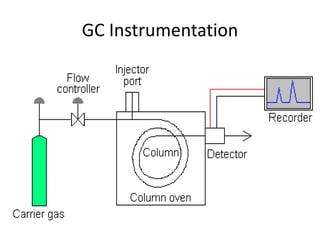
GC Instrumentation
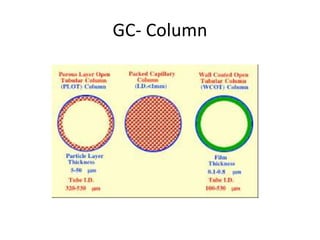
GC- Column
GC- Detectors
1. Flame ionization detector ( FID)
2. Thermal conductivity detector (TCD)
3. Electron capture detector (ECD)
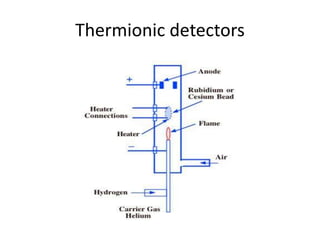
4. Thermionic detector (TID)
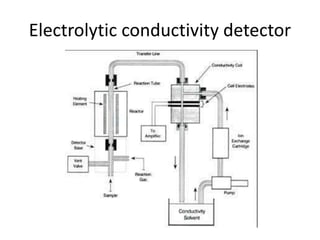
5. Electrolytic conductivity detector
6. Photoionization detector (PID)
7. Atomic Emission detector (AED)
8. Flame Photometric detector (FPD)
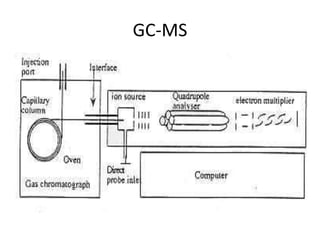
9. GC-MS
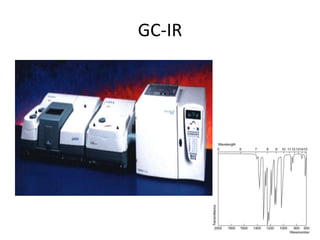
10.GC-IR
Ideal characteristics of a detector
• Adequate sensitivity
• Good stability & reproducibility
• Linear response
• Temp range from room temp to 400⁰C
• Short response time
• High reliability
• Selectivity
• Non destructive
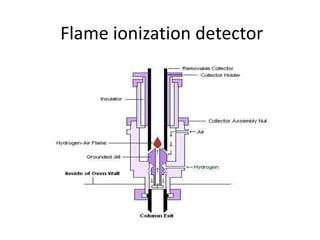
Flame ionization detector
FID
• Few hundred volts applied between burner tip
and collector electrode
• Resulting in generation of current
Advantages: 1. High sensitivity
2. Linear response & low noise
3. Rugged and easy to use
Disadvantages: 1. sample is destroyed
2. requires additional gases and
controllers
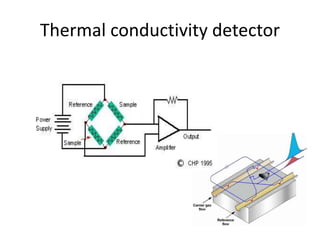
Thermal conductivity detector
TCD
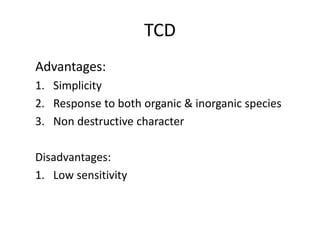
Advantages:
1. Simplicity
2. Response to both organic & inorganic species
3. Non destructive character
Disadvantages:
1. Low sensitivity
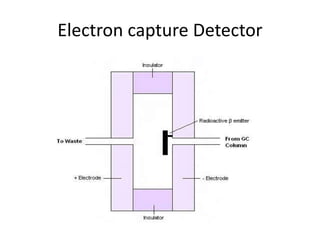
Electron capture Detector
ECD
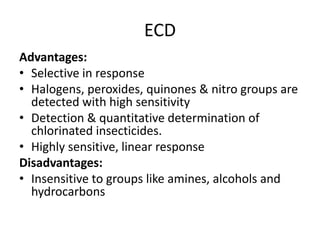
Advantages:
• Selective in response
• Halogens, peroxides, quinones & nitro groups are
detected with high sensitivity
• Detection & quantitative determination of
chlorinated insecticides.
• Highly sensitive, linear response
Disadvantages:
• Insensitive to groups like amines, alcohols and
hydrocarbons
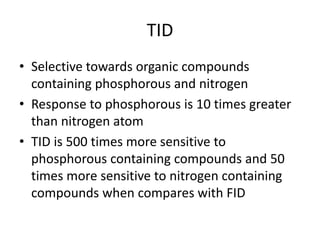
Thermionic detectors
TID
• Selective towards organic compounds
containing phosphorous and nitrogen
• Response to phosphorous is 10 times greater
than nitrogen atom
• TID is 500 times more sensitive to
phosphorous containing compounds and 50
times more sensitive to nitrogen containing
compounds when compares with FID
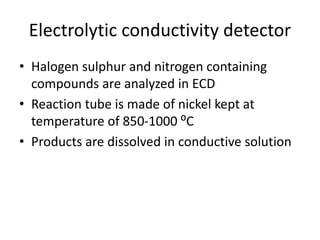
Electrolytic conductivity detector
• Halogen sulphur and nitrogen containing
compounds are analyzed in ECD
• Reaction tube is made of nickel kept at
temperature of 850-1000 ⁰C
• Products are dissolved in conductive solution
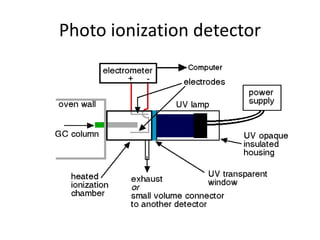
Photo ionization detector
PID
• Eluent is photoionised by UV radiation from
10.2eV hydrogen or 11.7eV argon lamp.
• More sensitive for aromatic hydrocarbons and
organophosphorous compounds which are
easily photionized
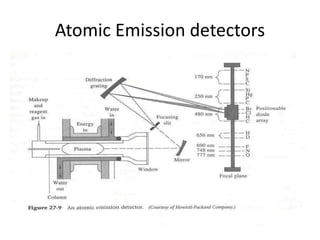
Atomic Emission detectors
AED
• Effluent is introduced into microwave induced
plasma
• Plasma atomizes all elements in sample
• Atomized elements excite to give
characteristic atomic emission spectra
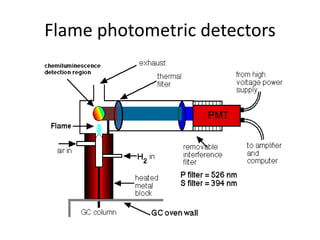
Flame photometric detectors
FPD
• Analysis of air water pollutants & pesticides
• Selective to phosphorous and sulphur
• P is converted into HPO which emits bands at
about 510 and 526nm
• S is converted to S2 which emits the band at
394nm
GC-MS
GC-IR

Gas chromatography detectors types

  • 1.
  • 2.
  • 3.
  • 4.
    GC- Detectors 1. Flameionization detector ( FID) 2. Thermal conductivity detector (TCD) 3. Electron capture detector (ECD) 4. Thermionic detector (TID) 5. Electrolytic conductivity detector 6. Photoionization detector (PID) 7. Atomic Emission detector (AED) 8. Flame Photometric detector (FPD) 9. GC-MS 10.GC-IR
  • 5.
    Ideal characteristics ofa detector • Adequate sensitivity • Good stability & reproducibility • Linear response • Temp range from room temp to 400⁰C • Short response time • High reliability • Selectivity • Non destructive
  • 6.
  • 7.
    FID • Few hundredvolts applied between burner tip and collector electrode • Resulting in generation of current Advantages: 1. High sensitivity 2. Linear response & low noise 3. Rugged and easy to use Disadvantages: 1. sample is destroyed 2. requires additional gases and controllers
  • 8.
  • 9.
    TCD Advantages: 1. Simplicity 2. Responseto both organic & inorganic species 3. Non destructive character Disadvantages: 1. Low sensitivity
  • 10.
  • 11.
    ECD Advantages: • Selective inresponse • Halogens, peroxides, quinones & nitro groups are detected with high sensitivity • Detection & quantitative determination of chlorinated insecticides. • Highly sensitive, linear response Disadvantages: • Insensitive to groups like amines, alcohols and hydrocarbons
  • 12.
  • 13.
    TID • Selective towardsorganic compounds containing phosphorous and nitrogen • Response to phosphorous is 10 times greater than nitrogen atom • TID is 500 times more sensitive to phosphorous containing compounds and 50 times more sensitive to nitrogen containing compounds when compares with FID
  • 14.
  • 15.
    Electrolytic conductivity detector •Halogen sulphur and nitrogen containing compounds are analyzed in ECD • Reaction tube is made of nickel kept at temperature of 850-1000 ⁰C • Products are dissolved in conductive solution
  • 16.
  • 17.
    PID • Eluent isphotoionised by UV radiation from 10.2eV hydrogen or 11.7eV argon lamp. • More sensitive for aromatic hydrocarbons and organophosphorous compounds which are easily photionized
  • 18.
  • 19.
    AED • Effluent isintroduced into microwave induced plasma • Plasma atomizes all elements in sample • Atomized elements excite to give characteristic atomic emission spectra
  • 20.
  • 21.
    FPD • Analysis ofair water pollutants & pesticides • Selective to phosphorous and sulphur • P is converted into HPO which emits bands at about 510 and 526nm • S is converted to S2 which emits the band at 394nm
  • 22.
  • 23.