FFR
Introduction
• Fractional flow reserve (FFR) measurement involves
determining the ratio between the maximum achievable
blood flow in a diseased coronary artery and the
theoretical maximum flow in a normal coronary artery. An
FFR of 1.0 is widely accepted as normal. An FFR lower than
0.75-0.80 is generally considered to be associated with
myocardial ischemia (MI).
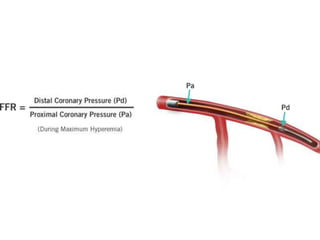
• FFR is easily measured during routine coronary angiography
by using a pressure wire to calculate the ratio between
coronary pressure distal to a coronary artery stenosis and
aortic pressure under conditions of maximum myocardial
hyperemia.This ratio represents the potential decrease in
coronary flow distal to the coronary stenosis
The ability of the cardiologist to discriminate
between lesions that can cause MI and lesions
that are physiologically insignificant on the
basis of coronary angiography alone is limited.
The use of FFR measurement provides the
cardiologist with a straightforward, readily
available, quantitative technique for
evaluating the physiologic significance of a
coronary stenosis.
Indication
Indications for FFR measurement are as follows:
• To determine the physiologic and hemodynamic
significance of an angiographically intermediate coronary
stenosis
• To identify appropriate culprit lesion(s) in multivessel
coronary artery disease (CAD)
• To measure the functional importance of stenosis in the
presence of distal collateral flow
• To identify the precise location of a coronary lesion when
the angiographic image is unclear
N.B. this procedure is not intended for use in the setting of a total vessel
occlusion.
Equipment
Manufacturer: Volcano Corporation and St Jude
Medical, Inc.
FFR equipment manufactured by Volcano :
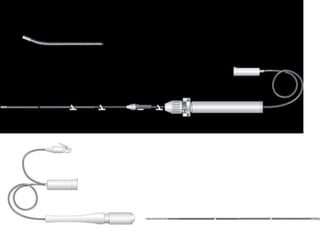
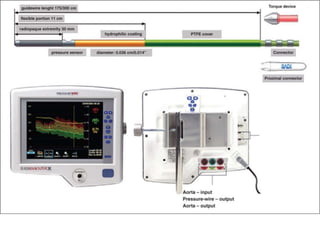
1. ComboMap Pressure and Flow System - This is a
combined system that displays both pressure
and flow
2. ComboWire XT Guide Wire - This wire allows
simultaneous measurement of intravascular
pressure and Doppler flow and, thus, is capable
of measuring stenotic and microvascular
resistance
Volcano equipment…
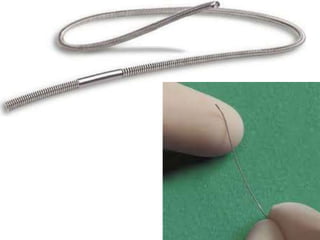
3. PrimeWire Guide Wire - This wire allows
measurement of intravascular pressure
4. FloWire Doppler Guide Wire - This wire allows
measurement of coronary arterial blood flow
velocity and coronary flow reserve
St. Jude equipment…
RadiAnalyzer Xpress - This combined system
takes pressure, flow, and temperature
measurements using 1 PressureWire and 1
instrument
Technique
• Typically, conscious sedation is administered as part of
the cardiac catheterization
• Wet the working length of the guide wire with normal
saline, and insert the wire through the appropriate
introducer components and guiding catheter into the
desired blood vessel
• Slowly advance the guide wire tip under fluoroscopic
guidance, using contrast injections to verify its location
• operator crosses the coronary stenosis with an FFR-
specific guide wire designed to record the coronary
arterial pressure distal to the stenosis.
Technique cont’d…
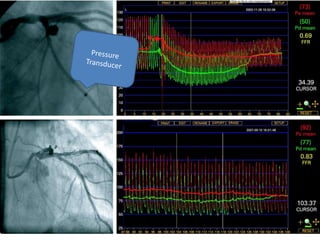
• The pressure transducer is located approximately 20 mm
proximal to the distal tip of the wire, and it can be seen
fluoroscopically.
• Once the transducer is distal to the stenosis, a hyperemic
stimulus is administered by injection through the guide
catheter, and the FFR is monitored for a significant change.
• To achieve maximum hyperemia, adenosine is typically
used: a 15-30 µg bolus in the right coronary artery, a 20-40
µg bolus in the left coronary artery, or intravenous (IV)
infusion for 3-4 minutes at 140 µg/kg/min.
• The mean arterial pressures from the pressure wire
transducer and from the guide catheter are then used to
calculate FFR.
Cont’d…
• An FFR value lower than 0.75 indicates a
hemodynamically significant stenosis. An FFR
value higher than 0.8 indicates a stenosis that
is not hemodynamically significant. Values
between 0.75 and 0.80 are indeterminate
Risk or complication
1. Risks specific to the FFR procedure include the
need for additional contrast use and radiation
exposure, as well as a slightly increased risk of
coronary arterial dissection with FFR wire
passage
2. Risk of left heart catheterization
Complications associated with cardiac catheterization
include the following:
• Coronary vessel dissection, occlusion, or perforation
• Embolism (coronary, cerebral, or other arterial)
• Coronary artery spasm
• Local or systemic infection
• Acute renal failure
• Myocardial infarction
• Stroke
• Serious arrhythmias
• Death
RAF
Introduction
RF energy, a low-voltage, high-frequency form of
electrical energy similar to electrocautery
used in surgery
RF energy produces small, homogeneous,
necrotic lesions by heating tissue. With typical
power settings and good catheter contact
pressure with cardiac tissue, lesions are
minimally about 5-7 mm in diameter and 3-5
mm in depth.
Indications
Common indications:
There are three class I indications for catheter
ablation
1. SVT due to AVNRT, WPW syndrome, unifocal
atrial tachycardia, or atrial flutter (especially
common right atrial forms).
2. AF with lifestyle-impairing symptoms and
inefficacy or intolerance of at least one
antiarrhythmic agent.
Ind. Cont’d…
3. Symptomatic VT. Catheter ablation is first-line
therapy in idiopathic VT if that is the patient’s
preference. In structural heart disease,
catheter ablation is generally performed for
drug inefficacy or intolerance or as adjunctive
therapy to patient with ICD.
Cont’d…
Uncommon indication:
1. Symptomatic drug-refractory (inefficacy or
intolerance) idiopathic sinus tachycardia
2. Lifestyle-impairing ectopic beats
3. Symptomatic junctional ectopic tachycardia
Contraindications
1. Left atrial ablation and ablation for persistent
atrial flutter should not be performed in the
presence of known atrial thrombus.
2. Mobile left ventricular thrombus would be a
contraindication to left ventricular ablation.
3. Mechanical prosthetic heart valves are
generally not crossed with ablation catheters.
4. Pregnant.
Preprocedural planning
Inv.: ECG
Echocardiography
ETT/ LHC- in specific cases
Cardiac medications with electrophysiologic effects
(eg, beta blockers, calcium channel blockers,
digoxin, and class I and III antiarrhythmic drugs)
are often tapered or discontinued before the
procedure.
Warfarin may or may not be held prior to the
procedure
Instruments
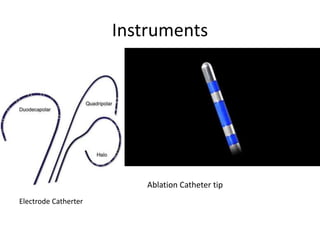
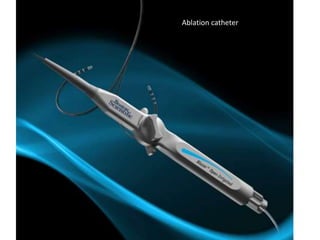
Ablation Catheter tip
Electrode Catherter
Ablation catheter
Technique
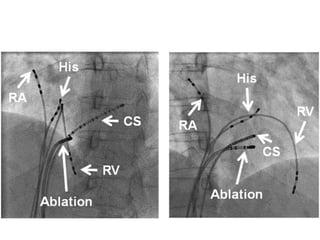
• Typically, two to five electrode catheters are
percutaneously inserted via the femoral or internal
jugular veins and are positioned within the left heart,
the right heart, or both
• Usually positions are high right atrium, Coronary sinus,
RV apex, His bundle.
• For left-heart catheterization, one of the following two
approaches may be taken:
 Transseptal catheterization via the interatrial
septum
 Retrograde catheterization across the aortic valve
• Anticoagulation with intravenous (IV) heparin
is used to reduce the risk of periprocedural
thromboembolism.
• Specific location to ablate for specific
arrythmia
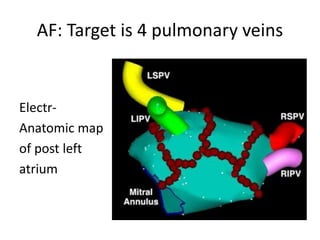
AF: Target is 4 pulmonary veins
Electr-
Anatomic map
of post left
atrium
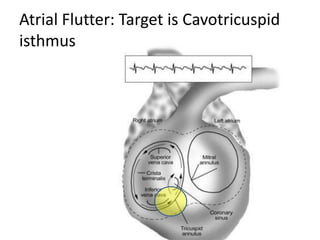
Atrial Flutter: Target is Cavotricuspid
isthmus
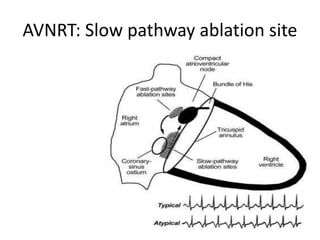
AVNRT: Slow pathway ablation site
VT: Right ventricular outflow tract
WPW syndrome: Target is accessory
pathway
Complications
Major complications occur in approximately
3% thromboembolism in fewer than 1% and death in 0.1-
0.2% of all procedures
Cardiac complications:
• High-grade AV block
• Cardiac tamponade (highest in AF ablation, up to 6%)
• Coronary artery spasm/thrombosis
• Pericarditis
• Valve trauma
N.B.: Radiation risk from catheter ablation is low, but it may
exceed the risk from common radiologic procedures.
Vascular complications, which occur in
approximately 2-4% of procedures, include the
following:
• Retroperitoneal bleeding
• Hematoma
• Vascular injury
• Transient ischemic attack/stroke
• Hypotension
• Thromboembolism or air embolism
Pulmonary complications include the following:
• Pulmonary hypertension, with or without
hemoptysis (secondary to pulmonary vein
stenosis)
• Pneumothorax
Miscellaneous complications include the following:
• Left atrial–esophageal fistula
• Acute pyloric spasm/gastric hypomotility
• Phrenic nerve paralysis
• Radiation- or electricity-induced skin damage
• Infection at access site
• Inappropriate sinus tachycardia
• Proarrhythmia
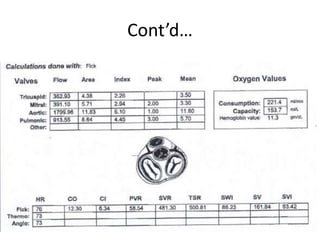
Assessment of shunt by cardiac
catheterization
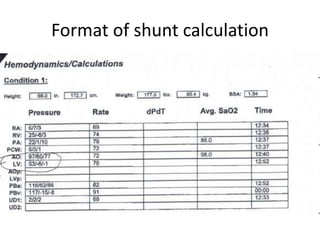
Format of shunt calculation
Cont’d…
Shunt by cardiac catheterization
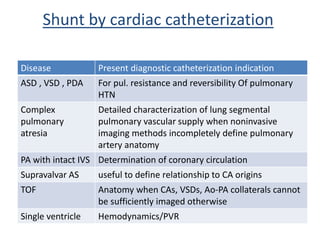
Disease Present diagnostic catheterization indication
ASD , VSD , PDA For pul. resistance and reversibility Of pulmonary
HTN
Complex
pulmonary
atresia
Detailed characterization of lung segmental
pulmonary vascular supply when noninvasive
imaging methods incompletely define pulmonary
artery anatomy
PA with intact IVS Determination of coronary circulation
Supravalvar AS useful to define relationship to CA origins
TOF Anatomy when CAs, VSDs, Ao-PA collaterals cannot
be sufficiently imaged otherwise
Single ventricle Hemodynamics/PVR
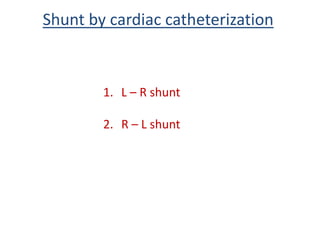
1. L – R shunt
2. R – L shunt
Shunt by cardiac catheterization
1. Pulmonary artery [PA] blood oxygen saturation is >80%, the
possibility of a left-to-right intracardiac shunt should be considered
.
When to suspect cardiac L – R
shunt ?
Plan of management by catheterisation:
1. Diagnosis
2. Quantification of shunt
3. Hemodynamic load
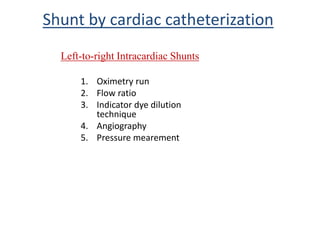
1. Oximetry run
2. Flow ratio
3. Indicator dye dilution
technique
4. Angiography
5. Pressure mearement
Shunt by cardiac catheterization
Left-to-right Intracardiac Shunts
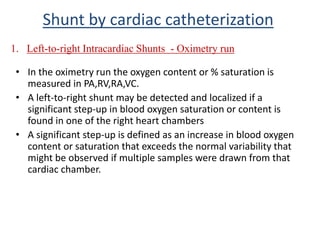
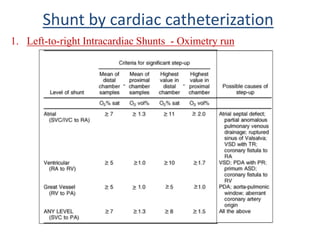
• In the oximetry run the oxygen content or % saturation is
measured in PA,RV,RA,VC.
• A left-to-right shunt may be detected and localized if a
significant step-up in blood oxygen saturation or content is
found in one of the right heart chambers
• A significant step-up is defined as an increase in blood oxygen
content or saturation that exceeds the normal variability that
might be observed if multiple samples were drawn from that
cardiac chamber.
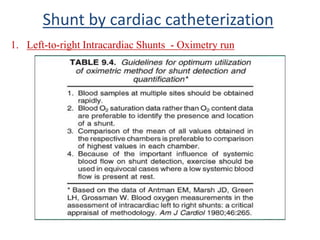
1. Left-to-right Intracardiac Shunts - Oximetry run
Shunt by cardiac catheterization
 Various methods used for oximetry run are
1. Oxygen content
2. Oxygen saturation
 Spectrophotometry
 Oxygen dissociation curve
 Oxygen content = O2 bound to Hb + dissolved O2
 Dissolved O2 = 3.26 * PaO2 / 100.
 Oxygen saturation = O2 bound to Hb / O2 capacity * 100
 Oxygen capacity = Hb * 13.6
Shunt by cardiac catheterization
1. Left-to-right Intracardiac Shunts - Oximetry run
• Oxygen content
The technique of the oximetry run is based on the
pioneering studies of Dexter and his associates in
1947
Oxygen content was measured by Van Slyke
technique , and other manometric studies
Proposed step up at atrial , ventricular , pulmonary
artery level are 2%, 1%, 0.5%.
Disadvantages of oxygen content technique
15 – 30 min for obtaining a reading
 Technically difficult to perform
Dependency on Hb content
Shunt by cardiac catheterization
1. Left-to-right Intracardiac Shunts - Oximetry run
• Oxygen content
Manometric to spectrophotometric method
Spectrophotometric is technically easy and results are
with 1 min
Oxygen content is calculated by saturation by
= O2 sat. * Hb % * 1.36
When oxygen content is derived in this manner, rather
than by direct oximetric technique, the value is no more
accurate (presence of carboxyhemoglobin or
hemoglobin variants with O2 capacity other than 1.36).
1. Left-to-right Intracardiac Shunts - Oximetry run
Shunt by cardiac catheterization
• Oxygen saturation :
O2 is determined by
1. O2 dissociation curve
2. Spectrophotometry
1. Left-to-right Intracardiac Shunts - Oximetry run
Shunt by cardiac catheterization
• O2 saturation by spectrophotometry :
– Based on Beers law
– Advantages : quick ,accurate, precise , subject to few
errors , less dependency on Hb% .
– Disadvantages :
Inaccurate if large amounts of carboxy hemoglobin is present
Indocyanin green interfere with light source of
spectrphotometry
Elevated bilirubin effect absorbtion of light
1. Left-to-right Intracardiac Shunts - Oximetry run
Shunt by cardiac catheterization
• O2 saturation by spectrophotometry :
– Disadvantages :
1% error at 95% O2 saturation
2.5% error at 70% O2 saturation
More accurate at 40-50%
Low values O2 saturation is not at all reliable if
necessary saturations below 50% can be determined
by blood gas method
1. Left-to-right Intracardiac Shunts - Oximetry run
Shunt by cardiac catheterization
O2 saturation spectrophotometry is presently best method for
oximetry
Procedure of oximetry run
• 2-mL sample from each of the following locations.
1. Left and/or right pulmonary artery & Main pulmonary
artery
2. Right ventricle, outflow tract, mid & tricuspid valve .
3. Right atrium, low or near tricuspid valve , mid & high .
4. Superior vena cava, low (near junction with right atrium).
5. Superior vena cava, high (near junction with innominate
vein).
6. Inferior vena cava, high (just at or below diaphragm).
7. Inferior vena cava, low (at L4-L5).
8. Left ventricle.
9. Aorta (distal to insertion of ductus).
1. Left-to-right Intracardiac Shunts - Oximetry run
Shunt by cardiac catheterization
Procedure of oximetry run
• In performing the oximetry run, an end-hole catheter (e.g.,
Swan-Ganz balloon flotation catheter) or one with side holes
close to its tip (e.g., a Goodale-Lubin catheter) can be used
• The entire procedure should take less than 7 minutes.
• If a sample cannot be obtained from a specific site because of
ventricular premature beats, that site should be skipped until
the rest of the run has been completed.
1. Left-to-right Intracardiac Shunts - Oximetry run
Shunt by cardiac catheterization
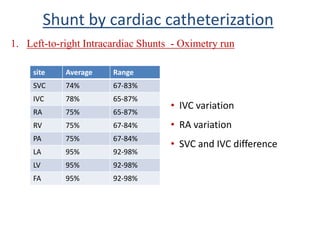
site Average Range
SVC 74% 67-83%
IVC 78% 65-87%
RA 75% 65-87%
RV 75% 67-84%
PA 75% 67-84%
LA 95% 92-98%
LV 95% 92-98%
FA 95% 92-98%
1. Left-to-right Intracardiac Shunts - Oximetry run
Shunt by cardiac catheterization
• IVC variation
• RA variation
• SVC and IVC difference
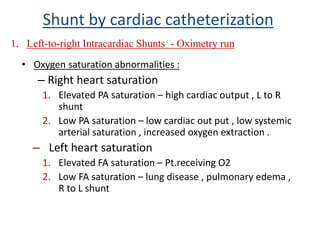
• Oxygen saturation abnormalities :
– Right heart saturation
1. Elevated PA saturation – high cardiac output , L to R
shunt
2. Low PA saturation – low cardiac out put , low systemic
arterial saturation , increased oxygen extraction .
– Left heart saturation
1. Elevated FA saturation – Pt.receiving O2
2. Low FA saturation – lung disease , pulmonary edema ,
R to L shunt
1. Left-to-right Intracardiac Shunts - Oximetry run
Shunt by cardiac catheterization
1. Left-to-right Intracardiac Shunts - Oximetry run
Shunt by cardiac catheterization
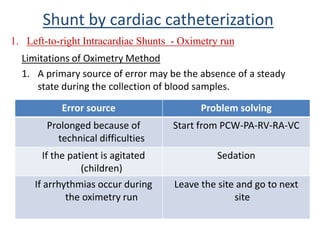
Limitations of Oximetry Method
1. A primary source of error may be the absence of a steady
state during the collection of blood samples.
1. Left-to-right Intracardiac Shunts - Oximetry run
Shunt by cardiac catheterization
Error source Problem solving
Prolonged because of
technical difficulties
Start from PCW-PA-RV-RA-VC
If the patient is agitated
(children)
Sedation
If arrhythmias occur during
the oximetry run
Leave the site and go to next
site
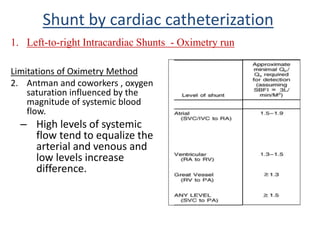
Limitations of Oximetry Method
2. Antman and coworkers , oxygen
saturation influenced by the
magnitude of systemic blood
flow.
– High levels of systemic
flow tend to equalize the
arterial and venous and
low levels increase
difference.
1. Left-to-right Intracardiac Shunts - Oximetry run
Shunt by cardiac catheterization
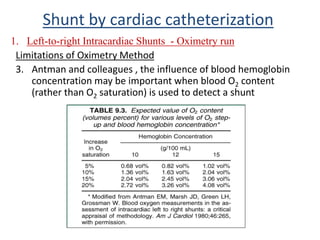
Limitations of Oximetry Method
3. Antman and colleagues , the influence of blood hemoglobin
concentration may be important when blood O2 content
(rather than O2 saturation) is used to detect a shunt
1. Left-to-right Intracardiac Shunts - Oximetry run
Shunt by cardiac catheterization
Limitations of Oximetry Method
4. Lacks sensitivity in detecting intracardiac shunts , Small
shunts, however, are not consistently detected by this
technique.
5. Variations in pulmonary venous saturation
– Lower portion of lung has lower O2 saturation
– Children CHD – atelectasis – compress the bronchus –
desaturation of corresponding bronchus
6. d/t the presence of physiological shunt
– Thebesian veins and coronary veins entering LV (R- L)
– Bronchial veins draining in to LA / PV (R- L)
– Bronchial artery to pulmonary artery (L – R )
1. Left-to-right Intracardiac Shunts - Oximetry run
Shunt by cardiac catheterization
7. Various CHD where it is virtually impossible to calculate
systemic and pulmonary blood flow
– In a patient with a large L-R shunt caused by
arterial collaterals entering the distal pulmonary
vascular bed , it is impossible to obtain a blood
sample distal to the shunt
Shunt by cardiac catheterization
1. Left-to-right Intracardiac Shunts - Oximetry run
Shunt by cardiac catheterization
1. Left-to-right Intracardiac Shunts - Oximetry run
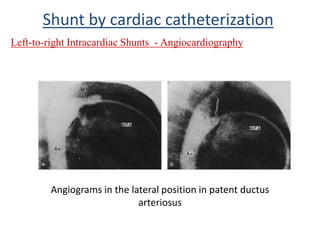
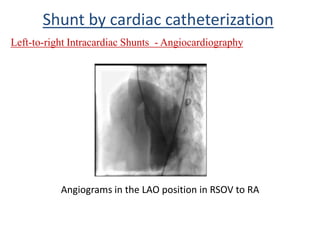
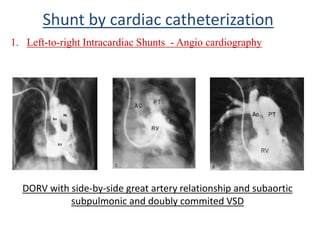
• Selective angiography is effective in visualizing and localizing
the site of left-to-right shunts
• Angiographic demonstration of anatomy has become a
routine part of the preoperative evaluation of patients with
congenital or acquired shunts and is useful in localizing the
anatomic site of the shunt
Left-to-right Intracardiac Shunts - Angiocardiography
Shunt by cardiac catheterization
Left-to-right Intracardiac Shunts - Angiocardiography
Shunt by cardiac catheterization
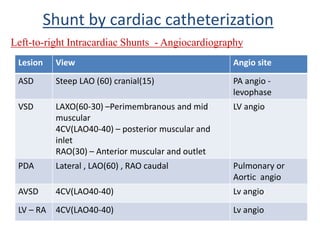
Lesion View Angio site
ASD Steep LAO (60) cranial(15) PA angio -
levophase
VSD LAXO(60-30) –Perimembranous and mid
muscular
4CV(LAO40-40) – posterior muscular and
inlet
RAO(30) – Anterior muscular and outlet
LV angio
PDA Lateral , LAO(60) , RAO caudal Pulmonary or
Aortic angio
AVSD 4CV(LAO40-40) Lv angio
LV – RA 4CV(LAO40-40) Lv angio
Left-to-right Intracardiac Shunts - Angiocardiography
Shunt by cardiac catheterization
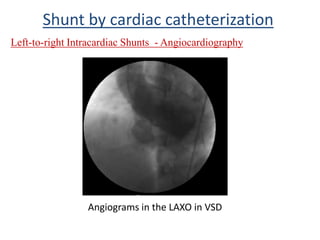
Angiograms in the LAXO in VSD
Left-to-right Intracardiac Shunts - Angiocardiography
Shunt by cardiac catheterization
Angiograms in the lateral position in patent ductus
arteriosus
Left-to-right Intracardiac Shunts - Angiocardiography
Shunt by cardiac catheterization
Angiograms in the LAO position in RSOV to RA
• Qualitative by oximetry and next Quantitative by flow ratio
• Quantification is done by Qp , Qs , Qp/Qs , Effevtive blood flow,
L-R shunt , R-L shunt .
• Qp and Qs are amount of blood flowing through pulmonary
and systemic vascular bed
• Qef is quantity of mixed venous blood that carries desaturated
blood from systemic capillaries to be oxygenated by lungs
• L-R and R-L shunt are amount of blood that bypass systemic
and pulmonary vascular bed .
Shunt by cardiac catheterization
Left-to-right Intracardiac Shunts - Flow ratio
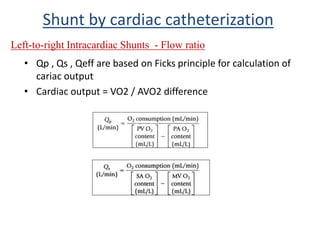
• Qp , Qs , Qeff are based on Ficks principle for calculation of
cariac output
• Cardiac output = VO2 / AVO2 difference
Shunt by cardiac catheterization
Left-to-right Intracardiac Shunts - Flow ratio
• Points of importance while calculation:
1. Oxygen consumption
2. Calculation of saturations
3. Oxygen content
Shunt by cardiac catheterization
Left-to-right Intracardiac Shunts - Flow ratio
Shunt by cardiac catheterization
Left-to-right Intracardiac Shunts - Flow ratio
• Oxygen consumption:
– Emperical formulas :
• VO2 = 125 * BSA
• For boys, VO2 = 138.1 - 11.49 In(age) + 0.378 (heart
rate).
• For girls, VO2 = 138.1 - 17.04 In(age) + 0.378 (heart rate).
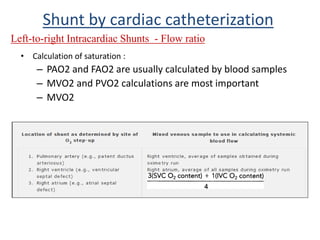
• Calculation of saturation :
– PAO2 and FAO2 are usually calculated by blood samples
– MVO2 and PVO2 calculations are most important
– MVO2
Shunt by cardiac catheterization
Left-to-right Intracardiac Shunts - Flow ratio
• MVO2 at atrium level
1. At rest = 3SVC + IVC / 4
Flamm's formula weights blood returning from the
superior vena cava more heavily than might be
expected on the basis of relative flows in the superior
and inferior cavae.
2. During bicycle ergometry = SVC + 2IVC / 3
3. Directly taking SVC saturation as MVO2
Shunt by cardiac catheterization
Left-to-right Intracardiac Shunts - Flow ratio
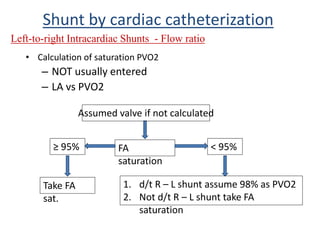
• Calculation of saturation PVO2
– NOT usually entered
– LA vs PVO2
Shunt by cardiac catheterization
Left-to-right Intracardiac Shunts - Flow ratio
Assumed valve if not calculated
FA
saturation
≥ 95% < 95%
Take FA
sat.
1. d/t R – L shunt assume 98% as PVO2
2. Not d/t R – L shunt take FA
saturation
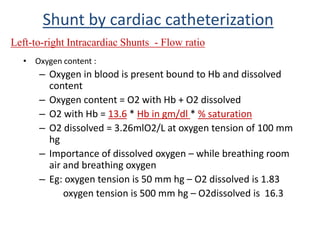
• Oxygen content :
– Oxygen in blood is present bound to Hb and dissolved
content
– Oxygen content = O2 with Hb + O2 dissolved
– O2 with Hb = 13.6 * Hb in gm/dl * % saturation
– O2 dissolved = 3.26mlO2/L at oxygen tension of 100 mm
hg
– Importance of dissolved oxygen – while breathing room
air and breathing oxygen
– Eg: oxygen tension is 50 mm hg – O2 dissolved is 1.83
oxygen tension is 500 mm hg – O2dissolved is 16.3
Shunt by cardiac catheterization
Left-to-right Intracardiac Shunts - Flow ratio
• Additional information that can be
obtained are
– Bidirectional shunt
– Double left to right shunt
Shunt by cardiac catheterization
Left-to-right Intracardiac Shunts - Flow ratio
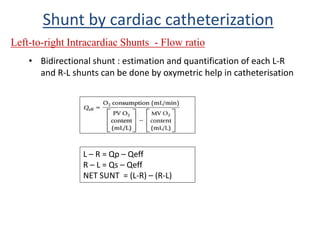
• Bidirectional shunt : estimation and quantification of each L-R
and R-L shunts can be done by oxymetric help in catheterisation
Shunt by cardiac catheterization
Left-to-right Intracardiac Shunts - Flow ratio
L – R = Qp – Qeff
R – L = Qs – Qeff
NET SUNT = (L-R) – (R-L)
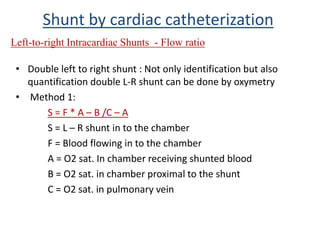
• Double left to right shunt : Not only identification but also
quantification double L-R shunt can be done by oxymetry
• Method 1:
S = F * A – B /C – A
S = L – R shunt in to the chamber
F = Blood flowing in to the chamber
A = O2 sat. In chamber receiving shunted blood
B = O2 sat. in chamber proximal to the shunt
C = O2 sat. in pulmonary vein
Shunt by cardiac catheterization
Left-to-right Intracardiac Shunts - Flow ratio
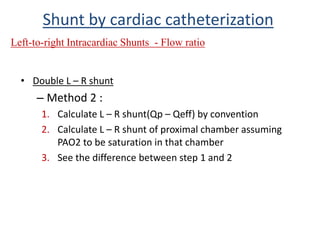
• Double L – R shunt
– Method 2 :
1. Calculate L – R shunt(Qp – Qeff) by convention
2. Calculate L – R shunt of proximal chamber assuming
PAO2 to be saturation in that chamber
3. See the difference between step 1 and 2
Shunt by cardiac catheterization
Left-to-right Intracardiac Shunts - Flow ratio
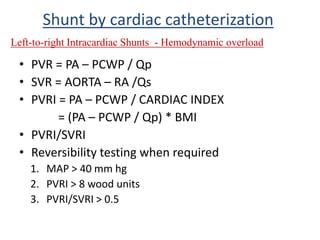
• PVR = PA – PCWP / Qp
• SVR = AORTA – RA /Qs
• PVRI = PA – PCWP / CARDIAC INDEX
= (PA – PCWP / Qp) * BMI
• PVRI/SVRI
• Reversibility testing when required
1. MAP > 40 mm hg
2. PVRI > 8 wood units
3. PVRI/SVRI > 0.5
Left-to-right Intracardiac Shunts - Hemodynamic overload
Shunt by cardiac catheterization
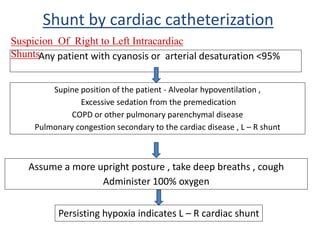
Any patient with cyanosis or arterial desaturation <95%
Shunt by cardiac catheterization
Suspicion Of Right to Left Intracardiac
Shunts
Supine position of the patient - Alveolar hypoventilation ,
Excessive sedation from the premedication
COPD or other pulmonary parenchymal disease
Pulmonary congestion secondary to the cardiac disease , L – R shunt
Assume a more upright posture , take deep breaths , cough
Administer 100% oxygen
Persisting hypoxia indicates L – R cardiac shunt
Shunt by cardiac catheterization
Detection Of Right to Left Intracardiac
Shunts
Various methods available in cahteterisation for R – L
1. Indicator dye dilution technique and other indicators
2. Angiography
3. Oximetry run
Catheterisation aims in R – L shunts are
1. Detection
2. localisation
3. magnitude of shunt
• The site of right-to-left shunts may be localized if blood
samples can be obtained from a PV , LA , LV , and Aorta
• The PV blood of patients with arterial hypoxemia caused by an
intracardiac right-to-left shunt is fully saturated with oxygen.
• The site of a right-to-left shunt may be localized by noting
which left heart chamber is the first to show desaturation
.(STEP DOWN).
• By calculation of Qeff quantification of total R – L can be
determined by Qs – Qeff
Shunt by cardiac catheterization
2. Left-to-right Intracardiac Shunts - Oximetry
Disadvantages of oxymetry in R – L shunt:
1. The main disadvantage of this technique is that a PV and the
LV must be entered. This is not as easy in adults as it is in
infants, in whom the LA is entered routinely by way of the
foramen ovale.
2. Quantification of desaturation that’s significant has not
been adequately determined like L – R shunt.
Shunt by cardiac catheterization
2. Left-to-right Intracardiac Shunts - Oximetry
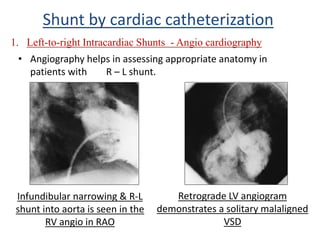
• Angiography helps in assessing appropriate anatomy in
patients with R – L shunt.
Shunt by cardiac catheterization
1. Left-to-right Intracardiac Shunts - Angio cardiography
Retrograde LV angiogram
demonstrates a solitary malaligned
VSD
Infundibular narrowing & R-L
shunt into aorta is seen in the
RV angio in RAO
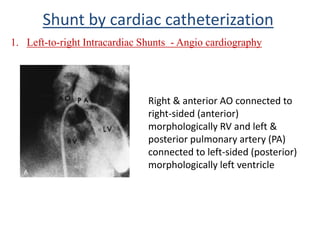
Right & anterior AO connected to
right-sided (anterior)
morphologically RV and left &
posterior pulmonary artery (PA)
connected to left-sided (posterior)
morphologically left ventricle
Shunt by cardiac catheterization
1. Left-to-right Intracardiac Shunts - Angio cardiography
Shunt by cardiac catheterization
1. Left-to-right Intracardiac Shunts - Angio cardiography
DORV with side-by-side great artery relationship and subaortic
subpulmonic and doubly commited VSD
PVR
• Vascular resistance is the resistance that must
be overcome to push blood through
the circulatory system and create flow.
• the resistance offered by the pulmonary
circulation is known as the pulmonary
vascular resistance (PVR)
• Units for measuring vascular resistance
are dyn·s·cm−5 or pascal seconds per cubic
metre (Pa·s/m³) or mmHg·min/l
• Pulmonary vascular resistance
20–130 dyn·s/cm5 or
2–13 MPa·s/m3 or
0.25–1.6 mmHg·min/l or Woods unit
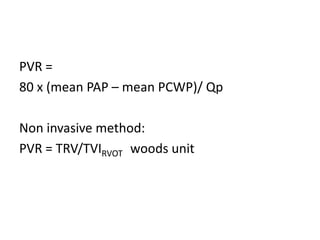
PVR =
80 x (mean PAP – mean PCWP)/ Qp
Non invasive method:
PVR = TRV/TVIRVOT woods unit

Ffr, raf, shunt calculation, pvr

  • 1.
  • 2.
    Introduction • Fractional flowreserve (FFR) measurement involves determining the ratio between the maximum achievable blood flow in a diseased coronary artery and the theoretical maximum flow in a normal coronary artery. An FFR of 1.0 is widely accepted as normal. An FFR lower than 0.75-0.80 is generally considered to be associated with myocardial ischemia (MI). • FFR is easily measured during routine coronary angiography by using a pressure wire to calculate the ratio between coronary pressure distal to a coronary artery stenosis and aortic pressure under conditions of maximum myocardial hyperemia.This ratio represents the potential decrease in coronary flow distal to the coronary stenosis
  • 3.
    The ability ofthe cardiologist to discriminate between lesions that can cause MI and lesions that are physiologically insignificant on the basis of coronary angiography alone is limited. The use of FFR measurement provides the cardiologist with a straightforward, readily available, quantitative technique for evaluating the physiologic significance of a coronary stenosis.
  • 4.
    Indication Indications for FFRmeasurement are as follows: • To determine the physiologic and hemodynamic significance of an angiographically intermediate coronary stenosis • To identify appropriate culprit lesion(s) in multivessel coronary artery disease (CAD) • To measure the functional importance of stenosis in the presence of distal collateral flow • To identify the precise location of a coronary lesion when the angiographic image is unclear N.B. this procedure is not intended for use in the setting of a total vessel occlusion.
  • 5.
    Equipment Manufacturer: Volcano Corporationand St Jude Medical, Inc. FFR equipment manufactured by Volcano : 1. ComboMap Pressure and Flow System - This is a combined system that displays both pressure and flow 2. ComboWire XT Guide Wire - This wire allows simultaneous measurement of intravascular pressure and Doppler flow and, thus, is capable of measuring stenotic and microvascular resistance
  • 7.
    Volcano equipment… 3. PrimeWireGuide Wire - This wire allows measurement of intravascular pressure 4. FloWire Doppler Guide Wire - This wire allows measurement of coronary arterial blood flow velocity and coronary flow reserve
  • 9.
    St. Jude equipment… RadiAnalyzerXpress - This combined system takes pressure, flow, and temperature measurements using 1 PressureWire and 1 instrument
  • 11.
    Technique • Typically, conscioussedation is administered as part of the cardiac catheterization • Wet the working length of the guide wire with normal saline, and insert the wire through the appropriate introducer components and guiding catheter into the desired blood vessel • Slowly advance the guide wire tip under fluoroscopic guidance, using contrast injections to verify its location • operator crosses the coronary stenosis with an FFR- specific guide wire designed to record the coronary arterial pressure distal to the stenosis.
  • 12.
    Technique cont’d… • Thepressure transducer is located approximately 20 mm proximal to the distal tip of the wire, and it can be seen fluoroscopically. • Once the transducer is distal to the stenosis, a hyperemic stimulus is administered by injection through the guide catheter, and the FFR is monitored for a significant change. • To achieve maximum hyperemia, adenosine is typically used: a 15-30 µg bolus in the right coronary artery, a 20-40 µg bolus in the left coronary artery, or intravenous (IV) infusion for 3-4 minutes at 140 µg/kg/min. • The mean arterial pressures from the pressure wire transducer and from the guide catheter are then used to calculate FFR.
  • 15.
    Cont’d… • An FFRvalue lower than 0.75 indicates a hemodynamically significant stenosis. An FFR value higher than 0.8 indicates a stenosis that is not hemodynamically significant. Values between 0.75 and 0.80 are indeterminate
  • 16.
    Risk or complication 1.Risks specific to the FFR procedure include the need for additional contrast use and radiation exposure, as well as a slightly increased risk of coronary arterial dissection with FFR wire passage 2. Risk of left heart catheterization
  • 17.
    Complications associated withcardiac catheterization include the following: • Coronary vessel dissection, occlusion, or perforation • Embolism (coronary, cerebral, or other arterial) • Coronary artery spasm • Local or systemic infection • Acute renal failure • Myocardial infarction • Stroke • Serious arrhythmias • Death
  • 18.
  • 19.
    Introduction RF energy, alow-voltage, high-frequency form of electrical energy similar to electrocautery used in surgery RF energy produces small, homogeneous, necrotic lesions by heating tissue. With typical power settings and good catheter contact pressure with cardiac tissue, lesions are minimally about 5-7 mm in diameter and 3-5 mm in depth.
  • 20.
    Indications Common indications: There arethree class I indications for catheter ablation 1. SVT due to AVNRT, WPW syndrome, unifocal atrial tachycardia, or atrial flutter (especially common right atrial forms). 2. AF with lifestyle-impairing symptoms and inefficacy or intolerance of at least one antiarrhythmic agent.
  • 21.
    Ind. Cont’d… 3. SymptomaticVT. Catheter ablation is first-line therapy in idiopathic VT if that is the patient’s preference. In structural heart disease, catheter ablation is generally performed for drug inefficacy or intolerance or as adjunctive therapy to patient with ICD.
  • 22.
    Cont’d… Uncommon indication: 1. Symptomaticdrug-refractory (inefficacy or intolerance) idiopathic sinus tachycardia 2. Lifestyle-impairing ectopic beats 3. Symptomatic junctional ectopic tachycardia
  • 23.
    Contraindications 1. Left atrialablation and ablation for persistent atrial flutter should not be performed in the presence of known atrial thrombus. 2. Mobile left ventricular thrombus would be a contraindication to left ventricular ablation. 3. Mechanical prosthetic heart valves are generally not crossed with ablation catheters. 4. Pregnant.
  • 24.
    Preprocedural planning Inv.: ECG Echocardiography ETT/LHC- in specific cases Cardiac medications with electrophysiologic effects (eg, beta blockers, calcium channel blockers, digoxin, and class I and III antiarrhythmic drugs) are often tapered or discontinued before the procedure. Warfarin may or may not be held prior to the procedure
  • 25.
  • 26.
  • 27.
    Technique • Typically, twoto five electrode catheters are percutaneously inserted via the femoral or internal jugular veins and are positioned within the left heart, the right heart, or both • Usually positions are high right atrium, Coronary sinus, RV apex, His bundle. • For left-heart catheterization, one of the following two approaches may be taken:  Transseptal catheterization via the interatrial septum  Retrograde catheterization across the aortic valve
  • 29.
    • Anticoagulation withintravenous (IV) heparin is used to reduce the risk of periprocedural thromboembolism. • Specific location to ablate for specific arrythmia
  • 30.
    AF: Target is4 pulmonary veins Electr- Anatomic map of post left atrium
  • 31.
    Atrial Flutter: Targetis Cavotricuspid isthmus
  • 32.
    AVNRT: Slow pathwayablation site
  • 33.
    VT: Right ventricularoutflow tract WPW syndrome: Target is accessory pathway
  • 34.
    Complications Major complications occurin approximately 3% thromboembolism in fewer than 1% and death in 0.1- 0.2% of all procedures Cardiac complications: • High-grade AV block • Cardiac tamponade (highest in AF ablation, up to 6%) • Coronary artery spasm/thrombosis • Pericarditis • Valve trauma N.B.: Radiation risk from catheter ablation is low, but it may exceed the risk from common radiologic procedures.
  • 35.
    Vascular complications, whichoccur in approximately 2-4% of procedures, include the following: • Retroperitoneal bleeding • Hematoma • Vascular injury • Transient ischemic attack/stroke • Hypotension • Thromboembolism or air embolism
  • 36.
    Pulmonary complications includethe following: • Pulmonary hypertension, with or without hemoptysis (secondary to pulmonary vein stenosis) • Pneumothorax
  • 37.
    Miscellaneous complications includethe following: • Left atrial–esophageal fistula • Acute pyloric spasm/gastric hypomotility • Phrenic nerve paralysis • Radiation- or electricity-induced skin damage • Infection at access site • Inappropriate sinus tachycardia • Proarrhythmia
  • 38.
    Assessment of shuntby cardiac catheterization
  • 39.
    Format of shuntcalculation
  • 40.
  • 41.
    Shunt by cardiaccatheterization Disease Present diagnostic catheterization indication ASD , VSD , PDA For pul. resistance and reversibility Of pulmonary HTN Complex pulmonary atresia Detailed characterization of lung segmental pulmonary vascular supply when noninvasive imaging methods incompletely define pulmonary artery anatomy PA with intact IVS Determination of coronary circulation Supravalvar AS useful to define relationship to CA origins TOF Anatomy when CAs, VSDs, Ao-PA collaterals cannot be sufficiently imaged otherwise Single ventricle Hemodynamics/PVR
  • 42.
    1. L –R shunt 2. R – L shunt Shunt by cardiac catheterization
  • 43.
    Shunt by cardiaccatheterization 1. Pulmonary artery [PA] blood oxygen saturation is >80%, the possibility of a left-to-right intracardiac shunt should be considered . When to suspect cardiac L – R shunt ? Plan of management by catheterisation: 1. Diagnosis 2. Quantification of shunt 3. Hemodynamic load
  • 44.
    1. Oximetry run 2.Flow ratio 3. Indicator dye dilution technique 4. Angiography 5. Pressure mearement Shunt by cardiac catheterization Left-to-right Intracardiac Shunts
  • 45.
    • In theoximetry run the oxygen content or % saturation is measured in PA,RV,RA,VC. • A left-to-right shunt may be detected and localized if a significant step-up in blood oxygen saturation or content is found in one of the right heart chambers • A significant step-up is defined as an increase in blood oxygen content or saturation that exceeds the normal variability that might be observed if multiple samples were drawn from that cardiac chamber. 1. Left-to-right Intracardiac Shunts - Oximetry run Shunt by cardiac catheterization
  • 46.
     Various methodsused for oximetry run are 1. Oxygen content 2. Oxygen saturation  Spectrophotometry  Oxygen dissociation curve  Oxygen content = O2 bound to Hb + dissolved O2  Dissolved O2 = 3.26 * PaO2 / 100.  Oxygen saturation = O2 bound to Hb / O2 capacity * 100  Oxygen capacity = Hb * 13.6 Shunt by cardiac catheterization 1. Left-to-right Intracardiac Shunts - Oximetry run
  • 47.
    • Oxygen content Thetechnique of the oximetry run is based on the pioneering studies of Dexter and his associates in 1947 Oxygen content was measured by Van Slyke technique , and other manometric studies Proposed step up at atrial , ventricular , pulmonary artery level are 2%, 1%, 0.5%. Disadvantages of oxygen content technique 15 – 30 min for obtaining a reading  Technically difficult to perform Dependency on Hb content Shunt by cardiac catheterization 1. Left-to-right Intracardiac Shunts - Oximetry run
  • 48.
    • Oxygen content Manometricto spectrophotometric method Spectrophotometric is technically easy and results are with 1 min Oxygen content is calculated by saturation by = O2 sat. * Hb % * 1.36 When oxygen content is derived in this manner, rather than by direct oximetric technique, the value is no more accurate (presence of carboxyhemoglobin or hemoglobin variants with O2 capacity other than 1.36). 1. Left-to-right Intracardiac Shunts - Oximetry run Shunt by cardiac catheterization
  • 49.
    • Oxygen saturation: O2 is determined by 1. O2 dissociation curve 2. Spectrophotometry 1. Left-to-right Intracardiac Shunts - Oximetry run Shunt by cardiac catheterization
  • 50.
    • O2 saturationby spectrophotometry : – Based on Beers law – Advantages : quick ,accurate, precise , subject to few errors , less dependency on Hb% . – Disadvantages : Inaccurate if large amounts of carboxy hemoglobin is present Indocyanin green interfere with light source of spectrphotometry Elevated bilirubin effect absorbtion of light 1. Left-to-right Intracardiac Shunts - Oximetry run Shunt by cardiac catheterization
  • 51.
    • O2 saturationby spectrophotometry : – Disadvantages : 1% error at 95% O2 saturation 2.5% error at 70% O2 saturation More accurate at 40-50% Low values O2 saturation is not at all reliable if necessary saturations below 50% can be determined by blood gas method 1. Left-to-right Intracardiac Shunts - Oximetry run Shunt by cardiac catheterization O2 saturation spectrophotometry is presently best method for oximetry
  • 52.
    Procedure of oximetryrun • 2-mL sample from each of the following locations. 1. Left and/or right pulmonary artery & Main pulmonary artery 2. Right ventricle, outflow tract, mid & tricuspid valve . 3. Right atrium, low or near tricuspid valve , mid & high . 4. Superior vena cava, low (near junction with right atrium). 5. Superior vena cava, high (near junction with innominate vein). 6. Inferior vena cava, high (just at or below diaphragm). 7. Inferior vena cava, low (at L4-L5). 8. Left ventricle. 9. Aorta (distal to insertion of ductus). 1. Left-to-right Intracardiac Shunts - Oximetry run Shunt by cardiac catheterization
  • 53.
    Procedure of oximetryrun • In performing the oximetry run, an end-hole catheter (e.g., Swan-Ganz balloon flotation catheter) or one with side holes close to its tip (e.g., a Goodale-Lubin catheter) can be used • The entire procedure should take less than 7 minutes. • If a sample cannot be obtained from a specific site because of ventricular premature beats, that site should be skipped until the rest of the run has been completed. 1. Left-to-right Intracardiac Shunts - Oximetry run Shunt by cardiac catheterization
  • 54.
    site Average Range SVC74% 67-83% IVC 78% 65-87% RA 75% 65-87% RV 75% 67-84% PA 75% 67-84% LA 95% 92-98% LV 95% 92-98% FA 95% 92-98% 1. Left-to-right Intracardiac Shunts - Oximetry run Shunt by cardiac catheterization • IVC variation • RA variation • SVC and IVC difference
  • 55.
    • Oxygen saturationabnormalities : – Right heart saturation 1. Elevated PA saturation – high cardiac output , L to R shunt 2. Low PA saturation – low cardiac out put , low systemic arterial saturation , increased oxygen extraction . – Left heart saturation 1. Elevated FA saturation – Pt.receiving O2 2. Low FA saturation – lung disease , pulmonary edema , R to L shunt 1. Left-to-right Intracardiac Shunts - Oximetry run Shunt by cardiac catheterization
  • 56.
    1. Left-to-right IntracardiacShunts - Oximetry run Shunt by cardiac catheterization
  • 57.
    Limitations of OximetryMethod 1. A primary source of error may be the absence of a steady state during the collection of blood samples. 1. Left-to-right Intracardiac Shunts - Oximetry run Shunt by cardiac catheterization Error source Problem solving Prolonged because of technical difficulties Start from PCW-PA-RV-RA-VC If the patient is agitated (children) Sedation If arrhythmias occur during the oximetry run Leave the site and go to next site
  • 58.
    Limitations of OximetryMethod 2. Antman and coworkers , oxygen saturation influenced by the magnitude of systemic blood flow. – High levels of systemic flow tend to equalize the arterial and venous and low levels increase difference. 1. Left-to-right Intracardiac Shunts - Oximetry run Shunt by cardiac catheterization
  • 59.
    Limitations of OximetryMethod 3. Antman and colleagues , the influence of blood hemoglobin concentration may be important when blood O2 content (rather than O2 saturation) is used to detect a shunt 1. Left-to-right Intracardiac Shunts - Oximetry run Shunt by cardiac catheterization
  • 60.
    Limitations of OximetryMethod 4. Lacks sensitivity in detecting intracardiac shunts , Small shunts, however, are not consistently detected by this technique. 5. Variations in pulmonary venous saturation – Lower portion of lung has lower O2 saturation – Children CHD – atelectasis – compress the bronchus – desaturation of corresponding bronchus 6. d/t the presence of physiological shunt – Thebesian veins and coronary veins entering LV (R- L) – Bronchial veins draining in to LA / PV (R- L) – Bronchial artery to pulmonary artery (L – R ) 1. Left-to-right Intracardiac Shunts - Oximetry run Shunt by cardiac catheterization
  • 61.
    7. Various CHDwhere it is virtually impossible to calculate systemic and pulmonary blood flow – In a patient with a large L-R shunt caused by arterial collaterals entering the distal pulmonary vascular bed , it is impossible to obtain a blood sample distal to the shunt Shunt by cardiac catheterization 1. Left-to-right Intracardiac Shunts - Oximetry run
  • 62.
    Shunt by cardiaccatheterization 1. Left-to-right Intracardiac Shunts - Oximetry run
  • 63.
    • Selective angiographyis effective in visualizing and localizing the site of left-to-right shunts • Angiographic demonstration of anatomy has become a routine part of the preoperative evaluation of patients with congenital or acquired shunts and is useful in localizing the anatomic site of the shunt Left-to-right Intracardiac Shunts - Angiocardiography Shunt by cardiac catheterization
  • 64.
    Left-to-right Intracardiac Shunts- Angiocardiography Shunt by cardiac catheterization Lesion View Angio site ASD Steep LAO (60) cranial(15) PA angio - levophase VSD LAXO(60-30) –Perimembranous and mid muscular 4CV(LAO40-40) – posterior muscular and inlet RAO(30) – Anterior muscular and outlet LV angio PDA Lateral , LAO(60) , RAO caudal Pulmonary or Aortic angio AVSD 4CV(LAO40-40) Lv angio LV – RA 4CV(LAO40-40) Lv angio
  • 65.
    Left-to-right Intracardiac Shunts- Angiocardiography Shunt by cardiac catheterization Angiograms in the LAXO in VSD
  • 66.
    Left-to-right Intracardiac Shunts- Angiocardiography Shunt by cardiac catheterization Angiograms in the lateral position in patent ductus arteriosus
  • 67.
    Left-to-right Intracardiac Shunts- Angiocardiography Shunt by cardiac catheterization Angiograms in the LAO position in RSOV to RA
  • 68.
    • Qualitative byoximetry and next Quantitative by flow ratio • Quantification is done by Qp , Qs , Qp/Qs , Effevtive blood flow, L-R shunt , R-L shunt . • Qp and Qs are amount of blood flowing through pulmonary and systemic vascular bed • Qef is quantity of mixed venous blood that carries desaturated blood from systemic capillaries to be oxygenated by lungs • L-R and R-L shunt are amount of blood that bypass systemic and pulmonary vascular bed . Shunt by cardiac catheterization Left-to-right Intracardiac Shunts - Flow ratio
  • 69.
    • Qp ,Qs , Qeff are based on Ficks principle for calculation of cariac output • Cardiac output = VO2 / AVO2 difference Shunt by cardiac catheterization Left-to-right Intracardiac Shunts - Flow ratio
  • 70.
    • Points ofimportance while calculation: 1. Oxygen consumption 2. Calculation of saturations 3. Oxygen content Shunt by cardiac catheterization Left-to-right Intracardiac Shunts - Flow ratio
  • 71.
    Shunt by cardiaccatheterization Left-to-right Intracardiac Shunts - Flow ratio • Oxygen consumption: – Emperical formulas : • VO2 = 125 * BSA • For boys, VO2 = 138.1 - 11.49 In(age) + 0.378 (heart rate). • For girls, VO2 = 138.1 - 17.04 In(age) + 0.378 (heart rate).
  • 72.
    • Calculation ofsaturation : – PAO2 and FAO2 are usually calculated by blood samples – MVO2 and PVO2 calculations are most important – MVO2 Shunt by cardiac catheterization Left-to-right Intracardiac Shunts - Flow ratio
  • 73.
    • MVO2 atatrium level 1. At rest = 3SVC + IVC / 4 Flamm's formula weights blood returning from the superior vena cava more heavily than might be expected on the basis of relative flows in the superior and inferior cavae. 2. During bicycle ergometry = SVC + 2IVC / 3 3. Directly taking SVC saturation as MVO2 Shunt by cardiac catheterization Left-to-right Intracardiac Shunts - Flow ratio
  • 74.
    • Calculation ofsaturation PVO2 – NOT usually entered – LA vs PVO2 Shunt by cardiac catheterization Left-to-right Intracardiac Shunts - Flow ratio Assumed valve if not calculated FA saturation ≥ 95% < 95% Take FA sat. 1. d/t R – L shunt assume 98% as PVO2 2. Not d/t R – L shunt take FA saturation
  • 75.
    • Oxygen content: – Oxygen in blood is present bound to Hb and dissolved content – Oxygen content = O2 with Hb + O2 dissolved – O2 with Hb = 13.6 * Hb in gm/dl * % saturation – O2 dissolved = 3.26mlO2/L at oxygen tension of 100 mm hg – Importance of dissolved oxygen – while breathing room air and breathing oxygen – Eg: oxygen tension is 50 mm hg – O2 dissolved is 1.83 oxygen tension is 500 mm hg – O2dissolved is 16.3 Shunt by cardiac catheterization Left-to-right Intracardiac Shunts - Flow ratio
  • 76.
    • Additional informationthat can be obtained are – Bidirectional shunt – Double left to right shunt Shunt by cardiac catheterization Left-to-right Intracardiac Shunts - Flow ratio
  • 77.
    • Bidirectional shunt: estimation and quantification of each L-R and R-L shunts can be done by oxymetric help in catheterisation Shunt by cardiac catheterization Left-to-right Intracardiac Shunts - Flow ratio L – R = Qp – Qeff R – L = Qs – Qeff NET SUNT = (L-R) – (R-L)
  • 78.
    • Double leftto right shunt : Not only identification but also quantification double L-R shunt can be done by oxymetry • Method 1: S = F * A – B /C – A S = L – R shunt in to the chamber F = Blood flowing in to the chamber A = O2 sat. In chamber receiving shunted blood B = O2 sat. in chamber proximal to the shunt C = O2 sat. in pulmonary vein Shunt by cardiac catheterization Left-to-right Intracardiac Shunts - Flow ratio
  • 79.
    • Double L– R shunt – Method 2 : 1. Calculate L – R shunt(Qp – Qeff) by convention 2. Calculate L – R shunt of proximal chamber assuming PAO2 to be saturation in that chamber 3. See the difference between step 1 and 2 Shunt by cardiac catheterization Left-to-right Intracardiac Shunts - Flow ratio
  • 80.
    • PVR =PA – PCWP / Qp • SVR = AORTA – RA /Qs • PVRI = PA – PCWP / CARDIAC INDEX = (PA – PCWP / Qp) * BMI • PVRI/SVRI • Reversibility testing when required 1. MAP > 40 mm hg 2. PVRI > 8 wood units 3. PVRI/SVRI > 0.5 Left-to-right Intracardiac Shunts - Hemodynamic overload Shunt by cardiac catheterization
  • 81.
    Any patient withcyanosis or arterial desaturation <95% Shunt by cardiac catheterization Suspicion Of Right to Left Intracardiac Shunts Supine position of the patient - Alveolar hypoventilation , Excessive sedation from the premedication COPD or other pulmonary parenchymal disease Pulmonary congestion secondary to the cardiac disease , L – R shunt Assume a more upright posture , take deep breaths , cough Administer 100% oxygen Persisting hypoxia indicates L – R cardiac shunt
  • 82.
    Shunt by cardiaccatheterization Detection Of Right to Left Intracardiac Shunts Various methods available in cahteterisation for R – L 1. Indicator dye dilution technique and other indicators 2. Angiography 3. Oximetry run Catheterisation aims in R – L shunts are 1. Detection 2. localisation 3. magnitude of shunt
  • 83.
    • The siteof right-to-left shunts may be localized if blood samples can be obtained from a PV , LA , LV , and Aorta • The PV blood of patients with arterial hypoxemia caused by an intracardiac right-to-left shunt is fully saturated with oxygen. • The site of a right-to-left shunt may be localized by noting which left heart chamber is the first to show desaturation .(STEP DOWN). • By calculation of Qeff quantification of total R – L can be determined by Qs – Qeff Shunt by cardiac catheterization 2. Left-to-right Intracardiac Shunts - Oximetry
  • 84.
    Disadvantages of oxymetryin R – L shunt: 1. The main disadvantage of this technique is that a PV and the LV must be entered. This is not as easy in adults as it is in infants, in whom the LA is entered routinely by way of the foramen ovale. 2. Quantification of desaturation that’s significant has not been adequately determined like L – R shunt. Shunt by cardiac catheterization 2. Left-to-right Intracardiac Shunts - Oximetry
  • 85.
    • Angiography helpsin assessing appropriate anatomy in patients with R – L shunt. Shunt by cardiac catheterization 1. Left-to-right Intracardiac Shunts - Angio cardiography Retrograde LV angiogram demonstrates a solitary malaligned VSD Infundibular narrowing & R-L shunt into aorta is seen in the RV angio in RAO
  • 86.
    Right & anteriorAO connected to right-sided (anterior) morphologically RV and left & posterior pulmonary artery (PA) connected to left-sided (posterior) morphologically left ventricle Shunt by cardiac catheterization 1. Left-to-right Intracardiac Shunts - Angio cardiography
  • 87.
    Shunt by cardiaccatheterization 1. Left-to-right Intracardiac Shunts - Angio cardiography DORV with side-by-side great artery relationship and subaortic subpulmonic and doubly commited VSD
  • 88.
    PVR • Vascular resistanceis the resistance that must be overcome to push blood through the circulatory system and create flow. • the resistance offered by the pulmonary circulation is known as the pulmonary vascular resistance (PVR) • Units for measuring vascular resistance are dyn·s·cm−5 or pascal seconds per cubic metre (Pa·s/m³) or mmHg·min/l
  • 89.
    • Pulmonary vascularresistance 20–130 dyn·s/cm5 or 2–13 MPa·s/m3 or 0.25–1.6 mmHg·min/l or Woods unit
  • 90.
    PVR = 80 x(mean PAP – mean PCWP)/ Qp Non invasive method: PVR = TRV/TVIRVOT woods unit