- VIKRAM SINGH RAJAWAT
- MSC(M), MSC(N), MBA
- JNU HOSPITAL
Cardiac Catheters
2
 In 1929 Werner Forssmann
demonstrated that a simple
Rubber catheter could be passed to
the pulmonary artery through the
antecubital Vein and
An angiographic film could be
obtained using radiographic
contrast.
 Introduction :-
 An invasive diagnostic procedure in which
one or more catheters are introduced into
heart and selected blood vessels to measure
pressure and to determine oxygen saturation
in the various heart chambers. The procedure
is carried out in the cardiac catheterization
lab.
CARDIAC CATHETERS
3
4
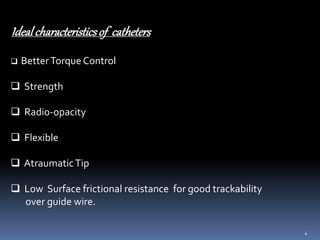
Idealcharacteristicsof catheters
 BetterTorque Control
 Strength
 Radio-opacity
 Flexible
 AtraumaticTip
 Low Surface frictional resistance for good trackability
over guide wire.
5
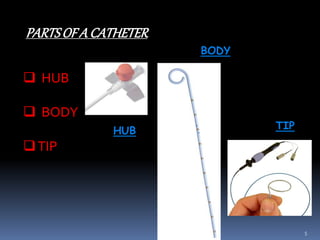
PARTSOF A CATHETER
 HUB
 BODY
TIP
HUB
BODY
TIP
6
FRENCHCATHETERSCALE:
The French catheter scale is commonly used to measure the outer
diameter of cylindrical medical instruments including catheters,
needles etc.
D(mm) = Fr/3 or Fr = D(mm)*3
MEASUREMENT:
 Most commonly in adult DiagnosticCatheters of 5 – 7 Fr is used.
7
 Thick walled- Accentuates pressure
waveform-systolic overshoot & diastolic dips.
 Thin walled _ Improves monitoring, blood
sampling & flushing abilities, decrease
thrombogenicity.
 Disadvantage – less torque control, not
suitable high pressure injection.
SIZE – wall thickness
8
9
Whatis a Catheter made up of ?
Materials:
A range of polymers are used for the construction of
catheters, including silicone rubber latex and
thermoplastic elastomers.
Silicone is one of the most common choices because it is
inert and unreactive to body fluids and a range of medical
fluids with which it might come into contact.
Materials:
CATHETER:
Polyvinylchloride (PVC)
Polyethylene (PE)
Fluoropolymers (PTFE) (TEFLON)
Polyurethane (PUR)
Silicone (SI)
 Very maneuverable & flexible.
 Covered by polyurethane coating – reduce
vascular trauma.
 Nylon core-increase bursting pressure
 Nylon – great mechanical & physical
strength, reduced friction coefficient.
 Eg- USCI Cournand, birds eye, eppendorf &
sones.
DACRON
10
 Stiffness inbetween polyurethane &Teflon.
 Selective injection.
 More thrombogenic than PVC, polyurethane,
silicone catheters.
 Stainless steel mesh braid improves
rotational control & increase bursting
pressure.
 Eg – pigtail angiographic catheters (cook),
judkins catheters, NIH & cournand.
POLYETHYLENE
11
 Excellent memory – Superselective injection.
 Softer than polyethylene orTeflon.
 Increased thrombogenicity
 Reshaped if immersed in boling water.
 Eg – pigtail angiographic (cordis) catheters &
original judkins catheters.
POLYURETHANE
12
 Stiffest.
 Low friction coefficient.
 Eg – Brockenbrough catheters, transducer-tip
catheters & introducer sheaths.
TEFLON
13
 Softest & flexible.
 High friction coefficient- venous spasm.
 Increased thrombogenicity.
 Very poor tensile strength ( memory)
 Cant be reformed.
 Most hydrophilic.
 Drugs absorbed- NTG, insulin,
diazepam,thiopentone.
 Eg- Balloon-tip flow directed catheters.
POLYVINYL CHLORIDE
14
CHARACTERISTIC TEFLON POLYETHYLENE POLYURETHANE PVC
FRICTION
COEFFICIENT
0.04 0.21 1.35 2.0
STIFFNESS +4 +3 +2 +1
MEMORY Good Excellent Excellent Fair
MOISTURE
ABSORPTION (%
24 HRS)
0 0.015 0.9 0.75
15
 TIP: Neither blunt nor too sharp, soft &
flexible.
 Bullet nose tip- least trauma,Though too
taper increased tip penetration.
 HUB: Metal or plastic, larger than catheter,
tapered hubs – easier insertion of guidewire.
TIP & HUB
16
 Rt heart catheters- 100 to 125cm.
 Lt heart catheters- 100 to 110cm.
 125cm for very tall person.
LENGTH
17
 Cournand
 Lehman
 Goodale–lubin
 Balloon floatation catheters
General purpose – RIGHT heart
catheters
18
 Gensini
 NIH
 Eppendorf
 Lehman ventriculography
 Pigtail angiographic catheter
 Flow directed angiographic catheter
ANGIOGRAPHIC CATHETERS
19
 Judkins
 Amplatz
 Schoonmaker multipurpose catheter
 Coronary bypass catheter
 Sones
 Castillo
PREFORMED CORONARY CATHETERS
20
 Shirey transvascular catheter
 Brockenbrough transeptal catheter
 Double lumen catheter
 Multilumen catheter
 Fogarty catheter
 Transducer-tip catheter
 Angioscopic catheter
 Pacing catheter.
SPECIALISED CATHETERS
21
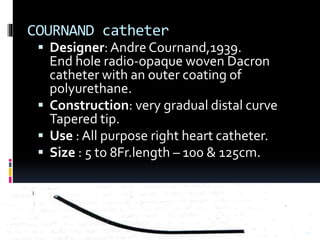
COURNAND catheter
 Designer: Andre Cournand,1939.
End hole radio-opaque woven Dacron
catheter with an outer coating of
polyurethane.
 Construction: very gradual distal curve
Tapered tip.
 Use : All purpose right heart catheter.
 Size : 5 to 8Fr.length – 100 & 125cm.
22
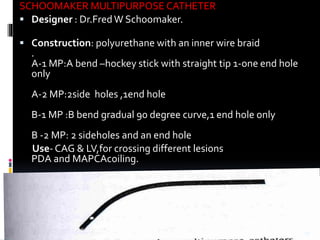
SCHOOMAKER MULTIPURPOSE CATHETER
 Designer : Dr.FredW Schoomaker.
 Construction: polyurethane with an inner wire braid
.
A-1 MP:A bend –hockey stick with straight tip 1-one end hole
only
A-2 MP:2side holes ,1end hole
B-1 MP :B bend gradual 90 degree curve,1 end hole only
B -2 MP: 2 sideholes and an end hole
Use- CAG & LV,for crossing different lesions
PDA and MAPCAcoiling.
 Size : 7 & 8 Fr. length –100cm.
23
NIH catheter

Construction: USCI version- woven dacron with a nylon
core.Injection at high flow rates
6 sideholes
COOK – polyethylene with a stainless steel braid, 4 to 6
sideholes.
Hole : No end hole , only sidehole catheter with a gentle
curve.[excellent mixing of contrast ]
 Use : visualizing RV.LV,arterial,pulmonary vasculature &
great veins.
 Size :USCI 5 to 8Fr.length –50, 80,100 cms
125cm.
 COOK:6.5,7.3 & 8.2Fr, all 100cm.
 Disadvantage : perforation
24
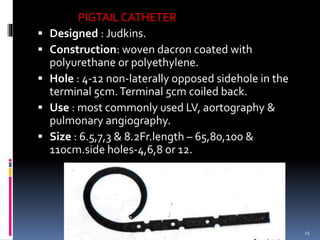
PIGTAIL CATHETER
 Designed : Judkins.
 Construction: woven dacron coated with
polyurethane or polyethylene.
 Hole : 4-12 non-laterally opposed sidehole in the
terminal 5cm.Terminal 5cm coiled back.
 Use : most commonly used LV, aortography &
pulmonary angiography.
 Size : 6.5,7,3 & 8.2Fr.length – 65,80,100 &
110cm.side holes-4,6,8 or 12.
25
 Advantage : least traumatic, less
incidence of arrythmia,catheter recoil,
intramyocardial injection & cardiac
perforation.
 Disadvantage :Thrombogenicity, & not
for prolonged haemodynamic monitoring.
Pigtail catheter
26
 Construction: polyurethane with stainless
steel braid.
 Hole : 8 nonlaterally opposed sidehole near
the endhole.
 Use. most commonly used LV, aortography &
pulmonary angiography
 Size : 7 & 8Fr. length – 110cm.
Positrol II pigtail catheter
27
 Construction: polyurethane over a thin nylon
core.
 Hole : 8 nonlaterally opposed sidehole near
the endhole.
 Use: LV, aortography.
 Size : 7 & 8Fr. length – 65,80 & 110cm.
 Advantage : flow rate equal to one Fr > than
designated.
Nycore high-flow pigtail
catheter
28
 Construction: polyurethane with a stainless
steel braid except in tip.
 Hole : 12 nonlaterally opposed sidehole near
the endhole.
 Use: LV, aortography.
 Size : 5,7 & 8Fr. length – 65,90 & 110cm.
 Advantage : can withstand upto 1000psi.
Ducor high-flow femoral-
ventricular Pigtail catheter
29
PIG TAIL ANGIOGRAPHIC
 12 Side holes
evenly disperses contrast in LV
QUANTICOR [Cardiomarker pig tail]
Radiopaque markers set 2 cm apart
Used for quantitative angiography
30
31
Grollman pigtail catheter
 Construction: polyethylene with for spiraled
side ports near tip.
 Hole : 12 nonlaterally opposed sidehole near
the endhole. 60 degree bend.
 Use: RV & selective PA angiography.
 Size : 5,7 & 8Fr. length – 65,90 & 110cm.
32
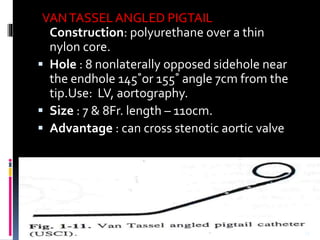
VANTASSELANGLED PIGTAIL
Construction: polyurethane over a thin
nylon core.
 Hole : 8 nonlaterally opposed sidehole near
the endhole 145˚or 155˚ angle 7cm from the
tip.Use: LV, aortography.
 Size : 7 & 8Fr. length – 110cm.
 Advantage : can cross stenotic aortic valve
33
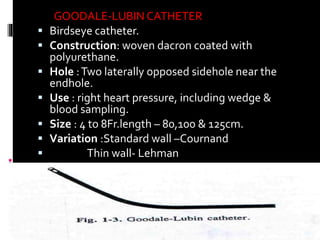
GOODALE-LUBIN CATHETER
 Birdseye catheter.
 Construction: woven dacron coated with
polyurethane.
 Hole :Two laterally opposed sidehole near the
endhole.
 Use : right heart pressure, including wedge &
blood sampling.
 Size : 4 to 8Fr.length – 80,100 & 125cm.
 Variation :Standard wall –Cournand
 Thin wall- Lehman
34
LEHMAN CATHETER;
 Thin wall variation of cournand.
 Shorter distal curve, increased inner
diameter & decreased stiffness.
 size-4 to 9Fr.length-50,80,100 &125cm.
35
GENSINI catheter
 Construction: woven dacron coated with
polyurethane.
 Hole :Three laterally opposed oval sidehole
within 1.5cm of its open tip.
 Use : right or left heart, pulmonary & vena
cava angiographic studies.
 Size : 5 to 8Fr.length – 80,100 & 125cm.
 Disadvantage: More arrythmogenic
36
EPPENDORF catheter

Construction: woven dacron coated with polyurethane area
20cm proximal to hub is reinforced with nylon
 Hole : closed-end, six laterally opposed sidehole catheter
with a gentle curve.
 Use : visualizing RV.LV,arterial,pulmonary vasculature &
great veins.
 Size : 7 to 8Fr.length –100 & 125cm.
 Feature: less stiff, & more torque control.
37
GUIDEWIRES
 Three components
Central core that tapers distally.
 Flexible tip
 Lubricious coating.
38
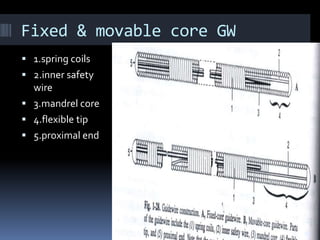
Fixed & movable core GW
 1.spring coils
 2.inner safety
wire
 3.mandrel core
 4.flexible tip
 5.proximal end
39
Guidewire
 First available standard guidewire -0.018’
contains 2 to 3cm,safety wire in the tip
 Safetywire is replaced by a ribbon
 steerability,trackability,torquability,kink
resistence, frictional resistance.
 Standard length- 175 to 190cm- usually 20cm
longer than the catheter.
 For exchange wire-300cm.
 Thickness – 0.035 inch (0.9mm).
40
CORE
 single or multiple segment.
 Provides tensile strength, torque strength,
torque transmission & blood compatibility.
 Commonly composed of stainless steel.
 Nitinol – increased tractability.
 Disadvantage- tends to store rather
than transmit torque- wireWINDING UP.
 Commonly used “workhorse wire” have
moderate flexibility & support.
41
Distal tip
 Platinum or tungsten alloy.
 Radiopacity ,flexibilty & blood compatibility.
 Radiopacity -2 to 3cm. Rarely 11 to 40cm.
 High radiopacity is a feature of more
aggressive wire,
 Tip load- Amount of force required to deflect
the tip into a predetermined configuration.
Exp-gms of force.
42
Coating
 - silicone, teflon, polytetrafluoroethylene,
hydrophilic polymer.
 Hydrophilic wire- crosses severe stenosis &
total occlusion,
43
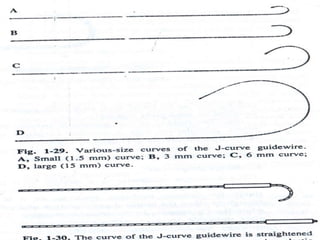
J-curve guidewire
44
46
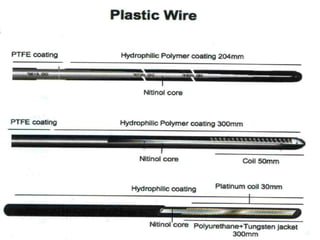
Spring tip wire & Plastic
wire
 Spring wire:A) stainless steel tip
 B) Nitinol tip jointed to stainless steel shaft
 Steerability helps
 Plastic wire: Little resistence, torquability
lost , useful for severe stenosis with heavy
calcification.
47
48
Thanks
49

Cardiac catheters

  • 1.
    - VIKRAM SINGHRAJAWAT - MSC(M), MSC(N), MBA - JNU HOSPITAL Cardiac Catheters
  • 2.
    2  In 1929Werner Forssmann demonstrated that a simple Rubber catheter could be passed to the pulmonary artery through the antecubital Vein and An angiographic film could be obtained using radiographic contrast.
  • 3.
     Introduction :- An invasive diagnostic procedure in which one or more catheters are introduced into heart and selected blood vessels to measure pressure and to determine oxygen saturation in the various heart chambers. The procedure is carried out in the cardiac catheterization lab. CARDIAC CATHETERS 3
  • 4.
    4 Idealcharacteristicsof catheters  BetterTorqueControl  Strength  Radio-opacity  Flexible  AtraumaticTip  Low Surface frictional resistance for good trackability over guide wire.
  • 5.
    5 PARTSOF A CATHETER HUB  BODY TIP HUB BODY TIP
  • 6.
    6 FRENCHCATHETERSCALE: The French catheterscale is commonly used to measure the outer diameter of cylindrical medical instruments including catheters, needles etc. D(mm) = Fr/3 or Fr = D(mm)*3 MEASUREMENT:  Most commonly in adult DiagnosticCatheters of 5 – 7 Fr is used.
  • 7.
  • 8.
     Thick walled-Accentuates pressure waveform-systolic overshoot & diastolic dips.  Thin walled _ Improves monitoring, blood sampling & flushing abilities, decrease thrombogenicity.  Disadvantage – less torque control, not suitable high pressure injection. SIZE – wall thickness 8
  • 9.
    9 Whatis a Cathetermade up of ? Materials: A range of polymers are used for the construction of catheters, including silicone rubber latex and thermoplastic elastomers. Silicone is one of the most common choices because it is inert and unreactive to body fluids and a range of medical fluids with which it might come into contact. Materials: CATHETER: Polyvinylchloride (PVC) Polyethylene (PE) Fluoropolymers (PTFE) (TEFLON) Polyurethane (PUR) Silicone (SI)
  • 10.
     Very maneuverable& flexible.  Covered by polyurethane coating – reduce vascular trauma.  Nylon core-increase bursting pressure  Nylon – great mechanical & physical strength, reduced friction coefficient.  Eg- USCI Cournand, birds eye, eppendorf & sones. DACRON 10
  • 11.
     Stiffness inbetweenpolyurethane &Teflon.  Selective injection.  More thrombogenic than PVC, polyurethane, silicone catheters.  Stainless steel mesh braid improves rotational control & increase bursting pressure.  Eg – pigtail angiographic catheters (cook), judkins catheters, NIH & cournand. POLYETHYLENE 11
  • 12.
     Excellent memory– Superselective injection.  Softer than polyethylene orTeflon.  Increased thrombogenicity  Reshaped if immersed in boling water.  Eg – pigtail angiographic (cordis) catheters & original judkins catheters. POLYURETHANE 12
  • 13.
     Stiffest.  Lowfriction coefficient.  Eg – Brockenbrough catheters, transducer-tip catheters & introducer sheaths. TEFLON 13
  • 14.
     Softest &flexible.  High friction coefficient- venous spasm.  Increased thrombogenicity.  Very poor tensile strength ( memory)  Cant be reformed.  Most hydrophilic.  Drugs absorbed- NTG, insulin, diazepam,thiopentone.  Eg- Balloon-tip flow directed catheters. POLYVINYL CHLORIDE 14
  • 15.
    CHARACTERISTIC TEFLON POLYETHYLENEPOLYURETHANE PVC FRICTION COEFFICIENT 0.04 0.21 1.35 2.0 STIFFNESS +4 +3 +2 +1 MEMORY Good Excellent Excellent Fair MOISTURE ABSORPTION (% 24 HRS) 0 0.015 0.9 0.75 15
  • 16.
     TIP: Neitherblunt nor too sharp, soft & flexible.  Bullet nose tip- least trauma,Though too taper increased tip penetration.  HUB: Metal or plastic, larger than catheter, tapered hubs – easier insertion of guidewire. TIP & HUB 16
  • 17.
     Rt heartcatheters- 100 to 125cm.  Lt heart catheters- 100 to 110cm.  125cm for very tall person. LENGTH 17
  • 18.
     Cournand  Lehman Goodale–lubin  Balloon floatation catheters General purpose – RIGHT heart catheters 18
  • 19.
     Gensini  NIH Eppendorf  Lehman ventriculography  Pigtail angiographic catheter  Flow directed angiographic catheter ANGIOGRAPHIC CATHETERS 19
  • 20.
     Judkins  Amplatz Schoonmaker multipurpose catheter  Coronary bypass catheter  Sones  Castillo PREFORMED CORONARY CATHETERS 20
  • 21.
     Shirey transvascularcatheter  Brockenbrough transeptal catheter  Double lumen catheter  Multilumen catheter  Fogarty catheter  Transducer-tip catheter  Angioscopic catheter  Pacing catheter. SPECIALISED CATHETERS 21
  • 22.
    COURNAND catheter  Designer:Andre Cournand,1939. End hole radio-opaque woven Dacron catheter with an outer coating of polyurethane.  Construction: very gradual distal curve Tapered tip.  Use : All purpose right heart catheter.  Size : 5 to 8Fr.length – 100 & 125cm. 22
  • 23.
    SCHOOMAKER MULTIPURPOSE CATHETER Designer : Dr.FredW Schoomaker.  Construction: polyurethane with an inner wire braid . A-1 MP:A bend –hockey stick with straight tip 1-one end hole only A-2 MP:2side holes ,1end hole B-1 MP :B bend gradual 90 degree curve,1 end hole only B -2 MP: 2 sideholes and an end hole Use- CAG & LV,for crossing different lesions PDA and MAPCAcoiling.  Size : 7 & 8 Fr. length –100cm. 23
  • 24.
    NIH catheter  Construction: USCIversion- woven dacron with a nylon core.Injection at high flow rates 6 sideholes COOK – polyethylene with a stainless steel braid, 4 to 6 sideholes. Hole : No end hole , only sidehole catheter with a gentle curve.[excellent mixing of contrast ]  Use : visualizing RV.LV,arterial,pulmonary vasculature & great veins.  Size :USCI 5 to 8Fr.length –50, 80,100 cms 125cm.  COOK:6.5,7.3 & 8.2Fr, all 100cm.  Disadvantage : perforation 24
  • 25.
    PIGTAIL CATHETER  Designed: Judkins.  Construction: woven dacron coated with polyurethane or polyethylene.  Hole : 4-12 non-laterally opposed sidehole in the terminal 5cm.Terminal 5cm coiled back.  Use : most commonly used LV, aortography & pulmonary angiography.  Size : 6.5,7,3 & 8.2Fr.length – 65,80,100 & 110cm.side holes-4,6,8 or 12. 25
  • 26.
     Advantage :least traumatic, less incidence of arrythmia,catheter recoil, intramyocardial injection & cardiac perforation.  Disadvantage :Thrombogenicity, & not for prolonged haemodynamic monitoring. Pigtail catheter 26
  • 27.
     Construction: polyurethanewith stainless steel braid.  Hole : 8 nonlaterally opposed sidehole near the endhole.  Use. most commonly used LV, aortography & pulmonary angiography  Size : 7 & 8Fr. length – 110cm. Positrol II pigtail catheter 27
  • 28.
     Construction: polyurethaneover a thin nylon core.  Hole : 8 nonlaterally opposed sidehole near the endhole.  Use: LV, aortography.  Size : 7 & 8Fr. length – 65,80 & 110cm.  Advantage : flow rate equal to one Fr > than designated. Nycore high-flow pigtail catheter 28
  • 29.
     Construction: polyurethanewith a stainless steel braid except in tip.  Hole : 12 nonlaterally opposed sidehole near the endhole.  Use: LV, aortography.  Size : 5,7 & 8Fr. length – 65,90 & 110cm.  Advantage : can withstand upto 1000psi. Ducor high-flow femoral- ventricular Pigtail catheter 29
  • 30.
    PIG TAIL ANGIOGRAPHIC 12 Side holes evenly disperses contrast in LV QUANTICOR [Cardiomarker pig tail] Radiopaque markers set 2 cm apart Used for quantitative angiography 30
  • 31.
  • 32.
    Grollman pigtail catheter Construction: polyethylene with for spiraled side ports near tip.  Hole : 12 nonlaterally opposed sidehole near the endhole. 60 degree bend.  Use: RV & selective PA angiography.  Size : 5,7 & 8Fr. length – 65,90 & 110cm. 32
  • 33.
    VANTASSELANGLED PIGTAIL Construction: polyurethaneover a thin nylon core.  Hole : 8 nonlaterally opposed sidehole near the endhole 145˚or 155˚ angle 7cm from the tip.Use: LV, aortography.  Size : 7 & 8Fr. length – 110cm.  Advantage : can cross stenotic aortic valve 33
  • 34.
    GOODALE-LUBIN CATHETER  Birdseyecatheter.  Construction: woven dacron coated with polyurethane.  Hole :Two laterally opposed sidehole near the endhole.  Use : right heart pressure, including wedge & blood sampling.  Size : 4 to 8Fr.length – 80,100 & 125cm.  Variation :Standard wall –Cournand  Thin wall- Lehman 34
  • 35.
    LEHMAN CATHETER;  Thinwall variation of cournand.  Shorter distal curve, increased inner diameter & decreased stiffness.  size-4 to 9Fr.length-50,80,100 &125cm. 35
  • 36.
    GENSINI catheter  Construction:woven dacron coated with polyurethane.  Hole :Three laterally opposed oval sidehole within 1.5cm of its open tip.  Use : right or left heart, pulmonary & vena cava angiographic studies.  Size : 5 to 8Fr.length – 80,100 & 125cm.  Disadvantage: More arrythmogenic 36
  • 37.
    EPPENDORF catheter  Construction: wovendacron coated with polyurethane area 20cm proximal to hub is reinforced with nylon  Hole : closed-end, six laterally opposed sidehole catheter with a gentle curve.  Use : visualizing RV.LV,arterial,pulmonary vasculature & great veins.  Size : 7 to 8Fr.length –100 & 125cm.  Feature: less stiff, & more torque control. 37
  • 38.
    GUIDEWIRES  Three components Centralcore that tapers distally.  Flexible tip  Lubricious coating. 38
  • 39.
    Fixed & movablecore GW  1.spring coils  2.inner safety wire  3.mandrel core  4.flexible tip  5.proximal end 39
  • 40.
    Guidewire  First availablestandard guidewire -0.018’ contains 2 to 3cm,safety wire in the tip  Safetywire is replaced by a ribbon  steerability,trackability,torquability,kink resistence, frictional resistance.  Standard length- 175 to 190cm- usually 20cm longer than the catheter.  For exchange wire-300cm.  Thickness – 0.035 inch (0.9mm). 40
  • 41.
    CORE  single ormultiple segment.  Provides tensile strength, torque strength, torque transmission & blood compatibility.  Commonly composed of stainless steel.  Nitinol – increased tractability.  Disadvantage- tends to store rather than transmit torque- wireWINDING UP.  Commonly used “workhorse wire” have moderate flexibility & support. 41
  • 42.
    Distal tip  Platinumor tungsten alloy.  Radiopacity ,flexibilty & blood compatibility.  Radiopacity -2 to 3cm. Rarely 11 to 40cm.  High radiopacity is a feature of more aggressive wire,  Tip load- Amount of force required to deflect the tip into a predetermined configuration. Exp-gms of force. 42
  • 43.
    Coating  - silicone,teflon, polytetrafluoroethylene, hydrophilic polymer.  Hydrophilic wire- crosses severe stenosis & total occlusion, 43
  • 44.
  • 45.
  • 46.
    Spring tip wire& Plastic wire  Spring wire:A) stainless steel tip  B) Nitinol tip jointed to stainless steel shaft  Steerability helps  Plastic wire: Little resistence, torquability lost , useful for severe stenosis with heavy calcification. 47
  • 47.
  • 48.