WELCOME
Percutaneous Transvenous
Mitral Commissurotomy (PTMC)
Dr. Md. Ahasanul Kabir
Phase B Resident
UCC, BSMMU
Chairperson:
Assoc. Prof. Dr. Tanjima Parveen
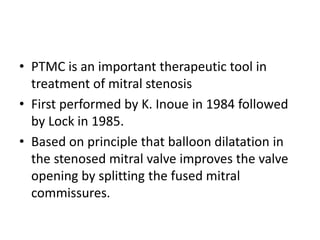
• PTMC is an important therapeutic tool in
treatment of mitral stenosis
• First performed by K. Inoue in 1984 followed
by Lock in 1985.
• Based on principle that balloon dilatation in
the stenosed mitral valve improves the valve
opening by splitting the fused mitral
commissures.
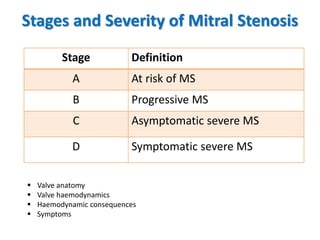
Stages and Severity of Mitral Stenosis
Stage Definition
A At risk of MS
B Progressive MS
C Asymptomatic severe MS
D Symptomatic severe MS
 Valve anatomy
 Valve haemodynamics
 Haemodynamic consequences
 Symptoms
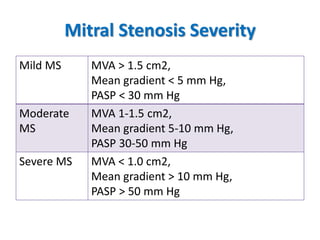
Mitral Stenosis Severity
Mild MS MVA > 1.5 cm2,
Mean gradient < 5 mm Hg,
PASP < 30 mm Hg
Moderate
MS
MVA 1-1.5 cm2,
Mean gradient 5-10 mm Hg,
PASP 30-50 mm Hg
Severe MS MVA < 1.0 cm2,
Mean gradient > 10 mm Hg,
PASP > 50 mm Hg
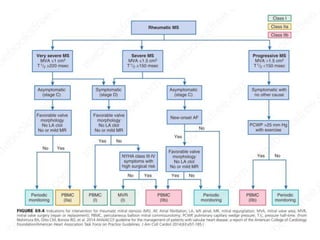
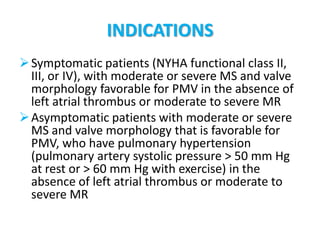
INDICATIONS
Symptomatic patients (NYHA functional class II,
III, or IV), with moderate or severe MS and valve
morphology favorable for PMV in the absence of
left atrial thrombus or moderate to severe MR
Asymptomatic patients with moderate or severe
MS and valve morphology that is favorable for
PMV, who have pulmonary hypertension
(pulmonary artery systolic pressure > 50 mm Hg
at rest or > 60 mm Hg with exercise) in the
absence of left atrial thrombus or moderate to
severe MR
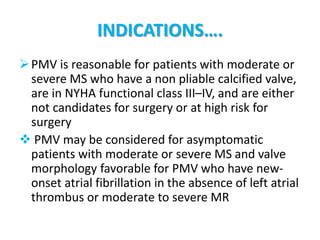
INDICATIONS….
PMV is reasonable for patients with moderate or
severe MS who have a non pliable calcified valve,
are in NYHA functional class III–IV, and are either
not candidates for surgery or at high risk for
surgery
 PMV may be considered for asymptomatic
patients with moderate or severe MS and valve
morphology favorable for PMV who have new-
onset atrial fibrillation in the absence of left atrial
thrombus or moderate to severe MR
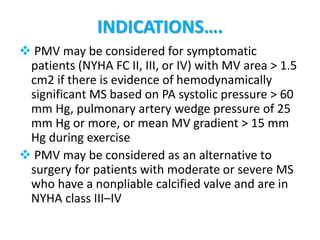
INDICATIONS….
 PMV may be considered for symptomatic
patients (NYHA FC II, III, or IV) with MV area > 1.5
cm2 if there is evidence of hemodynamically
significant MS based on PA systolic pressure > 60
mm Hg, pulmonary artery wedge pressure of 25
mm Hg or more, or mean MV gradient > 15 mm
Hg during exercise
 PMV may be considered as an alternative to
surgery for patients with moderate or severe MS
who have a nonpliable calcified valve and are in
NYHA class III–IV
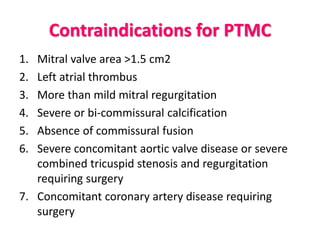
Contraindications for PTMC
1. Mitral valve area >1.5 cm2
2. Left atrial thrombus
3. More than mild mitral regurgitation
4. Severe or bi-commissural calcification
5. Absence of commissural fusion
6. Severe concomitant aortic valve disease or severe
combined tricuspid stenosis and regurgitation
requiring surgery
7. Concomitant coronary artery disease requiring
surgery
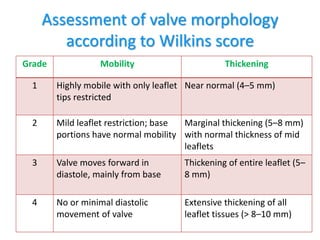
Assessment of valve morphology
according to Wilkins score
Grade Mobility Thickening
1 Highly mobile with only leaflet
tips restricted
Near normal (4–5 mm)
2 Mild leaflet restriction; base
portions have normal mobility
Marginal thickening (5–8 mm)
with normal thickness of mid
leaflets
3 Valve moves forward in
diastole, mainly from base
Thickening of entire leaflet (5–
8 mm)
4 No or minimal diastolic
movement of valve
Extensive thickening of all
leaflet tissues (> 8–10 mm)
Wilkins….
Grade Calcification Subvalvular thickening
1 Single area of echo
brightness
Minimal thickening below
leaflets
2 Scattered areas of
increased brightness along
leaflet margins
Chordal thickening up to
one-third of chordal length
3 Brightness extending to
the mid portion of leaflets
Thickening extending to
distal one-third of chords
4 Extensive brightness
throughout the leaflet
tissue
Extensive thickening to
papillary muscles
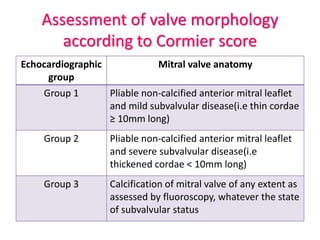
Assessment of valve morphology
according to Cormier score
Echocardiographic
group
Mitral valve anatomy
Group 1 Pliable non-calcified anterior mitral leaflet
and mild subvalvular disease(i.e thin cordae
≥ 10mm long)
Group 2 Pliable non-calcified anterior mitral leaflet
and severe subvalvular disease(i.e
thickened cordae < 10mm long)
Group 3 Calcification of mitral valve of any extent as
assessed by fluoroscopy, whatever the state
of subvalvular status
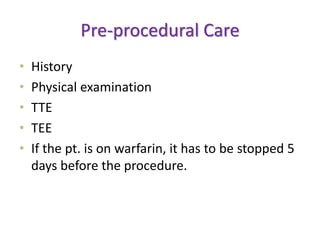
Pre-procedural Care
• History
• Physical examination
• TTE
• TEE
• If the pt. is on warfarin, it has to be stopped 5
days before the procedure.
• Transvenous or Antegrade Approach
• Inoue balloon technique
• Double balloon technique.
• Transarterial or Retrograde Approach
Technique
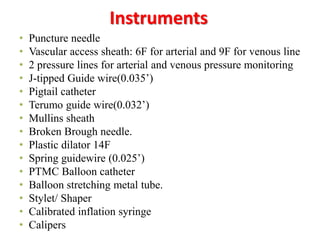
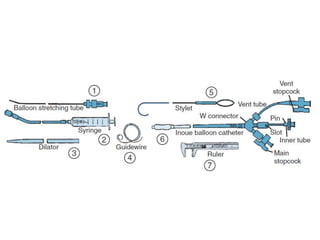
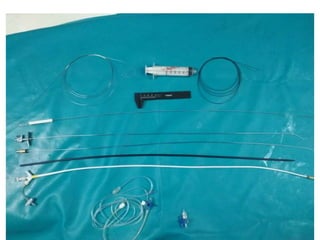
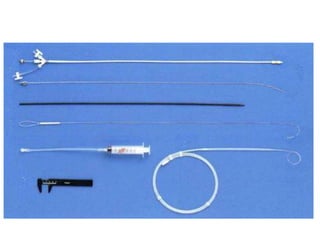
Instruments
• Puncture needle
• Vascular access sheath: 6F for arterial and 9F for venous line
• 2 pressure lines for arterial and venous pressure monitoring
• J-tipped Guide wire(0.035’)
• Pigtail catheter
• Terumo guide wire(0.032’)
• Mullins sheath
• Broken Brough needle.
• Plastic dilator 14F
• Spring guidewire (0.025’)
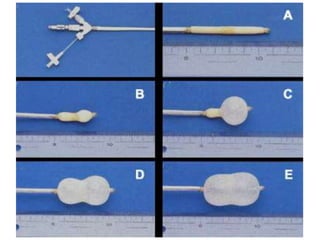
• PTMC Balloon catheter
• Balloon stretching metal tube.
• Stylet/ Shaper
• Calibrated inflation syringe
• Calipers
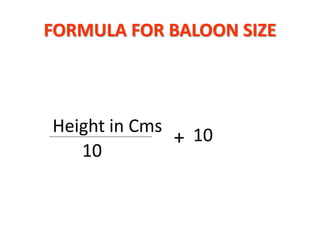
FORMULA FOR BALOON SIZE
Height in Cms
10
10+
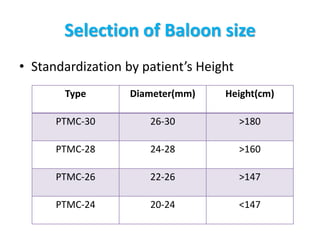
Selection of Baloon size
• Standardization by patient’s Height
Type Diameter(mm) Height(cm)
PTMC-30 26-30 >180
PTMC-28 24-28 >160
PTMC-26 22-26 >147
PTMC-24 20-24 <147
PTMC procedure
Post procedure evaluation
• Symptomatic improvement
• Ausculation of precordium
• Decrease in intensity of MDM
• Appearance of PSM
• Lung bases
• Two-dimensional and Doppler echocardiography
• Commissural separation
• Mitral valve area
• MR grading
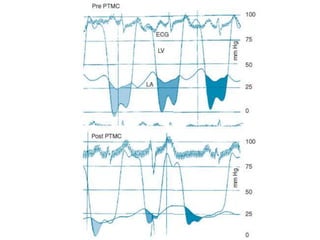
• Haemodynamics assessment
Successful PTMC
PTMC successful when
• final MVA is > 1.5 cm2
• mean mitral gradient < 5 mmHg
• with no major complications.
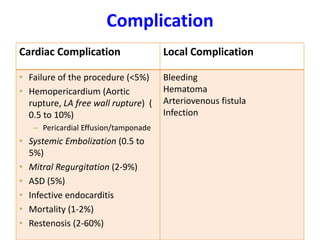
Complication
Cardiac Complication Local Complication
• Failure of the procedure (<5%)
• Hemopericardium (Aortic
rupture, LA free wall rupture) (
0.5 to 10%)
– Pericardial Effusion/tamponade
• Systemic Embolization (0.5 to
5%)
• Mitral Regurgitation (2-9%)
• ASD (5%)
• Infective endocarditis
• Mortality (1-2%)
• Restenosis (2-60%)
Bleeding
Hematoma
Arteriovenous fistula
Infection
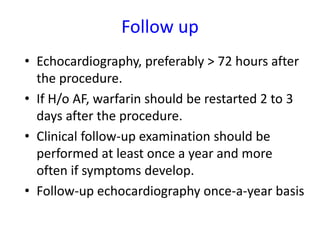
Follow up
• Echocardiography, preferably > 72 hours after
the procedure.
• If H/o AF, warfarin should be restarted 2 to 3
days after the procedure.
• Clinical follow-up examination should be
performed at least once a year and more
often if symptoms develop.
• Follow-up echocardiography once-a-year basis
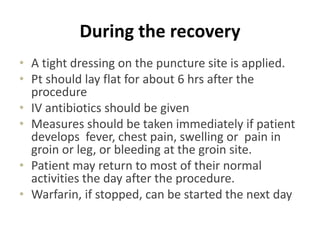
During the recovery
• A tight dressing on the puncture site is applied.
• Pt should lay flat for about 6 hrs after the
procedure
• IV antibiotics should be given
• Measures should be taken immediately if patient
develops fever, chest pain, swelling or pain in
groin or leg, or bleeding at the groin site.
• Patient may return to most of their normal
activities the day after the procedure.
• Warfarin, if stopped, can be started the next day
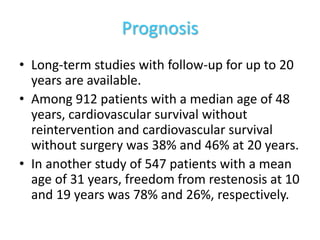
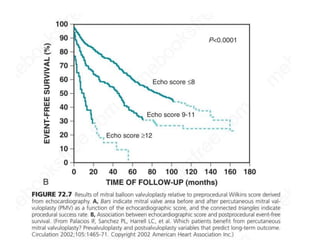
Prognosis
• Long-term studies with follow-up for up to 20
years are available.
• Among 912 patients with a median age of 48
years, cardiovascular survival without
reintervention and cardiovascular survival
without surgery was 38% and 46% at 20 years.
• In another study of 547 patients with a mean
age of 31 years, freedom from restenosis at 10
and 19 years was 78% and 26%, respectively.
Thank You
References
• The Cardiac Catheterization Handbook, Morton J.
Kern, 6th edition
• Interventional Cardiac Catheterization Handbook,
Morton J. Kern, 4rd edition
• Braunwald’s Heart Disease: A Textbook of
Cardiovascular Medicine, 11th edition
• Manual of Cardiovascular Medicine, Brain P. Griffin, 4th
edition
• 2014 ACC/AHA guideline for management of patients
with Valvular Heart Disease
• 2017 ESC/EACTS guidelines on management of
Valvular Heart Disease
• Prof Syed Ali Ahsan’s Patient Record
• Youtube and Internet Contents
PTMC/PBMC
PTMC/PBMC

PTMC/PBMC

  • 1.
  • 2.
    Percutaneous Transvenous Mitral Commissurotomy(PTMC) Dr. Md. Ahasanul Kabir Phase B Resident UCC, BSMMU Chairperson: Assoc. Prof. Dr. Tanjima Parveen
  • 3.
    • PTMC isan important therapeutic tool in treatment of mitral stenosis • First performed by K. Inoue in 1984 followed by Lock in 1985. • Based on principle that balloon dilatation in the stenosed mitral valve improves the valve opening by splitting the fused mitral commissures.
  • 4.
    Stages and Severityof Mitral Stenosis Stage Definition A At risk of MS B Progressive MS C Asymptomatic severe MS D Symptomatic severe MS  Valve anatomy  Valve haemodynamics  Haemodynamic consequences  Symptoms
  • 5.
    Mitral Stenosis Severity MildMS MVA > 1.5 cm2, Mean gradient < 5 mm Hg, PASP < 30 mm Hg Moderate MS MVA 1-1.5 cm2, Mean gradient 5-10 mm Hg, PASP 30-50 mm Hg Severe MS MVA < 1.0 cm2, Mean gradient > 10 mm Hg, PASP > 50 mm Hg
  • 7.
    INDICATIONS Symptomatic patients (NYHAfunctional class II, III, or IV), with moderate or severe MS and valve morphology favorable for PMV in the absence of left atrial thrombus or moderate to severe MR Asymptomatic patients with moderate or severe MS and valve morphology that is favorable for PMV, who have pulmonary hypertension (pulmonary artery systolic pressure > 50 mm Hg at rest or > 60 mm Hg with exercise) in the absence of left atrial thrombus or moderate to severe MR
  • 8.
    INDICATIONS…. PMV is reasonablefor patients with moderate or severe MS who have a non pliable calcified valve, are in NYHA functional class III–IV, and are either not candidates for surgery or at high risk for surgery  PMV may be considered for asymptomatic patients with moderate or severe MS and valve morphology favorable for PMV who have new- onset atrial fibrillation in the absence of left atrial thrombus or moderate to severe MR
  • 9.
    INDICATIONS….  PMV maybe considered for symptomatic patients (NYHA FC II, III, or IV) with MV area > 1.5 cm2 if there is evidence of hemodynamically significant MS based on PA systolic pressure > 60 mm Hg, pulmonary artery wedge pressure of 25 mm Hg or more, or mean MV gradient > 15 mm Hg during exercise  PMV may be considered as an alternative to surgery for patients with moderate or severe MS who have a nonpliable calcified valve and are in NYHA class III–IV
  • 10.
    Contraindications for PTMC 1.Mitral valve area >1.5 cm2 2. Left atrial thrombus 3. More than mild mitral regurgitation 4. Severe or bi-commissural calcification 5. Absence of commissural fusion 6. Severe concomitant aortic valve disease or severe combined tricuspid stenosis and regurgitation requiring surgery 7. Concomitant coronary artery disease requiring surgery
  • 11.
    Assessment of valvemorphology according to Wilkins score Grade Mobility Thickening 1 Highly mobile with only leaflet tips restricted Near normal (4–5 mm) 2 Mild leaflet restriction; base portions have normal mobility Marginal thickening (5–8 mm) with normal thickness of mid leaflets 3 Valve moves forward in diastole, mainly from base Thickening of entire leaflet (5– 8 mm) 4 No or minimal diastolic movement of valve Extensive thickening of all leaflet tissues (> 8–10 mm)
  • 12.
    Wilkins…. Grade Calcification Subvalvularthickening 1 Single area of echo brightness Minimal thickening below leaflets 2 Scattered areas of increased brightness along leaflet margins Chordal thickening up to one-third of chordal length 3 Brightness extending to the mid portion of leaflets Thickening extending to distal one-third of chords 4 Extensive brightness throughout the leaflet tissue Extensive thickening to papillary muscles
  • 13.
    Assessment of valvemorphology according to Cormier score Echocardiographic group Mitral valve anatomy Group 1 Pliable non-calcified anterior mitral leaflet and mild subvalvular disease(i.e thin cordae ≥ 10mm long) Group 2 Pliable non-calcified anterior mitral leaflet and severe subvalvular disease(i.e thickened cordae < 10mm long) Group 3 Calcification of mitral valve of any extent as assessed by fluoroscopy, whatever the state of subvalvular status
  • 14.
    Pre-procedural Care • History •Physical examination • TTE • TEE • If the pt. is on warfarin, it has to be stopped 5 days before the procedure.
  • 15.
    • Transvenous orAntegrade Approach • Inoue balloon technique • Double balloon technique. • Transarterial or Retrograde Approach Technique
  • 16.
    Instruments • Puncture needle •Vascular access sheath: 6F for arterial and 9F for venous line • 2 pressure lines for arterial and venous pressure monitoring • J-tipped Guide wire(0.035’) • Pigtail catheter • Terumo guide wire(0.032’) • Mullins sheath • Broken Brough needle. • Plastic dilator 14F • Spring guidewire (0.025’) • PTMC Balloon catheter • Balloon stretching metal tube. • Stylet/ Shaper • Calibrated inflation syringe • Calipers
  • 21.
    FORMULA FOR BALOONSIZE Height in Cms 10 10+
  • 22.
    Selection of Baloonsize • Standardization by patient’s Height Type Diameter(mm) Height(cm) PTMC-30 26-30 >180 PTMC-28 24-28 >160 PTMC-26 22-26 >147 PTMC-24 20-24 <147
  • 23.
  • 24.
    Post procedure evaluation •Symptomatic improvement • Ausculation of precordium • Decrease in intensity of MDM • Appearance of PSM • Lung bases • Two-dimensional and Doppler echocardiography • Commissural separation • Mitral valve area • MR grading • Haemodynamics assessment
  • 26.
    Successful PTMC PTMC successfulwhen • final MVA is > 1.5 cm2 • mean mitral gradient < 5 mmHg • with no major complications.
  • 27.
    Complication Cardiac Complication LocalComplication • Failure of the procedure (<5%) • Hemopericardium (Aortic rupture, LA free wall rupture) ( 0.5 to 10%) – Pericardial Effusion/tamponade • Systemic Embolization (0.5 to 5%) • Mitral Regurgitation (2-9%) • ASD (5%) • Infective endocarditis • Mortality (1-2%) • Restenosis (2-60%) Bleeding Hematoma Arteriovenous fistula Infection
  • 28.
    Follow up • Echocardiography,preferably > 72 hours after the procedure. • If H/o AF, warfarin should be restarted 2 to 3 days after the procedure. • Clinical follow-up examination should be performed at least once a year and more often if symptoms develop. • Follow-up echocardiography once-a-year basis
  • 29.
    During the recovery •A tight dressing on the puncture site is applied. • Pt should lay flat for about 6 hrs after the procedure • IV antibiotics should be given • Measures should be taken immediately if patient develops fever, chest pain, swelling or pain in groin or leg, or bleeding at the groin site. • Patient may return to most of their normal activities the day after the procedure. • Warfarin, if stopped, can be started the next day
  • 30.
    Prognosis • Long-term studieswith follow-up for up to 20 years are available. • Among 912 patients with a median age of 48 years, cardiovascular survival without reintervention and cardiovascular survival without surgery was 38% and 46% at 20 years. • In another study of 547 patients with a mean age of 31 years, freedom from restenosis at 10 and 19 years was 78% and 26%, respectively.
  • 32.
  • 33.
    References • The CardiacCatheterization Handbook, Morton J. Kern, 6th edition • Interventional Cardiac Catheterization Handbook, Morton J. Kern, 4rd edition • Braunwald’s Heart Disease: A Textbook of Cardiovascular Medicine, 11th edition • Manual of Cardiovascular Medicine, Brain P. Griffin, 4th edition • 2014 ACC/AHA guideline for management of patients with Valvular Heart Disease • 2017 ESC/EACTS guidelines on management of Valvular Heart Disease • Prof Syed Ali Ahsan’s Patient Record • Youtube and Internet Contents