FEVER
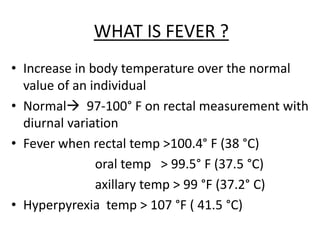
WHAT IS FEVER ?
• Increase in body temperature over the normal
value of an individual
• Normal 97-100° F on rectal measurement with
diurnal variation
• Fever when rectal temp >100.4° F (38 °C)
oral temp > 99.5° F (37.5 °C)
axillary temp > 99 °F (37.2° C)
• Hyperpyrexia temp > 107 °F ( 41.5 °C)
Fever
Pyrogens ( bacteria, virus, fungi,
malignancy, connective tissue disorders , trauma )
Endogenous pyrogens  IL-1 , TNF ,interferons,
IL-6, IL-11,
stimulates
Exogenous pyrogens bacterial cell wall
components (LPS) , enterotoxins , exotoxins
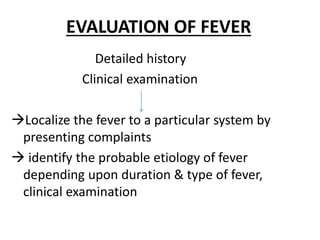
EVALUATION OF FEVER
Detailed history
Clinical examination
Localize the fever to a particular system by
presenting complaints
 identify the probable etiology of fever
depending upon duration & type of fever,
clinical examination
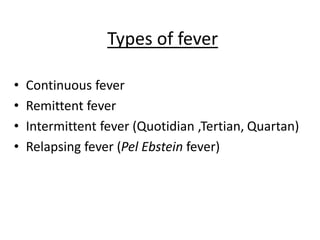
Types of fever
• Continuous fever
• Remittent fever
• Intermittent fever (Quotidian ,Tertian, Quartan)
• Relapsing fever (Pel Ebstein fever)
Localizing the focus of fever
• Exanthematous fevers  rash, erythema, pustules ,
nodules
• URTI  cough, cold, throat pain, running nose,
dysphagia, earache, horse voice , stridor , regional
lymphadenopathy
• LRTI  cough, difficulty & fast breathing , wheezing,
crepitations, chest pain, sputum
• UTI (upper) pain abdomen,vomiting,renal angle
tenderness (lower)  burning micturition, urgency,
frequency, hematuria
• Hematological  pallor, bleeding spots , bleeding
from any site, lymphadenopathy, bone pain
• CVS  dyspnea, palpitation, pedal edema,
precordial pain & buldge, prominent neck veins
• Hepatobiliary  jaundice, vomiting, diarrhea, pain
abdomen, abdominal distension, hepato-
spenomegaly
• CNS  vomiting, headache, seizures, lethargy,
altered sensorium, neck rigidity, irritability,
abnormal tone, abnormal movement,
Etiology of fever
Short duration fever
• lasting for less than 2 weeks
• Usually due to infection (bacteria, viral, fungus,
protozoa)
Prolonged duration fever
• lasting more than 2 weeks
• Both infectious & non-infectious causes
Management of fever
Two methods of antipyresis
Non-pharmacological
• Environmental measures
• Hydration (fluids)
• Hydrotherapy (sponging)
Pharmacological therapy
• Drugs  paracetamol, ibuprofen,mefenemic acid
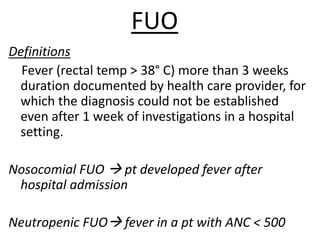
FUO
Definitions
Fever (rectal temp > 38° C) more than 3 weeks
duration documented by health care provider, for
which the diagnosis could not be established
even after 1 week of investigations in a hospital
setting.
Nosocomial FUO  pt developed fever after
hospital admission
Neutropenic FUO fever in a pt with ANC < 500
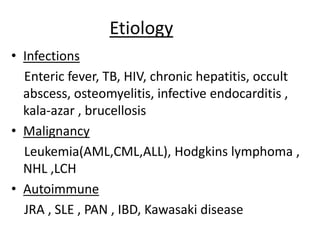
Etiology
• Infections
Enteric fever, TB, HIV, chronic hepatitis, occult
abscess, osteomyelitis, infective endocarditis ,
kala-azar , brucellosis
• Malignancy
Leukemia(AML,CML,ALL), Hodgkins lymphoma ,
NHL ,LCH
• Autoimmune
JRA , SLE , PAN , IBD, Kawasaki disease
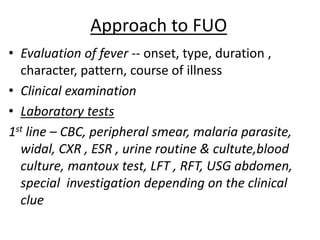
Approach to FUO
• Evaluation of fever -- onset, type, duration ,
character, pattern, course of illness
• Clinical examination
• Laboratory tests
1st line – CBC, peripheral smear, malaria parasite,
widal, CXR , ESR , urine routine & cultute,blood
culture, mantoux test, LFT , RFT, USG abdomen,
special investigation depending on the clinical
clue
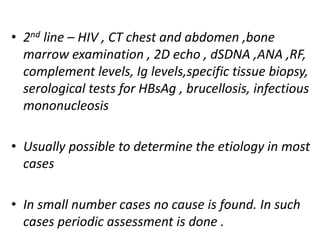
• 2nd line – HIV , CT chest and abdomen ,bone
marrow examination , 2D echo , dSDNA ,ANA ,RF,
complement levels, Ig levels,specific tissue biopsy,
serological tests for HBsAg , brucellosis, infectious
mononucleosis
• Usually possible to determine the etiology in most
cases
• In small number cases no cause is found. In such
cases periodic assessment is done .
Thank u
Fever is not a disease……… just a
symptom of the underlying illness
Treat the underlying disease not the
thermometer

Fever

  • 1.
  • 2.
    WHAT IS FEVER? • Increase in body temperature over the normal value of an individual • Normal 97-100° F on rectal measurement with diurnal variation • Fever when rectal temp >100.4° F (38 °C) oral temp > 99.5° F (37.5 °C) axillary temp > 99 °F (37.2° C) • Hyperpyrexia temp > 107 °F ( 41.5 °C)
  • 3.
    Fever Pyrogens ( bacteria,virus, fungi, malignancy, connective tissue disorders , trauma ) Endogenous pyrogens  IL-1 , TNF ,interferons, IL-6, IL-11, stimulates Exogenous pyrogens bacterial cell wall components (LPS) , enterotoxins , exotoxins
  • 4.
    EVALUATION OF FEVER Detailedhistory Clinical examination Localize the fever to a particular system by presenting complaints  identify the probable etiology of fever depending upon duration & type of fever, clinical examination
  • 5.
    Types of fever •Continuous fever • Remittent fever • Intermittent fever (Quotidian ,Tertian, Quartan) • Relapsing fever (Pel Ebstein fever)
  • 6.
    Localizing the focusof fever • Exanthematous fevers  rash, erythema, pustules , nodules • URTI  cough, cold, throat pain, running nose, dysphagia, earache, horse voice , stridor , regional lymphadenopathy • LRTI  cough, difficulty & fast breathing , wheezing, crepitations, chest pain, sputum • UTI (upper) pain abdomen,vomiting,renal angle tenderness (lower)  burning micturition, urgency, frequency, hematuria
  • 7.
    • Hematological pallor, bleeding spots , bleeding from any site, lymphadenopathy, bone pain • CVS  dyspnea, palpitation, pedal edema, precordial pain & buldge, prominent neck veins • Hepatobiliary  jaundice, vomiting, diarrhea, pain abdomen, abdominal distension, hepato- spenomegaly • CNS  vomiting, headache, seizures, lethargy, altered sensorium, neck rigidity, irritability, abnormal tone, abnormal movement,
  • 8.
    Etiology of fever Shortduration fever • lasting for less than 2 weeks • Usually due to infection (bacteria, viral, fungus, protozoa) Prolonged duration fever • lasting more than 2 weeks • Both infectious & non-infectious causes
  • 9.
    Management of fever Twomethods of antipyresis Non-pharmacological • Environmental measures • Hydration (fluids) • Hydrotherapy (sponging) Pharmacological therapy • Drugs  paracetamol, ibuprofen,mefenemic acid
  • 10.
    FUO Definitions Fever (rectal temp> 38° C) more than 3 weeks duration documented by health care provider, for which the diagnosis could not be established even after 1 week of investigations in a hospital setting. Nosocomial FUO  pt developed fever after hospital admission Neutropenic FUO fever in a pt with ANC < 500
  • 11.
    Etiology • Infections Enteric fever,TB, HIV, chronic hepatitis, occult abscess, osteomyelitis, infective endocarditis , kala-azar , brucellosis • Malignancy Leukemia(AML,CML,ALL), Hodgkins lymphoma , NHL ,LCH • Autoimmune JRA , SLE , PAN , IBD, Kawasaki disease
  • 12.
    Approach to FUO •Evaluation of fever -- onset, type, duration , character, pattern, course of illness • Clinical examination • Laboratory tests 1st line – CBC, peripheral smear, malaria parasite, widal, CXR , ESR , urine routine & cultute,blood culture, mantoux test, LFT , RFT, USG abdomen, special investigation depending on the clinical clue
  • 13.
    • 2nd line– HIV , CT chest and abdomen ,bone marrow examination , 2D echo , dSDNA ,ANA ,RF, complement levels, Ig levels,specific tissue biopsy, serological tests for HBsAg , brucellosis, infectious mononucleosis • Usually possible to determine the etiology in most cases • In small number cases no cause is found. In such cases periodic assessment is done .
  • 14.
    Thank u Fever isnot a disease……… just a symptom of the underlying illness Treat the underlying disease not the thermometer