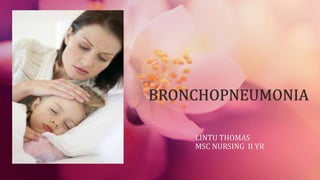
BRONCHOPNEUMONIA
LINTU THOMAS
MSC NURSING II YR
• INTRODUCTION
• DEVELOPMENTAL ANATOMY
at the of 4 weeks ,the respiratory system begins as
an out growth of the foregut ,it is anterior to the
pharynx ,the out growth is called Lung bud or
Respiratory diverticulum
• The endoderm lining the respiratory diverticulum
give rise to the epithelium and glands of the trachea
,bronchi and alveoli
• Mesoderm surroundings the respiratory
diverticulum give rise to connective tissue ,cartilage
and smooth muscles of these structures
• Respiratory diverticulum elongates and form
tracheal buds divides into bronchial buds ,which
branches repeatedly and develop with bronchi .by
24 weeks respiratory bronchioles have developed
• At 6 -16 weeks all major elements of lungs have
formed .
• Gas exchange started
• During 6 to 26 weeks lung tissue become vascular
• 20 weeks surfactant production started very small
amount .
• Sufficient amount produced at 26 to 28 weeks of
gestation
• At 30 weeks mature alveoli will develop
DEFINITION
• PNEUMONIA
IT IS AN INFLAMMATORY PROCESS
INVOLVING LUNG PARENCHYMA
BRONCHOPNEUMONIA
IT IS PRIMARILY SPREADING
INFLAMMATION OF A TERMINAL
BRONCHIOLES AND THEIR RELATED
ALVEOLI
•CLASSIFICATION OF PNEUMONIA
INCIDENCE
• IT IS SEEN IN AROUND 156 MILLION PEOPLE
,MORE SEEN IN CHILDRENS THAN ADULT
,28-34 % DEATH UNDER 5 YEARS ,
ETIOLOGY
• BACTERIAL INFECTION
Pneumococcus ,streptococcus ,staphylococcus ,
H .influenza
• Viral infection :influenza virus, adenovirus
• Fungus: Candida, Histoplasma
• Hypostatic pneumonia
• Aspiration of amniotic fluid ,food ,foreign bodies
PNEUMONIA PATOGENS IN VARIOUS AGE GROUP
• 1-3 Months :Parainfluenza ,Influenza ,Streptococcus
Pneumoniae ,Chlamydia Trachomatis
• 4 Months To 5 Years :Streptococcus Pneumoniae
,Chlamydia Pneumoniae ,Mycoplasma Pneumoniae
• 5 To 18 Years : Mycoplasma Pneumoniae ,Chlamedia
Pneumoniae ,Steptococcus Pneumoniae
CLINICAL FEATURES OF BRONCHOPNEUMONIA
• High fever with respiratory distress ,restlessness , air hunger
and cyanosis
• Grunting
• Nasal flaring
• Retraction of the supra clavicular ,intercostals ,subcostal areas
• Tachypnea
• Tachycardia
• Abdominal distention ,liver enlargement
Features of typical and atypical pneumonia
Features Typical Atypical
Onset sudden Gradual
Fever +++ + / _
Cough Productive Dry
Symptoms Pulmonary Systemic
Chest x ray
Localized Diffuse
Diagnostic evaluation of bronchopneumonia
• PHYSICAL EXAMINATION
 INSPECTION
Cyanosis ,sub costal ,substernal ,intercostal retraction ,tachypnea ,nasal
flaring
 AUSCULTATION
Wheezes Sound
 PERCUSSION
Dullness over a consolidated area
 PALPATION
LABORATORY AND DIAGNOSTIC TESTS
• Pulse Oxymetry
• Chest X Ray
• Sputum Culture
• Blood Examination
• Bronchoscopy
• Lung Biopsy
• Lung Aspiration
MANAGEMENT
• PNEUMOCOCCAL PNEUMONIA
• Penicillin G 50,000 units /kg/day ,IV OR IM ,for 5-7
days
• Procaine penicillin 600,000 units IM/DAY
• Allergic to penicillin alternative amoxicillin or ampicillin
,the alternatives are ceftrioxone /cefotaxime
• Oxygen administration
• STAPHYLOCOCCAL PNEUMONIA
• Isolation of patient
• Antipyretics for fever
• Maintain hydration with 5% dextrose
• Antibiotics therapy (penicillin ,erythromycin
,cephalosporin)
• Patient not respond soon vancomycin can use
• Hemophilus pneumonia
• Ampicillin 100 to 150 mg /kg /day and
chloramphenicol 50 mg /kg /day in a four divided
dose
• Cefotaxime 100 mg/kg /day or ceftrioxone 70
mg/kg /day are alternatively in seriously ill patient
• Streptococcal pneumonia
• Penicillin G 50,000 to 10000 units /kg/day for 7 to
10 days
Supportive care
Antipyretics for fever
Oxygen administration
Maintain hydration with iv fluid
Maintain position
• NURSING CARE MANAGEMENT
HOME CARE MANAGEMENT
• Increase oral intake
• Provide adequate bed rest
• Frequently check temperature
• Maintain position
• Give antipyretics to reduce fever
• High humid atmosphere
• Regular follow up
DIET
Complication
• Bactermia
• Sepsis
• Breathing problem
• Lung abscess
• Respiratory distress syndrome
• Pleural thickening
Nursing diagnosis
• Ineffective airway clearances related to inflammation,
increased secretions ,mechanical obstruction as evidenced
by presences of secretion ,productive cough ,tachypnea
• Ineffective breathing pattern related to inflammation as
evidenced by tachypnea ,increased work of breathing
• Impaired gas exchange related to hyperinflation airway
plugging as evidenced by cyanosis ,decreased oxygen
level and alteration in blood gases
• Risk for infection related to presences of infectious
organism as evidenced by fever or presences of
viruses or bacteria on laboratory screening
• Activity intolerances related to high respiratory
demand as evidenced by increased work of
breathing
• Fluid volume deficit related to decreased oral intake
• Altered nutritional status less than body requirement
related to feeding difficulty as evidenced by poor
oral intake
• Fear related to difficulty in breathing ,unfamiliar
situation ,procedures as evidenced by crying
,clinging and lack of co operation
Prognosis
THANK YOU
Bronchopneumonia (1)

Bronchopneumonia (1)

  • 1.
  • 3.
    • INTRODUCTION • DEVELOPMENTALANATOMY at the of 4 weeks ,the respiratory system begins as an out growth of the foregut ,it is anterior to the pharynx ,the out growth is called Lung bud or Respiratory diverticulum
  • 4.
    • The endodermlining the respiratory diverticulum give rise to the epithelium and glands of the trachea ,bronchi and alveoli • Mesoderm surroundings the respiratory diverticulum give rise to connective tissue ,cartilage and smooth muscles of these structures
  • 5.
    • Respiratory diverticulumelongates and form tracheal buds divides into bronchial buds ,which branches repeatedly and develop with bronchi .by 24 weeks respiratory bronchioles have developed • At 6 -16 weeks all major elements of lungs have formed . • Gas exchange started • During 6 to 26 weeks lung tissue become vascular
  • 6.
    • 20 weekssurfactant production started very small amount . • Sufficient amount produced at 26 to 28 weeks of gestation • At 30 weeks mature alveoli will develop
  • 8.
    DEFINITION • PNEUMONIA IT ISAN INFLAMMATORY PROCESS INVOLVING LUNG PARENCHYMA BRONCHOPNEUMONIA IT IS PRIMARILY SPREADING INFLAMMATION OF A TERMINAL BRONCHIOLES AND THEIR RELATED ALVEOLI
  • 11.
  • 14.
    INCIDENCE • IT ISSEEN IN AROUND 156 MILLION PEOPLE ,MORE SEEN IN CHILDRENS THAN ADULT ,28-34 % DEATH UNDER 5 YEARS ,
  • 15.
    ETIOLOGY • BACTERIAL INFECTION Pneumococcus,streptococcus ,staphylococcus , H .influenza • Viral infection :influenza virus, adenovirus • Fungus: Candida, Histoplasma • Hypostatic pneumonia • Aspiration of amniotic fluid ,food ,foreign bodies
  • 16.
    PNEUMONIA PATOGENS INVARIOUS AGE GROUP • 1-3 Months :Parainfluenza ,Influenza ,Streptococcus Pneumoniae ,Chlamydia Trachomatis • 4 Months To 5 Years :Streptococcus Pneumoniae ,Chlamydia Pneumoniae ,Mycoplasma Pneumoniae • 5 To 18 Years : Mycoplasma Pneumoniae ,Chlamedia Pneumoniae ,Steptococcus Pneumoniae
  • 17.
    CLINICAL FEATURES OFBRONCHOPNEUMONIA • High fever with respiratory distress ,restlessness , air hunger and cyanosis • Grunting • Nasal flaring • Retraction of the supra clavicular ,intercostals ,subcostal areas • Tachypnea • Tachycardia • Abdominal distention ,liver enlargement
  • 18.
    Features of typicaland atypical pneumonia Features Typical Atypical Onset sudden Gradual Fever +++ + / _ Cough Productive Dry Symptoms Pulmonary Systemic Chest x ray Localized Diffuse
  • 19.
    Diagnostic evaluation ofbronchopneumonia • PHYSICAL EXAMINATION  INSPECTION Cyanosis ,sub costal ,substernal ,intercostal retraction ,tachypnea ,nasal flaring  AUSCULTATION Wheezes Sound  PERCUSSION Dullness over a consolidated area  PALPATION
  • 20.
    LABORATORY AND DIAGNOSTICTESTS • Pulse Oxymetry • Chest X Ray • Sputum Culture • Blood Examination • Bronchoscopy • Lung Biopsy • Lung Aspiration
  • 24.
    MANAGEMENT • PNEUMOCOCCAL PNEUMONIA •Penicillin G 50,000 units /kg/day ,IV OR IM ,for 5-7 days • Procaine penicillin 600,000 units IM/DAY • Allergic to penicillin alternative amoxicillin or ampicillin ,the alternatives are ceftrioxone /cefotaxime • Oxygen administration
  • 25.
    • STAPHYLOCOCCAL PNEUMONIA •Isolation of patient • Antipyretics for fever • Maintain hydration with 5% dextrose • Antibiotics therapy (penicillin ,erythromycin ,cephalosporin) • Patient not respond soon vancomycin can use
  • 26.
    • Hemophilus pneumonia •Ampicillin 100 to 150 mg /kg /day and chloramphenicol 50 mg /kg /day in a four divided dose • Cefotaxime 100 mg/kg /day or ceftrioxone 70 mg/kg /day are alternatively in seriously ill patient
  • 27.
    • Streptococcal pneumonia •Penicillin G 50,000 to 10000 units /kg/day for 7 to 10 days Supportive care Antipyretics for fever Oxygen administration Maintain hydration with iv fluid Maintain position
  • 28.
    • NURSING CAREMANAGEMENT
  • 29.
    HOME CARE MANAGEMENT •Increase oral intake • Provide adequate bed rest • Frequently check temperature • Maintain position • Give antipyretics to reduce fever • High humid atmosphere • Regular follow up
  • 30.
  • 31.
    Complication • Bactermia • Sepsis •Breathing problem • Lung abscess • Respiratory distress syndrome • Pleural thickening
  • 32.
    Nursing diagnosis • Ineffectiveairway clearances related to inflammation, increased secretions ,mechanical obstruction as evidenced by presences of secretion ,productive cough ,tachypnea • Ineffective breathing pattern related to inflammation as evidenced by tachypnea ,increased work of breathing • Impaired gas exchange related to hyperinflation airway plugging as evidenced by cyanosis ,decreased oxygen level and alteration in blood gases
  • 33.
    • Risk forinfection related to presences of infectious organism as evidenced by fever or presences of viruses or bacteria on laboratory screening • Activity intolerances related to high respiratory demand as evidenced by increased work of breathing
  • 34.
    • Fluid volumedeficit related to decreased oral intake • Altered nutritional status less than body requirement related to feeding difficulty as evidenced by poor oral intake • Fear related to difficulty in breathing ,unfamiliar situation ,procedures as evidenced by crying ,clinging and lack of co operation
  • 35.
  • 36.