MEASLES
Etiology
• Highly contagious disease
• Caused by RNA virus belonging to
paramyxoviridae family.
• Measles is the leading killer among the vaccine
preventable diseases.
• Humans are the only host
Global Burden
• Despite of a effective vaccine……..
• Measles still causes 350000 childhood deaths
annually in developing countries
• 80000 per year in India alone.
• Due to poor coverage of routine immunization
PATHOGENESIS
• Mainly through droplet infection (secretion from
nose and throat)
• By direct person to person contact also
• Period of communicability is 4 days before and 5
days after the appearance of rash.
• Highly contagious with a secondary attack rate
of more than 90 % .
• The portal of entry is respiratory epithelium where the
virus multiplies.
• Primary viremia - infection of the reticuloendothelial cells.
• Secondary viremia – results in systemic symptom.
• Two types of giant cells seen in measles
- Epithelial giant cells in respiratory epithelium
- Warthin- Finkeldey giant cells in reticuloendothelial
system.
Clinical features
• Incubation period is 8-12 days ( avg 10 days)
3 phases are seen
Prodromal phase
- Acute onset of fever with cough, coryza, rhinitis,
conjunctivitis ,malaise , anorexia .
- Fever is mostly continuous and usually lasts for 1
week.
Enanthematous phase
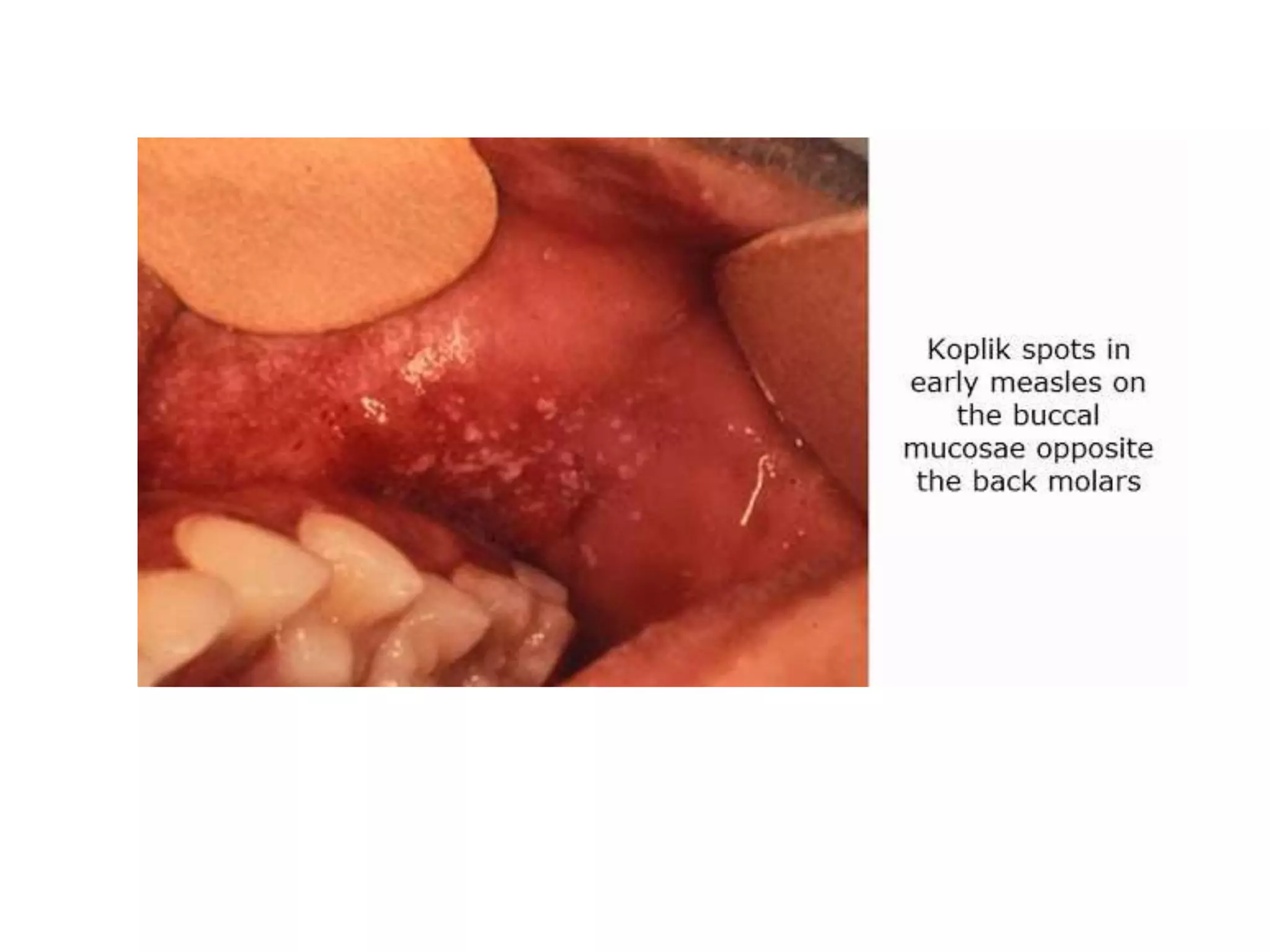
- on 2nd or 3rd of fever kopliks spots appear on the
buccal mucosa opposite of lower 2nd molars.
-Pathognomonic of measles
- Gray or white lesions like grains of sand with
surrounding edema.
- may also be seen in palate , lips , gums .
Exanthematous phase
- Rash appear on the 4th day
- Begins on the face and neck typically behind the
ear , along the posterior hairline and on the
posterior aspect of the cheek.
- Then it spreads to trunk , extremities, palms and
soles.
- Rash is erythematous and maculopapular
- Lasts for 5 days.
- It fades in the same manner as appearance.
- Heals with a browny pigmentation which fades
with in 10 days.
Modified measles
seen in persons who are partially immune
milder and shorter illness.
Hemorrhagic measles
- Purpuric rash with bleeding from mouth,nose or
bowels ,altered sensorium, seizures , coma
- High fatality rate
DIAGNOSIS
• Primarily clinical
• Serological – IgM antibodies in serum present 3
days after the rash and persists for 1 month.
• The virus can also be isolated from the
respiratory secretions , blood , urine during
illness.
Complications
• Due to widespread mucosal damage and
immunosupression.
• More in young infants , malnourished ,
immunocompromised .
• Common complications are
- Bronchopneumonia
- Otitis media
- Bronchitis
- Laryngitis
- Bronchiectasis
- Persistent diarrhea
- hepatitis
- Ileocolitis
- Appendicitis
- myocarditis
- AGN
- Acute encephalitis
- Post measles encephalitis
- SSPE ( subacute sclerosing panencephalitis)
Treatment
• Supportive
• Antipyretics
• Maintain hygiene
• Adequate fluid and calorie intake
• Vitamin a reduces the morbidity and mortality of
measles
dose – 1 lakh units below 1 year
2 lakh units above 1 year
Two doses 24 hours apart
Prevention
• By universal immunization
• Strain is Edmonston - Zagreb strain
THANK U

Measles

  • 1.
  • 2.
    Etiology • Highly contagiousdisease • Caused by RNA virus belonging to paramyxoviridae family. • Measles is the leading killer among the vaccine preventable diseases. • Humans are the only host
  • 3.
    Global Burden • Despiteof a effective vaccine…….. • Measles still causes 350000 childhood deaths annually in developing countries • 80000 per year in India alone. • Due to poor coverage of routine immunization
  • 4.
    PATHOGENESIS • Mainly throughdroplet infection (secretion from nose and throat) • By direct person to person contact also • Period of communicability is 4 days before and 5 days after the appearance of rash. • Highly contagious with a secondary attack rate of more than 90 % .
  • 5.
    • The portalof entry is respiratory epithelium where the virus multiplies. • Primary viremia - infection of the reticuloendothelial cells. • Secondary viremia – results in systemic symptom. • Two types of giant cells seen in measles - Epithelial giant cells in respiratory epithelium - Warthin- Finkeldey giant cells in reticuloendothelial system.
  • 6.
    Clinical features • Incubationperiod is 8-12 days ( avg 10 days) 3 phases are seen Prodromal phase - Acute onset of fever with cough, coryza, rhinitis, conjunctivitis ,malaise , anorexia . - Fever is mostly continuous and usually lasts for 1 week.
  • 7.
    Enanthematous phase - on2nd or 3rd of fever kopliks spots appear on the buccal mucosa opposite of lower 2nd molars. -Pathognomonic of measles - Gray or white lesions like grains of sand with surrounding edema. - may also be seen in palate , lips , gums .
  • 9.
    Exanthematous phase - Rashappear on the 4th day - Begins on the face and neck typically behind the ear , along the posterior hairline and on the posterior aspect of the cheek. - Then it spreads to trunk , extremities, palms and soles.
  • 10.
    - Rash iserythematous and maculopapular - Lasts for 5 days. - It fades in the same manner as appearance. - Heals with a browny pigmentation which fades with in 10 days.
  • 13.
    Modified measles seen inpersons who are partially immune milder and shorter illness. Hemorrhagic measles - Purpuric rash with bleeding from mouth,nose or bowels ,altered sensorium, seizures , coma - High fatality rate
  • 14.
    DIAGNOSIS • Primarily clinical •Serological – IgM antibodies in serum present 3 days after the rash and persists for 1 month. • The virus can also be isolated from the respiratory secretions , blood , urine during illness.
  • 15.
    Complications • Due towidespread mucosal damage and immunosupression. • More in young infants , malnourished , immunocompromised . • Common complications are - Bronchopneumonia - Otitis media - Bronchitis - Laryngitis - Bronchiectasis
  • 16.
    - Persistent diarrhea -hepatitis - Ileocolitis - Appendicitis - myocarditis - AGN - Acute encephalitis - Post measles encephalitis - SSPE ( subacute sclerosing panencephalitis)
  • 17.
    Treatment • Supportive • Antipyretics •Maintain hygiene • Adequate fluid and calorie intake • Vitamin a reduces the morbidity and mortality of measles dose – 1 lakh units below 1 year 2 lakh units above 1 year Two doses 24 hours apart
  • 18.
    Prevention • By universalimmunization • Strain is Edmonston - Zagreb strain
  • 19.