By
BASIL WILSON
13Q0408
PHARM D IVth yr
CASE PRESENTATION ON
Definition
An umbilical hernia is a health condition
where the abdominal wall behind the navel is
damaged. It may cause the navel to bulge
outwards — the bulge consisting of abdominal
fat from the greater omentum or occasionally
parts of the small intestine.
The increased pressure near the umbilicus
causes the umbilical hernia to bulge out.
Etiology
There are three causes of umbilical hernia.
 Congenital
Congenital umbilical hernia is a congenital malformation of the
navel (umbilicus). Among adults, it is three times more common
in women than in men.
 Acquired
An acquired umbilical hernia directly results from increased intra-
abdominal pressure caused by obesity, heavy lifting, a long
history of coughing, or multiple pregnancies.
 Para umbilical
Importantly this type of hernia must be distinguished from a
para umbilical hernia, which occurs in adults and involves a
defect in the midline near to the umbilicus.
Pathophysiology
A hernia refers to when an internal body part pushes through a
weak area of muscle or the surrounding tissue wall. Hernias often
do not cause any symptoms, although a swelling may appear in the
abdomen or groin.
An umbilical hernia forms when part of the intestine or fatty tissue
protrudes through an opening in the abdominal muscles near to the
naval, causing the belly button to swell. This hernia can affect adults,
possibly due to repeated abdominal strain.
umbilical hernia rarely causes complications, although
complications can occur if protruding abdominal tissue becomes
trapped and is not possible to push back into the abdominal cavity.
This “incarcerated” tissue receives a reduced supply of blood
which can lead to tissue damage and umbilical pain. If the trapped
tissue receives no blood supply at all (strangulation) gangrene may
occur and infection may spread throughout the abdomen, which can
be life threatening.
Signs and Symptoms
The most common symptoms are:
● Bulge in the abdominal area that
often increases with coughing or
straining
● Pain or pressure at the hernia site
● Increasing sharp abdominal pain and
vomiting
Demographic Details
Name : ABC Age : 32 Sex : F
I.P No : 27438 Dept. : Surgery Unit : B
D.O.A : 09/08/2016 D.O.D : 21/08/2016
Reason For Admission
c/o swelling over umbilical region -1.5 months
Past Medical History
H/o Lap Tubectomy 6 years back
Pt. was app alright 1.5 months back, then she
developed swelling over umbilical region,insidious in
onset,progressive in nature,initially of peanut size
now progressive to present size of 2*2 cm.Swelling
increase in size on coughing,straining and reducing
partially on lying down on rest.
H/o pain over abdomen
H/o vomiting
Expansile cough impulse positive,partially reduces on
its own
Scars of lap Tubectomy positive.
History Of Present Illness
Family History
 Diet : Mixed
 Sleep : Not Disturbed
 Appetite : Good
 Habits : Nil
General Physical Examination
Patient is moderately built and nourished
PR : 72 bpm
BP : 110/7 0
Afebrile
Systemic Examination
CVS : S1S2 + , no murmur
RS : NVBS + ,No added sounds
CNS : Intact
P/A : Everted,centrally placed 2*2 sized
spherical shape
Laboratory Data
RBC : 11.9 (12.0-16.0)
WBC : 9200 (4500-10500cells/uL)
Lymphocytes : 35 (20-40%)
RBC : 4.01 (4.2-5.4 million/uL)
Platelet : 248000 (150000 -450000 cells/cubic mm)
Sodium :137(135-147 mEq/L)
Potassium : 4.3(3.5-5.2 mEq/L)
Chlorides :104(95-107 mEq/L)
Sr. Urea: 21(10-50mg%)
Sr.Creatinine:0.9(0.6-1.2mg/dl)
BT :3 mints(1-6 mins) CT:5 mins(5-10 mins)
Provisional Diagnosis :
UMBILICAL HERNIA
TREATMENT CHART
BRAND NAME GENERIC NAME DOSE ROUTE FREQUENC
Y
D
A
Y
1
D
A
Y
2
D
A
Y
3
D
A
Y
4
D
A
Y
5
D
A
Y
6
D
A
Y
7
D
A
Y
8
D
A
Y
9
D
A
Y
1
0
D
A
Y
1
1
INJ. ZONOMAX CEFOPERAZONE +
SULBACTAM
1.5
GM
IV 1-0-1 √ √ √ √ √
INJ.JUSTIN DICLOFENAC
SODIUM
1 amp IV 1-0-1 √ √ √ √ √ √
INJ. EMSET ONDANSETRON 4 MG IV S-0-S √ √ √ √ √
TAB. PAN PANTOPRAZOLE 40
MG
P/O 1-0-0 √ √ √ √ √ √ √ √ √ √ √
IVF 1 PINT RL
1 PINT DNS
IV 70 ml/Hr √ √ √ √ √ √
INJ.AMICIN AMIKACIN
SULPHATE
1 GM IV 1-0-0 √ √ √ √
BRAND NAME GENERIC NAME DOSE ROUTE FREQUENC
Y
D
A
Y
1
D
A
Y
2
D
A
Y
3
D
A
Y
4
D
A
Y
5
D
A
Y
6
D
A
Y
7
D
A
Y
8
D
A
Y
9
D
A
Y
1
0
D
A
Y
1
1
TAB . DOLO PARACETAMOL 650
MG
P/O S-O-S √ √ √ √ √ √
TAB. LINCEF CEFIXIME +
LINEZOLID
600
MG
P/O 1-0-1 √ √ √ √ √ √
TAB. DOLWIN FORTE PARACETAMOL+
ACECLOFENAC+
SERRATIO
PEPTIDASE
500
MG
P/O 1-0-1 √ √ √
TAB. XYZAL LEVOCETIRIZINE 5 MG P/O 0-0-1 √
Daily Assesment
Day 1
Afebrile
PR : 80 bpm
B.P : 120/80 mmHg
No fresh complaints
Pre operative Orders
NBM from 10 PM Xylocaine test dose
Take informed consent Inform OT staff
Inj.TT 1 amp IM Shift to OT at 8:30 am
Inj.zostum 1.5 gm IV
Inj.Pan 40 mg IV
Inj.Emset 4 mg IV
Post Operative Orders
Foot end evaluation
Inj.Zonomax 1.5 gm IV BD
Tab. Pan 40 mg OD
Inj.Justin IM BD
Inj.Emset 4 mg IV SOS
IVF 1 pint RL
1 pint DNS @70cc/hr
Day 2
C/o pain over Sx site
Afebrile
B.P : 120/80 mmHg
P.R : 72 bpm
Dressing Intact
Tenderness and Guarding around Sx site positive
TREATMENT ADVICE
Continue same treatment
ADD-Inj.Amicin 1 gm IV
Day 3
No Fresh Complaints Continue Same Treatment
Pain over Sx site
Afebrile
B.P : 110/70
P.R : 80 bpm Tenderness and Guarding around
Sx site
Day 4
No Fresh Complaints Continue Same Treatment
Afebrile
B.P : 110/80
P.R : 72 bpm
Day 5 Continue Same Treatment
No Fresh Complaints
Afebrile
B.P : 110/80
P.R : 72bpm
DAY 6 TREATMENT ADVICE
C/o chills and rigors
Dressings intact Inj.Justin 1 amp IM BD
No soakage Tab.Pan 40 mg OD
IVF
Tab.Dolo 650 mg SOS
Tab.Lincef 600mg BD
DAY 7
No fresh complaints STOP-IVF
Dressings intact Inj.Justin
No soakage
DAY 8 Continue Same Treatment
No fresh complaints
Dressings intact
No soakage
B.P -120/80
PR – 80 bpm
DAY 9
No fresh complaints Continue Same Treatment
Dressings intact
No soakage ADD-Tab.Dolowin forte BD
B.P -120/80
PR – 80 bpm
DAY 10
No fresh complaints Continue Same Treatment
Surgical site healthy
NO discharge
B.P -120/80
PR – 80 bpm
DAY 11
No fresh complaints Continue Same Treatment
Surgical site healthy
NO discharge ADD-Tab.Xyzal 5mg OD
B.P -120/80
PR – 80 bpm
FINAL DIAGNOSIS
UMBILICAL HERNIA
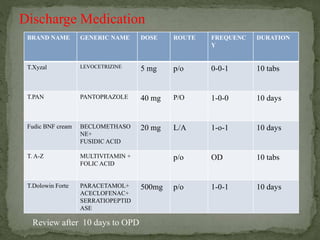
BRAND NAME GENERIC NAME DOSE ROUTE FREQUENC
Y
DURATION
T.Xyzal LEVOCETRIZINE 5 mg p/o 0-0-1 10 tabs
T.PAN PANTOPRAZOLE 40 mg P/O 1-0-0 10 days
Fudic BNF cream BECLOMETHASO
NE+
FUSIDIC ACID
20 mg L/A 1-o-1 10 days
T. A-Z MULTIVITAMIN +
FOLIC ACID
p/o OD 10 tabs
T.Dolowin Forte PARACETAMOL+
ACECLOFENAC+
SERRATIOPEPTID
ASE
500mg p/o 1-0-1 10 days
Discharge Medication
Review after 10 days to OPD
PHARMACEUTICAL CARE PLAN
Subjective Evidence
c/o swelling over umbilical region since 1.5 months
c/o pain over abdomen
Expansile cough impulse positive
Objective Evidence
Hb : 11.9 (12-16)
RBC : 4.01 (4.2-5.4million/uL)
WBC :9200(4500-10500 cells /UL)
Assesment
Based on the Subjective and Objective evidences ,
it is assessed that the patient is suffering from
UMBILICAL HERNIA
Plan
Treatment Goals
 To reduce swelling over umbilical
region
 To perform the surgery successfully
 To improve patients health status
 To prevent post-operative infections
 To reduce abdominal pain
 To stop vomiting
 Surgery done successfully
 Reduced abdominal pain
 Vomiting stops
No drug related problems identified in this case.
Patient Counselling
About disease
An umbilical hernia is a health condition where
the abdominal wall behind the navel is
damaged. It may cause the navel to bulge
outwards — the bulge consisting of abdominal
fat from the greater omentum or occasionally
parts of the small intestine.
About Drugs
Pantoprazole should be taken 1 hour before
meals.Swallow whole,do not chew/crush.
Cefoperazone is given to prevent the surgical
infections that can be occur post surgery.
Life Style Modification
 Getting regular exercise is an important safeguard as
muscles that are well toned and strong are less likely to
rupture.
 Maintain a healthy weight. Being overweight strains the
body and can also dangerously stretch the peritoneum - the
abdominal lining and is a risk factor for developing hernias
and many other physical problems.
 Don't strain your muscles. Weight lifters, football players,
and golfers frequently strain and can tear the muscles making
them more prone to hernias. If you play any such sports
ensure that adequate warm up is practised before starting the
game.
 Be careful when lifting heavy objects. Lift with your
knees rather than your back, and don't attempt to move
anything too heavy for one person to manage.
 Quit smoking. Smokers often are prone to persistent
cough, which can increase the risk for herniation .. In
addition it increases the risk for serious diseases such as
cancer, emphysema and heart disease.
 Get plenty of fibre. Regular bowel movements will
prevent undue straining. Fresh fruits and vegetables and
whole grains are good for overall health. They're also
packed with fibre that can help prevent constipation.
Umbilical hernia

Umbilical hernia

  • 1.
    By BASIL WILSON 13Q0408 PHARM DIVth yr CASE PRESENTATION ON
  • 2.
    Definition An umbilical herniais a health condition where the abdominal wall behind the navel is damaged. It may cause the navel to bulge outwards — the bulge consisting of abdominal fat from the greater omentum or occasionally parts of the small intestine. The increased pressure near the umbilicus causes the umbilical hernia to bulge out.
  • 3.
    Etiology There are threecauses of umbilical hernia.  Congenital Congenital umbilical hernia is a congenital malformation of the navel (umbilicus). Among adults, it is three times more common in women than in men.  Acquired An acquired umbilical hernia directly results from increased intra- abdominal pressure caused by obesity, heavy lifting, a long history of coughing, or multiple pregnancies.  Para umbilical Importantly this type of hernia must be distinguished from a para umbilical hernia, which occurs in adults and involves a defect in the midline near to the umbilicus.
  • 4.
    Pathophysiology A hernia refersto when an internal body part pushes through a weak area of muscle or the surrounding tissue wall. Hernias often do not cause any symptoms, although a swelling may appear in the abdomen or groin. An umbilical hernia forms when part of the intestine or fatty tissue protrudes through an opening in the abdominal muscles near to the naval, causing the belly button to swell. This hernia can affect adults, possibly due to repeated abdominal strain. umbilical hernia rarely causes complications, although complications can occur if protruding abdominal tissue becomes trapped and is not possible to push back into the abdominal cavity. This “incarcerated” tissue receives a reduced supply of blood which can lead to tissue damage and umbilical pain. If the trapped tissue receives no blood supply at all (strangulation) gangrene may occur and infection may spread throughout the abdomen, which can be life threatening.
  • 5.
    Signs and Symptoms Themost common symptoms are: ● Bulge in the abdominal area that often increases with coughing or straining ● Pain or pressure at the hernia site ● Increasing sharp abdominal pain and vomiting
  • 6.
    Demographic Details Name :ABC Age : 32 Sex : F I.P No : 27438 Dept. : Surgery Unit : B D.O.A : 09/08/2016 D.O.D : 21/08/2016
  • 7.
    Reason For Admission c/oswelling over umbilical region -1.5 months Past Medical History H/o Lap Tubectomy 6 years back
  • 8.
    Pt. was appalright 1.5 months back, then she developed swelling over umbilical region,insidious in onset,progressive in nature,initially of peanut size now progressive to present size of 2*2 cm.Swelling increase in size on coughing,straining and reducing partially on lying down on rest. H/o pain over abdomen H/o vomiting Expansile cough impulse positive,partially reduces on its own Scars of lap Tubectomy positive. History Of Present Illness
  • 9.
    Family History  Diet: Mixed  Sleep : Not Disturbed  Appetite : Good  Habits : Nil
  • 10.
    General Physical Examination Patientis moderately built and nourished PR : 72 bpm BP : 110/7 0 Afebrile
  • 11.
    Systemic Examination CVS :S1S2 + , no murmur RS : NVBS + ,No added sounds CNS : Intact P/A : Everted,centrally placed 2*2 sized spherical shape
  • 12.
    Laboratory Data RBC :11.9 (12.0-16.0) WBC : 9200 (4500-10500cells/uL) Lymphocytes : 35 (20-40%) RBC : 4.01 (4.2-5.4 million/uL) Platelet : 248000 (150000 -450000 cells/cubic mm) Sodium :137(135-147 mEq/L) Potassium : 4.3(3.5-5.2 mEq/L) Chlorides :104(95-107 mEq/L) Sr. Urea: 21(10-50mg%) Sr.Creatinine:0.9(0.6-1.2mg/dl) BT :3 mints(1-6 mins) CT:5 mins(5-10 mins)
  • 13.
  • 14.
    TREATMENT CHART BRAND NAMEGENERIC NAME DOSE ROUTE FREQUENC Y D A Y 1 D A Y 2 D A Y 3 D A Y 4 D A Y 5 D A Y 6 D A Y 7 D A Y 8 D A Y 9 D A Y 1 0 D A Y 1 1 INJ. ZONOMAX CEFOPERAZONE + SULBACTAM 1.5 GM IV 1-0-1 √ √ √ √ √ INJ.JUSTIN DICLOFENAC SODIUM 1 amp IV 1-0-1 √ √ √ √ √ √ INJ. EMSET ONDANSETRON 4 MG IV S-0-S √ √ √ √ √ TAB. PAN PANTOPRAZOLE 40 MG P/O 1-0-0 √ √ √ √ √ √ √ √ √ √ √ IVF 1 PINT RL 1 PINT DNS IV 70 ml/Hr √ √ √ √ √ √ INJ.AMICIN AMIKACIN SULPHATE 1 GM IV 1-0-0 √ √ √ √
  • 15.
    BRAND NAME GENERICNAME DOSE ROUTE FREQUENC Y D A Y 1 D A Y 2 D A Y 3 D A Y 4 D A Y 5 D A Y 6 D A Y 7 D A Y 8 D A Y 9 D A Y 1 0 D A Y 1 1 TAB . DOLO PARACETAMOL 650 MG P/O S-O-S √ √ √ √ √ √ TAB. LINCEF CEFIXIME + LINEZOLID 600 MG P/O 1-0-1 √ √ √ √ √ √ TAB. DOLWIN FORTE PARACETAMOL+ ACECLOFENAC+ SERRATIO PEPTIDASE 500 MG P/O 1-0-1 √ √ √ TAB. XYZAL LEVOCETIRIZINE 5 MG P/O 0-0-1 √
  • 16.
    Daily Assesment Day 1 Afebrile PR: 80 bpm B.P : 120/80 mmHg No fresh complaints Pre operative Orders NBM from 10 PM Xylocaine test dose Take informed consent Inform OT staff Inj.TT 1 amp IM Shift to OT at 8:30 am Inj.zostum 1.5 gm IV Inj.Pan 40 mg IV Inj.Emset 4 mg IV
  • 17.
    Post Operative Orders Footend evaluation Inj.Zonomax 1.5 gm IV BD Tab. Pan 40 mg OD Inj.Justin IM BD Inj.Emset 4 mg IV SOS IVF 1 pint RL 1 pint DNS @70cc/hr
  • 18.
    Day 2 C/o painover Sx site Afebrile B.P : 120/80 mmHg P.R : 72 bpm Dressing Intact Tenderness and Guarding around Sx site positive TREATMENT ADVICE Continue same treatment ADD-Inj.Amicin 1 gm IV
  • 19.
    Day 3 No FreshComplaints Continue Same Treatment Pain over Sx site Afebrile B.P : 110/70 P.R : 80 bpm Tenderness and Guarding around Sx site Day 4 No Fresh Complaints Continue Same Treatment Afebrile B.P : 110/80 P.R : 72 bpm Day 5 Continue Same Treatment No Fresh Complaints Afebrile B.P : 110/80 P.R : 72bpm
  • 20.
    DAY 6 TREATMENTADVICE C/o chills and rigors Dressings intact Inj.Justin 1 amp IM BD No soakage Tab.Pan 40 mg OD IVF Tab.Dolo 650 mg SOS Tab.Lincef 600mg BD DAY 7 No fresh complaints STOP-IVF Dressings intact Inj.Justin No soakage DAY 8 Continue Same Treatment No fresh complaints Dressings intact No soakage B.P -120/80 PR – 80 bpm
  • 21.
    DAY 9 No freshcomplaints Continue Same Treatment Dressings intact No soakage ADD-Tab.Dolowin forte BD B.P -120/80 PR – 80 bpm DAY 10 No fresh complaints Continue Same Treatment Surgical site healthy NO discharge B.P -120/80 PR – 80 bpm DAY 11 No fresh complaints Continue Same Treatment Surgical site healthy NO discharge ADD-Tab.Xyzal 5mg OD B.P -120/80 PR – 80 bpm
  • 22.
  • 23.
    BRAND NAME GENERICNAME DOSE ROUTE FREQUENC Y DURATION T.Xyzal LEVOCETRIZINE 5 mg p/o 0-0-1 10 tabs T.PAN PANTOPRAZOLE 40 mg P/O 1-0-0 10 days Fudic BNF cream BECLOMETHASO NE+ FUSIDIC ACID 20 mg L/A 1-o-1 10 days T. A-Z MULTIVITAMIN + FOLIC ACID p/o OD 10 tabs T.Dolowin Forte PARACETAMOL+ ACECLOFENAC+ SERRATIOPEPTID ASE 500mg p/o 1-0-1 10 days Discharge Medication Review after 10 days to OPD
  • 24.
    PHARMACEUTICAL CARE PLAN SubjectiveEvidence c/o swelling over umbilical region since 1.5 months c/o pain over abdomen Expansile cough impulse positive Objective Evidence Hb : 11.9 (12-16) RBC : 4.01 (4.2-5.4million/uL) WBC :9200(4500-10500 cells /UL)
  • 25.
    Assesment Based on theSubjective and Objective evidences , it is assessed that the patient is suffering from UMBILICAL HERNIA
  • 26.
    Plan Treatment Goals  Toreduce swelling over umbilical region  To perform the surgery successfully  To improve patients health status  To prevent post-operative infections  To reduce abdominal pain  To stop vomiting
  • 27.
     Surgery donesuccessfully  Reduced abdominal pain  Vomiting stops
  • 28.
    No drug relatedproblems identified in this case.
  • 29.
    Patient Counselling About disease Anumbilical hernia is a health condition where the abdominal wall behind the navel is damaged. It may cause the navel to bulge outwards — the bulge consisting of abdominal fat from the greater omentum or occasionally parts of the small intestine.
  • 30.
    About Drugs Pantoprazole shouldbe taken 1 hour before meals.Swallow whole,do not chew/crush. Cefoperazone is given to prevent the surgical infections that can be occur post surgery.
  • 31.
    Life Style Modification Getting regular exercise is an important safeguard as muscles that are well toned and strong are less likely to rupture.  Maintain a healthy weight. Being overweight strains the body and can also dangerously stretch the peritoneum - the abdominal lining and is a risk factor for developing hernias and many other physical problems.  Don't strain your muscles. Weight lifters, football players, and golfers frequently strain and can tear the muscles making them more prone to hernias. If you play any such sports ensure that adequate warm up is practised before starting the game.
  • 32.
     Be carefulwhen lifting heavy objects. Lift with your knees rather than your back, and don't attempt to move anything too heavy for one person to manage.  Quit smoking. Smokers often are prone to persistent cough, which can increase the risk for herniation .. In addition it increases the risk for serious diseases such as cancer, emphysema and heart disease.  Get plenty of fibre. Regular bowel movements will prevent undue straining. Fresh fruits and vegetables and whole grains are good for overall health. They're also packed with fibre that can help prevent constipation.