1

Fever
Fever is elevated body temperature (> 37.8° C orally or > 38.2° C rectally) or an
elevation above a person's known normal daily value by a resetting of the temperature
set point in the hypothalamus at higher value.
Hyperthermia: Elevated body temperature that is not caused by a resetting of the
temperature set point in the hypothalamus

During a 24-h period, temperature varies from lowest levels in the early morning to
highest in late afternoon. Maximum variation is about 0.6° C.
Consequences of fever
Modest transient core T ↑(ie, 38° to 40°) well tolerated by healthy adults-usually.
Extreme temperature elevation (typically > 41° C) may be damaging.
1. Organ failure; Protein denaturation occurs, and inflammatory cytokines that
activate the inflammatory cascade are released > cellular dysfunction >.
2. DIC < The coagulation cascade is also activated.
3. Physiologically stress adults with pre-existing cardiac or pulmonary
insufficiency.( fever can ↑ BMR by ~10 to 12% for every 1° C ↑ over 37° C)
4. Worsen mental status in patients with dementia.
5. Febrile seizures in children.
Etiology
Many disorders can cause fever. They are broadly categorized as
1. Infectious (most common)
2. Neoplastic
3. Inflammatory (including rheumatic, nonrheumatic, and drug-related)
Acute (ie, duration ≤ 4 days) fever in adults is highly likely to be infectious.
Fever due to a noninfectious cause, the fever is almost always chronic or recurrent.
Isolated, acute febrile event in patients with a known inflammatory or neoplastic
disorder is still most likely to be infectious.
Commonly
1. Upper and lower respiratory tract infections
2. GI infections
3. UTIs
4. Skin infections
Most acute respiratory tract and GI infections are viral.
Patient factors include health status, age, occupation, and risk factors (eg,
hospitalization, recent invasive procedures, presence of IV or urinary catheters, use of
mechanical ventilation).

Yapa Wijeratne

Merck Manual
2
External factors are those that expose patients to specific diseases—eg, through
infected contacts, local outbreaks, disease vectors (eg, mosquitoes, ticks), a common
vehicle (eg, food, water), or geographic location (eg, residence in or recent travel to
an endemic area).
Some Causes of Acute Fever
Predisposing Factor
None (healthy)

Cause
Upper or lower respiratory tract infection
GI infection
UTI
Skin infection
Hospitalization
IV catheter infection
UTI (particularly in patients with an indwelling catheter)
Pneumonia (particularly in patients using a ventilator)
Atelectasis
Surgical site infection (postoperatively)
Deep venous thrombosis or pulmonary embolism
Diarrhea (Clostridium difficile–induced)
Drugs
Hematoma
Transfusion reaction
Decubitus ulcers
Travel to endemic Malaria
areas
Viral hepatitis
Diarrheal disorders
Typhoid fever
Dengue fever (less common)
Vector exposure (in Ticks: Rickettsiosis, ehrlichiosis, anaplasmosis, Lyme disease,
US)
babesiosis, tularemia
Mosquitoes: Arboviral encephalitis
Wild animals: Tularemia, rabies, hantavirus infection
Fleas: Plague
Domestic animals: Brucellosis, cat-scratch disease, Q fever,
toxoplasmosis
Birds: Psittacosis
Reptiles: Salmonella infection
Bats: Rabies, histoplasmosis
Immunocompromise Viruses: VZV or CMV infection
Bacteria: Infection due to encapsulated organisms (eg,
pneumococcus, meningococcus), Staphylococcus aureus,
gram-negative bacteria (eg, Pseudomonas aeruginosa),
Nocardia sp, or Mycobacteria sp
Fungi: Infection due to Candida, Aspergillus, Zygomycetes,
Histoplasma, or Coccidioides sp or Pneumocystis jirovecii
Parasites: Infection due to Toxoplasma gondii, Strongyloides
stercoralis, Cryptosporidium sp, microsporidia, or

Yapa Wijeratne

Merck Manual
3

Drugs
that
increase
production

can
heat

Drugs
that can
trigger
a
hypersensitivity
reaction

Cystoisospora (previously Isospora) belli
Amphetamines
Cocaine
MDMA, or Ecstasy
Antipsychotics
Anesthetics
β-Lactam antibiotics
Sulfa drugs
Phenytoin
Carbamazepine
Procainamide
Quinidine
Amphotericin B
Interferons

Evaluation
History
History of present illness should cover
o Magnitude of fever
o Duration of fever
o Method used to take the temperature.
1.True rigors (severe, shaking, teeth-chattering chills—not simply feeling cold)
suggest fever due to infection but are not otherwise specific.
2. Pain; in the ears, head, joints etc.
3. Other localizing symptoms; nasal congestion and/or discharge, cough, diarrhea, &
urinary symptoms (frequency, urgency, dysuria).
4. Rash (including nature, location, and time of onset in relation to other symptoms)
and Lymphadenopathy.
5. Infected contacts and their diagnosis should be identified.
Review of systems
Symptoms of chronic illness; recurrent fevers, night sweats, and weight loss.
Past medical history
1. Recent surgery
2. Known disorders that predispose to infection (eg, HIV infection, diabetes, cancer,
organ transplantation, sickle cell disease, valvular heart disorders—particularly if an
artificial valve is present)
3. Known disorders that predispose to fever (eg, rheumatologic disorders, SLE, gout,
sarcoidosis, hyperthyroidism, cancer)
4. Recent travel include location, time since return, locale (eg, in back country, only
in cities), vaccinations received before travel, and any use of prophylactic antimalarial
drugs (if required).
5. Possible exposures (eg, via unsafe food or water, insect bites, animal contact, or
unprotected sex).
6. Vaccination; hepatitis A and B and against organisms that cause meningitis,

Yapa Wijeratne

Merck Manual
4
influenza, or pneumococcal infection
Drugs
1. Known to cause fever
2. Predispose to infection (eg, corticosteroids, anti-TNF drugs, chemotherapeutic and
antirejection drugs, other immunosuppressants)
3.Illicit use of injection drugs (predisposing to endocarditis, hepatitis, septic
pulmonary emboli, and skin and soft-tissue infections)
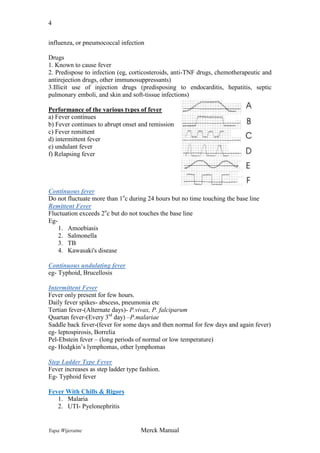
Performance of the various types of fever
a) Fever continues
b) Fever continues to abrupt onset and remission
c) Fever remittent
d) intermittent fever
e) undulant fever
f) Relapsing fever

Continuous fever
Do not fluctuate more than 1oc during 24 hours but no time touching the base line
Remittent Fever
Fluctuation exceeds 2oc but do not touches the base line
Eg1. Amoebiasis
2. Salmonella
3. TB
4. Kawasaki's disease
Continuous undulating fever
eg- Typhoid, Brucellosis
Intermittent Fever
Fever only present for few hours.
Daily fever spikes- abscess, pneumonia etc
Tertian fever-(Alternate days)- P.vivax, P. falciparum
Quartan fever-(Every 3rd day) –P.malariae
Saddle back fever-(fever for some days and then normal for few days and again fever)
eg- leptospirosis, Borrelia
Pel-Ebstein fever – (long periods of normal or low temperature)
eg- Hodgkin’s lymphomas, other lymphomas
Step Ladder Type Fever
Fever increases as step ladder type fashion.
Eg- Typhoid fever
Fever With Chills & Rigors
1. Malaria
2. UTI- Pyelonephritis

Yapa Wijeratne

Merck Manual
5
3. Cholecystitis/ ascending cholangitis
4. Pneumonia
5. Abscess
Low Grade Fevers
Chronic inflammatory conditions and in malignancies
Eg- TB
Sarcoidosis
Physical examination
A/febrile
Fever is most accurately diagnosed by measuring rectal temperature. Oral temperatures are normally about 0.6° C lower and may
be falsely even lower for many reasons, such as recent ingestion of a cold drink, mouth breathing, hyperventilation, and
inadequate measurement time (up to several minutes are required with mercury thermometers). Measurement of tympanic
membrane temperature by infrared sensor is less accurate than rectal temperature.

Tachypnea, tachycardia, or hypotension.
General appearance; any weakness, lethargy, confusion, cachexia, and distress.
Skin rash,
particularly petechial or hemorrhagic rash and any lesions or areas of erythema or
blistering suggesting skin or soft-tissue infection.
Lymphadenopathy; Axillae and epitrochlear and inguinal
In hospitalized patients, presence of any IVs, NGTs, urinary catheters..Etc.
Surgical sites If any recent Sx.
Head and neck examination
Tympanic membranes: Examined for infection
Sinuses (frontal and maxillary): Percussed
Temporal arteries: tenderness
Nose: Inspected for congestion and discharge (clear or purulent)
Eyes: conjunctivitis or icterus
Fundi: Roth's spots (suggesting endocarditis)
Oropharynx and gingiva: inflammation or ulceration (including any lesions of
candidiasis, which suggests immunocompromise)
Neck: meningismus, lymphadenopathy
The lungs; crackles or signs of consolidation, and the heart; murmurs (IE).
The abdomen; hepatosplenomegaly and tenderness (infection).
The flanks are percussed for tenderness over the kidneys (pyelonephritis).
A pelvic examination ♀ cervical motion or adnexal tenderness;
♂ genital : urethral discharge and local tenderness.
The rectum; tenderness and swelling > perirectal abscess (which may be occult in
immunosuppressed patients).

Yapa Wijeratne

Merck Manual
6

All major joints are examined for swelling, erythema, and tenderness (suggesting a
joint infection or rheumatologic disorder).
The hands and feet; for signs of endocarditis, splinter haemorrhages/Osler's
nodes/Janeway lesions.
Red flags
The following findings are of particular concern:
Altered mental status
Headache, stiff neck, or both
Petechial skin rash
Hypotension
Significant tachycardia or tachypnea
Temperature > 40° C or < 35° C
Recent travel to malaria-endemic area
Recent use of immunosuppressants
Headache, stiff neck, and petechial or purpuric rash > meningitis.
Tachycardia, tachypnea, with or without hypotension or mental status changes >
sepsis.
Malaria > traveled to an endemic area.
Generalized adenopathy may occur in older children and younger adults who have
acute mononucleosis; it is usually accompanied by significant pharyngitis, malaise,
and hepatosplenomegaly.
Primary HIV/ secondary syphilis should be suspected in patients with generalized
adenopathy, sometimes accompanied by arthralgias, rash, or both.
HIV infection develops 2 to 6 wk after exposure (although patients may not always report unprotected sexual
contact or other risk factors).
Secondary syphilis is usually preceded by a chancre, with systemic symptoms developing 4 to 10 wk later.

Petechial or purpuric rash > meningococcemia, DF, DHF, Rocky Mountain spotted
fever (particularly if the palms or soles are involved).
Classic erythema migrans rash of Lyme disease, target lesions of Stevens-Johnson
syndrome, and the painful, tender erythema of cellulitis and other bacterial soft-tissue
infections. The possibility of delayed drug hypersensitivity (even after long periods of
use)
Patients with significant underlying disorders are more likely to have an occult
bacterial or parasitic infection. Injection drug users and patients with a prosthetic
heart valve > endocarditis.
Drug fever (with or without rash) is a diagnosis of exclusion, often requiring a trial of
stopping the drug. Eg. fever and rash begin after clinical improvement from the initial infection and without worsening
or reappearance of the original symptoms (eg, in a patient being treated for pneumonia, fever reappears without cough, dyspnea,
or hypoxia).

Testing
Mononucleosis or HIV infection: Serologic testing
Bacterial or fungal infection: Blood cultures

Yapa Wijeratne

Merck Manual
7
Meningitis: Immediate LP & IV antibiotics (head CT should be done before LP if
patients are at risk of brain herniation; IV antibiotics must be given immediately after
blood cultures are obtained and before head CT is done)
Specific disorders based on exposure (eg, to contacts, to vectors, or in endemic areas):
peripheral blood smear for malaria
Sepsis > cultures (urine and blood), CXR, SE, glucose, BUN, creatinine, lactate, &
liver enzymes.
Risk groups of IE; serial blood cultures, ECHO
Patients taking immunosuppressants require FBC; if neutropenia is present, testing is
initiated and CXR, as are cultures of blood, sputum, urine, stool, and any suspicious
skin lesions.
Treatment
1. Drugs that inhibit brain cyclooxygenase effectively reduce fever:
PCM 650-1000 mg po q 6 h
Ibuprofen 400-600 mg po q 6 h
The daily dose of PCM should not exceed 4 g to avoid toxicity; patients should be
warned not to simultaneously take nonprescription cold or flu remedies that contain
PCM. Other NSAIDs (eg, aspirin, naproxen) are also effective antipyretics.
Salicylates should not be used to treat fever in children with viral illnesses (Reye's
syndrome.)
2. Antibiotics
3. If temperature is ≥ 41° C, start other cooling measures (eg, evaporative cooling
with tepid water mist, cooling blankets).
Geriatrics Essentials
In the frail elderly, infection is less likely to cause fever, and even when elevated by
infection, temperature may be lower than the standard definition of fever. Similarly,
other inflammatory symptoms, such as focal pain, may be less prominent.
Frequently, alteration of mental status or decline in daily functioning may be the only
other initial manifestations of pneumonia or UTI.
As in younger adults, the cause is commonly a respiratory infection or UTI, but in the
elderly, skin and soft-tissue infections are among the top causes.
Ix: urinalysis, urine culture, CXR. Blood cultures should be done to exclude
septicaemia.

Yapa Wijeratne

Merck Manual

Fever lecture note

  • 1.
    1 Fever Fever is elevatedbody temperature (> 37.8° C orally or > 38.2° C rectally) or an elevation above a person's known normal daily value by a resetting of the temperature set point in the hypothalamus at higher value. Hyperthermia: Elevated body temperature that is not caused by a resetting of the temperature set point in the hypothalamus During a 24-h period, temperature varies from lowest levels in the early morning to highest in late afternoon. Maximum variation is about 0.6° C. Consequences of fever Modest transient core T ↑(ie, 38° to 40°) well tolerated by healthy adults-usually. Extreme temperature elevation (typically > 41° C) may be damaging. 1. Organ failure; Protein denaturation occurs, and inflammatory cytokines that activate the inflammatory cascade are released > cellular dysfunction >. 2. DIC < The coagulation cascade is also activated. 3. Physiologically stress adults with pre-existing cardiac or pulmonary insufficiency.( fever can ↑ BMR by ~10 to 12% for every 1° C ↑ over 37° C) 4. Worsen mental status in patients with dementia. 5. Febrile seizures in children. Etiology Many disorders can cause fever. They are broadly categorized as 1. Infectious (most common) 2. Neoplastic 3. Inflammatory (including rheumatic, nonrheumatic, and drug-related) Acute (ie, duration ≤ 4 days) fever in adults is highly likely to be infectious. Fever due to a noninfectious cause, the fever is almost always chronic or recurrent. Isolated, acute febrile event in patients with a known inflammatory or neoplastic disorder is still most likely to be infectious. Commonly 1. Upper and lower respiratory tract infections 2. GI infections 3. UTIs 4. Skin infections Most acute respiratory tract and GI infections are viral. Patient factors include health status, age, occupation, and risk factors (eg, hospitalization, recent invasive procedures, presence of IV or urinary catheters, use of mechanical ventilation). Yapa Wijeratne Merck Manual
  • 2.
    2 External factors arethose that expose patients to specific diseases—eg, through infected contacts, local outbreaks, disease vectors (eg, mosquitoes, ticks), a common vehicle (eg, food, water), or geographic location (eg, residence in or recent travel to an endemic area). Some Causes of Acute Fever Predisposing Factor None (healthy) Cause Upper or lower respiratory tract infection GI infection UTI Skin infection Hospitalization IV catheter infection UTI (particularly in patients with an indwelling catheter) Pneumonia (particularly in patients using a ventilator) Atelectasis Surgical site infection (postoperatively) Deep venous thrombosis or pulmonary embolism Diarrhea (Clostridium difficile–induced) Drugs Hematoma Transfusion reaction Decubitus ulcers Travel to endemic Malaria areas Viral hepatitis Diarrheal disorders Typhoid fever Dengue fever (less common) Vector exposure (in Ticks: Rickettsiosis, ehrlichiosis, anaplasmosis, Lyme disease, US) babesiosis, tularemia Mosquitoes: Arboviral encephalitis Wild animals: Tularemia, rabies, hantavirus infection Fleas: Plague Domestic animals: Brucellosis, cat-scratch disease, Q fever, toxoplasmosis Birds: Psittacosis Reptiles: Salmonella infection Bats: Rabies, histoplasmosis Immunocompromise Viruses: VZV or CMV infection Bacteria: Infection due to encapsulated organisms (eg, pneumococcus, meningococcus), Staphylococcus aureus, gram-negative bacteria (eg, Pseudomonas aeruginosa), Nocardia sp, or Mycobacteria sp Fungi: Infection due to Candida, Aspergillus, Zygomycetes, Histoplasma, or Coccidioides sp or Pneumocystis jirovecii Parasites: Infection due to Toxoplasma gondii, Strongyloides stercoralis, Cryptosporidium sp, microsporidia, or Yapa Wijeratne Merck Manual
  • 3.
    3 Drugs that increase production can heat Drugs that can trigger a hypersensitivity reaction Cystoisospora (previouslyIsospora) belli Amphetamines Cocaine MDMA, or Ecstasy Antipsychotics Anesthetics β-Lactam antibiotics Sulfa drugs Phenytoin Carbamazepine Procainamide Quinidine Amphotericin B Interferons Evaluation History History of present illness should cover o Magnitude of fever o Duration of fever o Method used to take the temperature. 1.True rigors (severe, shaking, teeth-chattering chills—not simply feeling cold) suggest fever due to infection but are not otherwise specific. 2. Pain; in the ears, head, joints etc. 3. Other localizing symptoms; nasal congestion and/or discharge, cough, diarrhea, & urinary symptoms (frequency, urgency, dysuria). 4. Rash (including nature, location, and time of onset in relation to other symptoms) and Lymphadenopathy. 5. Infected contacts and their diagnosis should be identified. Review of systems Symptoms of chronic illness; recurrent fevers, night sweats, and weight loss. Past medical history 1. Recent surgery 2. Known disorders that predispose to infection (eg, HIV infection, diabetes, cancer, organ transplantation, sickle cell disease, valvular heart disorders—particularly if an artificial valve is present) 3. Known disorders that predispose to fever (eg, rheumatologic disorders, SLE, gout, sarcoidosis, hyperthyroidism, cancer) 4. Recent travel include location, time since return, locale (eg, in back country, only in cities), vaccinations received before travel, and any use of prophylactic antimalarial drugs (if required). 5. Possible exposures (eg, via unsafe food or water, insect bites, animal contact, or unprotected sex). 6. Vaccination; hepatitis A and B and against organisms that cause meningitis, Yapa Wijeratne Merck Manual
  • 4.
    4 influenza, or pneumococcalinfection Drugs 1. Known to cause fever 2. Predispose to infection (eg, corticosteroids, anti-TNF drugs, chemotherapeutic and antirejection drugs, other immunosuppressants) 3.Illicit use of injection drugs (predisposing to endocarditis, hepatitis, septic pulmonary emboli, and skin and soft-tissue infections) Performance of the various types of fever a) Fever continues b) Fever continues to abrupt onset and remission c) Fever remittent d) intermittent fever e) undulant fever f) Relapsing fever Continuous fever Do not fluctuate more than 1oc during 24 hours but no time touching the base line Remittent Fever Fluctuation exceeds 2oc but do not touches the base line Eg1. Amoebiasis 2. Salmonella 3. TB 4. Kawasaki's disease Continuous undulating fever eg- Typhoid, Brucellosis Intermittent Fever Fever only present for few hours. Daily fever spikes- abscess, pneumonia etc Tertian fever-(Alternate days)- P.vivax, P. falciparum Quartan fever-(Every 3rd day) –P.malariae Saddle back fever-(fever for some days and then normal for few days and again fever) eg- leptospirosis, Borrelia Pel-Ebstein fever – (long periods of normal or low temperature) eg- Hodgkin’s lymphomas, other lymphomas Step Ladder Type Fever Fever increases as step ladder type fashion. Eg- Typhoid fever Fever With Chills & Rigors 1. Malaria 2. UTI- Pyelonephritis Yapa Wijeratne Merck Manual
  • 5.
    5 3. Cholecystitis/ ascendingcholangitis 4. Pneumonia 5. Abscess Low Grade Fevers Chronic inflammatory conditions and in malignancies Eg- TB Sarcoidosis Physical examination A/febrile Fever is most accurately diagnosed by measuring rectal temperature. Oral temperatures are normally about 0.6° C lower and may be falsely even lower for many reasons, such as recent ingestion of a cold drink, mouth breathing, hyperventilation, and inadequate measurement time (up to several minutes are required with mercury thermometers). Measurement of tympanic membrane temperature by infrared sensor is less accurate than rectal temperature. Tachypnea, tachycardia, or hypotension. General appearance; any weakness, lethargy, confusion, cachexia, and distress. Skin rash, particularly petechial or hemorrhagic rash and any lesions or areas of erythema or blistering suggesting skin or soft-tissue infection. Lymphadenopathy; Axillae and epitrochlear and inguinal In hospitalized patients, presence of any IVs, NGTs, urinary catheters..Etc. Surgical sites If any recent Sx. Head and neck examination Tympanic membranes: Examined for infection Sinuses (frontal and maxillary): Percussed Temporal arteries: tenderness Nose: Inspected for congestion and discharge (clear or purulent) Eyes: conjunctivitis or icterus Fundi: Roth's spots (suggesting endocarditis) Oropharynx and gingiva: inflammation or ulceration (including any lesions of candidiasis, which suggests immunocompromise) Neck: meningismus, lymphadenopathy The lungs; crackles or signs of consolidation, and the heart; murmurs (IE). The abdomen; hepatosplenomegaly and tenderness (infection). The flanks are percussed for tenderness over the kidneys (pyelonephritis). A pelvic examination ♀ cervical motion or adnexal tenderness; ♂ genital : urethral discharge and local tenderness. The rectum; tenderness and swelling > perirectal abscess (which may be occult in immunosuppressed patients). Yapa Wijeratne Merck Manual
  • 6.
    6 All major jointsare examined for swelling, erythema, and tenderness (suggesting a joint infection or rheumatologic disorder). The hands and feet; for signs of endocarditis, splinter haemorrhages/Osler's nodes/Janeway lesions. Red flags The following findings are of particular concern: Altered mental status Headache, stiff neck, or both Petechial skin rash Hypotension Significant tachycardia or tachypnea Temperature > 40° C or < 35° C Recent travel to malaria-endemic area Recent use of immunosuppressants Headache, stiff neck, and petechial or purpuric rash > meningitis. Tachycardia, tachypnea, with or without hypotension or mental status changes > sepsis. Malaria > traveled to an endemic area. Generalized adenopathy may occur in older children and younger adults who have acute mononucleosis; it is usually accompanied by significant pharyngitis, malaise, and hepatosplenomegaly. Primary HIV/ secondary syphilis should be suspected in patients with generalized adenopathy, sometimes accompanied by arthralgias, rash, or both. HIV infection develops 2 to 6 wk after exposure (although patients may not always report unprotected sexual contact or other risk factors). Secondary syphilis is usually preceded by a chancre, with systemic symptoms developing 4 to 10 wk later. Petechial or purpuric rash > meningococcemia, DF, DHF, Rocky Mountain spotted fever (particularly if the palms or soles are involved). Classic erythema migrans rash of Lyme disease, target lesions of Stevens-Johnson syndrome, and the painful, tender erythema of cellulitis and other bacterial soft-tissue infections. The possibility of delayed drug hypersensitivity (even after long periods of use) Patients with significant underlying disorders are more likely to have an occult bacterial or parasitic infection. Injection drug users and patients with a prosthetic heart valve > endocarditis. Drug fever (with or without rash) is a diagnosis of exclusion, often requiring a trial of stopping the drug. Eg. fever and rash begin after clinical improvement from the initial infection and without worsening or reappearance of the original symptoms (eg, in a patient being treated for pneumonia, fever reappears without cough, dyspnea, or hypoxia). Testing Mononucleosis or HIV infection: Serologic testing Bacterial or fungal infection: Blood cultures Yapa Wijeratne Merck Manual
  • 7.
    7 Meningitis: Immediate LP& IV antibiotics (head CT should be done before LP if patients are at risk of brain herniation; IV antibiotics must be given immediately after blood cultures are obtained and before head CT is done) Specific disorders based on exposure (eg, to contacts, to vectors, or in endemic areas): peripheral blood smear for malaria Sepsis > cultures (urine and blood), CXR, SE, glucose, BUN, creatinine, lactate, & liver enzymes. Risk groups of IE; serial blood cultures, ECHO Patients taking immunosuppressants require FBC; if neutropenia is present, testing is initiated and CXR, as are cultures of blood, sputum, urine, stool, and any suspicious skin lesions. Treatment 1. Drugs that inhibit brain cyclooxygenase effectively reduce fever: PCM 650-1000 mg po q 6 h Ibuprofen 400-600 mg po q 6 h The daily dose of PCM should not exceed 4 g to avoid toxicity; patients should be warned not to simultaneously take nonprescription cold or flu remedies that contain PCM. Other NSAIDs (eg, aspirin, naproxen) are also effective antipyretics. Salicylates should not be used to treat fever in children with viral illnesses (Reye's syndrome.) 2. Antibiotics 3. If temperature is ≥ 41° C, start other cooling measures (eg, evaporative cooling with tepid water mist, cooling blankets). Geriatrics Essentials In the frail elderly, infection is less likely to cause fever, and even when elevated by infection, temperature may be lower than the standard definition of fever. Similarly, other inflammatory symptoms, such as focal pain, may be less prominent. Frequently, alteration of mental status or decline in daily functioning may be the only other initial manifestations of pneumonia or UTI. As in younger adults, the cause is commonly a respiratory infection or UTI, but in the elderly, skin and soft-tissue infections are among the top causes. Ix: urinalysis, urine culture, CXR. Blood cultures should be done to exclude septicaemia. Yapa Wijeratne Merck Manual