Postoperative Care
Care in the PACU- post anaesthetic care unit or recovery room ACP gives report to admitting PACU nurse What information would you want to know? Initial Assessment  What should be included? What is the priority?
Care in the PACU What should be included in the following assessments? Respiratory Assessment Cardiovascular Assessment Neurological Assessment
Initial Assessments cont’d in PACU Urinary assessment Wound assessment
Potential Alterations in Respiratory Function Airway obstruction Hypoxemia Atelectasis Pulmonary edema Aspiration of gastric secretions Bronchospasm Hypoventilation
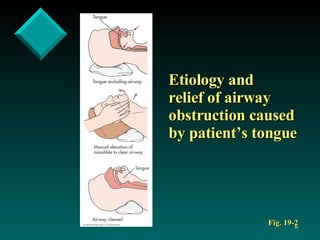
Etiology and  relief of airway obstruction caused by patient’s tongue Fig. 19-2
Nursing Management Respiratory Complications Nursing Diagnoses Ineffective airway clearance Ineffective breathing pattern Impaired gas exchange Risk for aspiration Potential complication: hypoxemia
Nursing Management Respiratory Complications Nursing Implementation What are some nursing actions that the nurse can implement for a client exhibiting respiratory complications?
Potential Complications in Cardiovascular Function Most common complications:  hypotension hypertension arrhythmia Greatest risk:  Cardiac history Elderly Debilitated or critically ill
Nursing Management Cardiovascular Complications Nursing Assessment What assessments need to be done to monitor the cardiovascular system?
Nursing Management Cardiovascular Complications Nursing Diagnoses Decreased cardiac output Deficient fluid volume Ineffective tissue perfusion Excess fluid volume Potential complication: hypovolemic shock
Nursing Management Cardiovascular Complications Nursing Implementation What interventions can the nurse expect to be done for someone exhibiting cardiovascular complications?
Nursing Management   Neurologic Complications Nursing Assessments for neurological system?
Nursing Management   Neurologic Complications Nursing Diagnoses Disturbed sensory perception Risk for injury Disturbed thought processes Impaired verbal communication Nursing Implementation?
Pain and Discomfort What nursing assessments can be done to assess for pain and discomfort? Nursing Diagnoses Acute pain Anxiety Nursing Implementation for pain management?
  Hypothermia Nursing Assessment? Nursing Diagnoses Hypothermia Risk for imbalanced body temperature Nursing Implementation?
Nausea and Vomiting Significant problems in postoperative period Responsible for unanticipated admission, increased discomfort, delays in discharge, and dissatisfaction with surgical experience
Nausea and Vomiting Nursing Assessment? Nursing Diagnoses Nausea Risk for aspiration Risk for deficient fluid volume Nursing Implementation
Care of Postoperative Patient   on Clinical Unit PACU nurse gives report to receiving nurse summarizing operative and postoperative periods Receiving nurse assists with transfer onto bed Vital signs obtained and compared to report
Potential Complications  in Respiratory Function Atelectasis and pneumonia commonly occur after abdominal and thoracic surgery
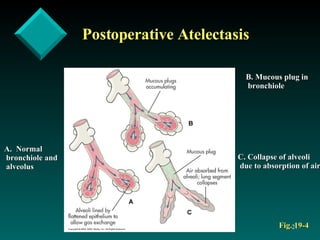
Postoperative Atelectasis Fig. 19-4 Normal  bronchiole and alveolus B. Mucous plug in bronchiole C. Collapse of alveoli due to absorption of air
Potential Complications  in Respiratory Function Nursing Diagnoses Ineffective airway clearance Ineffective breathing pattern Impaired gas exchange Potential complication: pneumonia Potential complication: atelectasis
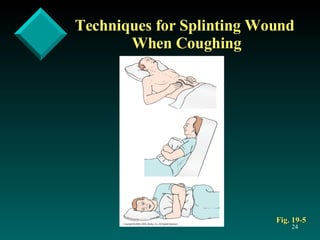
Potential Complications  in Respiratory Function Nursing Implementation Deep breathing and cough helps prevent alveolar collapse Incentive spirometer Splinting Diaphragmatic breathing Change position q2h
Techniques for Splinting Wound  When Coughing Fig. 19-5
Potential Alterations in Cardiovascular Function Fluid and electrolyte imbalances contribute to alterations Hypokalemia can result from urinary or GI losses DVT and pulmonary embolism Syncope
Nursing Management Cardiovascular Complications Nursing Assessment Regular monitoring of BP, HR, pulse, and skin temperature and color Compare with preoperative status and postoperative findings
Nursing Management Cardiovascular Complications Nursing Diagnoses Decreased cardiac output Deficient fluid volume Excess fluid volume Ineffective tissue perfusion Activity intolerance Potential complication: thromboembolism
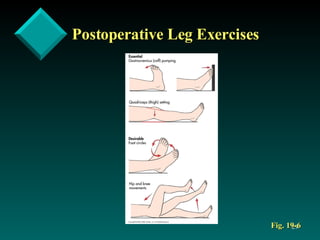
Nursing Management Cardiovascular Complications Nursing Implementation Accurate I&Os Monitor laboratory findings Assessment of infusion rate of fluid replacement and infusion site Adequate mouth care Leg exercises
Postoperative Leg Exercises Fig. 19-6
Nursing Management Cardiovascular Complications Elastic stockings or compressive devices Unfractionated or low-molecular-weight heparin Ambulation Slowly progress Monitor pulse Assess for feelings of faintness
Potential Alterations   in Urinary Function Low urinary output may be expected in the first 24 hours, regardless of intake
Nursing Management Urinary Complications Nursing Assessment Urine examined for quantity and quality Note color, amount, consistency, and odor Assess indwelling catheters for patency Urine output should be at least 0.5 ml/kg per hour or 30cc/hr.
Nursing Management Urinary Complications Nursing Diagnoses Impaired urinary elimination Potential complication: acute urinary retention
Nursing Management Urinary Complications Nursing Implementation Position patient for normal voiding Reassure patient of ability to void Use techniques such as running water, drinking water, pouring water over perineum, ambulation, or use of bedside commode
Potential Alterations in Gastrointestinal Function Nausea and vomiting may be caused from anesthetic agents or narcotics, delayed gastric emptying, slowed peristalsis, resumption of oral intake too soon after surgery Abdominal distention from decreased peristalsis caused by handling of bowel during surgery
Potential Alterations in Gastrointestinal Function Swallowed air and GI secretions may accumulate in colon, producing distention and gas pains Hiccoughs from irritation of phrenic nerve
Nursing Management   Gastrointestinal Complications Nursing Assessment Auscultate abdomen in all four quadrants for presence, frequency, and characteristics of bowel sounds Can be absent or diminished in immediate postoperative period Return of bowel motility accompanied by flatus
Potential Alterations in Gastrointestinal Function Nursing Diagnoses Nausea Imbalanced nutrition: less than body requirements Potential complication: paralytic ileus Potential complication: hiccoughs
Potential Alterations in Gastrointestinal Function Nursing Implementation May resume intake upon return of gag reflex NPO until return of bowel sounds for patient with abdominal surgery IVF, NG for decompression Clear liquids, advance as tolerated
Potential Alterations in Gastrointestinal Function Nursing Implementation   Regular mouth care when NPO Antiemetics administered  for nausea NG tube if symptoms persist Early and frequent ambulation to prevent abdominal distention Assess patient regularly for resumption of normal peristalsis
Potential Alterations in Gastrointestinal Function Nursing Implementation  Encourage patient to expel flatus and explain expulsion is necessary and desirable Relief of gas pains by frequent ambulation and repositioning Suppositories prn Determine cause of hiccoughs
Potential Alterations   of the Integument Incision disrupts skin barrier and healing is major concern during postoperative period Adequate nutrition Impaired wound healing with chronic disease and elderly Wound infection
Potential Alterations   of the Integument Evidence of wound infection usually not apparent until 3 rd  to 5 th  postoperative day Local manifestations of redness, edema, pain, and tenderness Systemic manifestations of leukocytosis and fever
Potential Alterations   of the Integument Accumulation of fluid in wound may impair healing and predispose to infection Drain may be placed
Nursing Management Surgical Wounds Nursing Assessment Knowledge of type of wound, drains, and expected drainage Drainage should change from sanguineous to serosanguineous to serous with decreasing output  Wound dehiscence may be preceded by sudden brown, pink, or clear discharge
Potential Alterations   of the Integument Nursing Diagnoses Risk for infection Potential complication: impaired wound healing
Potential Alterations   of the Integument Nursing Implementation Note type, amount, color, and consistency of drainage Assess affect of position changes on drainage
Potential Alterations   of the Integument Notify surgeon of excessive or abnormal drainage and significant changes in vitals Note number and type of drains when changing dressing Examine incision site Clean gloves and sterile technique
Pain and Discomfort Postoperative pain caused by a number of physiologic and psychologic interactions  Traumatization of skin and tissues Reflex muscle spasms Anxiety/fear increase muscle tone and spasm
Nursing Management Pain Nursing Assessment Nursing Diagnoses Acute pain Disturbed sensory perception Nursing Implementation
Potential Alterations in Temperature Hypothermia may be present in immediate postoperative period Fever may occur at any time Mild elevation (up to 38 degrees C) may result from stress response Moderate elevation (>38 °   C) usually caused by respiratory congestion or atelectasis and rarely by dehydration
Potential Alterations in Temperature Wound infection often accompanied by fever spiking in afternoon and near-normal in morning Can signal  C. difficile  when accompanied by diarrhea and abdominal pain Intermittent high with shaking chills and diaphoresis indicates septicemia
Nursing Management Altered Temperature Nursing Assessment Nursing Diagnoses Risk for imbalanced body temperature Hyperthermia Hypothermia
Nursing Management Altered Temperature Nursing Implementation Measure temperature q4h for first 48 hours postoperatively Asepsis with wound and IV sites Encourage airway clearance Chest x-rays and cultures if infection suspected Antipyretics and body-cooling >39.4 °  C
Potential Alterations in Psychologic Function Anxiety and depression may be more pronounced with radical surgery or with poor prognosis Confusion and delirium may result from psychological and physiologic sources
Nursing Management  Psychologic Function Nursing Diagnoses Anxiety Ineffective coping Disturbed body image Decisional conflict
Nursing Management  Psychologic Function Nursing Implementation Provide adequate support Listen and talk with patient, offer explanations, reassure, and encourage involvement of significant other Discuss expectation of activity and assistance needed after discharge
Nursing Management  Psychologic Function Patient must be included in discharge planning and provided with information and support to make informed decisions about continuing care Recognition of alcohol withdrawal syndrome Report any unusual behavior for immediate diagnosis and treatment
Planning for Discharge and  Follow-up Care Planning for discharge begins in preoperative period Provide information to patient and caregivers   What information is needed?

Post Op

  • 1.
  • 2.
    Care in thePACU- post anaesthetic care unit or recovery room ACP gives report to admitting PACU nurse What information would you want to know? Initial Assessment What should be included? What is the priority?
  • 3.
    Care in thePACU What should be included in the following assessments? Respiratory Assessment Cardiovascular Assessment Neurological Assessment
  • 4.
    Initial Assessments cont’din PACU Urinary assessment Wound assessment
  • 5.
    Potential Alterations inRespiratory Function Airway obstruction Hypoxemia Atelectasis Pulmonary edema Aspiration of gastric secretions Bronchospasm Hypoventilation
  • 6.
    Etiology and relief of airway obstruction caused by patient’s tongue Fig. 19-2
  • 7.
    Nursing Management RespiratoryComplications Nursing Diagnoses Ineffective airway clearance Ineffective breathing pattern Impaired gas exchange Risk for aspiration Potential complication: hypoxemia
  • 8.
    Nursing Management RespiratoryComplications Nursing Implementation What are some nursing actions that the nurse can implement for a client exhibiting respiratory complications?
  • 9.
    Potential Complications inCardiovascular Function Most common complications: hypotension hypertension arrhythmia Greatest risk: Cardiac history Elderly Debilitated or critically ill
  • 10.
    Nursing Management CardiovascularComplications Nursing Assessment What assessments need to be done to monitor the cardiovascular system?
  • 11.
    Nursing Management CardiovascularComplications Nursing Diagnoses Decreased cardiac output Deficient fluid volume Ineffective tissue perfusion Excess fluid volume Potential complication: hypovolemic shock
  • 12.
    Nursing Management CardiovascularComplications Nursing Implementation What interventions can the nurse expect to be done for someone exhibiting cardiovascular complications?
  • 13.
    Nursing Management Neurologic Complications Nursing Assessments for neurological system?
  • 14.
    Nursing Management Neurologic Complications Nursing Diagnoses Disturbed sensory perception Risk for injury Disturbed thought processes Impaired verbal communication Nursing Implementation?
  • 15.
    Pain and DiscomfortWhat nursing assessments can be done to assess for pain and discomfort? Nursing Diagnoses Acute pain Anxiety Nursing Implementation for pain management?
  • 16.
    HypothermiaNursing Assessment? Nursing Diagnoses Hypothermia Risk for imbalanced body temperature Nursing Implementation?
  • 17.
    Nausea and VomitingSignificant problems in postoperative period Responsible for unanticipated admission, increased discomfort, delays in discharge, and dissatisfaction with surgical experience
  • 18.
    Nausea and VomitingNursing Assessment? Nursing Diagnoses Nausea Risk for aspiration Risk for deficient fluid volume Nursing Implementation
  • 19.
    Care of PostoperativePatient on Clinical Unit PACU nurse gives report to receiving nurse summarizing operative and postoperative periods Receiving nurse assists with transfer onto bed Vital signs obtained and compared to report
  • 20.
    Potential Complications in Respiratory Function Atelectasis and pneumonia commonly occur after abdominal and thoracic surgery
  • 21.
    Postoperative Atelectasis Fig.19-4 Normal bronchiole and alveolus B. Mucous plug in bronchiole C. Collapse of alveoli due to absorption of air
  • 22.
    Potential Complications in Respiratory Function Nursing Diagnoses Ineffective airway clearance Ineffective breathing pattern Impaired gas exchange Potential complication: pneumonia Potential complication: atelectasis
  • 23.
    Potential Complications in Respiratory Function Nursing Implementation Deep breathing and cough helps prevent alveolar collapse Incentive spirometer Splinting Diaphragmatic breathing Change position q2h
  • 24.
    Techniques for SplintingWound When Coughing Fig. 19-5
  • 25.
    Potential Alterations inCardiovascular Function Fluid and electrolyte imbalances contribute to alterations Hypokalemia can result from urinary or GI losses DVT and pulmonary embolism Syncope
  • 26.
    Nursing Management CardiovascularComplications Nursing Assessment Regular monitoring of BP, HR, pulse, and skin temperature and color Compare with preoperative status and postoperative findings
  • 27.
    Nursing Management CardiovascularComplications Nursing Diagnoses Decreased cardiac output Deficient fluid volume Excess fluid volume Ineffective tissue perfusion Activity intolerance Potential complication: thromboembolism
  • 28.
    Nursing Management CardiovascularComplications Nursing Implementation Accurate I&Os Monitor laboratory findings Assessment of infusion rate of fluid replacement and infusion site Adequate mouth care Leg exercises
  • 29.
  • 30.
    Nursing Management CardiovascularComplications Elastic stockings or compressive devices Unfractionated or low-molecular-weight heparin Ambulation Slowly progress Monitor pulse Assess for feelings of faintness
  • 31.
    Potential Alterations in Urinary Function Low urinary output may be expected in the first 24 hours, regardless of intake
  • 32.
    Nursing Management UrinaryComplications Nursing Assessment Urine examined for quantity and quality Note color, amount, consistency, and odor Assess indwelling catheters for patency Urine output should be at least 0.5 ml/kg per hour or 30cc/hr.
  • 33.
    Nursing Management UrinaryComplications Nursing Diagnoses Impaired urinary elimination Potential complication: acute urinary retention
  • 34.
    Nursing Management UrinaryComplications Nursing Implementation Position patient for normal voiding Reassure patient of ability to void Use techniques such as running water, drinking water, pouring water over perineum, ambulation, or use of bedside commode
  • 35.
    Potential Alterations inGastrointestinal Function Nausea and vomiting may be caused from anesthetic agents or narcotics, delayed gastric emptying, slowed peristalsis, resumption of oral intake too soon after surgery Abdominal distention from decreased peristalsis caused by handling of bowel during surgery
  • 36.
    Potential Alterations inGastrointestinal Function Swallowed air and GI secretions may accumulate in colon, producing distention and gas pains Hiccoughs from irritation of phrenic nerve
  • 37.
    Nursing Management Gastrointestinal Complications Nursing Assessment Auscultate abdomen in all four quadrants for presence, frequency, and characteristics of bowel sounds Can be absent or diminished in immediate postoperative period Return of bowel motility accompanied by flatus
  • 38.
    Potential Alterations inGastrointestinal Function Nursing Diagnoses Nausea Imbalanced nutrition: less than body requirements Potential complication: paralytic ileus Potential complication: hiccoughs
  • 39.
    Potential Alterations inGastrointestinal Function Nursing Implementation May resume intake upon return of gag reflex NPO until return of bowel sounds for patient with abdominal surgery IVF, NG for decompression Clear liquids, advance as tolerated
  • 40.
    Potential Alterations inGastrointestinal Function Nursing Implementation Regular mouth care when NPO Antiemetics administered for nausea NG tube if symptoms persist Early and frequent ambulation to prevent abdominal distention Assess patient regularly for resumption of normal peristalsis
  • 41.
    Potential Alterations inGastrointestinal Function Nursing Implementation Encourage patient to expel flatus and explain expulsion is necessary and desirable Relief of gas pains by frequent ambulation and repositioning Suppositories prn Determine cause of hiccoughs
  • 42.
    Potential Alterations of the Integument Incision disrupts skin barrier and healing is major concern during postoperative period Adequate nutrition Impaired wound healing with chronic disease and elderly Wound infection
  • 43.
    Potential Alterations of the Integument Evidence of wound infection usually not apparent until 3 rd to 5 th postoperative day Local manifestations of redness, edema, pain, and tenderness Systemic manifestations of leukocytosis and fever
  • 44.
    Potential Alterations of the Integument Accumulation of fluid in wound may impair healing and predispose to infection Drain may be placed
  • 45.
    Nursing Management SurgicalWounds Nursing Assessment Knowledge of type of wound, drains, and expected drainage Drainage should change from sanguineous to serosanguineous to serous with decreasing output Wound dehiscence may be preceded by sudden brown, pink, or clear discharge
  • 46.
    Potential Alterations of the Integument Nursing Diagnoses Risk for infection Potential complication: impaired wound healing
  • 47.
    Potential Alterations of the Integument Nursing Implementation Note type, amount, color, and consistency of drainage Assess affect of position changes on drainage
  • 48.
    Potential Alterations of the Integument Notify surgeon of excessive or abnormal drainage and significant changes in vitals Note number and type of drains when changing dressing Examine incision site Clean gloves and sterile technique
  • 49.
    Pain and DiscomfortPostoperative pain caused by a number of physiologic and psychologic interactions Traumatization of skin and tissues Reflex muscle spasms Anxiety/fear increase muscle tone and spasm
  • 50.
    Nursing Management PainNursing Assessment Nursing Diagnoses Acute pain Disturbed sensory perception Nursing Implementation
  • 51.
    Potential Alterations inTemperature Hypothermia may be present in immediate postoperative period Fever may occur at any time Mild elevation (up to 38 degrees C) may result from stress response Moderate elevation (>38 ° C) usually caused by respiratory congestion or atelectasis and rarely by dehydration
  • 52.
    Potential Alterations inTemperature Wound infection often accompanied by fever spiking in afternoon and near-normal in morning Can signal C. difficile when accompanied by diarrhea and abdominal pain Intermittent high with shaking chills and diaphoresis indicates septicemia
  • 53.
    Nursing Management AlteredTemperature Nursing Assessment Nursing Diagnoses Risk for imbalanced body temperature Hyperthermia Hypothermia
  • 54.
    Nursing Management AlteredTemperature Nursing Implementation Measure temperature q4h for first 48 hours postoperatively Asepsis with wound and IV sites Encourage airway clearance Chest x-rays and cultures if infection suspected Antipyretics and body-cooling >39.4 ° C
  • 55.
    Potential Alterations inPsychologic Function Anxiety and depression may be more pronounced with radical surgery or with poor prognosis Confusion and delirium may result from psychological and physiologic sources
  • 56.
    Nursing Management Psychologic Function Nursing Diagnoses Anxiety Ineffective coping Disturbed body image Decisional conflict
  • 57.
    Nursing Management Psychologic Function Nursing Implementation Provide adequate support Listen and talk with patient, offer explanations, reassure, and encourage involvement of significant other Discuss expectation of activity and assistance needed after discharge
  • 58.
    Nursing Management Psychologic Function Patient must be included in discharge planning and provided with information and support to make informed decisions about continuing care Recognition of alcohol withdrawal syndrome Report any unusual behavior for immediate diagnosis and treatment
  • 59.
    Planning for Dischargeand Follow-up Care Planning for discharge begins in preoperative period Provide information to patient and caregivers What information is needed?