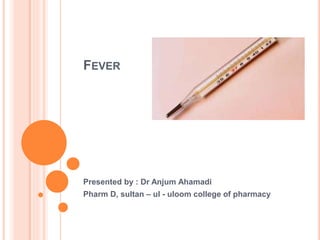
FEVER
Presented by : Dr Anjum Ahamadi
Pharm D, sultan – ul - uloom college of pharmacy
WHAT IS FEVER?
 A fever is a physiological problem when your body
temperature is above the normal range. An
elevated body temperature usually accompanies an
underlying condition. Your body increases your
temperature to help fight infection or signal a
problem from within.
 Normal range of body temperature - 98 to 100
degrees Fahrenheit. The immune system is trying
to remove the cause of your illness by making a
fever. Normally, it will resolve on its own within a
week at the most.
SIGNS AND SYMPTOMS
Depending on etiology the signs and symptoms can be :
 Sweating
 Chills and shivering
 Headache
 Muscle aches
 Loss of appetite
 Irritability
 Dehydration
 General weakness
 Children between the age group of 6 months and 5 years
may experience febrile seizures. About one third of
children may have recurrent febrile seizures, most
commonly within the next 12 months.
CHECKING OF TEMPERATURE
 Infants : Rectal region
 Paediatricts and adults :1.oral (below tongue),
2. underarms.
DRUGS:
Antibiotics ,
Anticonvulsants
etc
CANCER:
Medications
TYPES OF FEVER
 Intermittent fever : This fever has a fluctuating baseline
between normal temperatures and fever levels over the course of
the day. Fever raises and falls to normal every day.(37.2°C or
below). Fever at 48-hour intervals suggests Plasmodium
vivax or P. ovale; 72-hour intervals suggest P. malariae, while P.
falciparum often has an unsynchronized intermittent fever.
 Remittent fever : This type of fever may come and go, and
temperature fluctuates, but though it falls, it never falls all the way
back to normal. In these two patterns (intermittent and remittent)
the amplitude of temperature change is more than 0.3°C and less
than 1.4°C.
 Hectic fever : Either an intermittent or a remittent fever is
considered hectic if the temperature range swings widely
throughout the day, with a difference of at least 1.4 degrees
Celsius between the highest and lowest temperatures. (1.4°C or
more). Along with chills seen in TB, hypernephromas,
lymphomas, and drug reactions, abcess, pyelonephrities.
• Continuous fever :Also called a “sustained”
fever, this is a prolonged fever with little or no
change in temperature over the course of a day.
Sustained fever is a pattern in which there is
little change (0.3°C or less) in the elevated
temperature during a 24-hour period. typhoid
fever or typhus, although commonly seen in
bacterial endocarditis, tuberculosis, fungal
disease, and bacterial pneumonia.
Noninfectious etiologies include neoplasms,
connective tissue disease, and drug fever.
• Relapsing : This is a type of
intermittent fever that spikes up
again after days or weeks of
normal temperatures. This type of
fever is seen in rat-bite fever,
malaria, cholangitis, infections
with Borrelia recurrentis, Hodgkin's
disease (Pel-Ebstein fever), and
other neoplasms.
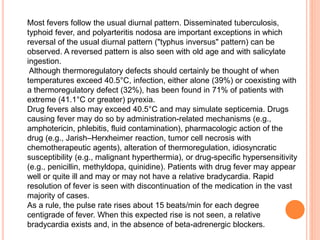
Most fevers follow the usual diurnal pattern. Disseminated tuberculosis,
typhoid fever, and polyarteritis nodosa are important exceptions in which
reversal of the usual diurnal pattern ("typhus inversus" pattern) can be
observed. A reversed pattern is also seen with old age and with salicylate
ingestion.
Although thermoregulatory defects should certainly be thought of when
temperatures exceed 40.5°C, infection, either alone (39%) or coexisting with
a thermoregulatory defect (32%), has been found in 71% of patients with
extreme (41.1°C or greater) pyrexia.
Drug fevers also may exceed 40.5°C and may simulate septicemia. Drugs
causing fever may do so by administration-related mechanisms (e.g.,
amphotericin, phlebitis, fluid contamination), pharmacologic action of the
drug (e.g., Jarish–Herxheimer reaction, tumor cell necrosis with
chemotherapeutic agents), alteration of thermoregulation, idiosyncratic
susceptibility (e.g., malignant hyperthermia), or drug-specific hypersensitivity
(e.g., penicillin, methyldopa, quinidine). Patients with drug fever may appear
well or quite ill and may or may not have a relative bradycardia. Rapid
resolution of fever is seen with discontinuation of the medication in the vast
majority of cases.
As a rule, the pulse rate rises about 15 beats/min for each degree
centigrade of fever. When this expected rise is not seen, a relative
bradycardia exists and, in the absence of beta-adrenergic blockers.
FACTORS INVOLVED
 Endogenous pyrogens : Interleukin-1, interferon-
alpha, tumor necrosis factor.
1. Interleukin-1: identical to lymphocyte activating
factors, hence in addition to fever modulate large
no. of host defence mechanism via T helper cells.
2. TNF-alpha: similar to IL1 but doesnot activate
lymphocytes.
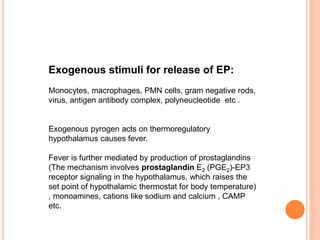
Exogenous stimuli for release of EP:
Monocytes, macrophages, PMN cells, gram negative rods,
virus, antigen antibody complex, polyneucleotide etc .
Exogenous pyrogen acts on thermoregulatory
hypothalamus causes fever.
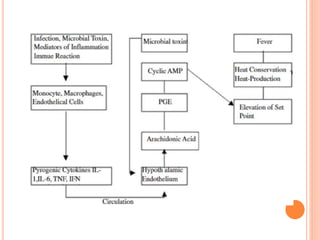
Fever is further mediated by production of prostaglandins
(The mechanism involves prostaglandin E2 (PGE2)-EP3
receptor signaling in the hypothalamus, which raises the
set point of hypothalamic thermostat for body temperature)
, monoamines, cations like sodium and calcium , CAMP
etc.
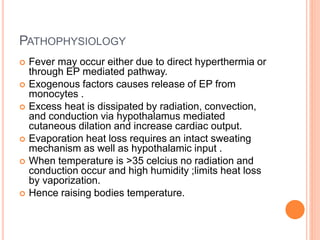
PATHOPHYSIOLOGY
 Fever may occur either due to direct hyperthermia or
through EP mediated pathway.
 Exogenous factors causes release of EP from
monocytes .
 Excess heat is dissipated by radiation, convection,
and conduction via hypothalamus mediated
cutaneous dilation and increase cardiac output.
 Evaporation heat loss requires an intact sweating
mechanism as well as hypothalamic input .
 When temperature is >35 celcius no radiation and
conduction occur and high humidity ;limits heat loss
by vaporization.
 Hence raising bodies temperature.
TREATMENT
Non pharmacological
treatment :
Plenty of fluids : It is important to drink plenty of
fluids and stay hydrated. Especially if you have the
flu or gastroenteritis which may cause you to lose
many fluids. Drinking water, broth, or oral
electrolytes to replenish those fluids.
Digestible foods : eating crackers, soup, or rice
will help ease your stomach while still getting
necessary nutrients.
Warm bath : A slightly warm bath or warm, damp
washcloths on your forehead and wrists may ease
PHARMACOLOGICAL THERAPY
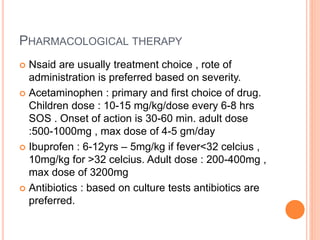
 Nsaid are usually treatment choice , rote of
administration is preferred based on severity.
 Acetaminophen : primary and first choice of drug.
Children dose : 10-15 mg/kg/dose every 6-8 hrs
SOS . Onset of action is 30-60 min. adult dose
:500-1000mg , max dose of 4-5 gm/day
 Ibuprofen : 6-12yrs – 5mg/kg if fever<32 celcius ,
10mg/kg for >32 celcius. Adult dose : 200-400mg ,
max dose of 3200mg
 Antibiotics : based on culture tests antibiotics are
preferred.
Fever

Fever

  • 1.
    FEVER Presented by :Dr Anjum Ahamadi Pharm D, sultan – ul - uloom college of pharmacy
  • 2.
    WHAT IS FEVER? A fever is a physiological problem when your body temperature is above the normal range. An elevated body temperature usually accompanies an underlying condition. Your body increases your temperature to help fight infection or signal a problem from within.  Normal range of body temperature - 98 to 100 degrees Fahrenheit. The immune system is trying to remove the cause of your illness by making a fever. Normally, it will resolve on its own within a week at the most.
  • 3.
    SIGNS AND SYMPTOMS Dependingon etiology the signs and symptoms can be :  Sweating  Chills and shivering  Headache  Muscle aches  Loss of appetite  Irritability  Dehydration  General weakness  Children between the age group of 6 months and 5 years may experience febrile seizures. About one third of children may have recurrent febrile seizures, most commonly within the next 12 months.
  • 4.
    CHECKING OF TEMPERATURE Infants : Rectal region  Paediatricts and adults :1.oral (below tongue), 2. underarms.
  • 5.
  • 6.
    TYPES OF FEVER Intermittent fever : This fever has a fluctuating baseline between normal temperatures and fever levels over the course of the day. Fever raises and falls to normal every day.(37.2°C or below). Fever at 48-hour intervals suggests Plasmodium vivax or P. ovale; 72-hour intervals suggest P. malariae, while P. falciparum often has an unsynchronized intermittent fever.  Remittent fever : This type of fever may come and go, and temperature fluctuates, but though it falls, it never falls all the way back to normal. In these two patterns (intermittent and remittent) the amplitude of temperature change is more than 0.3°C and less than 1.4°C.  Hectic fever : Either an intermittent or a remittent fever is considered hectic if the temperature range swings widely throughout the day, with a difference of at least 1.4 degrees Celsius between the highest and lowest temperatures. (1.4°C or more). Along with chills seen in TB, hypernephromas, lymphomas, and drug reactions, abcess, pyelonephrities.
  • 7.
    • Continuous fever:Also called a “sustained” fever, this is a prolonged fever with little or no change in temperature over the course of a day. Sustained fever is a pattern in which there is little change (0.3°C or less) in the elevated temperature during a 24-hour period. typhoid fever or typhus, although commonly seen in bacterial endocarditis, tuberculosis, fungal disease, and bacterial pneumonia. Noninfectious etiologies include neoplasms, connective tissue disease, and drug fever.
  • 8.
    • Relapsing :This is a type of intermittent fever that spikes up again after days or weeks of normal temperatures. This type of fever is seen in rat-bite fever, malaria, cholangitis, infections with Borrelia recurrentis, Hodgkin's disease (Pel-Ebstein fever), and other neoplasms.
  • 9.
    Most fevers followthe usual diurnal pattern. Disseminated tuberculosis, typhoid fever, and polyarteritis nodosa are important exceptions in which reversal of the usual diurnal pattern ("typhus inversus" pattern) can be observed. A reversed pattern is also seen with old age and with salicylate ingestion. Although thermoregulatory defects should certainly be thought of when temperatures exceed 40.5°C, infection, either alone (39%) or coexisting with a thermoregulatory defect (32%), has been found in 71% of patients with extreme (41.1°C or greater) pyrexia. Drug fevers also may exceed 40.5°C and may simulate septicemia. Drugs causing fever may do so by administration-related mechanisms (e.g., amphotericin, phlebitis, fluid contamination), pharmacologic action of the drug (e.g., Jarish–Herxheimer reaction, tumor cell necrosis with chemotherapeutic agents), alteration of thermoregulation, idiosyncratic susceptibility (e.g., malignant hyperthermia), or drug-specific hypersensitivity (e.g., penicillin, methyldopa, quinidine). Patients with drug fever may appear well or quite ill and may or may not have a relative bradycardia. Rapid resolution of fever is seen with discontinuation of the medication in the vast majority of cases. As a rule, the pulse rate rises about 15 beats/min for each degree centigrade of fever. When this expected rise is not seen, a relative bradycardia exists and, in the absence of beta-adrenergic blockers.
  • 11.
    FACTORS INVOLVED  Endogenouspyrogens : Interleukin-1, interferon- alpha, tumor necrosis factor. 1. Interleukin-1: identical to lymphocyte activating factors, hence in addition to fever modulate large no. of host defence mechanism via T helper cells. 2. TNF-alpha: similar to IL1 but doesnot activate lymphocytes.
  • 12.
    Exogenous stimuli forrelease of EP: Monocytes, macrophages, PMN cells, gram negative rods, virus, antigen antibody complex, polyneucleotide etc . Exogenous pyrogen acts on thermoregulatory hypothalamus causes fever. Fever is further mediated by production of prostaglandins (The mechanism involves prostaglandin E2 (PGE2)-EP3 receptor signaling in the hypothalamus, which raises the set point of hypothalamic thermostat for body temperature) , monoamines, cations like sodium and calcium , CAMP etc.
  • 14.
    PATHOPHYSIOLOGY  Fever mayoccur either due to direct hyperthermia or through EP mediated pathway.  Exogenous factors causes release of EP from monocytes .  Excess heat is dissipated by radiation, convection, and conduction via hypothalamus mediated cutaneous dilation and increase cardiac output.  Evaporation heat loss requires an intact sweating mechanism as well as hypothalamic input .  When temperature is >35 celcius no radiation and conduction occur and high humidity ;limits heat loss by vaporization.  Hence raising bodies temperature.
  • 16.
    TREATMENT Non pharmacological treatment : Plentyof fluids : It is important to drink plenty of fluids and stay hydrated. Especially if you have the flu or gastroenteritis which may cause you to lose many fluids. Drinking water, broth, or oral electrolytes to replenish those fluids. Digestible foods : eating crackers, soup, or rice will help ease your stomach while still getting necessary nutrients. Warm bath : A slightly warm bath or warm, damp washcloths on your forehead and wrists may ease
  • 17.
    PHARMACOLOGICAL THERAPY  Nsaidare usually treatment choice , rote of administration is preferred based on severity.  Acetaminophen : primary and first choice of drug. Children dose : 10-15 mg/kg/dose every 6-8 hrs SOS . Onset of action is 30-60 min. adult dose :500-1000mg , max dose of 4-5 gm/day  Ibuprofen : 6-12yrs – 5mg/kg if fever<32 celcius , 10mg/kg for >32 celcius. Adult dose : 200-400mg , max dose of 3200mg  Antibiotics : based on culture tests antibiotics are preferred.