V.S.Rashmi Priyem
IIYear B.D.S.
ULTRAโ€™S BEST Dental Science College, Madurai
โ–ช Introduction
โ–ช Classification of Hypersensitivity Reactions
โ–ช Type I
โ–ช Anaphylaxis
โ–ช Atopy
โ–ช Type II
โ–ช Hypersensitivity in Dentistry
โ–ช Allergic to Any Medications ?
โ–ช Have you Ever had a Reaction to a Anaesthetic ?
โ–ช IfYes, Describe what Happened ?
โ–ช Was Treatment Given ? If So,What ?
โ–ช Hypersensitivity refers to the Undesirable Injurious
Consequences in the Sensitised Host, following
Contact with Specific Antigens.
โ–ช Result of Inappropriate Immune Reaction.
IMPortant 2M
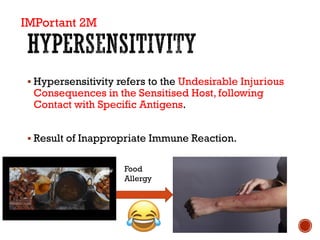
Food
Allergy
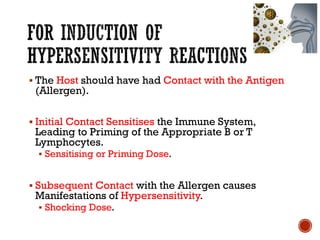
โ–ช The Host should have had Contact with the Antigen
(Allergen).
โ–ช Initial Contact Sensitises the Immune System,
Leading to Priming of the Appropriate B or T
Lymphocytes.
โ–ช Sensitising or Priming Dose.
โ–ช Subsequent Contact with the Allergen causes
Manifestations of Hypersensitivity.
โ–ช Shocking Dose.
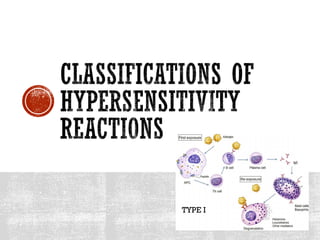
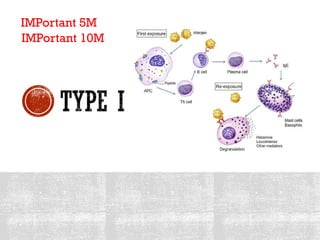
TYPE I
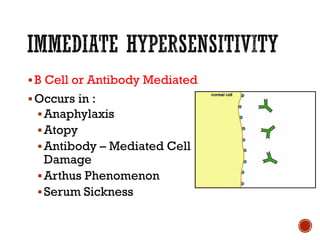
โ–ชB Cell or Antibody Mediated
โ–ชOccurs in :
โ–ชAnaphylaxis
โ–ชAtopy
โ–ชAntibody โ€“ Mediated Cell
Damage
โ–ชArthus Phenomenon
โ–ชSerum Sickness
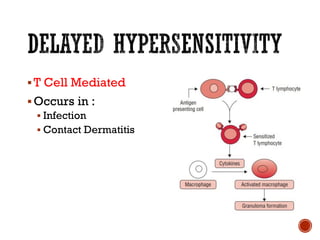
โ–ชT Cell Mediated
โ–ชOccurs in :
โ–ช Infection
โ–ช Contact Dermatitis
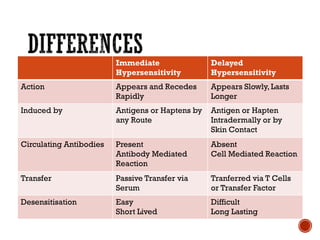
Immediate
Hypersensitivity
Delayed
Hypersensitivity
Action Appears and Recedes
Rapidly
Appears Slowly, Lasts
Longer
Induced by Antigens or Haptens by
any Route
Antigen or Hapten
Intradermally or by
Skin Contact
Circulating Antibodies Present
Antibody Mediated
Reaction
Absent
Cell Mediated Reaction
Transfer Passive Transfer via
Serum
Tranferred via T Cells
or Transfer Factor
Desensitisation Easy
Short Lived
Difficult
Long Lasting
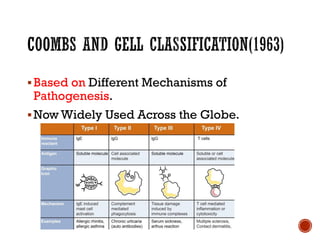
โ–ชBased on Different Mechanisms of
Pathogenesis.
โ–ชNow Widely Used Across the Globe.
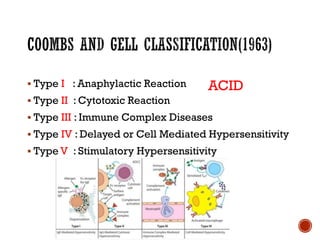
โ–ช Type I : Anaphylactic Reaction
โ–ช Type II : Cytotoxic Reaction
โ–ช Type III : Immune Complex Diseases
โ–ช Type IV : Delayed or Cell Mediated Hypersensitivity
โ–ช Type V : Stimulatory Hypersensitivity
ACID
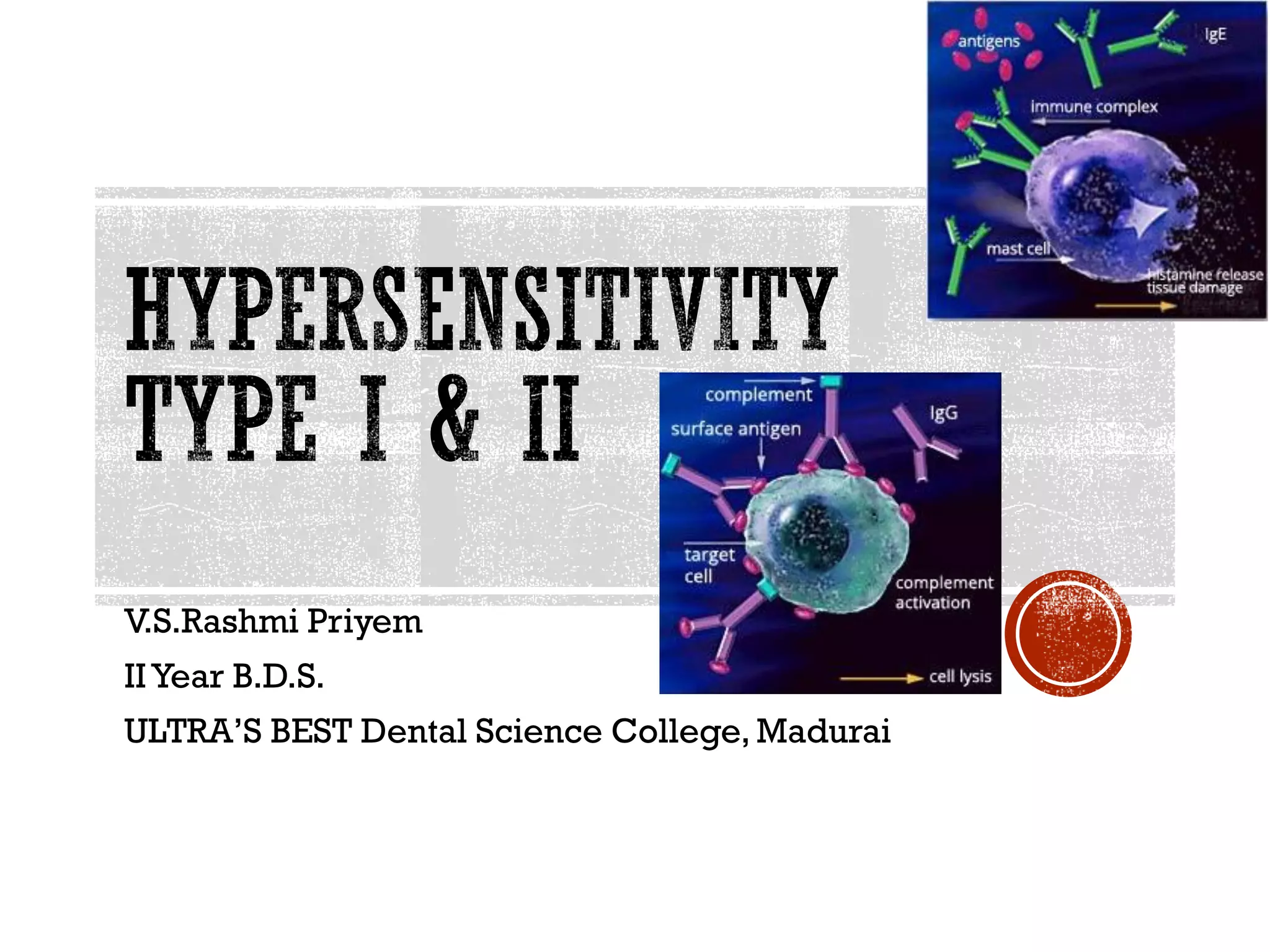
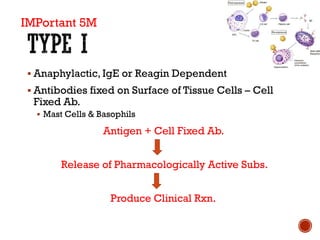
โ–ช Anaphylactic, IgE or Reagin Dependent
โ–ช Antibodies fixed on Surface of Tissue Cells โ€“ Cell
Fixed Ab.
โ–ช Mast Cells & Basophils
Antigen + Cell Fixed Ab.
Release of Pharmacologically Active Subs.
Produce Clinical Rxn.
IMPortant 5M
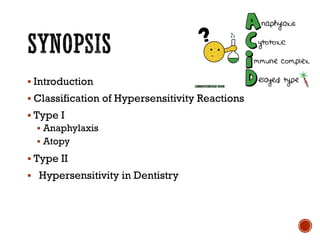
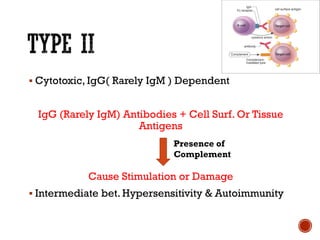
โ–ช Cytotoxic, IgG( Rarely IgM ) Dependent
IgG (Rarely IgM) Antibodies + Cell Surf. Or Tissue
Antigens
Cause Stimulation or Damage
โ–ช Intermediate bet. Hypersensitivity & Autoimmunity
Presence of
Complement
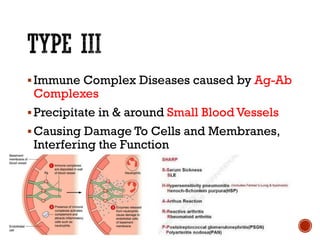
โ–ชImmune Complex Diseases caused by Ag-Ab
Complexes
โ–ชPrecipitate in & around Small Blood Vessels
โ–ชCausing Damage To Cells and Membranes,
Interfering the Function
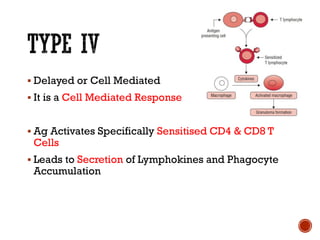
โ–ช Delayed or Cell Mediated
โ–ช It is a Cell Mediated Response
โ–ช Ag Activates Specifically Sensitised CD4 & CD8 T
Cells
โ–ช Leads to Secretion of Lymphokines and Phagocyte
Accumulation
โ–ช A Collective Term for the Four Enzyme Cascadesโ€”
the Complement, Coagulation, Fibrinolytic, and Kinin
Systems
โ–ช The Pathology and Clinical Features of
Immunological Diseases would also be Influenced by
the Mechanisms such as Inflammation, Complement,
Coagulation, Fibrinolytic and Kininogenic Systems
IMPortant 2M
IMPortant 5M
IMPortant 10M
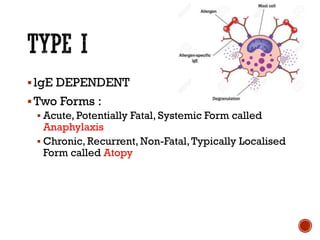
โ–ชlgE DEPENDENT
โ–ชTwo Forms :
โ–ช Acute, Potentially Fatal, Systemic Form called
Anaphylaxis
โ–ช Chronic, Recurrent, Non-Fatal,Typically Localised
Form called Atopy
โ–ช Classical Immediate Hypersensitivity Reaction.
โ–ช Antigens and Haptens can Induce Anaphylaxis.
โ–ช Haptens โ€“ Primitive Molecule Which Elicit Prod. Of Ab
โ–ช Interval of atleast 2-3 weeks between the Sensitising
and Shocking Dose.
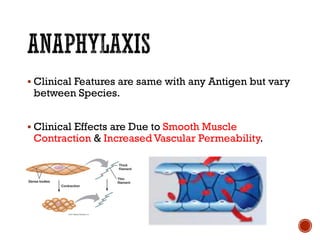
โ–ช Clinical Features are same with any Antigen but vary
between Species.
โ–ช Clinical Effects are Due to Smooth Muscle
Contraction & Increased Vascular Permeability.
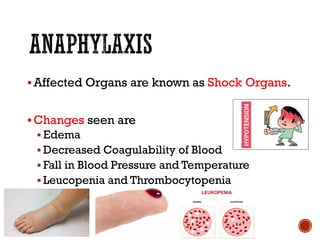
โ–ชAffected Organs are known as Shock Organs.
โ–ชChanges seen are
โ–ช Edema
โ–ช Decreased Coagulability of Blood
โ–ช Fall in Blood Pressure and Temperature
โ–ช Leucopenia and Thrombocytopenia
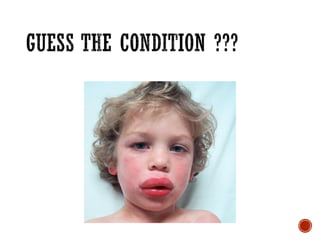
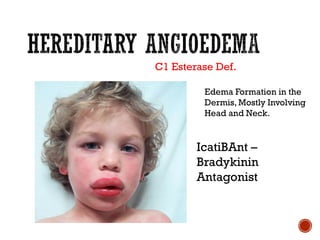
Edema Formation in the
Dermis, Mostly Involving
Head and Neck.
IcatiBAnt โ€“
Bradykinin
Antagonist
C1 Esterase Def.
โ–ชHuman Anaphylaxis, Previously associated
with Heterologous Serum Therapy, is Now
seen mostly following Injection of Antibiotics
or other drugs.
โ–ชPrompt Treatment with Adrenaline can be
Life-Saving.
โ–ช 0.5ml of a 1 in 1000 Soln. Subcutaneously or
Intramuscularly.
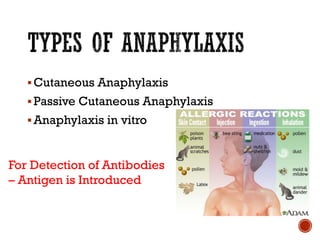
โ–ชCutaneous Anaphylaxis
โ–ชPassive Cutaneous Anaphylaxis
โ–ชAnaphylaxis in vitro
For Detection of Antibodies
โ€“ Antigen is Introduced
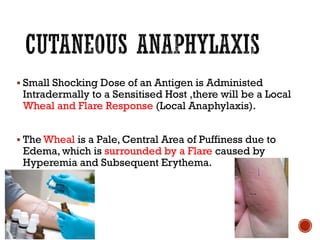
โ–ช Small Shocking Dose of an Antigen is Administed
Intradermally to a Sensitised Host ,there will be a Local
Wheal and Flare Response (Local Anaphylaxis).
โ–ช The Wheal is a Pale, Central Area of Puffiness due to
Edema, which is surrounded by a Flare caused by
Hyperemia and Subsequent Erythema.
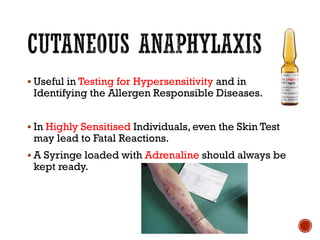
โ–ช Useful in Testing for Hypersensitivity and in
Identifying the Allergen Responsible Diseases.
โ–ช In Highly Sensitised Individuals, even the Skin Test
may lead to Fatal Reactions.
โ–ช A Syringe loaded with Adrenaline should always be
kept ready.
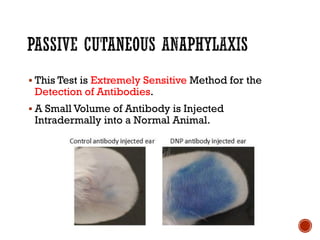
โ–ช This Test is Extremely Sensitive Method for the
Detection of Antibodies.
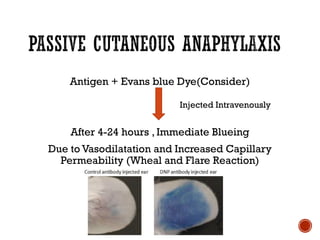
โ–ช A Small Volume of Antibody is Injected
Intradermally into a Normal Animal.
Antigen + Evans blue Dye(Consider)
After 4-24 hours , Immediate Blueing
Due to Vasodilatation and Increased Capillary
Permeability (Wheal and Flare Reaction)
Injected Intravenously
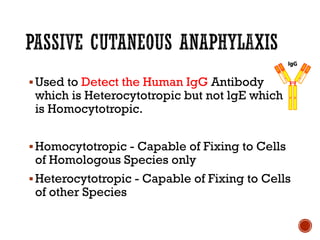
โ–ชUsed to Detect the Human IgG Antibody
which is Heterocytotropic but not lgE which
is Homocytotropic.
โ–ชHomocytotropic - Capable of Fixing to Cells
of Homologous Species only
โ–ชHeterocytotropic - Capable of Fixing to Cells
of other Species
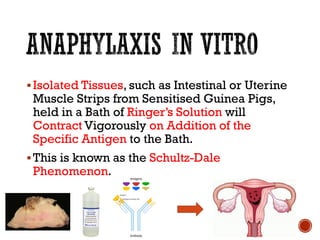
โ–ชIsolated Tissues, such as Intestinal or Uterine
Muscle Strips from Sensitised Guinea Pigs,
held in a Bath of Ringerโ€™s Solution will
Contract Vigorously on Addition of the
Specific Antigen to the Bath.
โ–ชThis is known as the Schultz-Dale
Phenomenon.
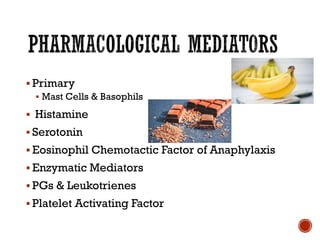
โ–ช Primary
โ–ช Mast Cells & Basophils
โ–ช Histamine
โ–ช Serotonin
โ–ช Eosinophil Chemotactic Factor of Anaphylaxis
โ–ช Enzymatic Mediators
โ–ช PGs & Leukotrienes
โ–ช Platelet Activating Factor
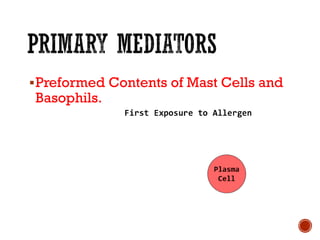
โ–ชPreformed Contents of Mast Cells and
Basophils.
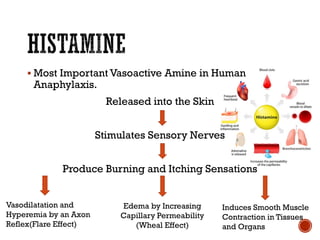
โ–ช Most Important Vasoactive Amine in Human
Anaphylaxis.
Released into the Skin
Stimulates Sensory Nerves
Produce Burning and Itching Sensations
Vasodilatation and
Hyperemia by an Axon
Reflex(Flare Effect)
Edema by Increasing
Capillary Permeability
(Wheal Effect)
Induces Smooth Muscle
Contraction in Tissues
and Organs
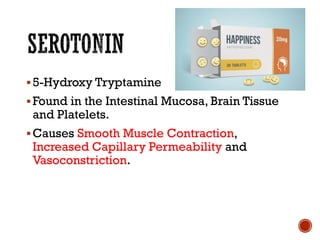
โ–ช5-Hydroxy Tryptamine
โ–ชFound in the Intestinal Mucosa, Brain Tissue
and Platelets.
โ–ชCauses Smooth Muscle Contraction,
Increased Capillary Permeability and
Vasoconstriction.
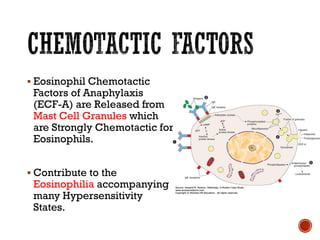
โ–ช Eosinophil Chemotactic
Factors of Anaphylaxis
(ECF-A) are Released from
Mast Cell Granules which
are Strongly Chemotactic for
Eosinophils.
โ–ช Contribute to the
Eosinophilia accompanying
many Hypersensitivity
States.
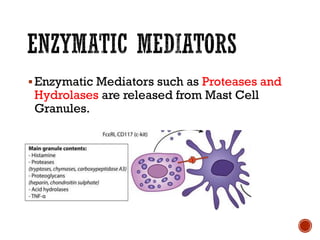
โ–ชEnzymatic Mediators such as Proteases and
Hydrolases are released from Mast Cell
Granules.
โ–ช The Lipoxygenase Pathway leads to the Formation of
Leukotrienes.
โ–ช The Cyclo-oxygenase Pathway leads to the
Formation of Prostaglandins and Thromboxane.
โ–ช Prostaglandin F2ฮฑ and Thromboxane A2 are
Powerful but Transient Bronchoconstrictors.
โ–ช PGs Affect Secretion by Mucous Glands, Platelet
Adhesion, Permeability and Dilatation of Capillaries
and the Pain Threshold.
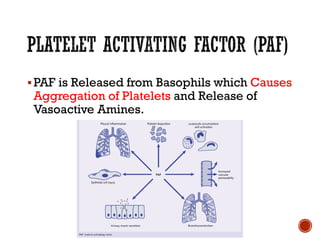
โ–ชPAF is Released from Basophils which Causes
Aggregation of Platelets and Release of
Vasoactive Amines.
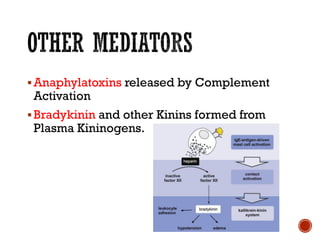
โ–ชAnaphylatoxins released by Complement
Activation
โ–ชBradykinin and other Kinins formed from
Plasma Kininogens.
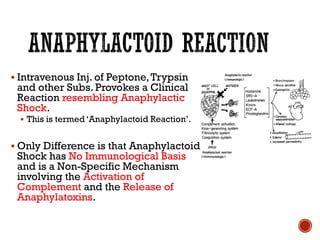
โ–ช Intravenous Inj. of Peptone,Trypsin
and other Subs. Provokes a Clinical
Reaction resembling Anaphylactic
Shock.
โ–ช This is termed โ€˜Anaphylactoid Reactionโ€™.
โ–ช Only Difference is that Anaphylactoid
Shock has No Immunological Basis
and is a Non-Specific Mechanism
involving the Activation of
Complement and the Release of
Anaphylatoxins.
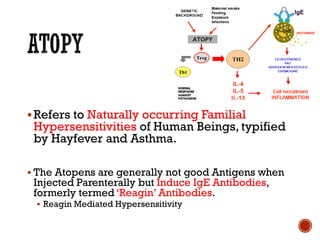
โ–ชRefers to Naturally occurring Familial
Hypersensitivities of Human Beings, typified
by Hayfever and Asthma.
โ–ช The Atopens are generally not good Antigens when
Injected Parenterally but Induce IgE Antibodies,
formerly termed โ€˜Reaginโ€™ Antibodies.
โ–ช Reagin Mediated Hypersensitivity
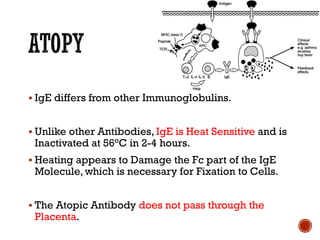
โ–ช IgE differs from other Immunoglobulins.
โ–ช Unlike other Antibodies, IgE is Heat Sensitive and is
Inactivated at 56ยฐC in 2-4 hours.
โ–ช Heating appears to Damage the Fc part of the IgE
Molecule, which is necessary for Fixation to Cells.
โ–ช The Atopic Antibody does not pass through the
Placenta.
Guess The Personality ?
He is Related To _____ .
Prausnitz-Kustner
(PK) Reaction
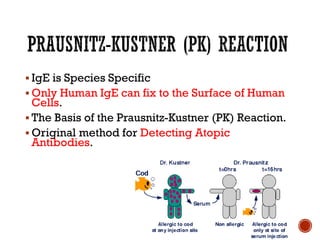
โ–ช IgE is Species Specific
โ–ช Only Human IgE can fix to the Surface of Human
Cells.
โ–ช The Basis of the Prausnitz-Kustner (PK) Reaction.
โ–ช Original method for Detecting Atopic
Antibodies.
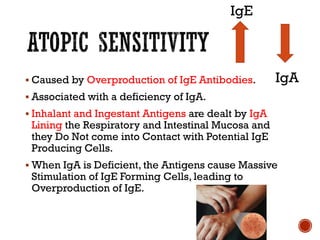
โ–ช Caused by Overproduction of IgE Antibodies.
โ–ช Associated with a deficiency of IgA.
โ–ช Inhalant and Ingestant Antigens are dealt by IgA
Lining the Respiratory and Intestinal Mucosa and
they Do Not come into Contact with Potential IgE
Producing Cells.
โ–ช When IgA is Deficient, the Antigens cause Massive
Stimulation of IgE Forming Cells, leading to
Overproduction of IgE.
IgE
IgA
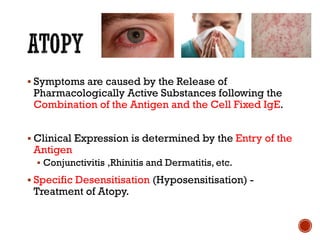
โ–ช Symptoms are caused by the Release of
Pharmacologically Active Substances following the
Combination of the Antigen and the Cell Fixed IgE.
โ–ช Clinical Expression is determined by the Entry of the
Antigen
โ–ช Conjunctivitis ,Rhinitis and Dermatitis, etc.
โ–ช Specific Desensitisation (Hyposensitisation) -
Treatment of Atopy.
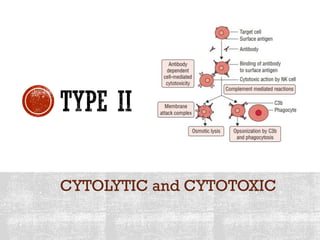
CYTOLYTIC and CYTOTOXIC
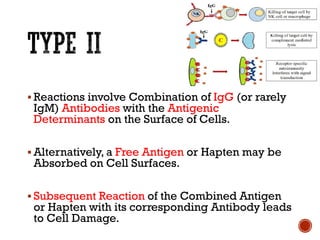
โ–ช Reactions involve Combination of IgG (or rarely
IgM) Antibodies with the Antigenic
Determinants on the Surface of Cells.
โ–ช Alternatively, a Free Antigen or Hapten may be
Absorbed on Cell Surfaces.
โ–ช Subsequent Reaction of the Combined Antigen
or Hapten with its corresponding Antibody leads
to Cell Damage.
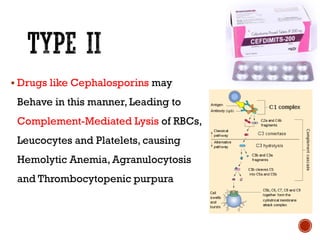
โ–ช Drugs like Cephalosporins may
Behave in this manner, Leading to
Complement-Mediated Lysis of RBCs,
Leucocytes and Platelets, causing
Hemolytic Anemia, Agranulocytosis
and Thrombocytopenic purpura
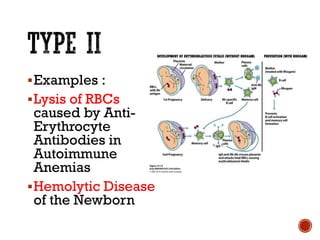
โ–ชExamples :
โ–ชLysis of RBCs
caused by Anti-
Erythrocyte
Antibodies in
Autoimmune
Anemias
โ–ชHemolytic Disease
of the Newborn
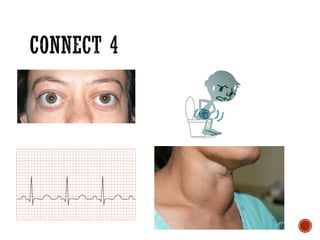
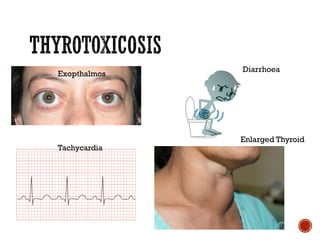
Exopthalmos
Diarrhoea
Tachycardia
Enlarged Thyroid
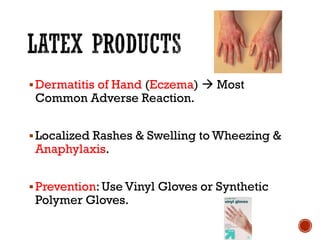
โ–ชDermatitis of Hand (Eczema) โ†’ Most
Common Adverse Reaction.
โ–ชLocalized Rashes & Swelling to Wheezing &
Anaphylaxis.
โ–ชPrevention: Use Vinyl Gloves or Synthetic
Polymer Gloves.
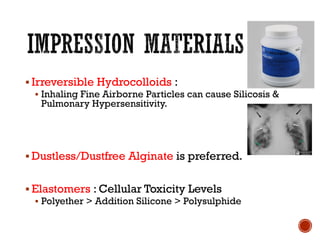
โ–ช Irreversible Hydrocolloids :
โ–ช Inhaling Fine Airborne Particles can cause Silicosis &
Pulmonary Hypersensitivity.
โ–ช Dustless/Dustfree Alginate is preferred.
โ–ช Elastomers : Cellular Toxicity Levels
โ–ช Polyether > Addition Silicone > Polysulphide
โ–ช Heavy Metals like Lead and Silica particles are
present in the Alginate powder.
โ–ช Have Potential Toxicity Risk for Both Practitioner and Patient.
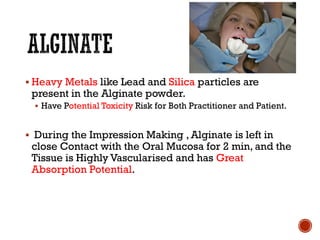
โ–ช During the Impression Making , Alginate is left in
close Contact with the Oral Mucosa for 2 min, and the
Tissue is Highly Vascularised and has Great
Absorption Potential.
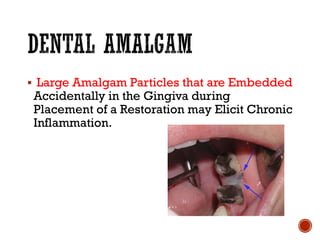
โ–ช Large Amalgam Particles that are Embedded
Accidentally in the Gingiva during
Placement of a Restoration may Elicit Chronic
Inflammation.
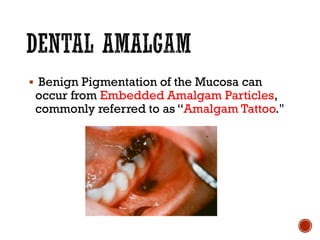
โ–ช Benign Pigmentation of the Mucosa can
occur from Embedded Amalgam Particles,
commonly referred to as โ€œAmalgam Tattoo."
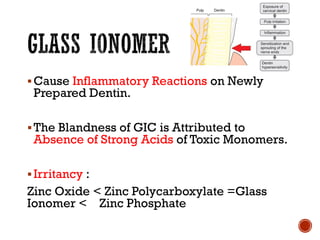
โ–ชCause Inflammatory Reactions on Newly
Prepared Dentin.
โ–ชThe Blandness of GIC is Attributed to
Absence of Strong Acids of Toxic Monomers.
โ–ชIrritancy :
Zinc Oxide < Zinc Polycarboxylate =Glass
Ionomer < Zinc Phosphate
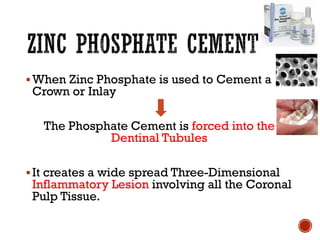
โ–ชWhen Zinc Phosphate is used to Cement a
Crown or Inlay
The Phosphate Cement is forced into the
Dentinal Tubules
โ–ชIt creates a wide spread Three-Dimensional
Inflammatory Lesion involving all the Coronal
Pulp Tissue.
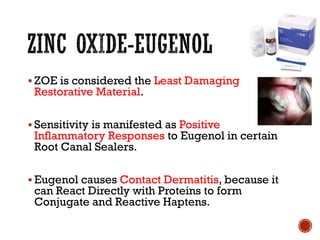
โ–ช ZOE is considered the Least Damaging
Restorative Material.
โ–ช Sensitivity is manifested as Positive
Inflammatory Responses to Eugenol in certain
Root Canal Sealers.
โ–ช Eugenol causes Contact Dermatitis, because it
can React Directly with Proteins to form
Conjugate and Reactive Haptens.
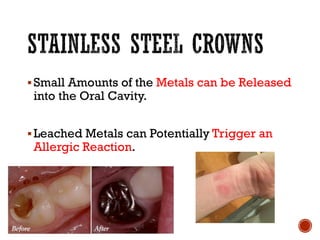
โ–ชSmall Amounts of the Metals can be Released
into the Oral Cavity.
โ–ชLeached Metals can Potentially Trigger an
Allergic Reaction.
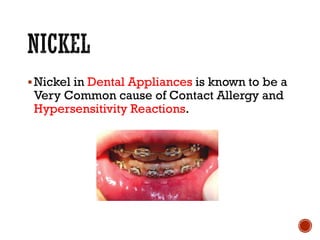
โ–ชNickel in Dental Appliances is known to be a
Very Common cause of Contact Allergy and
Hypersensitivity Reactions.
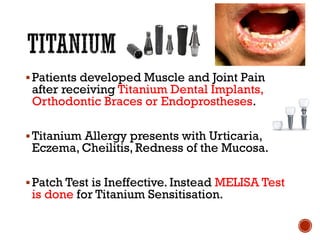
โ–ชPatients developed Muscle and Joint Pain
after receiving Titanium Dental Implants,
Orthodontic Braces or Endoprostheses.
โ–ชTitanium Allergy presents with Urticaria,
Eczema, Cheilitis, Redness of the Mucosa.
โ–ชPatch Test is Ineffective. Instead MELISA Test
is done for Titanium Sensitisation.
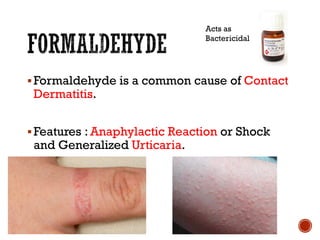
โ–ชFormaldehyde is a common cause of Contact
Dermatitis.
โ–ชFeatures : Anaphylactic Reaction or Shock
and Generalized Urticaria.
Acts as
Bactericidal
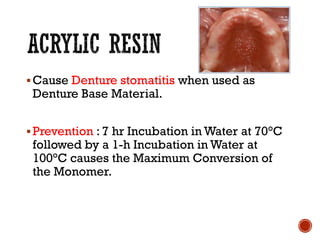
โ–ชCause Denture stomatitis when used as
Denture Base Material.
โ–ชPrevention : 7 hr Incubation in Water at 70ยฐC
followed by a 1-h Incubation in Water at
100ยฐC causes the Maximum Conversion of
the Monomer.
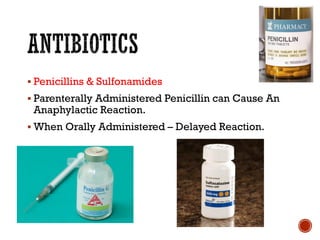
โ–ช Penicillins & Sulfonamides
โ–ช Parenterally Administered Penicillin can Cause An
Anaphylactic Reaction.
โ–ช When Orally Administered โ€“ Delayed Reaction.
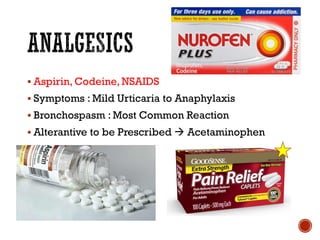
โ–ช Aspirin, Codeine, NSAIDS
โ–ช Symptoms : Mild Urticaria to Anaphylaxis
โ–ช Bronchospasm : Most Common Reaction
โ–ช Alterantive to be Prescribed โ†’ Acetaminophen
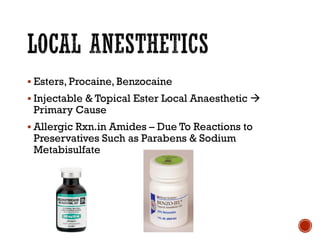
โ–ช Esters, Procaine, Benzocaine
โ–ช Injectable & Topical Ester Local Anaesthetic โ†’
Primary Cause
โ–ช Allergic Rxn.in Amides โ€“ Due To Reactions to
Preservatives Such as Parabens & Sodium
Metabisulfate
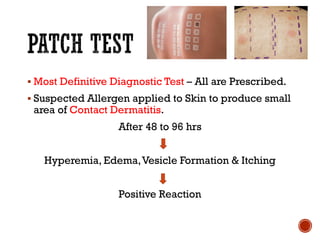
โ–ช Most Definitive Diagnostic Test โ€“ All are Prescribed.
โ–ช Suspected Allergen applied to Skin to produce small
area of Contact Dermatitis.
After 48 to 96 hrs
Hyperemia, Edema,Vesicle Formation & Itching
Positive Reaction
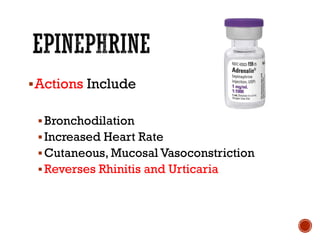
โ–ชActions Include
โ–ชBronchodilation
โ–ชIncreased Heart Rate
โ–ชCutaneous, Mucosal Vasoconstriction
โ–ชReverses Rhinitis and Urticaria
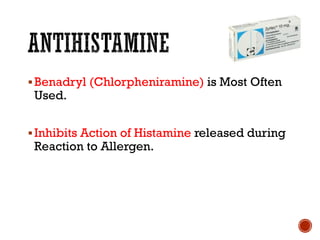
โ–ชBenadryl (Chlorpheniramine) is Most Often
Used.
โ–ชInhibits Action of Histamine released during
Reaction to Allergen.
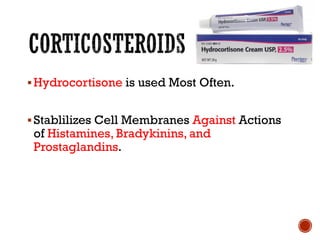
โ–ชHydrocortisone is used Most Often.
โ–ชStablilizes Cell Membranes Against Actions
of Histamines, Bradykinins, and
Prostaglandins.
Always!

Hypersensitivity in Dentistry | Types

  • 1.
    V.S.Rashmi Priyem IIYear B.D.S. ULTRAโ€™SBEST Dental Science College, Madurai
  • 2.
    โ–ช Introduction โ–ช Classificationof Hypersensitivity Reactions โ–ช Type I โ–ช Anaphylaxis โ–ช Atopy โ–ช Type II โ–ช Hypersensitivity in Dentistry
  • 3.
    โ–ช Allergic toAny Medications ? โ–ช Have you Ever had a Reaction to a Anaesthetic ? โ–ช IfYes, Describe what Happened ? โ–ช Was Treatment Given ? If So,What ?
  • 4.
    โ–ช Hypersensitivity refersto the Undesirable Injurious Consequences in the Sensitised Host, following Contact with Specific Antigens. โ–ช Result of Inappropriate Immune Reaction. IMPortant 2M Food Allergy
  • 5.
    โ–ช The Hostshould have had Contact with the Antigen (Allergen). โ–ช Initial Contact Sensitises the Immune System, Leading to Priming of the Appropriate B or T Lymphocytes. โ–ช Sensitising or Priming Dose. โ–ช Subsequent Contact with the Allergen causes Manifestations of Hypersensitivity. โ–ช Shocking Dose.
  • 6.
  • 7.
    โ–ชB Cell orAntibody Mediated โ–ชOccurs in : โ–ชAnaphylaxis โ–ชAtopy โ–ชAntibody โ€“ Mediated Cell Damage โ–ชArthus Phenomenon โ–ชSerum Sickness
  • 8.
    โ–ชT Cell Mediated โ–ชOccursin : โ–ช Infection โ–ช Contact Dermatitis
  • 9.
    Immediate Hypersensitivity Delayed Hypersensitivity Action Appears andRecedes Rapidly Appears Slowly, Lasts Longer Induced by Antigens or Haptens by any Route Antigen or Hapten Intradermally or by Skin Contact Circulating Antibodies Present Antibody Mediated Reaction Absent Cell Mediated Reaction Transfer Passive Transfer via Serum Tranferred via T Cells or Transfer Factor Desensitisation Easy Short Lived Difficult Long Lasting
  • 10.
    โ–ชBased on DifferentMechanisms of Pathogenesis. โ–ชNow Widely Used Across the Globe.
  • 11.
    โ–ช Type I: Anaphylactic Reaction โ–ช Type II : Cytotoxic Reaction โ–ช Type III : Immune Complex Diseases โ–ช Type IV : Delayed or Cell Mediated Hypersensitivity โ–ช Type V : Stimulatory Hypersensitivity ACID
  • 12.
    โ–ช Anaphylactic, IgEor Reagin Dependent โ–ช Antibodies fixed on Surface of Tissue Cells โ€“ Cell Fixed Ab. โ–ช Mast Cells & Basophils Antigen + Cell Fixed Ab. Release of Pharmacologically Active Subs. Produce Clinical Rxn. IMPortant 5M
  • 13.
    โ–ช Cytotoxic, IgG(Rarely IgM ) Dependent IgG (Rarely IgM) Antibodies + Cell Surf. Or Tissue Antigens Cause Stimulation or Damage โ–ช Intermediate bet. Hypersensitivity & Autoimmunity Presence of Complement
  • 14.
    โ–ชImmune Complex Diseasescaused by Ag-Ab Complexes โ–ชPrecipitate in & around Small Blood Vessels โ–ชCausing Damage To Cells and Membranes, Interfering the Function
  • 15.
    โ–ช Delayed orCell Mediated โ–ช It is a Cell Mediated Response โ–ช Ag Activates Specifically Sensitised CD4 & CD8 T Cells โ–ช Leads to Secretion of Lymphokines and Phagocyte Accumulation
  • 16.
    โ–ช A CollectiveTerm for the Four Enzyme Cascadesโ€” the Complement, Coagulation, Fibrinolytic, and Kinin Systems โ–ช The Pathology and Clinical Features of Immunological Diseases would also be Influenced by the Mechanisms such as Inflammation, Complement, Coagulation, Fibrinolytic and Kininogenic Systems IMPortant 2M
  • 17.
  • 18.
    โ–ชlgE DEPENDENT โ–ชTwo Forms: โ–ช Acute, Potentially Fatal, Systemic Form called Anaphylaxis โ–ช Chronic, Recurrent, Non-Fatal,Typically Localised Form called Atopy
  • 19.
    โ–ช Classical ImmediateHypersensitivity Reaction. โ–ช Antigens and Haptens can Induce Anaphylaxis. โ–ช Haptens โ€“ Primitive Molecule Which Elicit Prod. Of Ab โ–ช Interval of atleast 2-3 weeks between the Sensitising and Shocking Dose.
  • 20.
    โ–ช Clinical Featuresare same with any Antigen but vary between Species. โ–ช Clinical Effects are Due to Smooth Muscle Contraction & Increased Vascular Permeability.
  • 21.
    โ–ชAffected Organs areknown as Shock Organs. โ–ชChanges seen are โ–ช Edema โ–ช Decreased Coagulability of Blood โ–ช Fall in Blood Pressure and Temperature โ–ช Leucopenia and Thrombocytopenia
  • 23.
    Edema Formation inthe Dermis, Mostly Involving Head and Neck. IcatiBAnt โ€“ Bradykinin Antagonist C1 Esterase Def.
  • 24.
    โ–ชHuman Anaphylaxis, Previouslyassociated with Heterologous Serum Therapy, is Now seen mostly following Injection of Antibiotics or other drugs. โ–ชPrompt Treatment with Adrenaline can be Life-Saving. โ–ช 0.5ml of a 1 in 1000 Soln. Subcutaneously or Intramuscularly.
  • 25.
    โ–ชCutaneous Anaphylaxis โ–ชPassive CutaneousAnaphylaxis โ–ชAnaphylaxis in vitro For Detection of Antibodies โ€“ Antigen is Introduced
  • 26.
    โ–ช Small ShockingDose of an Antigen is Administed Intradermally to a Sensitised Host ,there will be a Local Wheal and Flare Response (Local Anaphylaxis). โ–ช The Wheal is a Pale, Central Area of Puffiness due to Edema, which is surrounded by a Flare caused by Hyperemia and Subsequent Erythema.
  • 27.
    โ–ช Useful inTesting for Hypersensitivity and in Identifying the Allergen Responsible Diseases. โ–ช In Highly Sensitised Individuals, even the Skin Test may lead to Fatal Reactions. โ–ช A Syringe loaded with Adrenaline should always be kept ready.
  • 28.
    โ–ช This Testis Extremely Sensitive Method for the Detection of Antibodies. โ–ช A Small Volume of Antibody is Injected Intradermally into a Normal Animal.
  • 29.
    Antigen + Evansblue Dye(Consider) After 4-24 hours , Immediate Blueing Due to Vasodilatation and Increased Capillary Permeability (Wheal and Flare Reaction) Injected Intravenously
  • 30.
    โ–ชUsed to Detectthe Human IgG Antibody which is Heterocytotropic but not lgE which is Homocytotropic. โ–ชHomocytotropic - Capable of Fixing to Cells of Homologous Species only โ–ชHeterocytotropic - Capable of Fixing to Cells of other Species
  • 31.
    โ–ชIsolated Tissues, suchas Intestinal or Uterine Muscle Strips from Sensitised Guinea Pigs, held in a Bath of Ringerโ€™s Solution will Contract Vigorously on Addition of the Specific Antigen to the Bath. โ–ชThis is known as the Schultz-Dale Phenomenon.
  • 32.
    โ–ช Primary โ–ช MastCells & Basophils โ–ช Histamine โ–ช Serotonin โ–ช Eosinophil Chemotactic Factor of Anaphylaxis โ–ช Enzymatic Mediators โ–ช PGs & Leukotrienes โ–ช Platelet Activating Factor
  • 33.
    โ–ชPreformed Contents ofMast Cells and Basophils.
  • 34.
    โ–ช Most ImportantVasoactive Amine in Human Anaphylaxis. Released into the Skin Stimulates Sensory Nerves Produce Burning and Itching Sensations Vasodilatation and Hyperemia by an Axon Reflex(Flare Effect) Edema by Increasing Capillary Permeability (Wheal Effect) Induces Smooth Muscle Contraction in Tissues and Organs
  • 35.
    โ–ช5-Hydroxy Tryptamine โ–ชFound inthe Intestinal Mucosa, Brain Tissue and Platelets. โ–ชCauses Smooth Muscle Contraction, Increased Capillary Permeability and Vasoconstriction.
  • 36.
    โ–ช Eosinophil Chemotactic Factorsof Anaphylaxis (ECF-A) are Released from Mast Cell Granules which are Strongly Chemotactic for Eosinophils. โ–ช Contribute to the Eosinophilia accompanying many Hypersensitivity States.
  • 37.
    โ–ชEnzymatic Mediators suchas Proteases and Hydrolases are released from Mast Cell Granules.
  • 38.
    โ–ช The LipoxygenasePathway leads to the Formation of Leukotrienes. โ–ช The Cyclo-oxygenase Pathway leads to the Formation of Prostaglandins and Thromboxane. โ–ช Prostaglandin F2ฮฑ and Thromboxane A2 are Powerful but Transient Bronchoconstrictors. โ–ช PGs Affect Secretion by Mucous Glands, Platelet Adhesion, Permeability and Dilatation of Capillaries and the Pain Threshold.
  • 39.
    โ–ชPAF is Releasedfrom Basophils which Causes Aggregation of Platelets and Release of Vasoactive Amines.
  • 40.
    โ–ชAnaphylatoxins released byComplement Activation โ–ชBradykinin and other Kinins formed from Plasma Kininogens.
  • 41.
    โ–ช Intravenous Inj.of Peptone,Trypsin and other Subs. Provokes a Clinical Reaction resembling Anaphylactic Shock. โ–ช This is termed โ€˜Anaphylactoid Reactionโ€™. โ–ช Only Difference is that Anaphylactoid Shock has No Immunological Basis and is a Non-Specific Mechanism involving the Activation of Complement and the Release of Anaphylatoxins.
  • 42.
    โ–ชRefers to Naturallyoccurring Familial Hypersensitivities of Human Beings, typified by Hayfever and Asthma. โ–ช The Atopens are generally not good Antigens when Injected Parenterally but Induce IgE Antibodies, formerly termed โ€˜Reaginโ€™ Antibodies. โ–ช Reagin Mediated Hypersensitivity
  • 43.
    โ–ช IgE differsfrom other Immunoglobulins. โ–ช Unlike other Antibodies, IgE is Heat Sensitive and is Inactivated at 56ยฐC in 2-4 hours. โ–ช Heating appears to Damage the Fc part of the IgE Molecule, which is necessary for Fixation to Cells. โ–ช The Atopic Antibody does not pass through the Placenta.
  • 44.
    Guess The Personality? He is Related To _____ .
  • 45.
  • 46.
    โ–ช IgE isSpecies Specific โ–ช Only Human IgE can fix to the Surface of Human Cells. โ–ช The Basis of the Prausnitz-Kustner (PK) Reaction. โ–ช Original method for Detecting Atopic Antibodies.
  • 47.
    โ–ช Caused byOverproduction of IgE Antibodies. โ–ช Associated with a deficiency of IgA. โ–ช Inhalant and Ingestant Antigens are dealt by IgA Lining the Respiratory and Intestinal Mucosa and they Do Not come into Contact with Potential IgE Producing Cells. โ–ช When IgA is Deficient, the Antigens cause Massive Stimulation of IgE Forming Cells, leading to Overproduction of IgE. IgE IgA
  • 48.
    โ–ช Symptoms arecaused by the Release of Pharmacologically Active Substances following the Combination of the Antigen and the Cell Fixed IgE. โ–ช Clinical Expression is determined by the Entry of the Antigen โ–ช Conjunctivitis ,Rhinitis and Dermatitis, etc. โ–ช Specific Desensitisation (Hyposensitisation) - Treatment of Atopy.
  • 49.
  • 50.
    โ–ช Reactions involveCombination of IgG (or rarely IgM) Antibodies with the Antigenic Determinants on the Surface of Cells. โ–ช Alternatively, a Free Antigen or Hapten may be Absorbed on Cell Surfaces. โ–ช Subsequent Reaction of the Combined Antigen or Hapten with its corresponding Antibody leads to Cell Damage.
  • 51.
    โ–ช Drugs likeCephalosporins may Behave in this manner, Leading to Complement-Mediated Lysis of RBCs, Leucocytes and Platelets, causing Hemolytic Anemia, Agranulocytosis and Thrombocytopenic purpura
  • 52.
    โ–ชExamples : โ–ชLysis ofRBCs caused by Anti- Erythrocyte Antibodies in Autoimmune Anemias โ–ชHemolytic Disease of the Newborn
  • 54.
  • 56.
    โ–ชDermatitis of Hand(Eczema) โ†’ Most Common Adverse Reaction. โ–ชLocalized Rashes & Swelling to Wheezing & Anaphylaxis. โ–ชPrevention: Use Vinyl Gloves or Synthetic Polymer Gloves.
  • 57.
    โ–ช Irreversible Hydrocolloids: โ–ช Inhaling Fine Airborne Particles can cause Silicosis & Pulmonary Hypersensitivity. โ–ช Dustless/Dustfree Alginate is preferred. โ–ช Elastomers : Cellular Toxicity Levels โ–ช Polyether > Addition Silicone > Polysulphide
  • 58.
    โ–ช Heavy Metalslike Lead and Silica particles are present in the Alginate powder. โ–ช Have Potential Toxicity Risk for Both Practitioner and Patient. โ–ช During the Impression Making , Alginate is left in close Contact with the Oral Mucosa for 2 min, and the Tissue is Highly Vascularised and has Great Absorption Potential.
  • 59.
    โ–ช Large AmalgamParticles that are Embedded Accidentally in the Gingiva during Placement of a Restoration may Elicit Chronic Inflammation.
  • 60.
    โ–ช Benign Pigmentationof the Mucosa can occur from Embedded Amalgam Particles, commonly referred to as โ€œAmalgam Tattoo."
  • 61.
    โ–ชCause Inflammatory Reactionson Newly Prepared Dentin. โ–ชThe Blandness of GIC is Attributed to Absence of Strong Acids of Toxic Monomers. โ–ชIrritancy : Zinc Oxide < Zinc Polycarboxylate =Glass Ionomer < Zinc Phosphate
  • 62.
    โ–ชWhen Zinc Phosphateis used to Cement a Crown or Inlay The Phosphate Cement is forced into the Dentinal Tubules โ–ชIt creates a wide spread Three-Dimensional Inflammatory Lesion involving all the Coronal Pulp Tissue.
  • 63.
    โ–ช ZOE isconsidered the Least Damaging Restorative Material. โ–ช Sensitivity is manifested as Positive Inflammatory Responses to Eugenol in certain Root Canal Sealers. โ–ช Eugenol causes Contact Dermatitis, because it can React Directly with Proteins to form Conjugate and Reactive Haptens.
  • 64.
    โ–ชSmall Amounts ofthe Metals can be Released into the Oral Cavity. โ–ชLeached Metals can Potentially Trigger an Allergic Reaction.
  • 65.
    โ–ชNickel in DentalAppliances is known to be a Very Common cause of Contact Allergy and Hypersensitivity Reactions.
  • 66.
    โ–ชPatients developed Muscleand Joint Pain after receiving Titanium Dental Implants, Orthodontic Braces or Endoprostheses. โ–ชTitanium Allergy presents with Urticaria, Eczema, Cheilitis, Redness of the Mucosa. โ–ชPatch Test is Ineffective. Instead MELISA Test is done for Titanium Sensitisation.
  • 67.
    โ–ชFormaldehyde is acommon cause of Contact Dermatitis. โ–ชFeatures : Anaphylactic Reaction or Shock and Generalized Urticaria. Acts as Bactericidal
  • 68.
    โ–ชCause Denture stomatitiswhen used as Denture Base Material. โ–ชPrevention : 7 hr Incubation in Water at 70ยฐC followed by a 1-h Incubation in Water at 100ยฐC causes the Maximum Conversion of the Monomer.
  • 69.
    โ–ช Penicillins &Sulfonamides โ–ช Parenterally Administered Penicillin can Cause An Anaphylactic Reaction. โ–ช When Orally Administered โ€“ Delayed Reaction.
  • 70.
    โ–ช Aspirin, Codeine,NSAIDS โ–ช Symptoms : Mild Urticaria to Anaphylaxis โ–ช Bronchospasm : Most Common Reaction โ–ช Alterantive to be Prescribed โ†’ Acetaminophen
  • 71.
    โ–ช Esters, Procaine,Benzocaine โ–ช Injectable & Topical Ester Local Anaesthetic โ†’ Primary Cause โ–ช Allergic Rxn.in Amides โ€“ Due To Reactions to Preservatives Such as Parabens & Sodium Metabisulfate
  • 73.
    โ–ช Most DefinitiveDiagnostic Test โ€“ All are Prescribed. โ–ช Suspected Allergen applied to Skin to produce small area of Contact Dermatitis. After 48 to 96 hrs Hyperemia, Edema,Vesicle Formation & Itching Positive Reaction
  • 75.
    โ–ชActions Include โ–ชBronchodilation โ–ชIncreased HeartRate โ–ชCutaneous, Mucosal Vasoconstriction โ–ชReverses Rhinitis and Urticaria
  • 76.
    โ–ชBenadryl (Chlorpheniramine) isMost Often Used. โ–ชInhibits Action of Histamine released during Reaction to Allergen.
  • 77.
    โ–ชHydrocortisone is usedMost Often. โ–ชStablilizes Cell Membranes Against Actions of Histamines, Bradykinins, and Prostaglandins.
  • 78.