CONTRACEPTIV
E TYPES AND
ITS
MECHANISM
CONTENT
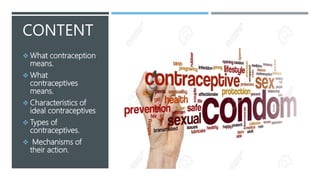
 What contraception
means.
 What
contraceptives
means.
 Characteristics of
ideal contraceptives
 Types of
contraceptives.
 Mechanisms of
their action.
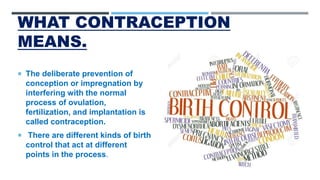
WHAT CONTRACEPTION
MEANS.
 The deliberate prevention of
conception or impregnation by
interfering with the normal
process of ovulation,
fertilization, and implantation is
called contraception.
 There are different kinds of birth
control that act at different
points in the process.
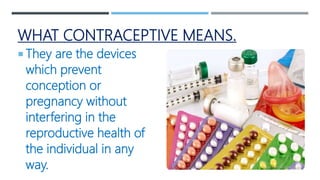
WHAT CONTRACEPTIVE MEANS.
 They are the devices
which prevent
conception or
pregnancy without
interfering in the
reproductive health of
the individual in any
way.
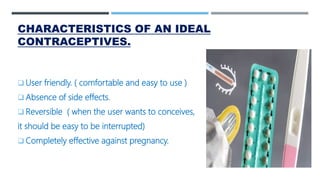
CHARACTERISTICS OF AN IDEAL
CONTRACEPTIVES.
 User friendly. ( comfortable and easy to use )
 Absence of side effects.
 Reversible ( when the user wants to conceives,
it should be easy to be interrupted)
 Completely effective against pregnancy.
….
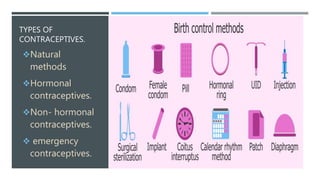
TYPES OF
CONTRACEPTIVES.
Natural
methods
Hormonal
contraceptives.
Non- hormonal
contraceptives.
 emergency
contraceptives.
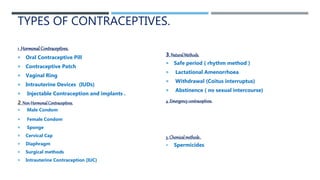
TYPES OF CONTRACEPTIVES.
1 .HormonalContraceptives.
 Oral Contraceptive Pill
 Contraceptive Patch
 Vaginal Ring
 Intrauterine Devices (IUDs)
 Injectable Contraception and implants .
2. Non-HormonalContraceptives.
 Male Condom
 Female Condom
 Sponge
 Cervical Cap
 Diaphragm
 Surgical methods
 Intrauterine Contraception (IUC)
3. NaturalMethods.
 Safe period ( rhythm method )
 Lactational Amenorrhoea
 Withdrawal (Coitus interruptus)
 Abstinence ( no sexual intercourse)
4 .Emergencycontraceptives.
5. Chemicalmethods.
 Spermicides
HORMONAL CONTRACEPTIVES
 Oral Contraceptive Pill
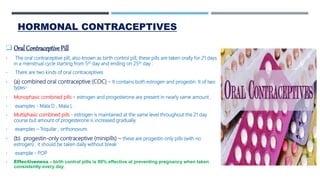
• The oral contraceptive pill, also known as birth control pill, these pills are taken orally for 21 days
in a menstrual cycle starting from 5th day and ending on 25th day .
• There are two kinds of oral contraceptives
• (a) combined oral contraceptive (COC) - It contains both estrogen and progestin. It of two
types-
• Monophasic combined pills - estrogen and progesterone are present in nearly same amount .
• examples - Mala D , Mala L .
• Multiphasic combined pills - estrogen is maintained at the same level throughout the 21 day
course but amount of progesterone is increased gradually.
• examples – Triquilar , orthonovum.
• (b) progestin-only contraceptive (minipills) – these are progestin only pills (with no
estrogen) . it should be taken daily without break
• example - POP
• Effectiveness - birth control pills is 99% effective at preventing pregnancy when taken
consistently every day.
MECHANISM
Oral pills act by four ways
a) Inhibition of ovulation
b) Alteration in uterine endometrium to make them unsuitable for
implantation.
c) Changes in cervical mucus, impairing its ability to allow passage and
transport of sperm.
d) Inhibition of motility and secretory activity of fallopian tubes.
….
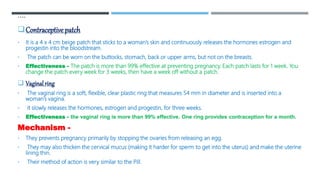
• It is a 4 x 4 cm beige patch that sticks to a woman’s skin and continuously releases the hormones estrogen and
progestin into the bloodstream.
• The patch can be worn on the buttocks, stomach, back or upper arms, but not on the breasts.
• Effectiveness - The patch is more than 99% effective at preventing pregnancy. Each patch lasts for 1 week. You
change the patch every week for 3 weeks, then have a week off without a patch.
 Vaginal ring
• The vaginal ring is a soft, flexible, clear plastic ring that measures 54 mm in diameter and is inserted into a
woman’s vagina.
• it slowly releases the hormones, estrogen and progestin, for three weeks.
• Effectiveness - the vaginal ring is more than 99% effective. One ring provides contraception for a month.
Mechanism -
• They prevents pregnancy primarily by stopping the ovaries from releasing an egg.
• They may also thicken the cervical mucus (making it harder for sperm to get into the uterus) and make the uterine
lining thin.
• Their method of action is very similar to the Pill.
Contraceptivepatch
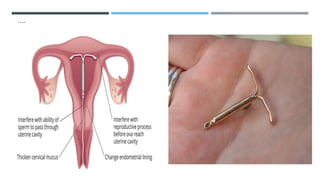
INTRAUTERINE DEVICES.
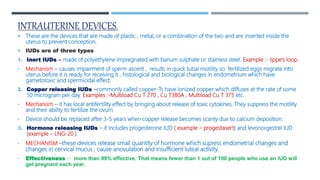
 These are the devices that are made of plastic , metal, or a combination of the two and are inserted inside the
uterus to prevent conception.
 IUDs are of three types
1. Inert IUDs – made of polyethylene impregnated with barium sulphate or stainless steel. Example :- lippe’s loop.
• Mechanism – causes impairment of sperm ascent , results in quick tubal motility so fertilized eggs migrate into
uterus before it is ready for receiving it , histological and biological changes in endometrium which have
gametotoxic and spermicidal effect.
2. Copper releasing IUDs –commonly called copper-Ts have ionized copper which diffuses at the rate of some
50 microgram per day. Examples :-Multiload Cu T 270 , Cu T380A , Multiload Cu T 375 etc.
• Mechanism – it has local antifertility effect by bringing about release of toxic cytokines. They suppress the motility
and their ability to fertilize the ovum.
• Device should be replaced after 3-5 years when copper release becomes scanty due to calcium deposition.
3. Hormone releasing IUDs – it includes progesterone IUD ( example – progestasert) and levonorgestrel IUD
(example – LNG-20 ).
• MECHANISM –these devices release small quantity of hormone which supress endometrial changes and
changes in cervical mucus , cause anovulation and insufficient luteal activity.
• Effectiveness :- more than 99% effective. That means fewer than 1 out of 100 people who use an IUD will
get pregnant each year.
….
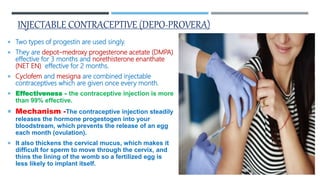
INJECTABLE CONTRACEPTIVE (DEPO-PROVERA)
 Two types of progestin are used singly.
 They are depot–medroxy progesterone acetate (DMPA)
effective for 3 months and norethisterone enanthate
(NET EN) effective for 2 months.
 Cyclofem and mesigna are combined injectable
contraceptives which are given once every month.
 Effectiveness - the contraceptive injection is more
than 99% effective.
 Mechanism -The contraceptive injection steadily
releases the hormone progestogen into your
bloodstream, which prevents the release of an egg
each month (ovulation).
 It also thickens the cervical mucus, which makes it
difficult for sperm to move through the cervix, and
thins the lining of the womb so a fertilized egg is
less likely to implant itself.
IMPLANTS
 Hormone containing devices which are implanted sub - dermally for
providing long term contraception.
 NORPLANT- progestin only device having six small silicon
capsule each having levonorgestrel.
 They are inserted under the skin in a fan shaped manner inside
upper arm or forearm through a small incision (Effective for 5 years)
 IMPLANON – single rod like device which is implanted through a
wide- bored needle. It contains 3- keto desogestrel. (effective for 3
years).
 Effectiveness - The implant is more than 99% effective.
 Mechanism-The primary mode of action of all
subdermal implants is to prevent ovulation.
 Secondary modes of action include prevention of sperm penetration
of the cervical mucus and prevention of implantation by thinning the
endometrium .
NON - HORMONAL CONTRACEPTIVES.
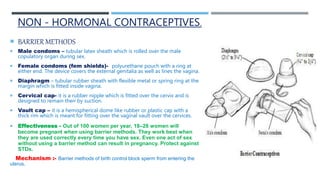
 BARRIER METHODS
 Male condoms – tubular latex sheath which is rolled over the male
copulatory organ during sex.
 Female condoms (fem shields)- polyurethane pouch with a ring at
either end. The device covers the external genitalia as well as lines the vagina.
 Diaphragm – tubular rubber sheath with flexible metal or spring ring at the
margin which is fitted inside vagina.
 Cervical cap- it is a rubber nipple which is fitted over the cervix and is
designed to remain their by suction.
 Vault cap – it is a hemispherical dome like rubber or plastic cap with a
thick rim which is meant for fitting over the vaginal vault over the cervices.
 Effectiveness - Out of 100 women per year, 18–28 women will
become pregnant when using barrier methods. They work best when
they are used correctly every time you have sex. Even one act of sex
without using a barrier method can result in pregnancy. Protect against
STDs.
Mechanism :- Barrier methods of birth control block sperm from entering the
uterus.
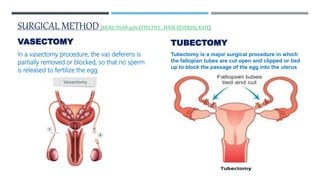
SURGICAL METHOD (MORE THAN 99% EFFECTIVE , POOR REVERSAL RATE)
VASECTOMY
In a vasectomy procedure, the vas deferens is
partially removed or blocked, so that no sperm
is released to fertilize the egg.
TUBECTOMY
Tubectomy is a major surgical procedure in which
the fallopian tubes are cut open and clipped or tied
up to block the passage of the egg into the uterus
NATURAL METHODS
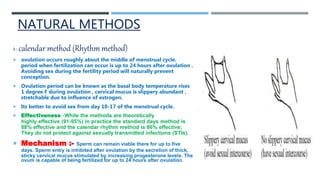
1- calendar method (Rhythm method)
 ovulation occurs roughly about the middle of menstrual cycle.
period when fertilization can occur is up to 24 hours after ovulation .
Avoiding sex during the fertility period will naturally prevent
conception.
 Ovulation period can be known as the basal body temperature rises
1 degree F during ovulation , cervical mucus is slippery abundant ,
stretchable due to influence of estrogen.
 Its better to avoid sex from day 10-17 of the menstrual cycle.
 Effectiveness -While the methods are theoretically
highly effective (91-95%) in practice the standard days method is
88% effective and the calendar rhythm method is 86% effective;
They do not protect against sexually transmitted infections (STIs).
 Mechanism :- Sperm can remain viable there for up to five
days. Sperm entry is inhibited after ovulation by the secretion of thick,
sticky cervical mucus stimulated by increasing progesterone levels. The
ovum is capable of being fertilized for up to 24 hours after ovulation.
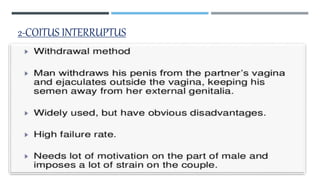
2-COITUS INTERRUPTUS
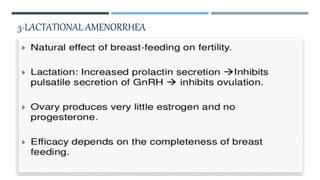
3-LACTATIONAL AMENORRHEA
EMERGENCY CONTRACEPTIVE
 It is a treatment for unprotected sex, sexual assault , missed pills ,and other reasons which have risk of
pregnancy
 Drugs used for treating emergency contraception are called morning after pills.
 Two ovral tablets to start and two tablets after 12 hours are effective.
 Other morning after pills are noral , norgynon , and ovidon .
 Mifepristone ( antiprogesterone ) or RU-486 is a single pill treatment, It blocks the action of
progesterone ( induce abortion)
 Insertion of IUD within 72 hours of unprotected sex prevents implantation.
 Effectiveness – it can prevent up to over 95% of pregnancies when taken within 5 days after intercourse.
 Mechanism :- Emergency contraceptive pills prevent pregnancy by preventing or delaying ovulation.
 The copper-bearing IUD prevents fertilization by causing a chemical change in sperm and egg before they
meet.
 Emergency contraception cannot interrupt an established pregnancy or harm a developing embryo.
CHEMICAL METHODS
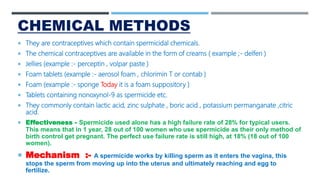
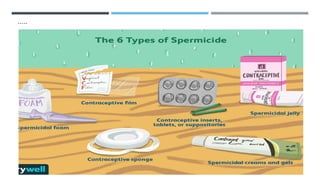
 They are contraceptives which contain spermicidal chemicals.
 The chemical contraceptives are available in the form of creams ( example ;- delfen )
 Jellies (example :- perceptin , volpar paste )
 Foam tablets (example :- aerosol foam , chlorimin T or contab )
 Foam (example :- sponge Today it is a foam suppository )
 Tablets containing nonoxynol-9 as spermicide etc.
 They commonly contain lactic acid, zinc sulphate , boric acid , potassium permanganate ,citric
acid.
 Effectiveness - Spermicide used alone has a high failure rate of 28% for typical users.
This means that in 1 year, 28 out of 100 women who use spermicide as their only method of
birth control get pregnant. The perfect use failure rate is still high, at 18% (18 out of 100
women).
 Mechanism :- A spermicide works by killing sperm as it enters the vagina, this
stops the sperm from moving up into the uterus and ultimately reaching and egg to
fertilize.
…..
THANK YOU………………………….

Contraceptive types and its mechanism

  • 1.
  • 2.
    CONTENT  What contraception means. What contraceptives means.  Characteristics of ideal contraceptives  Types of contraceptives.  Mechanisms of their action.
  • 3.
    WHAT CONTRACEPTION MEANS.  Thedeliberate prevention of conception or impregnation by interfering with the normal process of ovulation, fertilization, and implantation is called contraception.  There are different kinds of birth control that act at different points in the process.
  • 4.
    WHAT CONTRACEPTIVE MEANS. They are the devices which prevent conception or pregnancy without interfering in the reproductive health of the individual in any way.
  • 5.
    CHARACTERISTICS OF ANIDEAL CONTRACEPTIVES.  User friendly. ( comfortable and easy to use )  Absence of side effects.  Reversible ( when the user wants to conceives, it should be easy to be interrupted)  Completely effective against pregnancy.
  • 6.
  • 7.
  • 8.
    TYPES OF CONTRACEPTIVES. 1.HormonalContraceptives.  Oral Contraceptive Pill  Contraceptive Patch  Vaginal Ring  Intrauterine Devices (IUDs)  Injectable Contraception and implants . 2. Non-HormonalContraceptives.  Male Condom  Female Condom  Sponge  Cervical Cap  Diaphragm  Surgical methods  Intrauterine Contraception (IUC) 3. NaturalMethods.  Safe period ( rhythm method )  Lactational Amenorrhoea  Withdrawal (Coitus interruptus)  Abstinence ( no sexual intercourse) 4 .Emergencycontraceptives. 5. Chemicalmethods.  Spermicides
  • 9.
    HORMONAL CONTRACEPTIVES  OralContraceptive Pill • The oral contraceptive pill, also known as birth control pill, these pills are taken orally for 21 days in a menstrual cycle starting from 5th day and ending on 25th day . • There are two kinds of oral contraceptives • (a) combined oral contraceptive (COC) - It contains both estrogen and progestin. It of two types- • Monophasic combined pills - estrogen and progesterone are present in nearly same amount . • examples - Mala D , Mala L . • Multiphasic combined pills - estrogen is maintained at the same level throughout the 21 day course but amount of progesterone is increased gradually. • examples – Triquilar , orthonovum. • (b) progestin-only contraceptive (minipills) – these are progestin only pills (with no estrogen) . it should be taken daily without break • example - POP • Effectiveness - birth control pills is 99% effective at preventing pregnancy when taken consistently every day.
  • 10.
    MECHANISM Oral pills actby four ways a) Inhibition of ovulation b) Alteration in uterine endometrium to make them unsuitable for implantation. c) Changes in cervical mucus, impairing its ability to allow passage and transport of sperm. d) Inhibition of motility and secretory activity of fallopian tubes.
  • 11.
    …. • It isa 4 x 4 cm beige patch that sticks to a woman’s skin and continuously releases the hormones estrogen and progestin into the bloodstream. • The patch can be worn on the buttocks, stomach, back or upper arms, but not on the breasts. • Effectiveness - The patch is more than 99% effective at preventing pregnancy. Each patch lasts for 1 week. You change the patch every week for 3 weeks, then have a week off without a patch.  Vaginal ring • The vaginal ring is a soft, flexible, clear plastic ring that measures 54 mm in diameter and is inserted into a woman’s vagina. • it slowly releases the hormones, estrogen and progestin, for three weeks. • Effectiveness - the vaginal ring is more than 99% effective. One ring provides contraception for a month. Mechanism - • They prevents pregnancy primarily by stopping the ovaries from releasing an egg. • They may also thicken the cervical mucus (making it harder for sperm to get into the uterus) and make the uterine lining thin. • Their method of action is very similar to the Pill. Contraceptivepatch
  • 12.
    INTRAUTERINE DEVICES.  Theseare the devices that are made of plastic , metal, or a combination of the two and are inserted inside the uterus to prevent conception.  IUDs are of three types 1. Inert IUDs – made of polyethylene impregnated with barium sulphate or stainless steel. Example :- lippe’s loop. • Mechanism – causes impairment of sperm ascent , results in quick tubal motility so fertilized eggs migrate into uterus before it is ready for receiving it , histological and biological changes in endometrium which have gametotoxic and spermicidal effect. 2. Copper releasing IUDs –commonly called copper-Ts have ionized copper which diffuses at the rate of some 50 microgram per day. Examples :-Multiload Cu T 270 , Cu T380A , Multiload Cu T 375 etc. • Mechanism – it has local antifertility effect by bringing about release of toxic cytokines. They suppress the motility and their ability to fertilize the ovum. • Device should be replaced after 3-5 years when copper release becomes scanty due to calcium deposition. 3. Hormone releasing IUDs – it includes progesterone IUD ( example – progestasert) and levonorgestrel IUD (example – LNG-20 ). • MECHANISM –these devices release small quantity of hormone which supress endometrial changes and changes in cervical mucus , cause anovulation and insufficient luteal activity. • Effectiveness :- more than 99% effective. That means fewer than 1 out of 100 people who use an IUD will get pregnant each year.
  • 13.
  • 14.
    INJECTABLE CONTRACEPTIVE (DEPO-PROVERA) Two types of progestin are used singly.  They are depot–medroxy progesterone acetate (DMPA) effective for 3 months and norethisterone enanthate (NET EN) effective for 2 months.  Cyclofem and mesigna are combined injectable contraceptives which are given once every month.  Effectiveness - the contraceptive injection is more than 99% effective.  Mechanism -The contraceptive injection steadily releases the hormone progestogen into your bloodstream, which prevents the release of an egg each month (ovulation).  It also thickens the cervical mucus, which makes it difficult for sperm to move through the cervix, and thins the lining of the womb so a fertilized egg is less likely to implant itself.
  • 15.
    IMPLANTS  Hormone containingdevices which are implanted sub - dermally for providing long term contraception.  NORPLANT- progestin only device having six small silicon capsule each having levonorgestrel.  They are inserted under the skin in a fan shaped manner inside upper arm or forearm through a small incision (Effective for 5 years)  IMPLANON – single rod like device which is implanted through a wide- bored needle. It contains 3- keto desogestrel. (effective for 3 years).  Effectiveness - The implant is more than 99% effective.  Mechanism-The primary mode of action of all subdermal implants is to prevent ovulation.  Secondary modes of action include prevention of sperm penetration of the cervical mucus and prevention of implantation by thinning the endometrium .
  • 16.
    NON - HORMONALCONTRACEPTIVES.  BARRIER METHODS  Male condoms – tubular latex sheath which is rolled over the male copulatory organ during sex.  Female condoms (fem shields)- polyurethane pouch with a ring at either end. The device covers the external genitalia as well as lines the vagina.  Diaphragm – tubular rubber sheath with flexible metal or spring ring at the margin which is fitted inside vagina.  Cervical cap- it is a rubber nipple which is fitted over the cervix and is designed to remain their by suction.  Vault cap – it is a hemispherical dome like rubber or plastic cap with a thick rim which is meant for fitting over the vaginal vault over the cervices.  Effectiveness - Out of 100 women per year, 18–28 women will become pregnant when using barrier methods. They work best when they are used correctly every time you have sex. Even one act of sex without using a barrier method can result in pregnancy. Protect against STDs. Mechanism :- Barrier methods of birth control block sperm from entering the uterus.
  • 17.
    SURGICAL METHOD (MORETHAN 99% EFFECTIVE , POOR REVERSAL RATE) VASECTOMY In a vasectomy procedure, the vas deferens is partially removed or blocked, so that no sperm is released to fertilize the egg. TUBECTOMY Tubectomy is a major surgical procedure in which the fallopian tubes are cut open and clipped or tied up to block the passage of the egg into the uterus
  • 18.
    NATURAL METHODS 1- calendarmethod (Rhythm method)  ovulation occurs roughly about the middle of menstrual cycle. period when fertilization can occur is up to 24 hours after ovulation . Avoiding sex during the fertility period will naturally prevent conception.  Ovulation period can be known as the basal body temperature rises 1 degree F during ovulation , cervical mucus is slippery abundant , stretchable due to influence of estrogen.  Its better to avoid sex from day 10-17 of the menstrual cycle.  Effectiveness -While the methods are theoretically highly effective (91-95%) in practice the standard days method is 88% effective and the calendar rhythm method is 86% effective; They do not protect against sexually transmitted infections (STIs).  Mechanism :- Sperm can remain viable there for up to five days. Sperm entry is inhibited after ovulation by the secretion of thick, sticky cervical mucus stimulated by increasing progesterone levels. The ovum is capable of being fertilized for up to 24 hours after ovulation.
  • 19.
  • 20.
  • 21.
    EMERGENCY CONTRACEPTIVE  Itis a treatment for unprotected sex, sexual assault , missed pills ,and other reasons which have risk of pregnancy  Drugs used for treating emergency contraception are called morning after pills.  Two ovral tablets to start and two tablets after 12 hours are effective.  Other morning after pills are noral , norgynon , and ovidon .  Mifepristone ( antiprogesterone ) or RU-486 is a single pill treatment, It blocks the action of progesterone ( induce abortion)  Insertion of IUD within 72 hours of unprotected sex prevents implantation.  Effectiveness – it can prevent up to over 95% of pregnancies when taken within 5 days after intercourse.  Mechanism :- Emergency contraceptive pills prevent pregnancy by preventing or delaying ovulation.  The copper-bearing IUD prevents fertilization by causing a chemical change in sperm and egg before they meet.  Emergency contraception cannot interrupt an established pregnancy or harm a developing embryo.
  • 22.
    CHEMICAL METHODS  Theyare contraceptives which contain spermicidal chemicals.  The chemical contraceptives are available in the form of creams ( example ;- delfen )  Jellies (example :- perceptin , volpar paste )  Foam tablets (example :- aerosol foam , chlorimin T or contab )  Foam (example :- sponge Today it is a foam suppository )  Tablets containing nonoxynol-9 as spermicide etc.  They commonly contain lactic acid, zinc sulphate , boric acid , potassium permanganate ,citric acid.  Effectiveness - Spermicide used alone has a high failure rate of 28% for typical users. This means that in 1 year, 28 out of 100 women who use spermicide as their only method of birth control get pregnant. The perfect use failure rate is still high, at 18% (18 out of 100 women).  Mechanism :- A spermicide works by killing sperm as it enters the vagina, this stops the sperm from moving up into the uterus and ultimately reaching and egg to fertilize.
  • 23.
  • 24.