FLOATING DRUG DELIVERY
SYSTEMS (FDDS)
College of Pharmacy
University of Mosul
CONTENTS:
 1. Introduction
 Gastroretentive Drug Delivery SystemGRDDS
 Drug Candidates for GRDDS
 Approaches to GRDDS
 2. Floating Systems
 Classification of FDDS
 Advantages of FDDS
 Disadvantages of FDDS
 3. Some articles and researches
1. INTRODUCTION
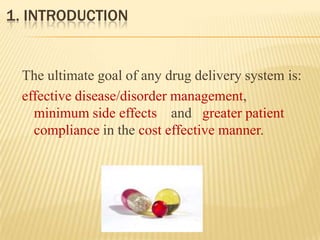
The ultimate goal of any drug delivery system is:
effective disease/disorder management,
minimum side effects and greater patient
compliance in the cost effective manner.
1. INTRODUCTION
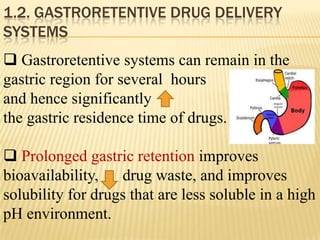
 Drug absorption from the gastrointestinal tract is
a complex procedure and is subject to many
variables.
 It is widely acknowledged that the extent of
gastrointestinal tract drug absorption is related to
contact time with the small intestinal mucosa
(Hirtz, 1985).
 small intestinal transit time is an important
parameter for drugs that are incompletely
absorbed.
1.2. GASTRORETENTIVE DRUG DELIVERY
SYSTEMS
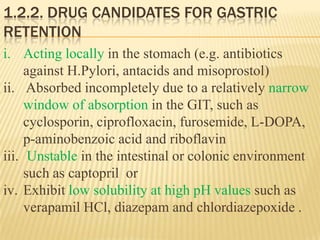
 Gastroretentive systems can remain in the
gastric region for several hours
and hence significantly
the gastric residence time of drugs.
 Prolonged gastric retention improves
bioavailability, drug waste, and improves
solubility for drugs that are less soluble in a high
pH environment.
1.2.2. DRUG CANDIDATES FOR GASTRIC
RETENTION
i. Acting locally in the stomach (e.g. antibiotics
against H.Pylori, antacids and misoprostol)
ii. Absorbed incompletely due to a relatively narrow
window of absorption in the GIT, such as
cyclosporin, ciprofloxacin, furosemide, L-DOPA,
p-aminobenzoic acid and riboflavin
iii. Unstable in the intestinal or colonic environment
such as captopril or
iv. Exhibit low solubility at high pH values such as
verapamil HCl, diazepam and chlordiazepoxide .
1-drugs that may cause gastric lesions, e.g., non-
steroidal anti-inflammatory agents and
2-drug substances that are unstable in the strong
acidic environment of the stomach, e.g.,erythromycin.
1.2.2. DRUG NOT CANDIDATES FOR
GASTRIC RETENTION
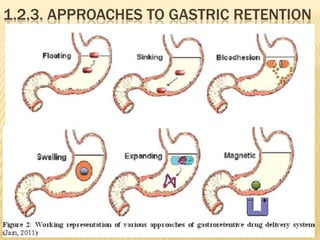
1.2.3. APPROACHES TO GASTRIC RETENTION
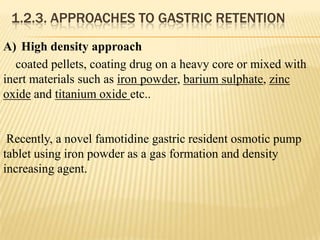
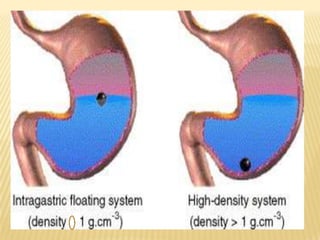
A) High density approach
coated pellets, coating drug on a heavy core or mixed with
inert materials such as iron powder, barium sulphate, zinc
oxide and titanium oxide etc..
Recently, a novel famotidine gastric resident osmotic pump
tablet using iron powder as a gas formation and density
increasing agent.
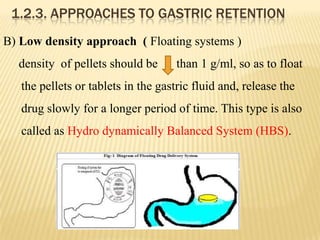
B) Low density approach ( Floating systems )
density of pellets should be than 1 g/ml, so as to float
the pellets or tablets in the gastric fluid and, release the
drug slowly for a longer period of time. This type is also
called as Hydro dynamically Balanced System (HBS).
1.2.3. APPROACHES TO GASTRIC RETENTION
}
Floating drug delivery systems are classified depending
up on the two formulations variables:
Effervescent and Non effervescent systems.
Floating systems can be based on several
principles including:
1. gas generation systems (effervescent systems),
2.swelling systems (non effervescent systems), and
3. inherent low density.
2.1. CLASSIFICATION OF FDDS
1. Gas generation systems (effervescent
systems),
matrices prepared using:
1. Swellable polymers such as MC, HPMC.
2. Polysaccharides such as chitosan.
3. Effervescent components such as sodium
bicarbonate, Calcium carbonate tartaric acid and
citric acid.
2.1. CLASSIFICATION OF FDDS
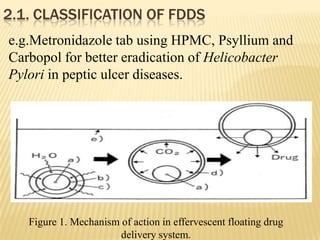
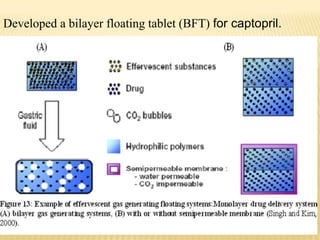
Figure 1. Mechanism of action in effervescent floating drug
delivery system.
2.1. CLASSIFICATION OF FDDS
e.g.Metronidazole tab using HPMC, Psyllium and
Carbopol for better eradication of Helicobacter
Pylori in peptic ulcer diseases.
Developed a bilayer floating tablet (BFT) for captopril.
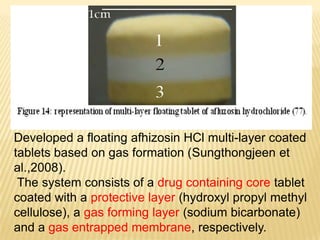
Developed a floating afhizosin HCl multi-layer coated
tablets based on gas formation (Sungthongjeen et
al.,2008).
The system consists of a drug containing core tablet
coated with a protective layer (hydroxyl propyl methyl
cellulose), a gas forming layer (sodium bicarbonate)
and a gas entrapped membrane, respectively.
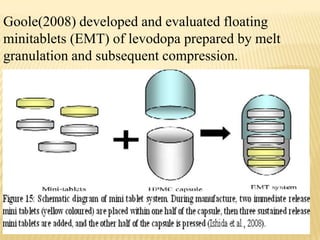
Goole(2008) developed and evaluated floating
minitablets (EMT) of levodopa prepared by melt
granulation and subsequent compression.
2.swelling systems (non effervescent
systems)
Hydro dynamically balanced systems
(HBS) are the systems, containing one or
more gel forming hydrophilic polymers
which upon contact with the gastric fluids
swells and forms a colloidal gel barrier
resulting in low density.
2.1. CLASSIFICATION OF FDDS
2.swelling systems (non effervescent
systems)
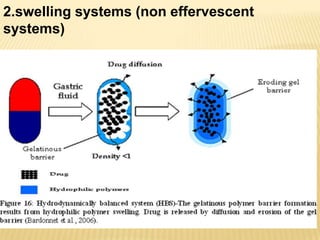
The polymer is mixed with drug and usually
administered in a gelatin capsule. The capsule
rapidly dissolves in the gastric fluid, and
hydration and swelling of the surface polymers
produces a floating mass (Bardonnet et al.,
2006).
Continuous erosion of the surface allows
water penetration to the inner layers,
maintaining surface hydration and buoyancy
(Figure ).
2.swelling systems (non effervescent
systems)
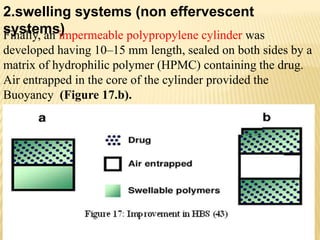
Finally, an impermeable polypropylene cylinder was
developed having 10–15 mm length, sealed on both sides by a
matrix of hydrophilic polymer (HPMC) containing the drug.
Air entrapped in the core of the cylinder provided the
Buoyancy (Figure 17.b).
2.swelling systems (non effervescent
systems)
3. inherent low density System
It is always desired that the drug delivery system
could float immediately upon contact with gastric
fluid which will reduced the risk associated with other
floating systems.
To achieve this, the low density should be provided
from the beginning either by:
 the entrapment of air (hollow chamber) or by
 the incorporation of low density material like oils
or foam powder (Bardonnet et al., 2006).
2.1. CLASSIFICATION OF FDDS
3. inherent low density System
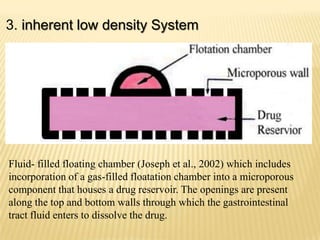
Fluid- filled floating chamber (Joseph et al., 2002) which includes
incorporation of a gas-filled floatation chamber into a microporous
component that houses a drug reservoir. The openings are present
along the top and bottom walls through which the gastrointestinal
tract fluid enters to dissolve the drug.
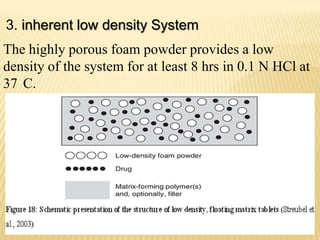
The highly porous foam powder provides a low
density of the system for at least 8 hrs in 0.1 N HCl at
37 C.
3. inherent low density System
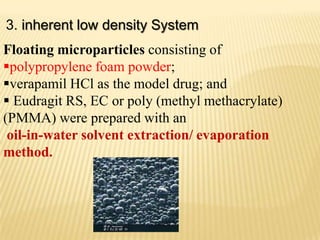
Floating microparticles consisting of
polypropylene foam powder;
verapamil HCl as the model drug; and
 Eudragit RS, EC or poly (methyl methacrylate)
(PMMA) were prepared with an
oil-in-water solvent extraction/ evaporation
method.
3. inherent low density System
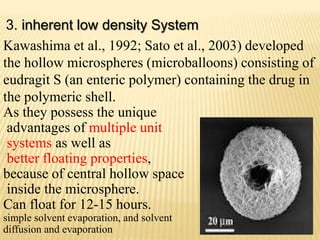
Kawashima et al., 1992; Sato et al., 2003) developed
the hollow microspheres (microballoons) consisting of
eudragit S (an enteric polymer) containing the drug in
the polymeric shell.
As they possess the unique
advantages of multiple unit
systems as well as
better floating properties,
because of central hollow space
inside the microsphere.
Can float for 12-15 hours.
simple solvent evaporation, and solvent
diffusion and evaporation
3. inherent low density System
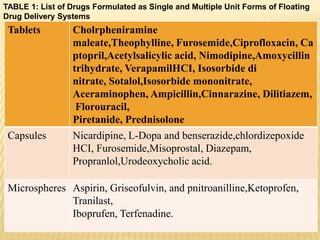
Cholrpheniramine
maleate,Theophylline, Furosemide,Ciprofloxacin, Ca
ptopril,Acetylsalicylic acid, Nimodipine,Amoxycillin
trihydrate, VerapamilHCI, Isosorbide di
nitrate, Sotalol,Isosorbide mononitrate,
Aceraminophen, Ampicillin,Cinnarazine, Dilitiazem,
Florouracil,
Piretanide, Prednisolone
Tablets
Nicardipine, L-Dopa and benserazide,chlordizepoxide
HCI, Furosemide,Misoprostal, Diazepam,
Propranlol,Urodeoxycholic acid.
Capsules
Aspirin, Griseofulvin, and pnitroanilline,Ketoprofen,
Tranilast,
Iboprufen, Terfenadine.
Microspheres
TABLE 1: List of Drugs Formulated as Single and Multiple Unit Forms of Floating
Drug Delivery Systems
Floating Solid lipid microparticle systems
SLNs/SLMs formulates into a
hydrodynamically balanced capsule, which is a
gastroretentive dosage form for prolonging the
release of administration.
Ofloxacin loaded SLNs were prepared using
palmitic acid as lipid matrix
and polyvinyl alcohol
(PVA) as emulsifier by
a hot homogenization and
ultrasonication method.
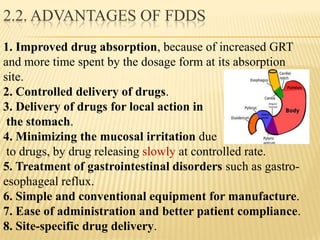
1. Improved drug absorption, because of increased GRT
and more time spent by the dosage form at its absorption
site.
2. Controlled delivery of drugs.
3. Delivery of drugs for local action in
the stomach.
4. Minimizing the mucosal irritation due
to drugs, by drug releasing slowly at controlled rate.
5. Treatment of gastrointestinal disorders such as gastro-
esophageal reflux.
6. Simple and conventional equipment for manufacture.
7. Ease of administration and better patient compliance.
8. Site-specific drug delivery.
2.2. ADVANTAGES OF FDDS
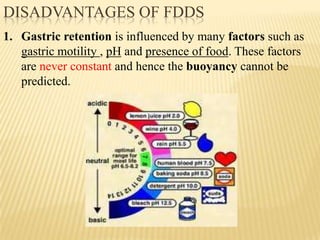
1. Gastric retention is influenced by many factors such as
gastric motility , pH and presence of food. These factors
are never constant and hence the buoyancy cannot be
predicted.
DISADVANTAGES OF FDDS
2. Drugs that cause irritation and lesion to gastric mucosa are
not suitable to be formulated as FDDS.
3. Gastric emptying of floating forms in supine subjects may
occur at random and becomes highly dependent on the
diameter and size. Therefore patients should not be dosed with
floating forms just before going to bed.
DISADVANTAGES OF FDDS
1- Dissertation on Development of extended release
multiple unit effervescent floating drug delivery
systems for drugs with different solubility. Samar
Elsamaligy 2010
2- Article of the Development And In Vitro Evaluation
Of Gastroretentive Floating Tablets Of
Famotidine.2011
Na bicarbonate 40,30mg citric acid and PVP K30 10mg
was found to be the best formulation in terms of drug
release and in vitro buoyancy time with stability
studies.
3. SOME ARTICLES AND RESEARCHES
3- Article of Formulation and Evaluation Of Floating
Drug Delivery System Of Famotidine BK Satishbabu
India 2011
floating beads of famotidine ,cod liver oil entrapped Ca
alginate beads were promising as a carrier for
intragastric floating DD of famotidine.
4- Preparation of a Matrix type Multiple unit GRFDDS
for Captopril Based on Gas Formation Technique:In
Vitro Evaluation 2008 Lingam Meka
3. SOME ARTICLES AND RESEARCHES
5- Prolonged Gastro Delivery of Vitamin B2 from a
Floating DDS:An in Vitro Study , 2007, Sunil
6- Design and In-Vitro Evaluation of Cefuroxime Axetil
Floating Microbeads for the Treatment of Hospital
Acquired Infection, 2012, Mohapatra
7- Design and Evaluation of Bilayer Floating tablets of
Cefuroxime axetil for bimodal release,2006,Ravindra
8- Development and Evaluation of a Monolithic Floating
DDS for Acyclovir, 2011,Naser
Fdds new

Fdds new

  • 1.
    FLOATING DRUG DELIVERY SYSTEMS(FDDS) College of Pharmacy University of Mosul
  • 2.
    CONTENTS:  1. Introduction Gastroretentive Drug Delivery SystemGRDDS  Drug Candidates for GRDDS  Approaches to GRDDS  2. Floating Systems  Classification of FDDS  Advantages of FDDS  Disadvantages of FDDS  3. Some articles and researches
  • 3.
    1. INTRODUCTION The ultimategoal of any drug delivery system is: effective disease/disorder management, minimum side effects and greater patient compliance in the cost effective manner.
  • 4.
    1. INTRODUCTION  Drugabsorption from the gastrointestinal tract is a complex procedure and is subject to many variables.  It is widely acknowledged that the extent of gastrointestinal tract drug absorption is related to contact time with the small intestinal mucosa (Hirtz, 1985).  small intestinal transit time is an important parameter for drugs that are incompletely absorbed.
  • 6.
    1.2. GASTRORETENTIVE DRUGDELIVERY SYSTEMS  Gastroretentive systems can remain in the gastric region for several hours and hence significantly the gastric residence time of drugs.  Prolonged gastric retention improves bioavailability, drug waste, and improves solubility for drugs that are less soluble in a high pH environment.
  • 7.
    1.2.2. DRUG CANDIDATESFOR GASTRIC RETENTION i. Acting locally in the stomach (e.g. antibiotics against H.Pylori, antacids and misoprostol) ii. Absorbed incompletely due to a relatively narrow window of absorption in the GIT, such as cyclosporin, ciprofloxacin, furosemide, L-DOPA, p-aminobenzoic acid and riboflavin iii. Unstable in the intestinal or colonic environment such as captopril or iv. Exhibit low solubility at high pH values such as verapamil HCl, diazepam and chlordiazepoxide .
  • 8.
    1-drugs that maycause gastric lesions, e.g., non- steroidal anti-inflammatory agents and 2-drug substances that are unstable in the strong acidic environment of the stomach, e.g.,erythromycin. 1.2.2. DRUG NOT CANDIDATES FOR GASTRIC RETENTION
  • 9.
    1.2.3. APPROACHES TOGASTRIC RETENTION
  • 10.
    1.2.3. APPROACHES TOGASTRIC RETENTION A) High density approach coated pellets, coating drug on a heavy core or mixed with inert materials such as iron powder, barium sulphate, zinc oxide and titanium oxide etc.. Recently, a novel famotidine gastric resident osmotic pump tablet using iron powder as a gas formation and density increasing agent.
  • 11.
    B) Low densityapproach ( Floating systems ) density of pellets should be than 1 g/ml, so as to float the pellets or tablets in the gastric fluid and, release the drug slowly for a longer period of time. This type is also called as Hydro dynamically Balanced System (HBS). 1.2.3. APPROACHES TO GASTRIC RETENTION
  • 12.
  • 13.
    Floating drug deliverysystems are classified depending up on the two formulations variables: Effervescent and Non effervescent systems. Floating systems can be based on several principles including: 1. gas generation systems (effervescent systems), 2.swelling systems (non effervescent systems), and 3. inherent low density. 2.1. CLASSIFICATION OF FDDS
  • 14.
    1. Gas generationsystems (effervescent systems), matrices prepared using: 1. Swellable polymers such as MC, HPMC. 2. Polysaccharides such as chitosan. 3. Effervescent components such as sodium bicarbonate, Calcium carbonate tartaric acid and citric acid. 2.1. CLASSIFICATION OF FDDS
  • 15.
    Figure 1. Mechanismof action in effervescent floating drug delivery system. 2.1. CLASSIFICATION OF FDDS e.g.Metronidazole tab using HPMC, Psyllium and Carbopol for better eradication of Helicobacter Pylori in peptic ulcer diseases.
  • 16.
    Developed a bilayerfloating tablet (BFT) for captopril.
  • 17.
    Developed a floatingafhizosin HCl multi-layer coated tablets based on gas formation (Sungthongjeen et al.,2008). The system consists of a drug containing core tablet coated with a protective layer (hydroxyl propyl methyl cellulose), a gas forming layer (sodium bicarbonate) and a gas entrapped membrane, respectively.
  • 18.
    Goole(2008) developed andevaluated floating minitablets (EMT) of levodopa prepared by melt granulation and subsequent compression.
  • 19.
    2.swelling systems (noneffervescent systems) Hydro dynamically balanced systems (HBS) are the systems, containing one or more gel forming hydrophilic polymers which upon contact with the gastric fluids swells and forms a colloidal gel barrier resulting in low density. 2.1. CLASSIFICATION OF FDDS
  • 20.
    2.swelling systems (noneffervescent systems)
  • 21.
    The polymer ismixed with drug and usually administered in a gelatin capsule. The capsule rapidly dissolves in the gastric fluid, and hydration and swelling of the surface polymers produces a floating mass (Bardonnet et al., 2006). Continuous erosion of the surface allows water penetration to the inner layers, maintaining surface hydration and buoyancy (Figure ). 2.swelling systems (non effervescent systems)
  • 22.
    Finally, an impermeablepolypropylene cylinder was developed having 10–15 mm length, sealed on both sides by a matrix of hydrophilic polymer (HPMC) containing the drug. Air entrapped in the core of the cylinder provided the Buoyancy (Figure 17.b). 2.swelling systems (non effervescent systems)
  • 23.
    3. inherent lowdensity System It is always desired that the drug delivery system could float immediately upon contact with gastric fluid which will reduced the risk associated with other floating systems. To achieve this, the low density should be provided from the beginning either by:  the entrapment of air (hollow chamber) or by  the incorporation of low density material like oils or foam powder (Bardonnet et al., 2006). 2.1. CLASSIFICATION OF FDDS
  • 24.
    3. inherent lowdensity System Fluid- filled floating chamber (Joseph et al., 2002) which includes incorporation of a gas-filled floatation chamber into a microporous component that houses a drug reservoir. The openings are present along the top and bottom walls through which the gastrointestinal tract fluid enters to dissolve the drug.
  • 25.
    The highly porousfoam powder provides a low density of the system for at least 8 hrs in 0.1 N HCl at 37 C. 3. inherent low density System
  • 26.
    Floating microparticles consistingof polypropylene foam powder; verapamil HCl as the model drug; and  Eudragit RS, EC or poly (methyl methacrylate) (PMMA) were prepared with an oil-in-water solvent extraction/ evaporation method. 3. inherent low density System
  • 27.
    Kawashima et al.,1992; Sato et al., 2003) developed the hollow microspheres (microballoons) consisting of eudragit S (an enteric polymer) containing the drug in the polymeric shell. As they possess the unique advantages of multiple unit systems as well as better floating properties, because of central hollow space inside the microsphere. Can float for 12-15 hours. simple solvent evaporation, and solvent diffusion and evaporation 3. inherent low density System
  • 28.
    Cholrpheniramine maleate,Theophylline, Furosemide,Ciprofloxacin, Ca ptopril,Acetylsalicylicacid, Nimodipine,Amoxycillin trihydrate, VerapamilHCI, Isosorbide di nitrate, Sotalol,Isosorbide mononitrate, Aceraminophen, Ampicillin,Cinnarazine, Dilitiazem, Florouracil, Piretanide, Prednisolone Tablets Nicardipine, L-Dopa and benserazide,chlordizepoxide HCI, Furosemide,Misoprostal, Diazepam, Propranlol,Urodeoxycholic acid. Capsules Aspirin, Griseofulvin, and pnitroanilline,Ketoprofen, Tranilast, Iboprufen, Terfenadine. Microspheres TABLE 1: List of Drugs Formulated as Single and Multiple Unit Forms of Floating Drug Delivery Systems
  • 29.
    Floating Solid lipidmicroparticle systems SLNs/SLMs formulates into a hydrodynamically balanced capsule, which is a gastroretentive dosage form for prolonging the release of administration. Ofloxacin loaded SLNs were prepared using palmitic acid as lipid matrix and polyvinyl alcohol (PVA) as emulsifier by a hot homogenization and ultrasonication method.
  • 30.
    1. Improved drugabsorption, because of increased GRT and more time spent by the dosage form at its absorption site. 2. Controlled delivery of drugs. 3. Delivery of drugs for local action in the stomach. 4. Minimizing the mucosal irritation due to drugs, by drug releasing slowly at controlled rate. 5. Treatment of gastrointestinal disorders such as gastro- esophageal reflux. 6. Simple and conventional equipment for manufacture. 7. Ease of administration and better patient compliance. 8. Site-specific drug delivery. 2.2. ADVANTAGES OF FDDS
  • 31.
    1. Gastric retentionis influenced by many factors such as gastric motility , pH and presence of food. These factors are never constant and hence the buoyancy cannot be predicted. DISADVANTAGES OF FDDS
  • 32.
    2. Drugs thatcause irritation and lesion to gastric mucosa are not suitable to be formulated as FDDS. 3. Gastric emptying of floating forms in supine subjects may occur at random and becomes highly dependent on the diameter and size. Therefore patients should not be dosed with floating forms just before going to bed. DISADVANTAGES OF FDDS
  • 33.
    1- Dissertation onDevelopment of extended release multiple unit effervescent floating drug delivery systems for drugs with different solubility. Samar Elsamaligy 2010 2- Article of the Development And In Vitro Evaluation Of Gastroretentive Floating Tablets Of Famotidine.2011 Na bicarbonate 40,30mg citric acid and PVP K30 10mg was found to be the best formulation in terms of drug release and in vitro buoyancy time with stability studies. 3. SOME ARTICLES AND RESEARCHES
  • 34.
    3- Article ofFormulation and Evaluation Of Floating Drug Delivery System Of Famotidine BK Satishbabu India 2011 floating beads of famotidine ,cod liver oil entrapped Ca alginate beads were promising as a carrier for intragastric floating DD of famotidine. 4- Preparation of a Matrix type Multiple unit GRFDDS for Captopril Based on Gas Formation Technique:In Vitro Evaluation 2008 Lingam Meka 3. SOME ARTICLES AND RESEARCHES
  • 35.
    3. SOME ARTICLESAND RESEARCHES 5- Prolonged Gastro Delivery of Vitamin B2 from a Floating DDS:An in Vitro Study , 2007, Sunil 6- Design and In-Vitro Evaluation of Cefuroxime Axetil Floating Microbeads for the Treatment of Hospital Acquired Infection, 2012, Mohapatra 7- Design and Evaluation of Bilayer Floating tablets of Cefuroxime axetil for bimodal release,2006,Ravindra 8- Development and Evaluation of a Monolithic Floating DDS for Acyclovir, 2011,Naser