L. J Institute of Pharmacy (M.Pharm Sem-II-2012-13)


GRDDS                 Department of Pharmaceutical Technology


                                                Prepared by:
                                                Harshil Senjalia
Guided by:
Dr. Shreeraj Shah                               Pushpraj Rana
Associate Professor                             Sahil Shaikh
                                                Vikas Kurmi
   Introduction to GRDDS.

   GRDDS approaches and classification.

   Publications covering recent advances/Innovations in GRDDS.

   Review of recent Patents related to GRDDS.

   References.


                                                                  2/32
   Gastro-retentive drug delivery system (GRDDS) is one of the

    site specific delivery of the drugs at stomach. It is obtained

    by retaining dosage form into stomach and drug is being

    released at sustained manner to specific site either in stomach

    or intestine.


                                                               3/32
4/32
Here, the drug is incorporated with
bio/Muco-adhesive agents, enabling
the device to adhere to the stomach
walls, Thus resisting gastric emptying.

However, the mucus on the walls of
the Stomach is in a state of constant
renewal, Resulting in unpredictable
adherence.


                                  5/32
 The   mechanism involved in this
        system includes the formation of a
        viscous cohesive gel in contact with
Raft    gastric fluids, wherein each portion
        of the liquid swells, forming a
        continuous layer called a raft. This
        raft floats on gastric fluids because
        of low bulk density created by the
        formation of CO2.


                                        6/32
         Retained in stomach

                           Useful for poorly water soluble OR
                            unstable in intestinal Fluid

                            Bulk density : Less than gastric fluid (<1
                            g/cm3),
                            so remain buoyant in the stomach
                                without affecting gastric emptying
                              rate
                             for prolonged period of time

                            So drug release slowly at the desired
                             rate from system

                                                                   7/32
Also called ‘ PLUG SYSTEM’
                                       •A dosage form in the stomach will
                                       withstand gastric transit if it is bigger
                                       than the pyloric sphincter


                                       •However, the dosage form must be
                                       small enough to be swallowed, and
                       13mm diameter
                                       must not cause gastric obstruction
Expansion by swelling or
unfolding to a large size.             either singly or by accumulation.
                                                                       8/32
Density should be more then
stomach content i.e. 3 gm/cm3

Capable to withstand with
peristaltic movement   of
stomach

Prepared by coating or mixing
drug with heavy inert material


                           9/32
•Caldwell and co-workers proposed the different geometric forms
(tetrahedron, ring or planar membrane [4-lobed, disc or 4-limbed cross
form]) of bioerodible polymer compressed within a capsule.
                                                               10/32
A             B


(A)Superporous hydrogel in its dry (a) and water-swollen (b) state.(B) Schematic illustration
of the transit of superporous hydrogel.


Although these are swellable systems, they differ sufficiently from the conventional types to
warrant separate classification. With pore size ranging between 10 nm and 10 µm, absorption
of water by conventional hydrogel is a very slow process and several hours may be needed to
reach an equilibrium state during which premature evacuation of the dosage form may occur.
                                                                                  11/32
Journal: International Journal of Pharmaceutics
         (Volume 255, Issues 1–2, 14 April 2003, Pages 13–32)

Authors: Jaspreet Kaur Vasir, Kaustubh Tambwekar, Sanjay Garg,

Abstract:
The phenomenon of bioadhesion, introduced by Park and Robinson [Park, K., Robinson, J.R., 1984. Bioadhesive
polymers as platforms for oral controlled drug delivery: method to study bioadhesion. Int. J. Pharm. 198, 107–127],
has been studied extensively in the last decade and applied to improve the performance of these drug delivery
systems. Recent advances in polymer science and drug carrier technologies have promulgated the development of
novel drug carriers such as bioadhesive microspheres that have boosted the use of “bioadhesion” in drug delivery.
This article presents the spectrum of potential applications of bioadhesive microspheres in controlled drug delivery
ranging from the small molecules, to peptides, and to the macromolecular drugs such as proteins,
oligonucleotides and even DNA. The development of mucus or cell-specific bioadhesive polymers and the
concepts of cytoadhesion and bioinvasion provide unprecedented opportunities for targeting drugs to specific
cells or intracellular compartments. Developments in the techniques for in vitro and in vivo evaluation of
bioadhesive microspheres have also been discussed.                                                     12/32
Journal : International Society for the Study of Xenobiotics (2001, Vol. 33, No. 2 , Pages 149-
160)
Inventors: Kumaresh S. Soppimath, Anandrao R. Kulkarni, Walter E. Rudzinski and Tejraj M.
Aminabhavi

Abstract:
The floating or hydrodynamically controlled drug-delivery systems are useful in gastro retentive
applications. The present review addresses briefly the physiology of the gastric emptying process
with respect to floating drug-delivery systems. In recent years, the multiparticulate drug-delivery
systems are used in the oral delivery of drugs. One of the approaches toward this goal is to develop
the floating microspheres so as to increase the gastric retention time. Such systems have more
advantages over the single-unit dosage forms. The development of floating microspheres involves
different solvent evaporation techniques to create the hollow inner core. The present review
addresses the preparation and characterization of the floating microspheres for the peroral route of
administration of the drug.
                                                                                        13/32
Journal: Research in Pharmacy 1(4) :10-16, 2011

Authors: SuparnaDugal* and Andrea Fernandes

Abstract:
The limited solubility, and therefore bioavailability, of the antimycotic drug, itraconazole, used for the
treatment of intestinal Candidiasis in immunocompromised individuals, has been well documented.
Therapeutic regimen in these patients may include daily administration of multiple doses of various drugs.
Hence, improving the residence time of therapeutic agents, would ensure a high continuous concentration
in the body and help decrease the dosing frequency. In our current study, we have investigated a novel
method of drug delivery, developed by utilizing the concept of mucoadhesiveness, for the sustained release
of the drug, itraconazole. Mucoadhesive beads were prepared using two natural polymers, isabghula husk
and alginate. The minimum inhibitory concentration of itraconazole for Candida was found to be
1.5milligram per millilitre. Accordingly, beads were prepared by ionic gelation method using calcium
chloride as a crosslinking agent. Marked improvement in solubility of the drug was noted after entrapment.
                                                                                              14/32
Journal: DRUG DEVELOPMENT AND INDUSTRIAL PHARMACY
         (Vol. 30, No. 4, pp. 405–412, 2004)

Authors: R. Talukder and R. Fassihi

Abstract:
The objective of this study was to develop a floatable multiparticulate system with potential for intragastric
sustained drug delivery. Cross-linked beads were made by using calcium and low methoxylated pectin (LMP),
which is an anionic polysaccharide, and calcium, LMP, and sodium alginate. Beads were dried separately in an air
convection type oven at 40C for 6 hours and in a freeze dryer to evaluate the changes in bead characteristics due
to process variability. Riboflavin (B-2), tetracycline (TCN), and Methotrexate (MTX) were used as model drugs for
encapsulation. Ionic and nonionic excipients were added to study their effects on the release profiles of the beads.
The presence of noncross linking agents in low amounts (less than 2%) did not significantly interfere with release
kinetics.y. Evaluation of the drying process demonstrated that the freeze-dried beads remained buoyant over 12
hours in United States Pharmacopeia (USP) hydrochloride buffer at pH 1.5, whereas the air-dried beads remained
submerged throughout the release study. Confocal laser microscopy revealed the presence of air-filled hollow
spaces inside the freeze dried beads, which was responsible for the flotation property of the beads.   15/32
Journal: Indian Journal of Pharmaceutical Education and Research
Authors: Ashwani Goyal , Sandeep Kumar , Manju Nagpal , Inderbir Singh and Sandeep Arora

Abstract: Recently the use of herbal medicines has been increased all over the world due to their
miraculous therapeutic effects and fewer adverse effects as compared to the modern medicines. However,
delivery of herbal drugs also requires modifications with the purpose to achieve sustained release, to
increase patient compliance etc. Previously herbal drugs could not attract scientists towards the
development of novel drug delivery systems due to processing, standardising, extracting and identification
difficulties. But now days with the advancement in the technology, novel drug delivery systems opens the
door towards the development of herbal drug delivery systems. Novel drug delivery technologies have
gained the importance to achieve modified delivery of herbal drugs thereby increasing the therapeutic
value as well as reducing toxicity. For last one decade many novel carriers such as liposomes, nanoparticles,
phytosomes and implants have been reported for successful modified delivery of various herbal drugs e.g.
curcumin, quercetin, silybin, ginkgo etc.

                                                                                                16/32
   Black Myrobalan(Terminalia Chebula Retz)
   Ginger Root(Zingiber Officinale Rosc)
   Turmeric(Curcuma Longa L)
   Thyme
   Licorice
   Berberine
   Goshuyn(Evodia Rutaecarpa)
   Other Chinese Herbs: Coptis Chinensis, Rheum Palmatum, Panax
    Notogenseng, Magnolia Officinalis, Prunus Mume, Corydalis Yanhusuo


                                                                         17/32
Journal: Pharmacognosy Research(Year : 2010 | Volume : 2 | Issue : 5 | Page : 304-308)

Authors: HN Aswatha Ram, Prachiti Lachake, Ujjwal Kaushik, CS Shreedhara

Abstract: Floating tablets prolong the gastric residence time of drugs, improve bioavailability, and
facilitate local drug delivery to the stomach. With this objective, floating tablets containing aqueous
extract of liquorice as drug was prepared for the treatment of Helicobacter pylori and gastric ulcers.


Method: The aqueous extract of liquorice was standardized by HPTLC. Tablets containing HPMC
K100M (hydrophilic polymer), liquorice extract, sodium bicarbonate (gas generating agent), talc, and
magnesium stearate were prepared using direct compression method. The formulations were
evaluated for physical parameters like diameter, thickness, hardness, friability, uniformity of weight,
drug content, buoyancy time, dissolution, and drug release mechanism. The formulations were
optimized on the basis of buoyancy time and in vitro drug release.
                                                                                            18/32
Journal: Asian Journal of Pharmaceutical and Clinical Research (Vol 5, Issue 1, 2012 )
Authors: CHAKRABORTY M, GUPTA BIJAN KUMAR , DEBNATH R, PAL R.N, KUMAR RAJIB

ABSTRACT: In the present study, Forskolin, a natural root extract from the Coleus Forskohlii,
was developed into a gastro retentive floating drug delivery system, using different grades of
HPMC. The drug is used as anti-obesity agent reducing fat in body muscles. Forskolin increases
cAMP accumulation, and therefore stimulates lipolysis. So, with high concentrations of
forskolin, cAMP and lipolysis increases Enhanced lipolysis increases fat degradation and fat
usage as a fuel in the body. This may promote fat and weight loss. It is thought that
supplementing with forskolin may enhance fat loss without loss of muscle mass .Presently the
drug is available in conventional capsule dosage form with effect on systolic blood pressure. In
floating drug delivery ,the release rate of drug was controlled minimizing dose related side
effects. The cumulative drug release was fitted in different kinetic models and statistically
validated.                                                                               19/32
Journal: Tropical Journal of Pharmaceutical Research October 2012; 11 (5): 713-719

Authors: Kapil Kumar and AK Rai

Abstract: Floating microsphere were prepared by emulsion solvent diffusion method,
using hydroxylpropyl methylcellulose (HPMC), ethyl cellulose (EC), Eudragit S 100
polymer in varying ratios. Ethanol/dichloromethane blend was used as solvent in a ratio
of 1:1. The floating microspheres were evaluated for flow properties, particle size,
incorporation efficiency, as well as in-vitro floatability and drug release. The shape and
surface morphology of the microspheres were characterized by optical and scanning
electron microscopy.

                                                                                20/32
   Publication number: EP2329810 A1
   Publication date: Jun 8, 2011
   Filing date: Nov 4, 2008
   Priority date: Aug 18, 2008
   Inventors: Qingwei Jiang, Quanzhi Liu, Wenbin Yang, Junli Zheng
   Applicant: Team Academy Of Pharmaceutical Science
   ABSTRACT: A gastroretentive drug delivery system is provided. Said system
    comprises a hollow vesicle and a drug-containing layer which surrounds the hollow
    vesicle. Said hollow vesicle preferably has a single chamber structure. The size in
    maximal diameter direction of said hollow vesicle is preferably 0.5-3.5 cm. The
    gastroretentive drug delivery system preferably contains an isolating layer and/or
    waterproofing layer between the hollow vesicle and the layer containing drug.
                                                                                    21/32
   Application Number: 10/514674
   Publication Date: 05/11/2006
   Filing Date: 05/21/2002
   Inventors: Kumar, Manoj (Haryana, IN) Talwar, Naresh (New Delhi, IN) Raghuvanshi,Rajeev Singh (New
    Delhi, IN) Rampal, Ashok Kumar (Punjab, IN)
   Abstract:
   The present invention relates to an oral drug delivery system with biphasic release characteristics comprising
    a porous matrix comprising at least one drug substance, sugar(s), a release retarding polymer, gas generating
    components     and    optionally,   pharma-ceuti-cally    acceptable     auxiliary   components     wherein    the
    pharmaceutical composition further comprises a coating of said drug substance. The pharmaceutical
    composi-tion, either in the form of pellets (multiparticulate or single unit dosage form), beads, granules,
    capsules or tablets, is retained in the stomach while selectively delivering the drug(s) at gastrointestinal levels
    and upper parts of the small intestine over an extended period of time. The release of the drug from the said
    pharmaceutical composition is characterized by a biphasic release profile of the drug substance, which
    exhibits both immediate and controlled release characteristics.
                                                                                                            22/32
   Application Number: PCT/GB1998/001513
   Publication Date: 11/26/1998
   Filing Date: 05/22/1998
   Inventors: Illum Lisbeth, Ping He
   Abstract:
   There is provided a drug delivery composition for the controlled release of an
    active agent in the stomach environment over a prolonged period of time which
    comprises a microsphere comprising an active ingredient in the inner core of the
    microsphere and (i) a rate controlling layer of a water insoluble polymer and (ii) an
    outer layer of a bioadhesive agent in the form of a cationic polymer.


                                                                                 23/32
   Publication number: EP2276473 A1
   Publication date: Jan 26, 2011
   Filing date: Apr 17, 2009
   Inventors: Giora Carni, David Kirmayer, Elena Kluev, Eytan Moor, Nadav Navon
   Applicant: Intec Pharma Ltd.
   ABSTRACT A gastroretentive drug formulation for the sustained release of an active
    agent in the gastrointestinal tract comprises an internal layer or compartment comprising
    an active agent and one or more pharmaceutical excipients, of which at least one is a
    polymer and two membranes forming together an envelope around the inner membrane,
    each membrane comprising at least one polymeric combination of an enteric polymer
    which is not soluble in gastric juice, and an hydrophilic swelling polymer, and at least one
    plasticizer.
                                                                                       24/32
   Publication number:EP1513508 A1
   Publication date:Mar 16, 2005
   Filing date:Jun 18, 2003
   Inventors: Mohammad Hassan
   Applicant: Euro-Celtique S.A.
   ABSTRACT According to the present invention there is provided a pharmaceutical
    product for retention in the stomach. The product is produced by extrusion. The use of
    extrusion enables the product to take many useful forms. The product may comprise a
    sheet of hydratable polymer, the hydrated sheet being of a size which will not pass out
    of the stomach, for example a shaped sheet or a roll. The product may also comprise a
    sealed hollow tubular extrudate, for example a tube sealed at both ends. The product
    may comprise a filled capsule.                                                 25/32
   Publication number: EP2378883 A2
   Publication date: Oct 26, 2011
   Filing date: Oct 19, 2009
   Inventors: Giora Carni, David Kirmayer, Elena Kluev, Suher Masri, Eytan Moor, Nadav Navon
   Applicant: Intec Pharma Ltd.
   ABSTRACT: A biodegradable, multi-layered controlled release gastroretentive dosage form
    which is optionally divided into a first dosage of zaleplon for controlled release and a second
    dosage of zaleplon for immediate release in the stomach and gastrointestinal tract of a patient,
    folded into a capsule which disintegrates upon contact with gastric juice and the gastroretentive
    dosage form unfolds rapidly upon contact with gastric juice. The biodegradable, multi- layered
    gastroretentive dosage forms of the invention provide efficient sleep induction with good sleep
    maintenance and minimal next day residual effects.


                                                                                            26/32
   Application Number: 13/608994
   Publication Date: 01/03/2013
   Filing Date: 09/10/2012
   Inventors:          Muthusamy,             Ramesh            (Pune,           IN)
    Kulkarni, Mohan Gopalkrishna (Pune, IN)
   Abstract:
   A gastroretentive, extended release composition which floats and swells at acidic
    pH prevalent in the stomach. The composition includes a pH dependent graft
    copolymer, a gellable polymer, a therapeutic agent, a gas generating system and
    pharmaceutically acceptable ingredients. The disclosed composition is useful to
    deliver the therapeutic agent within the stomach for an extended period of time.
                                                                              27/32
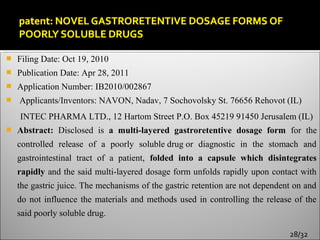
   Filing Date: Oct 19, 2010
   Publication Date: Apr 28, 2011
   Application Number: IB2010/002867
   Applicants/Inventors: NAVON, Nadav, 7 Sochovolsky St. 76656 Rehovot (IL)
    INTEC PHARMA LTD., 12 Hartom Street P.O. Box 45219 91450 Jerusalem (IL)
   Abstract: Disclosed is a multi-layered gastroretentive dosage form for the
    controlled release of a poorly soluble drug or diagnostic in the stomach and
    gastrointestinal tract of a patient, folded into a capsule which disintegrates
    rapidly and the said multi-layered dosage form unfolds rapidly upon contact with
    the gastric juice. The mechanisms of the gastric retention are not dependent on and
    do not influence the materials and methods used in controlling the release of the
    said poorly soluble drug.

                                                                               28/32
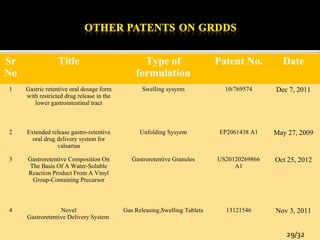
Sr                Title                          Type of                    Patent No.        Date
No                                             formulation
1    Gastric retentive oral dosage form           Swelling sysyem             10/769574     Dec 7, 2011
     with restricted drug release in the
        lower gastrointestinal tract


2    Extended release gastro-retentive           Unfolding Sysyem           EP2061438 A1    May 27, 2009
       oral drug delivery system for
                 valsartan

3    Gastroretentive Composition On           Gastroretentive Granules      US20120269866   Oct 25, 2012
      The Basis Of A Water-Soluble                                               A1
     Reaction Product From A Vinyl
       Group-Containing Precursor


4                 Novel                    Gas Releasing,Swelling Tablets     13121546      Nov 3, 2011
     Gastroretentive Delivery System

                                                                                               29/32
Brand Name                Formulation          Active Ingredients

 MADOPAR® HBS (Roche)              Capsule
                                                          L-Dopa

 Liquid Gaviscon® (GSK)     Floating Alginate Raft        Antacid


  Almagate Flot-Coat®                                   aluminium
                                      -              magnesium antacid

Beclofan GRS (Sun Pharma)             -                       -

   Cifran OD (Ranbaxy)             Tablet               Ciprofloxacin

       Glumetza®             Tablet (Acuform®)         Metformin HCl
 Proquin® XR (Depomed)                                Ciprofloxacin HCl

     Coreg CR (GSK)             Micropump®           Carvdilol Phosphate
                                                                   30/32
1.    http://www.patentlens.net , Accessed on 10-03-2013
2.    Doshi S.M., Tank H.M., Gastro Retention – An Innovation over Conventional poorly Soluble Drugs :
      A review, International Journal of Pharmaceutical and chemcal Sciences, 2012;1(2):859-866.
3.    S. P. Vyas, Roop K. Khar, CONTROLLED DRUG DELIVERY – Concepts & Advances, Vallabh
      Prakashan, page no. 196-217.
4.    N. K. Jain, Progress in Controlled & Novel Drug Delivery Systems, 1st edition 2004, CBS Publishers,
      page no.76-97
5.    http://www.sciencedirect.com/science/article/pii/S037851731201054X, Accessed on 10-03-2013
6.    G. Chawla, P. Gupta, V. Koradia, A. K. Bansal, Pharmaceutical Technology July 2003, 50-68
7.    Vyas, S.P.; Khar, R.Ks. Gastroretentive systems. In: Controlled drug Delivery. Vallabh Prakashan,
      Delhi, India. 2006.
8.    www.ijpras.com, Accessed on 10-03-2013
9.    International Journal of PharmTech Research
10.   Asian Journal of Biomedical and Pharmaceutical Sciences, 2 (8), 2012, 01-08


                                                                                                   31/32
GRDDS


        32/32

Recent advances in GRDDS

  • 1.
    L. J Instituteof Pharmacy (M.Pharm Sem-II-2012-13) GRDDS Department of Pharmaceutical Technology Prepared by: Harshil Senjalia Guided by: Dr. Shreeraj Shah Pushpraj Rana Associate Professor Sahil Shaikh Vikas Kurmi
  • 2.
    Introduction to GRDDS.  GRDDS approaches and classification.  Publications covering recent advances/Innovations in GRDDS.  Review of recent Patents related to GRDDS.  References. 2/32
  • 3.
    Gastro-retentive drug delivery system (GRDDS) is one of the site specific delivery of the drugs at stomach. It is obtained by retaining dosage form into stomach and drug is being released at sustained manner to specific site either in stomach or intestine. 3/32
  • 4.
  • 5.
    Here, the drugis incorporated with bio/Muco-adhesive agents, enabling the device to adhere to the stomach walls, Thus resisting gastric emptying. However, the mucus on the walls of the Stomach is in a state of constant renewal, Resulting in unpredictable adherence. 5/32
  • 6.
     The mechanism involved in this system includes the formation of a viscous cohesive gel in contact with Raft gastric fluids, wherein each portion of the liquid swells, forming a continuous layer called a raft. This raft floats on gastric fluids because of low bulk density created by the formation of CO2. 6/32
  • 7.
    Retained in stomach  Useful for poorly water soluble OR  unstable in intestinal Fluid  Bulk density : Less than gastric fluid (<1 g/cm3),  so remain buoyant in the stomach  without affecting gastric emptying rate  for prolonged period of time  So drug release slowly at the desired  rate from system 7/32
  • 8.
    Also called ‘PLUG SYSTEM’ •A dosage form in the stomach will withstand gastric transit if it is bigger than the pyloric sphincter •However, the dosage form must be small enough to be swallowed, and 13mm diameter must not cause gastric obstruction Expansion by swelling or unfolding to a large size. either singly or by accumulation. 8/32
  • 9.
    Density should bemore then stomach content i.e. 3 gm/cm3 Capable to withstand with peristaltic movement of stomach Prepared by coating or mixing drug with heavy inert material 9/32
  • 10.
    •Caldwell and co-workersproposed the different geometric forms (tetrahedron, ring or planar membrane [4-lobed, disc or 4-limbed cross form]) of bioerodible polymer compressed within a capsule. 10/32
  • 11.
    A B (A)Superporous hydrogel in its dry (a) and water-swollen (b) state.(B) Schematic illustration of the transit of superporous hydrogel. Although these are swellable systems, they differ sufficiently from the conventional types to warrant separate classification. With pore size ranging between 10 nm and 10 µm, absorption of water by conventional hydrogel is a very slow process and several hours may be needed to reach an equilibrium state during which premature evacuation of the dosage form may occur. 11/32
  • 12.
    Journal: International Journalof Pharmaceutics (Volume 255, Issues 1–2, 14 April 2003, Pages 13–32) Authors: Jaspreet Kaur Vasir, Kaustubh Tambwekar, Sanjay Garg, Abstract: The phenomenon of bioadhesion, introduced by Park and Robinson [Park, K., Robinson, J.R., 1984. Bioadhesive polymers as platforms for oral controlled drug delivery: method to study bioadhesion. Int. J. Pharm. 198, 107–127], has been studied extensively in the last decade and applied to improve the performance of these drug delivery systems. Recent advances in polymer science and drug carrier technologies have promulgated the development of novel drug carriers such as bioadhesive microspheres that have boosted the use of “bioadhesion” in drug delivery. This article presents the spectrum of potential applications of bioadhesive microspheres in controlled drug delivery ranging from the small molecules, to peptides, and to the macromolecular drugs such as proteins, oligonucleotides and even DNA. The development of mucus or cell-specific bioadhesive polymers and the concepts of cytoadhesion and bioinvasion provide unprecedented opportunities for targeting drugs to specific cells or intracellular compartments. Developments in the techniques for in vitro and in vivo evaluation of bioadhesive microspheres have also been discussed. 12/32
  • 13.
    Journal : InternationalSociety for the Study of Xenobiotics (2001, Vol. 33, No. 2 , Pages 149- 160) Inventors: Kumaresh S. Soppimath, Anandrao R. Kulkarni, Walter E. Rudzinski and Tejraj M. Aminabhavi Abstract: The floating or hydrodynamically controlled drug-delivery systems are useful in gastro retentive applications. The present review addresses briefly the physiology of the gastric emptying process with respect to floating drug-delivery systems. In recent years, the multiparticulate drug-delivery systems are used in the oral delivery of drugs. One of the approaches toward this goal is to develop the floating microspheres so as to increase the gastric retention time. Such systems have more advantages over the single-unit dosage forms. The development of floating microspheres involves different solvent evaporation techniques to create the hollow inner core. The present review addresses the preparation and characterization of the floating microspheres for the peroral route of administration of the drug. 13/32
  • 14.
    Journal: Research inPharmacy 1(4) :10-16, 2011 Authors: SuparnaDugal* and Andrea Fernandes Abstract: The limited solubility, and therefore bioavailability, of the antimycotic drug, itraconazole, used for the treatment of intestinal Candidiasis in immunocompromised individuals, has been well documented. Therapeutic regimen in these patients may include daily administration of multiple doses of various drugs. Hence, improving the residence time of therapeutic agents, would ensure a high continuous concentration in the body and help decrease the dosing frequency. In our current study, we have investigated a novel method of drug delivery, developed by utilizing the concept of mucoadhesiveness, for the sustained release of the drug, itraconazole. Mucoadhesive beads were prepared using two natural polymers, isabghula husk and alginate. The minimum inhibitory concentration of itraconazole for Candida was found to be 1.5milligram per millilitre. Accordingly, beads were prepared by ionic gelation method using calcium chloride as a crosslinking agent. Marked improvement in solubility of the drug was noted after entrapment. 14/32
  • 15.
    Journal: DRUG DEVELOPMENTAND INDUSTRIAL PHARMACY (Vol. 30, No. 4, pp. 405–412, 2004) Authors: R. Talukder and R. Fassihi Abstract: The objective of this study was to develop a floatable multiparticulate system with potential for intragastric sustained drug delivery. Cross-linked beads were made by using calcium and low methoxylated pectin (LMP), which is an anionic polysaccharide, and calcium, LMP, and sodium alginate. Beads were dried separately in an air convection type oven at 40C for 6 hours and in a freeze dryer to evaluate the changes in bead characteristics due to process variability. Riboflavin (B-2), tetracycline (TCN), and Methotrexate (MTX) were used as model drugs for encapsulation. Ionic and nonionic excipients were added to study their effects on the release profiles of the beads. The presence of noncross linking agents in low amounts (less than 2%) did not significantly interfere with release kinetics.y. Evaluation of the drying process demonstrated that the freeze-dried beads remained buoyant over 12 hours in United States Pharmacopeia (USP) hydrochloride buffer at pH 1.5, whereas the air-dried beads remained submerged throughout the release study. Confocal laser microscopy revealed the presence of air-filled hollow spaces inside the freeze dried beads, which was responsible for the flotation property of the beads. 15/32
  • 16.
    Journal: Indian Journalof Pharmaceutical Education and Research Authors: Ashwani Goyal , Sandeep Kumar , Manju Nagpal , Inderbir Singh and Sandeep Arora Abstract: Recently the use of herbal medicines has been increased all over the world due to their miraculous therapeutic effects and fewer adverse effects as compared to the modern medicines. However, delivery of herbal drugs also requires modifications with the purpose to achieve sustained release, to increase patient compliance etc. Previously herbal drugs could not attract scientists towards the development of novel drug delivery systems due to processing, standardising, extracting and identification difficulties. But now days with the advancement in the technology, novel drug delivery systems opens the door towards the development of herbal drug delivery systems. Novel drug delivery technologies have gained the importance to achieve modified delivery of herbal drugs thereby increasing the therapeutic value as well as reducing toxicity. For last one decade many novel carriers such as liposomes, nanoparticles, phytosomes and implants have been reported for successful modified delivery of various herbal drugs e.g. curcumin, quercetin, silybin, ginkgo etc. 16/32
  • 17.
    Black Myrobalan(Terminalia Chebula Retz)  Ginger Root(Zingiber Officinale Rosc)  Turmeric(Curcuma Longa L)  Thyme  Licorice  Berberine  Goshuyn(Evodia Rutaecarpa)  Other Chinese Herbs: Coptis Chinensis, Rheum Palmatum, Panax Notogenseng, Magnolia Officinalis, Prunus Mume, Corydalis Yanhusuo 17/32
  • 18.
    Journal: Pharmacognosy Research(Year: 2010 | Volume : 2 | Issue : 5 | Page : 304-308) Authors: HN Aswatha Ram, Prachiti Lachake, Ujjwal Kaushik, CS Shreedhara Abstract: Floating tablets prolong the gastric residence time of drugs, improve bioavailability, and facilitate local drug delivery to the stomach. With this objective, floating tablets containing aqueous extract of liquorice as drug was prepared for the treatment of Helicobacter pylori and gastric ulcers. Method: The aqueous extract of liquorice was standardized by HPTLC. Tablets containing HPMC K100M (hydrophilic polymer), liquorice extract, sodium bicarbonate (gas generating agent), talc, and magnesium stearate were prepared using direct compression method. The formulations were evaluated for physical parameters like diameter, thickness, hardness, friability, uniformity of weight, drug content, buoyancy time, dissolution, and drug release mechanism. The formulations were optimized on the basis of buoyancy time and in vitro drug release. 18/32
  • 19.
    Journal: Asian Journalof Pharmaceutical and Clinical Research (Vol 5, Issue 1, 2012 ) Authors: CHAKRABORTY M, GUPTA BIJAN KUMAR , DEBNATH R, PAL R.N, KUMAR RAJIB ABSTRACT: In the present study, Forskolin, a natural root extract from the Coleus Forskohlii, was developed into a gastro retentive floating drug delivery system, using different grades of HPMC. The drug is used as anti-obesity agent reducing fat in body muscles. Forskolin increases cAMP accumulation, and therefore stimulates lipolysis. So, with high concentrations of forskolin, cAMP and lipolysis increases Enhanced lipolysis increases fat degradation and fat usage as a fuel in the body. This may promote fat and weight loss. It is thought that supplementing with forskolin may enhance fat loss without loss of muscle mass .Presently the drug is available in conventional capsule dosage form with effect on systolic blood pressure. In floating drug delivery ,the release rate of drug was controlled minimizing dose related side effects. The cumulative drug release was fitted in different kinetic models and statistically validated. 19/32
  • 20.
    Journal: Tropical Journalof Pharmaceutical Research October 2012; 11 (5): 713-719 Authors: Kapil Kumar and AK Rai Abstract: Floating microsphere were prepared by emulsion solvent diffusion method, using hydroxylpropyl methylcellulose (HPMC), ethyl cellulose (EC), Eudragit S 100 polymer in varying ratios. Ethanol/dichloromethane blend was used as solvent in a ratio of 1:1. The floating microspheres were evaluated for flow properties, particle size, incorporation efficiency, as well as in-vitro floatability and drug release. The shape and surface morphology of the microspheres were characterized by optical and scanning electron microscopy. 20/32
  • 21.
    Publication number: EP2329810 A1  Publication date: Jun 8, 2011  Filing date: Nov 4, 2008  Priority date: Aug 18, 2008  Inventors: Qingwei Jiang, Quanzhi Liu, Wenbin Yang, Junli Zheng  Applicant: Team Academy Of Pharmaceutical Science  ABSTRACT: A gastroretentive drug delivery system is provided. Said system comprises a hollow vesicle and a drug-containing layer which surrounds the hollow vesicle. Said hollow vesicle preferably has a single chamber structure. The size in maximal diameter direction of said hollow vesicle is preferably 0.5-3.5 cm. The gastroretentive drug delivery system preferably contains an isolating layer and/or waterproofing layer between the hollow vesicle and the layer containing drug. 21/32
  • 22.
    Application Number: 10/514674  Publication Date: 05/11/2006  Filing Date: 05/21/2002  Inventors: Kumar, Manoj (Haryana, IN) Talwar, Naresh (New Delhi, IN) Raghuvanshi,Rajeev Singh (New Delhi, IN) Rampal, Ashok Kumar (Punjab, IN)  Abstract:  The present invention relates to an oral drug delivery system with biphasic release characteristics comprising a porous matrix comprising at least one drug substance, sugar(s), a release retarding polymer, gas generating components and optionally, pharma-ceuti-cally acceptable auxiliary components wherein the pharmaceutical composition further comprises a coating of said drug substance. The pharmaceutical composi-tion, either in the form of pellets (multiparticulate or single unit dosage form), beads, granules, capsules or tablets, is retained in the stomach while selectively delivering the drug(s) at gastrointestinal levels and upper parts of the small intestine over an extended period of time. The release of the drug from the said pharmaceutical composition is characterized by a biphasic release profile of the drug substance, which exhibits both immediate and controlled release characteristics. 22/32
  • 23.
    Application Number: PCT/GB1998/001513  Publication Date: 11/26/1998  Filing Date: 05/22/1998  Inventors: Illum Lisbeth, Ping He  Abstract:  There is provided a drug delivery composition for the controlled release of an active agent in the stomach environment over a prolonged period of time which comprises a microsphere comprising an active ingredient in the inner core of the microsphere and (i) a rate controlling layer of a water insoluble polymer and (ii) an outer layer of a bioadhesive agent in the form of a cationic polymer. 23/32
  • 24.
    Publication number: EP2276473 A1  Publication date: Jan 26, 2011  Filing date: Apr 17, 2009  Inventors: Giora Carni, David Kirmayer, Elena Kluev, Eytan Moor, Nadav Navon  Applicant: Intec Pharma Ltd.  ABSTRACT A gastroretentive drug formulation for the sustained release of an active agent in the gastrointestinal tract comprises an internal layer or compartment comprising an active agent and one or more pharmaceutical excipients, of which at least one is a polymer and two membranes forming together an envelope around the inner membrane, each membrane comprising at least one polymeric combination of an enteric polymer which is not soluble in gastric juice, and an hydrophilic swelling polymer, and at least one plasticizer. 24/32
  • 25.
    Publication number:EP1513508 A1  Publication date:Mar 16, 2005  Filing date:Jun 18, 2003  Inventors: Mohammad Hassan  Applicant: Euro-Celtique S.A.  ABSTRACT According to the present invention there is provided a pharmaceutical product for retention in the stomach. The product is produced by extrusion. The use of extrusion enables the product to take many useful forms. The product may comprise a sheet of hydratable polymer, the hydrated sheet being of a size which will not pass out of the stomach, for example a shaped sheet or a roll. The product may also comprise a sealed hollow tubular extrudate, for example a tube sealed at both ends. The product may comprise a filled capsule. 25/32
  • 26.
    Publication number: EP2378883 A2  Publication date: Oct 26, 2011  Filing date: Oct 19, 2009  Inventors: Giora Carni, David Kirmayer, Elena Kluev, Suher Masri, Eytan Moor, Nadav Navon  Applicant: Intec Pharma Ltd.  ABSTRACT: A biodegradable, multi-layered controlled release gastroretentive dosage form which is optionally divided into a first dosage of zaleplon for controlled release and a second dosage of zaleplon for immediate release in the stomach and gastrointestinal tract of a patient, folded into a capsule which disintegrates upon contact with gastric juice and the gastroretentive dosage form unfolds rapidly upon contact with gastric juice. The biodegradable, multi- layered gastroretentive dosage forms of the invention provide efficient sleep induction with good sleep maintenance and minimal next day residual effects. 26/32
  • 27.
    Application Number: 13/608994  Publication Date: 01/03/2013  Filing Date: 09/10/2012  Inventors: Muthusamy, Ramesh (Pune, IN) Kulkarni, Mohan Gopalkrishna (Pune, IN)  Abstract:  A gastroretentive, extended release composition which floats and swells at acidic pH prevalent in the stomach. The composition includes a pH dependent graft copolymer, a gellable polymer, a therapeutic agent, a gas generating system and pharmaceutically acceptable ingredients. The disclosed composition is useful to deliver the therapeutic agent within the stomach for an extended period of time. 27/32
  • 28.
    Filing Date: Oct 19, 2010  Publication Date: Apr 28, 2011  Application Number: IB2010/002867  Applicants/Inventors: NAVON, Nadav, 7 Sochovolsky St. 76656 Rehovot (IL) INTEC PHARMA LTD., 12 Hartom Street P.O. Box 45219 91450 Jerusalem (IL)  Abstract: Disclosed is a multi-layered gastroretentive dosage form for the controlled release of a poorly soluble drug or diagnostic in the stomach and gastrointestinal tract of a patient, folded into a capsule which disintegrates rapidly and the said multi-layered dosage form unfolds rapidly upon contact with the gastric juice. The mechanisms of the gastric retention are not dependent on and do not influence the materials and methods used in controlling the release of the said poorly soluble drug. 28/32
  • 29.
    Sr Title Type of Patent No. Date No formulation 1 Gastric retentive oral dosage form Swelling sysyem 10/769574 Dec 7, 2011 with restricted drug release in the lower gastrointestinal tract 2 Extended release gastro-retentive Unfolding Sysyem EP2061438 A1 May 27, 2009 oral drug delivery system for valsartan 3 Gastroretentive Composition On Gastroretentive Granules US20120269866 Oct 25, 2012 The Basis Of A Water-Soluble A1 Reaction Product From A Vinyl Group-Containing Precursor 4 Novel Gas Releasing,Swelling Tablets 13121546 Nov 3, 2011 Gastroretentive Delivery System 29/32
  • 30.
    Brand Name Formulation Active Ingredients MADOPAR® HBS (Roche) Capsule L-Dopa Liquid Gaviscon® (GSK) Floating Alginate Raft Antacid Almagate Flot-Coat® aluminium - magnesium antacid Beclofan GRS (Sun Pharma) - - Cifran OD (Ranbaxy) Tablet Ciprofloxacin Glumetza® Tablet (Acuform®) Metformin HCl Proquin® XR (Depomed) Ciprofloxacin HCl Coreg CR (GSK) Micropump® Carvdilol Phosphate 30/32
  • 31.
    1. http://www.patentlens.net , Accessed on 10-03-2013 2. Doshi S.M., Tank H.M., Gastro Retention – An Innovation over Conventional poorly Soluble Drugs : A review, International Journal of Pharmaceutical and chemcal Sciences, 2012;1(2):859-866. 3. S. P. Vyas, Roop K. Khar, CONTROLLED DRUG DELIVERY – Concepts & Advances, Vallabh Prakashan, page no. 196-217. 4. N. K. Jain, Progress in Controlled & Novel Drug Delivery Systems, 1st edition 2004, CBS Publishers, page no.76-97 5. http://www.sciencedirect.com/science/article/pii/S037851731201054X, Accessed on 10-03-2013 6. G. Chawla, P. Gupta, V. Koradia, A. K. Bansal, Pharmaceutical Technology July 2003, 50-68 7. Vyas, S.P.; Khar, R.Ks. Gastroretentive systems. In: Controlled drug Delivery. Vallabh Prakashan, Delhi, India. 2006. 8. www.ijpras.com, Accessed on 10-03-2013 9. International Journal of PharmTech Research 10. Asian Journal of Biomedical and Pharmaceutical Sciences, 2 (8), 2012, 01-08 31/32
  • 32.
    GRDDS 32/32