Flouting tablet as a novel technology of
oral drug delivery system
Laith J. Al-Asadi
Introduction
• Oral administration is the most convenient and preferred
means of any drug delivery to the systematic circulation.
• Oral controlled release drug delivery have recently been of
increasing interest in pharmaceutical field to achieve
improved therapeutic advantages, such as :
 ease of administration.
 patient compliance.
 flexibility in formulation.
Controlled release systems
• Drugs that are easily absorbed from
gastrointestinal tract (GIT) and have short
half-lives are eliminated quickly from the
systemic circulation.
• Frequent dosing of these drugs is required to
achieve suitable therapeutic activity.
• To avoid this limitation, the development of
oral sustained-controlled release
formulations.
Controlled release systems
• After oral administration, such a drug delivery would
be retained in the stomach and release the drug in a
controlled manner.
• So that the drug could be supplied continuously to its
absorption sites in the gastrointestinal tract (GIT).
• To formulate a site-specific orally administered
controlled release dosage form, it is desirable to
achieve a prolong gastric residence time by the drug
delivery.
Gastro-retentive drug delivery system
• Gastro-retentive drug delivery is an approach to
prolong gastric residence time, there by targeting
site-specific drug release and localized in the
stomach and upper gastrointestinal tract for local or
systemic effects.
• GRDS have a bulk density less than gastric fluids, so
remain buoyant in the stomach without affecting
the gastric emptying rate for a prolonged period of
time.
Advantages :
• Improve bioavailability.
• Increases the duration of drug release.
• Reduces drug waste.
• Improves the drug solubility that are less soluble
in a high pH environment.
• Provide local action in the upper part of the
small intestine e.g. treatment of peptic ulcer,
etc.
• Minimized adverse activity at the colon.
Drugs candidate to formulated as
GRDDS
• Drugs that absorbed from stomach
(levodopa and furosemide).
• Drugs with variable bioavailability (sotalol).
• Drugs acting locally in the stomach
(misoprostol).
• Poorly soluble drugs at alkaline PH
(diazepam ).
• Drugs that degraded in colon (ranitidine ,
metronidazole).
Drugs not intended to formulate as
grdds
• Drugs that have limited acid solubility.
(phenytoin).
• Drugs that instable in gastric condition.
(erythromycin).
• Drugs that cause gastric lesions(NSAIDs).
• Drugs have wide absorption sites
(nifedipine).
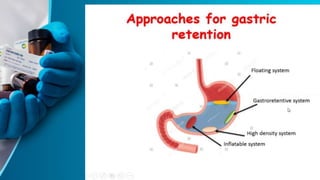
Gastro-retentive systems
• high density (sinking) systems.
• low density (floating) systems.
• mucoadhesive systems.
• swellable systems.
• super porous hydrogel systems.
Floating drug delivery system
• Floating drug delivery is the system float on the
gastric contents.
• FDDS have a bulk density less than gastric fluid.
• The drug is released slowly at the desired rate
from the system.
• After release of the drug, the residual system is
emptied from the stomach.
• This results in an increased GRT and a better
control of the fluctuations in plasma drug
concentration.
Limitation Of FDDS:
• These systems require a high level of fluid in
the stomach.
• Patients should not be dosed with floating
forms just before going to bed.
• Not suitable for drugs that have solubility or
stability problem in GIT.
Limitation Of FDDS:
• Drugs which are irritant to gastric mucosa are
also not desirable or suitable.
• The drug substances that are unstable in the
acidic environment of the stomach.
• These systems do not offer significant advantages
over the conventional dosage. forms for drugs
which are absorbed throughout the
gastrointestinal tract.
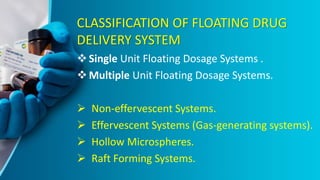
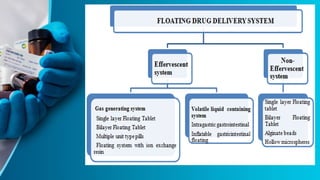
CLASSIFICATION OF FLOATING DRUG
DELIVERY SYSTEM
Single Unit Floating Dosage Systems .
Multiple Unit Floating Dosage Systems.
 Non-effervescent Systems.
 Effervescent Systems (Gas-generating systems).
 Hollow Microspheres.
 Raft Forming Systems.
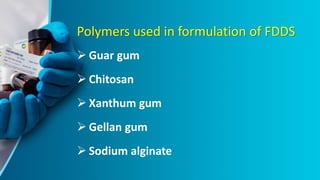
Polymers used in formulation of FDDS
 Guar gum
 Chitosan
 Xanthum gum
 Gellan gum
 Sodium alginate
EVALUATION TESTS
• Hardness & thickness
• Weight variation
• Content uniformity
• Powder compressibility & followability
• Friability
• Flouting time
• Density
• In-vitro release
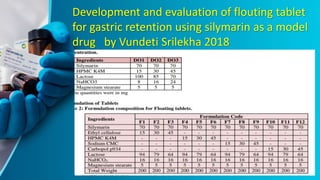
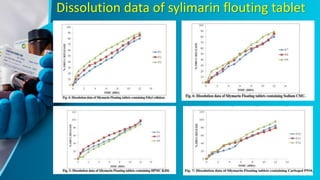
Development and evaluation of flouting tablet
for gastric retention using silymarin as a model
drug by Vundeti Srilekha 2018
Dissolution data of sylimarin flouting tablet
References :
 Samadhan Mali, S.Talele, A.Jadhav “ Effervescent Floating
Drug Delivery System: A Review” , Human Journals
Review Article March 2020 Vol.:17, Issue:4
 Shaika Saadia Zubedi, Shahid “Flouting tablets and its
polymers” , Mohammed Journal of Drug Delivery &
Therapeutics. , 2018; 8(5-s):16-24
 Vundeti Srilekha and Dr. M. Dhanalakshmi “Development
and evaluation of flouting tablet for gastric retention
using silymarin as a model drug” , wjpmr, 2018,4(12),
242-253
References :
 Harshal Ashok Pawar, Pooja Ramchandra Gharat
et al. “Development and evaluation of gastro-
retentive flouting tablet of antihypertensive drug
using hydrogenated cottonseed oil” , ISRN
Pharm. 2013; 2013: 137238.
 Dr. Sameer Shakur Sheaikh “Current technologies
for enhancing oral drug delivery system” ,
International Journal of Research in Pharmacy and
Biosciences / Volume 4, Issue 10, 2017, PP 1-10
Flouting drug delivery system

Flouting drug delivery system

  • 1.
    Flouting tablet asa novel technology of oral drug delivery system Laith J. Al-Asadi
  • 2.
    Introduction • Oral administrationis the most convenient and preferred means of any drug delivery to the systematic circulation. • Oral controlled release drug delivery have recently been of increasing interest in pharmaceutical field to achieve improved therapeutic advantages, such as :  ease of administration.  patient compliance.  flexibility in formulation.
  • 3.
    Controlled release systems •Drugs that are easily absorbed from gastrointestinal tract (GIT) and have short half-lives are eliminated quickly from the systemic circulation. • Frequent dosing of these drugs is required to achieve suitable therapeutic activity. • To avoid this limitation, the development of oral sustained-controlled release formulations.
  • 4.
    Controlled release systems •After oral administration, such a drug delivery would be retained in the stomach and release the drug in a controlled manner. • So that the drug could be supplied continuously to its absorption sites in the gastrointestinal tract (GIT). • To formulate a site-specific orally administered controlled release dosage form, it is desirable to achieve a prolong gastric residence time by the drug delivery.
  • 5.
    Gastro-retentive drug deliverysystem • Gastro-retentive drug delivery is an approach to prolong gastric residence time, there by targeting site-specific drug release and localized in the stomach and upper gastrointestinal tract for local or systemic effects. • GRDS have a bulk density less than gastric fluids, so remain buoyant in the stomach without affecting the gastric emptying rate for a prolonged period of time.
  • 6.
    Advantages : • Improvebioavailability. • Increases the duration of drug release. • Reduces drug waste. • Improves the drug solubility that are less soluble in a high pH environment. • Provide local action in the upper part of the small intestine e.g. treatment of peptic ulcer, etc. • Minimized adverse activity at the colon.
  • 7.
    Drugs candidate toformulated as GRDDS • Drugs that absorbed from stomach (levodopa and furosemide). • Drugs with variable bioavailability (sotalol). • Drugs acting locally in the stomach (misoprostol). • Poorly soluble drugs at alkaline PH (diazepam ). • Drugs that degraded in colon (ranitidine , metronidazole).
  • 8.
    Drugs not intendedto formulate as grdds • Drugs that have limited acid solubility. (phenytoin). • Drugs that instable in gastric condition. (erythromycin). • Drugs that cause gastric lesions(NSAIDs). • Drugs have wide absorption sites (nifedipine).
  • 9.
    Gastro-retentive systems • highdensity (sinking) systems. • low density (floating) systems. • mucoadhesive systems. • swellable systems. • super porous hydrogel systems.
  • 11.
    Floating drug deliverysystem • Floating drug delivery is the system float on the gastric contents. • FDDS have a bulk density less than gastric fluid. • The drug is released slowly at the desired rate from the system. • After release of the drug, the residual system is emptied from the stomach. • This results in an increased GRT and a better control of the fluctuations in plasma drug concentration.
  • 12.
    Limitation Of FDDS: •These systems require a high level of fluid in the stomach. • Patients should not be dosed with floating forms just before going to bed. • Not suitable for drugs that have solubility or stability problem in GIT.
  • 13.
    Limitation Of FDDS: •Drugs which are irritant to gastric mucosa are also not desirable or suitable. • The drug substances that are unstable in the acidic environment of the stomach. • These systems do not offer significant advantages over the conventional dosage. forms for drugs which are absorbed throughout the gastrointestinal tract.
  • 14.
    CLASSIFICATION OF FLOATINGDRUG DELIVERY SYSTEM Single Unit Floating Dosage Systems . Multiple Unit Floating Dosage Systems.  Non-effervescent Systems.  Effervescent Systems (Gas-generating systems).  Hollow Microspheres.  Raft Forming Systems.
  • 16.
    Polymers used informulation of FDDS  Guar gum  Chitosan  Xanthum gum  Gellan gum  Sodium alginate
  • 17.
    EVALUATION TESTS • Hardness& thickness • Weight variation • Content uniformity • Powder compressibility & followability • Friability • Flouting time • Density • In-vitro release
  • 18.
    Development and evaluationof flouting tablet for gastric retention using silymarin as a model drug by Vundeti Srilekha 2018
  • 19.
    Dissolution data ofsylimarin flouting tablet
  • 20.
    References :  SamadhanMali, S.Talele, A.Jadhav “ Effervescent Floating Drug Delivery System: A Review” , Human Journals Review Article March 2020 Vol.:17, Issue:4  Shaika Saadia Zubedi, Shahid “Flouting tablets and its polymers” , Mohammed Journal of Drug Delivery & Therapeutics. , 2018; 8(5-s):16-24  Vundeti Srilekha and Dr. M. Dhanalakshmi “Development and evaluation of flouting tablet for gastric retention using silymarin as a model drug” , wjpmr, 2018,4(12), 242-253
  • 21.
    References :  HarshalAshok Pawar, Pooja Ramchandra Gharat et al. “Development and evaluation of gastro- retentive flouting tablet of antihypertensive drug using hydrogenated cottonseed oil” , ISRN Pharm. 2013; 2013: 137238.  Dr. Sameer Shakur Sheaikh “Current technologies for enhancing oral drug delivery system” , International Journal of Research in Pharmacy and Biosciences / Volume 4, Issue 10, 2017, PP 1-10