Md:Akibur Rahman Akash
ID : UG08-32-18-054
Batch: 32(B)
Prospects of
Floating Drug Delivery System
(FDDS)
Purpose of the Study
The purpose of writing this review on floating drug delivery
systems (FDDS) was to compile the recent literature with special
focus on the principal mechanism of floatation to achieve gastric
retention. Drug delivery systems are those that float immediately
upon contact with gastric fluids present promising approaches for
increasing the bioavailability of drugs with absorption windows
in stomach or upper small intestine, unstable in the intestinal or
colonic environment, and exhibit low solubility at high pH
values. It is new drug delivery system maximize effectiveness
and compliance.
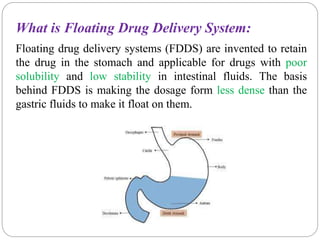
What is Floating Drug Delivery System:
Floating drug delivery systems (FDDS) are invented to retain
the drug in the stomach and applicable for drugs with poor
solubility and low stability in intestinal fluids. The basis
behind FDDS is making the dosage form less dense than the
gastric fluids to make it float on them.
Factors Affecting Gastric Retention
The rate of gastric emptying depends mainly on viscosity,
volume, and caloric content of meals.
 Increase in acidity and caloric value slows down gastric
emptying time.
 Biological factors such as age, body mass index (BMI),
gender, posture, and diseased states (diabetes) influence
gastric emptying.
 In the case of elderly persons, gastric emptying is slowed
down.
 Generally females have slower gastric emptying rates than
males.
 Stress increases gastric emptying rates while depression
slows it down.
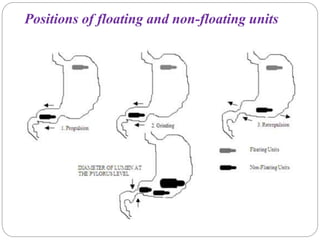
Positions of floating and non-floating units
Classification:
Floating drug delivery systems are classified depending on
the use of 2 formulation variables;
1. Effervescent Floating Dosage Forms
2. Non-Effervescent Floating Dosage Forms
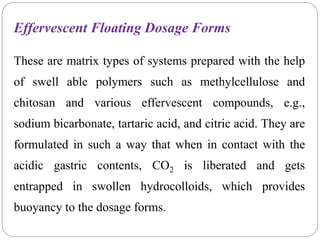
Effervescent Floating Dosage Forms
These are matrix types of systems prepared with the help
of swell able polymers such as methylcellulose and
chitosan and various effervescent compounds, e.g.,
sodium bicarbonate, tartaric acid, and citric acid. They are
formulated in such a way that when in contact with the
acidic gastric contents, CO2 is liberated and gets
entrapped in swollen hydrocolloids, which provides
buoyancy to the dosage forms.
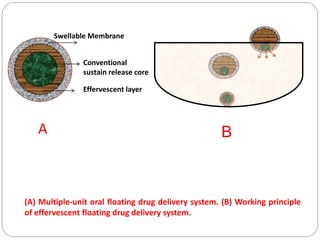
(A) Multiple-unit oral floating drug delivery system. (B) Working principle
of effervescent floating drug delivery system.
Swellable Membrane
Conventional
sustain release core
Effervescent layer
A B
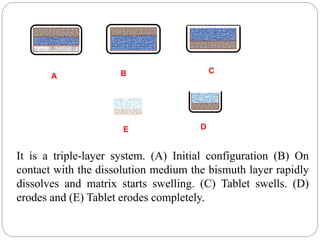
It is a triple-layer system. (A) Initial configuration (B) On
contact with the dissolution medium the bismuth layer rapidly
dissolves and matrix starts swelling. (C) Tablet swells. (D)
erodes and (E) Tablet erodes completely.
A B C
D
E
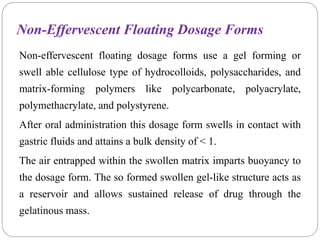
Non-effervescent floating dosage forms use a gel forming or
swell able cellulose type of hydrocolloids, polysaccharides, and
matrix-forming polymers like polycarbonate, polyacrylate,
polymethacrylate, and polystyrene.
After oral administration this dosage form swells in contact with
gastric fluids and attains a bulk density of < 1.
The air entrapped within the swollen matrix imparts buoyancy to
the dosage form. The so formed swollen gel-like structure acts as
a reservoir and allows sustained release of drug through the
gelatinous mass.
Non-Effervescent Floating Dosage Forms
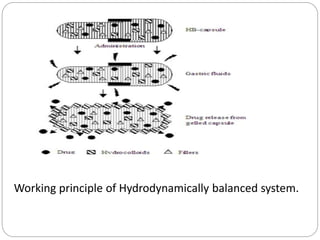
Working principle of Hydrodynamically balanced system.
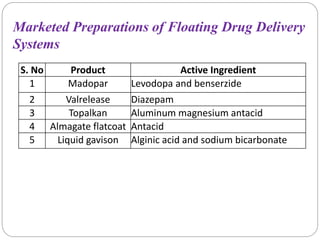
Marketed Preparations of Floating Drug Delivery
Systems
S. No Product Active Ingredient
1 Madopar Levodopa and benserzide
2 Valrelease Diazepam
3 Topalkan Aluminum magnesium antacid
4 Almagate flatcoat Antacid
5 Liquid gavison Alginic acid and sodium bicarbonate
Evaluation of floating drug delivery systems
Various parameters that need to be evaluated in gastro-
retentive formulations include;
1. Floating duration,
2. Dissolution profiles,
3. Specific gravity,
4. Content uniformity,
5. Hardness, and
6. Friability.
The tests for floating ability and drug release are
generally performed in simulated gastric fluids at 37ºC.
Applications of Floating Drug Delivery Systems
Floating drug delivery offers several applications for drugs
having poor bioavailability because of the narrow absorption
window in the upper part of the gastrointestinal tract. These
are summarized as follows.
Sustained Drug Delivery
Site-Specific Drug Delivery
 These systems are particularly advantageous for drugs
that are specifically absorbed from stomach or the
proximal part of the small intestine, e.g., riboflavin and
furosemide.
Limitations of FDDS
1. These systems require a high level of fluid in the stomach for
drug delivery to float and work efficiently-coat.
2. Not suitable for drugs that have solubility or stability
problem in GIT.
3. Drugs such as Nifedipine which is well absorbed along the
entire GIT and which undergoes first pass metabolism, may not
be desirable.
4.The drug substances that are unstable in the acidic
environment of the stomach are not suitable candidates to be
incorporated in the systems.
6. The dosage form should be administered with a full glass of
water (200-250 ml).
Floating Drug Delivery System(FDDS).pptx

Floating Drug Delivery System(FDDS).pptx

  • 1.
    Md:Akibur Rahman Akash ID: UG08-32-18-054 Batch: 32(B) Prospects of Floating Drug Delivery System (FDDS)
  • 2.
    Purpose of theStudy The purpose of writing this review on floating drug delivery systems (FDDS) was to compile the recent literature with special focus on the principal mechanism of floatation to achieve gastric retention. Drug delivery systems are those that float immediately upon contact with gastric fluids present promising approaches for increasing the bioavailability of drugs with absorption windows in stomach or upper small intestine, unstable in the intestinal or colonic environment, and exhibit low solubility at high pH values. It is new drug delivery system maximize effectiveness and compliance.
  • 3.
    What is FloatingDrug Delivery System: Floating drug delivery systems (FDDS) are invented to retain the drug in the stomach and applicable for drugs with poor solubility and low stability in intestinal fluids. The basis behind FDDS is making the dosage form less dense than the gastric fluids to make it float on them.
  • 4.
    Factors Affecting GastricRetention The rate of gastric emptying depends mainly on viscosity, volume, and caloric content of meals.  Increase in acidity and caloric value slows down gastric emptying time.  Biological factors such as age, body mass index (BMI), gender, posture, and diseased states (diabetes) influence gastric emptying.  In the case of elderly persons, gastric emptying is slowed down.  Generally females have slower gastric emptying rates than males.  Stress increases gastric emptying rates while depression slows it down.
  • 5.
    Positions of floatingand non-floating units
  • 6.
    Classification: Floating drug deliverysystems are classified depending on the use of 2 formulation variables; 1. Effervescent Floating Dosage Forms 2. Non-Effervescent Floating Dosage Forms
  • 7.
    Effervescent Floating DosageForms These are matrix types of systems prepared with the help of swell able polymers such as methylcellulose and chitosan and various effervescent compounds, e.g., sodium bicarbonate, tartaric acid, and citric acid. They are formulated in such a way that when in contact with the acidic gastric contents, CO2 is liberated and gets entrapped in swollen hydrocolloids, which provides buoyancy to the dosage forms.
  • 8.
    (A) Multiple-unit oralfloating drug delivery system. (B) Working principle of effervescent floating drug delivery system. Swellable Membrane Conventional sustain release core Effervescent layer A B
  • 9.
    It is atriple-layer system. (A) Initial configuration (B) On contact with the dissolution medium the bismuth layer rapidly dissolves and matrix starts swelling. (C) Tablet swells. (D) erodes and (E) Tablet erodes completely. A B C D E
  • 10.
    Non-effervescent floating dosageforms use a gel forming or swell able cellulose type of hydrocolloids, polysaccharides, and matrix-forming polymers like polycarbonate, polyacrylate, polymethacrylate, and polystyrene. After oral administration this dosage form swells in contact with gastric fluids and attains a bulk density of < 1. The air entrapped within the swollen matrix imparts buoyancy to the dosage form. The so formed swollen gel-like structure acts as a reservoir and allows sustained release of drug through the gelatinous mass. Non-Effervescent Floating Dosage Forms
  • 11.
    Working principle ofHydrodynamically balanced system.
  • 12.
    Marketed Preparations ofFloating Drug Delivery Systems S. No Product Active Ingredient 1 Madopar Levodopa and benserzide 2 Valrelease Diazepam 3 Topalkan Aluminum magnesium antacid 4 Almagate flatcoat Antacid 5 Liquid gavison Alginic acid and sodium bicarbonate
  • 13.
    Evaluation of floatingdrug delivery systems Various parameters that need to be evaluated in gastro- retentive formulations include; 1. Floating duration, 2. Dissolution profiles, 3. Specific gravity, 4. Content uniformity, 5. Hardness, and 6. Friability. The tests for floating ability and drug release are generally performed in simulated gastric fluids at 37ºC.
  • 14.
    Applications of FloatingDrug Delivery Systems Floating drug delivery offers several applications for drugs having poor bioavailability because of the narrow absorption window in the upper part of the gastrointestinal tract. These are summarized as follows. Sustained Drug Delivery Site-Specific Drug Delivery  These systems are particularly advantageous for drugs that are specifically absorbed from stomach or the proximal part of the small intestine, e.g., riboflavin and furosemide.
  • 15.
    Limitations of FDDS 1.These systems require a high level of fluid in the stomach for drug delivery to float and work efficiently-coat. 2. Not suitable for drugs that have solubility or stability problem in GIT. 3. Drugs such as Nifedipine which is well absorbed along the entire GIT and which undergoes first pass metabolism, may not be desirable. 4.The drug substances that are unstable in the acidic environment of the stomach are not suitable candidates to be incorporated in the systems. 6. The dosage form should be administered with a full glass of water (200-250 ml).