1
FIRDOUS,
M. PHARMACY.
Floating drug delivery system
 Introduction
 Why Floating Drug Delivery Systems ?
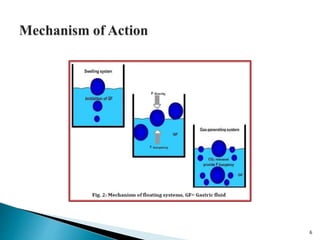
 Mechanism of Floating Drug Delivery System
 Types of Floating Drug Delivery System
1. Effervescent System
2. Non-Effervescent System
 Evaluation of Floating Drug Delivery System
 Advantages
 Disadvantages
 Conclusion
2
 Among all diff. routes, oral has achieved more attention &
quite successful.
 This is due to fact that GI physiology provides more
flexibility then other routes.
 But in oral solids, drug absorption is unsatisfactory and
variable .
 In oral controlled releases, release time was previously not
enhanced more then 12 hrs.
3
 This promoted the research in this direction by enhancing
gastric retention time.
 By this method, bioavailability enhanced, drug waste
reduced & solubility increased for insoluble drugs at high
pH levels.
4
 Various approaches followed to enhance GR (Gastric
Retention) Time for oral dosage form.
 Floating system has low bulk density & they can float on
gastric juice in the stomach.
 They can retain drug for longer time.
 This system can enhance drug's safety and reduce side effect .
 Thus ultimately, bioavailability enhanced.
5
6
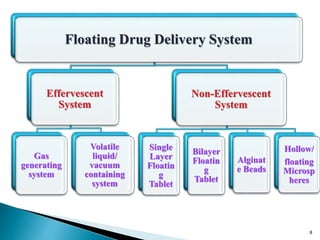
 Mainly FDDS categorized into 2 brief Categories.
1. Effervescent System,
2. Non-Effervescent System.
 These both then further divided into sub-categories.
 Chart of FDDS classification is shown as…..
7
Floating Drug Delivery System
Effervescent
System
Gas
generating
system
Volatile
liquid/
vacuum
containing
system
Non-Effervescent
System
Single
Layer
Floatin
g
Tablet
Bilayer
Floatin
g
Tablet
Alginat
e Beads
Hollow/
floating
Microsp
heres
8
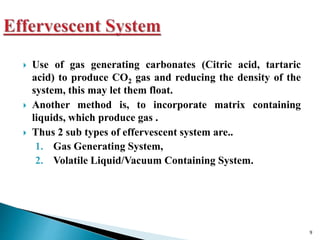
 Use of gas generating carbonates (Citric acid, tartaric
acid) to produce CO2 gas and reducing the density of the
system, this may let them float.
 Another method is, to incorporate matrix containing
liquids, which produce gas .
 Thus 2 sub types of effervescent system are..
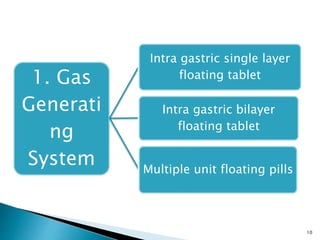
1. Gas Generating System,
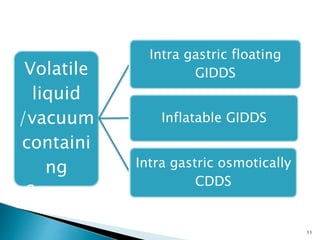
2. Volatile Liquid/Vacuum Containing System.
9
1. Gas
Generati
ng
System
Intra gastric single layer
floating tablet
Intra gastric bilayer
floating tablet
Multiple unit floating pills
10
2.
Volatile
liquid
/vacuum
containi
ng
System
Intra gastric floating
GIDDS
Inflatable GIDDS
Intra gastric osmotically
CDDS
11
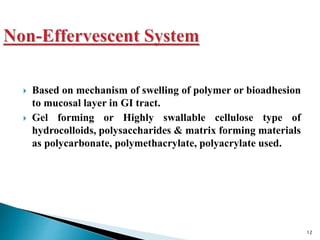
 Based on mechanism of swelling of polymer or bioadhesion
to mucosal layer in GI tract.
 Gel forming or Highly swallable cellulose type of
hydrocolloids, polysaccharides & matrix forming materials
as polycarbonate, polymethacrylate, polyacrylate used.
12
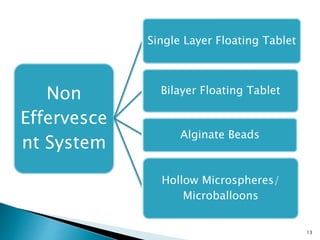
Non
Effervesce
nt System
Single Layer Floating Tablet
Bilayer Floating Tablet
Alginate Beads
Hollow Microspheres/
Microballoons
13
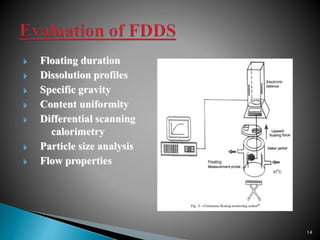
 Floating duration
 Dissolution profiles
 Specific gravity
 Content uniformity
 Differential scanning
calorimetry
 Particle size analysis
 Flow properties
14
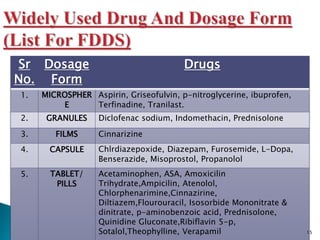
Sr
No.
Dosage
Form
Drugs
1. MICROSPHER
E
Aspirin, Griseofulvin, p-nitroglycerine, ibuprofen,
Terfinadine, Tranilast.
2. GRANULES Diclofenac sodium, Indomethacin, Prednisolone
3. FILMS Cinnarizine
4. CAPSULE Chlrdiazepoxide, Diazepam, Furosemide, L-Dopa,
Benserazide, Misoprostol, Propanolol
5. TABLET/
PILLS
Acetaminophen, ASA, Amoxicilin
Trihydrate,Ampicilin, Atenolol,
Chlorphenarimine,Cinnazirine,
Diltiazem,Flourouracil, Isosorbide Mononitrate &
dinitrate, p-aminobenzoic acid, Prednisolone,
Quinidine Gluconate,Ribiflavin 5-p,
Sotalol,Theophylline, Verapamil 15
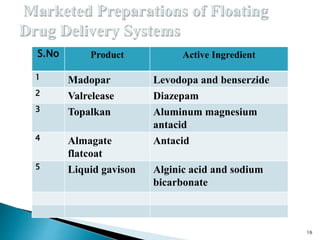
16
S.No Product Active Ingredient
1 Madopar Levodopa and benserzide
2 Valrelease Diazepam
3 Topalkan Aluminum magnesium
antacid
4 Almagate
flatcoat
Antacid
5 Liquid gavison Alginic acid and sodium
bicarbonate
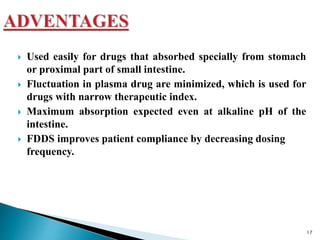
 Used easily for drugs that absorbed specially from stomach
or proximal part of small intestine.
 Fluctuation in plasma drug are minimized, which is used for
drugs with narrow therapeutic index.
 Maximum absorption expected even at alkaline pH of the
intestine.
 FDDS improves patient compliance by decreasing dosing
frequency.
17
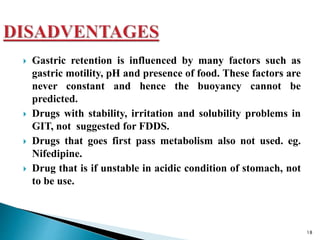
 Gastric retention is influenced by many factors such as
gastric motility, pH and presence of food. These factors are
never constant and hence the buoyancy cannot be
predicted.
 Drugs with stability, irritation and solubility problems in
GIT, not suggested for FDDS.
 Drugs that goes first pass metabolism also not used. eg.
Nifedipine.
 Drug that is if unstable in acidic condition of stomach, not
to be use.
18
19
Thank you

floating drug delivery system

  • 1.
  • 2.
     Introduction  WhyFloating Drug Delivery Systems ?  Mechanism of Floating Drug Delivery System  Types of Floating Drug Delivery System 1. Effervescent System 2. Non-Effervescent System  Evaluation of Floating Drug Delivery System  Advantages  Disadvantages  Conclusion 2
  • 3.
     Among alldiff. routes, oral has achieved more attention & quite successful.  This is due to fact that GI physiology provides more flexibility then other routes.  But in oral solids, drug absorption is unsatisfactory and variable .  In oral controlled releases, release time was previously not enhanced more then 12 hrs. 3
  • 4.
     This promotedthe research in this direction by enhancing gastric retention time.  By this method, bioavailability enhanced, drug waste reduced & solubility increased for insoluble drugs at high pH levels. 4
  • 5.
     Various approachesfollowed to enhance GR (Gastric Retention) Time for oral dosage form.  Floating system has low bulk density & they can float on gastric juice in the stomach.  They can retain drug for longer time.  This system can enhance drug's safety and reduce side effect .  Thus ultimately, bioavailability enhanced. 5
  • 6.
  • 7.
     Mainly FDDScategorized into 2 brief Categories. 1. Effervescent System, 2. Non-Effervescent System.  These both then further divided into sub-categories.  Chart of FDDS classification is shown as….. 7
  • 8.
    Floating Drug DeliverySystem Effervescent System Gas generating system Volatile liquid/ vacuum containing system Non-Effervescent System Single Layer Floatin g Tablet Bilayer Floatin g Tablet Alginat e Beads Hollow/ floating Microsp heres 8
  • 9.
     Use ofgas generating carbonates (Citric acid, tartaric acid) to produce CO2 gas and reducing the density of the system, this may let them float.  Another method is, to incorporate matrix containing liquids, which produce gas .  Thus 2 sub types of effervescent system are.. 1. Gas Generating System, 2. Volatile Liquid/Vacuum Containing System. 9
  • 10.
    1. Gas Generati ng System Intra gastricsingle layer floating tablet Intra gastric bilayer floating tablet Multiple unit floating pills 10
  • 11.
  • 12.
     Based onmechanism of swelling of polymer or bioadhesion to mucosal layer in GI tract.  Gel forming or Highly swallable cellulose type of hydrocolloids, polysaccharides & matrix forming materials as polycarbonate, polymethacrylate, polyacrylate used. 12
  • 13.
    Non Effervesce nt System Single LayerFloating Tablet Bilayer Floating Tablet Alginate Beads Hollow Microspheres/ Microballoons 13
  • 14.
     Floating duration Dissolution profiles  Specific gravity  Content uniformity  Differential scanning calorimetry  Particle size analysis  Flow properties 14
  • 15.
    Sr No. Dosage Form Drugs 1. MICROSPHER E Aspirin, Griseofulvin,p-nitroglycerine, ibuprofen, Terfinadine, Tranilast. 2. GRANULES Diclofenac sodium, Indomethacin, Prednisolone 3. FILMS Cinnarizine 4. CAPSULE Chlrdiazepoxide, Diazepam, Furosemide, L-Dopa, Benserazide, Misoprostol, Propanolol 5. TABLET/ PILLS Acetaminophen, ASA, Amoxicilin Trihydrate,Ampicilin, Atenolol, Chlorphenarimine,Cinnazirine, Diltiazem,Flourouracil, Isosorbide Mononitrate & dinitrate, p-aminobenzoic acid, Prednisolone, Quinidine Gluconate,Ribiflavin 5-p, Sotalol,Theophylline, Verapamil 15
  • 16.
    16 S.No Product ActiveIngredient 1 Madopar Levodopa and benserzide 2 Valrelease Diazepam 3 Topalkan Aluminum magnesium antacid 4 Almagate flatcoat Antacid 5 Liquid gavison Alginic acid and sodium bicarbonate
  • 17.
     Used easilyfor drugs that absorbed specially from stomach or proximal part of small intestine.  Fluctuation in plasma drug are minimized, which is used for drugs with narrow therapeutic index.  Maximum absorption expected even at alkaline pH of the intestine.  FDDS improves patient compliance by decreasing dosing frequency. 17
  • 18.
     Gastric retentionis influenced by many factors such as gastric motility, pH and presence of food. These factors are never constant and hence the buoyancy cannot be predicted.  Drugs with stability, irritation and solubility problems in GIT, not suggested for FDDS.  Drugs that goes first pass metabolism also not used. eg. Nifedipine.  Drug that is if unstable in acidic condition of stomach, not to be use. 18
  • 19.