Solubility and Distribution
Phenomenon
PHYSICAL PHARMACY II (lec1)
2ND CLASS / PHARMACY COLLEGE
Lecturer: Amina Mudhafar Mosul University
Special thanks: dr. Eman Alkhedairy Baghdad
University
Solubility (qualitatively): is the spontaneous interaction of two
or more substances to form a homogeneous molecular
dispersion.
Solubility (quantitatively): is the concentration of solute in a
saturated solution at a certain temperature.
Definitions
2
• An unsaturated (subsaturated solution) contains the dissolved solute in a
concentration below that necessary for complete saturation at a definite
temperature.
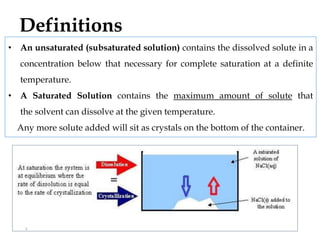
• A Saturated Solution contains the maximum amount of solute that
the solvent can dissolve at the given temperature.
Any more solute added will sit as crystals on the bottom of the container.
Definitions
3
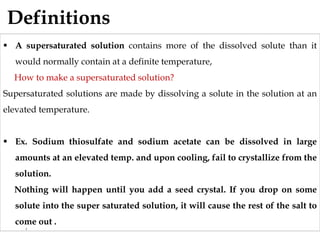
 A supersaturated solution contains more of the dissolved solute than it
would normally contain at a definite temperature,
How to make a supersaturated solution?
Supersaturated solutions are made by dissolving a solute in the solution at an
elevated temperature.
 Ex. Sodium thiosulfate and sodium acetate can be dissolved in large
amounts at an elevated temp. and upon cooling, fail to crystallize from the
solution.
Nothing will happen until you add a seed crystal. If you drop on some
solute into the super saturated solution, it will cause the rest of the salt to
come out .
Definitions
4
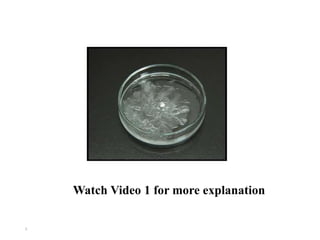
Watch Video 1 for more explanation
5
6
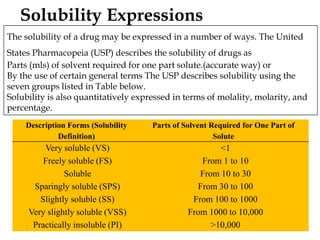
Description Forms (Solubility
Definition)
Parts of Solvent Required for One Part of
Solute
Very soluble (VS) <1
Freely soluble (FS) From 1 to 10
Soluble From 10 to 30
Sparingly soluble (SPS) From 30 to 100
Slightly soluble (SS) From 100 to 1000
Very slightly soluble (VSS) From 1000 to 10,000
Practically insoluble (PI) >10,000
The solubility of a drug may be expressed in a number of ways. The United
States Pharmacopeia (USP) describes the solubility of drugs as
Parts (mls) of solvent required for one part solute.(accurate way) or
By the use of certain general terms The USP describes solubility using the
seven groups listed in Table below.
Solubility is also quantitatively expressed in terms of molality, molarity, and
percentage.
Solubility Expressions
7
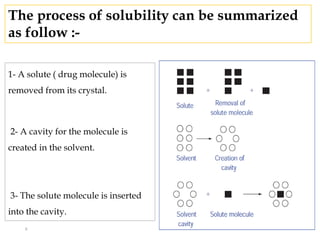
1- A solute ( drug molecule) is
removed from its crystal.
2- A cavity for the molecule is
created in the solvent.
3- The solute molecule is inserted
into the cavity.
The process of solubility can be summarized
as follow :-
8
In general the solubility of a solute in a solvent may be predicted
by solute- solute, solvent-solvent and solute-solvent interaction
- Adhesive forces  cohesive forces  increase solubility.
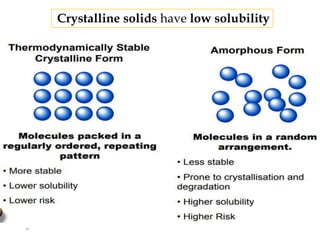
Crystalline solids have low solubility.
The insoluble nature is due to the stable crystalline arrangement
and low intermolecular forces between solvent and solute
-  melting point  solubility (for solid)
Solvent–Solute Interactions
9
Crystalline solids have low solubility
10
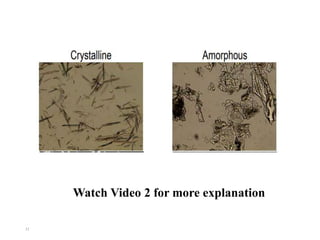
Watch Video 2 for more explanation
11
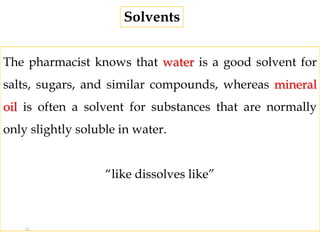
The pharmacist knows that water is a good solvent for
salts, sugars, and similar compounds, whereas mineral
oil is often a solvent for substances that are normally
only slightly soluble in water.
“like dissolves like”
Solvents
12
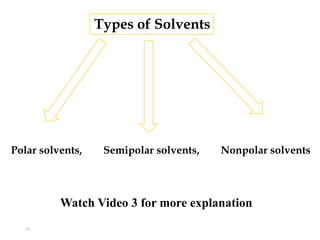
Types of Solvents
Polar solvents, Semipolar solvents, Nonpolar solvents
Watch Video 3 for more explanation
13
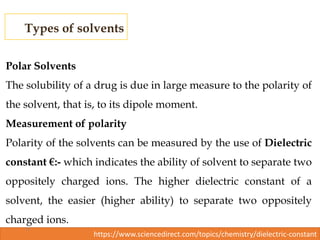
Polar Solvents
The solubility of a drug is due in large measure to the polarity of
the solvent, that is, to its dipole moment.
Measurement of polarity
Polarity of the solvents can be measured by the use of Dielectric
constant €:- which indicates the ability of solvent to separate two
oppositely charged ions. The higher dielectric constant of a
solvent, the easier (higher ability) to separate two oppositely
charged ions.
Types of solvents
https://www.sciencedirect.com/topics/chemistry/dielectric-constant
14
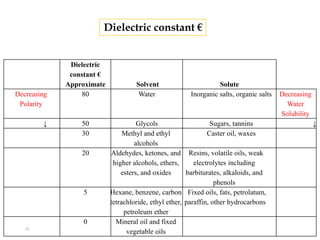
Dielectric
constant €
Approximate Solvent Solute
Decreasing
Polarity
80 Water Inorganic salts, organic salts Decreasing
Water
Solubility
↓ 50 Glycols Sugars, tannins ↓
30 Methyl and ethyl
alcohols
Caster oil, waxes
20 Aldehydes, ketones, and
higher alcohols, ethers,
esters, and oxides
Resins, volatile oils, weak
electrolytes including
barbiturates, alkaloids, and
phenols
5 Hexane, benzene, carbon
tetrachloride, ethyl ether,
petroleum ether
Fixed oils, fats, petrolatum,
paraffin, other hydrocarbons
0 Mineral oil and fixed
vegetable oils
Dielectric constant €
15
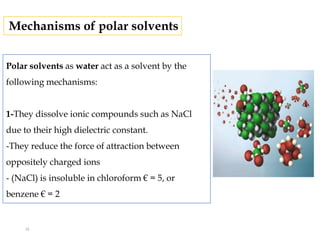
Polar solvents as water act as a solvent by the
following mechanisms:
1-They dissolve ionic compounds such as NaCl
due to their high dielectric constant.
-They reduce the force of attraction between
oppositely charged ions
- (NaCl) is insoluble in chloroform € = 5, or
benzene € = 2
Mechanisms of polar solvents
16
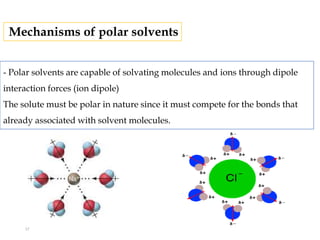
- Polar solvents are capable of solvating molecules and ions through dipole
interaction forces (ion dipole)
The solute must be polar in nature since it must compete for the bonds that
already associated with solvent molecules.
Mechanisms of polar solvents
17
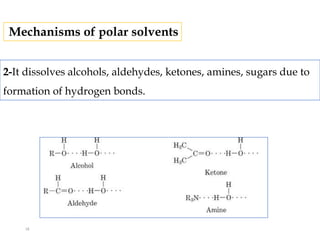
2-It dissolves alcohols, aldehydes, ketones, amines, sugars due to
formation of hydrogen bonds.
Mechanisms of polar solvents
18
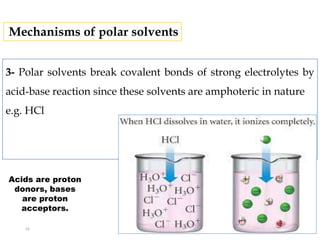
3- Polar solvents break covalent bonds of strong electrolytes by
acid-base reaction since these solvents are amphoteric in nature
e.g. HCl
Mechanisms of polar solvents
Acids are proton
donors, bases
are proton
acceptors.
19
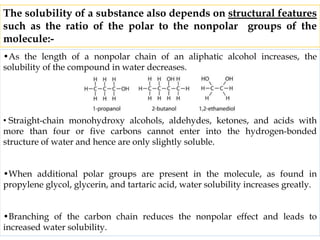
•As the length of a nonpolar chain of an aliphatic alcohol increases, the
solubility of the compound in water decreases.
• Straight-chain monohydroxy alcohols, aldehydes, ketones, and acids with
more than four or five carbons cannot enter into the hydrogen-bonded
structure of water and hence are only slightly soluble.
•When additional polar groups are present in the molecule, as found in
propylene glycol, glycerin, and tartaric acid, water solubility increases greatly.
•Branching of the carbon chain reduces the nonpolar effect and leads to
increased water solubility.
The solubility of a substance also depends on structural features
such as the ratio of the polar to the nonpolar groups of the
molecule:-
20
•Branching will decrease the size or volume of the molecule and make it easier
to solvate the molecule with the solvent.
•Solubility is affected by molecular size of particle.
The solubility of the substance is decreased when molecules have higher
molecular weight and high molecular size because larger molecules are more
difficult to be surrounded with the solvent molecules in order to solvate
substance.
The solubility of a substance also depends on structural features
such as the ratio of the polar to the nonpolar groups of the
molecule:-
21

Solubility lec 1

  • 1.
    Solubility and Distribution Phenomenon PHYSICALPHARMACY II (lec1) 2ND CLASS / PHARMACY COLLEGE Lecturer: Amina Mudhafar Mosul University Special thanks: dr. Eman Alkhedairy Baghdad University
  • 2.
    Solubility (qualitatively): isthe spontaneous interaction of two or more substances to form a homogeneous molecular dispersion. Solubility (quantitatively): is the concentration of solute in a saturated solution at a certain temperature. Definitions 2
  • 3.
    • An unsaturated(subsaturated solution) contains the dissolved solute in a concentration below that necessary for complete saturation at a definite temperature. • A Saturated Solution contains the maximum amount of solute that the solvent can dissolve at the given temperature. Any more solute added will sit as crystals on the bottom of the container. Definitions 3
  • 4.
     A supersaturatedsolution contains more of the dissolved solute than it would normally contain at a definite temperature, How to make a supersaturated solution? Supersaturated solutions are made by dissolving a solute in the solution at an elevated temperature.  Ex. Sodium thiosulfate and sodium acetate can be dissolved in large amounts at an elevated temp. and upon cooling, fail to crystallize from the solution. Nothing will happen until you add a seed crystal. If you drop on some solute into the super saturated solution, it will cause the rest of the salt to come out . Definitions 4
  • 5.
    Watch Video 1for more explanation 5
  • 6.
  • 7.
    Description Forms (Solubility Definition) Partsof Solvent Required for One Part of Solute Very soluble (VS) <1 Freely soluble (FS) From 1 to 10 Soluble From 10 to 30 Sparingly soluble (SPS) From 30 to 100 Slightly soluble (SS) From 100 to 1000 Very slightly soluble (VSS) From 1000 to 10,000 Practically insoluble (PI) >10,000 The solubility of a drug may be expressed in a number of ways. The United States Pharmacopeia (USP) describes the solubility of drugs as Parts (mls) of solvent required for one part solute.(accurate way) or By the use of certain general terms The USP describes solubility using the seven groups listed in Table below. Solubility is also quantitatively expressed in terms of molality, molarity, and percentage. Solubility Expressions 7
  • 8.
    1- A solute( drug molecule) is removed from its crystal. 2- A cavity for the molecule is created in the solvent. 3- The solute molecule is inserted into the cavity. The process of solubility can be summarized as follow :- 8
  • 9.
    In general thesolubility of a solute in a solvent may be predicted by solute- solute, solvent-solvent and solute-solvent interaction - Adhesive forces  cohesive forces  increase solubility. Crystalline solids have low solubility. The insoluble nature is due to the stable crystalline arrangement and low intermolecular forces between solvent and solute -  melting point  solubility (for solid) Solvent–Solute Interactions 9
  • 10.
    Crystalline solids havelow solubility 10
  • 11.
    Watch Video 2for more explanation 11
  • 12.
    The pharmacist knowsthat water is a good solvent for salts, sugars, and similar compounds, whereas mineral oil is often a solvent for substances that are normally only slightly soluble in water. “like dissolves like” Solvents 12
  • 13.
    Types of Solvents Polarsolvents, Semipolar solvents, Nonpolar solvents Watch Video 3 for more explanation 13
  • 14.
    Polar Solvents The solubilityof a drug is due in large measure to the polarity of the solvent, that is, to its dipole moment. Measurement of polarity Polarity of the solvents can be measured by the use of Dielectric constant €:- which indicates the ability of solvent to separate two oppositely charged ions. The higher dielectric constant of a solvent, the easier (higher ability) to separate two oppositely charged ions. Types of solvents https://www.sciencedirect.com/topics/chemistry/dielectric-constant 14
  • 15.
    Dielectric constant € Approximate SolventSolute Decreasing Polarity 80 Water Inorganic salts, organic salts Decreasing Water Solubility ↓ 50 Glycols Sugars, tannins ↓ 30 Methyl and ethyl alcohols Caster oil, waxes 20 Aldehydes, ketones, and higher alcohols, ethers, esters, and oxides Resins, volatile oils, weak electrolytes including barbiturates, alkaloids, and phenols 5 Hexane, benzene, carbon tetrachloride, ethyl ether, petroleum ether Fixed oils, fats, petrolatum, paraffin, other hydrocarbons 0 Mineral oil and fixed vegetable oils Dielectric constant € 15
  • 16.
    Polar solvents aswater act as a solvent by the following mechanisms: 1-They dissolve ionic compounds such as NaCl due to their high dielectric constant. -They reduce the force of attraction between oppositely charged ions - (NaCl) is insoluble in chloroform € = 5, or benzene € = 2 Mechanisms of polar solvents 16
  • 17.
    - Polar solventsare capable of solvating molecules and ions through dipole interaction forces (ion dipole) The solute must be polar in nature since it must compete for the bonds that already associated with solvent molecules. Mechanisms of polar solvents 17
  • 18.
    2-It dissolves alcohols,aldehydes, ketones, amines, sugars due to formation of hydrogen bonds. Mechanisms of polar solvents 18
  • 19.
    3- Polar solventsbreak covalent bonds of strong electrolytes by acid-base reaction since these solvents are amphoteric in nature e.g. HCl Mechanisms of polar solvents Acids are proton donors, bases are proton acceptors. 19
  • 20.
    •As the lengthof a nonpolar chain of an aliphatic alcohol increases, the solubility of the compound in water decreases. • Straight-chain monohydroxy alcohols, aldehydes, ketones, and acids with more than four or five carbons cannot enter into the hydrogen-bonded structure of water and hence are only slightly soluble. •When additional polar groups are present in the molecule, as found in propylene glycol, glycerin, and tartaric acid, water solubility increases greatly. •Branching of the carbon chain reduces the nonpolar effect and leads to increased water solubility. The solubility of a substance also depends on structural features such as the ratio of the polar to the nonpolar groups of the molecule:- 20
  • 21.
    •Branching will decreasethe size or volume of the molecule and make it easier to solvate the molecule with the solvent. •Solubility is affected by molecular size of particle. The solubility of the substance is decreased when molecules have higher molecular weight and high molecular size because larger molecules are more difficult to be surrounded with the solvent molecules in order to solvate substance. The solubility of a substance also depends on structural features such as the ratio of the polar to the nonpolar groups of the molecule:- 21

Editor's Notes

  • #5 Na2S2O3  is used as a medication to treat cyanide poisoning, pityriasis versicolor, and to decrease side effects from cisplatin. CH3COONa is used widely in many industrial purposes like for concret and others.
  • #7 You have to heat the solution and keep adding crystals until its supersaturated. Let it cool down to room temp then add a single seed crystal and it will start growing.
  • #10 Physical properties e.g. melting point may indicate the enhancement of the amorphous solubility over that of the crystalline.
  • #11 prone-= likely or liable to suffer from
  • #15 Dielectric constant (ϵr) is defined as the ratio of the electric permeability of the material to the electric permeability of free space (i.e., vacuum) and its value can derived from a simplified capacitor model.
  • #20 Acids are proton donors, bases are proton acceptors.