


INTRODUCTION NEED FOR GRDDS ADVANTAGES  &  LIMITATION POTENTIAL DRUG CANDIDATES FOR GRDDS UNSUITABLE  CANDIDATES FOR GRDDS  APPROACHES EVALUATION  CONCLUSION  REFERENCES
The control of gastrointestinal transit of orally administered dosage forms using  gastroretentive drug delivery systems  (GRDDS) can improve the bioavailability of drugs that exhibit site-specific absorption.  Prolonged gastric retention can be achieved by using  floating, swelling, bioadhesive, high-density systems etc.
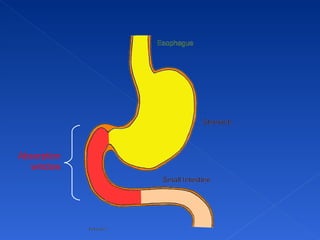
A controlled drug delivery system with prolonged residence time in the stomach is of particular interest: Drugs which are locally active in the stomach (misoprostol, antacids ,antibiotics against H.pylori).  Have an absorption window in stomach or in the upper small intestine (L-dopa, P-aminobenzoic acid, furosemide).  Are unstable in the intestine or colonic environment (captopril).  Exhibit low solubility at high pH values (diazepam, verapamil).  Alter normal flora of the colon (antibiotics).  Absorbed by transporter mechanism (paclitaxel).
Absorption window
Improved drug absorption, because of  increased GRT  and more time spent by the dosage form at its absorption site. Controlled delivery  of drugs.  Delivery of drugs for  local action  in the stomach.  Minimizing mucosal irritation  by drugs (drug releasing slowly at a controlled rate).  Treatment of gastrointestinal disorders  such as gastro-esophageal reflux.  Ease of administration and  better patient compliance.
They require a  sufficiently high level of fluids  in the stomach for the drug delivery buoyancy, to float therein and to work efficiently.  Floating systems are not feasible for those drugs that have  solubility or stability problems in gastric fluid .  Drugs which  are well absorbed along the entire GI tract  and which undergoes significant first- pass metabolism, may not be desirable candidates for GRDDS since the slow gastric emptying may lead to reduced systemic bioavailability.  Drugs that  are irritant to gastric mucosa  are not suitable for GRDDS.
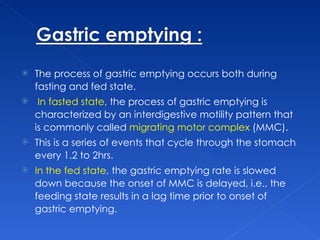
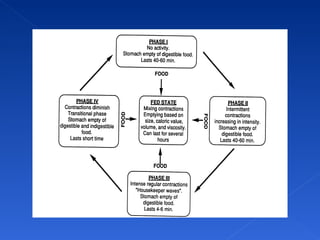
The process of gastric emptying occurs both during fasting and fed state. In fasted state , the process of gastric emptying is characterized by an interdigestive motility pattern that is commonly called  migrating motor complex  (MMC).  This is a series of events that cycle through the stomach every 1.2 to 2hrs.  In the fed state , the gastric emptying rate is slowed down because the onset of MMC is delayed, i.e., the feeding state results in a lag time prior to onset of gastric emptying.
 
Density of dosage form.  Size of dosage form. Food intake and nature of food.  Effects of gender, posture, and age.
Potential drug candidates for gastro-retentive drug delivery systems: Weakly basic drugs  that are poorly soluble in intestinal pHs and have better dissolution in the acidic medium of stomach.  Drugs that have absorption windows in the  upper part of the small intestine. They will  gradually empty in solution form to the site of  absorption.  All drugs that are intended for local action on the  gastro-duodenal wall e.g. therapeutic agents of  ulcerous diseases.
Drugs that are unsuitable for gastro-retentive drug delivery system: a .  Enteric coated systems. b. Drugs intended for selective release in the colon e.g. 5-aminosalicylic acid and corticosteroids.  c. Drugs that have very limited acid solubility e.g. phenytoin. d. Drugs that suffer instability in the gastric environment e.g. erythromycin
High-density systems. Floating systems. Hydrodynamically Balance System. Gas Generating System. Raft forming System. Swelling and expanding systems. Superporous hydrogels. Mucoadhesive & Bioadhesive systems.
Gastric contents have a density close to water (  1.004 g cm− 3). When the patient is upright small high-density pellets sink to the bottom of the stomach where they become entrapped in the folds of the antrum and withstand the peristaltic waves of the stomach wall. A density close to 2.5 g cm −3  seems necessary for significant prolongation of gastric residence time. Barium sulphate, zinc oxide, iron powder, and titanium dioxide are examples for excipients used.
These have a bulk density lower than the gastric content. They remain buoyant in the stomach for a prolonged period of time, with the potential for continuous release of drug. They Include: Hydrodynamically balanced systems HBS™  Gas-generating systems  Raft-forming systems  Low-density systems
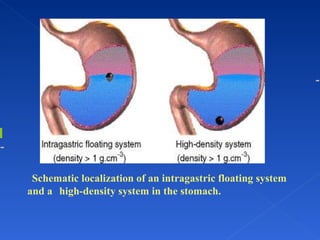
    Schematic localization of an intragastric floating system  and a  high-density system in the stomach.         
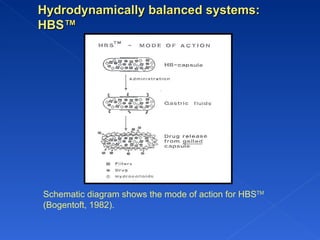
Prepared by incorporating a high level(20-75%w/w) gel-forming hydrocolloids. Eg:- Hydoxyethylcellulose, hydroxypropylcellulose, HPMC & Sod. CMC into the formulation and then compressing these granules into a tablets or (encapsulating into capsules.)  This hydocolloids forms  a colloidal gel barrier around its surface which controls  the rate of solvent penetration into the device and drug release from the device. It maintains the bulk density less than 1.
Hydrodynamically balanced systems: HBS™  Schematic diagram shows the mode of action for HBS TM   (Bogentoft, 1982).
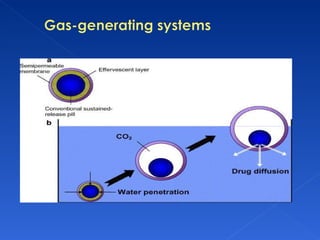
Carbonates or bicarbonates, which react with gastric acid or any other acid (e.g., citric or tartaric) present in the formulation to produce CO 2   , are usually incorporated in the dosage form, thus reducing the density of the system and making it float on the media.  An alternative is incorporation of matrix containing portions of liquid, which produce gas that evaporates at body temperature.
 
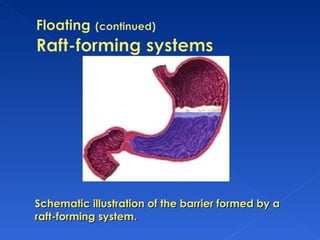
This system is used for delivery of antacids and drug delivery for treatment of gastrointestinal infections and disorders. The mechanism involved in this system includes the formation of a viscous cohesive gel in contact with gastric fluids, wherein each portion of the liquid swells, forming a continuous layer called raft.  This raft floats in gastric fluids because of the low bulk density created by the formation of CO 2 . Usually the system contains a gel-forming agent and alkaline bicarbonates or carbonates responsible for the formation of CO 2  to make the system less dense and more apt to float on the gastric fluids.
Schematic illustration of the barrier formed by a raft-forming system.
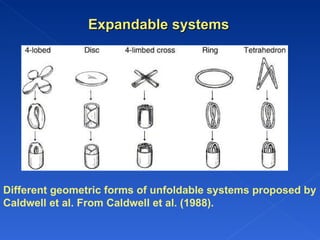
These systems include Unfoldable and Swellable systems.  Unfoldable systems  are made of biodegradable polymers. The concept is to make a carrier, such as a capsule, incorporating a compressed system which extends in the stomach. Caldwell et al. proposed different geometric forms (tetrahedron, ring or planar membrane [4-lobed, disc or 4-limbed cross form] ) of bioerodible polymer compressed within a capsule. Swellable systems  are retained because of their mechanical properties. The swelling is usually results from osmotic absorption of water.  The device gradually decreases in volume and rigidity as a result depletion of drug and expanding agent and/or bioreosion of polymer layer, enabling its elimination.
                                                                            Different geometric forms of unfoldable systems proposed by Caldwell et al. From Caldwell et al. (1988). Expandable systems                  
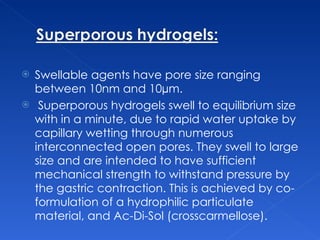
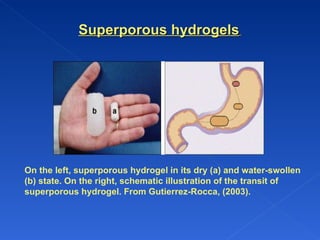
Swellable agents have pore size ranging between 10nm and 10Âľm.  Superporous hydrogels swell to equilibrium size with in a minute, due to rapid water uptake by capillary wetting through numerous interconnected open pores. They swell to large size and are intended to have sufficient mechanical strength to withstand pressure by the gastric contraction. This is achieved by co-formulation of a hydrophilic particulate material, and Ac-Di-Sol (crosscarmellose).
On the left, superporous hydrogel in its dry (a) and water-swollen (b) state. On the right, schematic illustration of the transit of superporous hydrogel. From Gutierrez-Rocca, (2003).  Superporous hydrogels
The basis of mucoadhesion is that a dosage form can stick to the mucosal surface by different mechanisms.  Examples for Materials commonly used for bioadhesion are poly(acrylic acid) (CarbopolÂŽ, polycarbophil), chitosan, GantrezÂŽ (Polymethyl vinyl ether/maleic anhydride copolymers), cholestyramine, tragacanth, sodium alginate.
 
Magnetic Resonance Imaging : It is a noninvasive technique and allow observation of total anatomical structure in relatively high resolution. The visualization of GI tract by MRI has to be further improved by the administration of contrast media. For solid DFs, the incorporation of a superparamagnetic compound such as ferrous oxide enables their visualization by MRI.  Radiology (X-Ray) : In this technique a radio-opaque material has to be incorporated in the DF, and its location is tracked by X-ray picture.
Gamma scintigraphy relies on the administration of a DF containing a small amount of radioisotope, e.g.,152Sm,which is a gamma ray emitter with a relatively short half life.  Gastroscopy: Gastroscopy is commonly used for the diagnosis and monitoring of the GI tract. This technique utilizes a fiberoptic or video system and can be easily applied for monitoring and locating GRDFs in the stomach.  
Tablets weighed individually (W1) and placed in Petri dishes containing 15ml of 0.1N HCl. At regular intervals they are removed from Petri dishes and excess surface water was removed using filter paper The swollen tablets were reweighed (W2). The swollen tablets are dried at 60° C at 24hrs in an oven and kept in desiccators for 24hrs and reweighed (W3).  Degree of swelling = (W2 - W1)/W1 %Erosion = (W1 - W3) X 100 /W1
The development of GRDDs can be advantageous for the administration of some important drugs and significantly improves their therapeutic outcome. Gastroretentivity of a DF can be achieved by the development of devices that can be significantly expand their volume by unfolding or swelling, adhering to gastric mucosa, or have the suitable density to sink or float over the gastric fluids.
Chien Yie W. “ Novel drug delivery systems”, Vol-50, 2 nd  ed, Marcel Dekker . Inc, New York. Pg No.164-177. Anand S. Surana & Rakhee K. Kotecha, “An overview on various approaches to oral controlled drug delivery system via gastroretention” IJPSRR, Vol-2, May-June 2010. pp: 68-72.
 

Sagar grdds final ppt pd

  • 1.
  • 2.
    INTRODUCTION NEED FORGRDDS ADVANTAGES & LIMITATION POTENTIAL DRUG CANDIDATES FOR GRDDS UNSUITABLE CANDIDATES FOR GRDDS APPROACHES EVALUATION CONCLUSION REFERENCES
  • 3.
    The control ofgastrointestinal transit of orally administered dosage forms using gastroretentive drug delivery systems (GRDDS) can improve the bioavailability of drugs that exhibit site-specific absorption. Prolonged gastric retention can be achieved by using floating, swelling, bioadhesive, high-density systems etc.
  • 4.
    A controlled drugdelivery system with prolonged residence time in the stomach is of particular interest: Drugs which are locally active in the stomach (misoprostol, antacids ,antibiotics against H.pylori). Have an absorption window in stomach or in the upper small intestine (L-dopa, P-aminobenzoic acid, furosemide). Are unstable in the intestine or colonic environment (captopril). Exhibit low solubility at high pH values (diazepam, verapamil). Alter normal flora of the colon (antibiotics). Absorbed by transporter mechanism (paclitaxel).
  • 5.
  • 6.
    Improved drug absorption,because of increased GRT and more time spent by the dosage form at its absorption site. Controlled delivery of drugs. Delivery of drugs for local action in the stomach. Minimizing mucosal irritation by drugs (drug releasing slowly at a controlled rate). Treatment of gastrointestinal disorders such as gastro-esophageal reflux. Ease of administration and better patient compliance.
  • 7.
    They require a sufficiently high level of fluids in the stomach for the drug delivery buoyancy, to float therein and to work efficiently. Floating systems are not feasible for those drugs that have solubility or stability problems in gastric fluid . Drugs which are well absorbed along the entire GI tract and which undergoes significant first- pass metabolism, may not be desirable candidates for GRDDS since the slow gastric emptying may lead to reduced systemic bioavailability. Drugs that are irritant to gastric mucosa are not suitable for GRDDS.
  • 8.
    The process ofgastric emptying occurs both during fasting and fed state. In fasted state , the process of gastric emptying is characterized by an interdigestive motility pattern that is commonly called migrating motor complex (MMC). This is a series of events that cycle through the stomach every 1.2 to 2hrs. In the fed state , the gastric emptying rate is slowed down because the onset of MMC is delayed, i.e., the feeding state results in a lag time prior to onset of gastric emptying.
  • 9.
  • 10.
    Density of dosageform. Size of dosage form. Food intake and nature of food. Effects of gender, posture, and age.
  • 11.
    Potential drug candidatesfor gastro-retentive drug delivery systems: Weakly basic drugs that are poorly soluble in intestinal pHs and have better dissolution in the acidic medium of stomach. Drugs that have absorption windows in the upper part of the small intestine. They will gradually empty in solution form to the site of absorption. All drugs that are intended for local action on the gastro-duodenal wall e.g. therapeutic agents of ulcerous diseases.
  • 12.
    Drugs that areunsuitable for gastro-retentive drug delivery system: a . Enteric coated systems. b. Drugs intended for selective release in the colon e.g. 5-aminosalicylic acid and corticosteroids. c. Drugs that have very limited acid solubility e.g. phenytoin. d. Drugs that suffer instability in the gastric environment e.g. erythromycin
  • 13.
    High-density systems. Floatingsystems. Hydrodynamically Balance System. Gas Generating System. Raft forming System. Swelling and expanding systems. Superporous hydrogels. Mucoadhesive & Bioadhesive systems.
  • 14.
    Gastric contents havea density close to water (  1.004 g cm− 3). When the patient is upright small high-density pellets sink to the bottom of the stomach where they become entrapped in the folds of the antrum and withstand the peristaltic waves of the stomach wall. A density close to 2.5 g cm −3 seems necessary for significant prolongation of gastric residence time. Barium sulphate, zinc oxide, iron powder, and titanium dioxide are examples for excipients used.
  • 15.
    These have abulk density lower than the gastric content. They remain buoyant in the stomach for a prolonged period of time, with the potential for continuous release of drug. They Include: Hydrodynamically balanced systems HBS™ Gas-generating systems Raft-forming systems Low-density systems
  • 16.
        Schematiclocalization of an intragastric floating system and a high-density system in the stomach.        
  • 17.
    Prepared by incorporatinga high level(20-75%w/w) gel-forming hydrocolloids. Eg:- Hydoxyethylcellulose, hydroxypropylcellulose, HPMC & Sod. CMC into the formulation and then compressing these granules into a tablets or (encapsulating into capsules.) This hydocolloids forms a colloidal gel barrier around its surface which controls the rate of solvent penetration into the device and drug release from the device. It maintains the bulk density less than 1.
  • 18.
    Hydrodynamically balanced systems:HBS™ Schematic diagram shows the mode of action for HBS TM (Bogentoft, 1982).
  • 19.
    Carbonates or bicarbonates,which react with gastric acid or any other acid (e.g., citric or tartaric) present in the formulation to produce CO 2 , are usually incorporated in the dosage form, thus reducing the density of the system and making it float on the media. An alternative is incorporation of matrix containing portions of liquid, which produce gas that evaporates at body temperature.
  • 20.
  • 21.
    This system isused for delivery of antacids and drug delivery for treatment of gastrointestinal infections and disorders. The mechanism involved in this system includes the formation of a viscous cohesive gel in contact with gastric fluids, wherein each portion of the liquid swells, forming a continuous layer called raft. This raft floats in gastric fluids because of the low bulk density created by the formation of CO 2 . Usually the system contains a gel-forming agent and alkaline bicarbonates or carbonates responsible for the formation of CO 2 to make the system less dense and more apt to float on the gastric fluids.
  • 22.
    Schematic illustration ofthe barrier formed by a raft-forming system.
  • 23.
    These systems includeUnfoldable and Swellable systems. Unfoldable systems are made of biodegradable polymers. The concept is to make a carrier, such as a capsule, incorporating a compressed system which extends in the stomach. Caldwell et al. proposed different geometric forms (tetrahedron, ring or planar membrane [4-lobed, disc or 4-limbed cross form] ) of bioerodible polymer compressed within a capsule. Swellable systems are retained because of their mechanical properties. The swelling is usually results from osmotic absorption of water. The device gradually decreases in volume and rigidity as a result depletion of drug and expanding agent and/or bioreosion of polymer layer, enabling its elimination.
  • 24.
  • 25.
    Swellable agents havepore size ranging between 10nm and 10Âľm. Superporous hydrogels swell to equilibrium size with in a minute, due to rapid water uptake by capillary wetting through numerous interconnected open pores. They swell to large size and are intended to have sufficient mechanical strength to withstand pressure by the gastric contraction. This is achieved by co-formulation of a hydrophilic particulate material, and Ac-Di-Sol (crosscarmellose).
  • 26.
    On the left,superporous hydrogel in its dry (a) and water-swollen (b) state. On the right, schematic illustration of the transit of superporous hydrogel. From Gutierrez-Rocca, (2003). Superporous hydrogels
  • 27.
    The basis ofmucoadhesion is that a dosage form can stick to the mucosal surface by different mechanisms. Examples for Materials commonly used for bioadhesion are poly(acrylic acid) (CarbopolÂŽ, polycarbophil), chitosan, GantrezÂŽ (Polymethyl vinyl ether/maleic anhydride copolymers), cholestyramine, tragacanth, sodium alginate.
  • 28.
  • 29.
    Magnetic Resonance Imaging: It is a noninvasive technique and allow observation of total anatomical structure in relatively high resolution. The visualization of GI tract by MRI has to be further improved by the administration of contrast media. For solid DFs, the incorporation of a superparamagnetic compound such as ferrous oxide enables their visualization by MRI. Radiology (X-Ray) : In this technique a radio-opaque material has to be incorporated in the DF, and its location is tracked by X-ray picture.
  • 30.
    Gamma scintigraphy relieson the administration of a DF containing a small amount of radioisotope, e.g.,152Sm,which is a gamma ray emitter with a relatively short half life. Gastroscopy: Gastroscopy is commonly used for the diagnosis and monitoring of the GI tract. This technique utilizes a fiberoptic or video system and can be easily applied for monitoring and locating GRDFs in the stomach.  
  • 31.
    Tablets weighed individually(W1) and placed in Petri dishes containing 15ml of 0.1N HCl. At regular intervals they are removed from Petri dishes and excess surface water was removed using filter paper The swollen tablets were reweighed (W2). The swollen tablets are dried at 60° C at 24hrs in an oven and kept in desiccators for 24hrs and reweighed (W3). Degree of swelling = (W2 - W1)/W1 %Erosion = (W1 - W3) X 100 /W1
  • 32.
    The development ofGRDDs can be advantageous for the administration of some important drugs and significantly improves their therapeutic outcome. Gastroretentivity of a DF can be achieved by the development of devices that can be significantly expand their volume by unfolding or swelling, adhering to gastric mucosa, or have the suitable density to sink or float over the gastric fluids.
  • 33.
    Chien Yie W.“ Novel drug delivery systems”, Vol-50, 2 nd ed, Marcel Dekker . Inc, New York. Pg No.164-177. Anand S. Surana & Rakhee K. Kotecha, “An overview on various approaches to oral controlled drug delivery system via gastroretention” IJPSRR, Vol-2, May-June 2010. pp: 68-72.
  • 34.