Two Clinical ocular signs

       Monday unit
      Dr. Ankit Raiyani
1. Horner's syndrome in a case of CV
junction anomaly
• 26 Year Male/Hindu/Right handed/ R/o Bandra/Street
  hawker, head load worker
• Presented with complaints of
   – Progressive weakness in right upper limb since 5 years (starting
       with difficulty in holding small objects in right hand….gradually progressing to
       involve whole right UL over next 2 years….now patient cannot move his right UL
       since last 3 years)
   –   Tingling sensations in right upper limb since 5 years (continuous,
       not affected by movements of neck, coughing)
   – Difficulty in walking due to tightness in right lower limb since 3
     months (difficulty in bending his right knee while walking)
• On enquiry patient also gave H/O
   – Twitching in right shoulder and right arm
   – Absence of sweating over right side of face, right forequarters,
     and right upper limb.
Relevant clinical findings
• Exaggerated Cervical lordosis, scoliosis with convexity to right
• Anhidrosis involving right side of face, right upper
  forequarters, right UL
• Right pupil 2mm RTL slow to relax in dark
• Left pupil 3 mm RTL.
• Tongue fasciculations with atrophy of right side of tongue
• LMN type weakness(wasting, flaccidity, areflexia) in right
  upper limb
• Spasticity and hyperreflexia in right lower limb
• Loss of touch, pain, temp in right shoulder and right UL in c5-
  c8 dermatomal areas with preservation of post column
  sensations
• Clinical Diagnosis- 26/M with right UL LMN
  paralysis with right LL UMN involvement with
  ipsilateral sensory loss (involving touch, pain,
  temp) from C3-C8 dermatome with ipsilateral
  Horner’s syndrome
Basilar invagination and sup migration of
odontoid process causing compression of
cervicomedullary junction, occipitalization of
atlas vertebra
Syringohydromyelia extending from C2- D9
• Diagnosis- CV junction anomaly (Basilar
  Invagination Group A) with dorsal
  syringohydromyelia(C2-D9)
Horner’s syndrome
•   Ptosis
•   Miosis
•   Anhidrosis
•   Loss of ciliospinal reflex
•   Heterochromia iridis (if congenital)
Sympathetic system
• 1st order neurons- from hypothalamus to
  spinal cord
• 2nd order neurons- from intermediolateral
  grey column to paravertebral sympathetic
  ganglion chain
• 3rd order neuron – from paravertebral
  sympathetic ganglia to different organs
Although pathway starts in hypothalamus,
  there is considerable ipsilateral cortical control
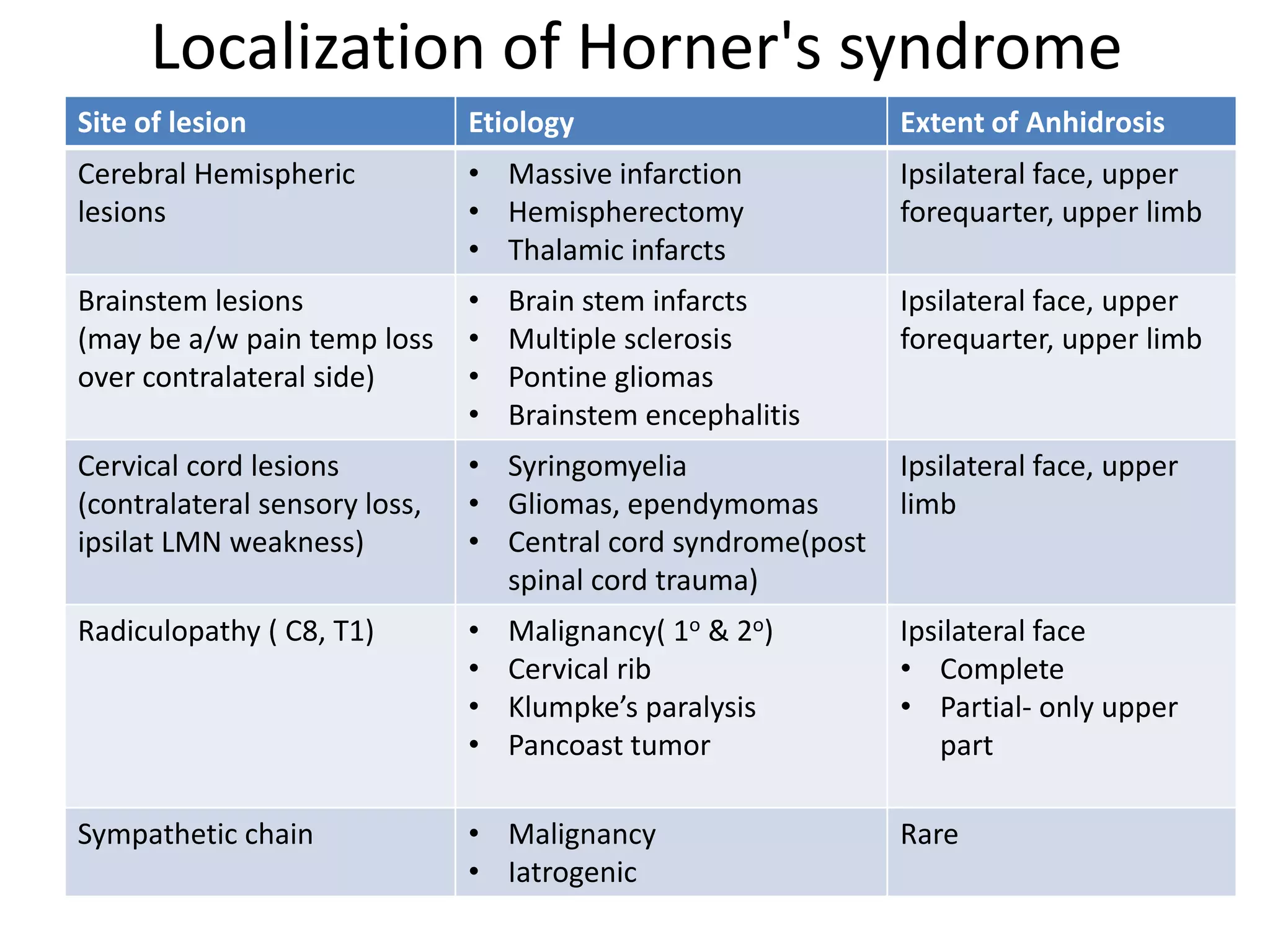
Localization of Horner's syndrome
Site of lesion                 Etiology                       Extent of Anhidrosis
Cerebral Hemispheric           • Massive infarction           Ipsilateral face, upper
lesions                        • Hemispherectomy              forequarter, upper limb
                               • Thalamic infarcts
Brainstem lesions              •   Brain stem infarcts        Ipsilateral face, upper
(may be a/w pain temp loss     •   Multiple sclerosis         forequarter, upper limb
over contralateral side)       •   Pontine gliomas
                               •   Brainstem encephalitis
Cervical cord lesions          • Syringomyelia                Ipsilateral face, upper
(contralateral sensory loss,   • Gliomas, ependymomas         limb
ipsilat LMN weakness)          • Central cord syndrome(post
                                 spinal cord trauma)
Radiculopathy ( C8, T1)        •   Malignancy( 1o & 2o)       Ipsilateral face
                               •   Cervical rib               • Complete
                               •   Klumpke’s paralysis        • Partial- only upper
                               •   Pancoast tumor                part

Sympathetic chain              • Malignancy                   Rare
                               • Iatrogenic
Case
• 20yr/male/college student/unmarried
• Referred with
  difficulty in standing and walking due to imbalance,
  tendency to fall on either side 2 days
• Clinical Exam on presentation- Sensory ataxia,
  areflexia. Power was 4+ diffusely at first
  examination.
• Diagnosed as Miller Fisher Syndrome initially
• Past history- acute pharyngitis 1 week before
  onset of paralysis
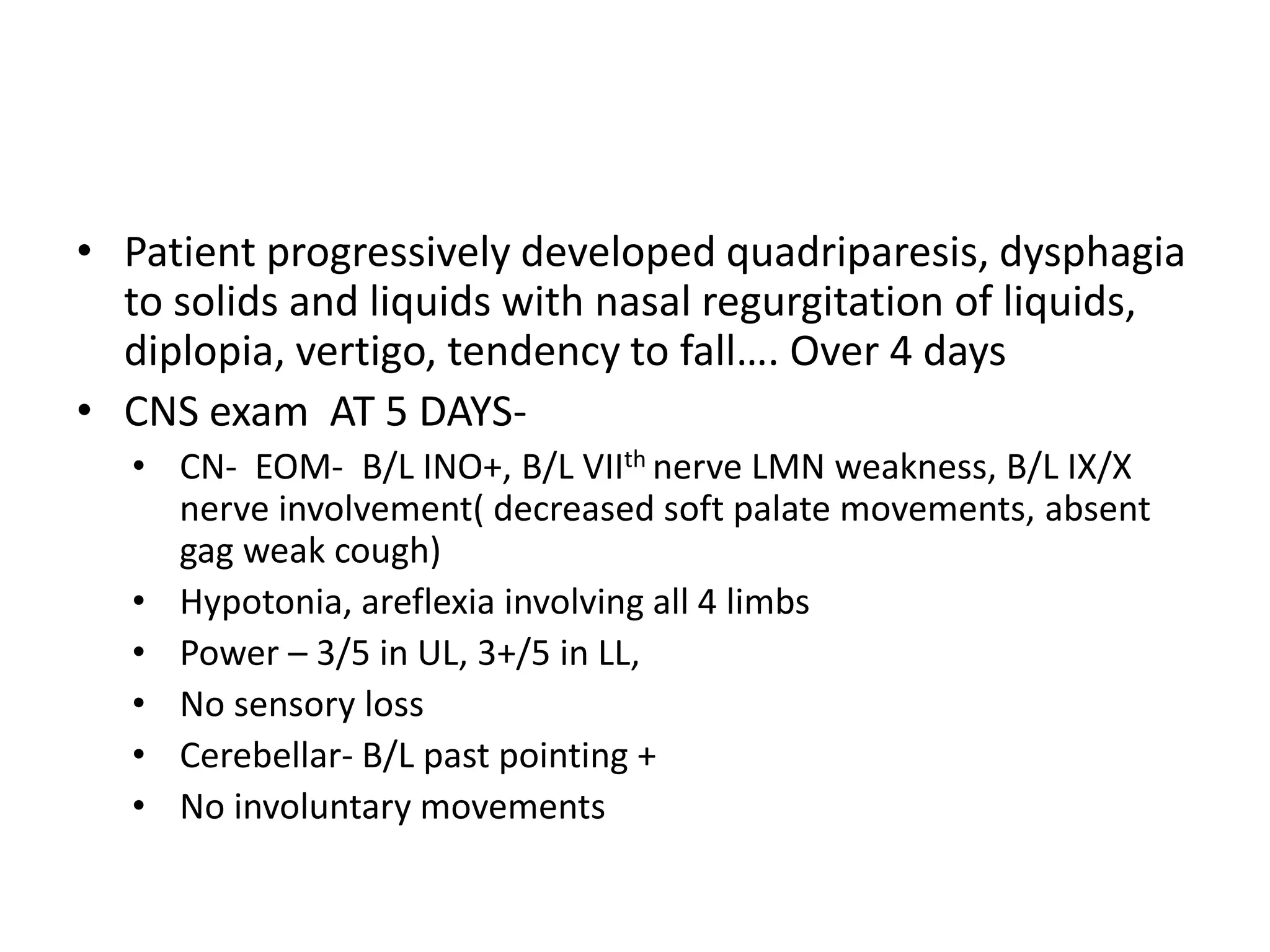
• Patient progressively developed quadriparesis, dysphagia
  to solids and liquids with nasal regurgitation of liquids,
  diplopia, vertigo, tendency to fall…. Over 4 days
• CNS exam AT 5 DAYS-
   • CN- EOM- B/L INO+, B/L VIIth nerve LMN weakness, B/L IX/X
     nerve involvement( decreased soft palate movements, absent
     gag weak cough)
   • Hypotonia, areflexia involving all 4 limbs
   • Power – 3/5 in UL, 3+/5 in LL,
   • No sensory loss
   • Cerebellar- B/L past pointing +
   • No involuntary movements
• EMG/NCV- early demyelinating
  polyradiculoneuropathy s/o Guillain Barre
  Syndrome
• Diagnosis- Miller-Fisher variant of GBS
• Treatment-
  – Plasmapheresis - total 7 cycles
  – IV Immunoglobulin 2Gm/kg body weight over 5
    days
Internuclear
ophthalmoplegia

• Disorder of
  conjugate lateral
  gaze
• two types-
  – Anterior INO
  – Posterior INO
a) Anterior INO1
    • Eyes are divergent
    • Paralysis of both medial recti
    • Seen in midbrain infarcts, multiple sclerosis


1 Crane TB, et al. Analysis of characteristic eye movement abnormalities in internuclear
ophthalmoplegia. Arch Ophthalmol 1983; 101:206-210
b). Posterior INO
• There is a painless onset of visual
   disturbance,
• No diplopia in primary gaze
• Medial longitudinal Fasciculus involved
• the affected eye shows impairment of
   adduction when both eyes are tested
   simultaneously
• The contralateral eye abducts, however
   with nystagmus.
• This is reversed when patient looks to
   opposite side in bilateral involvement
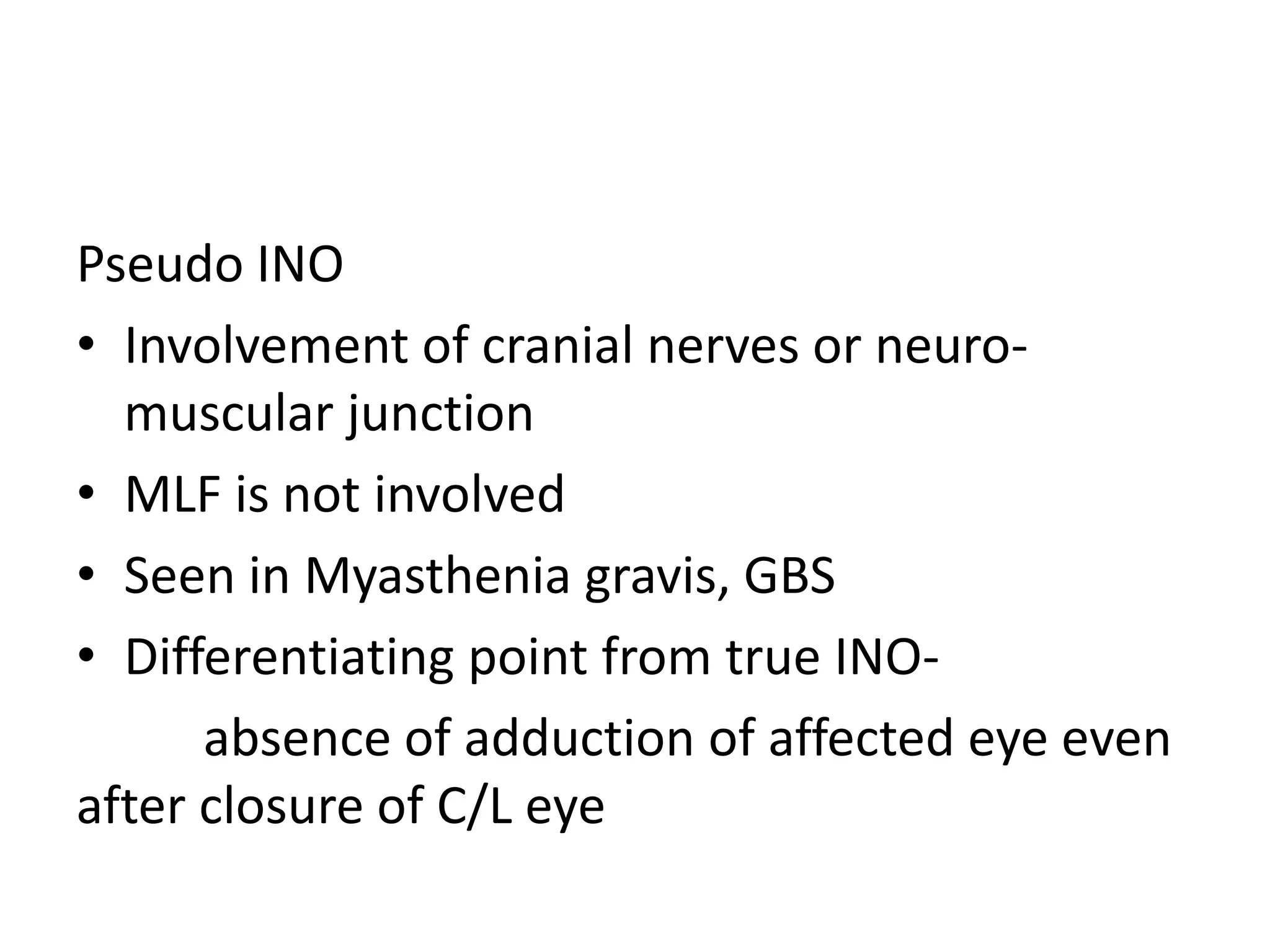
Pseudo INO
• Involvement of cranial nerves or neuro-
  muscular junction
• MLF is not involved
• Seen in Myasthenia gravis, GBS
• Differentiating point from true INO-
      absence of adduction of affected eye even
after closure of C/L eye
Thank you

Horner's syndrome and Internuclear ophthalmoplegia

  • 1.
    Two Clinical ocularsigns Monday unit Dr. Ankit Raiyani
  • 2.
    1. Horner's syndromein a case of CV junction anomaly • 26 Year Male/Hindu/Right handed/ R/o Bandra/Street hawker, head load worker • Presented with complaints of – Progressive weakness in right upper limb since 5 years (starting with difficulty in holding small objects in right hand….gradually progressing to involve whole right UL over next 2 years….now patient cannot move his right UL since last 3 years) – Tingling sensations in right upper limb since 5 years (continuous, not affected by movements of neck, coughing) – Difficulty in walking due to tightness in right lower limb since 3 months (difficulty in bending his right knee while walking) • On enquiry patient also gave H/O – Twitching in right shoulder and right arm – Absence of sweating over right side of face, right forequarters, and right upper limb.
  • 3.
    Relevant clinical findings •Exaggerated Cervical lordosis, scoliosis with convexity to right • Anhidrosis involving right side of face, right upper forequarters, right UL • Right pupil 2mm RTL slow to relax in dark • Left pupil 3 mm RTL. • Tongue fasciculations with atrophy of right side of tongue • LMN type weakness(wasting, flaccidity, areflexia) in right upper limb • Spasticity and hyperreflexia in right lower limb • Loss of touch, pain, temp in right shoulder and right UL in c5- c8 dermatomal areas with preservation of post column sensations
  • 4.
    • Clinical Diagnosis-26/M with right UL LMN paralysis with right LL UMN involvement with ipsilateral sensory loss (involving touch, pain, temp) from C3-C8 dermatome with ipsilateral Horner’s syndrome
  • 6.
    Basilar invagination andsup migration of odontoid process causing compression of cervicomedullary junction, occipitalization of atlas vertebra
  • 7.
  • 8.
    • Diagnosis- CVjunction anomaly (Basilar Invagination Group A) with dorsal syringohydromyelia(C2-D9)
  • 9.
    Horner’s syndrome • Ptosis • Miosis • Anhidrosis • Loss of ciliospinal reflex • Heterochromia iridis (if congenital)
  • 10.
    Sympathetic system • 1storder neurons- from hypothalamus to spinal cord • 2nd order neurons- from intermediolateral grey column to paravertebral sympathetic ganglion chain • 3rd order neuron – from paravertebral sympathetic ganglia to different organs Although pathway starts in hypothalamus, there is considerable ipsilateral cortical control
  • 12.
    Localization of Horner'ssyndrome Site of lesion Etiology Extent of Anhidrosis Cerebral Hemispheric • Massive infarction Ipsilateral face, upper lesions • Hemispherectomy forequarter, upper limb • Thalamic infarcts Brainstem lesions • Brain stem infarcts Ipsilateral face, upper (may be a/w pain temp loss • Multiple sclerosis forequarter, upper limb over contralateral side) • Pontine gliomas • Brainstem encephalitis Cervical cord lesions • Syringomyelia Ipsilateral face, upper (contralateral sensory loss, • Gliomas, ependymomas limb ipsilat LMN weakness) • Central cord syndrome(post spinal cord trauma) Radiculopathy ( C8, T1) • Malignancy( 1o & 2o) Ipsilateral face • Cervical rib • Complete • Klumpke’s paralysis • Partial- only upper • Pancoast tumor part Sympathetic chain • Malignancy Rare • Iatrogenic
  • 13.
    Case • 20yr/male/college student/unmarried •Referred with difficulty in standing and walking due to imbalance, tendency to fall on either side 2 days • Clinical Exam on presentation- Sensory ataxia, areflexia. Power was 4+ diffusely at first examination. • Diagnosed as Miller Fisher Syndrome initially • Past history- acute pharyngitis 1 week before onset of paralysis
  • 14.
    • Patient progressivelydeveloped quadriparesis, dysphagia to solids and liquids with nasal regurgitation of liquids, diplopia, vertigo, tendency to fall…. Over 4 days • CNS exam AT 5 DAYS- • CN- EOM- B/L INO+, B/L VIIth nerve LMN weakness, B/L IX/X nerve involvement( decreased soft palate movements, absent gag weak cough) • Hypotonia, areflexia involving all 4 limbs • Power – 3/5 in UL, 3+/5 in LL, • No sensory loss • Cerebellar- B/L past pointing + • No involuntary movements
  • 15.
    • EMG/NCV- earlydemyelinating polyradiculoneuropathy s/o Guillain Barre Syndrome • Diagnosis- Miller-Fisher variant of GBS • Treatment- – Plasmapheresis - total 7 cycles – IV Immunoglobulin 2Gm/kg body weight over 5 days
  • 17.
    Internuclear ophthalmoplegia • Disorder of conjugate lateral gaze • two types- – Anterior INO – Posterior INO
  • 18.
    a) Anterior INO1 • Eyes are divergent • Paralysis of both medial recti • Seen in midbrain infarcts, multiple sclerosis 1 Crane TB, et al. Analysis of characteristic eye movement abnormalities in internuclear ophthalmoplegia. Arch Ophthalmol 1983; 101:206-210
  • 19.
    b). Posterior INO •There is a painless onset of visual disturbance, • No diplopia in primary gaze • Medial longitudinal Fasciculus involved • the affected eye shows impairment of adduction when both eyes are tested simultaneously • The contralateral eye abducts, however with nystagmus. • This is reversed when patient looks to opposite side in bilateral involvement
  • 20.
    Pseudo INO • Involvementof cranial nerves or neuro- muscular junction • MLF is not involved • Seen in Myasthenia gravis, GBS • Differentiating point from true INO- absence of adduction of affected eye even after closure of C/L eye
  • 21.