Rivaroxaban
(Xarelto)
Dr. Ankit Raiyani
Hematology Dept.
Sahyadri Specialty Hospital
Blood Vessel Injury
IX IXa
XI XIa
X Xa
XII XIIa
Tissue Injury
Tissue Factor
Thromboplastin
VIIa VII
X
Prothrombin Thrombin
Fibrinogen Fibrin monomer
Fibrin polymerXIII
Factors affected
By Heparin
Vit. K dependent Factors
Affected by Oral Anticoagulants
Anticoagulants
• Parenteral anticoagulants:
– Unfractionated heparin
– LMWH
– Fondaparinux
– DTIs- Lepirudin, Argatroban, Bivalirudin
• Oral anticoagulants:
– VKAs- Warfarin, Acitrom
– Anti-Xa- Rivaroxaban, Apixaban, Edoxaban,
– Anti-IIa- Debigatran
Drawbacks of Traditional
anticoagulants
• UFH
– Parenteral
administration
– Monitoring and dose
adjustment required
– Risk of HIT
• LMWH
– Parenteral
administration
– Body weight-adjusted
dosing
– Renal failure
• Oral VKAs
• Narrow therapeutic
window
• Significant Interaction
with food and drugs
• Frequent monitoring
and dose adjustment
required
• Need for heparin
overlap
Rivaroxaban
(XARELTO)
• Factor Xa inhibitor
• Predictable therapeutic effect
– Not affected by age, sex, body weight
– Fixed dose
• Rapid onset
– Peak plasma level at 2-3 hours
– No need of overlap with heparin
• Half-life 7-14 hours
Dual mode of elimination
• Two-thirds of the drug undergoes
metabolic degradation in the liver
– Substrate of CYP3A4 and the drug
transporter P-glycoprotein (P-gp)
• One-third of the dose is eliminated as
unchanged drug in the urine
Drug interactions
• COX-1 inhibitors:
– BT slightly prolonged. Clinically insignificant
• Rivaroxaban is not recommended with
potent inhibitors of CYP3A4 and P-gp
– ketoconazole, itraconazole, voriconazole,
posaconazole, ritonavir
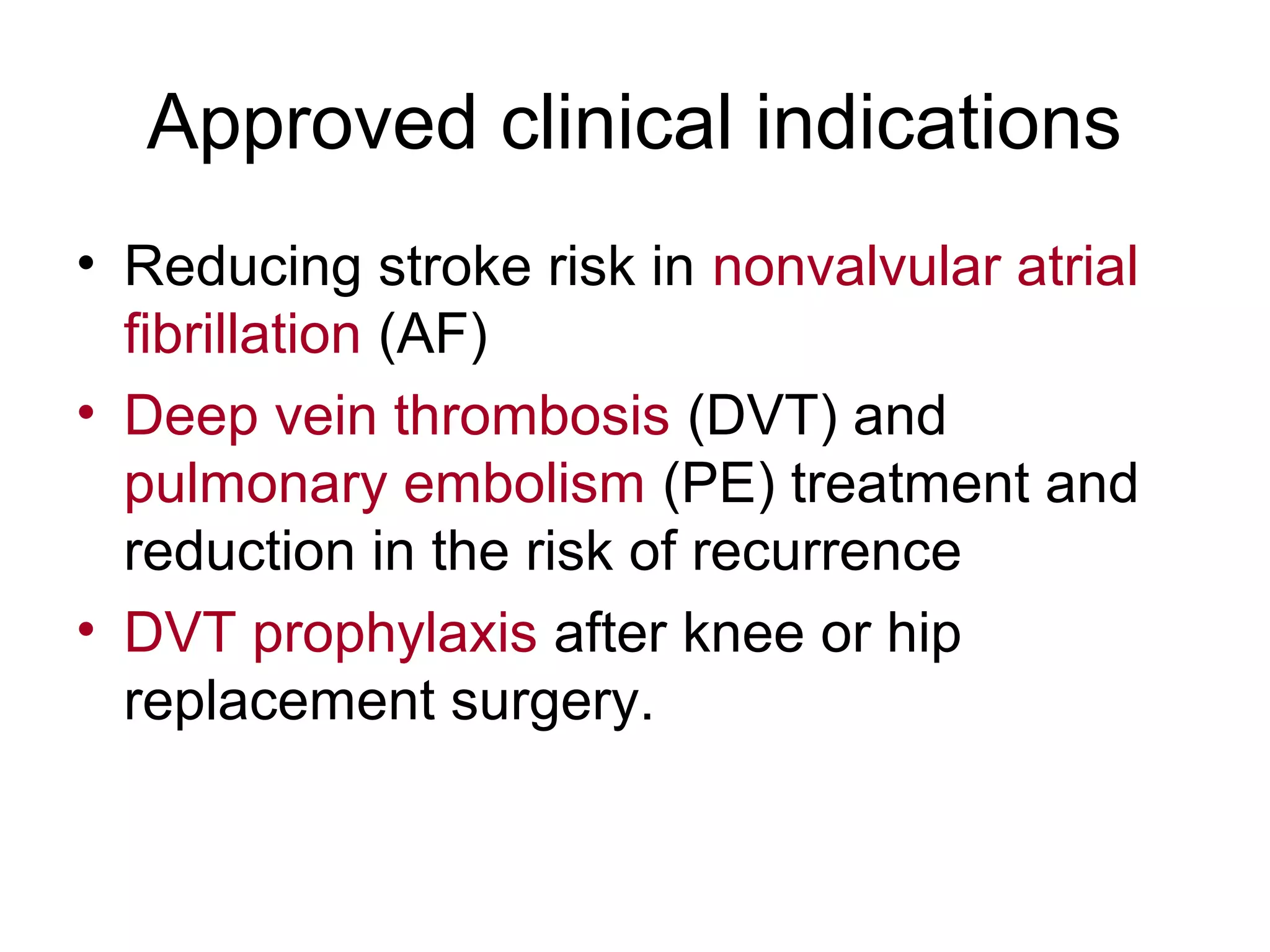
Approved clinical indications
• Reducing stroke risk in nonvalvular atrial
fibrillation (AF)
• Deep vein thrombosis (DVT) and
pulmonary embolism (PE) treatment and
reduction in the risk of recurrence
• DVT prophylaxis after knee or hip
replacement surgery.
Dosage of Rivaroxaban
• 10 mg OD for DVT prophylaxis
• 15 mg BD for 3 weeks followed by 20 mg
OD for VTE & PE
• No need for dose modification in respect
of age, sex, body mass.
• No need for monitoring
Switching to Rivaroxaban
• From warfarin to rivaroxaban:
– Discontinue warfarin and start rivaroxaban as soon as
INR is below 3.0
• From unfractionated heparin continuous infusion
to rivaroxaban:
– Stop infusion and start rivaroxaban at the same time
• From anticoagulant other than warfarin to
rivaroxaban:
– Start rivaroxaban 0 to 2 hours prior to next scheduled
evening administration of the drug and omit
administration of the other anticoagulant
Switching from Rivaroxaban
• From rivaroxaban to warfarin:
– INR measurements made during coadministration
with warfarin may not be useful for determining the
appropriate dose of warfarin;
– one approach is to discontinue rivaroxaban and begin
both a parenteral anticoagulant and warfarin at the
time of the next dose of rivaroxaban
• From rivaroxaban to rapid-onset anticoagulant:
– Discontinue rivaroxaban and start first dose of other
anticoagulant at the time the next rivaroxaban dose
would have been taken
Discontinuation for surgery or other
procedures
• Stop rivaroxaban at least 24 hours before
procedure
• Restart rivaroxaban after
surgery/procedure as soon as adequate
hemostasis is established
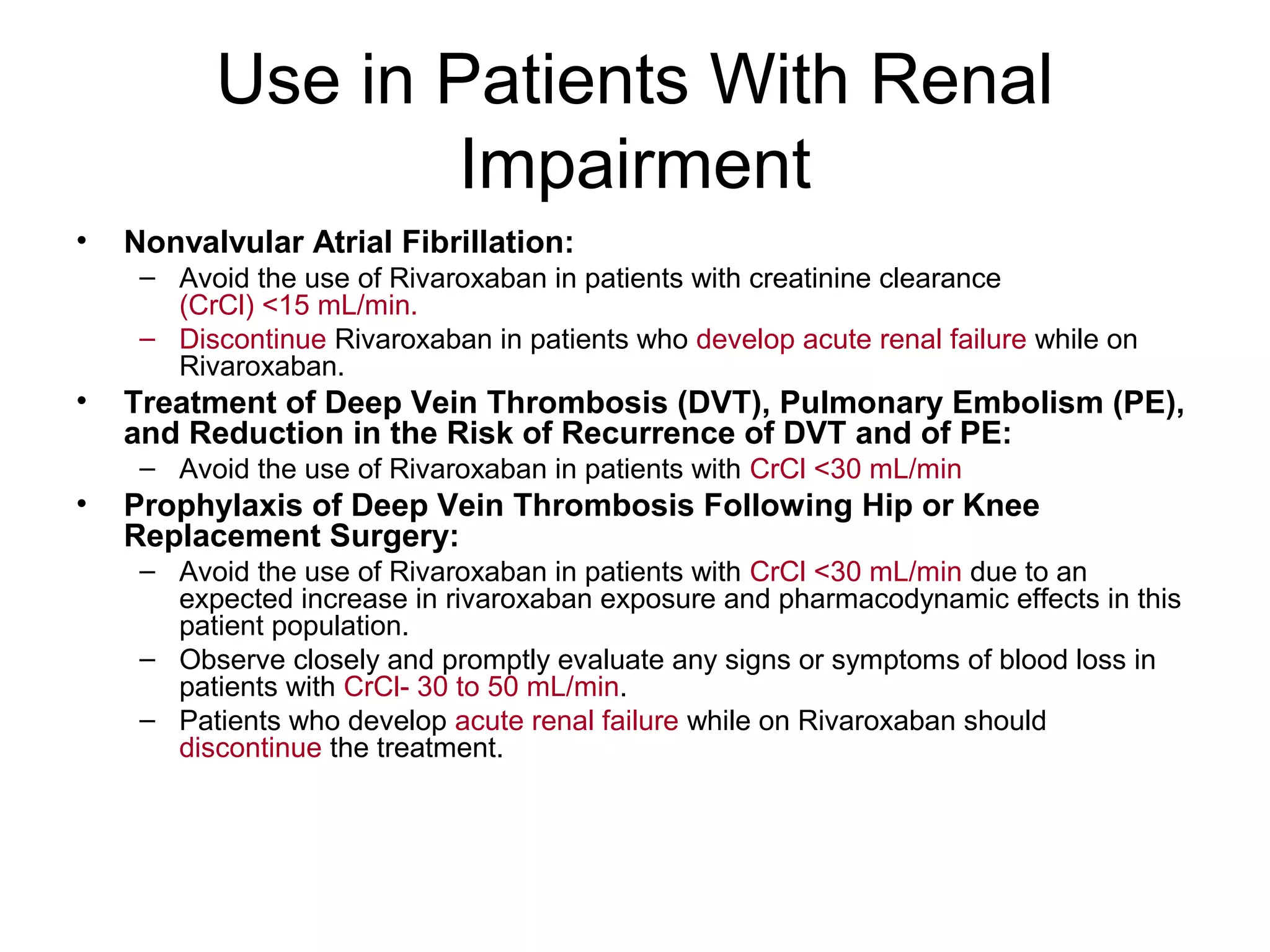
Use in Patients With Renal
Impairment
• Nonvalvular Atrial Fibrillation:
– Avoid the use of Rivaroxaban in patients with creatinine clearance
(CrCl) <15 mL/min.
– Discontinue Rivaroxaban in patients who develop acute renal failure while on
Rivaroxaban.
• Treatment of Deep Vein Thrombosis (DVT), Pulmonary Embolism (PE),
and Reduction in the Risk of Recurrence of DVT and of PE:
– Avoid the use of Rivaroxaban in patients with CrCl <30 mL/min
• Prophylaxis of Deep Vein Thrombosis Following Hip or Knee
Replacement Surgery:
– Avoid the use of Rivaroxaban in patients with CrCl <30 mL/min due to an
expected increase in rivaroxaban exposure and pharmacodynamic effects in this
patient population.
– Observe closely and promptly evaluate any signs or symptoms of blood loss in
patients with CrCl- 30 to 50 mL/min.
– Patients who develop acute renal failure while on Rivaroxaban should
discontinue the treatment.
Use in Patients With Hepatic
Impairment
• No clinical data are available for patients
with severe hepatic impairment.
• Avoid use of Rivaroxaban in patients with
moderate (Child-Pugh B) and severe
(Child-Pugh C) hepatic impairment or with
any hepatic disease associated with
coagulopathy.
Use in Pregnancy
• In pregnant women, Rivaroxaban should
be used only if the potential benefit
justifies the potential risk to the mother
and fetus.
• Rivaroxaban dosing in pregnancy has not
been studied.
Patients With Prosthetic Heart
Valves
• The safety and efficacy of
Rivaroxaban have not been studied in
patients with prosthetic heart valves.
• Therefore, use of Rivaroxaban is not
recommended in these patients.
Patients with Acute pulmonary
embolism
• Rivaroxaban should not be used in
patients of acute PE when -
– Patient is hemodynamicallly unstable
– Thrombolysis/embolectomy is planned
Clinical Trials
• RECORD I to IV
• ROCKET AF
• EINSTEIN DVT, EXT, PE
RECORD
Phase III programme for VTE prevention
• Rivaroxaban 10 mg od was investigated in RECORD trials
• RECORD trials were randomized, multi-centered,active-comparator-
controlled, parallel-group,double-blind, double-dummy trials
KNEE replacement
Rivaroxaban 10 mg od
for 10–14 days
vs
enoxaparin 40 mg od
for 10–14 days
N=2,531
HIP replacement
Rivaroxaban 10 mg od
for 5 weeks
vs
enoxaparin 40 mg od
for 5 weeks
N=4,541
HIP replacement
Rivaroxaban 10 mg od
for 5 weeks
vs
enoxaparin 40 mg od
for 10–14 days then
oral placebo
N=2,509
KNEE replacement
Rivaroxaban 10 mg od
for 10–14 days
vs
enoxaparin 30 mg bid
for 10–14 days
N=3,148
RECORD Programme had a large patient pool of more than 12,500
patients
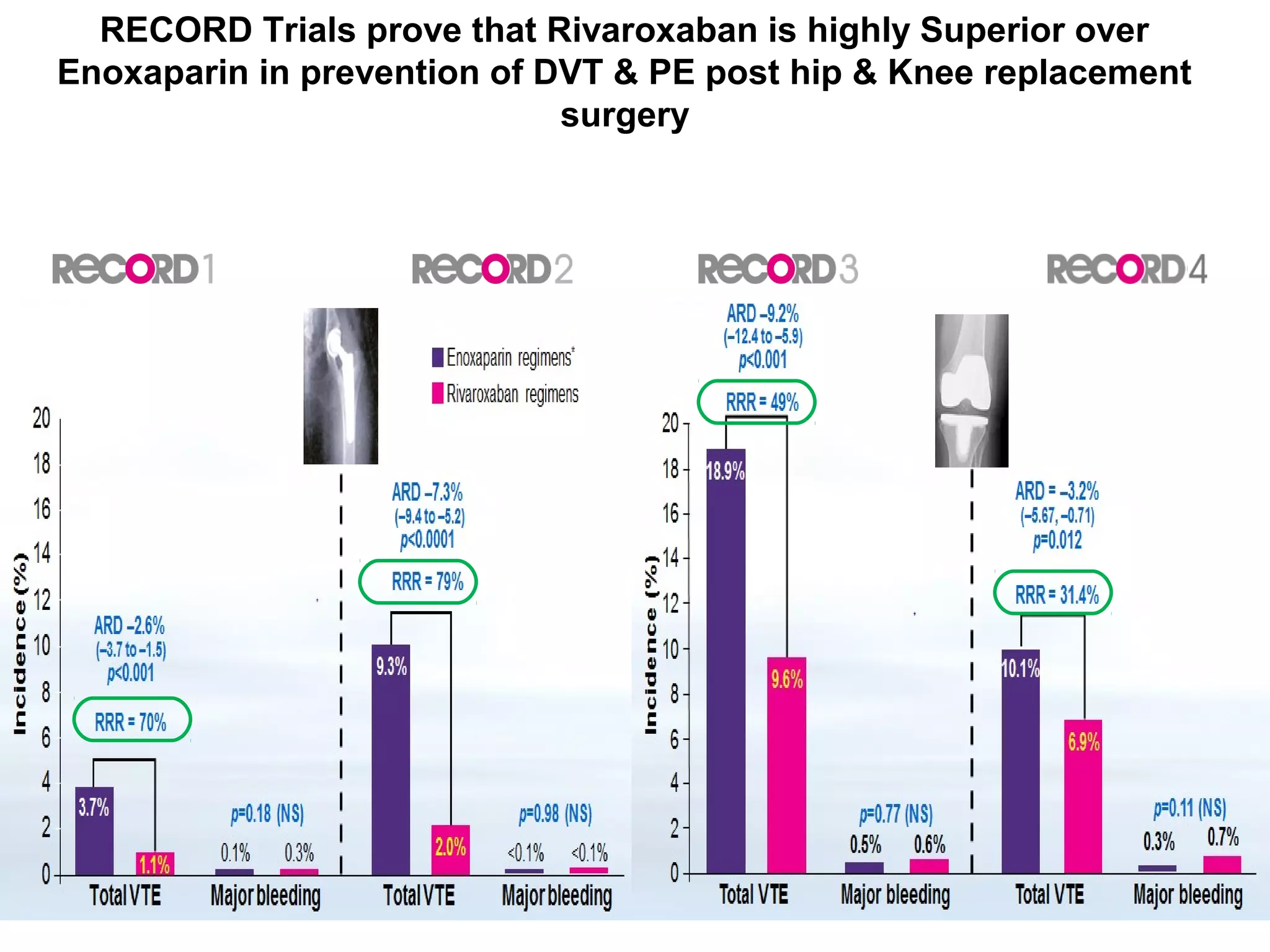
RECORD Trials prove that Rivaroxaban is highly Superior over
Enoxaparin in prevention of DVT & PE post hip & Knee replacement
surgery
Rivaroxaban Once-daily oral direct factor Xa inhibition
Compared with vitamin K antagonism for prevention
of stroke and Embolism Trial in Atrial Fibrillation
Warfarin target INR 2–3
Rivaroxaban 20 mg once daily**
Non-valvular AF
 History of stroke,
TIA or non-CNS SE
OR
≥2* of the following:
 CHF
 Hypertension
 Age ≥75 years
 Diabetes
N=14,264
*Enrollment of patients with ≤ 2 risk factors or without prior stroke/TIA or non-CNS SE was limited to 10%
**Patients with CrCl 30–49 ml/min: 15 mg rivaroxaban once daily
***Duration of therapy varied for each patient as study was event-driven
ROCKET AF – Study Design
Randomized, double-blind, double-dummy, event-driven
ROCKET AF Study Investigators. Am Heart J 2010; Patel et al. NEJM 2011, August 10th epub ahead of print
Endofstudy
30-dayfollow-up
R
~11–41 months***
Number of subjects at risk
Rivaroxaban 6958 6211 5786 5468 4406 3407 2472 1496
Warfarin 7004 6327 5911 5542 4461 3478 2539 1538
ROCKET AF – Primary Efficacy Endpoint
Per-protocol population – as treated population
Warfarin
Rivaroxaban
Days since randomization
HR 0.79 (0.66, 0.96)
p<0.001 (non-inferiority)
0 120 240 480 600 720
0
1
2
3
4
5
6
840360
Cumulativeeventrate(%) Stroke or Systemic Embolism
Patel et al. NEJM 2011, August 10th epub ahead of print
21%
RRR
Parameter
Rivaroxaban
(N=7111)
Warfarin
(N=7125)
Hazard ratio
(95% CI)n (% per year) n (% per year)
Principal safety
endpoint
1475 (14.9) 1449 (14.5) 1.03 (0.96,1.11)
Major bleeding 395 (3.6) 386 (3.4) 1.04 (0.90,1.20)
Hemoglobin drop (≥2
g/dl)
305 (2.8) 254 (2.3) 1.22 (1.03,1.44)*
Transfusion 183 (1.6) 149 (1.3) 1.25 (1.01,1.55)*
Critical organ
bleeding
91 (0.8) 133 (1.2) 0.69 (0.53,0.91)*
Intracranial
hemorrhage
55 (0.5) 84 (0.7) 0.67 (0.47,0.93)*
Fatal bleeding 27 (0.2) 55 (0.5) 0.50 (0.31,0.79)*
Non-major clinically
relevant bleeding
1185 (11.8) 1151 (11.4) 1.04 (0.96,1.13)
Safety population – as-treated analysis;
*statistically significant
ROCKET AF – Bleeding Analysis
Importantly, Rivaroxaban showed significantly lower criticalImportantly, Rivaroxaban showed significantly lower critical
organ bleeding, ICH and fatal bleeds compared to warfarin.organ bleeding, ICH and fatal bleeds compared to warfarin.
Hazard ratio
and 95% CIs
0.2 0.5 1 2 5
Favors
rivaroxaban
Favors
warfarin
Patel et al. NEJM 2011
Phase III programme for VTE treatment
for Rivaroxaban
Trial Design
Results
• In patients who had acute symptomatic proximal DVT, without
symptomatic PE, rivaroxaban showed:
• Non-inferiority to LMWH/VKA for efficacy: HR=0.68 (0.44–1.04);
p<0.0001 for non-inferiority
• Comparable principal safety outcome: HR=0.97 (0.76–1.22); p=0.77
• Consistent efficacy and safety results irrespective of age, body
weight, gender, creatinine clearance and cancer
• No evidence for liver toxicity
• Oral rivaroxaban, 15 mg twice-daily for 3 weeks followed by 20 mg
once-daily, could provide clinicians and patients with a simple, single-
drug approach for the acute and continued treatment of DVT that
potentially improves the benefit–risk profile of anticoagulation
Trial Design
Results
•In patients who had completed 6 or 12 months of anticoagulation rivaroxaban
showed
•82% relative risk reduction in the recurrence of VTE (HR=0.184; p<0.0001)
•Absolute risk reduction of 5.8% hence, 15 patients need to be treated to
prevent one recurrent venous thromboembolic event
•Low incidence of major bleeding (0.7%; p=0.11; number needed to harm
approximately 139)
•Efficacy and safety results were consistent irrespective of bodyweight and
creatinine clearance
•No signal for liver toxicity
Oral rivaroxaban, 20 mg once daily, would provide clinicians and patients with a
simple and effective option for continued anticoagulant treatment*
• Management of bleeding
events & overdosing
Rivaroxaban Overdose/Bleeding
complications
• No routine lab test can accurately detect
overdose of Rivaroxaban
• Prolonged PT and aPTT may indicate
Rivaroxaban effect. But this cannot be used for
monitoring of drug, or detecting overdose.
• Factor Xa assay
– No assay for rivaroxaban available
– Assay calibrated for enoxaparin has to be used
• Activated charcoal- If last dose within 2
hours
• Non dialyzable as it is highly protein
bound
• FEIBA NF- Anti inhibitor coagulant
complex
• Andexanet alfa
– Selective antidote for Factor Xa inhibitors
– In phase III trial (ANNEXA-R)
– Recently (March 2015) approved by US-FDA
as an orphan drug
• Monthly cost of warfarin therapy
– Medicine cost- Rs. 100
– Monitoring (PT) cost – Rs 500-750
– Total cost- Rs 600 to 800 per month
• Monthly cost of Rivaroxaban therapy
– Rs. 4000 per month
Rivaroxaban (XARELTO)
PROs CONs
Convenient- Oral OD
dose
No antidote available as of now
No overlap required Effect can’t be monitored
Fixed dose Higher overall bleeds
Less drug interactions Can’t be used in some clinical
scenario.
No monitoring required Costly
Less major bleeds in
critical areas
Increased thrombotic risk after
premature discontinuation.
• Thank you!

Rivaroxaban (XARELTO)

  • 1.
    Rivaroxaban (Xarelto) Dr. Ankit Raiyani HematologyDept. Sahyadri Specialty Hospital
  • 2.
    Blood Vessel Injury IXIXa XI XIa X Xa XII XIIa Tissue Injury Tissue Factor Thromboplastin VIIa VII X Prothrombin Thrombin Fibrinogen Fibrin monomer Fibrin polymerXIII Factors affected By Heparin Vit. K dependent Factors Affected by Oral Anticoagulants
  • 3.
    Anticoagulants • Parenteral anticoagulants: –Unfractionated heparin – LMWH – Fondaparinux – DTIs- Lepirudin, Argatroban, Bivalirudin • Oral anticoagulants: – VKAs- Warfarin, Acitrom – Anti-Xa- Rivaroxaban, Apixaban, Edoxaban, – Anti-IIa- Debigatran
  • 4.
    Drawbacks of Traditional anticoagulants •UFH – Parenteral administration – Monitoring and dose adjustment required – Risk of HIT • LMWH – Parenteral administration – Body weight-adjusted dosing – Renal failure • Oral VKAs • Narrow therapeutic window • Significant Interaction with food and drugs • Frequent monitoring and dose adjustment required • Need for heparin overlap
  • 5.
    Rivaroxaban (XARELTO) • Factor Xainhibitor • Predictable therapeutic effect – Not affected by age, sex, body weight – Fixed dose • Rapid onset – Peak plasma level at 2-3 hours – No need of overlap with heparin • Half-life 7-14 hours
  • 6.
    Dual mode ofelimination • Two-thirds of the drug undergoes metabolic degradation in the liver – Substrate of CYP3A4 and the drug transporter P-glycoprotein (P-gp) • One-third of the dose is eliminated as unchanged drug in the urine
  • 7.
    Drug interactions • COX-1inhibitors: – BT slightly prolonged. Clinically insignificant • Rivaroxaban is not recommended with potent inhibitors of CYP3A4 and P-gp – ketoconazole, itraconazole, voriconazole, posaconazole, ritonavir
  • 8.
    Approved clinical indications •Reducing stroke risk in nonvalvular atrial fibrillation (AF) • Deep vein thrombosis (DVT) and pulmonary embolism (PE) treatment and reduction in the risk of recurrence • DVT prophylaxis after knee or hip replacement surgery.
  • 9.
    Dosage of Rivaroxaban •10 mg OD for DVT prophylaxis • 15 mg BD for 3 weeks followed by 20 mg OD for VTE & PE • No need for dose modification in respect of age, sex, body mass. • No need for monitoring
  • 10.
    Switching to Rivaroxaban •From warfarin to rivaroxaban: – Discontinue warfarin and start rivaroxaban as soon as INR is below 3.0 • From unfractionated heparin continuous infusion to rivaroxaban: – Stop infusion and start rivaroxaban at the same time • From anticoagulant other than warfarin to rivaroxaban: – Start rivaroxaban 0 to 2 hours prior to next scheduled evening administration of the drug and omit administration of the other anticoagulant
  • 11.
    Switching from Rivaroxaban •From rivaroxaban to warfarin: – INR measurements made during coadministration with warfarin may not be useful for determining the appropriate dose of warfarin; – one approach is to discontinue rivaroxaban and begin both a parenteral anticoagulant and warfarin at the time of the next dose of rivaroxaban • From rivaroxaban to rapid-onset anticoagulant: – Discontinue rivaroxaban and start first dose of other anticoagulant at the time the next rivaroxaban dose would have been taken
  • 12.
    Discontinuation for surgeryor other procedures • Stop rivaroxaban at least 24 hours before procedure • Restart rivaroxaban after surgery/procedure as soon as adequate hemostasis is established
  • 13.
    Use in PatientsWith Renal Impairment • Nonvalvular Atrial Fibrillation: – Avoid the use of Rivaroxaban in patients with creatinine clearance (CrCl) <15 mL/min. – Discontinue Rivaroxaban in patients who develop acute renal failure while on Rivaroxaban. • Treatment of Deep Vein Thrombosis (DVT), Pulmonary Embolism (PE), and Reduction in the Risk of Recurrence of DVT and of PE: – Avoid the use of Rivaroxaban in patients with CrCl <30 mL/min • Prophylaxis of Deep Vein Thrombosis Following Hip or Knee Replacement Surgery: – Avoid the use of Rivaroxaban in patients with CrCl <30 mL/min due to an expected increase in rivaroxaban exposure and pharmacodynamic effects in this patient population. – Observe closely and promptly evaluate any signs or symptoms of blood loss in patients with CrCl- 30 to 50 mL/min. – Patients who develop acute renal failure while on Rivaroxaban should discontinue the treatment.
  • 14.
    Use in PatientsWith Hepatic Impairment • No clinical data are available for patients with severe hepatic impairment. • Avoid use of Rivaroxaban in patients with moderate (Child-Pugh B) and severe (Child-Pugh C) hepatic impairment or with any hepatic disease associated with coagulopathy.
  • 15.
    Use in Pregnancy •In pregnant women, Rivaroxaban should be used only if the potential benefit justifies the potential risk to the mother and fetus. • Rivaroxaban dosing in pregnancy has not been studied.
  • 16.
    Patients With ProstheticHeart Valves • The safety and efficacy of Rivaroxaban have not been studied in patients with prosthetic heart valves. • Therefore, use of Rivaroxaban is not recommended in these patients.
  • 17.
    Patients with Acutepulmonary embolism • Rivaroxaban should not be used in patients of acute PE when - – Patient is hemodynamicallly unstable – Thrombolysis/embolectomy is planned
  • 18.
    Clinical Trials • RECORDI to IV • ROCKET AF • EINSTEIN DVT, EXT, PE
  • 19.
    RECORD Phase III programmefor VTE prevention • Rivaroxaban 10 mg od was investigated in RECORD trials • RECORD trials were randomized, multi-centered,active-comparator- controlled, parallel-group,double-blind, double-dummy trials KNEE replacement Rivaroxaban 10 mg od for 10–14 days vs enoxaparin 40 mg od for 10–14 days N=2,531 HIP replacement Rivaroxaban 10 mg od for 5 weeks vs enoxaparin 40 mg od for 5 weeks N=4,541 HIP replacement Rivaroxaban 10 mg od for 5 weeks vs enoxaparin 40 mg od for 10–14 days then oral placebo N=2,509 KNEE replacement Rivaroxaban 10 mg od for 10–14 days vs enoxaparin 30 mg bid for 10–14 days N=3,148 RECORD Programme had a large patient pool of more than 12,500 patients
  • 20.
    RECORD Trials provethat Rivaroxaban is highly Superior over Enoxaparin in prevention of DVT & PE post hip & Knee replacement surgery
  • 21.
    Rivaroxaban Once-daily oraldirect factor Xa inhibition Compared with vitamin K antagonism for prevention of stroke and Embolism Trial in Atrial Fibrillation
  • 22.
    Warfarin target INR2–3 Rivaroxaban 20 mg once daily** Non-valvular AF  History of stroke, TIA or non-CNS SE OR ≥2* of the following:  CHF  Hypertension  Age ≥75 years  Diabetes N=14,264 *Enrollment of patients with ≤ 2 risk factors or without prior stroke/TIA or non-CNS SE was limited to 10% **Patients with CrCl 30–49 ml/min: 15 mg rivaroxaban once daily ***Duration of therapy varied for each patient as study was event-driven ROCKET AF – Study Design Randomized, double-blind, double-dummy, event-driven ROCKET AF Study Investigators. Am Heart J 2010; Patel et al. NEJM 2011, August 10th epub ahead of print Endofstudy 30-dayfollow-up R ~11–41 months***
  • 23.
    Number of subjectsat risk Rivaroxaban 6958 6211 5786 5468 4406 3407 2472 1496 Warfarin 7004 6327 5911 5542 4461 3478 2539 1538 ROCKET AF – Primary Efficacy Endpoint Per-protocol population – as treated population Warfarin Rivaroxaban Days since randomization HR 0.79 (0.66, 0.96) p<0.001 (non-inferiority) 0 120 240 480 600 720 0 1 2 3 4 5 6 840360 Cumulativeeventrate(%) Stroke or Systemic Embolism Patel et al. NEJM 2011, August 10th epub ahead of print 21% RRR
  • 24.
    Parameter Rivaroxaban (N=7111) Warfarin (N=7125) Hazard ratio (95% CI)n(% per year) n (% per year) Principal safety endpoint 1475 (14.9) 1449 (14.5) 1.03 (0.96,1.11) Major bleeding 395 (3.6) 386 (3.4) 1.04 (0.90,1.20) Hemoglobin drop (≥2 g/dl) 305 (2.8) 254 (2.3) 1.22 (1.03,1.44)* Transfusion 183 (1.6) 149 (1.3) 1.25 (1.01,1.55)* Critical organ bleeding 91 (0.8) 133 (1.2) 0.69 (0.53,0.91)* Intracranial hemorrhage 55 (0.5) 84 (0.7) 0.67 (0.47,0.93)* Fatal bleeding 27 (0.2) 55 (0.5) 0.50 (0.31,0.79)* Non-major clinically relevant bleeding 1185 (11.8) 1151 (11.4) 1.04 (0.96,1.13) Safety population – as-treated analysis; *statistically significant ROCKET AF – Bleeding Analysis Importantly, Rivaroxaban showed significantly lower criticalImportantly, Rivaroxaban showed significantly lower critical organ bleeding, ICH and fatal bleeds compared to warfarin.organ bleeding, ICH and fatal bleeds compared to warfarin. Hazard ratio and 95% CIs 0.2 0.5 1 2 5 Favors rivaroxaban Favors warfarin Patel et al. NEJM 2011
  • 25.
    Phase III programmefor VTE treatment for Rivaroxaban
  • 26.
  • 27.
    Results • In patientswho had acute symptomatic proximal DVT, without symptomatic PE, rivaroxaban showed: • Non-inferiority to LMWH/VKA for efficacy: HR=0.68 (0.44–1.04); p<0.0001 for non-inferiority • Comparable principal safety outcome: HR=0.97 (0.76–1.22); p=0.77 • Consistent efficacy and safety results irrespective of age, body weight, gender, creatinine clearance and cancer • No evidence for liver toxicity • Oral rivaroxaban, 15 mg twice-daily for 3 weeks followed by 20 mg once-daily, could provide clinicians and patients with a simple, single- drug approach for the acute and continued treatment of DVT that potentially improves the benefit–risk profile of anticoagulation
  • 28.
  • 29.
    Results •In patients whohad completed 6 or 12 months of anticoagulation rivaroxaban showed •82% relative risk reduction in the recurrence of VTE (HR=0.184; p<0.0001) •Absolute risk reduction of 5.8% hence, 15 patients need to be treated to prevent one recurrent venous thromboembolic event •Low incidence of major bleeding (0.7%; p=0.11; number needed to harm approximately 139) •Efficacy and safety results were consistent irrespective of bodyweight and creatinine clearance •No signal for liver toxicity Oral rivaroxaban, 20 mg once daily, would provide clinicians and patients with a simple and effective option for continued anticoagulant treatment*
  • 30.
    • Management ofbleeding events & overdosing
  • 31.
    Rivaroxaban Overdose/Bleeding complications • Noroutine lab test can accurately detect overdose of Rivaroxaban • Prolonged PT and aPTT may indicate Rivaroxaban effect. But this cannot be used for monitoring of drug, or detecting overdose. • Factor Xa assay – No assay for rivaroxaban available – Assay calibrated for enoxaparin has to be used
  • 32.
    • Activated charcoal-If last dose within 2 hours • Non dialyzable as it is highly protein bound • FEIBA NF- Anti inhibitor coagulant complex • Andexanet alfa – Selective antidote for Factor Xa inhibitors – In phase III trial (ANNEXA-R) – Recently (March 2015) approved by US-FDA as an orphan drug
  • 34.
    • Monthly costof warfarin therapy – Medicine cost- Rs. 100 – Monitoring (PT) cost – Rs 500-750 – Total cost- Rs 600 to 800 per month • Monthly cost of Rivaroxaban therapy – Rs. 4000 per month
  • 35.
    Rivaroxaban (XARELTO) PROs CONs Convenient-Oral OD dose No antidote available as of now No overlap required Effect can’t be monitored Fixed dose Higher overall bleeds Less drug interactions Can’t be used in some clinical scenario. No monitoring required Costly Less major bleeds in critical areas Increased thrombotic risk after premature discontinuation.
  • 36.

Editor's Notes

  • #23 References Patel MR, et al. ROCKET AF study investigators. Rivaroxaban-once daily, oral, direct factor Xa inhibition compared with vitamin K antagonism for prevention of stroke and Embolism Trial in Atrial Fibrillation: rationale and design of the ROCKET AF study. Am Heart J 2010;159:340-347.e1. [ROCKET AF primary paper – citation to be updated]
  • #24 Please note: as treated = on-treatment (used in previous communication) = during treatment = time patient was exposed to study drug = time from first to last study drug intake + 2 d
  • #25 The principal safety outcome was defined as the composite of major and non-major clinically relevant bleeding P-values (2-sided for superiority of rivaroxaban versus warfarin in hazard ratio): Principal safety outcome: p=0.44 Major bleeding: p=0.58 Decrease in hemoglobin (≥2 g/dl): p=0.02 Transfusion: p=0.04 Critical bleeding: p=0.007 Fatal bleeding: p=0.003 Intracranial hemorrhage: p=0.02 Non-major clinically relevant bleeding: p=0.35 Major bleeding from a gastrointestinal site was more common with rivaroxaban (224 bleeds [3.2%] compared with warfarin (154 bleeds [2.2%]; p&amp;lt;0.001).
  • #32 prolongation of these parameters varies significantly depending on the clotting assays and conditions used