www.stjohnslabs.com
Protocol Series:
Immunocytochemistry
Information on the general steps required for carrying out Immunocytochemistry
St John's Laboratory Ltd St John's Laboratory Ltd @StJohnsLabs St John's Laboratory Ltd
For more in our protocol series, visit Slideshare.net/StJohnsLabs
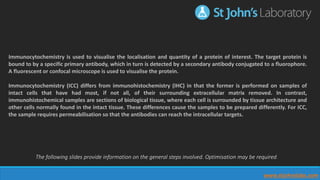
Immunocytochemistry is used to visualise the localisation and quantity of a protein of interest. The target protein is
bound to by a specific primary antibody, which in turn is detected by a secondary antibody conjugated to a fluorophore.
A fluorescent or confocal microscope is used to visualise the protein.
Immunocytochemistry (ICC) differs from immunohistochemistry (IHC) in that the former is performed on samples of
intact cells that have had most, if not all, of their surrounding extracellular matrix removed. In contrast,
immunohistochemical samples are sections of biological tissue, where each cell is surrounded by tissue architecture and
other cells normally found in the intact tissue. These differences cause the samples to be prepared differently. For ICC,
the sample requires permeabilisation so that the antibodies can reach the intracellular targets.
The following slides provide information on the general steps involved. Optimisation may be required.
www.stjohnslabs.com
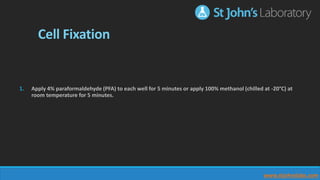
Cell Fixation
1. Apply 4% paraformaldehyde (PFA) to each well for 5 minutes or apply 100% methanol (chilled at -20°C) at
room temperature for 5 minutes.
www.stjohnslabs.com
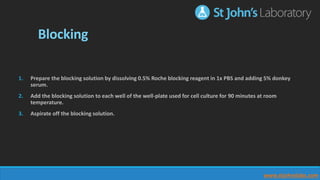
Blocking
1. Prepare the blocking solution by dissolving 0.5% Roche blocking reagent in 1x PBS and adding 5% donkey
serum.
2. Add the blocking solution to each well of the well-plate used for cell culture for 90 minutes at room
temperature.
3. Aspirate off the blocking solution.
www.stjohnslabs.com
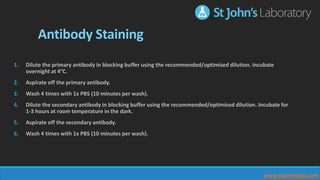
Antibody Staining
1. Dilute the primary antibody in blocking buffer using the recommended/optimised dilution. Incubate
overnight at 4°C.
2. Aspirate off the primary antibody.
3. Wash 4 times with 1x PBS (10 minutes per wash).
4. Dilute the secondary antibody in blocking buffer using the recommended/optimised dilution. Incubate for
1-3 hours at room temperature in the dark.
5. Aspirate off the secondary antibody.
6. Wash 4 times with 1x PBS (10 minutes per wash).
www.stjohnslabs.com
Counterstaining
1. Counterstain the cell nuclei with 4,6-diamidino-2-phenylindole (DAPI) diluted 1:5000 in 1x PBS for 1 minute
at room temperature in the dark.
2. Wash with 1x PBS for 1 minute.
3. Wash with distilled water for 1 minute.
www.stjohnslabs.com
Mounting
1. Mount the coverslips cell-side down onto microscope slides using mounting medium.
2. Seal with clear nail varnish and leave to dry.
3. Store at 4°C.
www.stjohnslabs.com
Visualisation
1. View the coverslips under a fluorescent or confocal microscope to view the stained nuclei and target
protein.
www.stjohnslabs.com
Download this protocol in PDF format:
www.stjohnslabs.com
Antibody Validation Project
www.stjohnslabs.com
Receive rewards when you validate our products.
Click here to find out more.

Immunocytochemistry Protocol

  • 1.
    www.stjohnslabs.com Protocol Series: Immunocytochemistry Information onthe general steps required for carrying out Immunocytochemistry St John's Laboratory Ltd St John's Laboratory Ltd @StJohnsLabs St John's Laboratory Ltd For more in our protocol series, visit Slideshare.net/StJohnsLabs
  • 2.
    Immunocytochemistry is usedto visualise the localisation and quantity of a protein of interest. The target protein is bound to by a specific primary antibody, which in turn is detected by a secondary antibody conjugated to a fluorophore. A fluorescent or confocal microscope is used to visualise the protein. Immunocytochemistry (ICC) differs from immunohistochemistry (IHC) in that the former is performed on samples of intact cells that have had most, if not all, of their surrounding extracellular matrix removed. In contrast, immunohistochemical samples are sections of biological tissue, where each cell is surrounded by tissue architecture and other cells normally found in the intact tissue. These differences cause the samples to be prepared differently. For ICC, the sample requires permeabilisation so that the antibodies can reach the intracellular targets. The following slides provide information on the general steps involved. Optimisation may be required. www.stjohnslabs.com
  • 3.
    Cell Fixation 1. Apply4% paraformaldehyde (PFA) to each well for 5 minutes or apply 100% methanol (chilled at -20°C) at room temperature for 5 minutes. www.stjohnslabs.com
  • 4.
    Blocking 1. Prepare theblocking solution by dissolving 0.5% Roche blocking reagent in 1x PBS and adding 5% donkey serum. 2. Add the blocking solution to each well of the well-plate used for cell culture for 90 minutes at room temperature. 3. Aspirate off the blocking solution. www.stjohnslabs.com
  • 5.
    Antibody Staining 1. Dilutethe primary antibody in blocking buffer using the recommended/optimised dilution. Incubate overnight at 4°C. 2. Aspirate off the primary antibody. 3. Wash 4 times with 1x PBS (10 minutes per wash). 4. Dilute the secondary antibody in blocking buffer using the recommended/optimised dilution. Incubate for 1-3 hours at room temperature in the dark. 5. Aspirate off the secondary antibody. 6. Wash 4 times with 1x PBS (10 minutes per wash). www.stjohnslabs.com
  • 6.
    Counterstaining 1. Counterstain thecell nuclei with 4,6-diamidino-2-phenylindole (DAPI) diluted 1:5000 in 1x PBS for 1 minute at room temperature in the dark. 2. Wash with 1x PBS for 1 minute. 3. Wash with distilled water for 1 minute. www.stjohnslabs.com
  • 7.
    Mounting 1. Mount thecoverslips cell-side down onto microscope slides using mounting medium. 2. Seal with clear nail varnish and leave to dry. 3. Store at 4°C. www.stjohnslabs.com
  • 8.
    Visualisation 1. View thecoverslips under a fluorescent or confocal microscope to view the stained nuclei and target protein. www.stjohnslabs.com
  • 9.
    Download this protocolin PDF format: www.stjohnslabs.com
  • 10.
    Antibody Validation Project www.stjohnslabs.com Receiverewards when you validate our products. Click here to find out more.