Interesting Case Presentation

        Dr. Ankit Raiyani
        Medicine Dept.
         LTMMC & GH
History
42 yr male married R/O Matunga illiterate tailor
Presented with c/o
• Difficulty in holding small objects in right hand with loss of
   dexterity, progressive over 6 months and in left UL since last 2
   mths
• Difficulty in walking due to tightness in both LL progressive
   over 6 mths
• Difficulty in speaking requiring more effort, more after talking
   for long time, progressively worsening over 6 mths
• Twitching in both UL since 4 mths, in LL since 2 mths
• Difficulty in swallowing solids and liquids with nasal
   regurgitation of liquids
• increased frequency of micturition a/w urgency since 2 mths
No complaints of
• Diplopia, blurring of vision
• Headache, loss of consciousness,
• Bowel, bladder incontinence
• Loose motions, vomiting, abdominal pain
• Tingling, numbness
Past history
• k/c/o sero positive status, on ART (ZLN) since
   2008, CD4 count- 222 in march 2011
• H/O trauma to right knee at the age of 16 year.
   Unable to bend his right knee since then
• Not a K/C/O diabetes, hypertension,
• No P/H/O tuberculosis
Personal history- Ex alcoholic, ex tobacco chewer
left since last 6 mths
Family history- no h/o such illness in family
Examination
• Patient conscious oriented avg
  built, nourished
• P- 88/min reg, all pp well felt
• BP- 118/74 mm of Hg, supine
• No pallor, icterus, clubbing, LNpathy, edema
• Poor oral hygiene, no oral candidiasis, no
  linear bluish discoloration of gums
• Skull, spine- NAD
CNS examination-
• Conscious oriented co-operative
• MMSE- 27/30, spastic dysarthria
• Cranial nerves-
  – II to VIII – normal
  – IX, X- soft palate movement decreased , gag
    ++, cough +
  – XI- SCM, trapezius b/l normal
  – XII- atrophy +, fasciculations+
• Motor system
  – Nutrition- wasting of the thenar and hypothenar muscles
    of both hands
  – Patient sitting in bed with elbows flexed and wrist palmar
    flexed
  – fasciculations seen over both upper limbs, poly mini
    myoclonus+
  – Tone - spasticity in BL LL > UL
  – Power-
     • 3/5 in right UL, 4/5 in left UL,
     • Wasting of thenar and hypothenar muscles, dorsal interossei , abd
       digiti minimi on both hands Rt > Lt
  – Reflexes-
     • DTR- brisk in all 4 limbs
     • Sup-Abdominal, Cremasteric- absent, Plantar - both extensor
• No sensory deficits. Rhomberg’s –negative
• No cerebellar signs
• Gait- spastic, scissoring
Other systems - NAD
• 35 year male with diffuse mixture of LMN and
  UMN weakness in both UL and LL with
  pseudobulbar palsy

• Clinical diagnosis- Motor Neuron Disease
Diff. diagnosis
• Motor neuron disease-
  – Paraneoplastic syndrome
  – Heavy metal poisoning
  – Paraproteinemia
  – Metabolic
  – HIV associated MND
• Pure motor polyradiculopathy
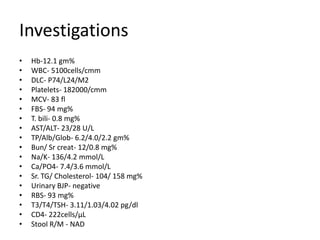
Investigations
•   Hb-12.1 gm%
•   WBC- 5100cells/cmm
•   DLC- P74/L24/M2
•   Platelets- 182000/cmm
•   MCV- 83 fl
•   FBS- 94 mg%
•   T. bili- 0.8 mg%
•   AST/ALT- 23/28 U/L
•   TP/Alb/Glob- 6.2/4.0/2.2 gm%
•   Bun/ Sr creat- 12/0.8 mg%
•   Na/K- 136/4.2 mmol/L
•   Ca/PO4- 7.4/3.6 mmol/L
•   Sr. TG/ Cholesterol- 104/ 158 mg%
•   Urinary BJP- negative
•   RBS- 93 mg%
•   T3/T4/TSH- 3.11/1.03/4.02 pg/dl
•   CD4- 222cells/µL
•   Stool R/M - NAD
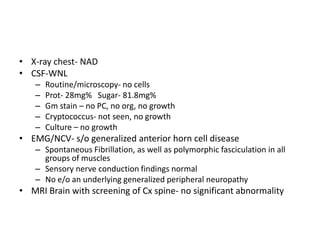
• X-ray chest- NAD
• CSF-WNL
   –   Routine/microscopy- no cells
   –   Prot- 28mg% Sugar- 81.8mg%
   –   Gm stain – no PC, no org, no growth
   –   Cryptococcus- not seen, no growth
   –   Culture – no growth
• EMG/NCV- s/o generalized anterior horn cell disease
   – Spontaneous Fibrillation, as well as polymorphic fasciculation in all
     groups of muscles
   – Sensory nerve conduction findings normal
   – No e/o an underlying generalized peripheral neuropathy
• MRI Brain with screening of Cx spine- no significant abnormality
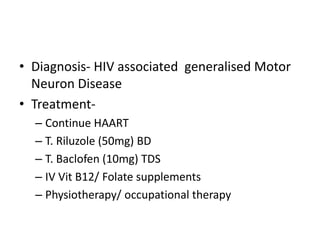
• Diagnosis- HIV associated generalised Motor
  Neuron Disease
• Treatment-
  – Continue HAART
  – T. Riluzole (50mg) BD
  – T. Baclofen (10mg) TDS
  – IV Vit B12/ Folate supplements
  – Physiotherapy/ occupational therapy
HIV associated Motor neuron disease
• HIV infection has been associated with increased incidence
  of ALS and other MND(1,2,3)
• Possible mechanisms- not completely understood
    1.       Retroviral myelopathy(4)
    2.       Through HERV- K reactivation(5,6)-
         •      HIV infection induces reactivation and replication of dormant Human
                Endogenous Retro Virus-K10. (5)
         •      HERV-K has recently been implicated for pathogenesis of ALS though
                exact mechanism is not established.HERV-K pol transcripts were
                shown to be significantly increased in brain biopsy of patients with
                ALS compared to those with chronic systemic illness. (6)
•    Whole spectrum of MND ( UMN/LMN/Both) can be seen
     in different cases
•    Commonly involves patients not yet started on HAART
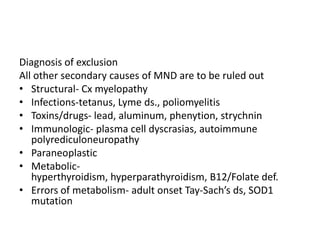
Diagnosis of exclusion
All other secondary causes of MND are to be ruled out
• Structural- Cx myelopathy
• Infections-tetanus, Lyme ds., poliomyelitis
• Toxins/drugs- lead, aluminum, phenytion, strychnin
• Immunologic- plasma cell dyscrasias, autoimmune
   polyrediculoneuropathy
• Paraneoplastic
• Metabolic-
   hyperthyroidism, hyperparathyroidism, B12/Folate def.
• Errors of metabolism- adult onset Tay-Sach’s ds, SOD1
   mutation
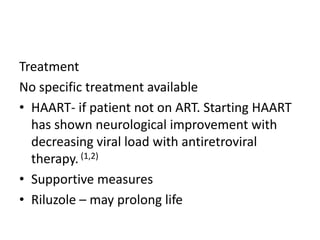
Treatment
No specific treatment available
• HAART- if patient not on ART. Starting HAART
  has shown neurological improvement with
  decreasing viral load with antiretroviral
  therapy. (1,2)
• Supportive measures
• Riluzole – may prolong life
References-
1. Moulignier A, Moulonguet A, Pialoux G, et al. Reversible ALS-like
    disorder in HIV infection. Neurology 2001;57:995–1001
2. Reversal of HIV-associated motor neuron syndrome after highly
    active antiretroviral therapy. J Neurol 2001;248:233–4.
3. Jubelt B, Berger JR. Does viral disease underlie ALS? Lessons from
    the AIDS pandemic. Neurology 2001;57:945–6.
4. Modi G, Ranchhod J, Hari K, Mochan A, Modi M. Non-traumatic
    myelopathy -the influence of HIV. QJM 2011 Aug;104(8):697-703
5. Garrison KE et al. T cell responses to human endogenous
    retroviruses in HIV-1 infection. PLoS Pathog. 2007 Nov;3(11):e165.
6. Douville R, Liu J, Rothstein J, Nath A. Identification of active loci of
    a human endogenous retrovirus in neurons of patients with
    amyotrophic lateral sclerosis. Ann Neurol. 2011 Jan;69(1):141-51.
    doi: 10.1002/ana.22149.

Motor neuron disease in HIV

  • 1.
    Interesting Case Presentation Dr. Ankit Raiyani Medicine Dept. LTMMC & GH
  • 2.
    History 42 yr malemarried R/O Matunga illiterate tailor Presented with c/o • Difficulty in holding small objects in right hand with loss of dexterity, progressive over 6 months and in left UL since last 2 mths • Difficulty in walking due to tightness in both LL progressive over 6 mths • Difficulty in speaking requiring more effort, more after talking for long time, progressively worsening over 6 mths • Twitching in both UL since 4 mths, in LL since 2 mths • Difficulty in swallowing solids and liquids with nasal regurgitation of liquids • increased frequency of micturition a/w urgency since 2 mths
  • 3.
    No complaints of •Diplopia, blurring of vision • Headache, loss of consciousness, • Bowel, bladder incontinence • Loose motions, vomiting, abdominal pain • Tingling, numbness
  • 4.
    Past history • k/c/osero positive status, on ART (ZLN) since 2008, CD4 count- 222 in march 2011 • H/O trauma to right knee at the age of 16 year. Unable to bend his right knee since then • Not a K/C/O diabetes, hypertension, • No P/H/O tuberculosis Personal history- Ex alcoholic, ex tobacco chewer left since last 6 mths Family history- no h/o such illness in family
  • 5.
    Examination • Patient consciousoriented avg built, nourished • P- 88/min reg, all pp well felt • BP- 118/74 mm of Hg, supine • No pallor, icterus, clubbing, LNpathy, edema • Poor oral hygiene, no oral candidiasis, no linear bluish discoloration of gums • Skull, spine- NAD
  • 6.
    CNS examination- • Consciousoriented co-operative • MMSE- 27/30, spastic dysarthria • Cranial nerves- – II to VIII – normal – IX, X- soft palate movement decreased , gag ++, cough + – XI- SCM, trapezius b/l normal – XII- atrophy +, fasciculations+
  • 7.
    • Motor system – Nutrition- wasting of the thenar and hypothenar muscles of both hands – Patient sitting in bed with elbows flexed and wrist palmar flexed – fasciculations seen over both upper limbs, poly mini myoclonus+ – Tone - spasticity in BL LL > UL – Power- • 3/5 in right UL, 4/5 in left UL, • Wasting of thenar and hypothenar muscles, dorsal interossei , abd digiti minimi on both hands Rt > Lt – Reflexes- • DTR- brisk in all 4 limbs • Sup-Abdominal, Cremasteric- absent, Plantar - both extensor
  • 8.
    • No sensorydeficits. Rhomberg’s –negative • No cerebellar signs • Gait- spastic, scissoring Other systems - NAD
  • 9.
    • 35 yearmale with diffuse mixture of LMN and UMN weakness in both UL and LL with pseudobulbar palsy • Clinical diagnosis- Motor Neuron Disease
  • 10.
    Diff. diagnosis • Motorneuron disease- – Paraneoplastic syndrome – Heavy metal poisoning – Paraproteinemia – Metabolic – HIV associated MND • Pure motor polyradiculopathy
  • 11.
    Investigations • Hb-12.1 gm% • WBC- 5100cells/cmm • DLC- P74/L24/M2 • Platelets- 182000/cmm • MCV- 83 fl • FBS- 94 mg% • T. bili- 0.8 mg% • AST/ALT- 23/28 U/L • TP/Alb/Glob- 6.2/4.0/2.2 gm% • Bun/ Sr creat- 12/0.8 mg% • Na/K- 136/4.2 mmol/L • Ca/PO4- 7.4/3.6 mmol/L • Sr. TG/ Cholesterol- 104/ 158 mg% • Urinary BJP- negative • RBS- 93 mg% • T3/T4/TSH- 3.11/1.03/4.02 pg/dl • CD4- 222cells/µL • Stool R/M - NAD
  • 12.
    • X-ray chest-NAD • CSF-WNL – Routine/microscopy- no cells – Prot- 28mg% Sugar- 81.8mg% – Gm stain – no PC, no org, no growth – Cryptococcus- not seen, no growth – Culture – no growth • EMG/NCV- s/o generalized anterior horn cell disease – Spontaneous Fibrillation, as well as polymorphic fasciculation in all groups of muscles – Sensory nerve conduction findings normal – No e/o an underlying generalized peripheral neuropathy • MRI Brain with screening of Cx spine- no significant abnormality
  • 13.
    • Diagnosis- HIVassociated generalised Motor Neuron Disease • Treatment- – Continue HAART – T. Riluzole (50mg) BD – T. Baclofen (10mg) TDS – IV Vit B12/ Folate supplements – Physiotherapy/ occupational therapy
  • 14.
    HIV associated Motorneuron disease • HIV infection has been associated with increased incidence of ALS and other MND(1,2,3) • Possible mechanisms- not completely understood 1. Retroviral myelopathy(4) 2. Through HERV- K reactivation(5,6)- • HIV infection induces reactivation and replication of dormant Human Endogenous Retro Virus-K10. (5) • HERV-K has recently been implicated for pathogenesis of ALS though exact mechanism is not established.HERV-K pol transcripts were shown to be significantly increased in brain biopsy of patients with ALS compared to those with chronic systemic illness. (6) • Whole spectrum of MND ( UMN/LMN/Both) can be seen in different cases • Commonly involves patients not yet started on HAART
  • 15.
    Diagnosis of exclusion Allother secondary causes of MND are to be ruled out • Structural- Cx myelopathy • Infections-tetanus, Lyme ds., poliomyelitis • Toxins/drugs- lead, aluminum, phenytion, strychnin • Immunologic- plasma cell dyscrasias, autoimmune polyrediculoneuropathy • Paraneoplastic • Metabolic- hyperthyroidism, hyperparathyroidism, B12/Folate def. • Errors of metabolism- adult onset Tay-Sach’s ds, SOD1 mutation
  • 16.
    Treatment No specific treatmentavailable • HAART- if patient not on ART. Starting HAART has shown neurological improvement with decreasing viral load with antiretroviral therapy. (1,2) • Supportive measures • Riluzole – may prolong life
  • 17.
    References- 1. Moulignier A,Moulonguet A, Pialoux G, et al. Reversible ALS-like disorder in HIV infection. Neurology 2001;57:995–1001 2. Reversal of HIV-associated motor neuron syndrome after highly active antiretroviral therapy. J Neurol 2001;248:233–4. 3. Jubelt B, Berger JR. Does viral disease underlie ALS? Lessons from the AIDS pandemic. Neurology 2001;57:945–6. 4. Modi G, Ranchhod J, Hari K, Mochan A, Modi M. Non-traumatic myelopathy -the influence of HIV. QJM 2011 Aug;104(8):697-703 5. Garrison KE et al. T cell responses to human endogenous retroviruses in HIV-1 infection. PLoS Pathog. 2007 Nov;3(11):e165. 6. Douville R, Liu J, Rothstein J, Nath A. Identification of active loci of a human endogenous retrovirus in neurons of patients with amyotrophic lateral sclerosis. Ann Neurol. 2011 Jan;69(1):141-51. doi: 10.1002/ana.22149.