CLINICAL SERIES:   ARTHRITIS BY:  Ahmed AL-Jabri  R2
AIM JOINT inflammation : Articular vs periarticular ? Inflammatory vs non-inflammatory ?  focus on septic  arthritis AND crystal induced arthritis
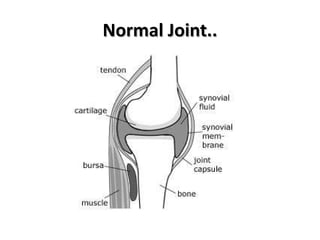
Normal Joint..
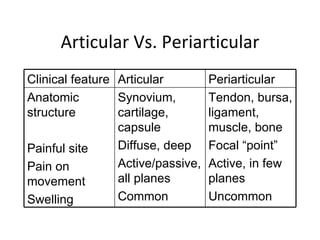
Articular Vs. Periarticular Clinical feature Articular  Periarticular Anatomic structure Painful site  Pain on movement Swelling  Synovium, cartilage, capsule Diffuse, deep Active/passive, all planes Common Tendon, bursa, ligament, muscle, bone Focal “point” Active, in few planes Uncommon
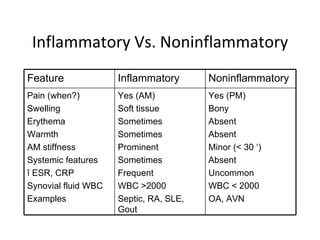
Inflammatory Vs. Noninflammatory Feature Inflammatory Noninflammatory Pain (when?) Swelling Erythema Warmth AM stiffness Systemic features î  ESR, CRP Synovial fluid WBC Examples  Yes (AM) Soft tissue  Sometimes Sometimes Prominent  Sometimes Frequent WBC >2000 Septic, RA, SLE, Gout Yes (PM) Bony Absent Absent Minor (< 30  ‘) Absent Uncommon WBC < 2000 OA, AVN

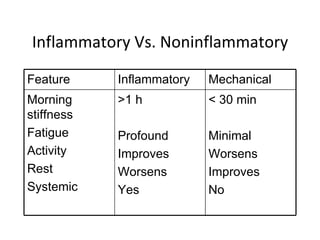
Inflammatory Vs. Noninflammatory Feature Inflammatory Mechanical Morning stiffness Fatigue Activity Rest Systemic >1 h Profound  Improves Worsens Yes < 30 min Minimal Worsens Improves No
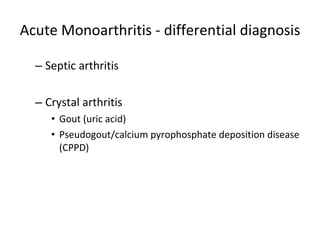
Acute Monoarthritis - differential diagnosis Septic arthritis  Crystal arthritis Gout (uric acid) Pseudogout/calcium pyrophosphate deposition disease (CPPD)
What are other differentials for acute monoarticular pain?
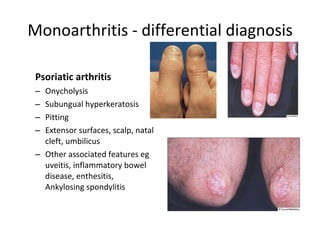
Monoarthritis - differential diagnosis Psoriatic arthritis Onycholysis Subungual hyperkeratosis Pitting Extensor surfaces, scalp, natal cleft, umbilicus Other associated features eg uveitis, inflammatory bowel disease, enthesitis, Ankylosing spondylitis
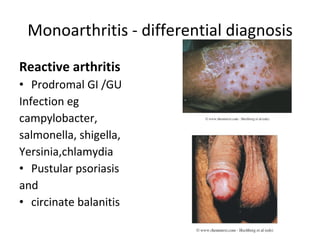
Monoarthritis - differential diagnosis Reactive arthritis Prodromal GI /GU Infection eg campylobacter,  salmonella, shigella,  Yersinia,chlamydia Pustular psoriasis  and  circinate balanitis
Q: Physical examination of a patient with reiter’s  syndrome may be expected to reveal :  Waxy plaques on the palms and soles Sausage-like swelling of the fingers Painful, shallow ulcers in the mouth Iritis All of the above  Non of the above
Q: Physical examination of a patient with reiter’s  syndrome may be expected to reveal :  Waxy plaques on the palms and soles Sausage-like swelling of the fingers Painful, shallow ulcers in the mouth Iritis All of the above
Monoarthritis - differential diagnosis Trauma  - # and haemarthroses (warfarin, bleeding disorders)
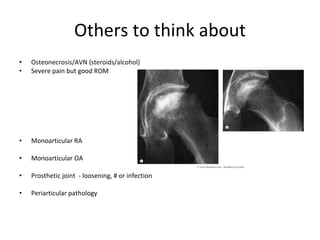
Others to think about Osteonecrosis/AVN (steroids/alcohol) Severe pain but good ROM  Monoarticular RA Monoarticular OA Prosthetic joint  - loosening, # or infection Periarticular pathology
Is it an articular or extra-articular problem? ARTICULAR PERI-ARTICULAR pain all planes pain in plane of tendon active = passive active < passive capsular swelling/effusion    linear swelling joint line tenderness  localised tenderness diffuse erythema/heat localised erythema/heat
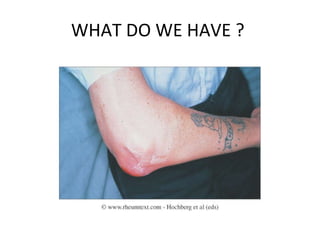
WHAT DO WE HAVE ?
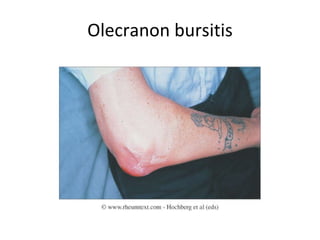
Olecranon bursitis
42 YRS OLD MALE  presents with pain, warmth, and swelling over his posterior  elbow. The pt reports frequntly having to lean on his elbow while performing electrical work as part of his job. Although he is able to flex and extend the joint , flexion results in increased pain. After aspiration and cell count of the fluid obtained, which of the following is the minimum WBC count suggestive of infection ? WBC > 500 per mm3 . WBC  > 7,000 per mm3  WBC  > 10,000 per mm3  WBC  > 50,000 per mm3  WBC  > 100,000 per mm3
42 YRS OLD MALE  presents with pain, warmth, and swelling over his posterior  elbow. The pt reports frequntly having to lean on his elbow while performing electrical work as part of his job. Although he is able to flex and extend the joint , flexion results in increased pain. After aspiration and cell count of the fluid obtained, which of the following is the minimum WBC count suggestive of infection ? WBC > 500 per mm3 . WBC  > 7,000 per mm3  WBC  > 10,000 per mm3  SEPTIC BURSITIS ACCOUNTS FOR 33% OF ALL OLECRANON BURSITIS .
What is the expected WBC counts in aspirated synovial fluid from a patient with septic arthitis ?
It will be a turbid/purulent fluid,  USUALLY > 50,000 wbc/mm3  ( 5000-50,000) > 75% PMN WBC  What is the expected WBC counts in aspirated synovial fluid from a patient with septic arthitis ?
A patient presents with acute polyarthritis. Joint fluid shows less than 10,000 WBCs, mostly lymphocytes. This is most consistent with __. rheumatoid arthritis viral infection  gonococcal arthritis  systemic lupus erythematosus (SLE)  rheumatic fever
A patient presents with acute polyarthritis. Joint fluid shows less than 10,000 WBCs, mostly lymphocytes. This is most consistent with __. rheumatoid arthritis viral infection  gonococcal arthritis  systemic lupus erythematosus (SLE)  rheumatic fever In the other conditions, the WBC count is usually higher, with predominantly PMNs.
Septic arthritis 15-30 per 100,000 population Fatal in 11% of cases  Delayed or inadequate treatment leads to irreversible joint damage
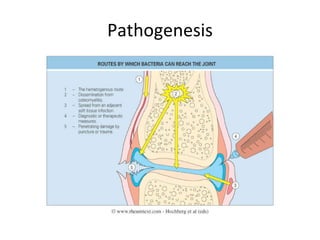
How do you get septic arthritis?
Pathogenesis
Who gets septic arthritis?
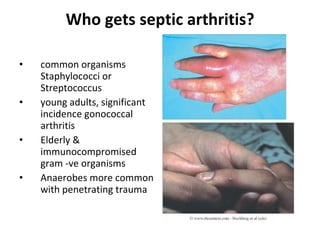
Who gets septic arthritis? common organisms Staphylococci or Streptococcus young adults, significant incidence gonococcal arthritis Elderly & immunocompromised gram -ve organisms  Anaerobes more common with penetrating trauma
Who gets septic arthritis? pre-existing joint disease prosthetic joints IV drug abuse, alcoholism  diabetes, steroids, immunosuppression  previous intra-articular steroid injection
What are the signs and symptoms of septic arthritis?
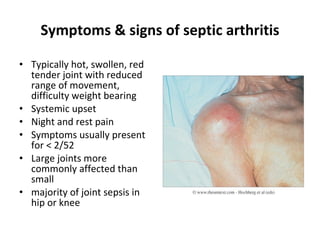
Symptoms & signs of septic arthritis Typically hot, swollen, red tender joint with reduced range of movement, difficulty weight bearing  Systemic upset Night and rest pain  Symptoms usually present for  <  2/52  Large joints more commonly affected than small majority of joint sepsis in hip or knee
55 YRS OLD  female with h/o RA presents with progressive swelling and pain in her knee for 6 days. She is on prednisone and states that her standard flares involve her ankles and fingers. Her vitals are normal ; afebrile .  Examination reveals a moderate-sized knee effusion with warmth and tenderness and extreme pain on range of motion of the joint. Which of the following is the most appropriate next step in management ? Joint aspiration MRI of the knee Colchicine PO Stress-dose steroids  Indomethacin PO
55 YRS OLD  female with h/o RA presents with progressive swelling and pain in her knee for 6 days. She is on prednisone and states that her standard flares involve her ankles and fingers. Her vitals are normal ; afebrile .  Examination reveals a moderate-sized knee effusion with warmth and tenderness and extreme pain on range of motion of the joint. Which of the following is the most appropriate next step in management ? Joint aspiration
Symptoms & signs of septic arthritis In pre-existing inflammatory joint disease symptoms in affected joint(s), out of proportion to disease activity in other joints. 10-15% of cases,  >  one joint  - so polyarticular presentation does not exclude sepsis presence of fever not reliable indicator- if clinical suspicion high - treat
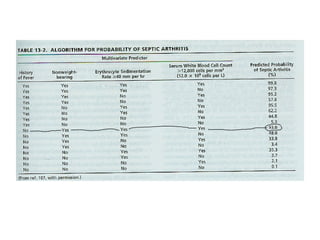
Kocher et al. 1999 Hx of fever Nonweightbearing ESR >40mm/hr WBC >12,000/mm3
 
What investigations are useful in septic arthritis?
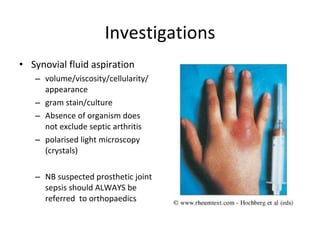
Investigations Synovial fluid aspiration volume/viscosity/cellularity/ appearance gram stain/culture Absence of organism does not exclude septic arthritis polarised light microscopy (crystals) NB suspected prosthetic joint sepsis should ALWAYS be referred  to orthopaedics
Investigations Always  blood cultures  significant proportion blood cultures + ve in  absence of + ve synovial fluid cultures FBC ESR & CRP BUT absence of raised WBC, ESR or CRP Do not exclude diagnosis of sepsis - if clinical suspicion high always treat
Other investigations CRP useful for monitoring response to treatment  Urate may be normal in acute gout and of no diagnostic value in acute gout or sepsis  Measure urea, electrolytes & liver function for end organ damage (poor prognostic feature) Renal function may influence antibiotic choice
Other tests? If skin pustule is present, suggestive of gonococcal infection, then skin swab should be taken  If history suggests possibility of genitourinary or respiratory tract infection then culture sputum (and CXR) & urine & take anogenital & throat swabs where appropriate If periarticular sepsis – appropriate swabs and cultures
Antibiotic treatment of septic arthritis Local and national guidelines Liaise with micro. guided by gram stain  Conventionally given iv for 2 weeks or until signs improve, then orally for around 4 weeks
SEPTIC ARTHRITS: Oral Antibiotics Amoxicillin (25 mg/kg per dose administered every 6 hours)  Cephalexin (37.5 mg/kg per dose administered every 6 hours)  Clindamycin (13 mg/kg per dose administered every 8 hours)  Cloxacillin (31 mg/kg per dose administered every 6 hours)  Dicloxacillin (25 mg/kg per dose administered every 6 hours) Penicillin V (22 mg/kg per dose administered every 4 hours)
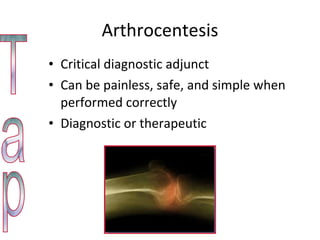
Arthrocentesis Critical diagnostic adjunct  Can be painless, safe, and simple when performed correctly Diagnostic or therapeutic Tap
Indications  Obtain joint fluid for analysis Drain tense hemarthroses  Instill analgesics and anti-inflammatory agents Prosthetic joints: only to rule out infection Tap
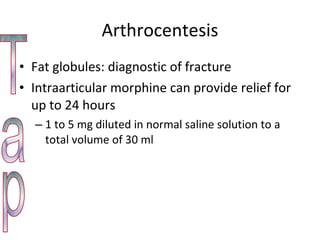
Arthrocentesis Fat globules: diagnostic of fracture Intraarticular morphine can provide relief for up to 24 hours 1 to 5 mg diluted in normal saline solution to a total volume of 30 ml Tap
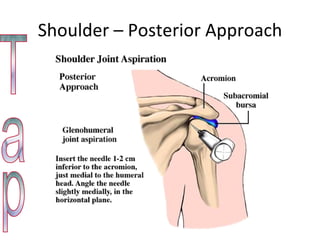
Shoulder – Posterior Approach Tap
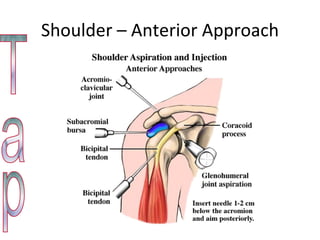
Shoulder – Anterior Approach Tap
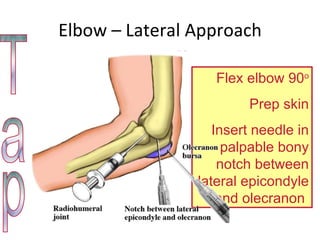
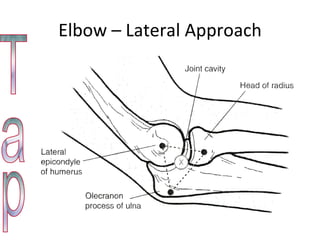
Elbow – Lateral Approach Tap Flex elbow 90 o Prep skin Insert needle in palpable bony notch between lateral epicondyle and olecranon
Elbow – Lateral Approach Tap
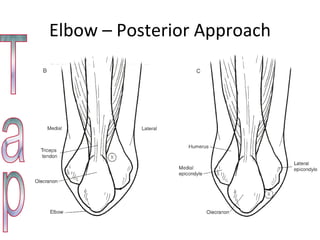
Elbow – Posterior Approach Tap
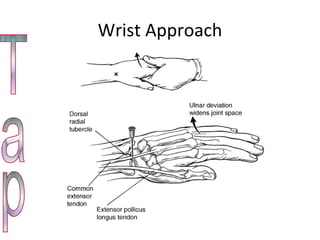
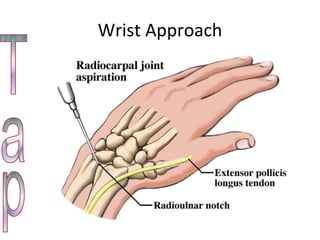
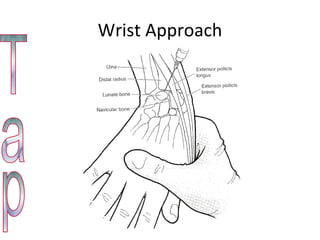
Wrist Approach Tap
Wrist Approach Tap
Wrist Approach Tap
A patient has wrist inflammation that is too subtle to detect visually. It may best be detected by comparing __ to the opposite side. pronation  supination  flexion and extension
A patient has wrist inflammation that is too subtle to detect visually. It may best be detected by comparing __ to the opposite side. pronation  supination   flexion and extension With even minimal inflammation, there will be a noticeable decrease in the flexion-extension range of motion
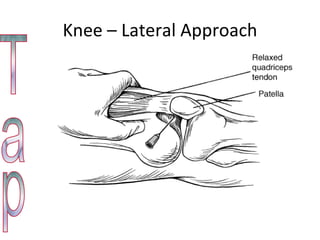
Knee – Lateral Approach Tap
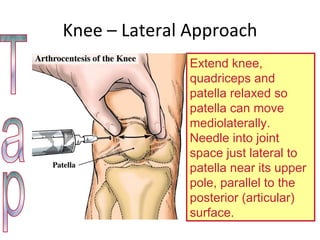
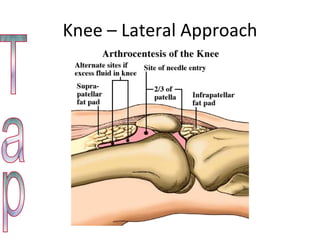
Knee – Lateral Approach Extend knee, quadriceps and patella relaxed so patella can move mediolaterally. Needle into joint space just lateral to patella near its upper pole, parallel to the posterior (articular) surface.  Tap
Knee – Lateral Approach Tap
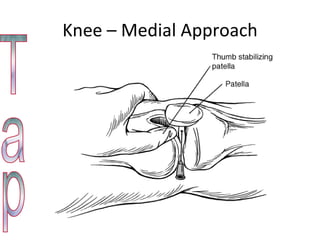
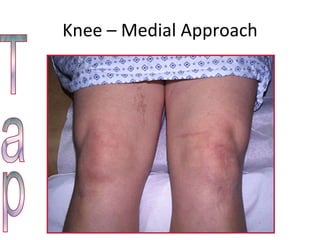
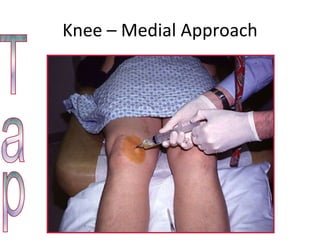
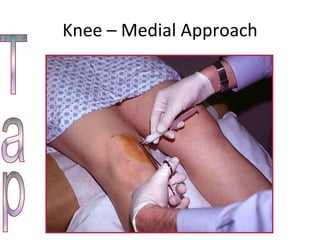
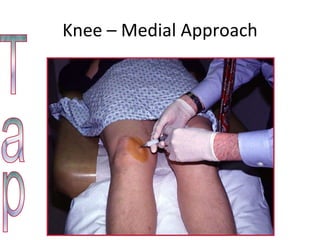
Knee – Medial Approach Tap
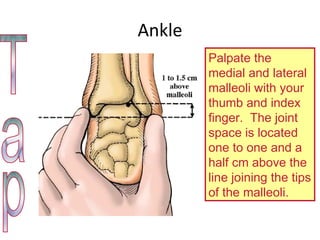
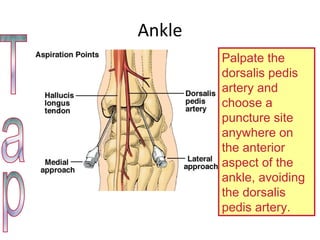
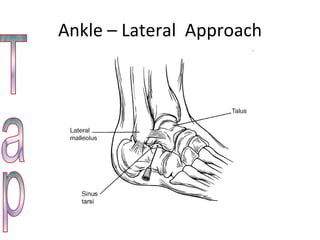
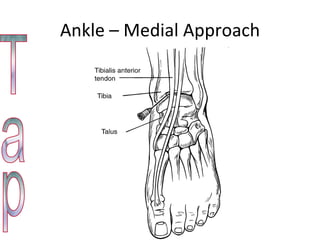
Ankle Tap Palpate the medial and lateral malleoli with your thumb and index finger.  The joint space is located one to one and a half cm above the line joining the tips of the malleoli.
Ankle Tap Palpate the dorsalis pedis artery and choose a puncture site anywhere on the anterior aspect of the ankle, avoiding the dorsalis pedis artery.
Ankle – Lateral  Approach Tap
Ankle – Medial Approach Tap
Synovial Fluid Analysis Identify crystals, pus  Analyze color, clarity, cell count, differential, Gram’s stain, crystals Positive Gram’s stain: diagnostic for septic arthritis Negative Gram’s stain: does not rule out septic arthritis Fluid
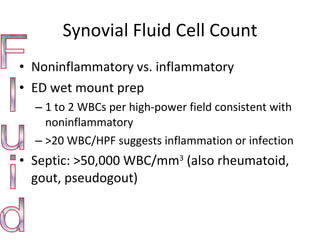
Synovial Fluid Cell Count Noninflammatory vs. inflammatory ED wet mount prep 1 to 2 WBCs per high-power field consistent with noninflammatory >20 WBC/HPF suggests inflammation or infection Septic: >50,000 WBC/mm 3  (also rheumatoid, gout, pseudogout) Fluid
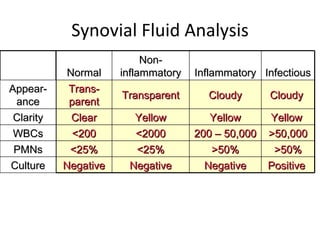
Synovial Fluid Analysis Normal Non-inflammatory Inflammatory Infectious Trans-parent Transparent Cloudy Cloudy  Clear Yellow Yellow Yellow  <200 <2000 200 – 50,000 >50,000 <25% <25% >50% >50% Negative Negative Negative Positive  Appear-ance Clarity WBCs PMNs Culture
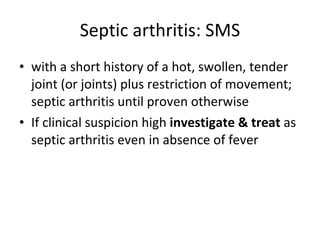
Septic arthritis: SMS with a short history of a hot, swollen, tender joint (or joints) plus restriction of movement; septic arthritis until proven otherwise  If clinical suspicion high  investigate & treat  as septic arthritis even in absence of fever
gout
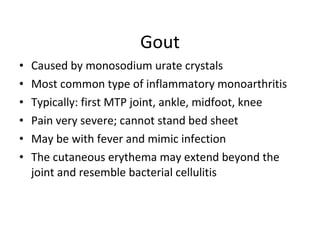
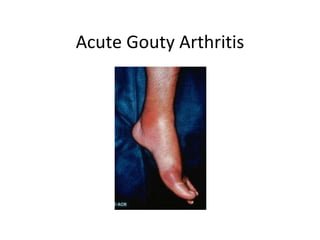
Gout Caused by monosodium urate crystals Most common type of inflammatory monoarthritis Typically: first MTP joint, ankle, midfoot, knee Pain very severe; cannot stand bed sheet May be with fever and mimic infection The cutaneous erythema may extend beyond the joint and resemble bacterial cellulitis
Acute Gouty Arthritis
Risk Factors Primary gout: Obesity, hyperlipidemia, diabetes mellitus, hypertension, and atherosclerosis. Secondary gout: alcoholism, drug therapy (diuretics, cytotoxics), myeloproliferative disorders, chronic renal failure.
Microscopic appearance of the crystals of gout include all of the following EXCEPT: needle-shaped urate crystals positively birefringent  negatively birefringent Non of the above
Microscopic appearance of the crystals of gout include all of the following EXCEPT: needle-shaped urate crystals positively birefringent
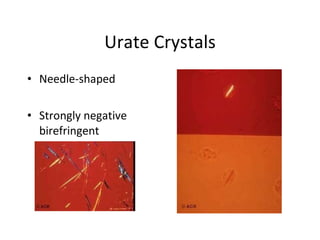
Urate Crystals Needle-shaped Strongly negative birefringent
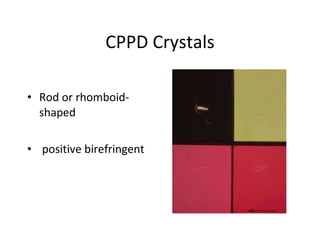
CPPD Crystals Deposition Disease Can cause monoarthritis clinically indistinguishable from gout – hence called  Pseudogout. Often precipitated by illness or surgery. Pseudogout is most common in the knee (50%) and wrist. Reported in any joint (Including MTP). CPPD disease may be asymptomatic (deposition of CPP in cartilage).
Associated Conditions Hyperparathyroidism Hypercalcemia Hypocalciuria Hemochromatosis Hypothyroidism Gout Aging
CPPD Crystals Rod or rhomboid-shaped positive birefringent
THANK-YOU

F:\clinical series`arthitis

  • 1.
    CLINICAL SERIES: ARTHRITIS BY: Ahmed AL-Jabri R2
  • 2.
    AIM JOINT inflammation: Articular vs periarticular ? Inflammatory vs non-inflammatory ? focus on septic arthritis AND crystal induced arthritis
  • 3.
  • 4.
    Articular Vs. PeriarticularClinical feature Articular Periarticular Anatomic structure Painful site Pain on movement Swelling Synovium, cartilage, capsule Diffuse, deep Active/passive, all planes Common Tendon, bursa, ligament, muscle, bone Focal “point” Active, in few planes Uncommon
  • 5.
    Inflammatory Vs. NoninflammatoryFeature Inflammatory Noninflammatory Pain (when?) Swelling Erythema Warmth AM stiffness Systemic features î ESR, CRP Synovial fluid WBC Examples Yes (AM) Soft tissue Sometimes Sometimes Prominent Sometimes Frequent WBC >2000 Septic, RA, SLE, Gout Yes (PM) Bony Absent Absent Minor (< 30 ‘) Absent Uncommon WBC < 2000 OA, AVN
  • 6.
    Inflammatory Vs. NoninflammatoryFeature Inflammatory Mechanical Morning stiffness Fatigue Activity Rest Systemic >1 h Profound Improves Worsens Yes < 30 min Minimal Worsens Improves No
  • 7.
    Acute Monoarthritis -differential diagnosis Septic arthritis Crystal arthritis Gout (uric acid) Pseudogout/calcium pyrophosphate deposition disease (CPPD)
  • 8.
    What are otherdifferentials for acute monoarticular pain?
  • 9.
    Monoarthritis - differentialdiagnosis Psoriatic arthritis Onycholysis Subungual hyperkeratosis Pitting Extensor surfaces, scalp, natal cleft, umbilicus Other associated features eg uveitis, inflammatory bowel disease, enthesitis, Ankylosing spondylitis
  • 10.
    Monoarthritis - differentialdiagnosis Reactive arthritis Prodromal GI /GU Infection eg campylobacter, salmonella, shigella, Yersinia,chlamydia Pustular psoriasis and circinate balanitis
  • 11.
    Q: Physical examinationof a patient with reiter’s syndrome may be expected to reveal : Waxy plaques on the palms and soles Sausage-like swelling of the fingers Painful, shallow ulcers in the mouth Iritis All of the above Non of the above
  • 12.
    Q: Physical examinationof a patient with reiter’s syndrome may be expected to reveal : Waxy plaques on the palms and soles Sausage-like swelling of the fingers Painful, shallow ulcers in the mouth Iritis All of the above
  • 13.
    Monoarthritis - differentialdiagnosis Trauma - # and haemarthroses (warfarin, bleeding disorders)
  • 14.
    Others to thinkabout Osteonecrosis/AVN (steroids/alcohol) Severe pain but good ROM Monoarticular RA Monoarticular OA Prosthetic joint - loosening, # or infection Periarticular pathology
  • 15.
    Is it anarticular or extra-articular problem? ARTICULAR PERI-ARTICULAR pain all planes pain in plane of tendon active = passive active < passive capsular swelling/effusion linear swelling joint line tenderness localised tenderness diffuse erythema/heat localised erythema/heat
  • 16.
    WHAT DO WEHAVE ?
  • 17.
  • 18.
    42 YRS OLDMALE presents with pain, warmth, and swelling over his posterior elbow. The pt reports frequntly having to lean on his elbow while performing electrical work as part of his job. Although he is able to flex and extend the joint , flexion results in increased pain. After aspiration and cell count of the fluid obtained, which of the following is the minimum WBC count suggestive of infection ? WBC > 500 per mm3 . WBC > 7,000 per mm3 WBC > 10,000 per mm3 WBC > 50,000 per mm3 WBC > 100,000 per mm3
  • 19.
    42 YRS OLDMALE presents with pain, warmth, and swelling over his posterior elbow. The pt reports frequntly having to lean on his elbow while performing electrical work as part of his job. Although he is able to flex and extend the joint , flexion results in increased pain. After aspiration and cell count of the fluid obtained, which of the following is the minimum WBC count suggestive of infection ? WBC > 500 per mm3 . WBC > 7,000 per mm3 WBC > 10,000 per mm3 SEPTIC BURSITIS ACCOUNTS FOR 33% OF ALL OLECRANON BURSITIS .
  • 20.
    What is theexpected WBC counts in aspirated synovial fluid from a patient with septic arthitis ?
  • 21.
    It will bea turbid/purulent fluid, USUALLY > 50,000 wbc/mm3 ( 5000-50,000) > 75% PMN WBC What is the expected WBC counts in aspirated synovial fluid from a patient with septic arthitis ?
  • 22.
    A patient presentswith acute polyarthritis. Joint fluid shows less than 10,000 WBCs, mostly lymphocytes. This is most consistent with __. rheumatoid arthritis viral infection gonococcal arthritis systemic lupus erythematosus (SLE) rheumatic fever
  • 23.
    A patient presentswith acute polyarthritis. Joint fluid shows less than 10,000 WBCs, mostly lymphocytes. This is most consistent with __. rheumatoid arthritis viral infection gonococcal arthritis systemic lupus erythematosus (SLE) rheumatic fever In the other conditions, the WBC count is usually higher, with predominantly PMNs.
  • 24.
    Septic arthritis 15-30per 100,000 population Fatal in 11% of cases Delayed or inadequate treatment leads to irreversible joint damage
  • 25.
    How do youget septic arthritis?
  • 26.
  • 27.
    Who gets septicarthritis?
  • 28.
    Who gets septicarthritis? common organisms Staphylococci or Streptococcus young adults, significant incidence gonococcal arthritis Elderly & immunocompromised gram -ve organisms Anaerobes more common with penetrating trauma
  • 29.
    Who gets septicarthritis? pre-existing joint disease prosthetic joints IV drug abuse, alcoholism diabetes, steroids, immunosuppression previous intra-articular steroid injection
  • 30.
    What are thesigns and symptoms of septic arthritis?
  • 31.
    Symptoms & signsof septic arthritis Typically hot, swollen, red tender joint with reduced range of movement, difficulty weight bearing Systemic upset Night and rest pain Symptoms usually present for < 2/52 Large joints more commonly affected than small majority of joint sepsis in hip or knee
  • 32.
    55 YRS OLD female with h/o RA presents with progressive swelling and pain in her knee for 6 days. She is on prednisone and states that her standard flares involve her ankles and fingers. Her vitals are normal ; afebrile . Examination reveals a moderate-sized knee effusion with warmth and tenderness and extreme pain on range of motion of the joint. Which of the following is the most appropriate next step in management ? Joint aspiration MRI of the knee Colchicine PO Stress-dose steroids Indomethacin PO
  • 33.
    55 YRS OLD female with h/o RA presents with progressive swelling and pain in her knee for 6 days. She is on prednisone and states that her standard flares involve her ankles and fingers. Her vitals are normal ; afebrile . Examination reveals a moderate-sized knee effusion with warmth and tenderness and extreme pain on range of motion of the joint. Which of the following is the most appropriate next step in management ? Joint aspiration
  • 34.
    Symptoms & signsof septic arthritis In pre-existing inflammatory joint disease symptoms in affected joint(s), out of proportion to disease activity in other joints. 10-15% of cases, > one joint - so polyarticular presentation does not exclude sepsis presence of fever not reliable indicator- if clinical suspicion high - treat
  • 35.
    Kocher et al.1999 Hx of fever Nonweightbearing ESR >40mm/hr WBC >12,000/mm3
  • 36.
  • 37.
    What investigations areuseful in septic arthritis?
  • 38.
    Investigations Synovial fluidaspiration volume/viscosity/cellularity/ appearance gram stain/culture Absence of organism does not exclude septic arthritis polarised light microscopy (crystals) NB suspected prosthetic joint sepsis should ALWAYS be referred to orthopaedics
  • 39.
    Investigations Always blood cultures significant proportion blood cultures + ve in absence of + ve synovial fluid cultures FBC ESR & CRP BUT absence of raised WBC, ESR or CRP Do not exclude diagnosis of sepsis - if clinical suspicion high always treat
  • 40.
    Other investigations CRPuseful for monitoring response to treatment Urate may be normal in acute gout and of no diagnostic value in acute gout or sepsis Measure urea, electrolytes & liver function for end organ damage (poor prognostic feature) Renal function may influence antibiotic choice
  • 41.
    Other tests? Ifskin pustule is present, suggestive of gonococcal infection, then skin swab should be taken If history suggests possibility of genitourinary or respiratory tract infection then culture sputum (and CXR) & urine & take anogenital & throat swabs where appropriate If periarticular sepsis – appropriate swabs and cultures
  • 42.
    Antibiotic treatment ofseptic arthritis Local and national guidelines Liaise with micro. guided by gram stain Conventionally given iv for 2 weeks or until signs improve, then orally for around 4 weeks
  • 43.
    SEPTIC ARTHRITS: OralAntibiotics Amoxicillin (25 mg/kg per dose administered every 6 hours) Cephalexin (37.5 mg/kg per dose administered every 6 hours) Clindamycin (13 mg/kg per dose administered every 8 hours) Cloxacillin (31 mg/kg per dose administered every 6 hours) Dicloxacillin (25 mg/kg per dose administered every 6 hours) Penicillin V (22 mg/kg per dose administered every 4 hours)
  • 44.
    Arthrocentesis Critical diagnosticadjunct Can be painless, safe, and simple when performed correctly Diagnostic or therapeutic Tap
  • 45.
    Indications Obtainjoint fluid for analysis Drain tense hemarthroses Instill analgesics and anti-inflammatory agents Prosthetic joints: only to rule out infection Tap
  • 46.
    Arthrocentesis Fat globules:diagnostic of fracture Intraarticular morphine can provide relief for up to 24 hours 1 to 5 mg diluted in normal saline solution to a total volume of 30 ml Tap
  • 47.
  • 48.
  • 49.
    Elbow – LateralApproach Tap Flex elbow 90 o Prep skin Insert needle in palpable bony notch between lateral epicondyle and olecranon
  • 50.
    Elbow – LateralApproach Tap
  • 51.
    Elbow – PosteriorApproach Tap
  • 52.
  • 53.
  • 54.
  • 55.
    A patient haswrist inflammation that is too subtle to detect visually. It may best be detected by comparing __ to the opposite side. pronation supination flexion and extension
  • 56.
    A patient haswrist inflammation that is too subtle to detect visually. It may best be detected by comparing __ to the opposite side. pronation supination flexion and extension With even minimal inflammation, there will be a noticeable decrease in the flexion-extension range of motion
  • 57.
    Knee – LateralApproach Tap
  • 58.
    Knee – LateralApproach Extend knee, quadriceps and patella relaxed so patella can move mediolaterally. Needle into joint space just lateral to patella near its upper pole, parallel to the posterior (articular) surface. Tap
  • 59.
    Knee – LateralApproach Tap
  • 60.
    Knee – MedialApproach Tap
  • 61.
    Knee – MedialApproach Tap
  • 62.
    Knee – MedialApproach Tap
  • 63.
    Knee – MedialApproach Tap
  • 64.
    Knee – MedialApproach Tap
  • 65.
    Ankle Tap Palpatethe medial and lateral malleoli with your thumb and index finger. The joint space is located one to one and a half cm above the line joining the tips of the malleoli.
  • 66.
    Ankle Tap Palpatethe dorsalis pedis artery and choose a puncture site anywhere on the anterior aspect of the ankle, avoiding the dorsalis pedis artery.
  • 67.
    Ankle – Lateral Approach Tap
  • 68.
    Ankle – MedialApproach Tap
  • 69.
    Synovial Fluid AnalysisIdentify crystals, pus Analyze color, clarity, cell count, differential, Gram’s stain, crystals Positive Gram’s stain: diagnostic for septic arthritis Negative Gram’s stain: does not rule out septic arthritis Fluid
  • 70.
    Synovial Fluid CellCount Noninflammatory vs. inflammatory ED wet mount prep 1 to 2 WBCs per high-power field consistent with noninflammatory >20 WBC/HPF suggests inflammation or infection Septic: >50,000 WBC/mm 3 (also rheumatoid, gout, pseudogout) Fluid
  • 71.
    Synovial Fluid AnalysisNormal Non-inflammatory Inflammatory Infectious Trans-parent Transparent Cloudy Cloudy Clear Yellow Yellow Yellow <200 <2000 200 – 50,000 >50,000 <25% <25% >50% >50% Negative Negative Negative Positive Appear-ance Clarity WBCs PMNs Culture
  • 72.
    Septic arthritis: SMSwith a short history of a hot, swollen, tender joint (or joints) plus restriction of movement; septic arthritis until proven otherwise If clinical suspicion high investigate & treat as septic arthritis even in absence of fever
  • 73.
  • 74.
    Gout Caused bymonosodium urate crystals Most common type of inflammatory monoarthritis Typically: first MTP joint, ankle, midfoot, knee Pain very severe; cannot stand bed sheet May be with fever and mimic infection The cutaneous erythema may extend beyond the joint and resemble bacterial cellulitis
  • 75.
  • 76.
    Risk Factors Primarygout: Obesity, hyperlipidemia, diabetes mellitus, hypertension, and atherosclerosis. Secondary gout: alcoholism, drug therapy (diuretics, cytotoxics), myeloproliferative disorders, chronic renal failure.
  • 77.
    Microscopic appearance ofthe crystals of gout include all of the following EXCEPT: needle-shaped urate crystals positively birefringent negatively birefringent Non of the above
  • 78.
    Microscopic appearance ofthe crystals of gout include all of the following EXCEPT: needle-shaped urate crystals positively birefringent
  • 79.
    Urate Crystals Needle-shapedStrongly negative birefringent
  • 80.
    CPPD Crystals DepositionDisease Can cause monoarthritis clinically indistinguishable from gout – hence called Pseudogout. Often precipitated by illness or surgery. Pseudogout is most common in the knee (50%) and wrist. Reported in any joint (Including MTP). CPPD disease may be asymptomatic (deposition of CPP in cartilage).
  • 81.
    Associated Conditions HyperparathyroidismHypercalcemia Hypocalciuria Hemochromatosis Hypothyroidism Gout Aging
  • 82.
    CPPD Crystals Rodor rhomboid-shaped positive birefringent
  • 83.