Paediatric Septic 
Arthritis
Contents 
• Introduction 
• Pathophysiology 
• Microbiology 
• Diagnosis 
• History 
• PE 
• Investigations 
• Treatment Options
What is it? 
• An infection of the joint space 
• Monoarticular-90%, Polyarticular, Suppurative and non-suppurative
Routes of Infection 
1. Hematogenous 
• Most common 
• Bacteremia associated with URTI, Skin or GIT infections. Or 
invasive procedures. 
2. Direct Inoculation 
• Joint contamination by foreign object 
3. Contiguous spread 
• Osteomyelitis due to several factors in infants
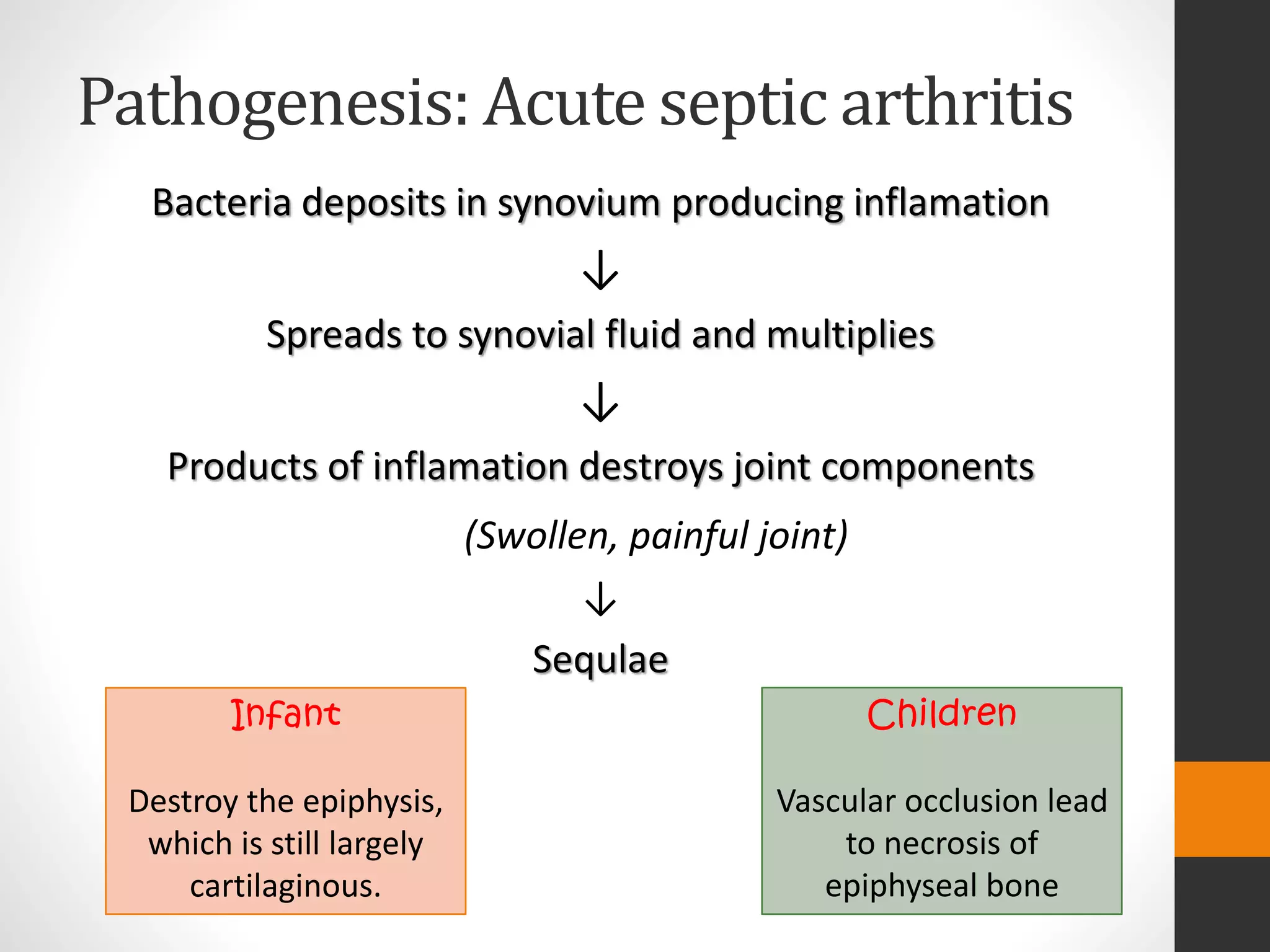
Pathogenesis: Acute septic arthritis 
Bacteria deposits in synovium producing inflamation 
↓ 
Spreads to synovial fluid and multiplies 
↓ 
Products of inflamation destroys joint components 
(Swollen, painful joint) 
↓ 
Sequlae 
Infant 
Destroy the epiphysis, 
which is still largely 
cartilaginous. 
Children 
Vascular occlusion lead 
to necrosis of 
epiphyseal bone
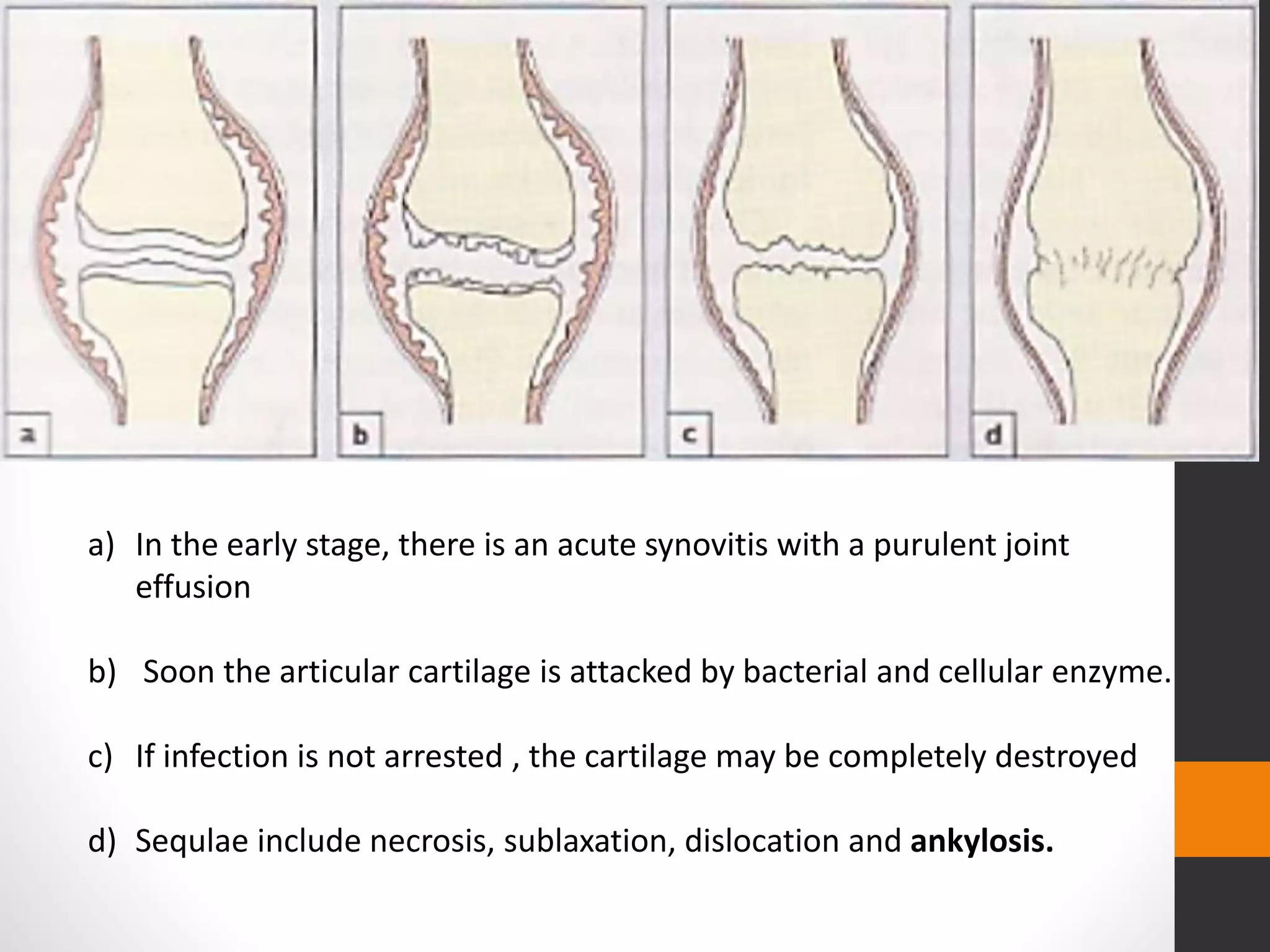
a) In the early stage, there is an acute synovitis with a purulent joint 
effusion 
b) Soon the articular cartilage is attacked by bacterial and cellular enzyme. 
c) If infection is not arrested , the cartilage may be completely destroyed 
d) Sequlae include necrosis, sublaxation, dislocation and ankylosis.
Healing 
May occur with/and/or 
1.Complete resolution 
2.Partial loss of articular cartilage and 
fibrosis of joint 
3.Loss of articular cartilage and bony 
ankylosis 
4.Bony destruction and permanent 
deformity
What causes it? 
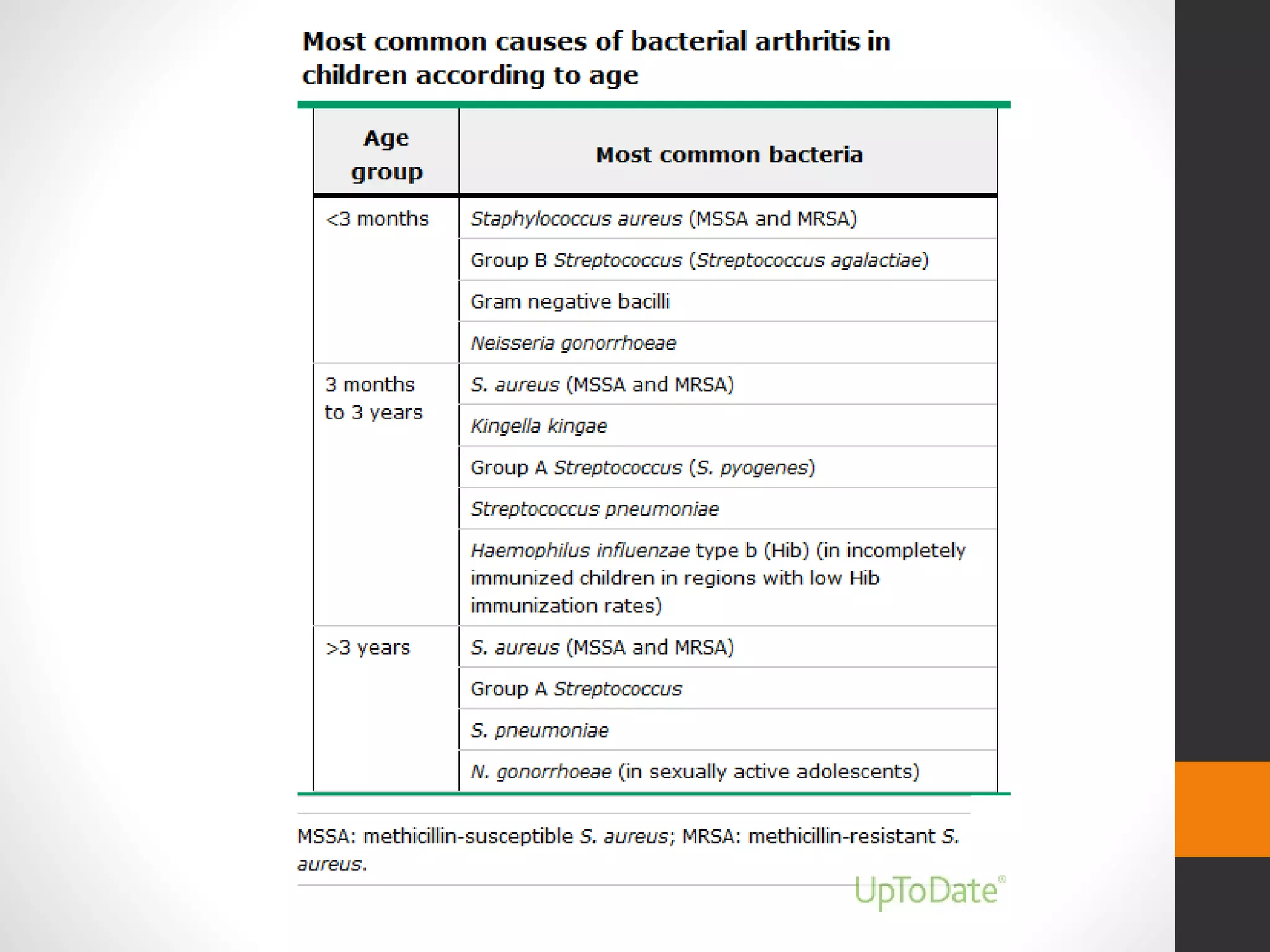
• Mostly bactireal. Also caused by mycobacteria, 
virus and fungi. (HiB vaccination status 
dependent) 
• Gram positive 70-80% of which 40% is S. aureus 
• Gram negative 9-20% 
• Kingella kingae, N. gonorrhoeae
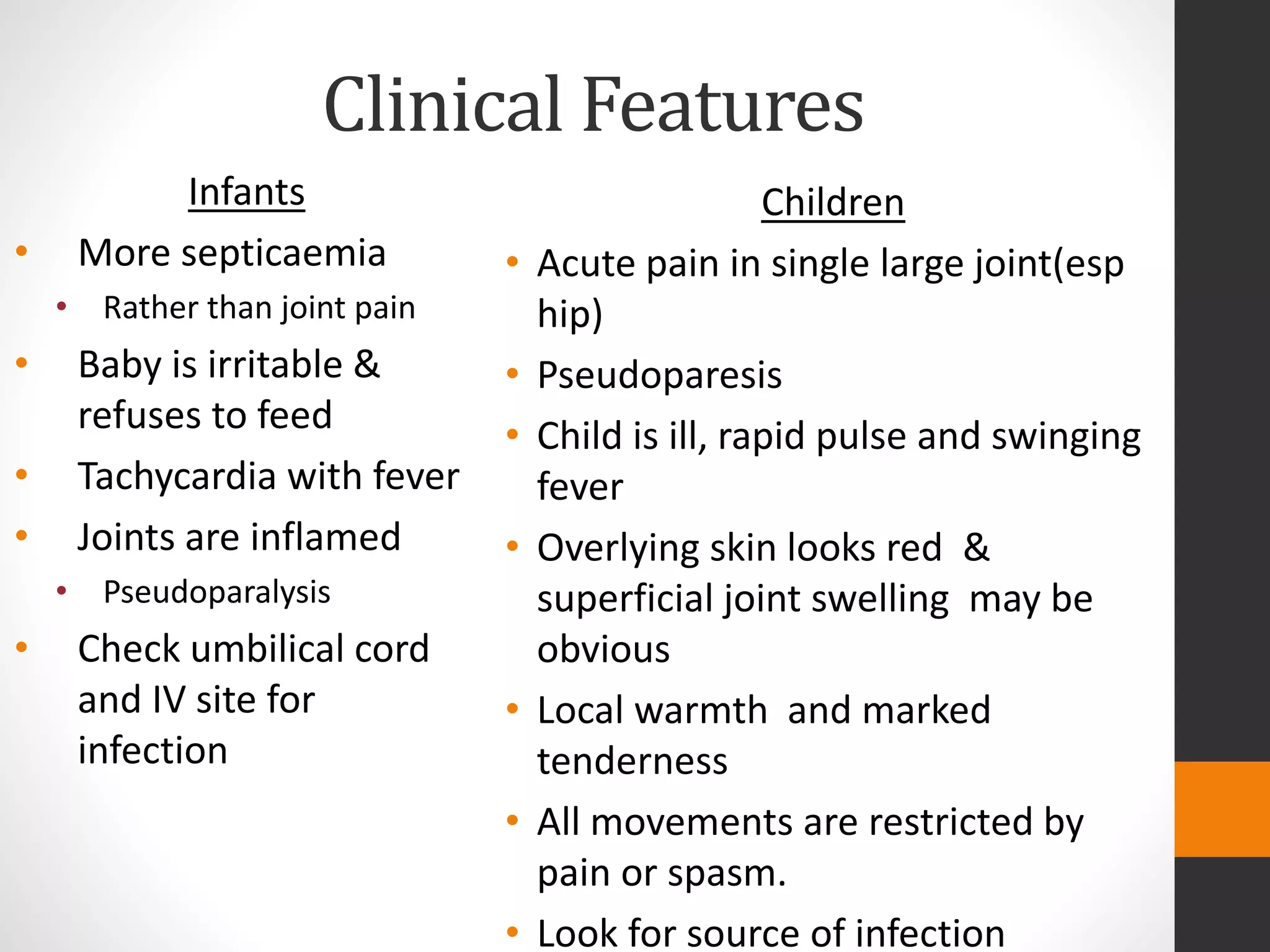
Clinical Features 
Infants 
• More septicaemia 
• Rather than joint pain 
• Baby is irritable & 
refuses to feed 
• Tachycardia with fever 
• Joints are inflamed 
• Pseudoparalysis 
• Check umbilical cord 
and IV site for 
infection 
Children 
• Acute pain in single large joint(esp 
hip) 
• Pseudoparesis 
• Child is ill, rapid pulse and swinging 
fever 
• Overlying skin looks red & 
superficial joint swelling may be 
obvious 
• Local warmth and marked 
tenderness 
• All movements are restricted by 
pain or spasm. 
• Look for source of infection
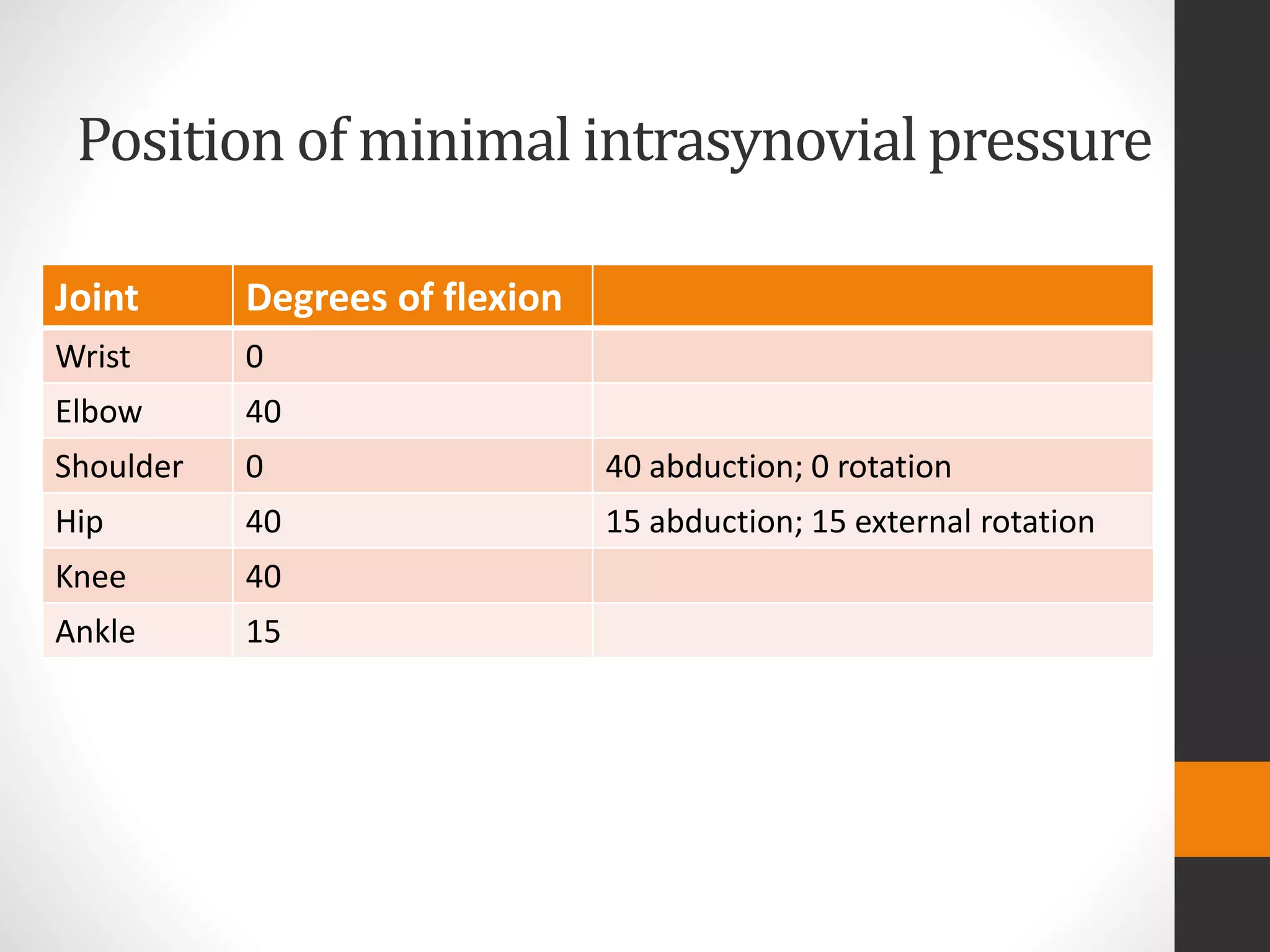
Position of minimal intrasynovial pressure 
Joint Degrees of flexion 
Wrist 0 
Elbow 40 
Shoulder 0 40 abduction; 0 rotation 
Hip 40 15 abduction; 15 external rotation 
Knee 40 
Ankle 15
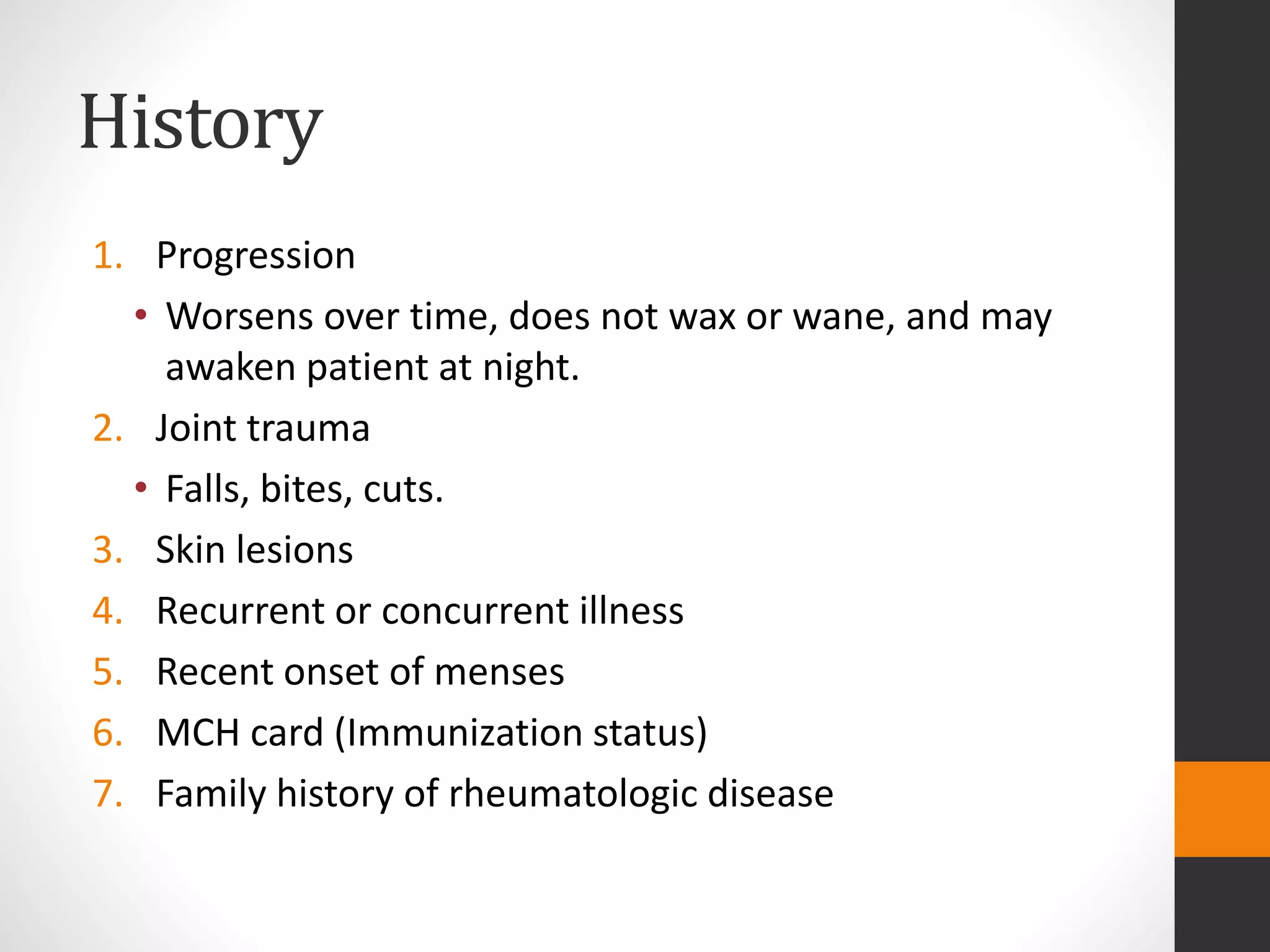
History 
1. Progression 
• Worsens over time, does not wax or wane, and may 
awaken patient at night. 
2. Joint trauma 
• Falls, bites, cuts. 
3. Skin lesions 
4. Recurrent or concurrent illness 
5. Recent onset of menses 
6. MCH card (Immunization status) 
7. Family history of rheumatologic disease
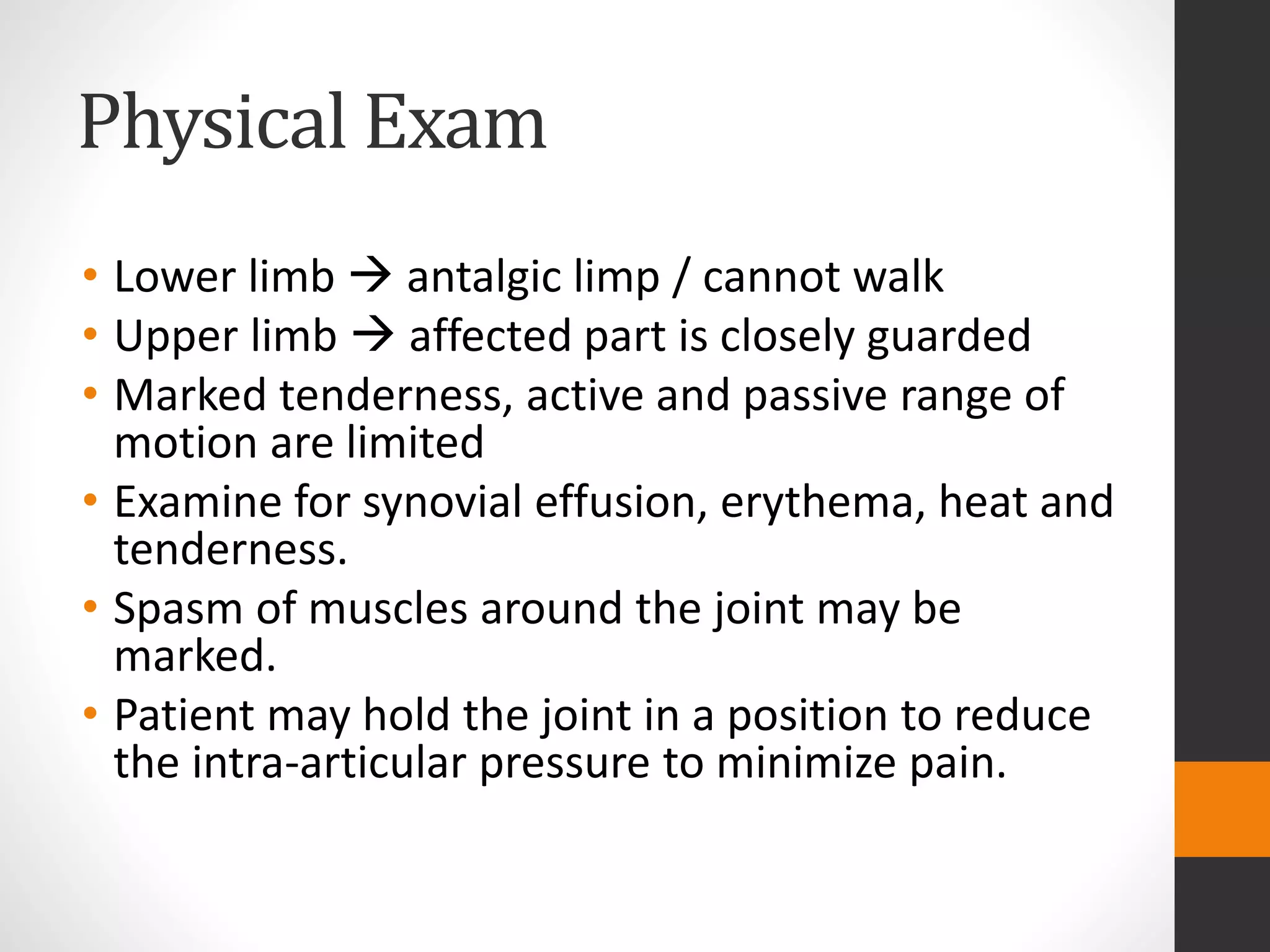
Physical Exam 
• Lower limb  antalgic limp / cannot walk 
• Upper limb  affected part is closely guarded 
• Marked tenderness, active and passive range of 
motion are limited 
• Examine for synovial effusion, erythema, heat and 
tenderness. 
• Spasm of muscles around the joint may be 
marked. 
• Patient may hold the joint in a position to reduce 
the intra-articular pressure to minimize pain.
Investigations 
Bloods Imaging Synovial 
Fluid 
Investigations Explaination 
Full blood count Elevated white blood cell count 
ESR > 40 mm/hr 
CRP > 20 mg/dL 
Blood culture May be positive 
Ultrasound 
Xray 
Synovial Fluid
Imaging 
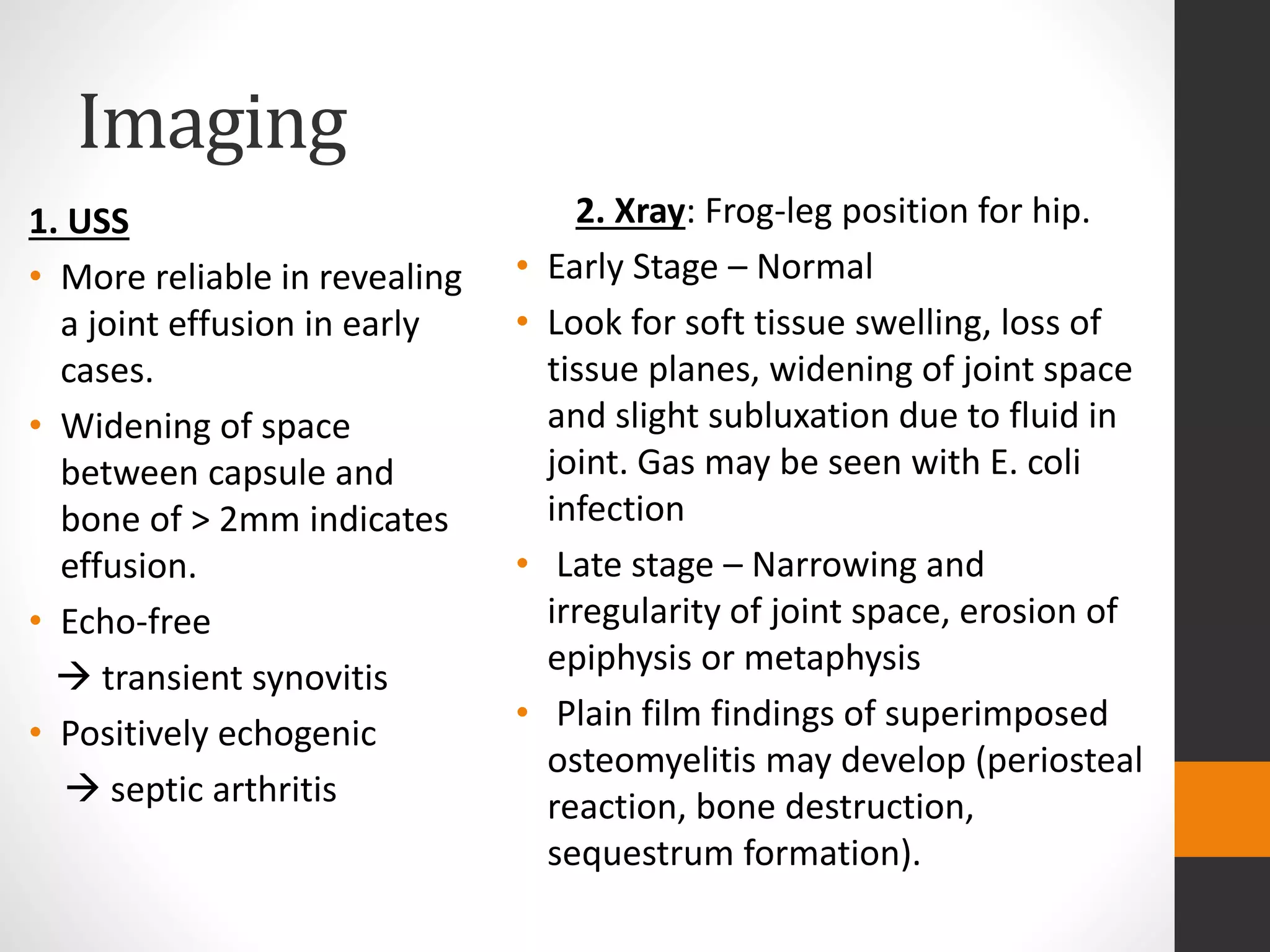
2. Xray: Frog-leg position for hip. 
• Early Stage – Normal 
• Look for soft tissue swelling, loss of 
tissue planes, widening of joint space 
and slight subluxation due to fluid in 
joint. Gas may be seen with E. coli 
infection 
• Late stage – Narrowing and 
irregularity of joint space, erosion of 
epiphysis or metaphysis 
• Plain film findings of superimposed 
osteomyelitis may develop (periosteal 
reaction, bone destruction, 
sequestrum formation). 
1. USS 
• More reliable in revealing 
a joint effusion in early 
cases. 
• Widening of space 
between capsule and 
bone of > 2mm indicates 
effusion. 
• Echo-free 
 transient synovitis 
• Positively echogenic 
 septic arthritis
Narrowing of joint space and 
irregularity of subchondral bone. 
Joint space loss 
subchondral erosions and 
sclerosis of the femoral 
head 
osteonecrosis and 
complete collapse of 
the femoral head
Synovial Fluid Analysis 
Arthritis Type Appearance Viscosity White 
cells/mm3 
Crystals Biochemistry Culture 
Normal Clear yellow High Few - As per plasma - 
Septic 
arthritis 
Purulent Low >>50,000 - Glucose low + 
Tuberculous 
arthritis 
Turbid Low <2000 - Glucose low + 
Rheumatoid 
arthritis 
Cloudy Low >2000 - - - 
Gout Cloudy Normal >2000 Urate 
NBF 
- - 
Pseudogout Cloudy Normal >2000 Pyrophos 
phate 
PBF 
- - 
Osteoarthritis Clear yellow High <2000 Often + - -
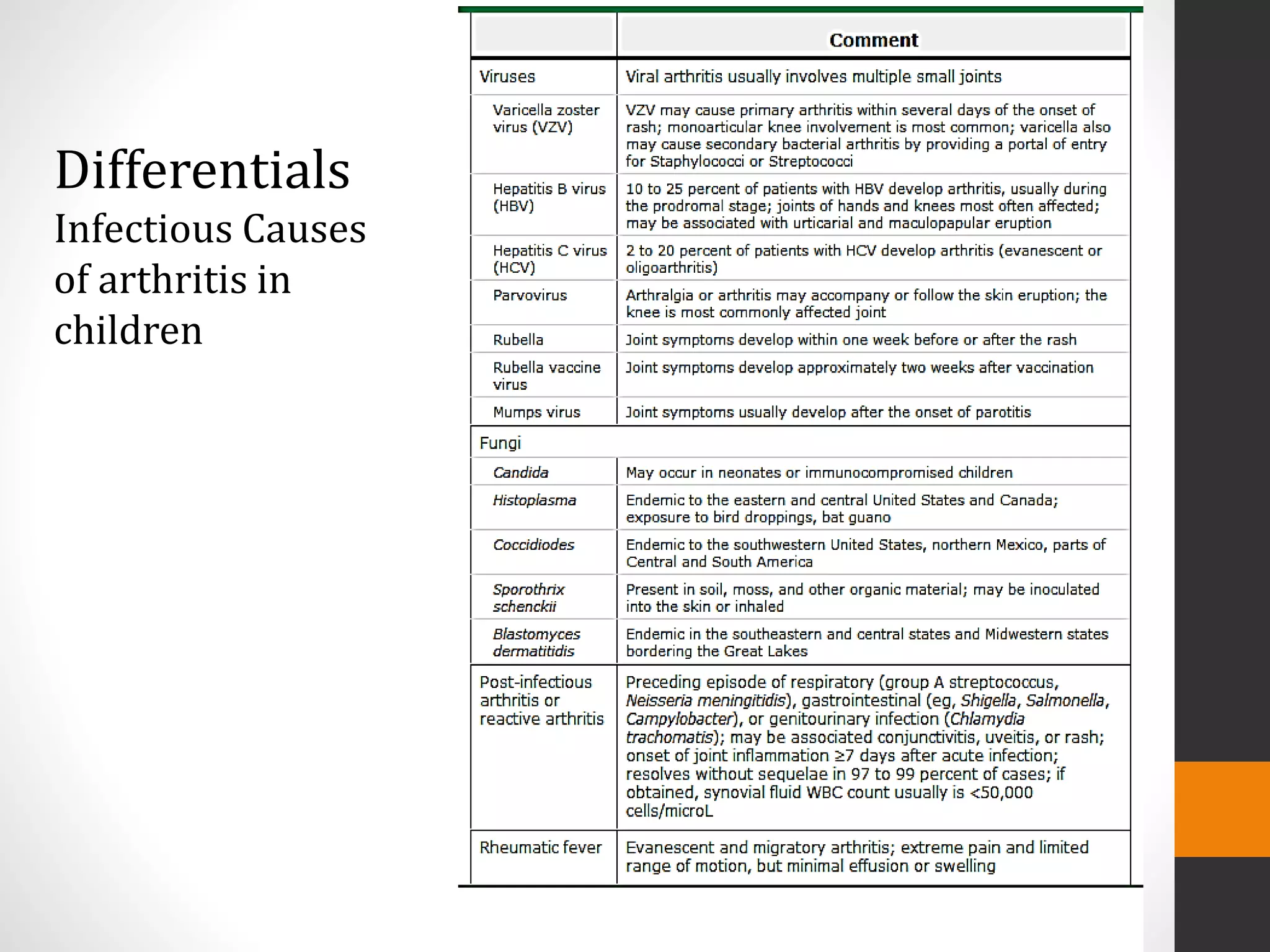
Differentials 
Infectious Causes 
of arthritis in 
children
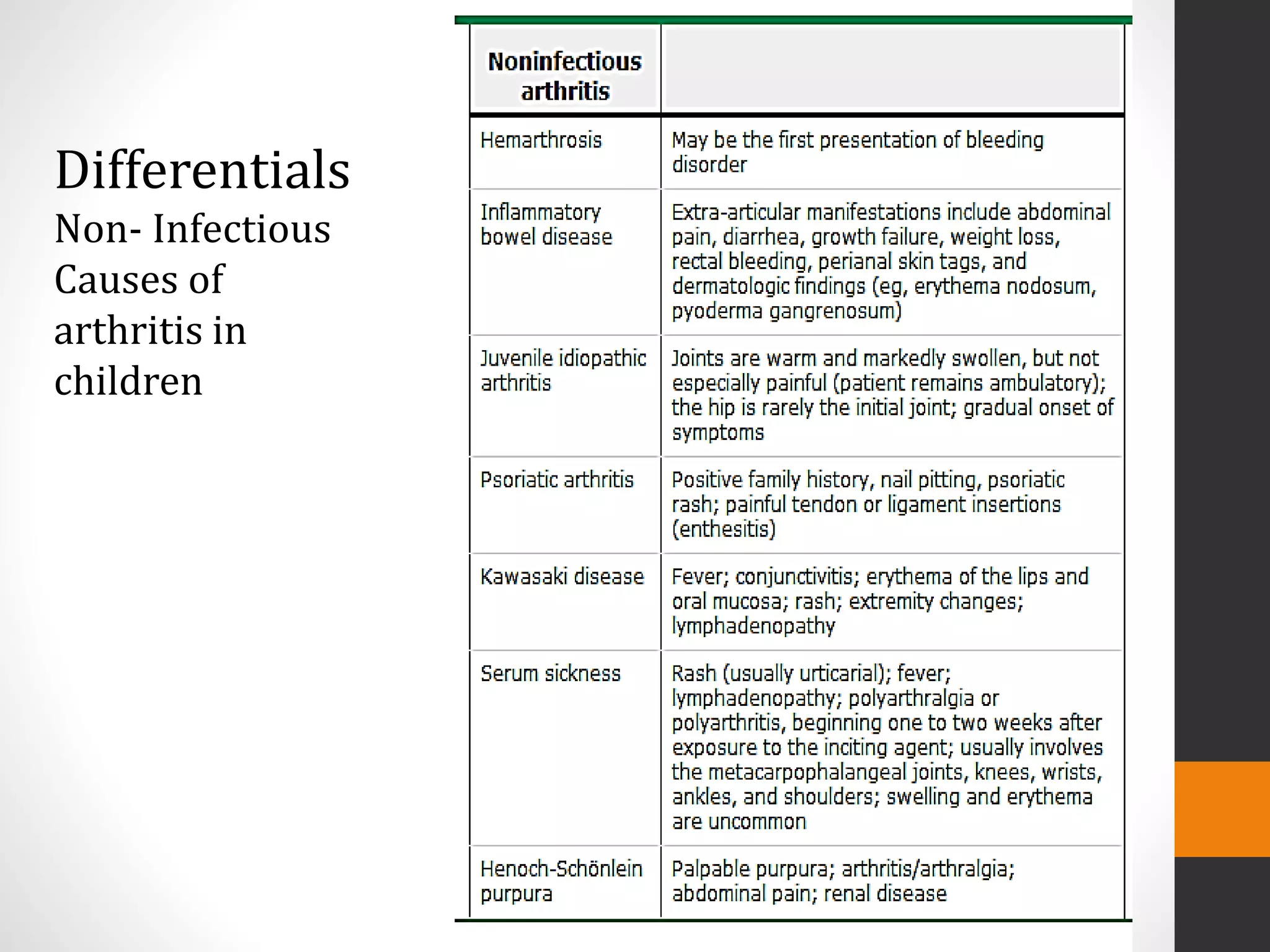
Differentials 
Non- Infectious 
Causes of 
arthritis in 
children
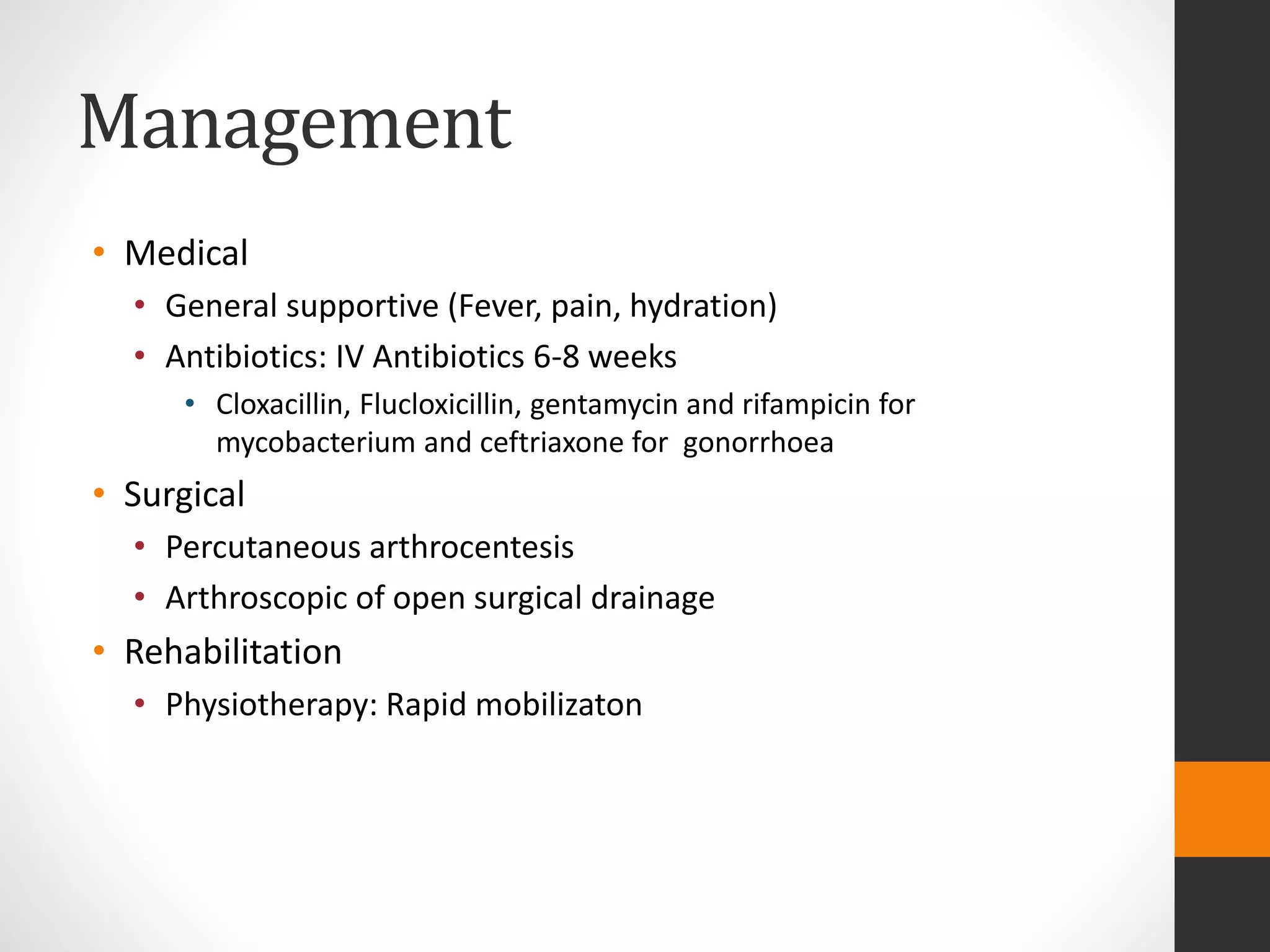
Management 
• Medical 
• General supportive (Fever, pain, hydration) 
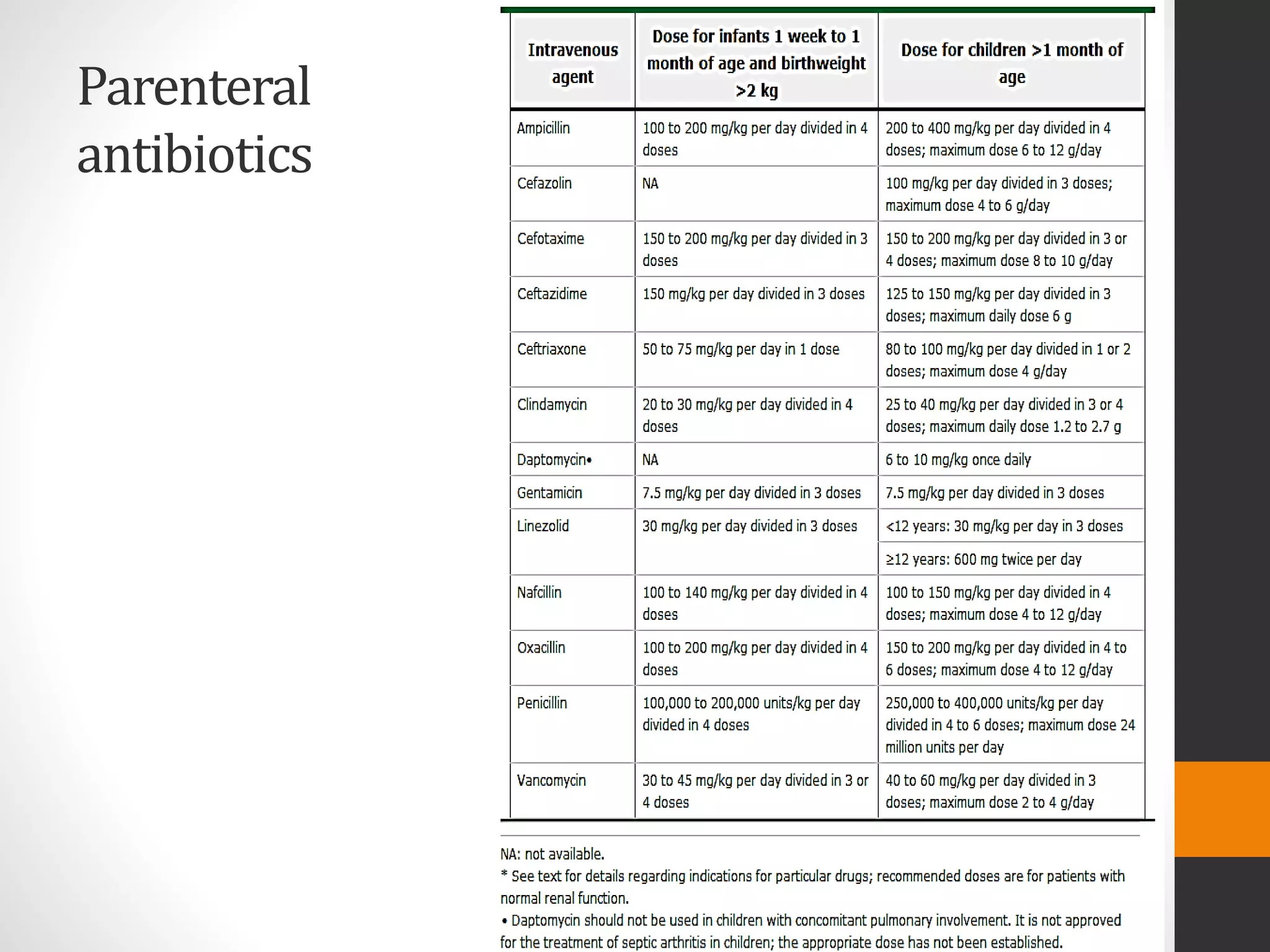
• Antibiotics: IV Antibiotics 6-8 weeks 
• Cloxacillin, Flucloxicillin, gentamycin and rifampicin for 
mycobacterium and ceftriaxone for gonorrhoea 
• Surgical 
• Percutaneous arthrocentesis 
• Arthroscopic of open surgical drainage 
• Rehabilitation 
• Physiotherapy: Rapid mobilizaton
Parenteral 
antibiotics
Take Home Points 
• Prompt diagnosis and treatment is crucial to preventing bad 
bad sequlae. Esp. if the hip is involved 
• Treatment goals are sterillisation and decompression of joint 
space and removal of debris 
• Follow-up must be scheduled to ensure a growing child won’t 
be affected the rest of her/his life. 
Veenaka 

Paediatric Septic Arthritis

  • 1.
  • 2.
    Contents • Introduction • Pathophysiology • Microbiology • Diagnosis • History • PE • Investigations • Treatment Options
  • 3.
    What is it? • An infection of the joint space • Monoarticular-90%, Polyarticular, Suppurative and non-suppurative
  • 4.
    Routes of Infection 1. Hematogenous • Most common • Bacteremia associated with URTI, Skin or GIT infections. Or invasive procedures. 2. Direct Inoculation • Joint contamination by foreign object 3. Contiguous spread • Osteomyelitis due to several factors in infants
  • 5.
    Pathogenesis: Acute septicarthritis Bacteria deposits in synovium producing inflamation ↓ Spreads to synovial fluid and multiplies ↓ Products of inflamation destroys joint components (Swollen, painful joint) ↓ Sequlae Infant Destroy the epiphysis, which is still largely cartilaginous. Children Vascular occlusion lead to necrosis of epiphyseal bone
  • 6.
    a) In theearly stage, there is an acute synovitis with a purulent joint effusion b) Soon the articular cartilage is attacked by bacterial and cellular enzyme. c) If infection is not arrested , the cartilage may be completely destroyed d) Sequlae include necrosis, sublaxation, dislocation and ankylosis.
  • 7.
    Healing May occurwith/and/or 1.Complete resolution 2.Partial loss of articular cartilage and fibrosis of joint 3.Loss of articular cartilage and bony ankylosis 4.Bony destruction and permanent deformity
  • 8.
    What causes it? • Mostly bactireal. Also caused by mycobacteria, virus and fungi. (HiB vaccination status dependent) • Gram positive 70-80% of which 40% is S. aureus • Gram negative 9-20% • Kingella kingae, N. gonorrhoeae
  • 10.
    Clinical Features Infants • More septicaemia • Rather than joint pain • Baby is irritable & refuses to feed • Tachycardia with fever • Joints are inflamed • Pseudoparalysis • Check umbilical cord and IV site for infection Children • Acute pain in single large joint(esp hip) • Pseudoparesis • Child is ill, rapid pulse and swinging fever • Overlying skin looks red & superficial joint swelling may be obvious • Local warmth and marked tenderness • All movements are restricted by pain or spasm. • Look for source of infection
  • 11.
    Position of minimalintrasynovial pressure Joint Degrees of flexion Wrist 0 Elbow 40 Shoulder 0 40 abduction; 0 rotation Hip 40 15 abduction; 15 external rotation Knee 40 Ankle 15
  • 15.
    History 1. Progression • Worsens over time, does not wax or wane, and may awaken patient at night. 2. Joint trauma • Falls, bites, cuts. 3. Skin lesions 4. Recurrent or concurrent illness 5. Recent onset of menses 6. MCH card (Immunization status) 7. Family history of rheumatologic disease
  • 16.
    Physical Exam •Lower limb  antalgic limp / cannot walk • Upper limb  affected part is closely guarded • Marked tenderness, active and passive range of motion are limited • Examine for synovial effusion, erythema, heat and tenderness. • Spasm of muscles around the joint may be marked. • Patient may hold the joint in a position to reduce the intra-articular pressure to minimize pain.
  • 18.
    Investigations Bloods ImagingSynovial Fluid Investigations Explaination Full blood count Elevated white blood cell count ESR > 40 mm/hr CRP > 20 mg/dL Blood culture May be positive Ultrasound Xray Synovial Fluid
  • 19.
    Imaging 2. Xray:Frog-leg position for hip. • Early Stage – Normal • Look for soft tissue swelling, loss of tissue planes, widening of joint space and slight subluxation due to fluid in joint. Gas may be seen with E. coli infection • Late stage – Narrowing and irregularity of joint space, erosion of epiphysis or metaphysis • Plain film findings of superimposed osteomyelitis may develop (periosteal reaction, bone destruction, sequestrum formation). 1. USS • More reliable in revealing a joint effusion in early cases. • Widening of space between capsule and bone of > 2mm indicates effusion. • Echo-free  transient synovitis • Positively echogenic  septic arthritis
  • 20.
    Narrowing of jointspace and irregularity of subchondral bone. Joint space loss subchondral erosions and sclerosis of the femoral head osteonecrosis and complete collapse of the femoral head
  • 21.
    Synovial Fluid Analysis Arthritis Type Appearance Viscosity White cells/mm3 Crystals Biochemistry Culture Normal Clear yellow High Few - As per plasma - Septic arthritis Purulent Low >>50,000 - Glucose low + Tuberculous arthritis Turbid Low <2000 - Glucose low + Rheumatoid arthritis Cloudy Low >2000 - - - Gout Cloudy Normal >2000 Urate NBF - - Pseudogout Cloudy Normal >2000 Pyrophos phate PBF - - Osteoarthritis Clear yellow High <2000 Often + - -
  • 22.
    Differentials Infectious Causes of arthritis in children
  • 23.
    Differentials Non- Infectious Causes of arthritis in children
  • 24.
    Management • Medical • General supportive (Fever, pain, hydration) • Antibiotics: IV Antibiotics 6-8 weeks • Cloxacillin, Flucloxicillin, gentamycin and rifampicin for mycobacterium and ceftriaxone for gonorrhoea • Surgical • Percutaneous arthrocentesis • Arthroscopic of open surgical drainage • Rehabilitation • Physiotherapy: Rapid mobilizaton
  • 25.
  • 26.
    Take Home Points • Prompt diagnosis and treatment is crucial to preventing bad bad sequlae. Esp. if the hip is involved • Treatment goals are sterillisation and decompression of joint space and removal of debris • Follow-up must be scheduled to ensure a growing child won’t be affected the rest of her/his life. Veenaka 

Editor's Notes

  • #4 Risk Factors Neonates at greater risk since their vessesl Umbilical vessel catheterisation Central venous catheters Femoral vessel blood sampling Osteomyelitis Immunodeficiency Joint surgery Thalassemias Diabetes
  • #5 Most common due to effective blood flow and lack of basement membrane in synovium The bacteria may invade other sites too such as meninges, pericardium, soft tissue) esp if H. influenza is involved Could be from trauma, kneeling, crawling on sharp objects. Cats claws or from surgery like arthroscopy. Polymicrobial should be suspected if this is the case. Could occur AFTER external wound heals Osteomyelitis in infants: Metaphyseal capillaries perforate epiphyseal growth plate so infection can easily spread to epiphysis and cartillage Joint capsule extends distal to epiphyseal plate
  • #6 Inflamed synovium: Vasodilatation, increased permeability oedema and neutrophilic infiltration Increased proteins due to permeability and decreased glucose due to bactireal and synovial consumption and reduced circulation Neutrophil damage: Reactive oxygen species (H peroxide, superoxide radicals) Depolymerises hyaluronic acid (Dec. viscosity to 15) Breaksdown cartillage matrix molecules Destroys protease inhibitors Proteolytic enzymes released Stimulates arachidonic acid metabolism Prostaglandins released which contribute to bone resorption Joint components damaged are articular cartillage, and synovium.
  • #7 Sequlae: We’ll see avascular necrosis due to ischaemia due to increased pressure Laxity of joint capsule due to distension. Causes subluxation and dislocation Joint restriction Limb length problem if growth plate involved Enlargement of femoral head in hip SA Pathological fractures
  • #8 Sequlae: We’ll see avascular necrosis due to ischaemia due to increased pressure Laxity of joint capsule due to distension. Causes subluxation and dislocation Joint restriction Limb length problem if growth plate involved Enlargement of femoral head in hip SA Pathological fractures
  • #9 Strep species include GABHemolytic (GAS, Strep. Pyogenes, S pneumoniae, Group B strep (s. agalactiae) Gnegative: Most common Kingella kingae
  • #11 Infants present with gen., non-specific s&s Cellulitis Discomfort on being handled Postural changes Unilateral swelling of extremity, buttocks or genitalia History Progression: Worsens with time, does not wax or wane. May awaken at night
  • #12 As we saw before, the inflammation causes increased pressure within the joint space. Certain positions help.
  • #13 Septic arthritis of hip. Held rigidly in flexion, external rotation, and abduction. SA of wrist in 8 day old. Group B Strep drained. E. coli arthritis of knee in neonate
  • #15 Gonorrhoea: Dermatitis-SA Has dermatitis, migratory polyarthralgia and tenosynovitis Fever, skin lesions, bacteremia In adolescent girls onset with mensus.
  • #16 Inflammatory arthropathies like JIA are worse in the morning Knee pain complaints may be referred from the hip Unusual pathogens Usually portal for s aureus and strep pyogenes leading to bactiremia. Very common in Fiji. UTRI can lead to bacterimia or viral synovitis. Concurrent varicella zoster virus can facilitate entry of s. aureus or GAS. Disseminated gonococcal infection usu in 7 days of mensus. Hib Psoriatic arthritis
  • #17 Don’t forget eyes: conjunctivitis in Kawasaki disease and reactive arthritis Liver: Hepatomegaly in brucella arthritis Musculoskeletal exam: Look, feel move all joints and affected one last. 90% cases are in ONE joint. There may be severe swelling due to extensive infection or venous thrombosis.
  • #19 ESR and CRP are better negative than positive predictors of SA. Good for monitering progress. ESR normal is newborns: 0-2 mm.hr and older: 3-20mm/hr May rise 3-5 days after therapy. Can stay elevated for a month. CRP usually <10mg/L Peaks within 30- 48 hours of infection and falls to normal within a week of treatment Other tests are PCR for K. kingae Cultures from genitals if gonococcal suspected GAS ASOT to be done
  • #20 Radiographic signs of hip arthritis may include [8,12,31,68-71]: ●Swelling of the capsule ●Obliteration or lateral displacement of the gluteal fat lines (image 1) ●Elevation of the femoral portion of Shenton line, with widening of the arc ●The obturator sign (the margins of the obturator internus are displaced medially into the pelvis as its tendon passes over the capsule of the hip joint) ●Lateral and superior displacement of the femoral head with relatively normal acetabular development (in contrast to developmental dysplasia of the hip, in which the acetabulum is abnormal) ●Concomitant osteomyelitis of the femur (this is a late sign, since bone destruction takes a minimum of a week to become apparent on routine radiographs)
  • #22 Usually higher than this. WBC can also >50,000 in JIA or reactive arthritis Gram stain very important as synovial fluid has bacteriostatic properties which may render culture negative
  • #25 Ctrl fever, pain and hydration and splinting affected limb in position of least pressure possibly with traction to prevent dislocation. NSAID will also stop PG production thereby reducing cartillage destruction Empirical stat and then based on culture results Open drainage indications: Hip SA Long duration Exclusion of foreign body Large amounts of fibrin Debridement in those with osteomyelitis Lack of clinical improvement after 48 hours of antibiotic therapy Criteria for oral meds: Clinical and lab improvements Dec. or absent fever Appropriate oral agent available for proper duration Adherence is assured
  • #26 1. Antistaph and antistrep: Clindamycin Vancomycin Cefazolin 2. Hib: cefotaxime or ceftriaxone or cefuroxime 3. Gonococcal: 3rd gen cephalosporin Salmonella: in sickle celled anemia- 3rd gen cephalosporin 4. Strep. Pneumonia: ceftriaxone, clindamycin, cefotaxime 5. Enteric gram neg: Cefotaxime, ceftri PLUS any aminoglycoside