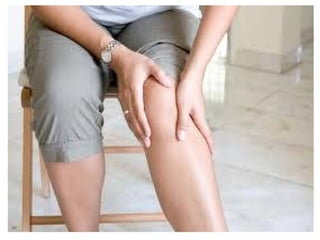
When we walk or run, a lot of effort is
made by the knee for proper movement.
Imagine wearing a shoe with
pointed heels and walking uncomfortably
every day!
The walking style will become your habit
but damage will be done to the cartilage
in the knee.
Evaluation of Patients Presenting
with Knee Pain
Dr. Jay Raj Sharma,
Department of Orthopedic and Traumatology,
Lumbini Medical College and Teaching Hospital,
Parvas, Palpa.
Knee pain is an extremely common complaint,
and there are many causes.
Family physicians, Orthopedic surgeons and
internist, Pediatricians and other doctors
frequently encounter patients with knee
pain.
PAIN CHARACTERISTICS
• onset (rapid or insidious),
• location (anterior, medial, lateral, or posterior knee),
• duration, severity, and quality (e.g., dull, sharp, achy).
• Aggravating and alleviating factors also need to be
identified.
MECHANICAL SYMPTOMS
A history of locking episodes suggests a meniscal
tear.
A sensation of popping at the time of injury
suggests ligamentous injury, probably complete
rupture of a ligament (third-degree tear).
Episodes of giving way are consistent with some
degree of knee instability and may indicate
patellar subluxation or ligamentous rupture.
EFFUSION
Rapid onset (within two hours) of a large, tense effusion
suggests rupture of the anterior cruciate ligament or
fracture of the tibial plateau with resultant
hemarthrosis,
Slower onset (24 to 36 hours)
mild to moderate effusion is consistent
with meniscal injury or ligamentous sprain.
Recurrent knee effusion after activity is consistent with
meniscal injury.
Also effusion in other pathological disease entity.
MECHANISM OF INJURY
The patient should be questioned about specific
details of the injury-
If the patient sustained direct blow to the knee
if the patient was decelerating or stopping suddenly
if the patient was landing from a jump,
if there was a twisting component to the injury, and
if hyperextension occurred.
A direct blow to the knee can cause serious injury.
Anterior force applied to the proximal tibia with the knee in flexion
(e.g., when the knee hits the dashboard in an automobile accident)
can cause injury to the posterior cruciate ligament.
The medial collateral ligament is most commonly injured as a result
of direct lateral force to the knee (e.g., clipping in football).
Quick stops and sharp cuts or turns create significant deceleration
forces that can sprain or rupture the anterior cruciate ligament.
Hyperextension can result in injury to the anterior cruciate ligament
or posterior cruciate ligament.
Sudden twisting or pivoting motions create shear forces that can
injure the meniscus.
MEDICAL HISTORY
• A history of knee injury or surgery .
• Previous attempts to treat knee pain, including the use
of medications, supporting devices, and physical
therapy.
• History of gout, pseudogout, rheumatoid arthritis, or
other degenerative joint disease and also past history of
TB and other chronic illness.
Physical Examination
INSPECTION AND PALPATION:
Erythema, swelling, bruising, and discoloration.
palpating and checking for pain, warmth, and effusion.
Point tenderness should be sought, particularly at the
patella, tibial tubercle, patellar tendon, quadriceps
tendon, anterolateral and anteromedial joint line, medial
joint line, and lateral joint line.
Range of motion should be assessed by extending and
flexing the knee as far as possible (normal range of
motion: extension, zero degrees; flexion, 135 degrees)
Specific examination
PATELLOFEMORAL ASSESSMENT:
An evaluation for effusion should be conducted with the
patient supine and the injured knee in extension.
The suprapatellar pouch should be milked to determine
whether an effusion is present
The presence of crepitus should be noted during palpation
of the patella.
The quadriceps angle (Q angle):
A Q angle greater than 15 degrees is a predisposing factor for
patellar subluxation
A patellar apprehension test:
CRUCIATE LIGAMENTS
ANTERIOR CRUCIATE LIGAMENT:
Anterior drawer test:
the patient assumes a supine position with the injured knee
flexed to 90 degrees. The examiner fixes the patient's
foot in slight external rotation (by sitting on the foot) and
then places thumbs at the tibial tubercle and fingers at
the posterior calf. With the patient's hamstring muscles
relaxed, the examiner pulls anteriorly and assesses
anterior displacement of the tibia (anterior drawer sign).
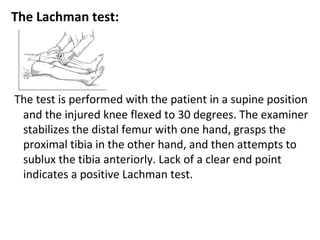
The Lachman test:
The test is performed with the patient in a supine position
and the injured knee flexed to 30 degrees. The examiner
stabilizes the distal femur with one hand, grasps the
proximal tibia in the other hand, and then attempts to
sublux the tibia anteriorly. Lack of a clear end point
indicates a positive Lachman test.
POSTERIOR CRUCIATE LIGAMENT
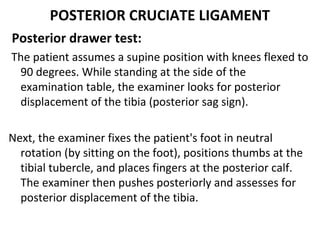
Posterior drawer test:
The patient assumes a supine position with knees flexed to
90 degrees. While standing at the side of the
examination table, the examiner looks for posterior
displacement of the tibia (posterior sag sign).
Next, the examiner fixes the patient's foot in neutral
rotation (by sitting on the foot), positions thumbs at the
tibial tubercle, and places fingers at the posterior calf.
The examiner then pushes posteriorly and assesses for
posterior displacement of the tibia.
COLLATERAL LIGAMENTS
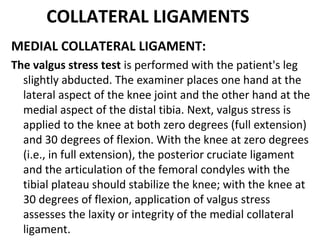
MEDIAL COLLATERAL LIGAMENT:
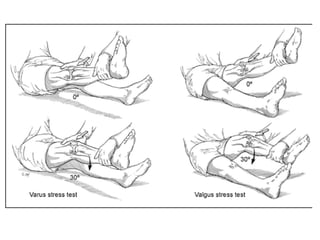
The valgus stress test is performed with the patient's leg
slightly abducted. The examiner places one hand at the
lateral aspect of the knee joint and the other hand at the
medial aspect of the distal tibia. Next, valgus stress is
applied to the knee at both zero degrees (full extension)
and 30 degrees of flexion. With the knee at zero degrees
(i.e., in full extension), the posterior cruciate ligament
and the articulation of the femoral condyles with the
tibial plateau should stabilize the knee; with the knee at
30 degrees of flexion, application of valgus stress
assesses the laxity or integrity of the medial collateral
ligament.
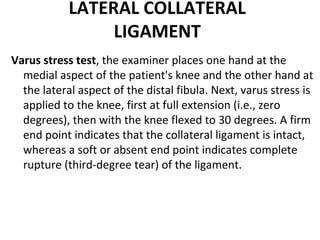
LATERAL COLLATERAL
LIGAMENT
Varus stress test, the examiner places one hand at the
medial aspect of the patient's knee and the other hand at
the lateral aspect of the distal fibula. Next, varus stress is
applied to the knee, first at full extension (i.e., zero
degrees), then with the knee flexed to 30 degrees. A firm
end point indicates that the collateral ligament is intact,
whereas a soft or absent end point indicates complete
rupture (third-degree tear) of the ligament.
MENISCI
Usually demonstrate tenderness at the joint line.
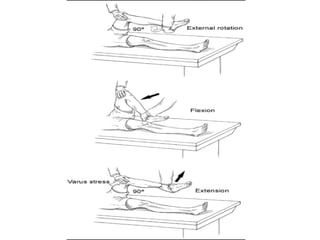
The McMurray test is performed with the patient lying
supine.
The test is performed with the patient supine and the knee
flexed to 90 degrees. To test the medial meniscus, the
examiner grasps the patient's heel with one hand to hold
the tibia in external rotation, with the thumb at the
lateral joint line, the fingers at the medial joint line. The
examiner flexes the patient's knee maximally to impinge
the posterior horn of the meniscus against the medial
femoral condyle.
A positive test produces a thud or a click, or causes pain in a
reproducible portion of the range of motion
Radiographs
Anteroposterior view,
Lateral view, and
Merchant's view (for the patellofemoral joint).
Notch or tunnel view (posteroanterior view with the knee flexed
to 40 to 50 degrees) for teenage patients who report chronic
knee pain and recurrent knee effusion to detect radiolucencies of
the femoral condyles (most commonly the medial femoral
condyle), which indicate the presence of osteochondritis
dissecans.
Inspect for signs of fracture, particularly involving the patella,
tibial plateau, tibial spines, proximal fibula, and femoral condyles.
Standing weight-bearing radiographs should be obtained
if osteoarthritis is suspected,
Arthroscopy
Laboratory Studies
Complete blood count with differential
and an erythrocyte sedimentation rate (ESR),
Arthrocentesis- The joint fluid should be sent to a
laboratory for a cell count with differential, glucose and
protein measurements, bacterial culture and sensitivity.
Rheumatoid Factor
Sr. Uric acid
Take Home Message
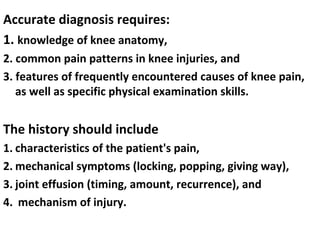
Accurate diagnosis requires:
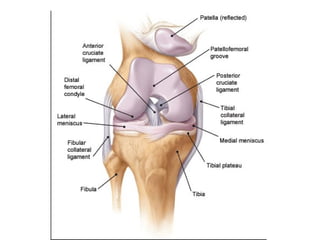
1. knowledge of knee anatomy,
2. common pain patterns in knee injuries, and
3. features of frequently encountered causes of knee pain,
as well as specific physical examination skills.
The history should include
1. characteristics of the patient's pain,
2. mechanical symptoms (locking, popping, giving way),
3. joint effusion (timing, amount, recurrence), and
4. mechanism of injury.
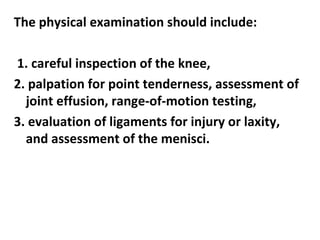
The physical examination should include:
1. careful inspection of the knee,
2. palpation for point tenderness, assessment of
joint effusion, range-of-motion testing,
3. evaluation of ligaments for injury or laxity,
and assessment of the menisci.
Evaluation of Patients Presenting with Knee
Pain:
Differential Diagnosis
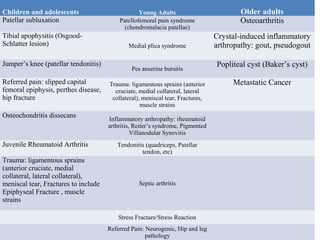
Differential Diagnosis of Knee Pain:
by Age Group
Children and adolescents Young Adults Older adults
Patellar subluxation Patellofemoral pain syndrome
(chondromalacia patellae)
Osteoarthritis
Tibial apophysitis (Osgood-
Schlatter lesion) Medial plica syndrome
Crystal-induced inflammatory
arthropathy: gout, pseudogout
Jumper’s knee (patellar tendonitis)
Pes anserine bursitis
Popliteal cyst (Baker’s cyst)
Referred pain: slipped capital
femoral epiphysis, perthes disease,
hip fracture
Trauma: ligamentous sprains (anterior
cruciate, medial collateral, lateral
collateral), meniscal tear, Fractures,
muscle strains
Metastatic Cancer
Osteochondritis dissecans Inflammatory arthropathy: rheumatoid
arthritis, Reiter’s syndrome, Pigmented
Villanodular Synovitis
Juvenile Rheumatoid Arthritis Tendonitis (quadriceps, Patellar
tendon, etc)
Trauma: ligamentous sprains
(anterior cruciate, medial
collateral, lateral collateral),
meniscal tear, Fractures to include
Epiphyseal Fracture , muscle
strains
Septic arthritis
Stress Fracture/Stress Reaction
Referred Pain: Neurogenic, Hip and leg
pathology
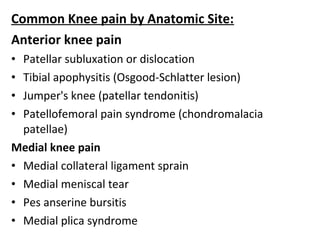
Common Knee pain by Anatomic Site:
Anterior knee pain
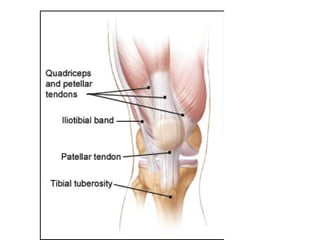
• Patellar subluxation or dislocation
• Tibial apophysitis (Osgood-Schlatter lesion)
• Jumper's knee (patellar tendonitis)
• Patellofemoral pain syndrome (chondromalacia
patellae)
Medial knee pain
• Medial collateral ligament sprain
• Medial meniscal tear
• Pes anserine bursitis
• Medial plica syndrome
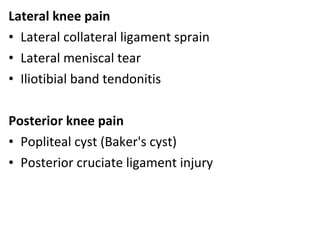
Lateral knee pain
• Lateral collateral ligament sprain
• Lateral meniscal tear
• Iliotibial band tendonitis
Posterior knee pain
• Popliteal cyst (Baker's cyst)
• Posterior cruciate ligament injury
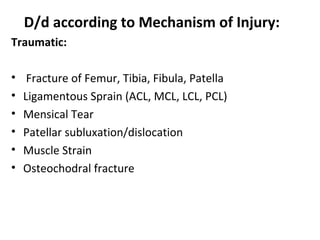
D/d according to Mechanism of Injury:
Traumatic:
• Fracture of Femur, Tibia, Fibula, Patella
• Ligamentous Sprain (ACL, MCL, LCL, PCL)
• Mensical Tear
• Patellar subluxation/dislocation
• Muscle Strain
• Osteochodral fracture
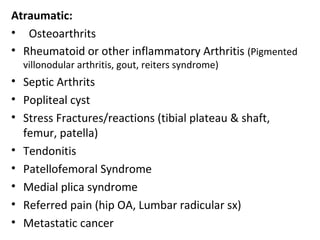
Atraumatic:
• Osteoarthrits
• Rheumatoid or other inflammatory Arthritis (Pigmented
villonodular arthritis, gout, reiters syndrome)
• Septic Arthrits
• Popliteal cyst
• Stress Fractures/reactions (tibial plateau & shaft,
femur, patella)
• Tendonitis
• Patellofemoral Syndrome
• Medial plica syndrome
• Referred pain (hip OA, Lumbar radicular sx)
• Metastatic cancer
Common Knee problem in
Children and Adolescents
PATELLAR SUBLUXATION:
Most likely diagnosis in a teenage girl who presents with
giving-way episodes of the knee.
Increased quadriceps angle (Q angle), usually greater
than 15 degrees.
Patellar apprehension is elicited. *
TIBIAL APOPHYSITIS:
A teenage boy with anterior knee pain localized to the
tibial tuberosity is likely to have tibial apophysitis, or
Osgood-Schlatter lesion.
C/O :
waxing and waning of knee pain for a period of months.
Pain worsens with squatting, walking up or down stairs.
This overuse apophysitis is exacerbated by jumping and
hurdling, because repetitive hard landings place excessive
stress on the insertion of the patellar tendon.
O.E :
The tibial tuberosity is tender and swollen, and
warm.
The knee pain is reproduced with resisted active
extension or passive hyperflexion of the knee.
No effusion is present.
Radiographs are usually negative; rarely, they
show avulsion of the apophysis at the tibial
tuberosity. *
PATELLAR TENDONITIS
Jumper's knee (irritation and inflammation of the patellar
tendon)
Most commonly occurs in teenage boys, particularly during
a growth spurt.
The patient reports vague anterior knee pain that has
persisted for months and worsens after activities such as
walking down stairs or running.
O.E: The patellar tendon is tender,
The pain is reproduced by resisted knee extension.
There is usually no effusion.
SLIPPED CAPITAL FEMORAL EPIPHYSIS
* Poorly localized knee pain and no history of knee
trauma.
Pt is usually overweight
Affected hip slightly flexed and externally rotated.
The knee examination is normal.
Hip pain is elicited with passive internal rotation or
extension of the affected hip.
Radiographs typically show displacement of the
epiphysis of the femoral head
**
OSTEOCHONDRITIS DISSECANS*
In the knee, the medial femoral condyle is most commonly
affected.
C/O : vague, poorly localized knee pain, as well as morning
stiffness or recurrent effusion.
- mechanical symptoms of locking or catching of the knee
joint also may be reported
O.E: Quadriceps atrophy.
Tenderness along the involved chondral surface.
A mild joint effusion may be present.
Plain-film radiographs: osteochondral lesion or a loose body
in the knee joint. **
Magnetic resonance imaging (MRI) is highly sensitive in
detecting these abnormalities
Common Knee
problems in
Adults
ANTERIOR KNEE PAIN
Patello-Femoral pain syndrome (chondromalacia
patellae)
vague history of mild to moderate anterior knee
pain that usually occurs after prolonged periods
of sitting.*
O.E:
Effusion may be present,
Patellar crepitus on ROM.
Pain may be reproduced by applying direct pressure
at the anterior aspect of the patella.
Patellar tenderness. **
MEDIAL KNEE PAIN
Medial Plica Syndrome:
Acute onset of medial knee pain after a marked
Increase of usual activities.
O.E :
Tender, mobile nodularity is present at the medial
aspect of the knee
LATERAL KNEE PAIN
iliotibial band tendonitis:
Commonly occurs in runners and cyclists.
Pain at the lateral aspect of the knee joint.
The pain is aggravated by activity, particularly running
downhill and climbing stairs
Predisposing factors: Tightness of the iliotibial band,
excessive foot pronation, genu varum, and tibial
Torsion
O.E: Tenderness is present at the lateral epicondyle of the
femur, approximately 3 cm proximal to the joint line.
Soft tissue swelling and crepitus
TRAUMA
ANTERIOR CRUCIATE LIGAMENT SPRAIN
Due to noncontact deceleration forces, as when a runner
plants one foot and sharply turns in the opposite direction.
Resultant valgus stress on the knee leads to anterior
displacement of the tibia and sprain or rupture of the
Ligament.
Patient usually reports hearing or feeling a “pop” at the time of the
injury.
Swelling of the knee within two hours after the injury indicates rupture
of the ligament and consequent hemarthrosis
O.E.
Moderate to severe joint effusion that limits range
of motion.
The anterior drawer test may be positive.*
The Lachman test should be positive.
Radiographs: to detect possible tibial spine
avulsion fracture.
MRI of the knee is indicated as part of a
presurgical evaluation.
MEDIAL COLLATERAL LIGAMENT
SPRAIN
 Result of acute trauma.
Pt. c/o
  misstep or collision that places valgus stress on the knee,
 followed by immediate onset of pain and swelling at the 
medial aspect of the knee
O.E :
Point tenderness at the medial joint line.
Valgus stress testing of the knee flexed to 30 degrees 
reproduces the pain.*
LATERAL COLLATERAL LIGAMENT
SPRAIN
 Much less common than injury of the medial collateral 
ligament.
Results from varus stress to the knee, as occurs when 
person plants one foot and then turns toward the 
ipsilateral knee.
Pt. C/o  acute onset of lateral knee pain that requires 
prompt cessation of activity.
O.E. : 
Point tenderness is present at the lateral joint line.
Instability or pain occurs with varus stress testing of the 
knee 
MENISCAL TEAR
Results due to sudden twisting injury of the knee.*
Also may occur in association with a prolonged
degenerative process.
The patient usually reports recurrent knee pain and 
episodes of catching or locking of the knee joint, 
especially with squatting or twisting of the knee.
O.E : A mild effusion is usually present.
         Tenderness at the medial or lateral joint line.
The McMurray test may be positive.
MRI is the radiologic test of choice.
INFECTION
Patients of any age. *
Abrupt onset of pain and swelling of the knee with no
antecedent trauma.
O.E : Knee is warm, swollen, and exquisitely tender. 
Even slight motion of the knee joint causes intense pain.
Arthrocentesis reveals turbid synovial fluid: 
WBC > 50,000  per mm3
 , PMNC > 75 %
 Elevated protein content (greater than 3 g per dL)
low glucose concentration.
Gram  may demonstrate the causative organism. 
Common are : 
Staphylococcus aureus, Streptococcus species, Haemophilus
influenzae, and Neisseria gonorrhoeae.
Hematologic studies:  elevated WBC,  elevated PMNC,
 elevated ESR, CRP
Common Knee problems
in Older Adults
OSTEOARTHRITIS
Common problem after 60 years of age. 
Knee pain that is aggravated by weight-bearing 
activities and relieved by rest.
No systemic symptoms but usually awakens with 
morning stiffness.
May report episodes of acute synovitis.
O.E : Decreased range of motion, crepitus, a mild joint 
effusion, and palpable osteophytic changes at the knee 
joint.
Radiograph:  joint-space narrowing, subchondral bony 
sclerosis, cystic changes, and hypertrophic osteophyte 
formation.
CRYSTAL-INDUCED INFLAMMATORY
ARTHROPATHY
Acute inflammation, pain, and swelling in the absence of 
trauma.
In gout sodium urate crystals precipitate in the knee joint and 
cause an intense inflammatory response. 
In pseudogout, calcium pyrophosphate crystals are the 
causative agents.
O.E: The knee joint is erythematous, warm, tender, and 
swollen. Even minimal range of motion is exquisitely 
painful.
Arthrocentesis: clear or slightly cloudy synovial fluid.
Analysis of the fluid yields 
a WBC count of 2,000 to 75,000 per mm3
 
a high protein content (greater than 32 g per dL,)
and a glucose concentration that is approximately 75 percent of the 
serum glucose concentration.
Polarized-light microscopy of the synovial fluid displays:
negatively birefringent rods in the patient with gout 
and positively birefringent rhomboids in the patient with pseudogout.
POPLITEAL CYST
The popliteal cyst (Baker's cyst) is the most common synovial
cyst of the knee.
It originates from the posteromedial aspect of the knee joint 
at the level of the gastrocnemio-semimembranous bursa.
Pt. c/o insidious onset of mild to moderate pain in the 
popliteal area of the knee.
O.E
 palpable fullness at the medial aspect of the popliteal area, 
or near the origin of the medial head of the gastrocnemius
muscle.
 Definitive diagnosis of a popliteal cyst may be made with 
arthrography, ultrasonography, CT scanning.
Take home Messages
Teenage girls and young women are more likely to
have patellar tracking problems such as patellar
subluxation and patellofemoral pain syndrome.
Teenage boys and young men are more likely to
have knee extensor mechanism problems such as
tibial apophysitis (Osgood-Schlatter lesion) and
patellar tendonitis.
Referred pain resulting from hip joint pathology,
such as slipped capital femoral epiphysis, also
may cause knee pain.
Active patients are more likely to have acute
ligamentous sprains.
Trauma may result in acute ligamentous rupture or
fracture, leading to acute knee joint swelling and
hemarthrosis.
Septic arthritis may develop in patients of any age,
but crystal-induced inflammatory arthropathy is
more likely in adults.
Osteoarthritis of the knee joint is common in older
adults.
Accurate diagnosis requires:
1. knowledge of knee anatomy,
2. common pain patterns in knee injuries, and
3. features of frequently encountered causes of knee pain,
as well as specific physical examination skills.
The history should include
1. characteristics of the patient's pain,
2. mechanical symptoms (locking, popping, giving way),
3. joint effusion (timing, amount, recurrence), and
4. mechanism of injury.
The physical examination should include:
1. careful inspection of the knee,
2. palpation for point tenderness, assessment of
joint effusion, range-of-motion testing,
3. evaluation of ligaments for injury or laxity,
and assessment of the menisci.
Approach to knee pain

Approach to knee pain

Editor's Notes

  • #37 * Patellar apprehension is elicited by subluxing the patella laterally, and a mild effusion is usually present. Moderate to severe knee swelling may indicate hemarthrosis, which suggests patellar dislocation with osteochondral fracture and bleeding.
  • #39 * However, the physician must not mistake the normal appearance of the tibial apophysis for an avulsion fracture.
  • #41 Radiographs are not indicated.
  • #42 * A number of pathologic conditions result in referral of pain to the knee. For example, the possibility of slipped capital femoral epiphysis must be considered in children and teenagers who present with knee pain ** negative radiographs do not rule out the diagnosis in patients with typical clinical findings. Computed tomographic (CT) scanning is indicated in these patients.
  • #43 *OSTEOCHONDRITIS DISSECANS: An intra-articular osteochondrosis of unknown etiology characterized by degeneration and re-calcification of articular cartilage and underlying bone. ** If osteochondritis dissecans is suspected, recommended radiographs include anteroposterior, posteroanterior tunnel, lateral, and Merchant's views. Osteochondral lesions at the lateral aspect of the medial femoral condyle may be visible only on the posteroanterior tunnel view.
  • #45 * (the so-called “theater sign”) ** Patellar tenderness may be elicited by subluxing the patella medially or laterally and palpating the superior and inferior facets of the patella
  • #46 The plica, a redundancy of the joint synovium medially, can become inflamed with repetitive overuse. Pes anserine bursitis is another possible cause of medial knee pain. The tendinous insertion of the sartorius, gracilis, and semi-tendinosus muscles at the anteromedial aspect of the proximal tibia forms the pes anserine bursa
  • #47 Noble's test is used to reproduce the pain in iliotibial band tendonitis. With the patient in a supine position, the physician places a thumb over the lateral femoral epicondyle as the patient repeatedly flexes and extends the knee.
  • #49 *The anterior drawer test may be positive, but can be negative because of hemarthrosis and guarding by the hamstring muscles.
  • #50 * A clearly defined end point on valgus stress testing indicates a grade 1 or grade 2 sprain, whereas complete medial instability indicates full rupture of the ligament (grade 3 sprain).
  • #52 * such as may occur when a runner suddenly changes direction
  • #53 more common in those whose immune system has been weakened by cancer, diabetes mellitus, alcoholism, acquired immunodeficiency syndrome, or corticosteroid therapy
  • #56 When osteoarthritis is suspected, recommended radiographs include weight-bearing anteroposterior and posteroanterior tunnel views, as well as non–weight-bearing Merchant's and lateral views.