Failed spinal anesthesia
Dr. S. Parthasarathy
MD., DA., DNB, MD (Acu), Dip. Diab. DCA,
Dip. Software statistics-
PhD ( physiology),
( IDRA )
Golden words of 1922
• Two conditions are absolutely necessary to produce
spinal anesthesia:
• puncture of the dura mater and subarachnoid
injection of an anesthetic agent.
• Gaston Labat
• 1922
Define it ?
• Spinal Anesthesia is considered to have failed
if anesthesia and analgesia have not effected
within 10 minutes of successful intrathecal
deposition of heavy bupivacaine and 25
minutes for plain bupivacaine
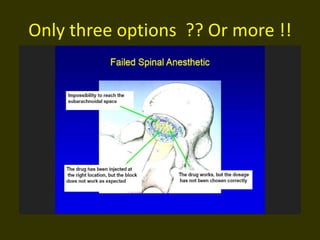
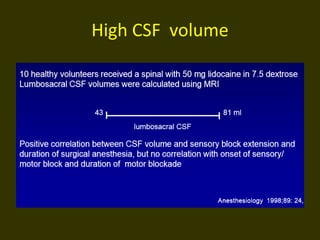
Only three options ?? Or more !!
Clinical definitions !!
• 1. Not acted at all
• 2. Acted but deficient in
• a) quantity,
• b) Quality or
• c) duration ??
• Incidence -- < 1 % some studies 17 %
• But acceptable is 3 -4 % in many reviews
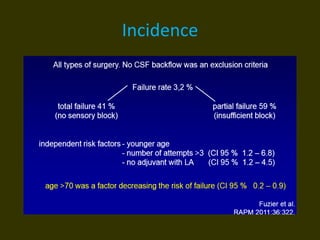
Incidence
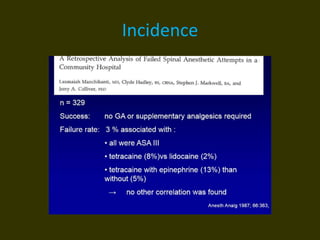
Incidence
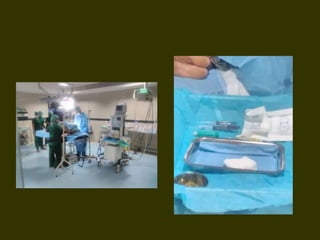
Cant go near !!
• Failed lumbar puncture
• Dry tap ??
• Needle without the stylet – blood tissue clogs
• But not common
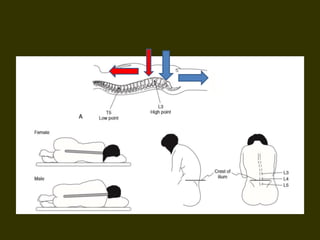
Faulty position
• Tip of table
• Flexion
• Shoulder straight ?
• Kyphosis , scoliosis ? Fracture hip
• Previous lamina surgery
• The sitting is usually an easier option in ‘difficult’
patients, but sometimes the reverse is true.
• The role of the assistant !!
Position and adjuncts
• A calm, relaxed patient is more likely to assume and
maintain the correct position,
• so explanation (before and during the procedure)
• Gentle slow handling
• light anxiolytic premedication
• local anaesthetic infiltration without obscuring the
landmarks, but must include both intradermal and
s.c. injection.
Needle insertion
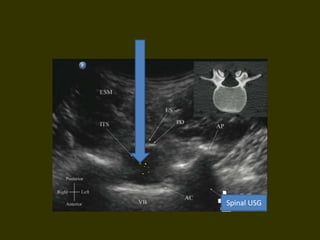
• Which space ?
• Midline , hitting bone
• Cephalad
• Rarely inferior and lateral
• Get the mental picture
• Midline calcification think paramedian
Spinal USG
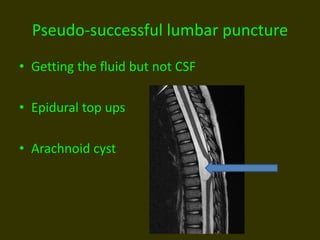
Pseudo-successful lumbar puncture
• Getting the fluid but not CSF
• Epidural top ups
• Arachnoid cyst
Solution injection errors
• Aspiration
• Correct dose
• Correct drug
Get the feel !!
Or
CSF alone is
dripping
Dose selection
• Correct dose –
• specific local anaesthetic used
• the baricity of that solution
• the patient’s subsequent posture,
• the type of block intended,
• anticipated duration of surgery
• Mass matters
Loss of injectate
• In the needle remains
• Luer lock
• Movement
• Labour pain ?
• Back of the other hand
• Aspirate but don’t displace
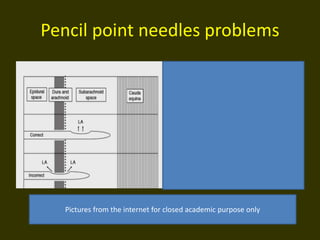
Pencil point needles problems
Pictures from the internet for closed academic purpose only
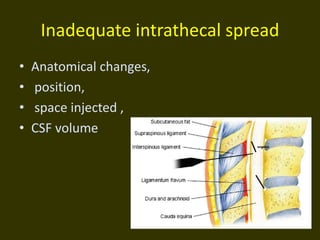
Inadequate intrathecal spread
• Anatomical changes,
• position,
• space injected ,
• CSF volume
Identification errors
• Which drug is local
• Which is test dose
• Which is spinal drug
• Confusion ?
Chemical incompatibility
• Clonidine + opioid + LA
• LA + 2 opioids
• LA with ketamine and midazolam
• LA with adrenaline
Not well defined
• The older, ester-type local anesthetics are
chemically labile
• heat sterilization and prolonged storage ?? ,
make them ineffective because of hydrolysis??
• Newer Amides are stable
“Resistance”
• Very rarely a failed spinal anaesthetic has
been attributed to physiological ‘resistance’ to
the actions of local anaesthetic drugs,
• Sodium channel mutation
• Scorpion stings !!
• Anecdotal
This batch is not good !!
• The neuroscience division of AstraZeneca received
562 ‘Product Defect Notification’ reports in the 6
year to December 31, 2007, all ascribing failed spinal
anaesthetics to ineffective bupivacaine solution
• But chemical analyses proved everything Ok in
all cases
Failure of subsequent management
• Level – covert pinch – glance of the eyes
between surgeons and anaes – yes OK – start
• Abdomen cleaning , mopping – sedatives
• Can we stay in an abnormal position for hours
? – table and position are for surgeons
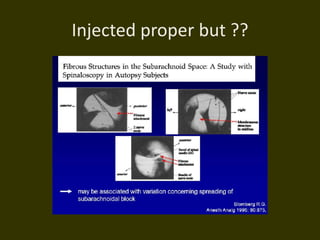
Injected proper but ??
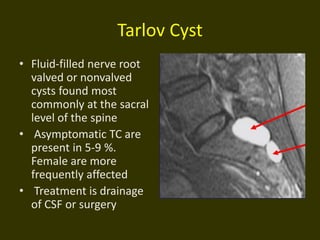
Tarlov Cyst
• Fluid-filled nerve root
valved or nonvalved
cysts found most
commonly at the sacral
level of the spine
• Asymptomatic TC are
present in 5-9 %.
Female are more
frequently affected
• Treatment is drainage
of CSF or surgery
High CSF volume
Volume ??
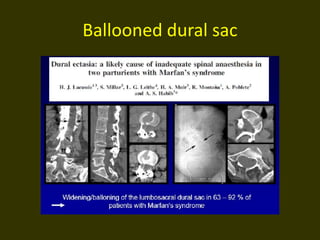
Ballooned dural sac
Can happen !!
• Some pain fibres pass via sympathetic nerve
and then via sympathetic chain to reach the
spinal cord at higher level than the site of
injection and may be the cause of failure.
• Lateral approach -- dural investment of nerve
root resulting in false feeling of placement of
needle tip in the subarachnoid space
Rapid sequence spinal anesthesia –
more likely to fail
• IV access , monitors with staff 1
• Chlorhexidine preparation with staff 2
• No local
• Non touch spinal
• No additives
• A larger dose
• Start as the block starts
• Be Ready for GA
• 5-7 minutes
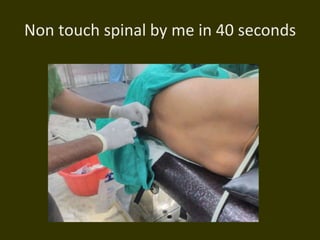
Non touch spinal by me in 40 seconds
Management of failure
Prevention is better than cure
Clinical and medicolegal!!
• How and when it is found out
• Tincture of time 15 minutes
• Then alternative arrangement
No block:
• the wrong solution,
• the wrong place,
• or it is ineffective.
• Repeating the procedure or conversion to
general anesthesia
• the patient has significant pruritus, - only
opioid injected
Good block but less height
• Flex knees and hips and trendelenberg
• Obstetrics – left and right lateral and head
down
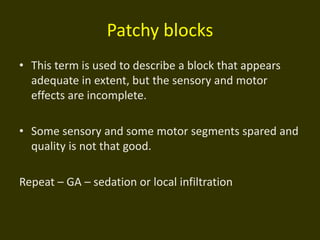
Patchy blocks
• This term is used to describe a block that appears
adequate in extent, but the sensory and motor
effects are incomplete.
• Some sensory and some motor segments spared and
quality is not that good.
Repeat – GA – sedation or local infiltration
When we repeat
• Excessive repeat dose – need to reduce !
• Higher level of injection
• Is it not neurotoxic
• Anesthetised nerves prone for nerve injuries
• Recourse to an epidural in technical
difficulties
• Rescue measures and GA – beware of already
existing sympathetic block and hypotension
• Document and explain to patients but avoid
medico legal problems
• Look for local hospital problems
Three muskateers
• Right place
• Right drug
• Right dose
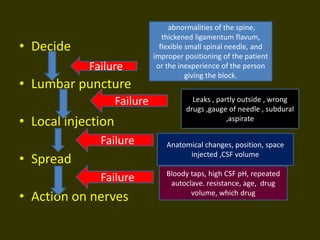
• Decide
• Lumbar puncture
• Local injection
• Spread
• Action on nerves
Failure
Failure
Failure
Failure
abnormalities of the spine,
thickened ligamentum flavum,
flexible small spinal needle, and
improper positioning of the patient
or the inexperience of the person
giving the block.
Leaks , partly outside , wrong
drugs ,gauge of needle , subdural
,aspirate
Anatomical changes, position, space
injected ,CSF volume
Bloody taps, high CSF pH, repeated
autoclave. resistance, age, drug
volume, which drug
• Alfred E. Barker wrote that for successful spinal
analgesia
• it is necessary ‘to enter the lumbar dural sac
effectually with the point of the needle, and to
discharge through this, all the contemplated dose of
the drug, directly and freely into the cerebrospinal
fluid, below the termination of the cord’
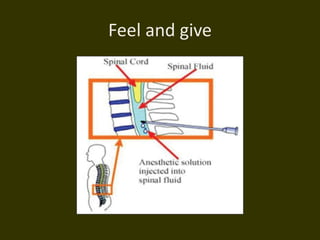
Feel and give
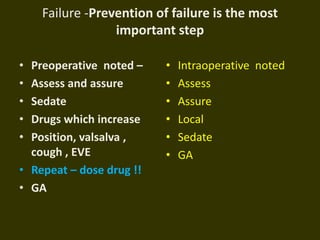
Failure -Prevention of failure is the most
important step
• Preoperative noted –
• Assess and assure
• Sedate
• Drugs which increase
• Position, valsalva ,
cough , EVE
• Repeat – dose drug !!
• GA
• Intraoperative noted
• Assess
• Assure
• Local
• Sedate
• GA
•Thank you
all

Failed spinal-anesthesia-mgmc

  • 1.
    Failed spinal anesthesia Dr.S. Parthasarathy MD., DA., DNB, MD (Acu), Dip. Diab. DCA, Dip. Software statistics- PhD ( physiology), ( IDRA )
  • 2.
    Golden words of1922 • Two conditions are absolutely necessary to produce spinal anesthesia: • puncture of the dura mater and subarachnoid injection of an anesthetic agent. • Gaston Labat • 1922
  • 3.
    Define it ? •Spinal Anesthesia is considered to have failed if anesthesia and analgesia have not effected within 10 minutes of successful intrathecal deposition of heavy bupivacaine and 25 minutes for plain bupivacaine
  • 4.
    Only three options?? Or more !!
  • 5.
    Clinical definitions !! •1. Not acted at all • 2. Acted but deficient in • a) quantity, • b) Quality or • c) duration ?? • Incidence -- < 1 % some studies 17 % • But acceptable is 3 -4 % in many reviews
  • 6.
  • 7.
  • 8.
    Cant go near!! • Failed lumbar puncture • Dry tap ?? • Needle without the stylet – blood tissue clogs • But not common
  • 9.
    Faulty position • Tipof table • Flexion • Shoulder straight ? • Kyphosis , scoliosis ? Fracture hip • Previous lamina surgery • The sitting is usually an easier option in ‘difficult’ patients, but sometimes the reverse is true. • The role of the assistant !!
  • 11.
    Position and adjuncts •A calm, relaxed patient is more likely to assume and maintain the correct position, • so explanation (before and during the procedure) • Gentle slow handling • light anxiolytic premedication • local anaesthetic infiltration without obscuring the landmarks, but must include both intradermal and s.c. injection.
  • 12.
    Needle insertion • Whichspace ? • Midline , hitting bone • Cephalad • Rarely inferior and lateral • Get the mental picture • Midline calcification think paramedian
  • 13.
  • 14.
    Pseudo-successful lumbar puncture •Getting the fluid but not CSF • Epidural top ups • Arachnoid cyst
  • 15.
    Solution injection errors •Aspiration • Correct dose • Correct drug Get the feel !! Or CSF alone is dripping
  • 16.
    Dose selection • Correctdose – • specific local anaesthetic used • the baricity of that solution • the patient’s subsequent posture, • the type of block intended, • anticipated duration of surgery • Mass matters
  • 17.
    Loss of injectate •In the needle remains • Luer lock • Movement • Labour pain ? • Back of the other hand • Aspirate but don’t displace
  • 18.
    Pencil point needlesproblems Pictures from the internet for closed academic purpose only
  • 19.
    Inadequate intrathecal spread •Anatomical changes, • position, • space injected , • CSF volume
  • 20.
    Identification errors • Whichdrug is local • Which is test dose • Which is spinal drug • Confusion ?
  • 22.
    Chemical incompatibility • Clonidine+ opioid + LA • LA + 2 opioids • LA with ketamine and midazolam • LA with adrenaline Not well defined
  • 23.
    • The older,ester-type local anesthetics are chemically labile • heat sterilization and prolonged storage ?? , make them ineffective because of hydrolysis?? • Newer Amides are stable
  • 24.
    “Resistance” • Very rarelya failed spinal anaesthetic has been attributed to physiological ‘resistance’ to the actions of local anaesthetic drugs, • Sodium channel mutation • Scorpion stings !! • Anecdotal
  • 25.
    This batch isnot good !! • The neuroscience division of AstraZeneca received 562 ‘Product Defect Notification’ reports in the 6 year to December 31, 2007, all ascribing failed spinal anaesthetics to ineffective bupivacaine solution • But chemical analyses proved everything Ok in all cases
  • 26.
    Failure of subsequentmanagement • Level – covert pinch – glance of the eyes between surgeons and anaes – yes OK – start • Abdomen cleaning , mopping – sedatives • Can we stay in an abnormal position for hours ? – table and position are for surgeons
  • 27.
  • 28.
    Tarlov Cyst • Fluid-fillednerve root valved or nonvalved cysts found most commonly at the sacral level of the spine • Asymptomatic TC are present in 5-9 %. Female are more frequently affected • Treatment is drainage of CSF or surgery
  • 29.
  • 30.
  • 31.
  • 32.
    Can happen !! •Some pain fibres pass via sympathetic nerve and then via sympathetic chain to reach the spinal cord at higher level than the site of injection and may be the cause of failure. • Lateral approach -- dural investment of nerve root resulting in false feeling of placement of needle tip in the subarachnoid space
  • 33.
    Rapid sequence spinalanesthesia – more likely to fail • IV access , monitors with staff 1 • Chlorhexidine preparation with staff 2 • No local • Non touch spinal • No additives • A larger dose • Start as the block starts • Be Ready for GA • 5-7 minutes
  • 34.
    Non touch spinalby me in 40 seconds
  • 35.
  • 36.
    Clinical and medicolegal!! •How and when it is found out • Tincture of time 15 minutes • Then alternative arrangement
  • 37.
    No block: • thewrong solution, • the wrong place, • or it is ineffective. • Repeating the procedure or conversion to general anesthesia • the patient has significant pruritus, - only opioid injected
  • 38.
    Good block butless height • Flex knees and hips and trendelenberg • Obstetrics – left and right lateral and head down
  • 39.
    Patchy blocks • Thisterm is used to describe a block that appears adequate in extent, but the sensory and motor effects are incomplete. • Some sensory and some motor segments spared and quality is not that good. Repeat – GA – sedation or local infiltration
  • 40.
    When we repeat •Excessive repeat dose – need to reduce ! • Higher level of injection • Is it not neurotoxic • Anesthetised nerves prone for nerve injuries • Recourse to an epidural in technical difficulties
  • 41.
    • Rescue measuresand GA – beware of already existing sympathetic block and hypotension • Document and explain to patients but avoid medico legal problems • Look for local hospital problems
  • 42.
    Three muskateers • Rightplace • Right drug • Right dose
  • 43.
    • Decide • Lumbarpuncture • Local injection • Spread • Action on nerves Failure Failure Failure Failure abnormalities of the spine, thickened ligamentum flavum, flexible small spinal needle, and improper positioning of the patient or the inexperience of the person giving the block. Leaks , partly outside , wrong drugs ,gauge of needle , subdural ,aspirate Anatomical changes, position, space injected ,CSF volume Bloody taps, high CSF pH, repeated autoclave. resistance, age, drug volume, which drug
  • 44.
    • Alfred E.Barker wrote that for successful spinal analgesia • it is necessary ‘to enter the lumbar dural sac effectually with the point of the needle, and to discharge through this, all the contemplated dose of the drug, directly and freely into the cerebrospinal fluid, below the termination of the cord’
  • 45.
  • 46.
    Failure -Prevention offailure is the most important step • Preoperative noted – • Assess and assure • Sedate • Drugs which increase • Position, valsalva , cough , EVE • Repeat – dose drug !! • GA • Intraoperative noted • Assess • Assure • Local • Sedate • GA
  • 47.