Benzodiazepines
Dr. S. Parthasarathy
MD., DA., DNB, MD (Acu), Dip. Diab.
DCA, Dip. Software statistics-
PhD ( physiology), IDRA
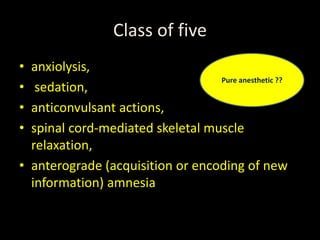
Class of five
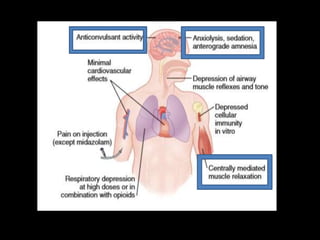
• anxiolysis,
• sedation,
• anticonvulsant actions,
• spinal cord-mediated skeletal muscle
relaxation,
• anterograde (acquisition or encoding of new
information) amnesia
Pure anesthetic ??
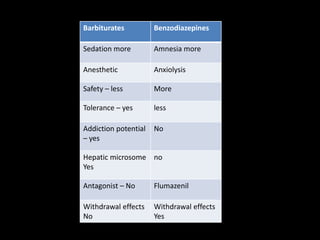
When we compare
The answer is
Barbiturates Benzodiazepines
Sedation more Amnesia more
Anesthetic Anxiolysis
Safety – less More
Tolerance – yes less
Addiction potential
– yes
No
Hepatic microsome
Yes
no
Antagonist – No Flumazenil
Withdrawal effects
No
Withdrawal effects
Yes
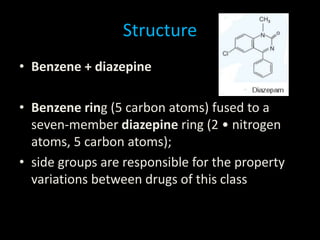
Structure
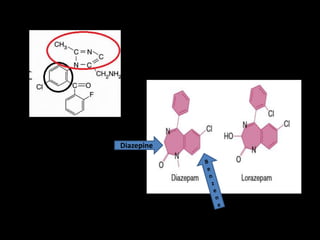
• Benzene + diazepine
• Benzene ring (5 carbon atoms) fused to a
seven-member diazepine ring (2 • nitrogen
atoms, 5 carbon atoms);
• side groups are responsible for the property
variations between drugs of this class
Diazepine
• Benzodiazepines enhance fast inhibitory
neurotransmission via modulating the activity
of GABA A receptors in postsynaptic
membranes
• Increased chloride ( hyperpolarization )
• Increased sodium is depolarization
• Inhibition of neurons – same as thio but why
diazepam is safe ??
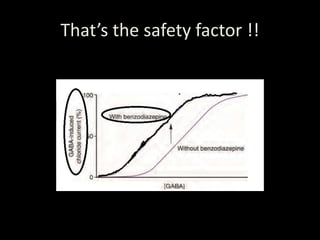
• The benzodiazepines do not activate the GABA
A receptors by themselves; rather,
benzodiazepines modulate the response to
GABA by enhancing the affinity of the receptor
for GABA
• It needs the neurotransmitter GABA –
• They are GABA facilitators than THIO ( GABA
mimetics)
• Hence the safety
That’s the safety factor !!
Other mechanisms
• benzodiazepines may be working by non-
GABA mechanisms such as inhibition of
adenosine reuptake
• inhibition of neuronal Ca2+ currents.
• (Anti convulsant predominant)
• agonist activity at the glycine receptor, an
important inhibitory neurotransmitter in the
spinal cord
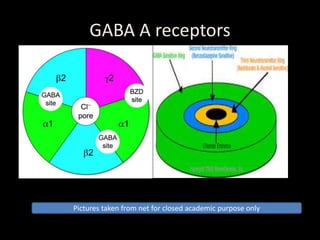
GABA A receptors
Pictures taken from net for closed academic purpose only
Supplied as
• Diazepam and lorazepam are “classic” benzodiazepines
that are lipid soluble and difficult to solubilize for
injection.
• Diazepam injection is supplied as a 0.5% solution in 40%
propylene glycol and 10% ethanol.
• Lorazepam is supplied as a 0.4% solution in 80%
propylene glycol, 18% polyethylene glycol, and 2% benzyl
alcohol.
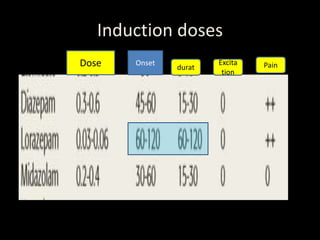
Induction doses
Dose Onset
durat
Excita
tion
Pain
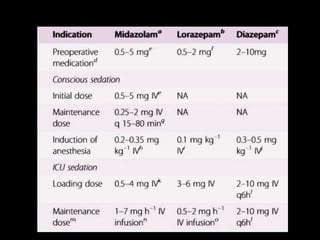
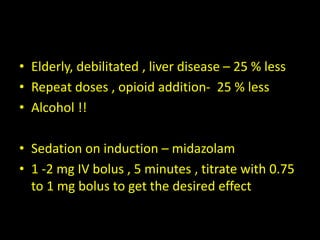
• Elderly, debilitated , liver disease – 25 % less
• Repeat doses , opioid addition- 25 % less
• Alcohol !!
• Sedation on induction – midazolam
• 1 -2 mg IV bolus , 5 minutes , titrate with 0.75
to 1 mg bolus to get the desired effect
Routes
• Oral , IM and IV routes are available
• The intravenous solution can be mixed with
fruit juice or flavored syrup--
• But IM diazepam ??
• IM midaz and ketamine are the two induction
agents
• Nasal, sublingual, intrathecal – Yes for
midazolam
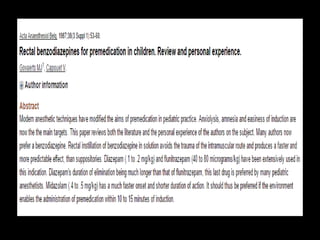
Rectal
• 0.4 mg / kg midazolam
• 0.75 mg/ kg of diazepam
• Rarely sublingual and skin patches have been
used
• Febrile fits in chubby child !!
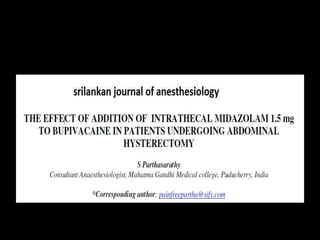
Intrathecal Benzodiazepines -
Midazolam
• GABA 2 receptors in dorsal horn
• Also delta receptors
• 1 -2 mg – motor block , early post op analgesia
• ? Prolongation of anaesthesia
• 12 mg / day – chronic pain
• Can be combined with opioids and clonidine
• Early - neuro toxicity - ? Possibly addition of 10 % HCl in
preparation – now proved as nil
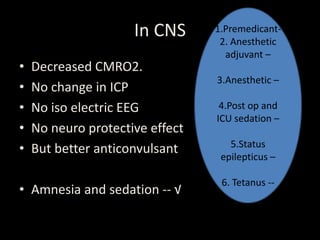
In CNS
• Decreased CMRO2.
• No change in ICP
• No iso electric EEG
• No neuro protective effect
• But better anticonvulsant
• Amnesia and sedation -- √
1.Premedicant-
2. Anesthetic
adjuvant –
3.Anesthetic –
4.Post op and
ICU sedation –
5.Status
epilepticus –
6. Tetanus --
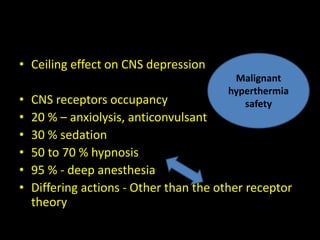
• Ceiling effect on CNS depression
• CNS receptors occupancy
• 20 % – anxiolysis, anticonvulsant
• 30 % sedation
• 50 to 70 % hypnosis
• 95 % - deep anesthesia
• Differing actions - Other than the other receptor
theory
Malignant
hyperthermia
safety
Debatable
• benzodiazepines can reduce anxiety at doses
that are not highly sedating.
• Of note, the same effects may not occur in
surgical patients.
• Many patients scheduled for surgery do not
have high levels of self-rated anxiety,
• effect of midazolam is more likely to produce
dizziness or sleepiness
Clinical tips
• Tolerance – yes
• Anticonvulsant in status but tolerance – chronic
seizure prophylaxis ???
• Emergence delirium; prophylaxis and treatment
• Withdrawal of abuse drugs
• Cardiac cath, reduce hallucinations after
ketamine
• Midazolam (0.5 to 1 mg IV) may be an effective
treatment for the paradoxical vocal cord motion
that may manifest postoperatively.
Other effects
• Benzodiazepines produce a mild reduction in
muscle tone, which may be advantageous
• Dislocations
• Mechanical ventilation
• Endoscopies
• Internuncial neurons in spinal cord
• No effect in NMJ
Effect on
limbic system
more than
cortex
MAOi – OK
Other effects
• No effect on blood pressure
• No effect on myocardial contractility
• dose-dependent decrease in hypoxic
ventilatory drive, also CO2 drive
• Sub hypnotic doses given alone rarely cause
apnea.
• Make unconscious – then apnea is comparable
with thiopentone
• No nausea
Metabolism
• Midaz – hydroxy midaz – can accumulate in infusion ,
but high clearance for shorter duration of action of
midazolam
• Diazepam is principally metabolized by hepatic
microsomal enzymes using an oxidative pathway of
N-demethylation.
• The two principal metabolites of diazepam are des
methyl diazepam and oxazepam, with a lesser
amount metabolized to temazepam.
• That’s why - the drowsiness
• It is absorbed on the plastic and cannot be removed
by dialysis.
All three drugs are
extensively protein bound–
but midaz
All are lipid soluble to act in
the brain
Lorazepam
• Higher affinity for receptors
• But less lipid soluble than others
• Cross slowly – slow onset
• Glucuronic acid and excreted
• Ideal drug for patients with liver disease and
alcohol withdrawal symptoms
Side effects
• Fatigue
• Drowsiness
• Decreased motor coordination
• Impairment of cognitive function
• Anterograde amnesia (accentuated by concomitant
ingestion of alcohol)
• Paradoxical agitations ( beware of periop agitation-
hypoxia, inadequate reversal, full bladder etc,, )
• Suicidality
• Worsen depression
Drug interactions
• Synergistic effects with other CNS depressants
• Decreased anesthetic requirements
• Potentiation of ventilatory depressant effects of
opioids
• Reduced analgesic effects of opioids
• Suppression of the hypothalamic-pituitary adrenal
axis
• Dependence
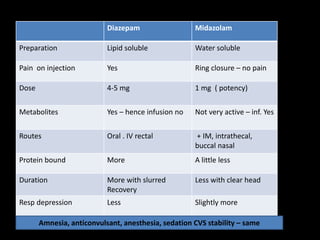
Diazepam Midazolam
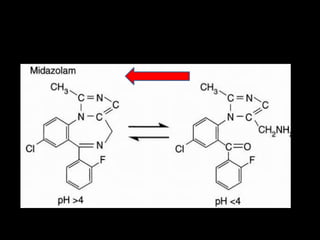
Preparation Lipid soluble Water soluble
Pain on injection Yes Ring closure – no pain
Dose 4-5 mg 1 mg ( potency)
Metabolites Yes – hence infusion no Not very active – inf. Yes
Routes Oral . IV rectal + IM, intrathecal,
buccal nasal
Protein bound More A little less
Duration More with slurred
Recovery
Less with clear head
Resp depression Less Slightly more
Amnesia, anticonvulsant, anesthesia, sedation CVS stability – same
Summary
• Structure
• Drugs
• Preparation
• Effects and uses
• Advantages
• Side effects

Benzodiazepines1

  • 1.
    Benzodiazepines Dr. S. Parthasarathy MD.,DA., DNB, MD (Acu), Dip. Diab. DCA, Dip. Software statistics- PhD ( physiology), IDRA
  • 2.
    Class of five •anxiolysis, • sedation, • anticonvulsant actions, • spinal cord-mediated skeletal muscle relaxation, • anterograde (acquisition or encoding of new information) amnesia Pure anesthetic ??
  • 3.
  • 4.
    Barbiturates Benzodiazepines Sedation moreAmnesia more Anesthetic Anxiolysis Safety – less More Tolerance – yes less Addiction potential – yes No Hepatic microsome Yes no Antagonist – No Flumazenil Withdrawal effects No Withdrawal effects Yes
  • 5.
    Structure • Benzene +diazepine • Benzene ring (5 carbon atoms) fused to a seven-member diazepine ring (2 • nitrogen atoms, 5 carbon atoms); • side groups are responsible for the property variations between drugs of this class
  • 6.
  • 8.
    • Benzodiazepines enhancefast inhibitory neurotransmission via modulating the activity of GABA A receptors in postsynaptic membranes • Increased chloride ( hyperpolarization ) • Increased sodium is depolarization • Inhibition of neurons – same as thio but why diazepam is safe ??
  • 9.
    • The benzodiazepinesdo not activate the GABA A receptors by themselves; rather, benzodiazepines modulate the response to GABA by enhancing the affinity of the receptor for GABA • It needs the neurotransmitter GABA – • They are GABA facilitators than THIO ( GABA mimetics) • Hence the safety
  • 10.
  • 11.
    Other mechanisms • benzodiazepinesmay be working by non- GABA mechanisms such as inhibition of adenosine reuptake • inhibition of neuronal Ca2+ currents. • (Anti convulsant predominant) • agonist activity at the glycine receptor, an important inhibitory neurotransmitter in the spinal cord
  • 12.
    GABA A receptors Picturestaken from net for closed academic purpose only
  • 13.
    Supplied as • Diazepamand lorazepam are “classic” benzodiazepines that are lipid soluble and difficult to solubilize for injection. • Diazepam injection is supplied as a 0.5% solution in 40% propylene glycol and 10% ethanol. • Lorazepam is supplied as a 0.4% solution in 80% propylene glycol, 18% polyethylene glycol, and 2% benzyl alcohol.
  • 14.
  • 16.
    • Elderly, debilitated, liver disease – 25 % less • Repeat doses , opioid addition- 25 % less • Alcohol !! • Sedation on induction – midazolam • 1 -2 mg IV bolus , 5 minutes , titrate with 0.75 to 1 mg bolus to get the desired effect
  • 17.
    Routes • Oral ,IM and IV routes are available • The intravenous solution can be mixed with fruit juice or flavored syrup-- • But IM diazepam ?? • IM midaz and ketamine are the two induction agents • Nasal, sublingual, intrathecal – Yes for midazolam
  • 19.
    Rectal • 0.4 mg/ kg midazolam • 0.75 mg/ kg of diazepam • Rarely sublingual and skin patches have been used • Febrile fits in chubby child !!
  • 21.
    Intrathecal Benzodiazepines - Midazolam •GABA 2 receptors in dorsal horn • Also delta receptors • 1 -2 mg – motor block , early post op analgesia • ? Prolongation of anaesthesia • 12 mg / day – chronic pain • Can be combined with opioids and clonidine • Early - neuro toxicity - ? Possibly addition of 10 % HCl in preparation – now proved as nil
  • 23.
    In CNS • DecreasedCMRO2. • No change in ICP • No iso electric EEG • No neuro protective effect • But better anticonvulsant • Amnesia and sedation -- √ 1.Premedicant- 2. Anesthetic adjuvant – 3.Anesthetic – 4.Post op and ICU sedation – 5.Status epilepticus – 6. Tetanus --
  • 24.
    • Ceiling effecton CNS depression • CNS receptors occupancy • 20 % – anxiolysis, anticonvulsant • 30 % sedation • 50 to 70 % hypnosis • 95 % - deep anesthesia • Differing actions - Other than the other receptor theory Malignant hyperthermia safety
  • 25.
    Debatable • benzodiazepines canreduce anxiety at doses that are not highly sedating. • Of note, the same effects may not occur in surgical patients. • Many patients scheduled for surgery do not have high levels of self-rated anxiety, • effect of midazolam is more likely to produce dizziness or sleepiness
  • 26.
    Clinical tips • Tolerance– yes • Anticonvulsant in status but tolerance – chronic seizure prophylaxis ??? • Emergence delirium; prophylaxis and treatment • Withdrawal of abuse drugs • Cardiac cath, reduce hallucinations after ketamine • Midazolam (0.5 to 1 mg IV) may be an effective treatment for the paradoxical vocal cord motion that may manifest postoperatively.
  • 27.
    Other effects • Benzodiazepinesproduce a mild reduction in muscle tone, which may be advantageous • Dislocations • Mechanical ventilation • Endoscopies • Internuncial neurons in spinal cord • No effect in NMJ Effect on limbic system more than cortex MAOi – OK
  • 28.
    Other effects • Noeffect on blood pressure • No effect on myocardial contractility • dose-dependent decrease in hypoxic ventilatory drive, also CO2 drive • Sub hypnotic doses given alone rarely cause apnea. • Make unconscious – then apnea is comparable with thiopentone • No nausea
  • 29.
    Metabolism • Midaz –hydroxy midaz – can accumulate in infusion , but high clearance for shorter duration of action of midazolam • Diazepam is principally metabolized by hepatic microsomal enzymes using an oxidative pathway of N-demethylation. • The two principal metabolites of diazepam are des methyl diazepam and oxazepam, with a lesser amount metabolized to temazepam. • That’s why - the drowsiness • It is absorbed on the plastic and cannot be removed by dialysis.
  • 30.
    All three drugsare extensively protein bound– but midaz All are lipid soluble to act in the brain
  • 31.
    Lorazepam • Higher affinityfor receptors • But less lipid soluble than others • Cross slowly – slow onset • Glucuronic acid and excreted • Ideal drug for patients with liver disease and alcohol withdrawal symptoms
  • 32.
    Side effects • Fatigue •Drowsiness • Decreased motor coordination • Impairment of cognitive function • Anterograde amnesia (accentuated by concomitant ingestion of alcohol) • Paradoxical agitations ( beware of periop agitation- hypoxia, inadequate reversal, full bladder etc,, ) • Suicidality • Worsen depression
  • 33.
    Drug interactions • Synergisticeffects with other CNS depressants • Decreased anesthetic requirements • Potentiation of ventilatory depressant effects of opioids • Reduced analgesic effects of opioids • Suppression of the hypothalamic-pituitary adrenal axis • Dependence
  • 34.
    Diazepam Midazolam Preparation Lipidsoluble Water soluble Pain on injection Yes Ring closure – no pain Dose 4-5 mg 1 mg ( potency) Metabolites Yes – hence infusion no Not very active – inf. Yes Routes Oral . IV rectal + IM, intrathecal, buccal nasal Protein bound More A little less Duration More with slurred Recovery Less with clear head Resp depression Less Slightly more Amnesia, anticonvulsant, anesthesia, sedation CVS stability – same
  • 35.
    Summary • Structure • Drugs •Preparation • Effects and uses • Advantages • Side effects