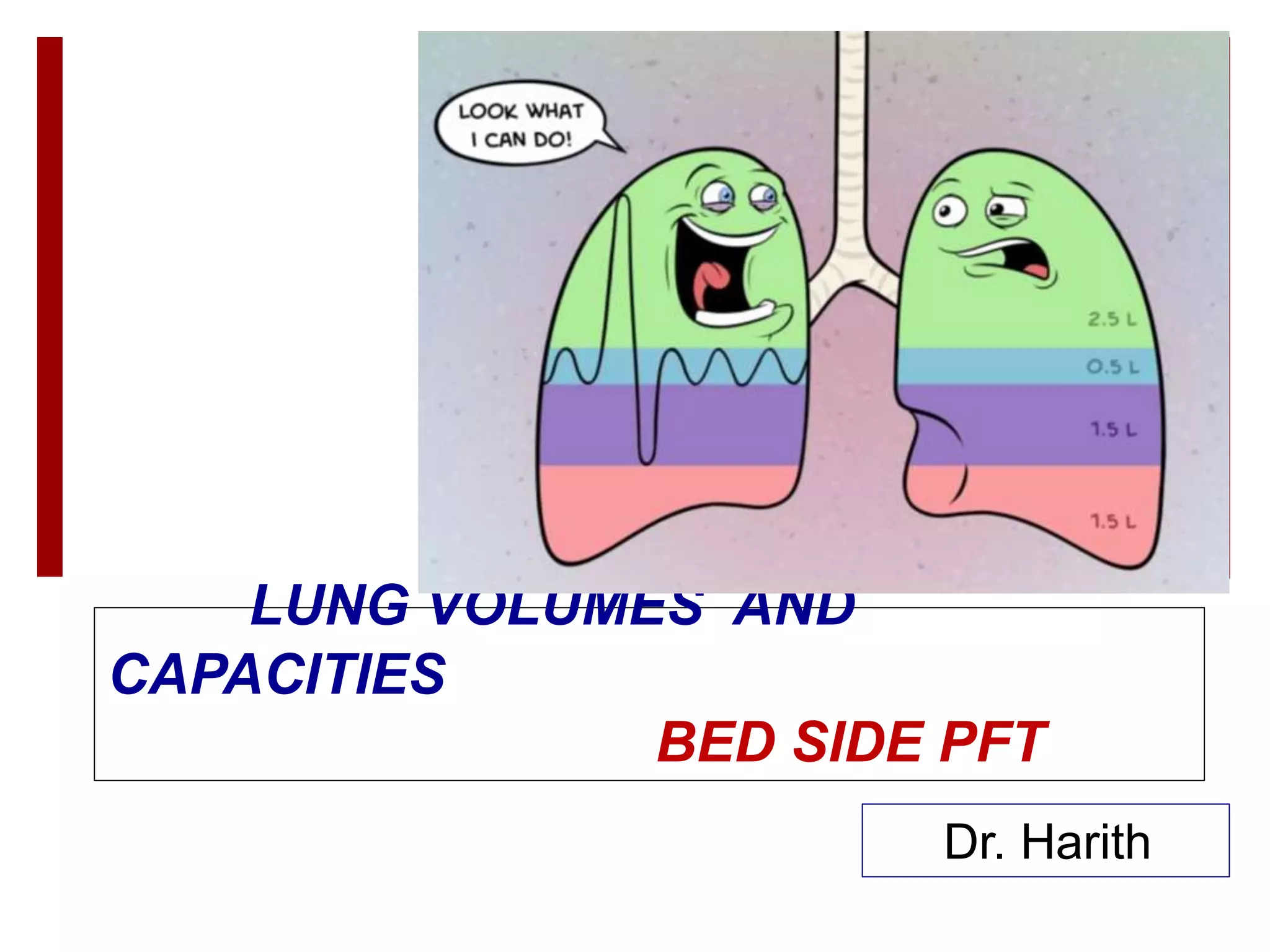
LUNG VOLUMES AND
CAPACITIES
BED SIDE PFT
Dr. Harith
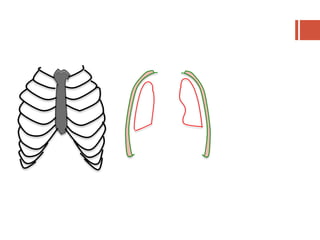
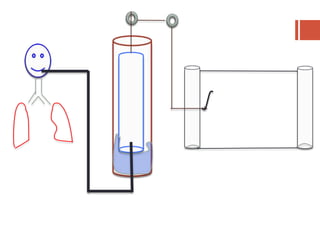
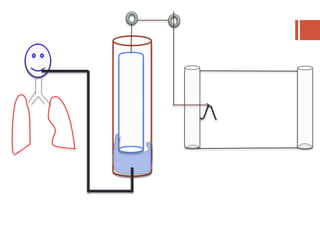
Lung volumes and lung capacities refer to
the volume of air associated with different phases
of the respiratory cycle.
 Lung volumes are directly measured; Lung
capacities are inferred from lung volumes.
Instrument is spirometry
LUNG VOLUMES
Four types
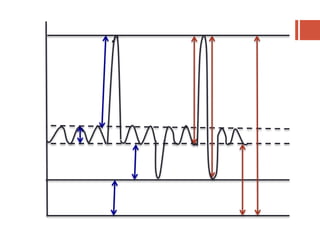
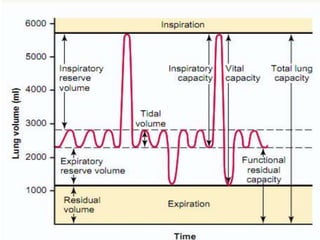
1. Tidal volume
2. Inspiratory reserve volume
3. Expiratory persevere volume
4. Residual volume
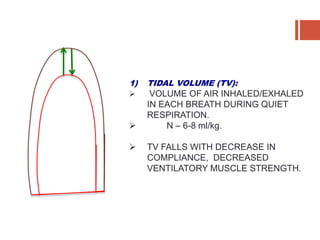
1) TIDAL VOLUME (TV):
 VOLUME OF AIR INHALED/EXHALED
IN EACH BREATH DURING QUIET
RESPIRATION.
 N – 6-8 ml/kg.
 TV FALLS WITH DECREASE IN
COMPLIANCE, DECREASED
VENTILATORY MUSCLE STRENGTH.
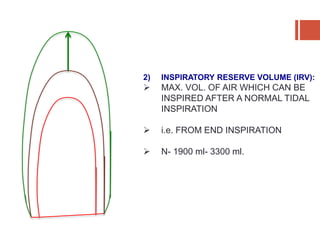
2) INSPIRATORY RESERVE VOLUME (IRV):
 MAX. VOL. OF AIR WHICH CAN BE
INSPIRED AFTER A NORMAL TIDAL
INSPIRATION
 i.e. FROM END INSPIRATION
 N- 1900 ml- 3300 ml.
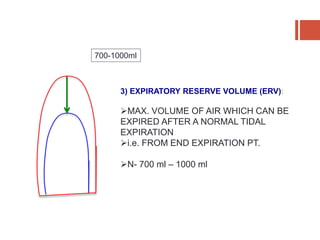
3) EXPIRATORY RESERVE VOLUME (ERV):
MAX. VOLUME OF AIR WHICH CAN BE
EXPIRED AFTER A NORMAL TIDAL
EXPIRATION
i.e. FROM END EXPIRATION PT.
N- 700 ml – 1000 ml
700-1000ml
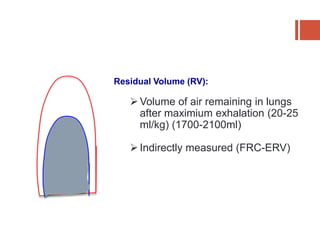
Residual Volume (RV):
Volume of air remaining in lungs
after maximium exhalation (20-25
ml/kg) (1700-2100ml)
Indirectly measured (FRC-ERV)
CAPACITIES
Two or more Volumes combined together
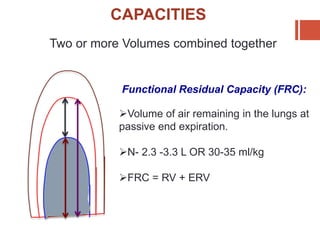
Functional Residual Capacity (FRC):
Volume of air remaining in the lungs at
passive end expiration.
N- 2.3 -3.3 L OR 30-35 ml/kg
FRC = RV + ERV
FRC INCREASES WITH
 Increased height
 Erect position (30% more than in supine)
 Decreased lung recoil (e.g. emphysema)
FRC DECREASES WITH
 Obesity
 Muscle paralysis (especially in supine)
 Supine position
 Restrictive lung disease (e.g. fibrosis, Pregnancy)
 FRC does NOT change with age.
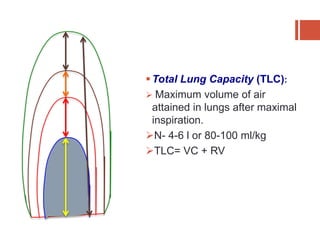
Total Lung Capacity (TLC):
 Maximum volume of air
attained in lungs after maximal
inspiration.
N- 4-6 l or 80-100 ml/kg
TLC= VC + RV
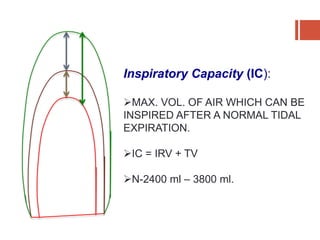
Inspiratory Capacity (IC):
MAX. VOL. OF AIR WHICH CAN BE
INSPIRED AFTER A NORMAL TIDAL
EXPIRATION.
IC = IRV + TV
N-2400 ml – 3800 ml.
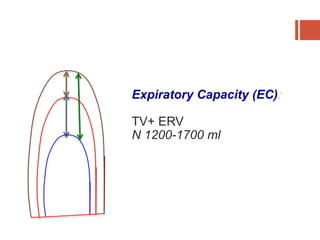
Expiratory Capacity (EC):
TV+ ERV
N 1200-1700 ml
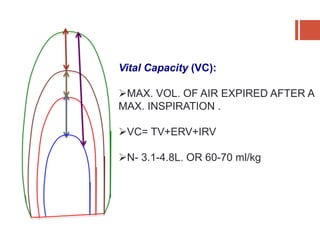
Vital Capacity (VC):
MAX. VOL. OF AIR EXPIRED AFTER A
MAX. INSPIRATION .
VC= TV+ERV+IRV
N- 3.1-4.8L. OR 60-70 ml/kg
 Alteration in muscle power- d/t drugs, n-m dis., cerebral tumours.
 Pulmonary diseases – pneumonia, chronic bronchitis, asthma, fibrosis,
emphysema, pulmonary edema,.
 Space occupying lesions in chest- tumours, pleural/pericardial effusion,
kyphoscoliosis
 Abdominal tumours, ascites.
 Depression of respiration : opioids/ volatile agents
 Abdominal splinting – abdominal binders, tight bandages, hip spica.
 Abdominal pain – decreases by 50% & 75% in lower & upper
abdominal Surgeries respectively.
 Posture – by altering pulmonary Blood volume.
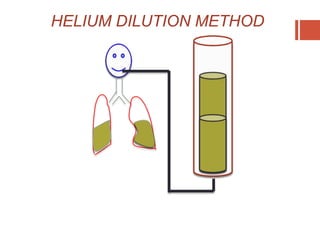
HELIUM DILUTION METHOD
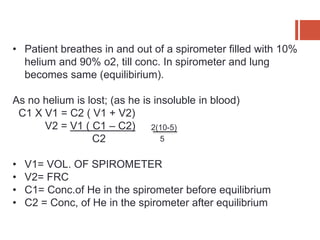
• Patient breathes in and out of a spirometer filled with 10%
helium and 90% o2, till conc. In spirometer and lung
becomes same (equilibirium).
As no helium is lost; (as he is insoluble in blood)
C1 X V1 = C2 ( V1 + V2)
V2 = V1 ( C1 – C2)
C2
• V1= VOL. OF SPIROMETER
• V2= FRC
• C1= Conc.of He in the spirometer before equilibrium
• C2 = Conc, of He in the spirometer after equilibrium
2(10-5)
5
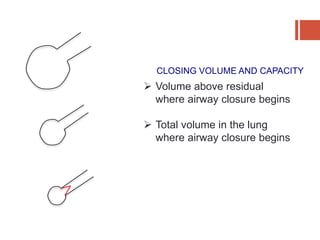
 Volume above residual
where airway closure begins
 Total volume in the lung
where airway closure begins
CLOSING VOLUME AND CAPACITY
BED SIDE PFT
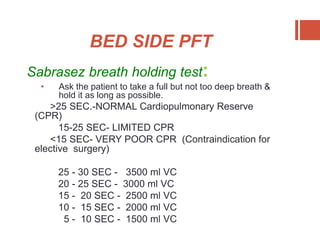
Sabrasez breath holding test:
• Ask the patient to take a full but not too deep breath &
hold it as long as possible.
>25 SEC.-NORMAL Cardiopulmonary Reserve
(CPR)
15-25 SEC- LIMITED CPR
<15 SEC- VERY POOR CPR (Contraindication for
elective surgery)
25 - 30 SEC - 3500 ml VC
20 - 25 SEC - 3000 ml VC
15 - 20 SEC - 2500 ml VC
10 - 15 SEC - 2000 ml VC
5 - 10 SEC - 1500 ml VC
Single breath count:
After deep breath, hold it and start counting till the next breath.
 N- 30-40 COUNT
Indicates vital capacity
SCHNEIDER’S MATCH BLOWING TEST: MEASURES Maximum Breathing
Capacity.
Ask to blow a match stick from a distance of 6” (15 cms) with-
 Mouth wide open
 Chin rested/supported
 No purse lipping
 No head movement
 No air movement in the room
 Mouth and match at the same level
Can not blow out a match
 MBC < 60 L/min
 FEV1 < 1.6L
Able to blow out a match
 MBC > 60 L/min
 FEV1 > 1.6L
MODIFIED MATCH TEST:
DISTANCE MBC
9” >150 L/MIN.
6” >60 L/MIN.
3” > 40 L/MIN.
COUGH TEST: DEEP BREATH F/BY COUGH
 ABILITY TO COUGH
 STRENGTH
 EFFECTIVENESS
INADEQUATE COUGH IF: FVC<20 ML/KG
FEV1 < 15 ML/KG
PEFR < 200 L/MIN.
VC ~ 3 TIMES TV FOR EFFECTIVE COUGH.
A wet productive cough / self propagated
paraoxysms of coughing – patient susceptible for
pulmonary Complication.
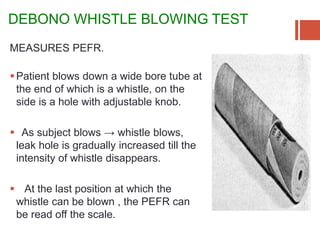
DEBONO WHISTLE BLOWING TEST
MEASURES PEFR.
Patient blows down a wide bore tube at
the end of which is a whistle, on the
side is a hole with adjustable knob.
 As subject blows → whistle blows,
leak hole is gradually increased till the
intensity of whistle disappears.
 At the last position at which the
whistle can be blown , the PEFR can
be read off the scale.
FORCED EXPIRATORY TIME:
After deep breath, exhale maximally and forcefully & keep
stethoscope over trachea & listen.
Normal FET – 3-5 SECS.
Obstructive Lung Disease - > 6 SEC
Restrictive Lung Disease - < 3 SEC
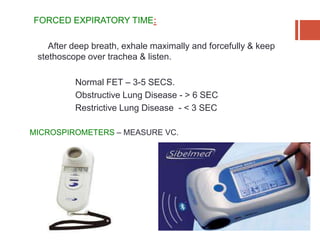
MICROSPIROMETERS – MEASURE VC.
THANK YOU

Lvcp

  • 1.
  • 2.
    Lung volumes andlung capacities refer to the volume of air associated with different phases of the respiratory cycle.  Lung volumes are directly measured; Lung capacities are inferred from lung volumes. Instrument is spirometry
  • 3.
    LUNG VOLUMES Four types 1.Tidal volume 2. Inspiratory reserve volume 3. Expiratory persevere volume 4. Residual volume
  • 6.
    1) TIDAL VOLUME(TV):  VOLUME OF AIR INHALED/EXHALED IN EACH BREATH DURING QUIET RESPIRATION.  N – 6-8 ml/kg.  TV FALLS WITH DECREASE IN COMPLIANCE, DECREASED VENTILATORY MUSCLE STRENGTH.
  • 7.
    2) INSPIRATORY RESERVEVOLUME (IRV):  MAX. VOL. OF AIR WHICH CAN BE INSPIRED AFTER A NORMAL TIDAL INSPIRATION  i.e. FROM END INSPIRATION  N- 1900 ml- 3300 ml.
  • 8.
    3) EXPIRATORY RESERVEVOLUME (ERV): MAX. VOLUME OF AIR WHICH CAN BE EXPIRED AFTER A NORMAL TIDAL EXPIRATION i.e. FROM END EXPIRATION PT. N- 700 ml – 1000 ml 700-1000ml
  • 9.
    Residual Volume (RV): Volumeof air remaining in lungs after maximium exhalation (20-25 ml/kg) (1700-2100ml) Indirectly measured (FRC-ERV)
  • 10.
    CAPACITIES Two or moreVolumes combined together Functional Residual Capacity (FRC): Volume of air remaining in the lungs at passive end expiration. N- 2.3 -3.3 L OR 30-35 ml/kg FRC = RV + ERV
  • 11.
    FRC INCREASES WITH Increased height  Erect position (30% more than in supine)  Decreased lung recoil (e.g. emphysema) FRC DECREASES WITH  Obesity  Muscle paralysis (especially in supine)  Supine position  Restrictive lung disease (e.g. fibrosis, Pregnancy)  FRC does NOT change with age.
  • 12.
    Total Lung Capacity(TLC):  Maximum volume of air attained in lungs after maximal inspiration. N- 4-6 l or 80-100 ml/kg TLC= VC + RV
  • 13.
    Inspiratory Capacity (IC): MAX.VOL. OF AIR WHICH CAN BE INSPIRED AFTER A NORMAL TIDAL EXPIRATION. IC = IRV + TV N-2400 ml – 3800 ml.
  • 14.
  • 15.
    Vital Capacity (VC): MAX.VOL. OF AIR EXPIRED AFTER A MAX. INSPIRATION . VC= TV+ERV+IRV N- 3.1-4.8L. OR 60-70 ml/kg
  • 16.
     Alteration inmuscle power- d/t drugs, n-m dis., cerebral tumours.  Pulmonary diseases – pneumonia, chronic bronchitis, asthma, fibrosis, emphysema, pulmonary edema,.  Space occupying lesions in chest- tumours, pleural/pericardial effusion, kyphoscoliosis  Abdominal tumours, ascites.  Depression of respiration : opioids/ volatile agents  Abdominal splinting – abdominal binders, tight bandages, hip spica.  Abdominal pain – decreases by 50% & 75% in lower & upper abdominal Surgeries respectively.  Posture – by altering pulmonary Blood volume.
  • 21.
  • 22.
    • Patient breathesin and out of a spirometer filled with 10% helium and 90% o2, till conc. In spirometer and lung becomes same (equilibirium). As no helium is lost; (as he is insoluble in blood) C1 X V1 = C2 ( V1 + V2) V2 = V1 ( C1 – C2) C2 • V1= VOL. OF SPIROMETER • V2= FRC • C1= Conc.of He in the spirometer before equilibrium • C2 = Conc, of He in the spirometer after equilibrium 2(10-5) 5
  • 23.
     Volume aboveresidual where airway closure begins  Total volume in the lung where airway closure begins CLOSING VOLUME AND CAPACITY
  • 24.
    BED SIDE PFT Sabrasezbreath holding test: • Ask the patient to take a full but not too deep breath & hold it as long as possible. >25 SEC.-NORMAL Cardiopulmonary Reserve (CPR) 15-25 SEC- LIMITED CPR <15 SEC- VERY POOR CPR (Contraindication for elective surgery) 25 - 30 SEC - 3500 ml VC 20 - 25 SEC - 3000 ml VC 15 - 20 SEC - 2500 ml VC 10 - 15 SEC - 2000 ml VC 5 - 10 SEC - 1500 ml VC
  • 25.
    Single breath count: Afterdeep breath, hold it and start counting till the next breath.  N- 30-40 COUNT Indicates vital capacity SCHNEIDER’S MATCH BLOWING TEST: MEASURES Maximum Breathing Capacity. Ask to blow a match stick from a distance of 6” (15 cms) with-  Mouth wide open  Chin rested/supported  No purse lipping  No head movement  No air movement in the room  Mouth and match at the same level
  • 26.
    Can not blowout a match  MBC < 60 L/min  FEV1 < 1.6L Able to blow out a match  MBC > 60 L/min  FEV1 > 1.6L MODIFIED MATCH TEST: DISTANCE MBC 9” >150 L/MIN. 6” >60 L/MIN. 3” > 40 L/MIN.
  • 27.
    COUGH TEST: DEEPBREATH F/BY COUGH  ABILITY TO COUGH  STRENGTH  EFFECTIVENESS INADEQUATE COUGH IF: FVC<20 ML/KG FEV1 < 15 ML/KG PEFR < 200 L/MIN. VC ~ 3 TIMES TV FOR EFFECTIVE COUGH. A wet productive cough / self propagated paraoxysms of coughing – patient susceptible for pulmonary Complication.
  • 28.
    DEBONO WHISTLE BLOWINGTEST MEASURES PEFR. Patient blows down a wide bore tube at the end of which is a whistle, on the side is a hole with adjustable knob.  As subject blows → whistle blows, leak hole is gradually increased till the intensity of whistle disappears.  At the last position at which the whistle can be blown , the PEFR can be read off the scale.
  • 29.
    FORCED EXPIRATORY TIME: Afterdeep breath, exhale maximally and forcefully & keep stethoscope over trachea & listen. Normal FET – 3-5 SECS. Obstructive Lung Disease - > 6 SEC Restrictive Lung Disease - < 3 SEC MICROSPIROMETERS – MEASURE VC.
  • 30.

Editor's Notes

  • #29 The whistle shows when the rate of airflow through the whistle exceeds a certain value