Failure rate
 17% - quoted from an American teaching hospital
 most of the failures were judged to be ‘avoidable’.
 4% - judgement errors as major factor
Levy JH, Islas JA, Ghia JN, Turnbull C. A retrospective study of the incidence and caues of failed
spinal anesthetics in a university hospital, Anesth Analg , 1985, vol. 64 (pg. 705-10)
Munhall RJ, Sukhani R, Winnie AP. Incidence and etiology of failed spinal anesthetics in a university hospital,
Anesth Analg , 1988, vol. 67 (pg. 843-8)
Implication
 Careful attention to detail is vital
 Failure rate of <1% attainable in everyday practice
Harten JM, Boyne I, Hannah P, Varveris D, Brown A. Effects of height and weight adjusted dose of
local anaesthetic for spinal anaesthesia for elective Caesarean section, Anaesthesia , 2005, vol. 60 (pg.
348-53)
Know the mechanism of failure
 “prevention must start with full recognition of the
potential pitfalls so that clinical practice can be
tailored to their avoidance. “
Three aspects of Failure
 Clinical technique
 Inexperience
 Failure to appreciate the need for a meticulous
approach
Charlton JE. Wildsmith JAW, Armitage EN, McClure JH. Managing the block, Principles and Practice of
Regional Anaesthesia , 20033rd EdnEdinburghChurchill Livingstone
5 Phases of an individual Spinal
Anaesthetic
1. lumbar puncture
2. solution injection
3. spreading of drug through CSF
4. drug action on the spinal nerve roots and cord
5. subsequent patient management
Product Defect Notification reports
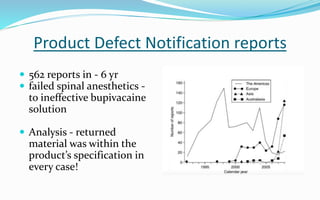
 562 reports in - 6 yr
 failed spinal anesthetics -
to ineffective bupivacaine
solution
 Analysis - returned
material was within the
product’s specification in
every case!
Mechanisms and their prevention
 Dry tap
 Poor positioning of patient
 Incorrect needle insertion
 needle and stylet must be
checked for correctness of
fit before use
 the needle should not be
advanced without the
stylet in place
 tissue or blood clot - easily
obstruct the fine bore
needles used now.
Factors making patient positioning
more difficult:
 Abnormalities of the spine (kyphosis, scoliosis,
calcification of ligaments
 consequences of osteoporosis
 obesity
 patient anxiety
 “good clinical training is the key to success, but most
difficulties are attributable to lack of adherence to
the basic rules”
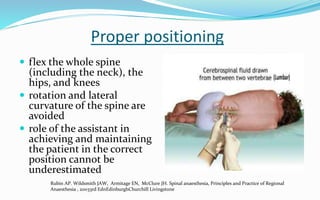
Proper positioning
 flex the whole spine
(including the neck), the
hips, and knees
 rotation and lateral
curvature of the spine are
avoided
 role of the assistant in
achieving and maintaining
the patient in the correct
position cannot be
underestimated
Rubin AP. Wildsmith JAW, Armitage EN, McClure JH. Spinal anaesthesia, Principles and Practice of Regional
Anaesthesia , 20033rd EdnEdinburghChurchill Livingstone
 Needle insertion
 Pseudosuccessful
 Midline first
 Congenital arachnoid
cyst
Stace JD, Gaylard DG. Failed spinal anaesthesia,
Anaesthesia , 1996, vol. 51 (pg. 892-3)
Solution injection errors
 Fully effective dose is both chosen and actually
deposited in the CSF
 important in determining the quality and duration of
block.
 Actual dose chosen will depend on specific local
anesthetic, baricity, patient’s posture, type of block
intended, anticipated duration of surgery
Hocking G, Wildsmith JAW. Intrathecal drug spread, Br J Anaesth , 2004, vol. 93 (pg. 568-78)
Loss of injectate
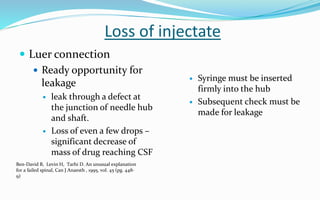
 Luer connection
 Ready opportunity for
leakage
 leak through a defect at
the junction of needle hub
and shaft.
 Loss of even a few drops –
significant decrease of
mass of drug reaching CSF
 Syringe must be inserted
firmly into the hub
 Subsequent check must be
made for leakage
Ben-David B, Levin H, Tarhi D. An unusual explanation
for a failed spinal, Can J Anaesth , 1995, vol. 45 (pg. 448-
9)
Misplaced injection
 Tip displacement
 Pencil point
 Opening at end of needles
 Proximal to the tip
 Minor degree of backward movement during syringe
attachment
 EPIDURAL INJECTION
Crone W. Failed spinal anesthesia with the Sprotte needle, Anesthesiology , 1991, vol. 75 (pg. 717-8)
Misplaced injection
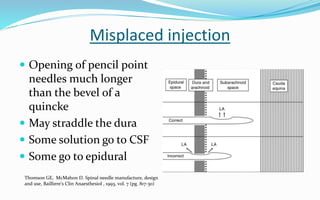
 Opening of pencil point
needles much longer
than the bevel of a
quincke
 May straddle the dura
 Some solution go to CSF
 Some go to epidural
Thomson GE, McMahon D. Spinal needle manufacture, design
and use, Bailliere’s Clin Anaesthesiol , 1993, vol. 7 (pg. 817-30)
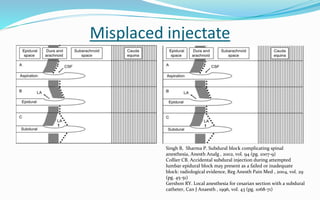
Misplaced injectate
Singh B, Sharma P. Subdural block complicating spinal
anesthesia, Anesth Analg , 2002, vol. 94 (pg. 1007-9)
Collier CB. Accidental subdural injection during attempted
lumbar epidural block may present as a failed or inadequate
block: radiological evidence, Reg Anesth Pain Med , 2004, vol. 29
(pg. 45-51)
Gershon RY. Local anesthesia for cesarian section with a subdural
catheter, Can J Anaesth , 1996, vol. 43 (pg. 1068-71)
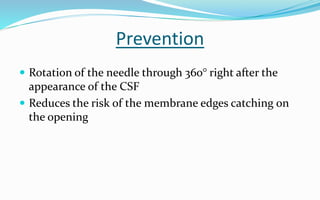
Prevention
 Rotation of the needle through 360° right after the
appearance of the CSF
 Reduces the risk of the membrane edges catching on
the opening
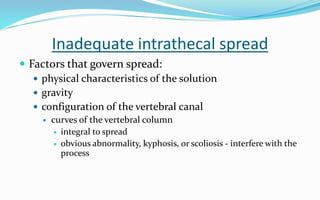
Inadequate intrathecal spread
 Factors that govern spread:
 physical characteristics of the solution
 gravity
 configuration of the vertebral canal
 curves of the vertebral column
 integral to spread
 obvious abnormality, kyphosis, or scoliosis - interfere with the
process
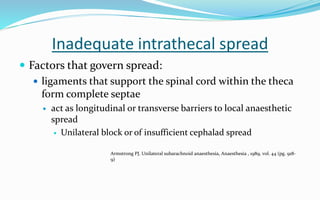
Inadequate intrathecal spread
 Factors that govern spread:
 ligaments that support the spinal cord within the theca
form complete septae
 act as longitudinal or transverse barriers to local anaesthetic
spread
 Unilateral block or of insufficient cephalad spread
Armstrong PJ. Unilateral subarachnoid anaesthesia, Anaesthesia , 1989, vol. 44 (pg. 918-
9)
Inadequate intrathecal spread
 Factors that govern spread:
 Spinal stenosis or pathological lesions
 Intrathecal chemotherapy
 Previous surgery – adhesions
 larger than usual volume of CSF in the lumbar theca
Adler R, Lenz G. Neurological complaints after unsuccessful spinal anaesthesia as a manifestation of incipient syringomyelia, Eur J
Anaesthesiol , 1998, vol. 15 (pg. 103-5)
Westphal M, Gotz T, Booke M. Failed spinal anaesthesia after intrathecal chemotherapy, Eur J Anaesthesiol , 2005, vol. 22 (pg. 235-
6)
Hirabayashi Y, Fukuda H, Saitoh K, Inoue S, Mitsuhata H, Shimizu R. Failed spinal anaesthesia: cause identified by MRI, Can J
Anaesth , 1996, vol. 43 (pg. 1072-5)
Inadequate intrathecal spread
 lumbar CSF volume- most important factor
influencing the variability seen between individuals in
the spread of an intrathecal injection
Carpenter RL, Hogan QH, Liu SS, Crane B, Moore J. Lumbosacral cerebrospinal fluid volume is the primary determinant of
sensory block extent and duration during spinal anesthesia, Anesthesiology , 1998, vol. 89 (pg. 24-9)
Lacassie HJ, Millar S, Leithe LG, et al. Dural ectasia: a likely cause of inadequate spinal anaesthesia in two parturients with
Marfan’s syndrome, Br J Anaesth , 2005, vol. 94 (pg. 500-4)
Solution density
 Isobaric - A solution with a density within the normal
range of that of CSF
 guarantee block of the lower limbs with little risk of
thoracic nerve block and thus hypotension
 hypobaric at body temperature
 range of spread - less predictable than that of a truly
isobaric preparation ( no higher than L1-L2 )
Wildsmith JAW, McClure JH, Brown DT, Scott DB. Effects of posture on the spread of isobaric
and hyperbaric amethocaine, Br J Anaesth , 1981, vol. 53 (pg. 273-8)
Logan ML, McClure JH, Wildsmith JAW. Plain bupivacaine—an unpredictable
spinal anaesthetic agent, Br J Anaesth , 1986, vol. 58 (pg. 292-6)
Solution density
 Hyperbaric – heavier than CSF
 moves in the direction of gravity
 And the curves of the vertebral canal
 Glucose – made effect more reliable
Barker AE. A report on clinical experiences with spinal analgesia in 100 cases, Br Med J , 1907,
vol. i (pg. 665-74)
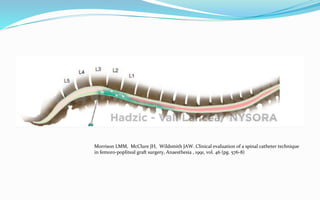
Morrison LMM, McClure JH, Wildsmith JAW. Clinical evaluation of a spinal catheter technique
in femoro-popliteal graft surgery, Anaesthesia , 1991, vol. 46 (pg. 576-8)
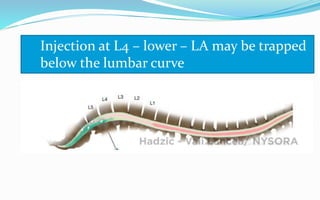
Injection at L4 – lower – LA may be trapped
below the lumbar curve
Ineffective drug action
 Identification errors
 Attention to detail is essential - minimize number of
ampoules on the block tray (such as using the same local
anaesthetic for both skin infiltration and spinal)
 consistent use of different sizes of syringe for each
component of the procedure help considerably
Ineffective drug action
 Chemical incompatibility with adjuvants
 Precipitate
 pH of local anesthetic ( epinephrine )
Manchikanti L, Hadley C, MArkwell SJ, Colliver JA. A retrospective analysis of failed
spinal anesthetic attempts in a community hospital, Anesth Analg , 1987, vol. 66 (pg. 363-6)
Inactive local anesthetic solution
 Ester- chemically labile
 Cannot be heat sterilized and
prolonged storage
 Hydrolysis
 Needs careful handling
 Amide-more stable
 can be heat sterilized
 Can be stored for several
years without loss of potency
 reports attributing failure of
spinal anaesthetics to
inactive drug.
Calthorpe N. Inadequate spinal anaesthesia with 0.5% Marcaine
Heavy (batch DK 2016), Int J Obstet Anaesth , 2004, vol. 13 pg. 131
Harris RW, McDonald P. Inadequate spinal anaesthesia with 0.5%
Marcaine Heavy (batch DK-1961), Int J Obstet Anaesth , 2004, vol.
13 (pg. 130-1)
Smiley RM, Redai I. More failed spinal anesthetics with hyperbaric
bupivacaine, Int J Obstet Anaesth , 2004, vol. 13 (pg. 131-4)
Wood M, Ismail F. Inadequate spinal anaesthesia with 0.5%
Marcaine Heavy (batch 1961), Int J Obstet Anaesth , 2003, vol. 12
(pg. 310-1)
Failed block
 No block
 wrong solution has been
injected
 deposited in the wrong place
 Options:
 Repeating the procedure
 conversion to general
anaesthesia
 If, after operation, the patient
has significant pruritus, it is
likely that only an opioid was
injected.
 Good block of inadequate
cephalad spread
 level of injection was too low
 anatomical abnormality has
restricted spread
 some injectate has been
misplaced
Failed block
 Good, but unilateral block:
 positioning
 longitudinal ligaments
supporting the cord have
blocked spread.
 turn the patient onto the
unblocked side if a
hyperbaric solution was
used
 reverse for isobaric to
facilitate spread.
 Patchy
 Either motor or sensory
block is inadequate
 local anaesthetic partially
misplaced
 inadequate dose
Failed block
 Inadequate dose
 Lidocaine mistaken for bupivacaine
 Procedure taken longer than expected
Failed block
Failed block
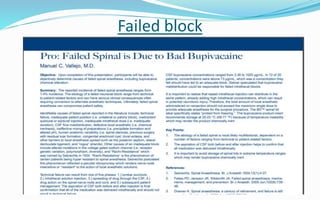
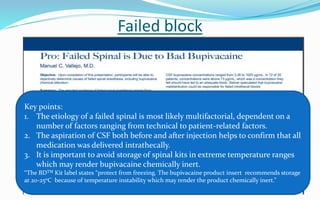
Key points:
1. The etiology of a failed spinal is most likely multifactorial, dependent on a
number of factors ranging from technical to patient-related factors.
2. The aspiration of CSF both before and after injection helps to confirm that all
medication was delivered intrathecally.
3. It is important to avoid storage of spinal kits in extreme temperature ranges
which may render bupivacaine chemically inert.
“The BDTM Kit label states “protect from freezing. The bupivacaine product insert recommends storage
at 20-250C because of temperature instability which may render the product chemically inert.”
Lee and Atkinson, on ‘The spinal that does not take’:
 “All experienced workers have encountered this
occasionally even though accepted procedure has
apparently been followed. Reflection, however, usually
discloses some flaw in technique. In 1907 Alfred E.
Barker wrote that for successful spinal analgesia it is
necessary ‘to enter the lumbar dural sac effectually with
the point of the needle, and to discharge through this, all
the contemplated dose of the drug, directly and freely
into the cerebrospinal fluid, below the termination of
the cord’ (Barker, 1907). Failure to follow the details of
this advice is the commonest cause of a poor result.27”
Lee JA, Atkinson RS. , Sir Robert Macintosh’s Lumbar Puncture and Spinal Analgesia , 1978EdinburghChurchill
Livingstone

Ensuring success in Spinal Anesthesia.pptx

  • 3.
    Failure rate  17%- quoted from an American teaching hospital  most of the failures were judged to be ‘avoidable’.  4% - judgement errors as major factor Levy JH, Islas JA, Ghia JN, Turnbull C. A retrospective study of the incidence and caues of failed spinal anesthetics in a university hospital, Anesth Analg , 1985, vol. 64 (pg. 705-10) Munhall RJ, Sukhani R, Winnie AP. Incidence and etiology of failed spinal anesthetics in a university hospital, Anesth Analg , 1988, vol. 67 (pg. 843-8)
  • 4.
    Implication  Careful attentionto detail is vital  Failure rate of <1% attainable in everyday practice Harten JM, Boyne I, Hannah P, Varveris D, Brown A. Effects of height and weight adjusted dose of local anaesthetic for spinal anaesthesia for elective Caesarean section, Anaesthesia , 2005, vol. 60 (pg. 348-53)
  • 5.
    Know the mechanismof failure  “prevention must start with full recognition of the potential pitfalls so that clinical practice can be tailored to their avoidance. “
  • 6.
    Three aspects ofFailure  Clinical technique  Inexperience  Failure to appreciate the need for a meticulous approach Charlton JE. Wildsmith JAW, Armitage EN, McClure JH. Managing the block, Principles and Practice of Regional Anaesthesia , 20033rd EdnEdinburghChurchill Livingstone
  • 7.
    5 Phases ofan individual Spinal Anaesthetic 1. lumbar puncture 2. solution injection 3. spreading of drug through CSF 4. drug action on the spinal nerve roots and cord 5. subsequent patient management
  • 8.
    Product Defect Notificationreports  562 reports in - 6 yr  failed spinal anesthetics - to ineffective bupivacaine solution  Analysis - returned material was within the product’s specification in every case!
  • 9.
    Mechanisms and theirprevention  Dry tap  Poor positioning of patient  Incorrect needle insertion  needle and stylet must be checked for correctness of fit before use  the needle should not be advanced without the stylet in place  tissue or blood clot - easily obstruct the fine bore needles used now.
  • 10.
    Factors making patientpositioning more difficult:  Abnormalities of the spine (kyphosis, scoliosis, calcification of ligaments  consequences of osteoporosis  obesity  patient anxiety
  • 11.
     “good clinicaltraining is the key to success, but most difficulties are attributable to lack of adherence to the basic rules”
  • 12.
    Proper positioning  flexthe whole spine (including the neck), the hips, and knees  rotation and lateral curvature of the spine are avoided  role of the assistant in achieving and maintaining the patient in the correct position cannot be underestimated Rubin AP. Wildsmith JAW, Armitage EN, McClure JH. Spinal anaesthesia, Principles and Practice of Regional Anaesthesia , 20033rd EdnEdinburghChurchill Livingstone
  • 13.
     Needle insertion Pseudosuccessful  Midline first  Congenital arachnoid cyst Stace JD, Gaylard DG. Failed spinal anaesthesia, Anaesthesia , 1996, vol. 51 (pg. 892-3)
  • 14.
    Solution injection errors Fully effective dose is both chosen and actually deposited in the CSF  important in determining the quality and duration of block.  Actual dose chosen will depend on specific local anesthetic, baricity, patient’s posture, type of block intended, anticipated duration of surgery Hocking G, Wildsmith JAW. Intrathecal drug spread, Br J Anaesth , 2004, vol. 93 (pg. 568-78)
  • 15.
    Loss of injectate Luer connection  Ready opportunity for leakage  leak through a defect at the junction of needle hub and shaft.  Loss of even a few drops – significant decrease of mass of drug reaching CSF  Syringe must be inserted firmly into the hub  Subsequent check must be made for leakage Ben-David B, Levin H, Tarhi D. An unusual explanation for a failed spinal, Can J Anaesth , 1995, vol. 45 (pg. 448- 9)
  • 16.
    Misplaced injection  Tipdisplacement  Pencil point  Opening at end of needles  Proximal to the tip  Minor degree of backward movement during syringe attachment  EPIDURAL INJECTION Crone W. Failed spinal anesthesia with the Sprotte needle, Anesthesiology , 1991, vol. 75 (pg. 717-8)
  • 17.
    Misplaced injection  Openingof pencil point needles much longer than the bevel of a quincke  May straddle the dura  Some solution go to CSF  Some go to epidural Thomson GE, McMahon D. Spinal needle manufacture, design and use, Bailliere’s Clin Anaesthesiol , 1993, vol. 7 (pg. 817-30)
  • 18.
    Misplaced injectate Singh B,Sharma P. Subdural block complicating spinal anesthesia, Anesth Analg , 2002, vol. 94 (pg. 1007-9) Collier CB. Accidental subdural injection during attempted lumbar epidural block may present as a failed or inadequate block: radiological evidence, Reg Anesth Pain Med , 2004, vol. 29 (pg. 45-51) Gershon RY. Local anesthesia for cesarian section with a subdural catheter, Can J Anaesth , 1996, vol. 43 (pg. 1068-71)
  • 19.
    Prevention  Rotation ofthe needle through 360° right after the appearance of the CSF  Reduces the risk of the membrane edges catching on the opening
  • 20.
    Inadequate intrathecal spread Factors that govern spread:  physical characteristics of the solution  gravity  configuration of the vertebral canal  curves of the vertebral column  integral to spread  obvious abnormality, kyphosis, or scoliosis - interfere with the process
  • 21.
    Inadequate intrathecal spread Factors that govern spread:  ligaments that support the spinal cord within the theca form complete septae  act as longitudinal or transverse barriers to local anaesthetic spread  Unilateral block or of insufficient cephalad spread Armstrong PJ. Unilateral subarachnoid anaesthesia, Anaesthesia , 1989, vol. 44 (pg. 918- 9)
  • 22.
    Inadequate intrathecal spread Factors that govern spread:  Spinal stenosis or pathological lesions  Intrathecal chemotherapy  Previous surgery – adhesions  larger than usual volume of CSF in the lumbar theca Adler R, Lenz G. Neurological complaints after unsuccessful spinal anaesthesia as a manifestation of incipient syringomyelia, Eur J Anaesthesiol , 1998, vol. 15 (pg. 103-5) Westphal M, Gotz T, Booke M. Failed spinal anaesthesia after intrathecal chemotherapy, Eur J Anaesthesiol , 2005, vol. 22 (pg. 235- 6) Hirabayashi Y, Fukuda H, Saitoh K, Inoue S, Mitsuhata H, Shimizu R. Failed spinal anaesthesia: cause identified by MRI, Can J Anaesth , 1996, vol. 43 (pg. 1072-5)
  • 23.
    Inadequate intrathecal spread lumbar CSF volume- most important factor influencing the variability seen between individuals in the spread of an intrathecal injection Carpenter RL, Hogan QH, Liu SS, Crane B, Moore J. Lumbosacral cerebrospinal fluid volume is the primary determinant of sensory block extent and duration during spinal anesthesia, Anesthesiology , 1998, vol. 89 (pg. 24-9) Lacassie HJ, Millar S, Leithe LG, et al. Dural ectasia: a likely cause of inadequate spinal anaesthesia in two parturients with Marfan’s syndrome, Br J Anaesth , 2005, vol. 94 (pg. 500-4)
  • 24.
    Solution density  Isobaric- A solution with a density within the normal range of that of CSF  guarantee block of the lower limbs with little risk of thoracic nerve block and thus hypotension  hypobaric at body temperature  range of spread - less predictable than that of a truly isobaric preparation ( no higher than L1-L2 ) Wildsmith JAW, McClure JH, Brown DT, Scott DB. Effects of posture on the spread of isobaric and hyperbaric amethocaine, Br J Anaesth , 1981, vol. 53 (pg. 273-8) Logan ML, McClure JH, Wildsmith JAW. Plain bupivacaine—an unpredictable spinal anaesthetic agent, Br J Anaesth , 1986, vol. 58 (pg. 292-6)
  • 25.
    Solution density  Hyperbaric– heavier than CSF  moves in the direction of gravity  And the curves of the vertebral canal  Glucose – made effect more reliable Barker AE. A report on clinical experiences with spinal analgesia in 100 cases, Br Med J , 1907, vol. i (pg. 665-74)
  • 26.
    Morrison LMM, McClureJH, Wildsmith JAW. Clinical evaluation of a spinal catheter technique in femoro-popliteal graft surgery, Anaesthesia , 1991, vol. 46 (pg. 576-8)
  • 27.
    Injection at L4– lower – LA may be trapped below the lumbar curve
  • 28.
    Ineffective drug action Identification errors  Attention to detail is essential - minimize number of ampoules on the block tray (such as using the same local anaesthetic for both skin infiltration and spinal)  consistent use of different sizes of syringe for each component of the procedure help considerably
  • 29.
    Ineffective drug action Chemical incompatibility with adjuvants  Precipitate  pH of local anesthetic ( epinephrine ) Manchikanti L, Hadley C, MArkwell SJ, Colliver JA. A retrospective analysis of failed spinal anesthetic attempts in a community hospital, Anesth Analg , 1987, vol. 66 (pg. 363-6)
  • 30.
    Inactive local anestheticsolution  Ester- chemically labile  Cannot be heat sterilized and prolonged storage  Hydrolysis  Needs careful handling  Amide-more stable  can be heat sterilized  Can be stored for several years without loss of potency  reports attributing failure of spinal anaesthetics to inactive drug. Calthorpe N. Inadequate spinal anaesthesia with 0.5% Marcaine Heavy (batch DK 2016), Int J Obstet Anaesth , 2004, vol. 13 pg. 131 Harris RW, McDonald P. Inadequate spinal anaesthesia with 0.5% Marcaine Heavy (batch DK-1961), Int J Obstet Anaesth , 2004, vol. 13 (pg. 130-1) Smiley RM, Redai I. More failed spinal anesthetics with hyperbaric bupivacaine, Int J Obstet Anaesth , 2004, vol. 13 (pg. 131-4) Wood M, Ismail F. Inadequate spinal anaesthesia with 0.5% Marcaine Heavy (batch 1961), Int J Obstet Anaesth , 2003, vol. 12 (pg. 310-1)
  • 31.
    Failed block  Noblock  wrong solution has been injected  deposited in the wrong place  Options:  Repeating the procedure  conversion to general anaesthesia  If, after operation, the patient has significant pruritus, it is likely that only an opioid was injected.  Good block of inadequate cephalad spread  level of injection was too low  anatomical abnormality has restricted spread  some injectate has been misplaced
  • 32.
    Failed block  Good,but unilateral block:  positioning  longitudinal ligaments supporting the cord have blocked spread.  turn the patient onto the unblocked side if a hyperbaric solution was used  reverse for isobaric to facilitate spread.  Patchy  Either motor or sensory block is inadequate  local anaesthetic partially misplaced  inadequate dose
  • 33.
    Failed block  Inadequatedose  Lidocaine mistaken for bupivacaine  Procedure taken longer than expected
  • 34.
  • 35.
    Failed block Key points: 1.The etiology of a failed spinal is most likely multifactorial, dependent on a number of factors ranging from technical to patient-related factors. 2. The aspiration of CSF both before and after injection helps to confirm that all medication was delivered intrathecally. 3. It is important to avoid storage of spinal kits in extreme temperature ranges which may render bupivacaine chemically inert. “The BDTM Kit label states “protect from freezing. The bupivacaine product insert recommends storage at 20-250C because of temperature instability which may render the product chemically inert.”
  • 36.
    Lee and Atkinson,on ‘The spinal that does not take’:  “All experienced workers have encountered this occasionally even though accepted procedure has apparently been followed. Reflection, however, usually discloses some flaw in technique. In 1907 Alfred E. Barker wrote that for successful spinal analgesia it is necessary ‘to enter the lumbar dural sac effectually with the point of the needle, and to discharge through this, all the contemplated dose of the drug, directly and freely into the cerebrospinal fluid, below the termination of the cord’ (Barker, 1907). Failure to follow the details of this advice is the commonest cause of a poor result.27” Lee JA, Atkinson RS. , Sir Robert Macintosh’s Lumbar Puncture and Spinal Analgesia , 1978EdinburghChurchill Livingstone

Editor's Notes

  • #4 a figure as high as 17% has been quoted from an American teaching hospital, yet most of the failures were judged to be ‘avoidable’.28  A survey at another such institution considered that this high rate was ‘unacceptable’, and recorded the much lower, but still significant, figure of 4%, with ‘errors of judgement’ as the major factor.32
  • #5 The clear implication is that careful attention to detail is vital, and it has been shown that a failure rate of <1% is attainable in everyday practice.17
  • #7 block failure is usually ascribed to one of three aspects: clinical technique, inexperience (of the unsupervised trainee especially), and failure to appreciate the need for a meticulous approach
  • #8 All of the problems involved are well described in the literature, but usually long ago, and many practitioners seem unaware of the issues involved.
  • #9 For instance, the neuroscience division of AstraZeneca received 562 ‘Product Defect Notification’ reports in the 6 yr to December 31, 2007, all ascribing failed spinal anaesthetics to ineffective bupivacaine solution (Fig. 1). Nearly one-third of reports (179) were from the UK, but virtually every country where the drug is marketed was represented. However, analysis showed that the returned material was within the product’s specification in every case so a formal review, based on a literature search, was thought to be worthwhile.
  • #10 poor positioning of the patient or incorrect needle insertion, both factors being within the control of the anaesthetist.
  • #11 make both positioning the patient and needle insertion more difficult, especially in the elderly. 
  • #13 the lumbar laminae and spines are ‘separated’ maximally by flexing
  • #15 The appearance of CSF in the needle hub is an essential pre-requisite for spinal anaesthesia, but it does not guarantee success, which also requires that a fully effective dose is both chosen and actually deposited in the CSF. Overall, the actual dose chosen will depend on the specific local anaesthetic used, the baricity of that solution, the patient’s subsequent posture, the type of block intended, and the anticipated duration of surgery. 
  • #16  Luer connection between syringe and needle provides a ready opportunity for leakage of solution.  the loss of even a few drops may cause a significant decrease in the mass of drug reaching the CSF, and thus in its effectiveness. To avoid this, it has long been conventional teaching that the syringe containing the injectate must be inserted very firmly into the hub of the needle, and that a subsequent check is made that no leakage occurs.
  • #17 . The opening at the end of these needles is proximal to the tip, so only a minor degree of ‘backward’ movement during syringe attachment may result in epidural injection as was recognized at an early stage in the widespread use of such needles.12 The distances involved are of the order of a millimetre or two, but (as with leakage) misplacement of only a small amount of solution can have significant effects.
  • #18 An additional issue with pencil-point needles is that the opening, being much longer than the bevel of a Quincke needle, may ‘straddle’ the dura so that some solution reaches the CSF, and some the epidural space (Fig. 2).41
  • #19 This may be exaggerated by the dura acting as a ‘flap’ valve across the needle opening. Initially, CSF pressure pushes the dura outwards so that aspiration is successful (Fig. 3A), but subsequent injection pushes the dura forward and the solution is misplaced (Fig. 3B). A variant is that the needle tip penetrates the dura, but it is the arachnoid mater that acts as the flap valve so that a subdural injection results (Fig. 3C). This misplacement is usually thought of as leading to excessive spread during epidural block, but the equivalent phenomenon has been described after intended subarachnoid injection,37and is a recognized complication of myelography.22 Subdural injection has also been identified as the cause of a failed block when either epidural11 or subarachnoid15injection was intended.  
  • #20 These eventualities, being subtle abnormalities of placement, are impossible to identify at the actual time, but rotation of the needle through 360° after the initial appearance of CSF, and before check aspiration, has been advocated as a way of minimizing the possibility of them occurring, the theory being that the rotation reduces the risk of the membrane edges catching on the opening.
  • #21 Intrathecal spread is governed by interplay between solution physical characteristics, gravity, and the configuration of the vertebral canal.  curves of the vertebral column are integral to solution spread and any obvious abnormality, kyphosis, or scoliosis, may interfere with the process.    Examination of the patient should reveal whether this might occur, but it is not possible to predict whether the effect will be excessive spread or failure.  
  • #22 ligaments that support the spinal cord within the theca form complete septae and act as longitudinal or transverse barriers to local anaesthetic spread.
  • #23 Spinal stenosis or other pathological lesions might also limit spread, effectiveness, or both, one such case being attributed to the consequences of previous intrathecal chemotherapy.1,42Similarly, previous surgery within the vertebral canal may result in adhesions that interfere with spread.  
  • #24 Subsequent systematic study has shown that lumbar CSF volume is the most important factor influencing the variability seen between individuals in the spread of an intrathecal injection.9 A negative correlation was found between lumbar CSF volume and the peak sensory level achieved with hyperbaric bupivacaine when the injection was performed in both supine and sitting positions. A variation of this factor is dural ectasia, which is a pathological enlargement of the dura seen in the majority of patients with Marfan’s syndrome and in some other connective tissue disorders.25
  • #26 Solutions with a density greater than that of CSF (hyperbaric) move very definitively under the combined influence of gravity and the curves of the vertebral canal. Over a hundred years ago, Barker, one of the early pioneers of spinal anaesthesia in the UK, observed that the addition of glucose to the solution made for a more reliable effect.4In the standard scenario, that of a patient placed supine after the injection of a hyperbaric preparation at the mid-lumbar level, the solution will spread ‘down’ the slope under the effect of gravity to pool at the ‘lowest’ point of the thoracic curve, so exposing all nerve roots up to that level to an effective concentration of local anaesthetic. However, if lumbar puncture is performed at the fourth lumbar or the lumbo-sacral interspace the local anaesthetic may be ‘trapped’ below the lumbar curve, especially if the patient is in the sitting position during injection and maintained in that position for a period thereafter. This results in a block that is restricted to the sacral segments, just as has been described with a spinal catheter that passes caudally.31 Prevention relies on avoiding too low an injection level unless, of course, a deliberate ‘saddle’ block is intended.
  • #27 Injection at the second or third lumbar interspace will normally result in a significant fraction of the drug spreading cranially from the point of injection (but too high an injection risks inadvertent damage to the spinal cord).  In the standard scenario, that of a patient placed supine after the injection of a hyperbaric preparation at the mid-lumbar level, the solution will spread ‘down’ the slope under the effect of gravity to pool at the ‘lowest’ point of the thoracic curve, so exposing all nerve roots up to that level to an effective concentration of local anaesthetic. 
  • #28 Injection at the fourth interspace or lower reduces the risk of cord damage, but it may result in predominantly caudal spread of the drug and an inadequate block for surgery.
  • #29 The last possible explanation for a failed spinal is that the solution actually injected reaches the target nerves, but is inactive or ineffective, with a variety of explanations being possible Attention to detail is essential, but minimizing the number of ampoules on the block tray (such as using the same local anaesthetic for both skin infiltration and spinal) and consistent use of different sizes of syringe for each component of the procedure help considerably.  
  • #30 Chemical reaction might generate an obvious precipitate, but another possibility is that the pH of the local anaesthetic solution becomes even lower than it was to start with. This would decrease the concentration of the un-ionized fraction that is what diffuses into nerve tissue and, unless the solution mixes well with CSF, a decreased effect could result. There is at least one report indicating that the incidence of failure is greater after the addition of a vasoconstrictor solution and this could represent an example of this effect.30
  • #31 Inactive local anaesthetic solution The older, ester-type local anaesthetics are chemically labile so that heat sterilization and prolonged storage, particularly in aqueous solution, can make them ineffective because of hydrolysis and hence they need very careful handling. Although the more modern amide-linked drugs (e.g. lidocaine, bupivacaine, etc.) are much more stable and can be heat sterilized in solution and then stored for several years without loss of potency, there have been a number of reports attributing failure of spinal anaesthetics to inactive drug.8,16,38,44    
  • #32 No block: the wrong solution has been injected, it has been deposited in the wrong place, or it is ineffective. Repeating the procedure or conversion to general anaesthesia are the only option. If, after operation, the patient has significant pruritus, it is likely that only an opioid was injected.
  • #33 Good, but unilateral block: this is most likely because of positioning, but it is possible that longitudinal ligaments supporting the cord have blocked spread. If the operation is to be on the anaesthetized limb, then the surgeon should know that the other leg has sensation, and the patient should be reassured and closely monitored. Otherwise, turning the patient onto the unblocked side if a hyperbaric solution was used (or the reverse for plain solutions) may facilitate spread. Patchy If this becomes apparent before surgery starts, the options are to repeat the spinal injection or to use a greater degree of systemic supplementation than was planned, the latter being the only option after skin incision. It may not be necessary to recourse to general anaesthesia, sedation, or analgesic drugs often being sufficient especially when patient anxiety is a major factor. Infiltration of the wound and other tissues with local anaesthetic by the surgeon may also be useful in such situations.
  • #34 Inadequate duration: the most likely explanation is that for one of several reasons an inadequate dose of local anaesthetic was delivered to the CSF. Alternatively, lidocaine (intended for skin infiltration) was confused for bupivacaine, or the operation has taken longer than expected. Systemic supplementation or infiltration of local anaesthetic may tide matters over, but often the only option is to convert to general anaesthesia.