Anesthesia Concerns in the
           Elderly
      Marc Evans M. Abat, MD, FPCP, FPSGM
       Internal Medicine-Geriatric Medicine
Department of Medicine and Center for Healthy Aging
                 The Medical City
Outline
• Those relating to physiologic changes with
  regards to aging
  – “What are some changes in the elderly that may
    modify how a patient will behave with
    anesthetics?”
• Those relating to co-morbidites that are
  particular to the geriatric age group, especially
  “geriatric syndromes”
  – “What are the concerns with regard to anesthetics
    in the presence of these conditions?”
Disclaimer

     I’m an internist and
      geriatrician......not
     an anesthesiologist.
     I hope we can help
         each other!
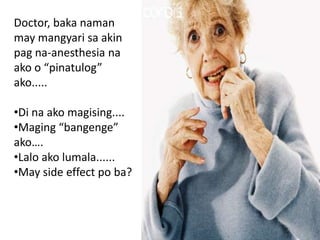
Doctor, baka naman
may mangyari sa akin
pag na-anesthesia na
ako o “pinatulog”
ako.....

•Di na ako magising....
•Maging “bangenge”
ako….
•Lalo ako lumala......
•May side effect po ba?
Hmmmmm....my patient will
undergo surgery.....hmmmm...
Details.....

•My patient is old....
•And has several diseases and
taking corresponding
medications...
•And has another surgical
disease that can worsen or may
interact with her other diseases
and medications
•Will need anesthesia...(Type?
Effects? Complications?)
•And has a risk for functional
decline and disability
•And can possibly die on me.....
Age-related changes and
      Anesthesia
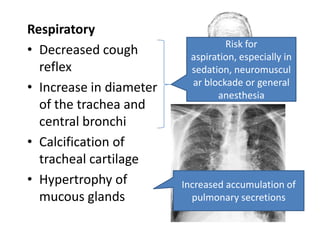
Respiratory
                                   Risk for
• Decreased cough          aspiration, especially in
  reflex                   sedation, neuromuscul
                           ar blockade or general
• Increase in diameter           anesthesia
  of the trachea and
  central bronchi
• Calcification of
  tracheal cartilage
• Hypertrophy of         Increased accumulation of
  mucous glands            pulmonary secretions
• ↓decreased elastic recoil
  •Compromised
    respiratory
                        (decreased lung elasticity)
     dynamics         • chest wall expands and
     (hypoxia,          stiffness
   hypercarbia)         increases, increasing
      •Risk for         expiration work of
respiratory fatigue     breathing
    and failure       • Elevated closing volumes-
      •Risk for         inability to drain certain
    atelectasis         lung areas
      •Risk for
                      • respiratory muscle
    pneumonia
                        endurance decreases
Cardiac
                  • Low-normal to normal
   •Risk for        heart rate but poor heart
 hypotension        rate response with effort
even at lower     • Lower cardiovascular
   doses of         reserve
 anesthetics
  •Relatively     • ↑vascular stiffness
higher risk for   • ↑ventricular stiffness
 arrhythmias      • Early reliance on the
                    Starling curve to maintain
                    cardiac output
• Conduction system
  degeneration
• Valvular degeneration
• ↓β-adrenergic
  responsiveness
• ↓baroreceptor
  sensitivity
• ↓SA node
  automaticity
Gastrointestinal/Hepatic
     •Risk for      • Decreased acid
prolonged post-       production
    operative
ileus, especially
                    • Adaptive relaxation is
with opioid use
                      impaired
  •Retention of     • Moderate atrophy of
gastric contents      small intestine villi
with subsequent     • Some lost of myenteric
   increase in        plexi throughout the GI
 aspiration risks     tract
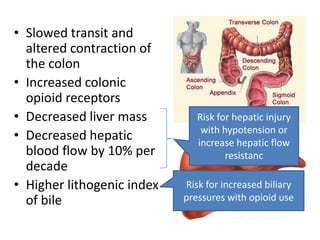
• Slowed transit and
  altered contraction of
  the colon
• Increased colonic
  opioid receptors
• Decreased liver mass         Risk for hepatic injury
                                with hypotension or
• Decreased hepatic            increase hepatic flow
  blood flow by 10% per               resistanc
  decade
• Higher lithogenic index   Risk for increased biliary
  of bile                   pressures with opioid use
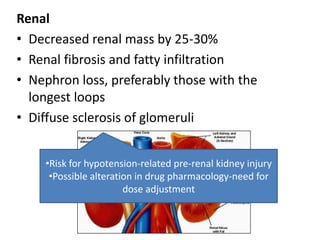
Renal
• Decreased renal mass by 25-30%
• Renal fibrosis and fatty infiltration
• Nephron loss, preferably those with the
  longest loops
• Diffuse sclerosis of glomeruli


    •Risk for hypotension-related pre-renal kidney injury
     •Possible alteration in drug pharmacology-need for
                       dose adjustment
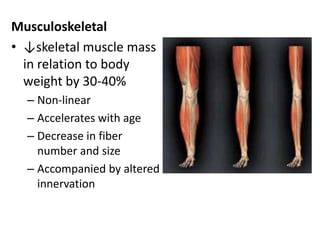
Musculoskeletal
• ↓skeletal muscle mass
  in relation to body
  weight by 30-40%
  – Non-linear
  – Accelerates with age
  – Decrease in fiber
    number and size
  – Accompanied by altered
    innervation
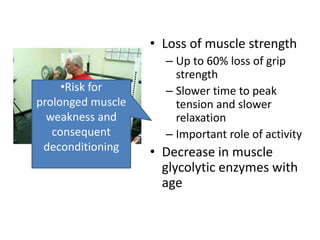
• Loss of muscle strength
                     – Up to 60% loss of grip
                       strength
     •Risk for       – Slower time to peak
prolonged muscle       tension and slower
  weakness and         relaxation
   consequent        – Important role of activity
 deconditioning    • Decrease in muscle
                     glycolytic enzymes with
                     age
Anesthesia and Geriatric
      Syndromes
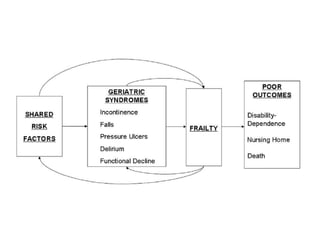
Geriatric syndromes
• refer to multifactorial health conditions that
  occur when the accumulated effects of
  impairments in multiple systems render an
  older person vulnerable to situational
  challenges
• Emphasizes multiple causation of a unified
  manifestation
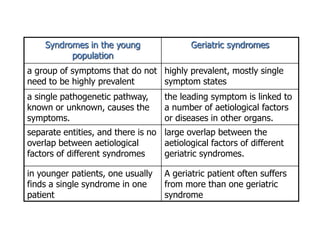
Syndromes in the young                 Geriatric syndromes
          population
a group of symptoms that do not highly prevalent, mostly single
need to be highly prevalent     symptom states
a single pathogenetic pathway,      the leading symptom is linked to
known or unknown, causes the        a number of aetiological factors
symptoms.                           or diseases in other organs.
separate entities, and there is no large overlap between the
overlap between aetiological       aetiological factors of different
factors of different syndromes     geriatric syndromes.

in younger patients, one usually    A geriatric patient often suffers
finds a single syndrome in one      from more than one geriatric
patient                             syndrome
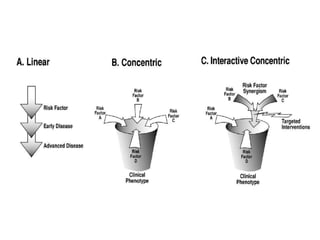
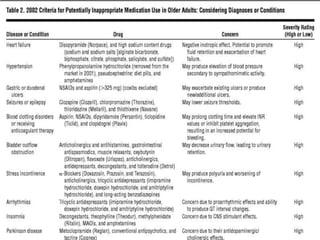
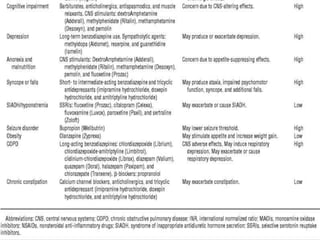
• Use of the terminology leads to special
  considerations
  – multiple risk factors and multiple organ systems
    are often involved
  – diagnostic strategies to identify the underlying
    causes can sometimes be ineffective,
    burdensome, dangerous, and costly
  – therapeutic management of the clinical
    manifestations can be helpful even in the absence
    of a firm diagnosis or clarification of the
    underlying causes
Geriatrics Today, 5, 69-75
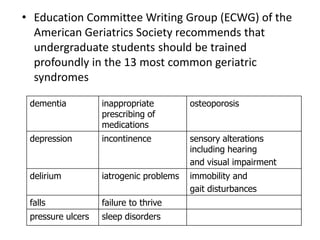
• Education Committee Writing Group (ECWG) of the
  American Geriatrics Society recommends that
  undergraduate students should be trained
  profoundly in the 13 most common geriatric
  syndromes

 dementia          inappropriate         osteoporosis
                   prescribing of
                   medications
 depression        incontinence          sensory alterations
                                         including hearing
                                         and visual impairment
 delirium          iatrogenic problems   immobility and
                                         gait disturbances
 falls             failure to thrive
 pressure ulcers   sleep disorders
• Other considered geriatric syndromes
  – Malnutrition
  – Dizziness and syncope
  – Deconditioning and sarcopenia
  – Arthritidis
  – Pain
Sample Case
• 83 year old priest
• Underwent PEG insertion under IV sedation
  and eventually discharged within 24 hours
  after the procedure
• Noted behavioral changes and confusion
  lasting > 72 hours, necessitating treatment
  with short-course antipsychotics and
  cholinesterase inhibitors
• Noted functional decline persisting for more
  than a month after the procedure
Post-Anesthesia Delirium and
                Dementia
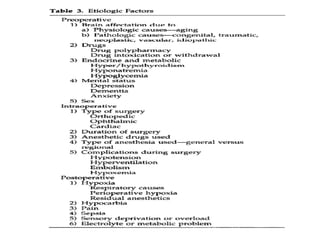
• Significant cognitive dysfunction was found to be common
  in elderly persons 1 to 3 days after surgery
   – eports of longer-term impairment are inconsistent due to the
     heterogeneity of the procedures used and populations targeted
     in such studies.
   – Incidence rates vary widely according to type of surgery,
     suggesting that factors other than anesthesia explain a
     significant proportion of the observed variance
• Anesthesia appears to be associated with longer-term
  cognitive disorder and the acceleration of senile dementia
   – only in a small number of cases, suggesting the existence of
     other interacting etiological factors.


                                International Psychogeriatrics (1997), 9: 309-
                                326
• Incidence
  – from 10% to 15% (3); for those in the
  – orthopedic surgery group, from 28% to 61.3%
    (4-6);
  – those in the cataract surgery group, from 1% to
    3%
  – 12% incidence of idiopathic postoperative
    delirium in 239 patients.
  – noticeable dysfunction persisted for 6 wk in 5%
    of the elderly patients

                                 Anesth Analg 1995;80:1223-32
• Risk factors on regression analysis
  – Age
  – Low educational level
  – Depression
  – Recent history of cognitive impairment


                                  Br J Psych. 2001. 178: 360-66
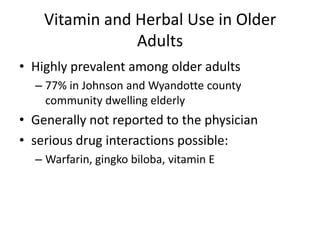
Vitamin and Herbal Use in Older
                Adults
• Highly prevalent among older adults
  – 77% in Johnson and Wyandotte county
    community dwelling elderly
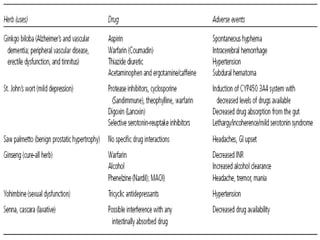
• Generally not reported to the physician
• serious drug interactions possible:
  – Warfarin, gingko biloba, vitamin E
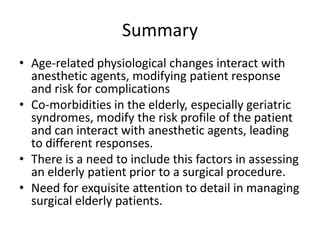
Summary
• Age-related physiological changes interact with
  anesthetic agents, modifying patient response
  and risk for complications
• Co-morbidities in the elderly, especially geriatric
  syndromes, modify the risk profile of the patient
  and can interact with anesthetic agents, leading
  to different responses.
• There is a need to include this factors in assessing
  an elderly patient prior to a surgical procedure.
• Need for exquisite attention to detail in managing
  surgical elderly patients.

Anesthesia concerns in the elderly

  • 1.
    Anesthesia Concerns inthe Elderly Marc Evans M. Abat, MD, FPCP, FPSGM Internal Medicine-Geriatric Medicine Department of Medicine and Center for Healthy Aging The Medical City
  • 2.
    Outline • Those relatingto physiologic changes with regards to aging – “What are some changes in the elderly that may modify how a patient will behave with anesthetics?” • Those relating to co-morbidites that are particular to the geriatric age group, especially “geriatric syndromes” – “What are the concerns with regard to anesthetics in the presence of these conditions?”
  • 3.
    Disclaimer I’m an internist and geriatrician......not an anesthesiologist. I hope we can help each other!
  • 4.
    Doctor, baka naman maymangyari sa akin pag na-anesthesia na ako o “pinatulog” ako..... •Di na ako magising.... •Maging “bangenge” ako…. •Lalo ako lumala...... •May side effect po ba?
  • 5.
    Hmmmmm....my patient will undergosurgery.....hmmmm... Details..... •My patient is old.... •And has several diseases and taking corresponding medications... •And has another surgical disease that can worsen or may interact with her other diseases and medications •Will need anesthesia...(Type? Effects? Complications?) •And has a risk for functional decline and disability •And can possibly die on me.....
  • 6.
  • 7.
    Respiratory Risk for • Decreased cough aspiration, especially in reflex sedation, neuromuscul ar blockade or general • Increase in diameter anesthesia of the trachea and central bronchi • Calcification of tracheal cartilage • Hypertrophy of Increased accumulation of mucous glands pulmonary secretions
  • 8.
    • ↓decreased elasticrecoil •Compromised respiratory (decreased lung elasticity) dynamics • chest wall expands and (hypoxia, stiffness hypercarbia) increases, increasing •Risk for expiration work of respiratory fatigue breathing and failure • Elevated closing volumes- •Risk for inability to drain certain atelectasis lung areas •Risk for • respiratory muscle pneumonia endurance decreases
  • 9.
    Cardiac • Low-normal to normal •Risk for heart rate but poor heart hypotension rate response with effort even at lower • Lower cardiovascular doses of reserve anesthetics •Relatively • ↑vascular stiffness higher risk for • ↑ventricular stiffness arrhythmias • Early reliance on the Starling curve to maintain cardiac output
  • 10.
    • Conduction system degeneration • Valvular degeneration • ↓β-adrenergic responsiveness • ↓baroreceptor sensitivity • ↓SA node automaticity
  • 11.
    Gastrointestinal/Hepatic •Risk for • Decreased acid prolonged post- production operative ileus, especially • Adaptive relaxation is with opioid use impaired •Retention of • Moderate atrophy of gastric contents small intestine villi with subsequent • Some lost of myenteric increase in plexi throughout the GI aspiration risks tract
  • 12.
    • Slowed transitand altered contraction of the colon • Increased colonic opioid receptors • Decreased liver mass Risk for hepatic injury with hypotension or • Decreased hepatic increase hepatic flow blood flow by 10% per resistanc decade • Higher lithogenic index Risk for increased biliary of bile pressures with opioid use
  • 13.
    Renal • Decreased renalmass by 25-30% • Renal fibrosis and fatty infiltration • Nephron loss, preferably those with the longest loops • Diffuse sclerosis of glomeruli •Risk for hypotension-related pre-renal kidney injury •Possible alteration in drug pharmacology-need for dose adjustment
  • 14.
    Musculoskeletal • ↓skeletal musclemass in relation to body weight by 30-40% – Non-linear – Accelerates with age – Decrease in fiber number and size – Accompanied by altered innervation
  • 15.
    • Loss ofmuscle strength – Up to 60% loss of grip strength •Risk for – Slower time to peak prolonged muscle tension and slower weakness and relaxation consequent – Important role of activity deconditioning • Decrease in muscle glycolytic enzymes with age
  • 16.
  • 17.
    Geriatric syndromes • referto multifactorial health conditions that occur when the accumulated effects of impairments in multiple systems render an older person vulnerable to situational challenges • Emphasizes multiple causation of a unified manifestation
  • 18.
    Syndromes in theyoung Geriatric syndromes population a group of symptoms that do not highly prevalent, mostly single need to be highly prevalent symptom states a single pathogenetic pathway, the leading symptom is linked to known or unknown, causes the a number of aetiological factors symptoms. or diseases in other organs. separate entities, and there is no large overlap between the overlap between aetiological aetiological factors of different factors of different syndromes geriatric syndromes. in younger patients, one usually A geriatric patient often suffers finds a single syndrome in one from more than one geriatric patient syndrome
  • 19.
    • Use ofthe terminology leads to special considerations – multiple risk factors and multiple organ systems are often involved – diagnostic strategies to identify the underlying causes can sometimes be ineffective, burdensome, dangerous, and costly – therapeutic management of the clinical manifestations can be helpful even in the absence of a firm diagnosis or clarification of the underlying causes
  • 22.
  • 23.
    • Education CommitteeWriting Group (ECWG) of the American Geriatrics Society recommends that undergraduate students should be trained profoundly in the 13 most common geriatric syndromes dementia inappropriate osteoporosis prescribing of medications depression incontinence sensory alterations including hearing and visual impairment delirium iatrogenic problems immobility and gait disturbances falls failure to thrive pressure ulcers sleep disorders
  • 24.
    • Other consideredgeriatric syndromes – Malnutrition – Dizziness and syncope – Deconditioning and sarcopenia – Arthritidis – Pain
  • 25.
    Sample Case • 83year old priest • Underwent PEG insertion under IV sedation and eventually discharged within 24 hours after the procedure • Noted behavioral changes and confusion lasting > 72 hours, necessitating treatment with short-course antipsychotics and cholinesterase inhibitors • Noted functional decline persisting for more than a month after the procedure
  • 26.
    Post-Anesthesia Delirium and Dementia • Significant cognitive dysfunction was found to be common in elderly persons 1 to 3 days after surgery – eports of longer-term impairment are inconsistent due to the heterogeneity of the procedures used and populations targeted in such studies. – Incidence rates vary widely according to type of surgery, suggesting that factors other than anesthesia explain a significant proportion of the observed variance • Anesthesia appears to be associated with longer-term cognitive disorder and the acceleration of senile dementia – only in a small number of cases, suggesting the existence of other interacting etiological factors. International Psychogeriatrics (1997), 9: 309- 326
  • 27.
    • Incidence – from 10% to 15% (3); for those in the – orthopedic surgery group, from 28% to 61.3% (4-6); – those in the cataract surgery group, from 1% to 3% – 12% incidence of idiopathic postoperative delirium in 239 patients. – noticeable dysfunction persisted for 6 wk in 5% of the elderly patients Anesth Analg 1995;80:1223-32
  • 28.
    • Risk factorson regression analysis – Age – Low educational level – Depression – Recent history of cognitive impairment Br J Psych. 2001. 178: 360-66
  • 32.
    Vitamin and HerbalUse in Older Adults • Highly prevalent among older adults – 77% in Johnson and Wyandotte county community dwelling elderly • Generally not reported to the physician • serious drug interactions possible: – Warfarin, gingko biloba, vitamin E
  • 34.
    Summary • Age-related physiologicalchanges interact with anesthetic agents, modifying patient response and risk for complications • Co-morbidities in the elderly, especially geriatric syndromes, modify the risk profile of the patient and can interact with anesthetic agents, leading to different responses. • There is a need to include this factors in assessing an elderly patient prior to a surgical procedure. • Need for exquisite attention to detail in managing surgical elderly patients.