
By Dr.Ayshvarya
Guide: Dr Sendhil Kumar Mohan
Moderator: Dr.N.Jothi
K.A.P.V.G.M.C, TRICHY
Neuraxial Blockade involving injection of local anaesthetic in the
sub-arachnoid space
Spinal anesthesia can be classified as a failure if the surgical
operation cannot be performed without the addition of general
anesthetic or an alternative regional block
No blockade
Inadequate Block for the surgery
The incidence of failure with spinal
anesthesia varies in different studies,
ranging from 3% to 17%.
In some smaller studies, failure rates
as high as 30% have been reported
More among unsupervised trainees
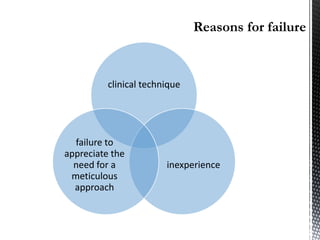
clinical technique
inexperience
failure to
appreciate the
need for a
meticulous
approach
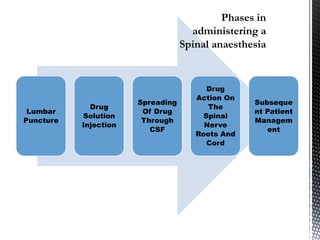
Lumbar
Puncture
Drug
Solution
Injection
Spreading
Of Drug
Through
CSF
Drug
Action On
The
Spinal
Nerve
Roots And
Cord
Subseque
nt Patient
Managem
ent
Prevention
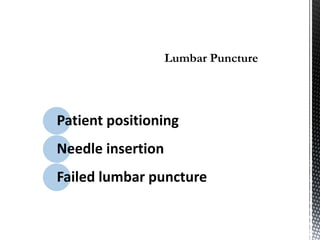
Patient positioning
Needle insertion
Failed lumbar puncture
Aim is to optimize the pt’s position
& prevent any movement
anxiolytic premedication
local anaesthetic infiltration at the
puncture site
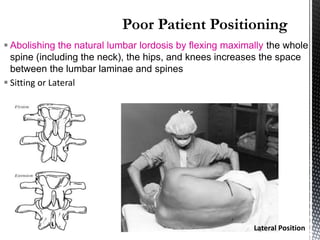
 Abolishing the natural lumbar lordosis by flexing maximally the whole
spine (including the neck), the hips, and knees increases the space
between the lumbar laminae and spines
 Sitting or Lateral
Lateral Position
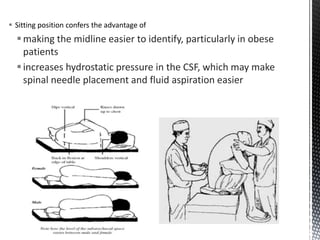
 Sitting position confers the advantage of
making the midline easier to identify, particularly in obese
patients
increases hydrostatic pressure in the CSF, which may make
spinal needle placement and fluid aspiration easier
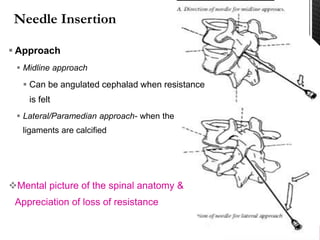
 Approach
 Midline approach
 Can be angulated cephalad when resistance
is felt
 Lateral/Paramedian approach- when the
ligaments are calcified
Mental picture of the spinal anatomy &
Appreciation of loss of resistance
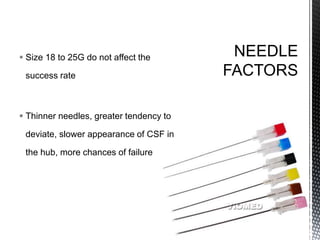
 Size 18 to 25G do not affect the
success rate
 Thinner needles, greater tendency to
deviate, slower appearance of CSF in
the hub, more chances of failure
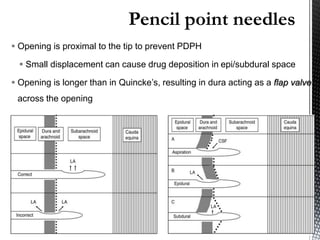
 Opening is proximal to the tip to prevent PDPH
 Small displacement can cause drug deposition in epi/subdural space
 Opening is longer than in Quincke’s, resulting in dura acting as a flap valve
across the opening
Dry tap
The needle & stylet should be
checked for any block
Pseudolumbar puncture
Needle should not be
inserted without the stylet
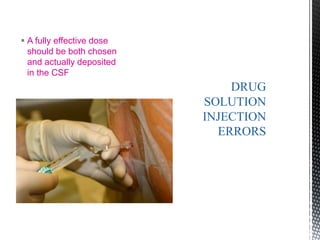
 A fully effective dose
should be both chosen
and actually deposited
in the CSF
DRUG
SOLUTION
INJECTION
ERRORS
Determines the quality & duration of the
block
Factors influencing intrathecal drug
spread & the LA drug
With low-dose, selective or U/L spinal
anesthesia, the proper technique more
important than with higher doses.
whole of the dose must be delivered into
the CSF, including the dead space of the
needle.
DOSE
SELECTION
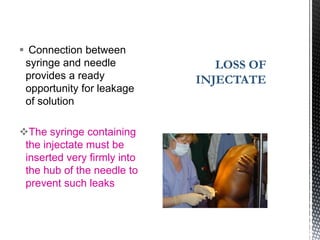
 Connection between
syringe and needle
provides a ready
opportunity for leakage
of solution
The syringe containing
the injectate must be
inserted very firmly into
the hub of the needle to
prevent such leaks
LOSS OF
INJECTATE
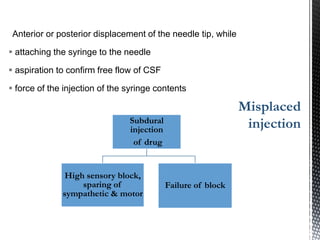
Anterior or posterior displacement of the needle tip, while
 attaching the syringe to the needle
 aspiration to confirm free flow of CSF
 force of the injection of the syringe contents
Misplaced
injectionSubdural
injection
of drug
High sensory block,
sparing of
sympathetic & motor
Failure of block
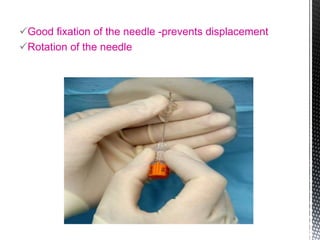
Good fixation of the needle -prevents displacement
Rotation of the needle
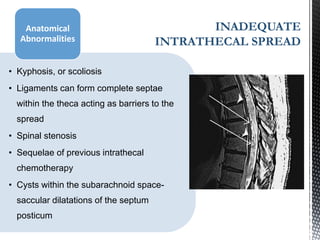
• Kyphosis, or scoliosis
• Ligaments can form complete septae
within the theca acting as barriers to the
spread
• Spinal stenosis
• Sequelae of previous intrathecal
chemotherapy
• Cysts within the subarachnoid space-
saccular dilatations of the septum
posticum
Anatomical
Abnormalities
INADEQUATE
INTRATHECAL SPREAD
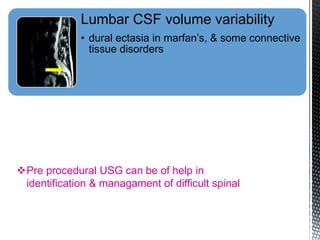
Lumbar CSF volume variability
• dural ectasia in marfan’s, & some connective
tissue disorders
Pre procedural USG can be of help in
identification & managament of difficult spinal
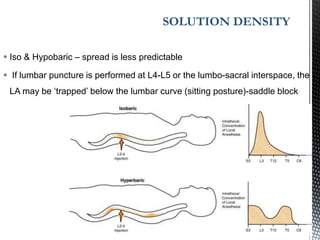
 Iso & Hypobaric – spread is less predictable
 If lumbar puncture is performed at L4-L5 or the lumbo-sacral interspace, the
LA may be ‘trapped’ below the lumbar curve (sitting posture)-saddle block
SOLUTION DENSITY
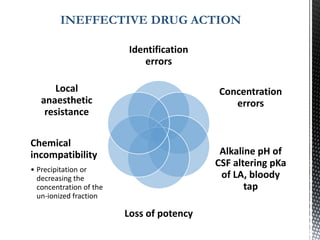
Identification
errors
Concentration
errors
Alkaline pH of
CSF altering pKa
of LA, bloody
tap
Loss of potency
Chemical
incompatibility
• Precipitation or
decreasing the
concentration of the
un-ionized fraction
Local
anaesthetic
resistance
INEFFECTIVE DRUG ACTION
Anxious patients
Requires good preoperative patient counseling followed
by a supportive approach, with intraoperative sedation
FAILURE OF SUBSEQUENT MANAGEMENT
Advisable to start testing in the lower segments, where
onset will be fastest, and work upwards.
Proving early on that there is some effect encourages
patient confidence; testing too soon does the opposite
 Problems of inadequacy & duration can
be solved by using either continuous
spinal or combined spinal–epidural
techniques
 Introducing a catheter may be difficult in
subarachnoid space
 To Avoid misdirection of LA solution- not
more than 2-3cm in intrathecal space
MANAGEMENT
OF
FAILURE
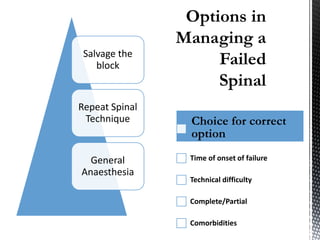
Salvage the
block
Repeat Spinal
Technique
General
Anaesthesia
Choice for correct
option
Time of onset of failure
Technical difficulty
Complete/Partial
Comorbidities
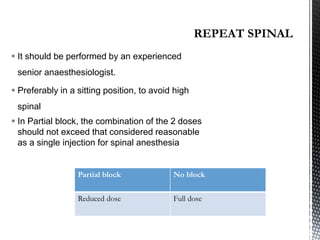
Partial block No block
Reduced dose Full dose
 It should be performed by an experienced
senior anaesthesiologist.
 Preferably in a sitting position, to avoid high
spinal
 In Partial block, the combination of the 2 doses
should not exceed that considered reasonable
as a single injection for spinal anesthesia
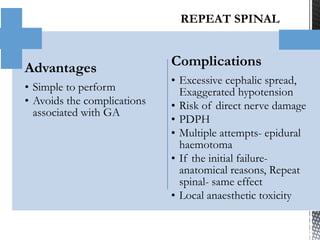
Advantages
• Simple to perform
• Avoids the complications
associated with GA
Complications
• Excessive cephalic spread,
Exaggerated hypotension
• Risk of direct nerve damage
• PDPH
• Multiple attempts- epidural
haemotoma
• If the initial failure-
anatomical reasons, Repeat
spinal- same effect
• Local anaesthetic toxicity
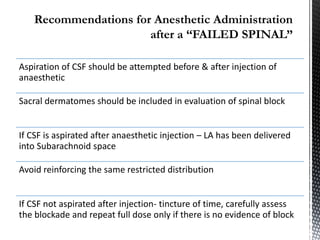
Aspiration of CSF should be attempted before & after injection of
anaesthetic
Sacral dermatomes should be included in evaluation of spinal block
If CSF is aspirated after anaesthetic injection – LA has been delivered
into Subarachnoid space
Avoid reinforcing the same restricted distribution
If CSF not aspirated after injection- tincture of time, carefully assess
the blockade and repeat full dose only if there is no evidence of block
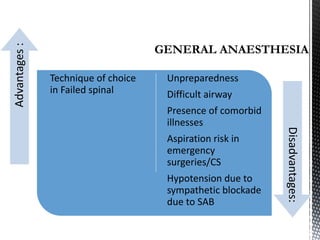
Technique of choice
in Failed spinal
Unpreparedness
Difficult airway
Presence of comorbid
illnesses
Aspiration risk in
emergency
surgeries/CS
Hypotension due to
sympathetic blockade
due to SAB
Advantages:
Disadvantages:
Inadequate spread due to vertebral canal pathology-
 R/O any signs & symptoms of Neurological disease
Investigating local anaesthetic effectiveness
 When series of failures in a short period of time
 Performing skin infiltration with some of the solution intended for
the spinal injection should demonstrate that it is effective
In 1907 Alfred E. Barker wrote that for successful spinal analgesia
it is necessary
‘to enter the lumbar dural sac effectually with the point of the
needle, and to discharge through this, all the contemplated dose of
the drug, directly and freely into the cerebrospinal fluid, below the
termination of the cord’ (Barker, 1907).
Failure to follow the details of this advice is the commonest cause
of a poor result
 Cousins & Bridenbaugh’s Neural Blockade In Clinical Anaesthesia & Pain Medicine
 Complications of Regional Anaesthesia, Brendan T. Finucane
 Br. J. Anaesth. (2009) 102 (6):739-748.doi: 10.1093/bja/aep096First published
online: May 6, 2009
 Pokharel, A. "Study of Failed Spinal Anesthesia Undergoing Caesarean Section and
Its Management." Post-Graduate Medical Journal of NAMS 11.02 (2011).
 Analgesia & Anesthesia in Labor and Delivery By D. K. Baheti
 Basics of Anesthesia, 6th Ed by Ronald Miller
Sub arachnoid block failure

Sub arachnoid block failure

  • 1.
    By Dr.Ayshvarya Guide: DrSendhil Kumar Mohan Moderator: Dr.N.Jothi K.A.P.V.G.M.C, TRICHY
  • 2.
    Neuraxial Blockade involvinginjection of local anaesthetic in the sub-arachnoid space Spinal anesthesia can be classified as a failure if the surgical operation cannot be performed without the addition of general anesthetic or an alternative regional block No blockade Inadequate Block for the surgery
  • 3.
    The incidence offailure with spinal anesthesia varies in different studies, ranging from 3% to 17%. In some smaller studies, failure rates as high as 30% have been reported More among unsupervised trainees
  • 4.
  • 5.
  • 6.
  • 7.
  • 8.
    Aim is tooptimize the pt’s position & prevent any movement anxiolytic premedication local anaesthetic infiltration at the puncture site
  • 9.
     Abolishing thenatural lumbar lordosis by flexing maximally the whole spine (including the neck), the hips, and knees increases the space between the lumbar laminae and spines  Sitting or Lateral Lateral Position
  • 10.
     Sitting positionconfers the advantage of making the midline easier to identify, particularly in obese patients increases hydrostatic pressure in the CSF, which may make spinal needle placement and fluid aspiration easier
  • 11.
     Approach  Midlineapproach  Can be angulated cephalad when resistance is felt  Lateral/Paramedian approach- when the ligaments are calcified Mental picture of the spinal anatomy & Appreciation of loss of resistance
  • 12.
     Size 18to 25G do not affect the success rate  Thinner needles, greater tendency to deviate, slower appearance of CSF in the hub, more chances of failure
  • 13.
     Opening isproximal to the tip to prevent PDPH  Small displacement can cause drug deposition in epi/subdural space  Opening is longer than in Quincke’s, resulting in dura acting as a flap valve across the opening
  • 14.
    Dry tap The needle& stylet should be checked for any block Pseudolumbar puncture Needle should not be inserted without the stylet
  • 15.
     A fullyeffective dose should be both chosen and actually deposited in the CSF DRUG SOLUTION INJECTION ERRORS
  • 16.
    Determines the quality& duration of the block Factors influencing intrathecal drug spread & the LA drug With low-dose, selective or U/L spinal anesthesia, the proper technique more important than with higher doses. whole of the dose must be delivered into the CSF, including the dead space of the needle. DOSE SELECTION
  • 17.
     Connection between syringeand needle provides a ready opportunity for leakage of solution The syringe containing the injectate must be inserted very firmly into the hub of the needle to prevent such leaks LOSS OF INJECTATE
  • 18.
    Anterior or posteriordisplacement of the needle tip, while  attaching the syringe to the needle  aspiration to confirm free flow of CSF  force of the injection of the syringe contents Misplaced injectionSubdural injection of drug High sensory block, sparing of sympathetic & motor Failure of block
  • 19.
    Good fixation ofthe needle -prevents displacement Rotation of the needle
  • 20.
    • Kyphosis, orscoliosis • Ligaments can form complete septae within the theca acting as barriers to the spread • Spinal stenosis • Sequelae of previous intrathecal chemotherapy • Cysts within the subarachnoid space- saccular dilatations of the septum posticum Anatomical Abnormalities INADEQUATE INTRATHECAL SPREAD
  • 21.
    Lumbar CSF volumevariability • dural ectasia in marfan’s, & some connective tissue disorders Pre procedural USG can be of help in identification & managament of difficult spinal
  • 22.
     Iso &Hypobaric – spread is less predictable  If lumbar puncture is performed at L4-L5 or the lumbo-sacral interspace, the LA may be ‘trapped’ below the lumbar curve (sitting posture)-saddle block SOLUTION DENSITY
  • 23.
    Identification errors Concentration errors Alkaline pH of CSFaltering pKa of LA, bloody tap Loss of potency Chemical incompatibility • Precipitation or decreasing the concentration of the un-ionized fraction Local anaesthetic resistance INEFFECTIVE DRUG ACTION
  • 24.
    Anxious patients Requires goodpreoperative patient counseling followed by a supportive approach, with intraoperative sedation FAILURE OF SUBSEQUENT MANAGEMENT
  • 25.
    Advisable to starttesting in the lower segments, where onset will be fastest, and work upwards. Proving early on that there is some effect encourages patient confidence; testing too soon does the opposite
  • 26.
     Problems ofinadequacy & duration can be solved by using either continuous spinal or combined spinal–epidural techniques  Introducing a catheter may be difficult in subarachnoid space  To Avoid misdirection of LA solution- not more than 2-3cm in intrathecal space
  • 27.
  • 28.
    Salvage the block Repeat Spinal Technique General Anaesthesia Choicefor correct option Time of onset of failure Technical difficulty Complete/Partial Comorbidities
  • 29.
    Partial block Noblock Reduced dose Full dose  It should be performed by an experienced senior anaesthesiologist.  Preferably in a sitting position, to avoid high spinal  In Partial block, the combination of the 2 doses should not exceed that considered reasonable as a single injection for spinal anesthesia
  • 30.
    Advantages • Simple toperform • Avoids the complications associated with GA Complications • Excessive cephalic spread, Exaggerated hypotension • Risk of direct nerve damage • PDPH • Multiple attempts- epidural haemotoma • If the initial failure- anatomical reasons, Repeat spinal- same effect • Local anaesthetic toxicity
  • 31.
    Aspiration of CSFshould be attempted before & after injection of anaesthetic Sacral dermatomes should be included in evaluation of spinal block If CSF is aspirated after anaesthetic injection – LA has been delivered into Subarachnoid space Avoid reinforcing the same restricted distribution If CSF not aspirated after injection- tincture of time, carefully assess the blockade and repeat full dose only if there is no evidence of block
  • 32.
    Technique of choice inFailed spinal Unpreparedness Difficult airway Presence of comorbid illnesses Aspiration risk in emergency surgeries/CS Hypotension due to sympathetic blockade due to SAB Advantages: Disadvantages:
  • 33.
    Inadequate spread dueto vertebral canal pathology-  R/O any signs & symptoms of Neurological disease Investigating local anaesthetic effectiveness  When series of failures in a short period of time  Performing skin infiltration with some of the solution intended for the spinal injection should demonstrate that it is effective
  • 34.
    In 1907 AlfredE. Barker wrote that for successful spinal analgesia it is necessary ‘to enter the lumbar dural sac effectually with the point of the needle, and to discharge through this, all the contemplated dose of the drug, directly and freely into the cerebrospinal fluid, below the termination of the cord’ (Barker, 1907). Failure to follow the details of this advice is the commonest cause of a poor result
  • 35.
     Cousins &Bridenbaugh’s Neural Blockade In Clinical Anaesthesia & Pain Medicine  Complications of Regional Anaesthesia, Brendan T. Finucane  Br. J. Anaesth. (2009) 102 (6):739-748.doi: 10.1093/bja/aep096First published online: May 6, 2009  Pokharel, A. "Study of Failed Spinal Anesthesia Undergoing Caesarean Section and Its Management." Post-Graduate Medical Journal of NAMS 11.02 (2011).  Analgesia & Anesthesia in Labor and Delivery By D. K. Baheti  Basics of Anesthesia, 6th Ed by Ronald Miller

Editor's Notes

  • #12 , insertion should start precisely in the mid-line, mid-way between the posterior spines, with the needle shaft at right angles to the back in both planes
  • #17 the specific local anaesthetic used, the baricity of that solution, the patient’s subsequent posture, the type of block intended, and the anticipated duration of surgery
  • #20 reduces the risk of the membrane edges catching on the opening.
  • #21 curves of the vertebral column are integral to solution spread
  • #24 Improper mixing or excessive dilution Resistance due to mutation of sodium ion channel
  • #27 Rapid onset and profound block of spinal anaesthesia,
  • #29 : Flex the hips & knee & give Head down tilt, or turning the patient onto the unblocked side in c/o Unilateral block, entonox inhalation in a parturient, local infiltration of the wound, supplementation with iv anaesthetics