Factoring & Forfeiting
What is Factoring?
Factoring is a financial transaction in which a
business sells its accounts receivable (i.e,
invoices) to a factor at a discount.
It is the conversion of credit sales into cash.

a financial institution (factor) buys the accounts receivable of a
company (Client) and pays up to 80%(rarely up to 90%) of the amount
immediately on agreement.
Factoring company pays the remaining amount (Balance 20%-finance
cost-operating cost) to the client when the customer pays the debt.
Collection of debt from the customer is done either by the factor or client
Case Study #1... James Manufacturing, Inc.
James Manufacturing is a small builder
of boat trailers and related products.
Bill James, its owner, was awarded a
contract to supply the Florida Fish
and Wildlife Conservation Commission
with 72 new trailers to replace old
units that were rusty and failing.
Each trailer was $2,900 for a total value of
$208,800.

James had 20 trailers in inventory to begin delivery and the contract called
for all trailers to be delivered within 60 days.
Problems Faced By James:•It had little excess capital.
•The state pays slowly and Bill James knew he would not
receive payment for the 20 trailer.
•He needed cash to order bulk steel and hardware to build the remaining 52
trailers and to be able to deliver them by the 60 day purchase order deadline

Solution:•He visited a local community bank where the loan officer explained him the
need of factoring.
•James was introduced to bank’s factoring officer.

•An account was immediately established to provide working capital to meet the
order.
RESULT
•

Through factoring, James would receive an initial advance from the
bank of $46,400 (80%) on the $58,000 invoice after delivery of the 20
finished trailers in inventory.

•

That advance of $46,500 was enough to then buy the bulk steel and
hardware to complete the other 52 trailers in time.

•

After the state paid for the 20 trailer shipment, the bank would then
give James the $11,500 not initially advanced less a small factoring
fee for services.
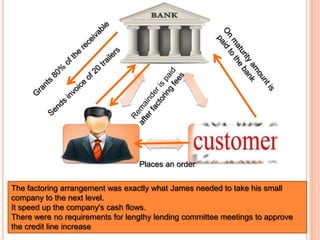
Places an order

The factoring arrangement was exactly what James needed to take his small
company to the next level.
It speed up the company's cash flows.
There were no requirements for lengthy lending committee meetings to approve
the credit line increase
CASE STUDY
BETTY’S BUILDING SERVICE,INC
BETTY'S BUILDING MAINTENANCE SERVICE, INC.
PROVIDES EXTERIOR BUILDING MAINTENANCE

INCLUDING PRESSURE WASHING AND WINDOW CLEANING


Betty receives many opportunities in the past as the contracts are relatively
large and both the county and city take 45 days to make payment for services
performed.



Betty's company has few hard assets to be used as collateral and she
cannot secure any form of business loan



Betty was contacted by Bill, a loan broker and small business consultant,
who explained to her the benefits of factoring



Bill then introduced Betty to a factor's business development officer who
quickly forwarded a proposal for a factoring arrangement whereby Betty

would be charged a flat rate of 4% of the invoice face amount for the first 45
days the invoice was outstanding and 1% for each fifteen days thereafter.


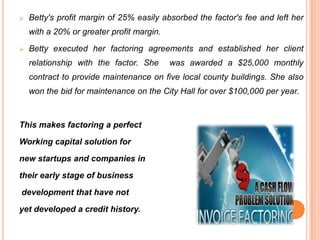
Betty's profit margin of 25% easily absorbed the factor's fee and left her

with a 20% or greater profit margin.


Betty executed her factoring agreements and established her client
relationship with the factor. She

was awarded a $25,000 monthly

contract to provide maintenance on five local county buildings. She also
won the bid for maintenance on the City Hall for over $100,000 per year.

This makes factoring a perfect

Working capital solution for
new startups and companies in
their early stage of business
development that have not
yet developed a credit history.
ORIGIN


Came into existence in the year 1920



It was not an organised sector that time



Association of British Factors(ABF) came in 1976



Nearly 90% of global factoring turnover comes from USA &

European countries


RBI appointed the C.S.Kalyanasundaram Committee (1988)



It suggested to start factoring by a bank through its subsidiary
AS OF TODAY,


Worldwide, factoring volume is more than USD 700 billion a year



Spread over nearly 60 countries and covering more than 1,00,000
businesses.



Particularly in developed countries, factoring is an accepted way of
conducting business.
FCI (FACTORS CHAIN INTERNATIONAL)



FCI is a global network of leading factoring countries



It helps its members achieving competitive advantage through:


A global network



Modern & effective communication system



Reliable legal framework



Standard procedures



Universal quality



World wide promotion



Training programmes
FCI MEMBERS



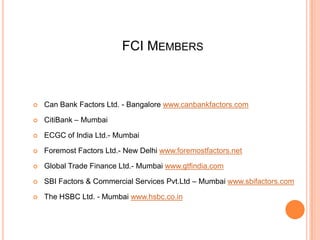
Can Bank Factors Ltd. - Bangalore www.canbankfactors.com



CitiBank – Mumbai



ECGC of India Ltd.- Mumbai



Foremost Factors Ltd.- New Delhi www.foremostfactors.net



Global Trade Finance Ltd.- Mumbai www.gtfindia.com



SBI Factors & Commercial Services Pvt.Ltd – Mumbai www.sbifactors.com



The HSBC Ltd. - Mumbai www.hsbc.co.in
OFFSHEET
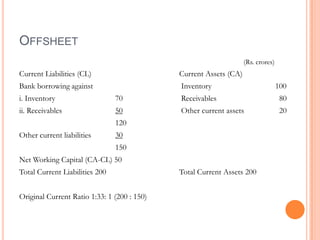
(Rs. crores)

Current Liabilities (CL)

Current Assets (CA)

Bank borrowing against

Inventory

100

i. Inventory

70

Receivables

80

ii. Receivables

50

Other current assets

20

120
Other current liabilities

30
150

Net Working Capital (CA-CL) 50
Total Current Liabilities 200
Original Current Ratio 1:33: 1 (200 : 150)

Total Current Assets 200
BALANCE SHEET: POST-FACTORING POSITION
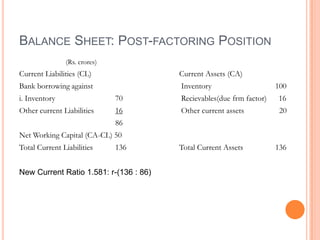
(Rs. crores)

Current Liabilities (CL)

Current Assets (CA)

Bank borrowing against

Inventory

100

i. Inventory

70

Recievables(due frm factor)

16

Other current Liabilities

16

Other current assets

20

Total Current Assets

136

86
Net Working Capital (CA-CL) 50
Total Current Liabilities

136

New Current Ratio 1.581: r-(136 : 86)
IMPACT OF FACTORING ON BALANCE SHEET


Improvement in Current Ratio.



The current ratio improves from 1.33: 1 (before factoring) to 1.58 : 1.
The new current ratio is better for the client and his credit rating goes
up before public eye.



Reduction in Current Liabilities.



An advance payment of Rs. 64 crores (i.e. 80% of 80 crore) is
utilised in repaying the bank borrowings against receivables to the
tune of Rs. 50 crores and for meeting other current liabilities to the
tune of Rs. 14 crores.
CASE STUDY
An exporter recently approached AIB Trade Finance Services with a common problem. The
company was spending a lot of time chasing their debtors for payment. The Financial
Director complained that despite having delivered their goods to the buyer, they were
incurring considerable expense in staff time and communication costs in order to chase their
money.
Despite the buyer's agreement to pay at the end of the month following the invoice date, the
exporter found that payment was actually received 30 to 60 days later. In addition the time
spent chasing the payment was creating additional costs as well as increasing the time spent.

CAN THE EXPORTER REGAIN CONTROL?
AIB Trade Finance Services advised the company to consider using a Documentary
Collection to obtain payment, or a commitment to pay from the buyer. This meant the
exporter was encouraged to send their shipping documents to the buyer through the banking
system accompanied by a Bill of Exchange* drawn on the buyer with a payment date at the
end of the month following the date of shipment.
The exporter instructed AIB Trade Finance Services, who in turn instructed the buyer's bank,
to only release the shipping documents to the buyer against their acceptance of the Bill of
Exchange and their agreement to make the payment on the due date. In addition AIB Trade
Finance Services was able to instruct the buyer's bank to hold the accepted Bill of Exchange
and present it to the buyer for payment on the due date.
THE BENEFITS FOR EXPORTERS WHEN USING DOCUMENTARY
COLLECTIONS.
The use of a Documentary Collection gives an exporter greater control over their goods and
when they get paid.
•The exporter can use the banking system to obtain the buyers commitment to pay.
•The exporter can also use the banking system to collect the debt.
•The exporter can retain control over their shipping documents until the buyer has paid or
agreed to pay.
•Documentary Collections are a relatively inexpensive payment mechanism.
For further protection and control the exporter could have requested that the buyer's bank
guarantee the buyer's commitment to pay. This provides additional benefits as follows:
•Gives greater security as the buyer's bank has added its guarantee that the Bill of Exchange
will be paid at maturity.
•It eliminates the risk of non-payment in the event of the buyer having difficulties.
•It also provides an opportunity to obtain finance through non-recourse Bill discounting.

CONCLUSION
This is an acceptable trading option for well known and financially secure customers in
developed economies, it may not be appropriate for customers with weaker financial
positions or located in less developed economies. The Documentary Collection can provide
some additional security for the exporter whilst ensuring that the payment process is not
unduly expensive or complex.
INVOICE DISCOUNTING
CASE STUDY-DEMICA
Close Invoice Finance Limited started life as a small factoring company called
Century Factors, based above a car showroom in Yeovil, Somerset. Century became
one of the first acquisitions by Close Brothers and in 1993 its name was changed to
Close Invoice Finance Limited.
When the company started in 1984, it had just 20 clients. Today it provides finance
services to over 1,000 clients and has won many accolades. Close Invoice Finance
was named Best Factoring & Invoice Discounting Provider from 2006 to 2009 by
Business Moneyfacts. In October 2008 Close Invoice Finance Limited won a
Global Business Excellence (GBE) Award for Outstanding Technology Solutions
for its IDeal invoice discounting and factoring system. In November 2008 Close
Invoice Finance Limited won one of the most prestigious awards in the IT industry:
a Computing Award for Excellence 2008 from Computing magazine, winning the
category of Best Small Business IT Strategy for its IDeal invoice discounting and
factoring system.
Close Invoice Finance is a distinct business group within the Close Brothers Group,
one of Europe’s most enterprising merchant banks and a FTSE top 250 listed
company. Close Invoice Finance continues to grow at a rate that is ahead of the
industry average and contributes more than 7% of the Close Brothers Group’s total
revenue.












Great expectations lead to greater achievements:The invoice discounting (asset based lending) solution that Close
Invoice
To enable the business to work with customers whose revenues were
otherwise too small or their ledger composition too complex or highrisk to service safely and cost-effectively.
Asset based lending to provide a transparent view of the underlying
debt structure of clients through invoice level access.
To improve service levels and provide self-service options for clients
(through asset based lending).
Receivables financing to achieve greater account management
efficiencies, Therefore, lower costs in order to be able to offer
customers more flexible and more competitive pricing.
To increase overall control and significantly reduce risk (through asset
based lending).
CASE STUDY: THE TRANSACTION:
TESCO/FOX FRESH EXPORT
ZIMBABWE
Under

this forfaiting transaction, the local company (Fox Fresh exports Zimbabwe)
airfreights its flowers or fresh vegetables to a foreign buyer, in this case, Tesco
Supermarkets in the United Kingdom.
Tesco

issues a tenored promissory note to the exporter. These notes are then
avalized by Tesco’s bank. Once the aval is added, the exporter, instead of waiting
for 30 to 180 days for payment and/or borrowing money on the local market to
finance his working capital needs, can approach a bank for immediate payment in
foreign currency less a discount rate.
The

exporter would then use the confirmed receivables backed by the aval of the
bank as security and would thus receive payment 2 – 4 days after exporting.
PROCEDURE :
 Fox

Fresh Exports Zimbabwe receives confirmation of
value of their exports and settlement dates from Tesco.
 Fox Fresh Exports Zimbabwe instructs Tesco to issue
promissory notes to be paid through its bank to
Rabobank.
 Tesco issues avalized promissory notes to the exporter.
 Rabobank pays Fox Fresh Exports Zimbabwe less the
discount (5%).
 In 90 days Tesco’s bankers make final settlement with
Rabobank.
ADVANTAGES IN THE TESCO/FOX FRESH
EXPORT ZIMBABWE TRANSACTION
To the buyer (Tesco):
 Enjoy a bit of credit terms
 The buyer can now get the
product, sell, receive money and invest it before final
settlement in 90 – 180 days.
2. To the exporter (Fox Fresh Exports Zimbabwe):
 Paid within 7 days of exporting.
 This facility does not require any rigorous credit
rating for Fox Fresh Exports Zimbabwe .
1.
3. To the bank (Rabobank):

Does not need to worry about country risk (Zimbabwe
risk).
 Facility is based on a transaction basis and the risk that
Rabobank is taking is with the foreign buyer Tesco,
and not with Fox Fresh Exports Zimbabwe.
4. To the country (Zimbabwe):
 Zimbabwe, is now collecting its foreign currency
receipts faster than before, thereby improving on its
balance of payments or foreign currency reserves.

FORFAITING
Forfaiting, or Medium-Term Capital Goods Financing, means
selling a bill of exchange, at a discount, to a third party, the Forfaiter,
who collects the payment from an, essentially, overseas customer,
through a collateral bank(s), and, thus, assuming the underlying
responsibility of exporters and simultaneously providing trade finance
for importers by converting a short-term loan to a medium term one.
FORFAITING…









Done on a non - recourse basis
Used for international trade transactions, usually for transactions not less than
$2,50,000
Tenor of instrument ranges from 180 days to 10 years payments are made
quarterly, semi-annually, annually
Not so Popular as People
are suspicious of its simplicity
coupled with a lack of complex documentation
INFORMATION THE FORFAITER NEEDS


who the buyer is and his nationality;



what goods are being sold;



details regarding the value and currency of the contract;



the date and duration of the contract including the credit period

and number and timing of payments (including any interest rate
already agreed with the buyer)


evidence of debt that will be used (either promissory notes, bills

of exchange, letters of credit)
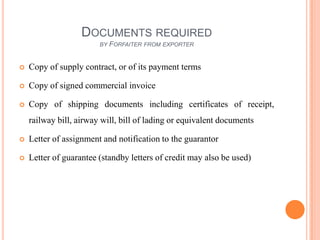
DOCUMENTS REQUIRED
BY

FORFAITER FROM EXPORTER



Copy of supply contract, or of its payment terms



Copy of signed commercial invoice



Copy of shipping documents including certificates of receipt,
railway bill, airway will, bill of lading or equivalent documents



Letter of assignment and notification to the guarantor



Letter of guarantee (standby letters of credit may also be used)
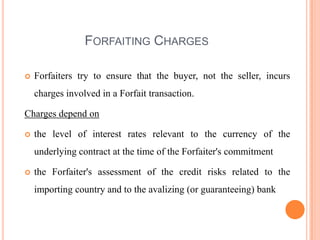
FORFAITING CHARGES


Forfaiters try to ensure that the buyer, not the seller, incurs
charges involved in a Forfait transaction.

Charges depend on


the level of interest rates relevant to the currency of the
underlying contract at the time of the Forfaiter's commitment



the Forfaiter's assessment of the credit risks related to the
importing country and to the avalizing (or guaranteeing) bank
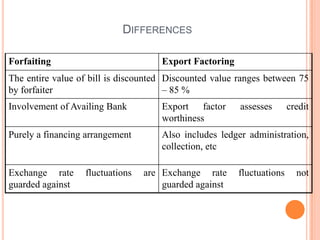
DIFFERENCES
Forfaiting

Export Factoring

The entire value of bill is discounted Discounted value ranges between 75
by forfaiter
– 85 %
Involvement of Availing Bank

Export factor
worthiness

Purely a financing arrangement

Also includes ledger administration,
collection, etc

Exchange rate
guarded against

fluctuations

are Exchange rate
guarded against

assesses

fluctuations

credit

not
Factoring and forfaiting

Factoring and forfaiting

  • 1.
  • 2.
    What is Factoring? Factoringis a financial transaction in which a business sells its accounts receivable (i.e, invoices) to a factor at a discount. It is the conversion of credit sales into cash. a financial institution (factor) buys the accounts receivable of a company (Client) and pays up to 80%(rarely up to 90%) of the amount immediately on agreement. Factoring company pays the remaining amount (Balance 20%-finance cost-operating cost) to the client when the customer pays the debt. Collection of debt from the customer is done either by the factor or client
  • 3.
    Case Study #1...James Manufacturing, Inc. James Manufacturing is a small builder of boat trailers and related products. Bill James, its owner, was awarded a contract to supply the Florida Fish and Wildlife Conservation Commission with 72 new trailers to replace old units that were rusty and failing. Each trailer was $2,900 for a total value of $208,800. James had 20 trailers in inventory to begin delivery and the contract called for all trailers to be delivered within 60 days.
  • 4.
    Problems Faced ByJames:•It had little excess capital. •The state pays slowly and Bill James knew he would not receive payment for the 20 trailer. •He needed cash to order bulk steel and hardware to build the remaining 52 trailers and to be able to deliver them by the 60 day purchase order deadline Solution:•He visited a local community bank where the loan officer explained him the need of factoring. •James was introduced to bank’s factoring officer. •An account was immediately established to provide working capital to meet the order.
  • 5.
    RESULT • Through factoring, Jameswould receive an initial advance from the bank of $46,400 (80%) on the $58,000 invoice after delivery of the 20 finished trailers in inventory. • That advance of $46,500 was enough to then buy the bulk steel and hardware to complete the other 52 trailers in time. • After the state paid for the 20 trailer shipment, the bank would then give James the $11,500 not initially advanced less a small factoring fee for services.
  • 6.
    Places an order Thefactoring arrangement was exactly what James needed to take his small company to the next level. It speed up the company's cash flows. There were no requirements for lengthy lending committee meetings to approve the credit line increase
  • 7.
  • 8.
    BETTY'S BUILDING MAINTENANCESERVICE, INC. PROVIDES EXTERIOR BUILDING MAINTENANCE INCLUDING PRESSURE WASHING AND WINDOW CLEANING  Betty receives many opportunities in the past as the contracts are relatively large and both the county and city take 45 days to make payment for services performed.  Betty's company has few hard assets to be used as collateral and she cannot secure any form of business loan  Betty was contacted by Bill, a loan broker and small business consultant, who explained to her the benefits of factoring  Bill then introduced Betty to a factor's business development officer who quickly forwarded a proposal for a factoring arrangement whereby Betty would be charged a flat rate of 4% of the invoice face amount for the first 45 days the invoice was outstanding and 1% for each fifteen days thereafter.
  • 9.
     Betty's profit marginof 25% easily absorbed the factor's fee and left her with a 20% or greater profit margin.  Betty executed her factoring agreements and established her client relationship with the factor. She was awarded a $25,000 monthly contract to provide maintenance on five local county buildings. She also won the bid for maintenance on the City Hall for over $100,000 per year. This makes factoring a perfect Working capital solution for new startups and companies in their early stage of business development that have not yet developed a credit history.
  • 10.
    ORIGIN  Came into existencein the year 1920  It was not an organised sector that time  Association of British Factors(ABF) came in 1976  Nearly 90% of global factoring turnover comes from USA & European countries  RBI appointed the C.S.Kalyanasundaram Committee (1988)  It suggested to start factoring by a bank through its subsidiary
  • 11.
    AS OF TODAY,  Worldwide,factoring volume is more than USD 700 billion a year  Spread over nearly 60 countries and covering more than 1,00,000 businesses.  Particularly in developed countries, factoring is an accepted way of conducting business.
  • 12.
    FCI (FACTORS CHAININTERNATIONAL)  FCI is a global network of leading factoring countries  It helps its members achieving competitive advantage through:  A global network  Modern & effective communication system  Reliable legal framework  Standard procedures  Universal quality  World wide promotion  Training programmes
  • 13.
    FCI MEMBERS  Can BankFactors Ltd. - Bangalore www.canbankfactors.com  CitiBank – Mumbai  ECGC of India Ltd.- Mumbai  Foremost Factors Ltd.- New Delhi www.foremostfactors.net  Global Trade Finance Ltd.- Mumbai www.gtfindia.com  SBI Factors & Commercial Services Pvt.Ltd – Mumbai www.sbifactors.com  The HSBC Ltd. - Mumbai www.hsbc.co.in
  • 14.
    OFFSHEET (Rs. crores) Current Liabilities(CL) Current Assets (CA) Bank borrowing against Inventory 100 i. Inventory 70 Receivables 80 ii. Receivables 50 Other current assets 20 120 Other current liabilities 30 150 Net Working Capital (CA-CL) 50 Total Current Liabilities 200 Original Current Ratio 1:33: 1 (200 : 150) Total Current Assets 200
  • 15.
    BALANCE SHEET: POST-FACTORINGPOSITION (Rs. crores) Current Liabilities (CL) Current Assets (CA) Bank borrowing against Inventory 100 i. Inventory 70 Recievables(due frm factor) 16 Other current Liabilities 16 Other current assets 20 Total Current Assets 136 86 Net Working Capital (CA-CL) 50 Total Current Liabilities 136 New Current Ratio 1.581: r-(136 : 86)
  • 16.
    IMPACT OF FACTORINGON BALANCE SHEET  Improvement in Current Ratio.  The current ratio improves from 1.33: 1 (before factoring) to 1.58 : 1. The new current ratio is better for the client and his credit rating goes up before public eye.  Reduction in Current Liabilities.  An advance payment of Rs. 64 crores (i.e. 80% of 80 crore) is utilised in repaying the bank borrowings against receivables to the tune of Rs. 50 crores and for meeting other current liabilities to the tune of Rs. 14 crores.
  • 18.
    CASE STUDY An exporterrecently approached AIB Trade Finance Services with a common problem. The company was spending a lot of time chasing their debtors for payment. The Financial Director complained that despite having delivered their goods to the buyer, they were incurring considerable expense in staff time and communication costs in order to chase their money. Despite the buyer's agreement to pay at the end of the month following the invoice date, the exporter found that payment was actually received 30 to 60 days later. In addition the time spent chasing the payment was creating additional costs as well as increasing the time spent. CAN THE EXPORTER REGAIN CONTROL? AIB Trade Finance Services advised the company to consider using a Documentary Collection to obtain payment, or a commitment to pay from the buyer. This meant the exporter was encouraged to send their shipping documents to the buyer through the banking system accompanied by a Bill of Exchange* drawn on the buyer with a payment date at the end of the month following the date of shipment. The exporter instructed AIB Trade Finance Services, who in turn instructed the buyer's bank, to only release the shipping documents to the buyer against their acceptance of the Bill of Exchange and their agreement to make the payment on the due date. In addition AIB Trade Finance Services was able to instruct the buyer's bank to hold the accepted Bill of Exchange and present it to the buyer for payment on the due date.
  • 19.
    THE BENEFITS FOREXPORTERS WHEN USING DOCUMENTARY COLLECTIONS. The use of a Documentary Collection gives an exporter greater control over their goods and when they get paid. •The exporter can use the banking system to obtain the buyers commitment to pay. •The exporter can also use the banking system to collect the debt. •The exporter can retain control over their shipping documents until the buyer has paid or agreed to pay. •Documentary Collections are a relatively inexpensive payment mechanism. For further protection and control the exporter could have requested that the buyer's bank guarantee the buyer's commitment to pay. This provides additional benefits as follows: •Gives greater security as the buyer's bank has added its guarantee that the Bill of Exchange will be paid at maturity. •It eliminates the risk of non-payment in the event of the buyer having difficulties. •It also provides an opportunity to obtain finance through non-recourse Bill discounting. CONCLUSION This is an acceptable trading option for well known and financially secure customers in developed economies, it may not be appropriate for customers with weaker financial positions or located in less developed economies. The Documentary Collection can provide some additional security for the exporter whilst ensuring that the payment process is not unduly expensive or complex.
  • 20.
  • 21.
    Close Invoice FinanceLimited started life as a small factoring company called Century Factors, based above a car showroom in Yeovil, Somerset. Century became one of the first acquisitions by Close Brothers and in 1993 its name was changed to Close Invoice Finance Limited. When the company started in 1984, it had just 20 clients. Today it provides finance services to over 1,000 clients and has won many accolades. Close Invoice Finance was named Best Factoring & Invoice Discounting Provider from 2006 to 2009 by Business Moneyfacts. In October 2008 Close Invoice Finance Limited won a Global Business Excellence (GBE) Award for Outstanding Technology Solutions for its IDeal invoice discounting and factoring system. In November 2008 Close Invoice Finance Limited won one of the most prestigious awards in the IT industry: a Computing Award for Excellence 2008 from Computing magazine, winning the category of Best Small Business IT Strategy for its IDeal invoice discounting and factoring system. Close Invoice Finance is a distinct business group within the Close Brothers Group, one of Europe’s most enterprising merchant banks and a FTSE top 250 listed company. Close Invoice Finance continues to grow at a rate that is ahead of the industry average and contributes more than 7% of the Close Brothers Group’s total revenue.
  • 22.
          Great expectations leadto greater achievements:The invoice discounting (asset based lending) solution that Close Invoice To enable the business to work with customers whose revenues were otherwise too small or their ledger composition too complex or highrisk to service safely and cost-effectively. Asset based lending to provide a transparent view of the underlying debt structure of clients through invoice level access. To improve service levels and provide self-service options for clients (through asset based lending). Receivables financing to achieve greater account management efficiencies, Therefore, lower costs in order to be able to offer customers more flexible and more competitive pricing. To increase overall control and significantly reduce risk (through asset based lending).
  • 23.
    CASE STUDY: THETRANSACTION: TESCO/FOX FRESH EXPORT ZIMBABWE Under this forfaiting transaction, the local company (Fox Fresh exports Zimbabwe) airfreights its flowers or fresh vegetables to a foreign buyer, in this case, Tesco Supermarkets in the United Kingdom. Tesco issues a tenored promissory note to the exporter. These notes are then avalized by Tesco’s bank. Once the aval is added, the exporter, instead of waiting for 30 to 180 days for payment and/or borrowing money on the local market to finance his working capital needs, can approach a bank for immediate payment in foreign currency less a discount rate. The exporter would then use the confirmed receivables backed by the aval of the bank as security and would thus receive payment 2 – 4 days after exporting.
  • 24.
    PROCEDURE :  Fox FreshExports Zimbabwe receives confirmation of value of their exports and settlement dates from Tesco.  Fox Fresh Exports Zimbabwe instructs Tesco to issue promissory notes to be paid through its bank to Rabobank.  Tesco issues avalized promissory notes to the exporter.  Rabobank pays Fox Fresh Exports Zimbabwe less the discount (5%).  In 90 days Tesco’s bankers make final settlement with Rabobank.
  • 25.
    ADVANTAGES IN THETESCO/FOX FRESH EXPORT ZIMBABWE TRANSACTION To the buyer (Tesco):  Enjoy a bit of credit terms  The buyer can now get the product, sell, receive money and invest it before final settlement in 90 – 180 days. 2. To the exporter (Fox Fresh Exports Zimbabwe):  Paid within 7 days of exporting.  This facility does not require any rigorous credit rating for Fox Fresh Exports Zimbabwe . 1.
  • 26.
    3. To thebank (Rabobank): Does not need to worry about country risk (Zimbabwe risk).  Facility is based on a transaction basis and the risk that Rabobank is taking is with the foreign buyer Tesco, and not with Fox Fresh Exports Zimbabwe. 4. To the country (Zimbabwe):  Zimbabwe, is now collecting its foreign currency receipts faster than before, thereby improving on its balance of payments or foreign currency reserves. 
  • 27.
    FORFAITING Forfaiting, or Medium-TermCapital Goods Financing, means selling a bill of exchange, at a discount, to a third party, the Forfaiter, who collects the payment from an, essentially, overseas customer, through a collateral bank(s), and, thus, assuming the underlying responsibility of exporters and simultaneously providing trade finance for importers by converting a short-term loan to a medium term one.
  • 28.
    FORFAITING…       Done on anon - recourse basis Used for international trade transactions, usually for transactions not less than $2,50,000 Tenor of instrument ranges from 180 days to 10 years payments are made quarterly, semi-annually, annually Not so Popular as People are suspicious of its simplicity coupled with a lack of complex documentation
  • 29.
    INFORMATION THE FORFAITERNEEDS  who the buyer is and his nationality;  what goods are being sold;  details regarding the value and currency of the contract;  the date and duration of the contract including the credit period and number and timing of payments (including any interest rate already agreed with the buyer)  evidence of debt that will be used (either promissory notes, bills of exchange, letters of credit)
  • 30.
    DOCUMENTS REQUIRED BY FORFAITER FROMEXPORTER  Copy of supply contract, or of its payment terms  Copy of signed commercial invoice  Copy of shipping documents including certificates of receipt, railway bill, airway will, bill of lading or equivalent documents  Letter of assignment and notification to the guarantor  Letter of guarantee (standby letters of credit may also be used)
  • 31.
    FORFAITING CHARGES  Forfaiters tryto ensure that the buyer, not the seller, incurs charges involved in a Forfait transaction. Charges depend on  the level of interest rates relevant to the currency of the underlying contract at the time of the Forfaiter's commitment  the Forfaiter's assessment of the credit risks related to the importing country and to the avalizing (or guaranteeing) bank
  • 32.
    DIFFERENCES Forfaiting Export Factoring The entirevalue of bill is discounted Discounted value ranges between 75 by forfaiter – 85 % Involvement of Availing Bank Export factor worthiness Purely a financing arrangement Also includes ledger administration, collection, etc Exchange rate guarded against fluctuations are Exchange rate guarded against assesses fluctuations credit not