FACTORING
DEFINITION 
Factoring is a financial transaction whereby a business sells its 
accounts receivable (i.e., invoices) to a third party (called a 
factor) at a discount in exchange for immediate money with 
which to finance continued business.
FACTORING VS BANK LOAN 
Factoring differs from a bank loan in three main ways. 
First, the emphasis is on the value of the receivables (essentially a 
financial asset), not the firm’s credit worthiness. 
Secondly, factoring is not a loan – it is the purchase of a financial 
asset (the receivable). 
Finally, a bank loan involves two parties whereas factoring involves 
three.
FUNCTIONS OF 
FACTORING 
Credit Evaluation: Assessment of credit-worthiness of customer 
Sales Ledger Administration: Recording, analysing, and reporting 
sales transactions 
Collect Book Debts: Collection of accounts receivables from 
customers as & when they become due 
Assume Risk of Default: Collection of receivables from customers, 
relieving the client-firm of credit risk or bad debt losses.
FUNCTIONS OF THE 
FACTORING 
Provide Finance: Providing finance to client-firm against book 
debts, upto 90% of invoice value of the factored receivables 
Provide Information: Advisory services on marketing strategies and 
foreign collaborations, sales analysis, invoice analysis, etc 
Provide Insurance: Debt Insurance to client-firm against possible 
losses due to bankruptcy or insolvency
ADVANTAGES 
1. It helps to improve the current ratio. Improvement in the 
current ratio is an indication of improved liquidity. Enables better 
working capital management. 
2. It increases the turnover of stocks. 
3. It ensures prompt payment and reduction in debt. 
4. It helps to reduce the risk. Present risk in bills financing like 
finance against accommodation bills can be reduced to minimum. 
5. It helps to avoid collection department. The client need not 
undertake any responsibility of collecting the dues from the 
buyers of the goods.
LIMITATIONS 
1. Factoring is a high risk area, and it may result in over 
dependence on factoring, mismanagement, over trading of even 
dishonesty on behalf of the clients. 
2. It is uneconomical for small companies with less turnover. 
3. The factoring is not suitable to the company’s manufacturing and 
selling highly specialized items because the factor may not have 
sufficient expertise to assess the credit risk. 
4. The developing countries such as India are not able to be well 
verse in factoring. The reason is lack of professionalism, non-acceptance 
of change and developed expertise.
PROCESS OF 
FACTORING 
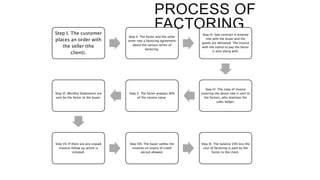
Step I. The customer 
places an order with 
the seller (the 
client). 
Step II. The factor and the seller 
enter into a factoring agreement 
about the various terms of 
factoring. 
Step III. Sale contract is entered 
into with the buyer and the 
goods are delivered. The invoice 
with the notice to pay the factor 
is sent along with. 
Step IV. The copy of invoice 
covering the above sale is sent to 
the factors, who maintain the 
sales ledger. 
Step V. The factor prepays 80% 
of the invoice value. 
Step VI. Monthly Statements are 
sent by the factor to the buyer. 
Step VII. If there are any unpaid 
invoices follow up action is 
initiated. 
Step VIII. The buyer settles the 
invoices on expiry of credit 
period allowed. 
Step IX. The balance 20% less the 
cost of factoring is paid by the 
factor to the client.
TYPES OF 
FACTORING 
Recourse factoring 
Non-recourse factoring 
Advance factoring 
Maturity factoring 
Invoice factoring 
Supplier guarantee factoring 
Bank participation factoring 
Cross-border factoring 
Confidential & undisclosed factoring
RECOURSE & NON-RECOURSE 
FACTORING 
 Recourse Factoring: In Recourse factoring, the credit risk 
remains with the client though the debt is assigned to the 
factor, i.e., the factor can have recourse to the client in the 
event of non-payment by the customer. 
 Non-Recourse Factoring: The Non-Recourse Factoring, also 
called as ‘Old-line factoring’, is an arrangement whereby he 
factor has no recourse to the client when the bill remains 
unpaid by the customer. Thus, the risk of bad debt is 
absorbed by the factor.
MATURITY & ADVANCE 
FACTORING 
 Maturity Factoring: In maturity factoring method, the 
factor may agree to pay an amount to the client for the 
bills purchased by him either immediately or on maturity. 
The later refers to a date agreed upon on which the factor 
pays the client. 
 Advance Factoring: Where the payment is made by the 
factor immediately is called Advance Factoring Under this 
type of factoring, the factor provides financial 
accommodation apart from non-financial services 
rendered by him.
INVOICE FACTORING 
It is simply a bill discounting process. 
Invoice discounting is a form of short-term borrowing often 
used to improve a company's working capital and cash flow 
position. 
Invoice discounting allows a business to draw money against 
its sales invoices before the customer has actually paid. To do 
this, the business borrows a percentage of the value of its 
sales ledger from a finance company, effectively using the 
unpaid sales invoices as collateral for the borrowing.
CONFIDENTIAL AND 
UNDISCLOSED FACTORING 
In confidential and undisclosed factoring the arrangement 
between the factor and the client are left un-notified to the 
customers and the client collects the bills from the customers 
without intimating them to the factoring arrangements.
SUPPLIER GUARANTEE 
FACTORING 
Supplier Guarantee Factoring is also known as ‘drop shipment 
factoring’. This happens when the client is a mediator between 
supplier and customer. When the client is a distributor, the 
factor guarantees the supplier against the invoices raised by 
the supplier upon the client and the goods may be delivered to 
the customer. The client thereafter raises bills on the customer 
and assigns them to the factor. The factor thus enables the 
client to make a gross profit with no financial involvement at 
all.
BANK PARTICIPATION & CROSS-BORDER/ 
INTERNATIONAL 
FACTORING 
Bank Participation Factoring: In bank participation factoring the 
bank takes a floating charge on the client’s equity i.e., the 
amount payable by the factor to the client in .respect of his 
receivables. On this basis, the bank lends to the client and 
enables him to have double financing. 
Cross-border/International Factoring: In domestic factoring, 
there are 3 parties involved – customer, client and factor. But in 
international factoring, 4 parties are involved, namely – 
exporter(client), importer(customer), export factor, and import 
factor.
FINANCIAL ASPECTS
FACTORING 
& 
BALANCE 
SHEET
FACTORING & BALANCE 
SHEET 
Impact of Factoring on Balance Sheet: 
 Reduction of Current Liabilities. 
 Improvement in Current Ratio and Efficiency. 
 Higher credit standing. 
Reduction of cost and expenses.
FACTORING AND P&L 
ACCOUNT 
The Benefits of factoring in terms of the profit and loss account 
are analyzed as under: 
The factor performs basis functions like administration of 
seller’s sales ledger, credit control, collection of dues, etc. This 
saves the administration costs. 
The improved liquidity position enables the firm to honour its 
obligations without any delay. 
The improved credit standing helps the firm to get the benefits 
of lower purchase price, longer credit period from suppliers, 
trade discount on bulk purchases, cash discount on early 
payment, better market standing, quicker sanction of loans and 
advances, and better terms and conditions while borrowing etc.
FACTORING CHARGES 
Finance Charge: Finance charge is computed on the prepayment 
outstanding in the client’s account at monthly intervals. Finance 
charges are only for financing that has been availed. These 
charges are similar to the interest levied on the cash credit 
facilities in a bank. 
Service fee: Service charge is a nominal charge levied at monthly 
intervals to cover the cost of services, namely, collection, sales 
ledger management, and periodical MIS reports. Service fee is 
determined on the basis of criteria such as the gross sales value, 
number of customers, the number of invoices and credit notes, 
and the degree of credit risk represented by the customers or 
the transaction.
PROSPECTS OF 
FACTORING IN INDIA
THE KALYANASUNDARAM 
REPORT 
In 1988, RBI formed a committee headed by CS Kalyansundaram, 
a former managing director of the State Bank of India SBI to 
examine the need for and the scope of factoring organizations in 
India. The committee submitted its report in December 1988 and 
recommended introduction of factoring services in India. The RBI 
advised banks to take up factoring activity through a subsidiary.
NEED FOR FACTORING 
SERVICES IN INDIA 
There is sufficient scope for the introduction of factoring 
services in India, which would be complementary to the services 
provided by banks. 
The introduction of export factoring services in India would 
provide an additional facility to exporters. 
With a view to attaining a balanced dispersal of risks, factors 
should offer their services to all industries and all sectors of the 
economy.
RBI GUIDELINES 
Banks are permitted to set up separate subsidiaries/invest in 
factoring companies. 
Should not engage in financing of other companies or other 
factoring companies. 
Investment of a bank cannot exceed in the aggregate 10% of paid-up 
capital and reserves of the bank. 
According to the RBI guidelines (2010), banks now with the prior 
approval of RBI can form subsidiary companies for undertaking the 
factoring services and other incidental activities.
SBI FACTORS AND 
COMMERCIAL SERVICES 
The State Bank of India, in association with the State Bank of 
Indore, the State Bank of Saurashtra, SIDBI, and the Union Bank 
of India set up the SBI Factors and Commercial Services in 
February 1991. 
SBI Factors commenced operations from April 1991. SBI factors 
was the first factoring company to be set up in India. It has a 
45% market share in this business. SBI Factors offers domestic, 
export, and import factoring services.
SBI FACTORS AND 
COMMERCIAL SERVICES 
SBI factors offers two types of products under domestic 
factoring: 
Bill2Cash: - The seller invoices the goods to the buyer, assigns 
the same to SBI factors, and receives prepayment up to 90 
percent of the invoice values immediately. 
Cash4Purchase: Facilitates instant payment for purchases made 
and is generally sanctioned in conjunction with receivable 
factoring facility or export factoring.
CANBANK FACTORS LTD. 
Jointly promoted by the Canara Bank, Andhra Bank and SIDBI in 
August,1992. 
Its Rs. 10 crore paid-up capital was contributed in the 
proportion of 60:20:20 by three promoters respectively. 
Initially operated in the south zone but regional restrictions on 
their operations were subsequently removed by the RBI. 
Main services provided by the Canbank Factors Ltd are 
domestic factoring and invoice discounting.
REASONS FOR SLOW 
GROWTH 
The overall worldwide growth in factoring is estimated at 12%. 
Europe has the largest market representing 64% of the world 
volumes with a growth of 18% during the year. America's 
growth was 10%, whereas Australia recorded impressive growth 
of 40%. Asia saw a fall in volume. 
The growth trends mentioned above support the fact that there 
is enormous scope for expansion worldwide and India is no 
exception to this. 
The potential in India is estimated at an annual turnover of Rs. 
15000 to Rs. 20000 crore, but large portion is untapped.
REASONS FOR SLOW 
GROWTH 
Lack of a credit appraisal system and authentic information about 
customers and clients restricts the growth of this business. 
Higher stamp duty on assigning of debt increases the cost of the 
client which reduces factoring arrangements. 
Non availability of permission to factoring companies for raising 
their debt restricts their financing capacity and thereby growth of 
the market. 
Being registered as NBFCs, factoring companies are not eligible 
for refinance which limits the extension of this facility to the 
exporters on open account sales. This restricts the growth of the 
market.
THANK 
YOU 
SUBMITTED BY: 
KUSHAL WALIA UM 10905 
PUJIT SINGH UM 10304 
SHIVAM MIGLANI UM 10307 
SAHIB SINGH UM 10809

Factoring

  • 1.
  • 2.
    DEFINITION Factoring isa financial transaction whereby a business sells its accounts receivable (i.e., invoices) to a third party (called a factor) at a discount in exchange for immediate money with which to finance continued business.
  • 3.
    FACTORING VS BANKLOAN Factoring differs from a bank loan in three main ways. First, the emphasis is on the value of the receivables (essentially a financial asset), not the firm’s credit worthiness. Secondly, factoring is not a loan – it is the purchase of a financial asset (the receivable). Finally, a bank loan involves two parties whereas factoring involves three.
  • 4.
    FUNCTIONS OF FACTORING Credit Evaluation: Assessment of credit-worthiness of customer Sales Ledger Administration: Recording, analysing, and reporting sales transactions Collect Book Debts: Collection of accounts receivables from customers as & when they become due Assume Risk of Default: Collection of receivables from customers, relieving the client-firm of credit risk or bad debt losses.
  • 5.
    FUNCTIONS OF THE FACTORING Provide Finance: Providing finance to client-firm against book debts, upto 90% of invoice value of the factored receivables Provide Information: Advisory services on marketing strategies and foreign collaborations, sales analysis, invoice analysis, etc Provide Insurance: Debt Insurance to client-firm against possible losses due to bankruptcy or insolvency
  • 6.
    ADVANTAGES 1. Ithelps to improve the current ratio. Improvement in the current ratio is an indication of improved liquidity. Enables better working capital management. 2. It increases the turnover of stocks. 3. It ensures prompt payment and reduction in debt. 4. It helps to reduce the risk. Present risk in bills financing like finance against accommodation bills can be reduced to minimum. 5. It helps to avoid collection department. The client need not undertake any responsibility of collecting the dues from the buyers of the goods.
  • 7.
    LIMITATIONS 1. Factoringis a high risk area, and it may result in over dependence on factoring, mismanagement, over trading of even dishonesty on behalf of the clients. 2. It is uneconomical for small companies with less turnover. 3. The factoring is not suitable to the company’s manufacturing and selling highly specialized items because the factor may not have sufficient expertise to assess the credit risk. 4. The developing countries such as India are not able to be well verse in factoring. The reason is lack of professionalism, non-acceptance of change and developed expertise.
  • 8.
    PROCESS OF FACTORING Step I. The customer places an order with the seller (the client). Step II. The factor and the seller enter into a factoring agreement about the various terms of factoring. Step III. Sale contract is entered into with the buyer and the goods are delivered. The invoice with the notice to pay the factor is sent along with. Step IV. The copy of invoice covering the above sale is sent to the factors, who maintain the sales ledger. Step V. The factor prepays 80% of the invoice value. Step VI. Monthly Statements are sent by the factor to the buyer. Step VII. If there are any unpaid invoices follow up action is initiated. Step VIII. The buyer settles the invoices on expiry of credit period allowed. Step IX. The balance 20% less the cost of factoring is paid by the factor to the client.
  • 9.
    TYPES OF FACTORING Recourse factoring Non-recourse factoring Advance factoring Maturity factoring Invoice factoring Supplier guarantee factoring Bank participation factoring Cross-border factoring Confidential & undisclosed factoring
  • 10.
    RECOURSE & NON-RECOURSE FACTORING  Recourse Factoring: In Recourse factoring, the credit risk remains with the client though the debt is assigned to the factor, i.e., the factor can have recourse to the client in the event of non-payment by the customer.  Non-Recourse Factoring: The Non-Recourse Factoring, also called as ‘Old-line factoring’, is an arrangement whereby he factor has no recourse to the client when the bill remains unpaid by the customer. Thus, the risk of bad debt is absorbed by the factor.
  • 11.
    MATURITY & ADVANCE FACTORING  Maturity Factoring: In maturity factoring method, the factor may agree to pay an amount to the client for the bills purchased by him either immediately or on maturity. The later refers to a date agreed upon on which the factor pays the client.  Advance Factoring: Where the payment is made by the factor immediately is called Advance Factoring Under this type of factoring, the factor provides financial accommodation apart from non-financial services rendered by him.
  • 12.
    INVOICE FACTORING Itis simply a bill discounting process. Invoice discounting is a form of short-term borrowing often used to improve a company's working capital and cash flow position. Invoice discounting allows a business to draw money against its sales invoices before the customer has actually paid. To do this, the business borrows a percentage of the value of its sales ledger from a finance company, effectively using the unpaid sales invoices as collateral for the borrowing.
  • 13.
    CONFIDENTIAL AND UNDISCLOSEDFACTORING In confidential and undisclosed factoring the arrangement between the factor and the client are left un-notified to the customers and the client collects the bills from the customers without intimating them to the factoring arrangements.
  • 14.
    SUPPLIER GUARANTEE FACTORING Supplier Guarantee Factoring is also known as ‘drop shipment factoring’. This happens when the client is a mediator between supplier and customer. When the client is a distributor, the factor guarantees the supplier against the invoices raised by the supplier upon the client and the goods may be delivered to the customer. The client thereafter raises bills on the customer and assigns them to the factor. The factor thus enables the client to make a gross profit with no financial involvement at all.
  • 15.
    BANK PARTICIPATION &CROSS-BORDER/ INTERNATIONAL FACTORING Bank Participation Factoring: In bank participation factoring the bank takes a floating charge on the client’s equity i.e., the amount payable by the factor to the client in .respect of his receivables. On this basis, the bank lends to the client and enables him to have double financing. Cross-border/International Factoring: In domestic factoring, there are 3 parties involved – customer, client and factor. But in international factoring, 4 parties are involved, namely – exporter(client), importer(customer), export factor, and import factor.
  • 16.
  • 17.
  • 18.
    FACTORING & BALANCE SHEET Impact of Factoring on Balance Sheet:  Reduction of Current Liabilities.  Improvement in Current Ratio and Efficiency.  Higher credit standing. Reduction of cost and expenses.
  • 19.
    FACTORING AND P&L ACCOUNT The Benefits of factoring in terms of the profit and loss account are analyzed as under: The factor performs basis functions like administration of seller’s sales ledger, credit control, collection of dues, etc. This saves the administration costs. The improved liquidity position enables the firm to honour its obligations without any delay. The improved credit standing helps the firm to get the benefits of lower purchase price, longer credit period from suppliers, trade discount on bulk purchases, cash discount on early payment, better market standing, quicker sanction of loans and advances, and better terms and conditions while borrowing etc.
  • 20.
    FACTORING CHARGES FinanceCharge: Finance charge is computed on the prepayment outstanding in the client’s account at monthly intervals. Finance charges are only for financing that has been availed. These charges are similar to the interest levied on the cash credit facilities in a bank. Service fee: Service charge is a nominal charge levied at monthly intervals to cover the cost of services, namely, collection, sales ledger management, and periodical MIS reports. Service fee is determined on the basis of criteria such as the gross sales value, number of customers, the number of invoices and credit notes, and the degree of credit risk represented by the customers or the transaction.
  • 21.
  • 22.
    THE KALYANASUNDARAM REPORT In 1988, RBI formed a committee headed by CS Kalyansundaram, a former managing director of the State Bank of India SBI to examine the need for and the scope of factoring organizations in India. The committee submitted its report in December 1988 and recommended introduction of factoring services in India. The RBI advised banks to take up factoring activity through a subsidiary.
  • 23.
    NEED FOR FACTORING SERVICES IN INDIA There is sufficient scope for the introduction of factoring services in India, which would be complementary to the services provided by banks. The introduction of export factoring services in India would provide an additional facility to exporters. With a view to attaining a balanced dispersal of risks, factors should offer their services to all industries and all sectors of the economy.
  • 24.
    RBI GUIDELINES Banksare permitted to set up separate subsidiaries/invest in factoring companies. Should not engage in financing of other companies or other factoring companies. Investment of a bank cannot exceed in the aggregate 10% of paid-up capital and reserves of the bank. According to the RBI guidelines (2010), banks now with the prior approval of RBI can form subsidiary companies for undertaking the factoring services and other incidental activities.
  • 25.
    SBI FACTORS AND COMMERCIAL SERVICES The State Bank of India, in association with the State Bank of Indore, the State Bank of Saurashtra, SIDBI, and the Union Bank of India set up the SBI Factors and Commercial Services in February 1991. SBI Factors commenced operations from April 1991. SBI factors was the first factoring company to be set up in India. It has a 45% market share in this business. SBI Factors offers domestic, export, and import factoring services.
  • 26.
    SBI FACTORS AND COMMERCIAL SERVICES SBI factors offers two types of products under domestic factoring: Bill2Cash: - The seller invoices the goods to the buyer, assigns the same to SBI factors, and receives prepayment up to 90 percent of the invoice values immediately. Cash4Purchase: Facilitates instant payment for purchases made and is generally sanctioned in conjunction with receivable factoring facility or export factoring.
  • 27.
    CANBANK FACTORS LTD. Jointly promoted by the Canara Bank, Andhra Bank and SIDBI in August,1992. Its Rs. 10 crore paid-up capital was contributed in the proportion of 60:20:20 by three promoters respectively. Initially operated in the south zone but regional restrictions on their operations were subsequently removed by the RBI. Main services provided by the Canbank Factors Ltd are domestic factoring and invoice discounting.
  • 28.
    REASONS FOR SLOW GROWTH The overall worldwide growth in factoring is estimated at 12%. Europe has the largest market representing 64% of the world volumes with a growth of 18% during the year. America's growth was 10%, whereas Australia recorded impressive growth of 40%. Asia saw a fall in volume. The growth trends mentioned above support the fact that there is enormous scope for expansion worldwide and India is no exception to this. The potential in India is estimated at an annual turnover of Rs. 15000 to Rs. 20000 crore, but large portion is untapped.
  • 29.
    REASONS FOR SLOW GROWTH Lack of a credit appraisal system and authentic information about customers and clients restricts the growth of this business. Higher stamp duty on assigning of debt increases the cost of the client which reduces factoring arrangements. Non availability of permission to factoring companies for raising their debt restricts their financing capacity and thereby growth of the market. Being registered as NBFCs, factoring companies are not eligible for refinance which limits the extension of this facility to the exporters on open account sales. This restricts the growth of the market.
  • 30.
    THANK YOU SUBMITTEDBY: KUSHAL WALIA UM 10905 PUJIT SINGH UM 10304 SHIVAM MIGLANI UM 10307 SAHIB SINGH UM 10809

Editor's Notes

  • #5 Book debts is the term used for sums of MONEY owed to the bankrupt, partnership or company at the date of the insolvency order, usually for goods or services supplied or work carried out. Sums due under loans may also be treated as book debts as can sums due from partners or directors under any loan accounts they may have had with the partnership business or company, although detailed information must be available regarding the loan etc for it to be collectable.