



PRESENTATION
ON
“SECURITIZATION IN INDIA”
INTRODUCTION
 Securitization is nothing but liquifying
assetscomprising loans and receivables of
aninstitution through systematic issuance
of financial instruments.
 It is a carefully structured process wherebyloans
and other receivables are packaged,underwritten
and sold in the form of AssetBacked Securities.
FEATURES OF SECURITISATION
Marketability
Merchantable Quality
Wide Distribution
Commoditization
3
SECURITIZATION PROCESS
 Selection of assets by the Originator
 Packaging of pool of loans and advances (assets)
 Underwriting by underwriters.
 Assigning or selling to of assets to SPV in return for cash
 Conversion of the assets into divisible securities
 SPV sells them to investors through private stock market in return
for cash
 Investors receive income and return of capital from the assets over
the life time of the securities
 The risk on the securities owned by investors is minimized as the
securities are collateralized by assets
 The difference between the rate of the borrowers and the return
promised to investors is the servicing fee for originator and the
SPV .
 Assets to be securitized to be homogeneous in terms of underlying
assets ,maturity period ,cash flow profile
5
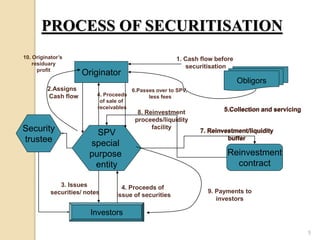
PROCESS OF SECURITISATION
Originator
Obligors
SPV
special
purpose
entity
2.Assigns
Cash flow
Investors
1. Cash flow before
securitisation
4. Proceeds of
issue of securities
3. Issues
securities/ notes
5.Collection and servicing
6.Passes over to SPV,
less fees
Reinvestment
contract
7. Reinvestment/liquidity
buffer
8. Reinvestment
proceeds/liquidity
facility
9. Payments to
investors
10. Originator’s
residuary
profit
4. Proceeds
of sale of
receivables
Security
trustee
5.Collection and servicing
7. Reinvestment/liquidity
buffer
PLAYERS IN SECURITISATION
 Obligor
 Originator
 Special Purpose Vehicle (SPV)
 Credit Rating Agency
 Underwriter
 Investors
 Agent and Trustee
 Enhancer/Insurer/Guarantor
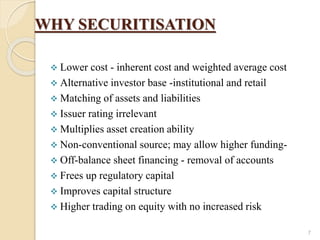
WHY SECURITISATION
 Lower cost - inherent cost and weighted average cost
 Alternative investor base -institutional and retail
 Matching of assets and liabilities
 Issuer rating irrelevant
 Multiplies asset creation ability
 Non-conventional source; may allow higher funding-
 Off-balance sheet financing - removal of accounts
 Frees up regulatory capital
 Improves capital structure
 Higher trading on equity with no increased risk
7
WHY SECURITISATION - 2
Extends credit pool
Not regulated as loan
Reduces credit concentration
Risk management by risk transfers
Arbitraging opportunities - repackaging
transactions
Avoids interest rate risk
Improves accounting profits
8
SECURITISABLE ASSETS
 Term Loans
 Commercial Loans
 Receivables From Government
 Vehicle Loans
 Lease Finance
 Mortgage Loans
 Credit Cards Receivables
SOME EXAMPLES OF
SECURITISATION IN THE INDIA
 First securitisation deal in India between Citibank and GIC Mutual Fund in 1991 for
Rs 160 mn
 L&T raised Rs 4,090 mn through the securitisation of future lease rentals to raise
capital for its power plant in 1999.
 India’s first securitisation of personal loan by Citibank in 1999 for Rs 2,841 mn.
 India’s first mortgage backed securities issue (MBS) of Rs 597 mn by NHB and
HDFC in 2001.
 Securitisation of aircraft receivables by Jet Airways for Rs 16,000 mn in 2001
through offshore SPV.
 India’s first sales tax deferrals securitisation by Govt of Maharashtra in 2001 for Rs
1,500 mn.
 India’s first deal in the power sector by Karnataka Electricity Board for receivables
worth Rs 1,940 mn and placed them with HUDCO.
 India’s first Collateralised Debt Obligation (CDO) deal by ICICI bank in 2002
 India’s first floating rate securitisation issuance by Citigroup of Rs 2,810 mn in
2003. The fixed rate auto loan receivables of Citibank and Citicorp Finance India
included in the securitisation
 India’s first securitisation of sovereign lease receivables by Indian Railway Finance
Corporation (IRFC) of Rs 1,960 mn in 2005. The receivables consist of lease
amounts payable by the ministry of railways to IRFC
 India’s largest securitisation deal by ICICI bank of Rs 19,299 mn in 2007. The
underlying asset pool was auto loan receivables.
BENEFITS OF SECURITISATION
Additional Source Of Fund (For Originator)
Greater Profitability
Spreading Of Risk
Higher Rate Of Return
Prevention Of Idle Capital
Provision of Multiple Instruments
CONDITIONS FOR SUCCESSFUL
SECURITISATION
 Assets need to be selected carefully
 Credit ratings
 SPV and originator should be separateparties
 The instruments arising out of securitisationmust be
listed in stock exchanges
 Standardized loan documents
 Proper guidelines
ISSUES FACING THE INDIAN
SECURITISATION MARKET
Stamp Duty
Foreclosure Laws
Taxation related issues
Issues under the SARFAESI Act
Legal Issues
REASONS FOR UNPOPULARITY
OF SECURITISATION IN INDIA
 New Concept
 Heavy stamp duty and registration fees
 Cumbersome Transfer Procedures
 Difficulty in assignment of debts
 Absence of standardised loan documentation
 Inadequate credit rating facilities
 Absence of proper guidelines
CONCLUSION
On the whole, securitisation in India seems to be
accelerating in its development. More and more institutions
start participating in the market and the scope of securitised
assets is steadily growing. Only in 2004 the average
securitisation deal doubled, amounting to £50 million. The
financial structure of agreements is getting more complicated
in order to suit new types of investors. However, problems
still remain. One of the most important of them is legislation
which lags behind the hovering securitisation market.
Authorities respond to new demands with great delay and not
always properly. Nonetheless, the perspectives of the Indian
securitisation market are fascinating. With the second largest
population in the world mortgage-backed securities and auto
loans are doomed to play a great role in India.

Securitization in india

  • 1.
  • 2.
    INTRODUCTION  Securitization isnothing but liquifying assetscomprising loans and receivables of aninstitution through systematic issuance of financial instruments.  It is a carefully structured process wherebyloans and other receivables are packaged,underwritten and sold in the form of AssetBacked Securities.
  • 3.
    FEATURES OF SECURITISATION Marketability MerchantableQuality Wide Distribution Commoditization 3
  • 4.
    SECURITIZATION PROCESS  Selectionof assets by the Originator  Packaging of pool of loans and advances (assets)  Underwriting by underwriters.  Assigning or selling to of assets to SPV in return for cash  Conversion of the assets into divisible securities  SPV sells them to investors through private stock market in return for cash  Investors receive income and return of capital from the assets over the life time of the securities  The risk on the securities owned by investors is minimized as the securities are collateralized by assets  The difference between the rate of the borrowers and the return promised to investors is the servicing fee for originator and the SPV .  Assets to be securitized to be homogeneous in terms of underlying assets ,maturity period ,cash flow profile
  • 5.
    5 PROCESS OF SECURITISATION Originator Obligors SPV special purpose entity 2.Assigns Cashflow Investors 1. Cash flow before securitisation 4. Proceeds of issue of securities 3. Issues securities/ notes 5.Collection and servicing 6.Passes over to SPV, less fees Reinvestment contract 7. Reinvestment/liquidity buffer 8. Reinvestment proceeds/liquidity facility 9. Payments to investors 10. Originator’s residuary profit 4. Proceeds of sale of receivables Security trustee 5.Collection and servicing 7. Reinvestment/liquidity buffer
  • 6.
    PLAYERS IN SECURITISATION Obligor  Originator  Special Purpose Vehicle (SPV)  Credit Rating Agency  Underwriter  Investors  Agent and Trustee  Enhancer/Insurer/Guarantor
  • 7.
    WHY SECURITISATION  Lowercost - inherent cost and weighted average cost  Alternative investor base -institutional and retail  Matching of assets and liabilities  Issuer rating irrelevant  Multiplies asset creation ability  Non-conventional source; may allow higher funding-  Off-balance sheet financing - removal of accounts  Frees up regulatory capital  Improves capital structure  Higher trading on equity with no increased risk 7
  • 8.
    WHY SECURITISATION -2 Extends credit pool Not regulated as loan Reduces credit concentration Risk management by risk transfers Arbitraging opportunities - repackaging transactions Avoids interest rate risk Improves accounting profits 8
  • 9.
    SECURITISABLE ASSETS  TermLoans  Commercial Loans  Receivables From Government  Vehicle Loans  Lease Finance  Mortgage Loans  Credit Cards Receivables
  • 10.
    SOME EXAMPLES OF SECURITISATIONIN THE INDIA  First securitisation deal in India between Citibank and GIC Mutual Fund in 1991 for Rs 160 mn  L&T raised Rs 4,090 mn through the securitisation of future lease rentals to raise capital for its power plant in 1999.  India’s first securitisation of personal loan by Citibank in 1999 for Rs 2,841 mn.  India’s first mortgage backed securities issue (MBS) of Rs 597 mn by NHB and HDFC in 2001.  Securitisation of aircraft receivables by Jet Airways for Rs 16,000 mn in 2001 through offshore SPV.  India’s first sales tax deferrals securitisation by Govt of Maharashtra in 2001 for Rs 1,500 mn.  India’s first deal in the power sector by Karnataka Electricity Board for receivables worth Rs 1,940 mn and placed them with HUDCO.  India’s first Collateralised Debt Obligation (CDO) deal by ICICI bank in 2002  India’s first floating rate securitisation issuance by Citigroup of Rs 2,810 mn in 2003. The fixed rate auto loan receivables of Citibank and Citicorp Finance India included in the securitisation  India’s first securitisation of sovereign lease receivables by Indian Railway Finance Corporation (IRFC) of Rs 1,960 mn in 2005. The receivables consist of lease amounts payable by the ministry of railways to IRFC  India’s largest securitisation deal by ICICI bank of Rs 19,299 mn in 2007. The underlying asset pool was auto loan receivables.
  • 11.
    BENEFITS OF SECURITISATION AdditionalSource Of Fund (For Originator) Greater Profitability Spreading Of Risk Higher Rate Of Return Prevention Of Idle Capital Provision of Multiple Instruments
  • 12.
    CONDITIONS FOR SUCCESSFUL SECURITISATION Assets need to be selected carefully  Credit ratings  SPV and originator should be separateparties  The instruments arising out of securitisationmust be listed in stock exchanges  Standardized loan documents  Proper guidelines
  • 13.
    ISSUES FACING THEINDIAN SECURITISATION MARKET Stamp Duty Foreclosure Laws Taxation related issues Issues under the SARFAESI Act Legal Issues
  • 14.
    REASONS FOR UNPOPULARITY OFSECURITISATION IN INDIA  New Concept  Heavy stamp duty and registration fees  Cumbersome Transfer Procedures  Difficulty in assignment of debts  Absence of standardised loan documentation  Inadequate credit rating facilities  Absence of proper guidelines
  • 15.
    CONCLUSION On the whole,securitisation in India seems to be accelerating in its development. More and more institutions start participating in the market and the scope of securitised assets is steadily growing. Only in 2004 the average securitisation deal doubled, amounting to £50 million. The financial structure of agreements is getting more complicated in order to suit new types of investors. However, problems still remain. One of the most important of them is legislation which lags behind the hovering securitisation market. Authorities respond to new demands with great delay and not always properly. Nonetheless, the perspectives of the Indian securitisation market are fascinating. With the second largest population in the world mortgage-backed securities and auto loans are doomed to play a great role in India.