PRESTIGE INSTITUTE OF MANAGEMENT & 
RESEARCH 
Topic 
“Venture capital & Angel Financing” 
Submitted to:- 
Prof. SAKET RATHI 
Submitted by:- 
AYUSH YADAV 
AVESH RAYEEN 
CHANCHAL JAIN 
PRASHANT MAHASHWARI
What is Venture Capital ??? 
Money provided by investors to start-up firms and 
small businesses with perceived long-term growth 
potential. 
Venture capital may be define as a form of “Equity 
Financing”, which is specially design for the funding 
high risk and high rewards projects. 
The objectives of venture capital is to help profession 
and small and medium entrepreneurs to launched 
enterprises with a specify promise.
Features of Venture Capital 
High Risk- The success rate in developed economics 
like USA is around 60% where as in a developing 
countries like INDIA is 20-30%. 
Finance High Tech Projects. 
It is for the longer period- The benefit or profit from 
the venture capital investment will start accruing only 
after an average period 4 to 5 years. 
It is an active form of investment with a higher degree 
of involvement in the management of the venture. 
It is a long-term investment and the returns are in the 
form of the capital gain.
Advantage of Venture Capital 
Venture capital has made significant contribution to 
technological innovations and promotion of 
entrepreneurship. 
1. Economic Oriented- 
Helps in the industrialization of a country. 
Helps in the technological development of a country. 
Generate employment. 
Helps in developing entrepreneur skill.
Advantage of Venture Capital 
2. Investor Oriented- 
They are invited to invest only after the company start 
earning profit so the risk is less and the healthy growth 
of capital market is entrusted. 
Profit to venture capital company’s/venture capital 
funds. 
3. Entrepreneur Oriented- 
Helps small and medium first generation entrepreneur 
to translate there idea into reality. 
Promotes entrepreneurship in the country.
Disadvantages of Venture Capital 
Lengthy and complex process (needs detailed business 
plan, financial projections and etc.) 
In the deal negotiation stage, you will have to pay for 
legal and accounting fees 
Investors become part owners of your business - 
founder loss of autonomy or control
Stages of Venture Capital 
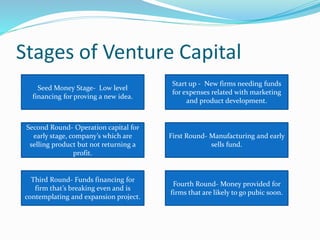
Seed Money Stage- Low level 
financing for proving a new idea. 
Start up - New firms needing funds 
for expenses related with marketing 
and product development. 
Second Round- Operation capital for 
early stage, company’s which are 
selling product but not returning a 
profit. 
First Round- Manufacturing and early 
sells fund. 
Third Round- Funds financing for 
firm that’s breaking even and is 
contemplating and expansion project. 
Fourth Round- Money provided for 
firms that are likely to go pubic soon.
How does Venture Capital works?? 
 Venture capital firms typically source the majority of 
their funding from large investment institutions. 
 Investment institutions expect very high ROI 
 VC’s invest in companies with high potential where 
they are able to exit through either an IPO or a 
merger/acquisition. 
 Their primary ROI comes from capital gains although 
they also receive some return through dividend.
Functions of Venture Capital 
The venture capital fill the gap of owner fund’s in 
relation to the quantum of equity required to support 
the successful launching of new business. 
The venture capitalist assist the entrepreneurs in 
locating, interviewing and employing corporate 
achievers to professionalise the firm. 
Venture capital provides finance as well as skills to new 
venture of existing based on high technology 
innovation.
Angels Financing 
Angel financing means an “Angel Investor” who 
provide financial backing for small start up or 
entrepreneur, an angle investor are usually found 
among an entrepreneur family and friends. 
The capital they provide can be one time injection of 
money or ongoing support to carry the company 
through difficult time.
Who are Angels ?? 
Angels are investors who: 
Expect a financial return. 
Believe in giving back to their communities. 
Invest locally and regionally. 
Participate in the investment process. 
Show interest in personal relationships with 
companies and employees. 
Guidance to entrepreneurs.
Financial Attributes of Angels 
Provide early-stage investment. 
Invest smaller amounts per-investment. 
Partially fill funding gap left by venture capital. (VCs) 
Invest individual wealth. 
Can tolerate loss of entire investment.
Q & A
Thank You

Venture capital and angel financing

  • 1.
    PRESTIGE INSTITUTE OFMANAGEMENT & RESEARCH Topic “Venture capital & Angel Financing” Submitted to:- Prof. SAKET RATHI Submitted by:- AYUSH YADAV AVESH RAYEEN CHANCHAL JAIN PRASHANT MAHASHWARI
  • 2.
    What is VentureCapital ??? Money provided by investors to start-up firms and small businesses with perceived long-term growth potential. Venture capital may be define as a form of “Equity Financing”, which is specially design for the funding high risk and high rewards projects. The objectives of venture capital is to help profession and small and medium entrepreneurs to launched enterprises with a specify promise.
  • 3.
    Features of VentureCapital High Risk- The success rate in developed economics like USA is around 60% where as in a developing countries like INDIA is 20-30%. Finance High Tech Projects. It is for the longer period- The benefit or profit from the venture capital investment will start accruing only after an average period 4 to 5 years. It is an active form of investment with a higher degree of involvement in the management of the venture. It is a long-term investment and the returns are in the form of the capital gain.
  • 4.
    Advantage of VentureCapital Venture capital has made significant contribution to technological innovations and promotion of entrepreneurship. 1. Economic Oriented- Helps in the industrialization of a country. Helps in the technological development of a country. Generate employment. Helps in developing entrepreneur skill.
  • 5.
    Advantage of VentureCapital 2. Investor Oriented- They are invited to invest only after the company start earning profit so the risk is less and the healthy growth of capital market is entrusted. Profit to venture capital company’s/venture capital funds. 3. Entrepreneur Oriented- Helps small and medium first generation entrepreneur to translate there idea into reality. Promotes entrepreneurship in the country.
  • 6.
    Disadvantages of VentureCapital Lengthy and complex process (needs detailed business plan, financial projections and etc.) In the deal negotiation stage, you will have to pay for legal and accounting fees Investors become part owners of your business - founder loss of autonomy or control
  • 7.
    Stages of VentureCapital Seed Money Stage- Low level financing for proving a new idea. Start up - New firms needing funds for expenses related with marketing and product development. Second Round- Operation capital for early stage, company’s which are selling product but not returning a profit. First Round- Manufacturing and early sells fund. Third Round- Funds financing for firm that’s breaking even and is contemplating and expansion project. Fourth Round- Money provided for firms that are likely to go pubic soon.
  • 8.
    How does VentureCapital works??  Venture capital firms typically source the majority of their funding from large investment institutions.  Investment institutions expect very high ROI  VC’s invest in companies with high potential where they are able to exit through either an IPO or a merger/acquisition.  Their primary ROI comes from capital gains although they also receive some return through dividend.
  • 9.
    Functions of VentureCapital The venture capital fill the gap of owner fund’s in relation to the quantum of equity required to support the successful launching of new business. The venture capitalist assist the entrepreneurs in locating, interviewing and employing corporate achievers to professionalise the firm. Venture capital provides finance as well as skills to new venture of existing based on high technology innovation.
  • 10.
    Angels Financing Angelfinancing means an “Angel Investor” who provide financial backing for small start up or entrepreneur, an angle investor are usually found among an entrepreneur family and friends. The capital they provide can be one time injection of money or ongoing support to carry the company through difficult time.
  • 11.
    Who are Angels?? Angels are investors who: Expect a financial return. Believe in giving back to their communities. Invest locally and regionally. Participate in the investment process. Show interest in personal relationships with companies and employees. Guidance to entrepreneurs.
  • 12.
    Financial Attributes ofAngels Provide early-stage investment. Invest smaller amounts per-investment. Partially fill funding gap left by venture capital. (VCs) Invest individual wealth. Can tolerate loss of entire investment.
  • 13.
  • 14.