Working Capital
Management
FIN353
Factoring and Forfaiting
Factoring: The Concept…
• “Factor is a financial intermediary which assumes the
responsibility of collection of receivables arising out of
credit sales of their clients and in return charges
commission for its services”.
• So, a Factor is…
ü A Financial Intermediary/Institute/Company
ü That buys invoices of a manufacturer or a trader, at a
discount, and
ü Takes responsibility for collection of payments.
Factoring: The Concept…
• “Factoring is the Sale of Book Debts by a firm
(Client) to a financial institution (Factor) on the
understanding that the Factor will pay for the Book
Debts as and when they are collected or on a
guaranteed payment date. Normally, the Factor
makes a part payment (usually upto 80%)
immediately after the debts are purchased
thereby providing immediate liquidity to the
Client”.
5/24/18 4
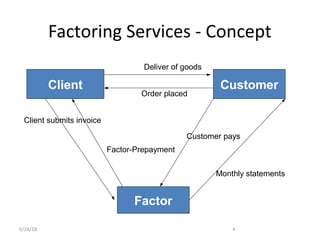
Factoring Services - Concept
Client Customer
Factor
Order placed
Deliver of goods
Client submits invoice
Factor-Prepayment
Monthly statements
Customer pays
Process of Factoring:
• Client makes a credit sale with a customer.
• Client sells the customer’s account to the Factor and notifies
the customer.
• Factor makes partly payment (advance) against account
purchased, after adjusting for commission and interest on
the advance.
• Factor maintains the customer’s account and follows up for
payment.
• Customer remits the amount due to the Factor.
• Factor makes the final payment to the Client when the
account is collected or on the guaranteed payment date.
Charges for Factoring Services:
• Factor charges Commission (as a flat percentage of value of
Debts purchased) (0.50% to 1.50%)
•
• Commission is charged up-front.
•
• For making immediate partly payment, interest charged.
Interest is higher than rate of interest charged on
Working Capital Finance by Banks.
•
• If interest is charged up-front, it is called Discount.
Functions of a Factor:
1. Administration of sales ledger
- Maintains the client’s sales ledger
- Gives periodic reports
- Current status of his receivables
- Receipts of payments from customers
- Customer-wise record of payments
- Change in payment pattern
2. Provision of collection facility
- Undertakes to collect receivables on behalf of the client
- Relieving the clients from problems involved in collection
- Enables the clients to reduce cost of collection
Functions of a Factor: CONT…
3. Financing Trade Debts:
4. Credit Control And Credit Protection:
- This service is provided where debts are factored
without recourse. Factor assumes the risk of default.
5. Advisory Services:
- Specialized knowledge and experience
- Customers’ perception
- Change in marketing strategies
- Emerging trends
Types / Forms of Factoring:
1. Recourse Factoring:
ü Factor does not assume credit risks associated with
receivables.
ü Credit Risk is borne by the Client.
ü In India, Factoring is done with recourse.
2. Non-Recourse Factoring:
ü Factor assumes credit risks associated with receivables.
Charges a higher commission
ü Credit risk is assumed by Factor
ü In USA/UK, Factoring is commonly done without recourse.
Types / Forms of Factoring:
3. Advance Factoring:
ü Factor pays a specified portion (75% to 90%) in advance.
ü Balance being paid upon collection from the customer. The
client has to pay interest on advance payment.
Example of Advance Factoring Mechanism:
Types / Forms of Factoring: CONT…
4. Maturity Factoring / Collection Factoring:
ü Factor does not make any advance payment to the Client.
ü Factor Pays on date of collection/agreed future date.
ü Less RISK for Factor and charges nominal commission.
5. Full Factoring / Old Line Factoring:
ü Features of almost all the factoring services.
ü Entire spectrum of services; collection, credit protection, sales
ledger administration, short-term finance.
Types / Forms of Factoring: CONT…
6. Disclosed Factoring:
ü Name of factor is disclosed in sales invoice.
7. Undisclosed Factoring:
ü Name of factor is NOT disclosed in sales invoice.
8. Domestic Factoring:
ü Buyer, Seller, Factor domiciled in the same
country.
Types / Forms of Factoring: CONT…
9. Export / Cross Border / International Factoring:
ü Usually Four Parties Involved Viz. the Exporter, Importer,
Export Factor, Import Factor.
ü Two Agreements.
ü Import Factor Provides Link Between Export Factor and
Importer.
ü Import factor underwrites customer trade credit risk, collects
receivables and transfers fund to export factor.
International Factoring Transactions:
Advantages of Factoring:
1. Off-balance Sheet Finance
2. Reduction of Current Liabilities
3. Improvement in Current Ratio
4. Higher Credit Standing:
5. More time for Planning and Production
6. Reduction of Cost and Expenses
7. Additional Source of Finance
WHY FACTORING HAS NOT BECOME POPULAR IN INDIA?
• Banks’ unwillingness to provide factoring services
• Problems in recovery.
• Factoring requires assignment of debt which attracts Stamp
Duty.
• Cost of transaction becomes high.
• Lack of awareness.
•
Factoring in INDIA: Major Players
• SBI Factors and Commercial Services Pvt. Ltd.
• Canbank Factors Limited
• Global Trade Finance Limited
• Foremost Factors Limited
• HSBC Bank
• CITI Bank NA, India
• Standard Chartered Bank
• SIDBI
• ECGC Ltd.
•
FORFAITING: THE CONCEPT
- “Forfeiting refers to financing of receivables pertaining to
international trade”.
- Forfaiting is a mechanism by which the right for export
receivables of an exporter (Client) is purchased by a
Financial Intermediary (Forfaiter) without recourse to him.
- Converts exporter’s credit sale into cash sale.
- Discounting the documents covering the entire risk of non-
payment in collection.
- Credit period can range from 3 to 5 years.
Characteristics of Forfaiting:
• Converts Deferred Payment Exports into cash transactions,
providing liquidity and cash flow to Exporter.
• Discharge Exporter from Cross-border Political OR Exchange
Risk associated with Export Receivables.
• Finance available upto 100% (as against 75 - 80% under
conventional credit) without recourse.
• Acts as additional source of funding and hence does not have
impact on Exporter’s borrowing limits. It does not reflect
as debt in Exporter’s Balance Sheet.
• Provides Fixed Rate Finance and hence risk of interest rate
fluctuation does not arise.
Characteristics of Forfaiting: Cont…
• Exporter is freed from credit administration.
• Simple Documentation as finance is available against bills.
• Forfait financer is responsible for each of the Exporter’s trade
transactions. Hence, Export business can be done more
efficiently.
• Forfait transactions are confidential.
•
FORFAITER’S CHARGES
• The DISCOUNT charged by the Forfaiter depends upon:
•
üCost of Forfaiting
üMargin to cover risk
üManagement charges
üFees for delayed payment
üPeriod of Forfaiting contract
üCredit rating of Avalling Bank
üCountry/Currency Risk of the importer
Export Factoring V/s Forfeiting:
●Sr.
No.
●Export Factoring ●Forfaiting
●1 ● 75 to 90% Financing ● 100% Financing
●2 ● Financing, Collection, Sales
● Ledger Administration
● Pure Financing
●3 ● Short Term Financing ● 3 To 5 Years
●4 ● Does not guard against
● Exchange Rate Fluctuation
● Forfaiter guards.
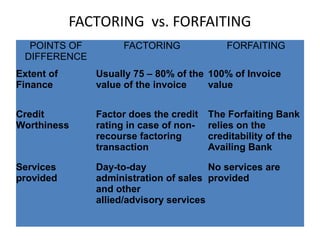
FACTORING vs. FORFAITING
POINTS OF
DIFFERENCE
FACTORING FORFAITING
Extent of
Finance
Usually 75 – 80% of the
value of the invoice
100% of Invoice
value
Credit
Worthiness
Factor does the credit
rating in case of non-
recourse factoring
transaction
The Forfaiting Bank
relies on the
creditability of the
Availing Bank
Services
provided
Day-to-day
administration of sales
and other
allied/advisory services
No services are
provided
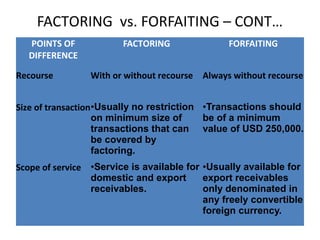
FACTORING vs. FORFAITING – CONT…
POINTS OF
DIFFERENCE
FACTORING FORFAITING
Recourse With or without recourse Always without recourse
Size of transaction●Usually no restriction
on minimum size of
transactions that can
be covered by
factoring.
●Transactions should
be of a minimum
value of USD 250,000.
Scope of service ●Service is available for
domestic and export
receivables.
●Usually available for
export receivables
only denominated in
any freely convertible
foreign currency.
WHY FORFAITING HAS NOT DEVELOPED…
• Relatively new concept in India.
• High Rupee Fluctuation
• High cost of funds
• High minimum cost of transactions (USD 250,000/-)
• RBI Guidelines are unclear.
• Very few institutions offer such services in India. Exim Bank
is one of the major player and very few other co’s
involved.
• Lack of awareness.
5/24/18 28
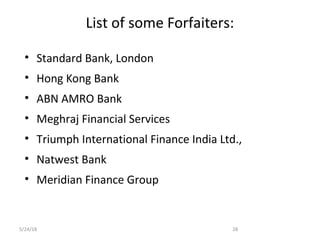
List of some Forfaiters:
• Standard Bank, London
• Hong Kong Bank
• ABN AMRO Bank
• Meghraj Financial Services
• Triumph International Finance India Ltd.,
• Natwest Bank
• Meridian Finance Group

Factoring

  • 1.
  • 2.
    Factoring: The Concept… •“Factor is a financial intermediary which assumes the responsibility of collection of receivables arising out of credit sales of their clients and in return charges commission for its services”. • So, a Factor is… ü A Financial Intermediary/Institute/Company ü That buys invoices of a manufacturer or a trader, at a discount, and ü Takes responsibility for collection of payments.
  • 3.
    Factoring: The Concept… •“Factoring is the Sale of Book Debts by a firm (Client) to a financial institution (Factor) on the understanding that the Factor will pay for the Book Debts as and when they are collected or on a guaranteed payment date. Normally, the Factor makes a part payment (usually upto 80%) immediately after the debts are purchased thereby providing immediate liquidity to the Client”.
  • 4.
    5/24/18 4 Factoring Services- Concept Client Customer Factor Order placed Deliver of goods Client submits invoice Factor-Prepayment Monthly statements Customer pays
  • 5.
    Process of Factoring: •Client makes a credit sale with a customer. • Client sells the customer’s account to the Factor and notifies the customer. • Factor makes partly payment (advance) against account purchased, after adjusting for commission and interest on the advance. • Factor maintains the customer’s account and follows up for payment. • Customer remits the amount due to the Factor. • Factor makes the final payment to the Client when the account is collected or on the guaranteed payment date.
  • 6.
    Charges for FactoringServices: • Factor charges Commission (as a flat percentage of value of Debts purchased) (0.50% to 1.50%) • • Commission is charged up-front. • • For making immediate partly payment, interest charged. Interest is higher than rate of interest charged on Working Capital Finance by Banks. • • If interest is charged up-front, it is called Discount.
  • 7.
    Functions of aFactor: 1. Administration of sales ledger - Maintains the client’s sales ledger - Gives periodic reports - Current status of his receivables - Receipts of payments from customers - Customer-wise record of payments - Change in payment pattern 2. Provision of collection facility - Undertakes to collect receivables on behalf of the client - Relieving the clients from problems involved in collection - Enables the clients to reduce cost of collection
  • 8.
    Functions of aFactor: CONT… 3. Financing Trade Debts: 4. Credit Control And Credit Protection: - This service is provided where debts are factored without recourse. Factor assumes the risk of default. 5. Advisory Services: - Specialized knowledge and experience - Customers’ perception - Change in marketing strategies - Emerging trends
  • 9.
    Types / Formsof Factoring: 1. Recourse Factoring: ü Factor does not assume credit risks associated with receivables. ü Credit Risk is borne by the Client. ü In India, Factoring is done with recourse. 2. Non-Recourse Factoring: ü Factor assumes credit risks associated with receivables. Charges a higher commission ü Credit risk is assumed by Factor ü In USA/UK, Factoring is commonly done without recourse.
  • 10.
    Types / Formsof Factoring: 3. Advance Factoring: ü Factor pays a specified portion (75% to 90%) in advance. ü Balance being paid upon collection from the customer. The client has to pay interest on advance payment.
  • 11.
    Example of AdvanceFactoring Mechanism:
  • 12.
    Types / Formsof Factoring: CONT… 4. Maturity Factoring / Collection Factoring: ü Factor does not make any advance payment to the Client. ü Factor Pays on date of collection/agreed future date. ü Less RISK for Factor and charges nominal commission. 5. Full Factoring / Old Line Factoring: ü Features of almost all the factoring services. ü Entire spectrum of services; collection, credit protection, sales ledger administration, short-term finance.
  • 13.
    Types / Formsof Factoring: CONT… 6. Disclosed Factoring: ü Name of factor is disclosed in sales invoice. 7. Undisclosed Factoring: ü Name of factor is NOT disclosed in sales invoice. 8. Domestic Factoring: ü Buyer, Seller, Factor domiciled in the same country.
  • 14.
    Types / Formsof Factoring: CONT… 9. Export / Cross Border / International Factoring: ü Usually Four Parties Involved Viz. the Exporter, Importer, Export Factor, Import Factor. ü Two Agreements. ü Import Factor Provides Link Between Export Factor and Importer. ü Import factor underwrites customer trade credit risk, collects receivables and transfers fund to export factor.
  • 15.
  • 16.
    Advantages of Factoring: 1.Off-balance Sheet Finance 2. Reduction of Current Liabilities 3. Improvement in Current Ratio 4. Higher Credit Standing: 5. More time for Planning and Production 6. Reduction of Cost and Expenses 7. Additional Source of Finance
  • 17.
    WHY FACTORING HASNOT BECOME POPULAR IN INDIA? • Banks’ unwillingness to provide factoring services • Problems in recovery. • Factoring requires assignment of debt which attracts Stamp Duty. • Cost of transaction becomes high. • Lack of awareness. •
  • 18.
    Factoring in INDIA:Major Players • SBI Factors and Commercial Services Pvt. Ltd. • Canbank Factors Limited • Global Trade Finance Limited • Foremost Factors Limited • HSBC Bank • CITI Bank NA, India • Standard Chartered Bank • SIDBI • ECGC Ltd. •
  • 19.
    FORFAITING: THE CONCEPT -“Forfeiting refers to financing of receivables pertaining to international trade”. - Forfaiting is a mechanism by which the right for export receivables of an exporter (Client) is purchased by a Financial Intermediary (Forfaiter) without recourse to him. - Converts exporter’s credit sale into cash sale. - Discounting the documents covering the entire risk of non- payment in collection. - Credit period can range from 3 to 5 years.
  • 21.
    Characteristics of Forfaiting: •Converts Deferred Payment Exports into cash transactions, providing liquidity and cash flow to Exporter. • Discharge Exporter from Cross-border Political OR Exchange Risk associated with Export Receivables. • Finance available upto 100% (as against 75 - 80% under conventional credit) without recourse. • Acts as additional source of funding and hence does not have impact on Exporter’s borrowing limits. It does not reflect as debt in Exporter’s Balance Sheet. • Provides Fixed Rate Finance and hence risk of interest rate fluctuation does not arise.
  • 22.
    Characteristics of Forfaiting:Cont… • Exporter is freed from credit administration. • Simple Documentation as finance is available against bills. • Forfait financer is responsible for each of the Exporter’s trade transactions. Hence, Export business can be done more efficiently. • Forfait transactions are confidential. •
  • 23.
    FORFAITER’S CHARGES • TheDISCOUNT charged by the Forfaiter depends upon: • üCost of Forfaiting üMargin to cover risk üManagement charges üFees for delayed payment üPeriod of Forfaiting contract üCredit rating of Avalling Bank üCountry/Currency Risk of the importer
  • 24.
    Export Factoring V/sForfeiting: ●Sr. No. ●Export Factoring ●Forfaiting ●1 ● 75 to 90% Financing ● 100% Financing ●2 ● Financing, Collection, Sales ● Ledger Administration ● Pure Financing ●3 ● Short Term Financing ● 3 To 5 Years ●4 ● Does not guard against ● Exchange Rate Fluctuation ● Forfaiter guards.
  • 25.
    FACTORING vs. FORFAITING POINTSOF DIFFERENCE FACTORING FORFAITING Extent of Finance Usually 75 – 80% of the value of the invoice 100% of Invoice value Credit Worthiness Factor does the credit rating in case of non- recourse factoring transaction The Forfaiting Bank relies on the creditability of the Availing Bank Services provided Day-to-day administration of sales and other allied/advisory services No services are provided
  • 26.
    FACTORING vs. FORFAITING– CONT… POINTS OF DIFFERENCE FACTORING FORFAITING Recourse With or without recourse Always without recourse Size of transaction●Usually no restriction on minimum size of transactions that can be covered by factoring. ●Transactions should be of a minimum value of USD 250,000. Scope of service ●Service is available for domestic and export receivables. ●Usually available for export receivables only denominated in any freely convertible foreign currency.
  • 27.
    WHY FORFAITING HASNOT DEVELOPED… • Relatively new concept in India. • High Rupee Fluctuation • High cost of funds • High minimum cost of transactions (USD 250,000/-) • RBI Guidelines are unclear. • Very few institutions offer such services in India. Exim Bank is one of the major player and very few other co’s involved. • Lack of awareness.
  • 28.
    5/24/18 28 List ofsome Forfaiters: • Standard Bank, London • Hong Kong Bank • ABN AMRO Bank • Meghraj Financial Services • Triumph International Finance India Ltd., • Natwest Bank • Meridian Finance Group

Editor's Notes