UNIT-5
FACTORING & FORFAITING
Mr. VIPULKUMAR N M
ASSISTANT PROFESSOR
DEPARTMENT OF COMMERCE
KRISTU JAYANTI COLLEGE (AUTONOMOUS)
BENGALURU
• A factor is a financial institution which offers services relating to
management and financing of debts arising out of credit sales. It
acts as another financial intermediary between the buyer and seller.
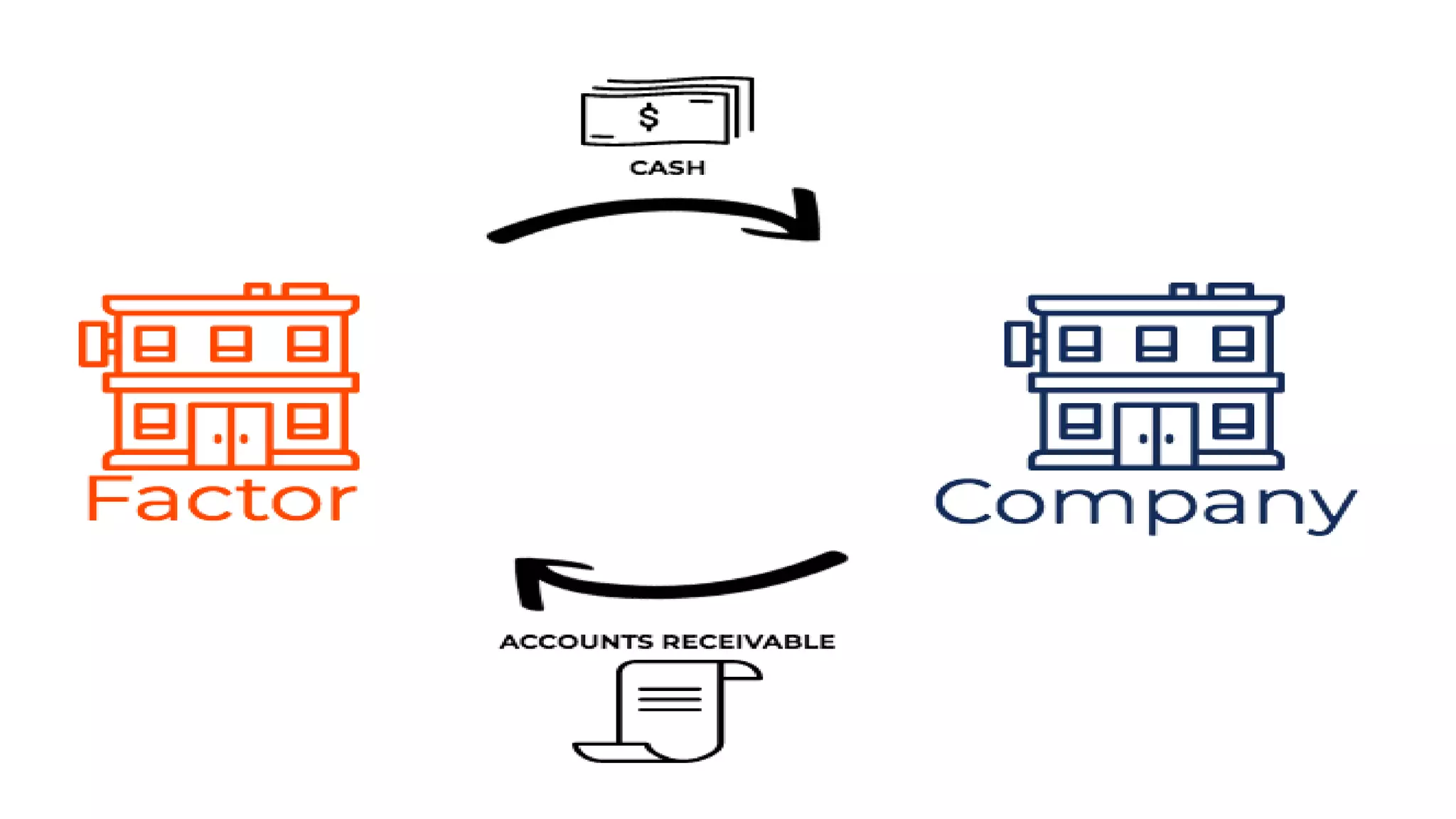
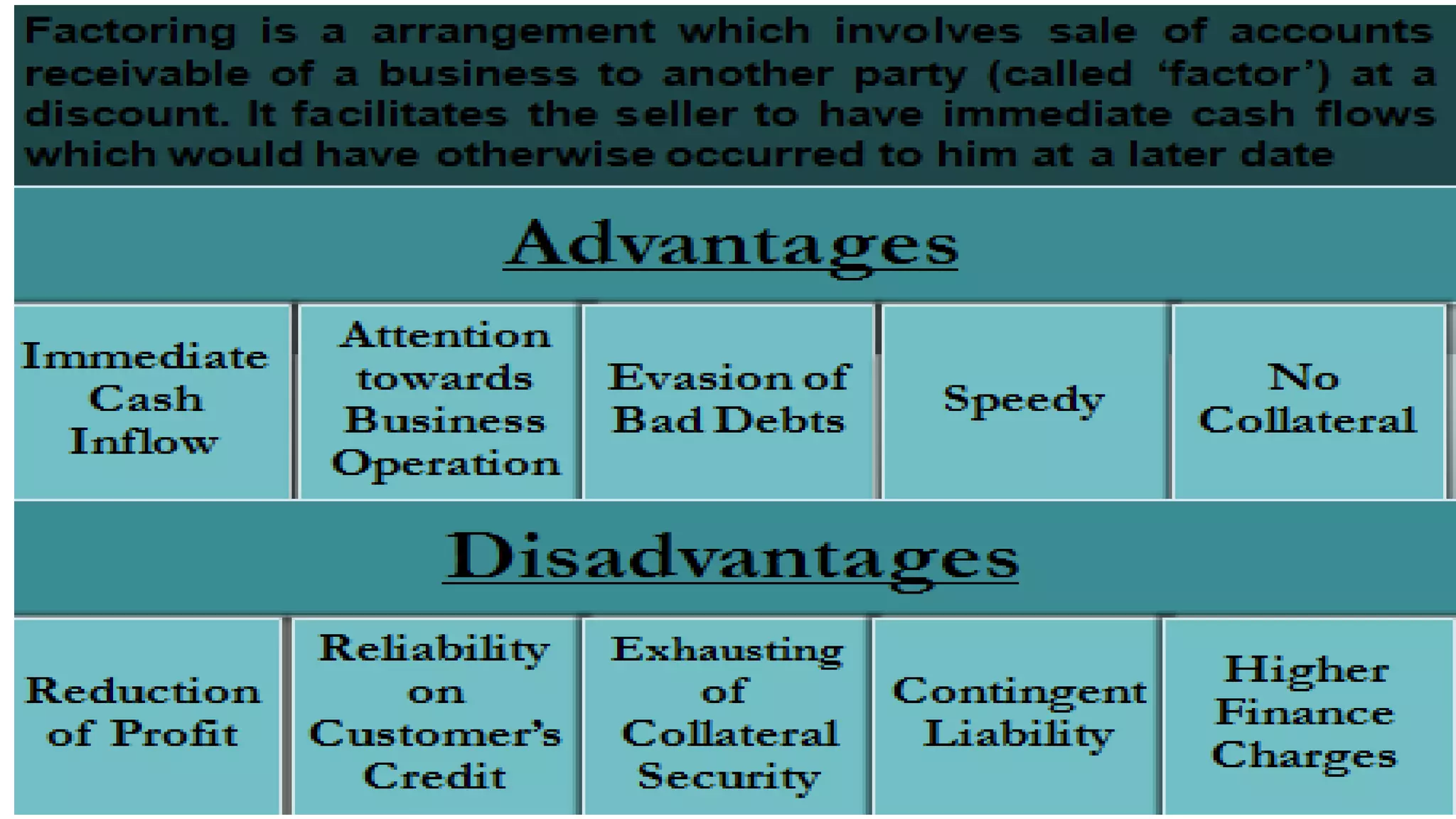
• Factoring is a financial transaction/relationship, where by a business
sells its Accounts Receivable (invoices) (Sundry Debtors+ Bills
Receivables) to a third party (called a factor) at a discount. Thus it
is a financing method in which a business owner sells Accounts
Receivable at a discount to a third party funding source to raise
capital (Working Capital).
Meaning
Parties to the factoring
1. The buyer of the goods
2. The seller of the goods
3. The factor (Financial Institution)
The 3 parties interact with each other during the purchase and Sale
of goods.
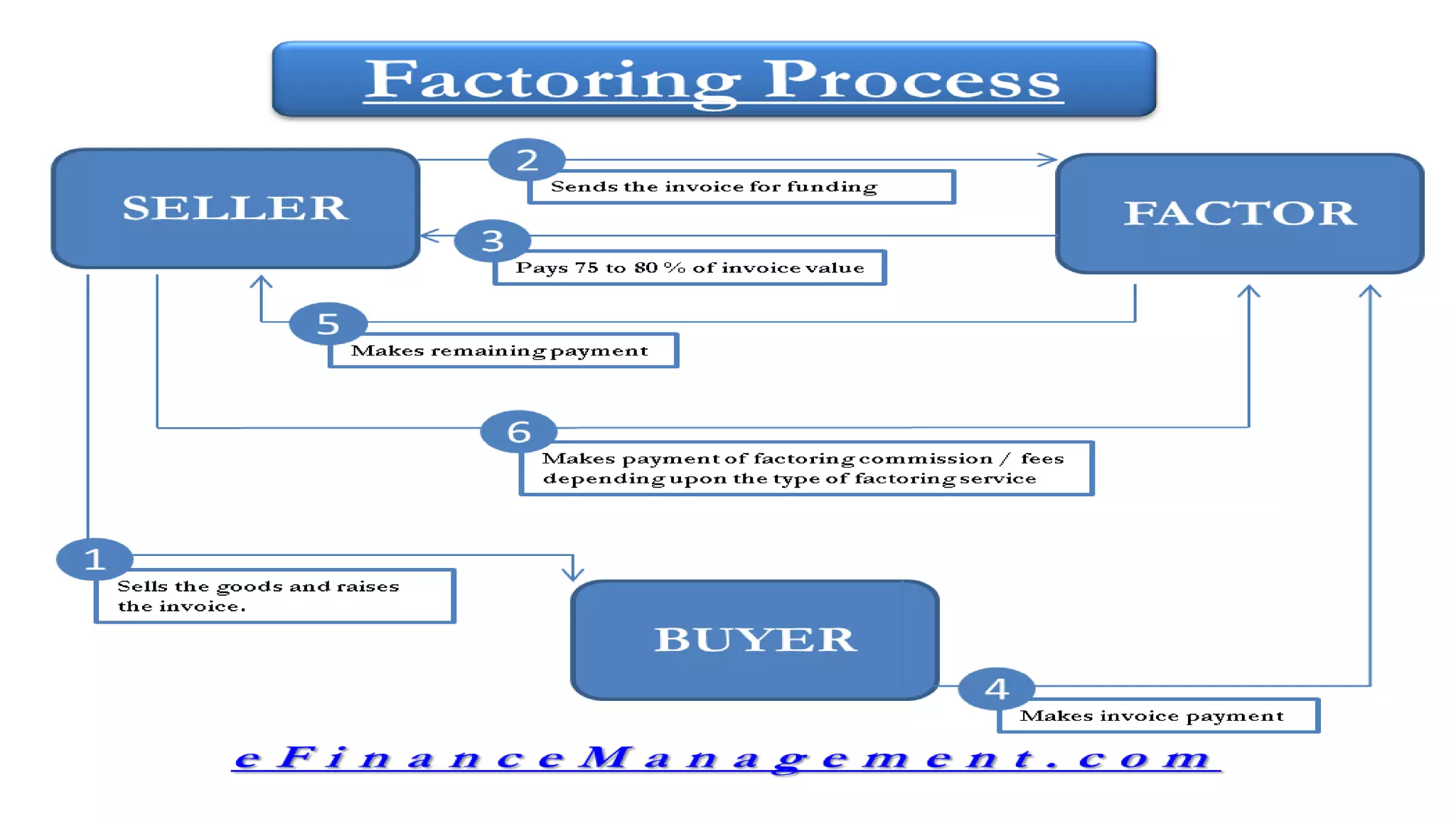
How Does Factoring Works….
MECHANISM OF FACTORING
• An agreement is entered into between the selling firm and the factor
firm. The agreement provides the basis and scope of the
understanding reached between the two for rendering factor services
• The sale documents should contain the instructions to make
payments directly to the factor who is assigned the job of collection
of receivables.
• When the payment is received by the factor , the account of the
selling firm is credited by the factor after deducting its fees,
charges, interest etc as agreed.
• The factor may provide advance finance to the selling firm if the
conditions of the agreement so require.
TYPES OF FACTORING
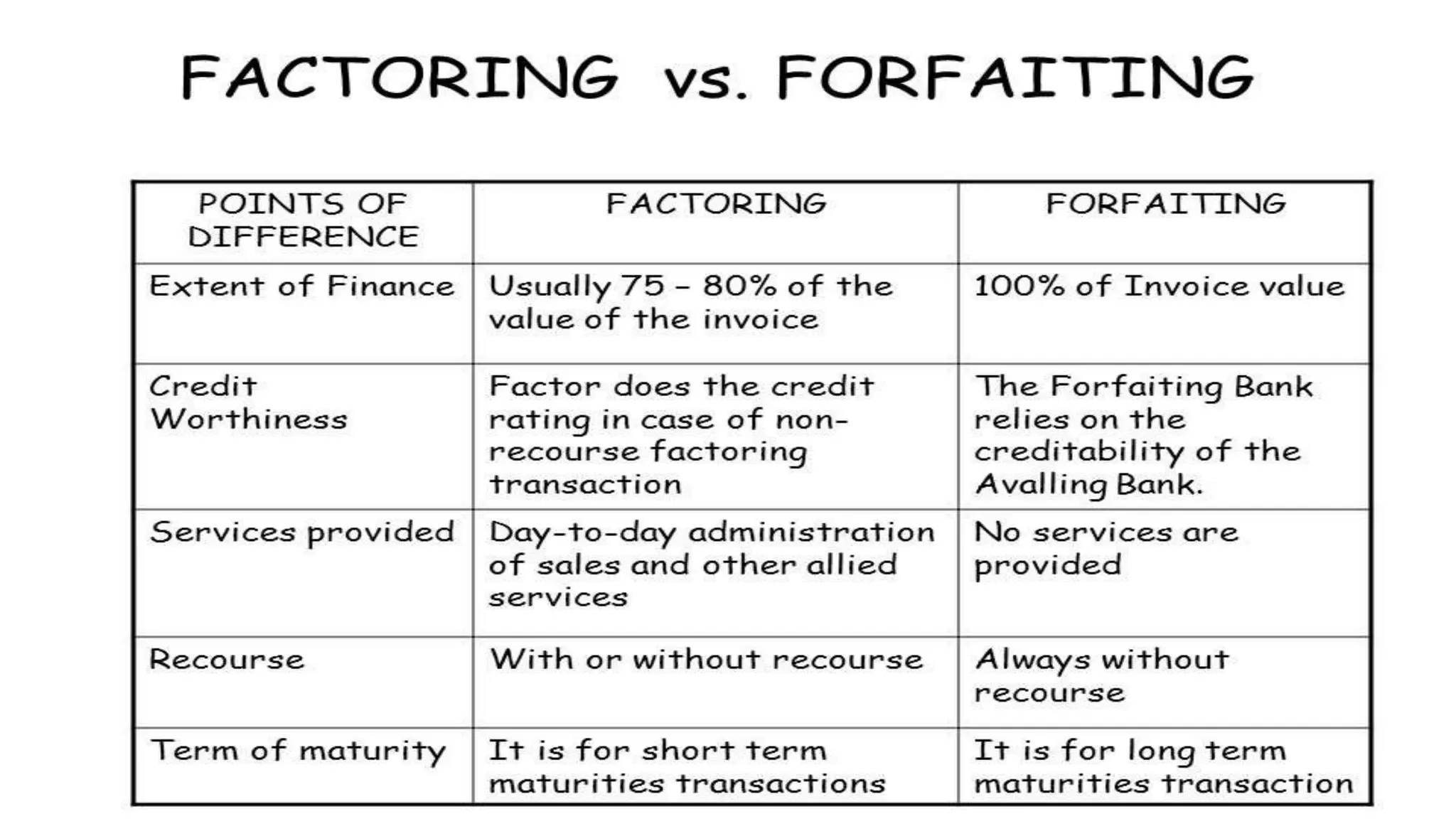
1. Recourse Factoring - In this, the client (seller firm) is liable for
any bad debts inured.
2. Non Recourse Factoring- In this, the factor assumes the entire
credit risk. Full amount of invoice is paid to the client ( Seller Firm)
in the event of the debt becoming bad. Since the factor bears the risk
of non payment, commission or fees charge for the services in case of
non recourse factoring is higher than under the course factoring.
3. Advance Factoring – In this, the factor provides an
immediate advance (75-90%) of the approved receivables to
the client (Seller Firm).
4. Maturity Factoring – In this no advance is paid to the client
and the payment is made to the client only on collection of
receivables or the guaranteed payment data as the case may be
agreed between the parties.
5. Conventional or Full Factoring - Under this the factor performs
almost all services of collection of receivables, maintenance of sales
ledger, credit collection, credit control and credit insurance. The
factor also fixes up a draw limit based on the bills outstanding
maturity wise and takes up the risk of default and will have claims on
the debtor as also the client creditor.
6. Disclosed and Undisclosed Factoring – In disclose factoring, the
name of the factor is mentioned in the invoice by the supplier telling
the buyer to make payment to the factor on due date.
Under undisclosed factoring , the name of the factor is not disclosed
in the invoice, but still the control lies with the factor.
7. International Factoring – It refers to the factoring of export sales.
An international factoring house, in addition to the usual service of a
factor also undertakes the responsibility of completing of all legal and
procedural formalities concerned with export sales, hence client is
saved from the trouble of getting itself involved in the complexities
associated with international trade.
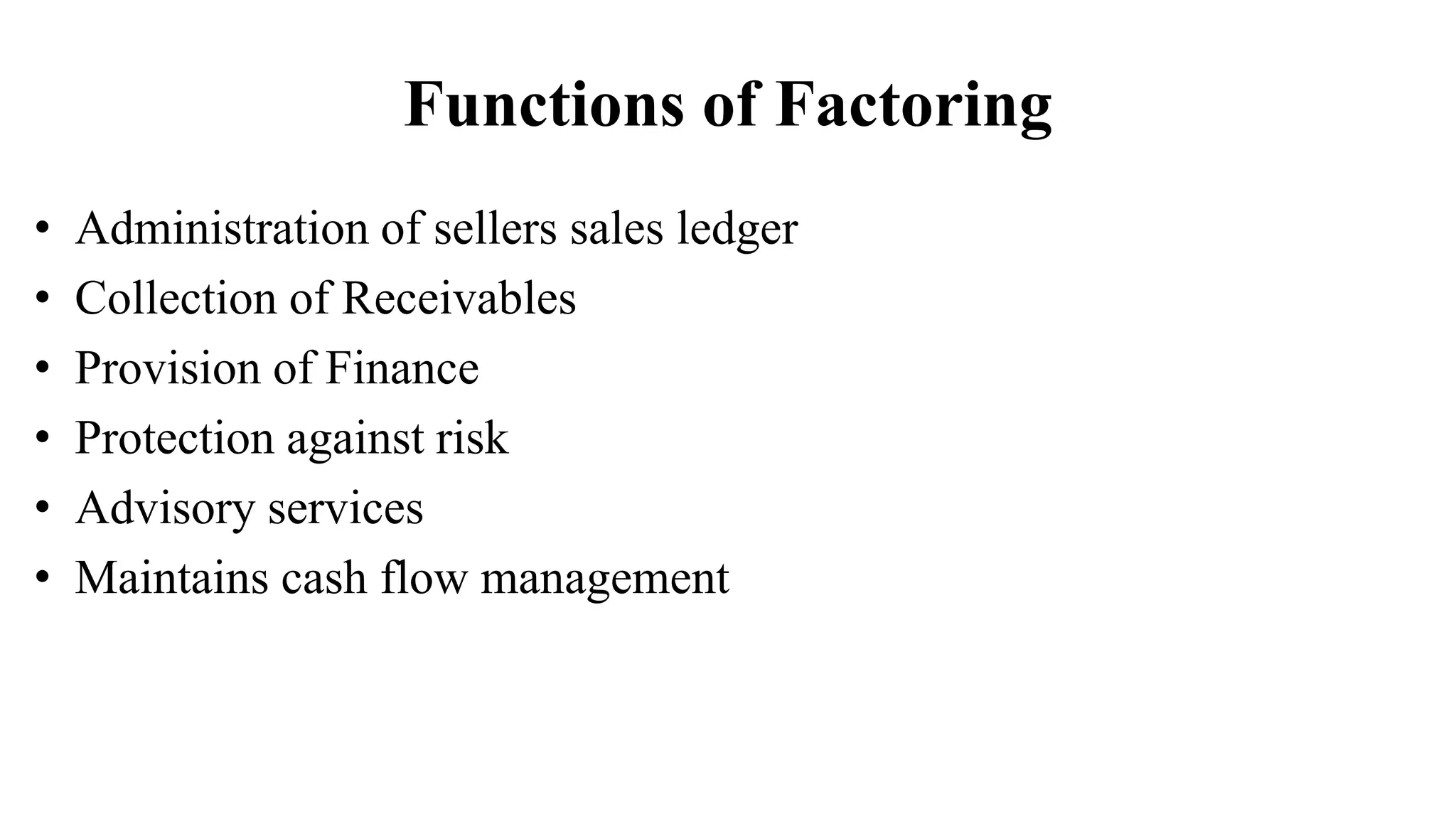
Functions of Factoring
• Administration of sellers sales ledger
• Collection of Receivables
• Provision of Finance
• Protection against risk
• Advisory services
• Maintains cash flow management
1. Administration of sales ledger
The factor maintains sales ledger in respect of each client. When the
sales transactions take place, an invoice is prepared in duplicate by
the client, one copy is given to the customer and second copy is
sent to the factor.
2. Collection of receivables
The main function of the factor is to collect the receivables on
behalf of the client and to relieve him from all the botheration's
associated with the collection. So the client can concentrate on
major areas of his business on one hand and reduce the cost of
collection by way of savings in labour, time and efforts on the other
hand.
3. Provision of Finance
Finance is made available easily by the factor to the client. A
factor purchases the book debt of his client and debts are assigned
in favour of the client. 75 to 80% of the assigned debts is given as
an advance to the client by the factor.
4.Protection against Risk
This service is provided where the debts are factored without
recourse. The factor fixes the credit limit in respect of approved
customers and assumes the risk of default in payment by the
customers.
5. Advisory Services
These services arise out of the close relationship between a factor
and a client. Since the factor have better knowledge and wide
experience in the field of finance, and possess extensive credit
information about the customers standing, they provide various
advisory services as and when required to the clients.
6. Maintains the cash flow management.
By providing advance payment against receivables, the factors
helps the clients to maintain a steady cash flow in the organization.
FORFAITING
Meaning
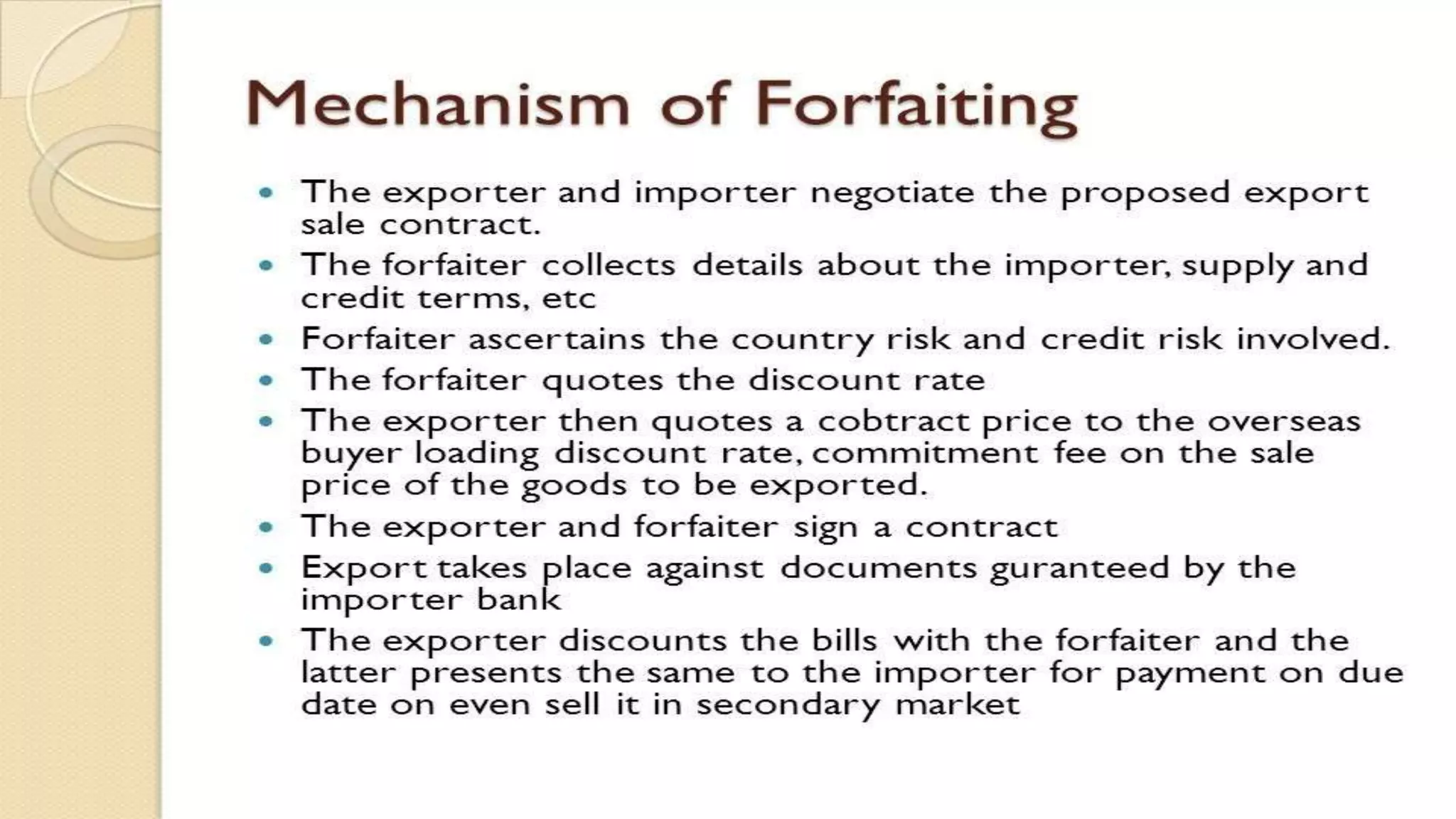
• Forfaiting refers to the financing of receivables pertaining
to international trade.
• Forfaiting is a mechanism by which the right for export
receivables of an exporter(client) is purchased by a
financial intermediary (forfeiter)without recourse to him.
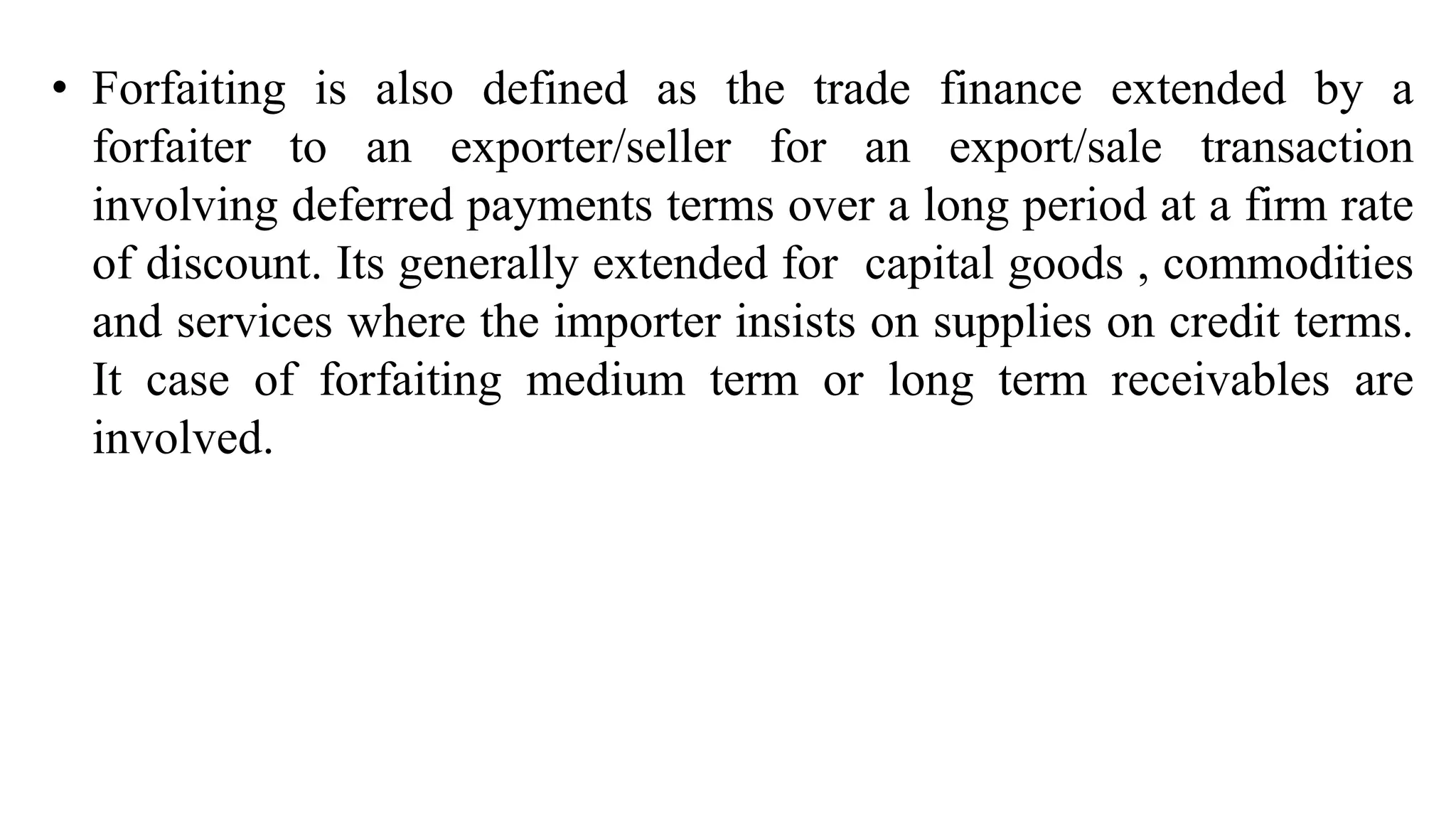
• Forfaiting is also defined as the trade finance extended by a
forfaiter to an exporter/seller for an export/sale transaction
involving deferred payments terms over a long period at a firm rate
of discount. Its generally extended for capital goods , commodities
and services where the importer insists on supplies on credit terms.
It case of forfaiting medium term or long term receivables are
involved.
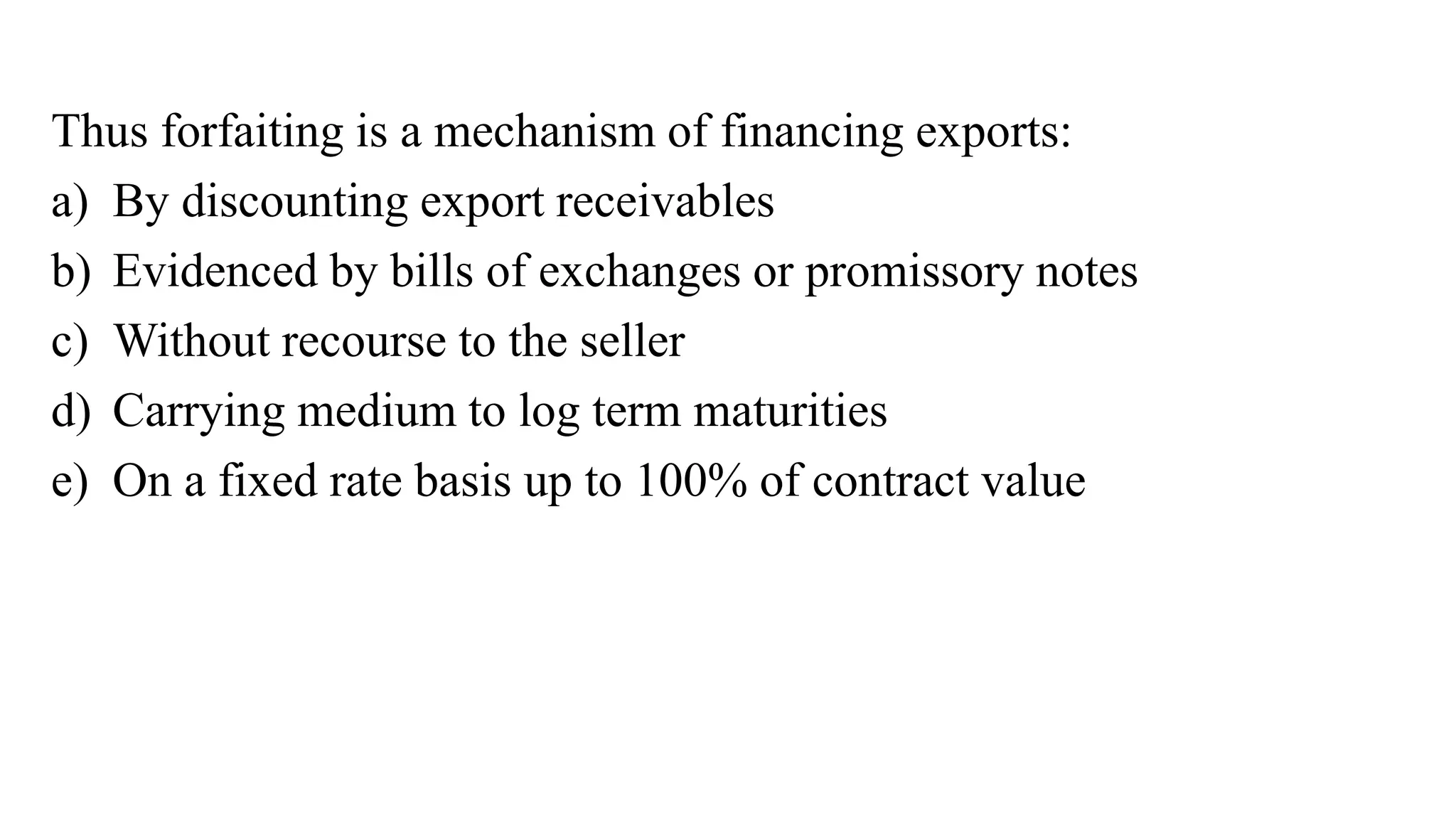
Thus forfaiting is a mechanism of financing exports:
a) By discounting export receivables
b) Evidenced by bills of exchanges or promissory notes
c) Without recourse to the seller
d) Carrying medium to log term maturities
e) On a fixed rate basis up to 100% of contract value
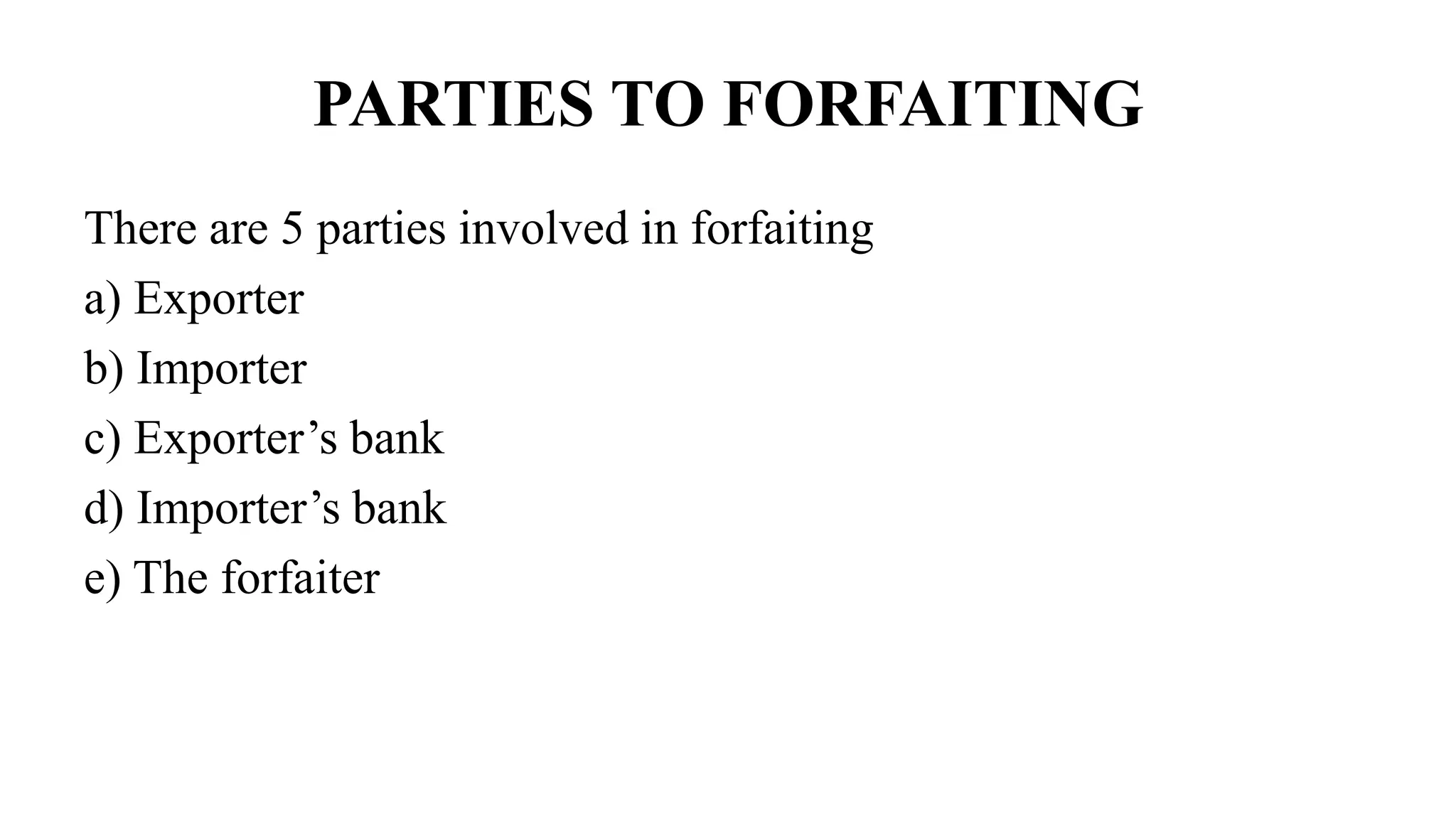
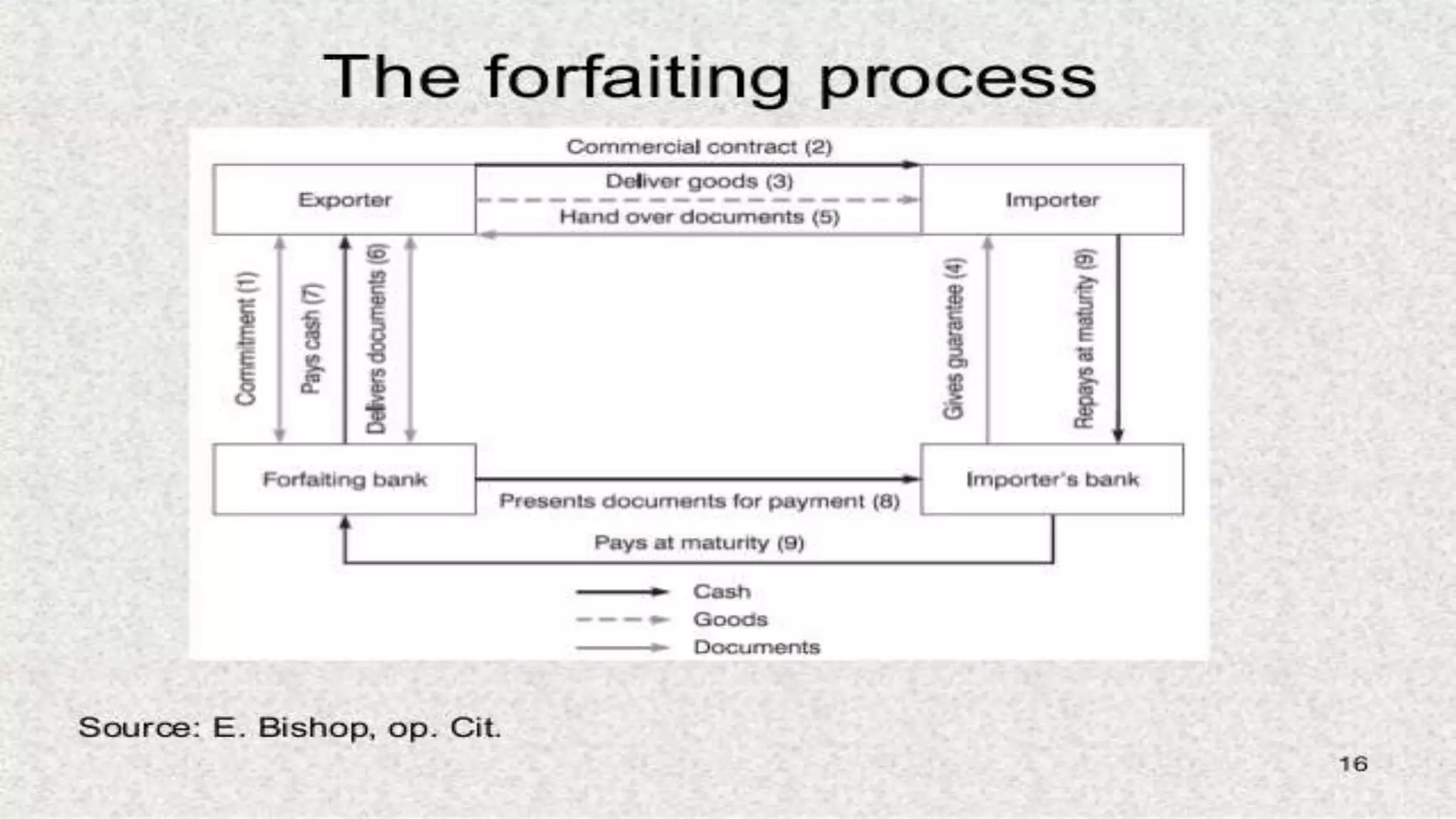
PARTIES TO FORFAITING
There are 5 parties involved in forfaiting
a) Exporter
b) Importer
c) Exporter’s bank
d) Importer’s bank
e) The forfaiter
Advantages of Forfaiting
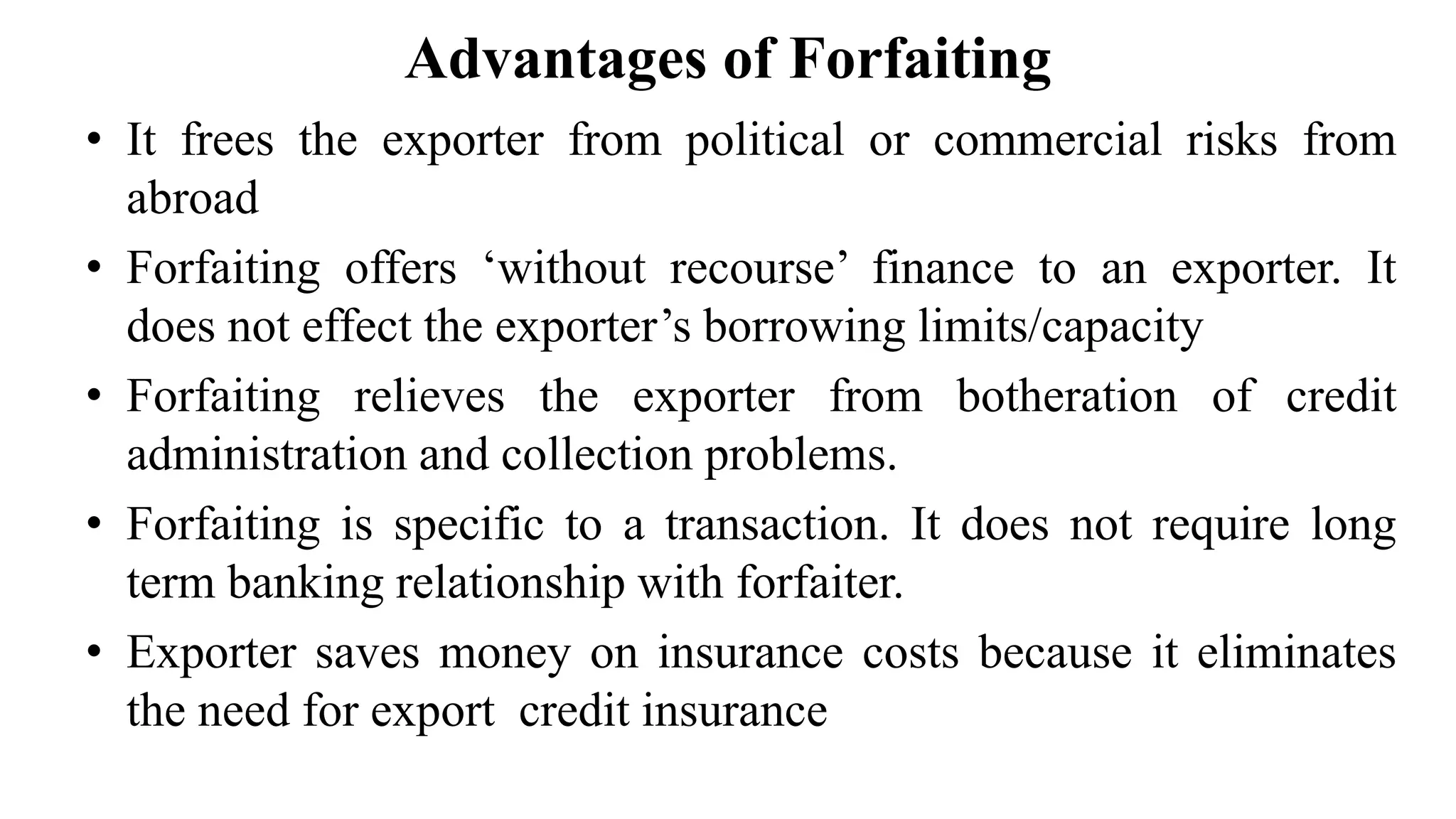
• It frees the exporter from political or commercial risks from
abroad
• Forfaiting offers ‘without recourse’ finance to an exporter. It
does not effect the exporter’s borrowing limits/capacity
• Forfaiting relieves the exporter from botheration of credit
administration and collection problems.
• Forfaiting is specific to a transaction. It does not require long
term banking relationship with forfaiter.
• Exporter saves money on insurance costs because it eliminates
the need for export credit insurance
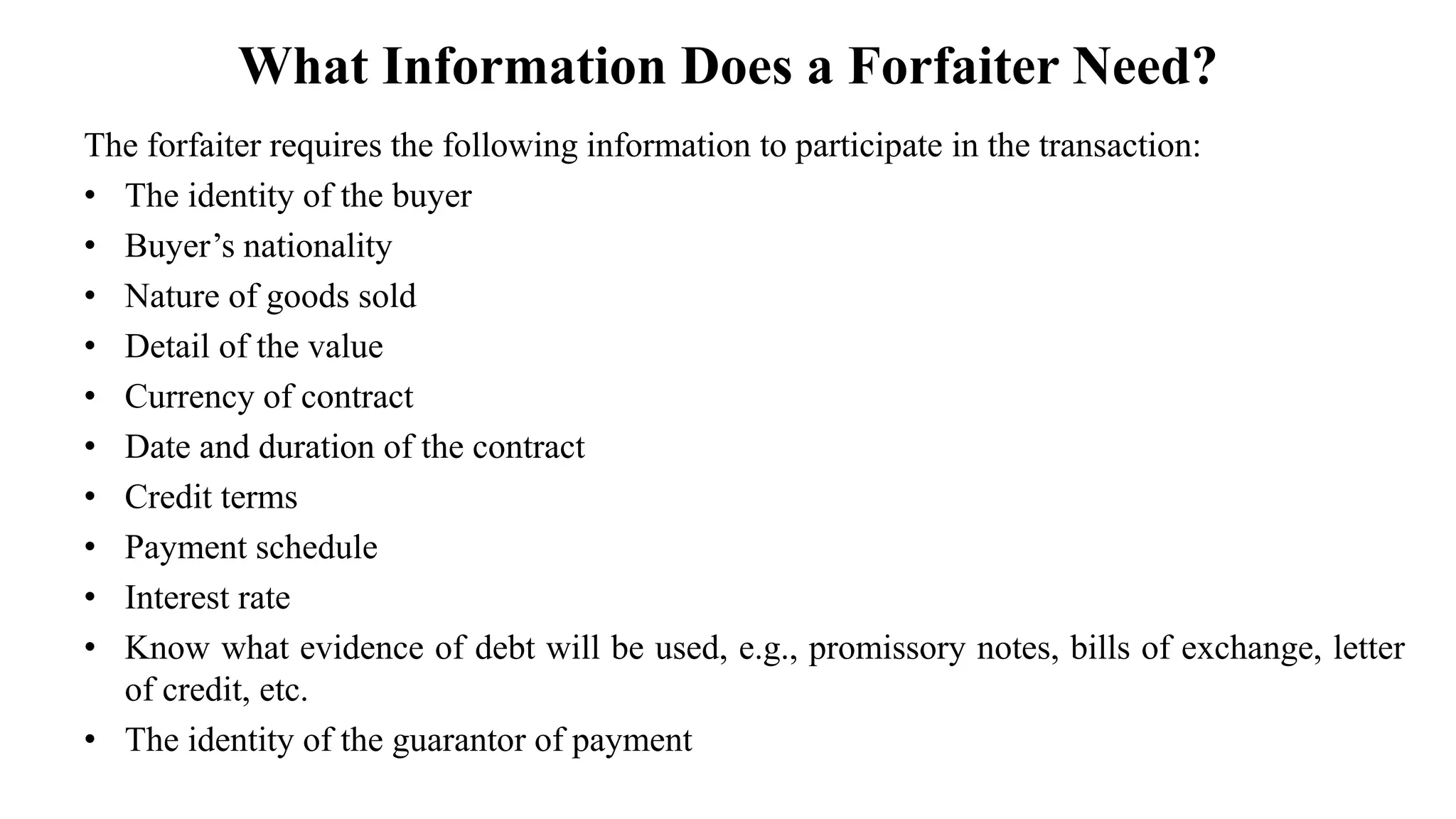
What Information Does a Forfaiter Need?
The forfaiter requires the following information to participate in the transaction:
• The identity of the buyer
• Buyer’s nationality
• Nature of goods sold
• Detail of the value
• Currency of contract
• Date and duration of the contract
• Credit terms
• Payment schedule
• Interest rate
• Know what evidence of debt will be used, e.g., promissory notes, bills of exchange, letter
of credit, etc.
• The identity of the guarantor of payment
Documents Required by the Forfaiter from the Exporter
• Copy of supply contract, or its payment’s terms
• Copy of shipping documents, including airway bill, bill of lading,
certificates of receipt, railway bill, or equivalent documents
• Copy of signed commercial invoice
• Letter of assignment and notification to the guarantor
• Letter of guarantee
THE END…..

Unit 5 Factoring and Forfaiting - FIS

  • 1.
    UNIT-5 FACTORING & FORFAITING Mr.VIPULKUMAR N M ASSISTANT PROFESSOR DEPARTMENT OF COMMERCE KRISTU JAYANTI COLLEGE (AUTONOMOUS) BENGALURU
  • 2.
    • A factoris a financial institution which offers services relating to management and financing of debts arising out of credit sales. It acts as another financial intermediary between the buyer and seller. • Factoring is a financial transaction/relationship, where by a business sells its Accounts Receivable (invoices) (Sundry Debtors+ Bills Receivables) to a third party (called a factor) at a discount. Thus it is a financing method in which a business owner sells Accounts Receivable at a discount to a third party funding source to raise capital (Working Capital). Meaning
  • 3.
    Parties to thefactoring 1. The buyer of the goods 2. The seller of the goods 3. The factor (Financial Institution) The 3 parties interact with each other during the purchase and Sale of goods.
  • 4.
  • 7.
    MECHANISM OF FACTORING •An agreement is entered into between the selling firm and the factor firm. The agreement provides the basis and scope of the understanding reached between the two for rendering factor services • The sale documents should contain the instructions to make payments directly to the factor who is assigned the job of collection of receivables.
  • 8.
    • When thepayment is received by the factor , the account of the selling firm is credited by the factor after deducting its fees, charges, interest etc as agreed. • The factor may provide advance finance to the selling firm if the conditions of the agreement so require.
  • 9.
  • 10.
    1. Recourse Factoring- In this, the client (seller firm) is liable for any bad debts inured. 2. Non Recourse Factoring- In this, the factor assumes the entire credit risk. Full amount of invoice is paid to the client ( Seller Firm) in the event of the debt becoming bad. Since the factor bears the risk of non payment, commission or fees charge for the services in case of non recourse factoring is higher than under the course factoring.
  • 11.
    3. Advance Factoring– In this, the factor provides an immediate advance (75-90%) of the approved receivables to the client (Seller Firm). 4. Maturity Factoring – In this no advance is paid to the client and the payment is made to the client only on collection of receivables or the guaranteed payment data as the case may be agreed between the parties.
  • 12.
    5. Conventional orFull Factoring - Under this the factor performs almost all services of collection of receivables, maintenance of sales ledger, credit collection, credit control and credit insurance. The factor also fixes up a draw limit based on the bills outstanding maturity wise and takes up the risk of default and will have claims on the debtor as also the client creditor. 6. Disclosed and Undisclosed Factoring – In disclose factoring, the name of the factor is mentioned in the invoice by the supplier telling the buyer to make payment to the factor on due date. Under undisclosed factoring , the name of the factor is not disclosed in the invoice, but still the control lies with the factor.
  • 13.
    7. International Factoring– It refers to the factoring of export sales. An international factoring house, in addition to the usual service of a factor also undertakes the responsibility of completing of all legal and procedural formalities concerned with export sales, hence client is saved from the trouble of getting itself involved in the complexities associated with international trade.
  • 17.
    Functions of Factoring •Administration of sellers sales ledger • Collection of Receivables • Provision of Finance • Protection against risk • Advisory services • Maintains cash flow management
  • 18.
    1. Administration ofsales ledger The factor maintains sales ledger in respect of each client. When the sales transactions take place, an invoice is prepared in duplicate by the client, one copy is given to the customer and second copy is sent to the factor. 2. Collection of receivables The main function of the factor is to collect the receivables on behalf of the client and to relieve him from all the botheration's associated with the collection. So the client can concentrate on major areas of his business on one hand and reduce the cost of collection by way of savings in labour, time and efforts on the other hand.
  • 19.
    3. Provision ofFinance Finance is made available easily by the factor to the client. A factor purchases the book debt of his client and debts are assigned in favour of the client. 75 to 80% of the assigned debts is given as an advance to the client by the factor. 4.Protection against Risk This service is provided where the debts are factored without recourse. The factor fixes the credit limit in respect of approved customers and assumes the risk of default in payment by the customers.
  • 20.
    5. Advisory Services Theseservices arise out of the close relationship between a factor and a client. Since the factor have better knowledge and wide experience in the field of finance, and possess extensive credit information about the customers standing, they provide various advisory services as and when required to the clients. 6. Maintains the cash flow management. By providing advance payment against receivables, the factors helps the clients to maintain a steady cash flow in the organization.
  • 21.
  • 22.
    Meaning • Forfaiting refersto the financing of receivables pertaining to international trade. • Forfaiting is a mechanism by which the right for export receivables of an exporter(client) is purchased by a financial intermediary (forfeiter)without recourse to him.
  • 23.
    • Forfaiting isalso defined as the trade finance extended by a forfaiter to an exporter/seller for an export/sale transaction involving deferred payments terms over a long period at a firm rate of discount. Its generally extended for capital goods , commodities and services where the importer insists on supplies on credit terms. It case of forfaiting medium term or long term receivables are involved.
  • 24.
    Thus forfaiting isa mechanism of financing exports: a) By discounting export receivables b) Evidenced by bills of exchanges or promissory notes c) Without recourse to the seller d) Carrying medium to log term maturities e) On a fixed rate basis up to 100% of contract value
  • 25.
    PARTIES TO FORFAITING Thereare 5 parties involved in forfaiting a) Exporter b) Importer c) Exporter’s bank d) Importer’s bank e) The forfaiter
  • 28.
    Advantages of Forfaiting •It frees the exporter from political or commercial risks from abroad • Forfaiting offers ‘without recourse’ finance to an exporter. It does not effect the exporter’s borrowing limits/capacity • Forfaiting relieves the exporter from botheration of credit administration and collection problems. • Forfaiting is specific to a transaction. It does not require long term banking relationship with forfaiter. • Exporter saves money on insurance costs because it eliminates the need for export credit insurance
  • 29.
    What Information Doesa Forfaiter Need? The forfaiter requires the following information to participate in the transaction: • The identity of the buyer • Buyer’s nationality • Nature of goods sold • Detail of the value • Currency of contract • Date and duration of the contract • Credit terms • Payment schedule • Interest rate • Know what evidence of debt will be used, e.g., promissory notes, bills of exchange, letter of credit, etc. • The identity of the guarantor of payment
  • 30.
    Documents Required bythe Forfaiter from the Exporter • Copy of supply contract, or its payment’s terms • Copy of shipping documents, including airway bill, bill of lading, certificates of receipt, railway bill, or equivalent documents • Copy of signed commercial invoice • Letter of assignment and notification to the guarantor • Letter of guarantee
  • 32.