FACE RECOGNITION
  TECHNOLOGY

        T.DIVYA
        ROLL NO.:08RG1A0481
        E.C.E
Topics Of Discussion
   Why FRT?
   How to implement?
   Applications
   Opposition
   Future of face recognition
Why only Face Recognition?
   It is accurate
   No need of expert
   Passive identification in one to many
    environment
Comparison types
   Verification
          accomplished by system performing a
       “one-to-many” search

   Identification
      accomplished by the system performing
            a “one-to-one” search
Components involved

   Enrolment module
   Data base
   Identification module
FIVE STEP PROCESS (STEP 1)
ACQUIRING THE IMAGE OF AN
  INDIVIDUALS FACE
2 WAYS TO AQUIRE IMAGE
1)Digitally scan an existing photograph
2)Acquire a live picture of a subject
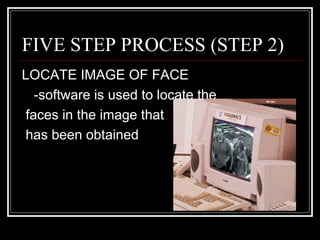
FIVE STEP PROCESS (STEP 2)
LOCATE IMAGE OF FACE
   -software is used to locate the
 faces in the image that
 has been obtained
FIVE STEP PROCESS (STEP 3)
ANALYSIS OF FACIAL IMAGE
 -software measures face according to is
 peaks and valleys (nodal points)
 -focuses on the inner region of the face
 known as the “golden triangle”
 -nodal points are used to make a face print
FIVE STEP PROCESS (STEP 4)
COMPARISON
 -the face print created by the software is
 compared to all face prints the system has
 stored in its database.
FIVE STEP PROCESS (STEP 5)
MATCH OR NO MATCH
 software decides whether or not any
 comparisons from step 4 are close enough
 to declare a possible match
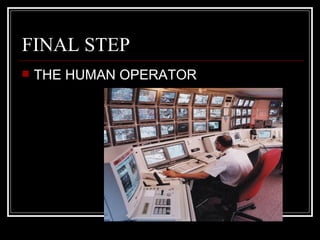
FINAL STEP
   THE HUMAN OPERATOR
Applications
   Residential security
   Banking using ATM
   Voter identification
   Immigration
   …………………….
Not Everyone Loves Face Recognition
   Critics say it produces too many false
    positives
   Invasion of privacy
   To easy to misuse for wrong purposes
   Technology is not accurate enough given
    the current technology and algorithms
Future Of Face Recognition
   Some consider the problem impossible
   No standard way of approaching the
    problem
   Advancements in hardware and software
   Slow integration into society in limited
    environments
   Very large potential market
Thank you


  ?

Face recognition technology

  • 1.
    FACE RECOGNITION TECHNOLOGY T.DIVYA ROLL NO.:08RG1A0481 E.C.E
  • 2.
    Topics Of Discussion  Why FRT?  How to implement?  Applications  Opposition  Future of face recognition
  • 3.
    Why only FaceRecognition?  It is accurate  No need of expert  Passive identification in one to many environment
  • 4.
    Comparison types  Verification accomplished by system performing a “one-to-many” search  Identification accomplished by the system performing a “one-to-one” search
  • 5.
    Components involved  Enrolment module  Data base  Identification module
  • 6.
    FIVE STEP PROCESS(STEP 1) ACQUIRING THE IMAGE OF AN INDIVIDUALS FACE 2 WAYS TO AQUIRE IMAGE 1)Digitally scan an existing photograph 2)Acquire a live picture of a subject
  • 7.
    FIVE STEP PROCESS(STEP 2) LOCATE IMAGE OF FACE -software is used to locate the faces in the image that has been obtained
  • 8.
    FIVE STEP PROCESS(STEP 3) ANALYSIS OF FACIAL IMAGE -software measures face according to is peaks and valleys (nodal points) -focuses on the inner region of the face known as the “golden triangle” -nodal points are used to make a face print
  • 9.
    FIVE STEP PROCESS(STEP 4) COMPARISON -the face print created by the software is compared to all face prints the system has stored in its database.
  • 10.
    FIVE STEP PROCESS(STEP 5) MATCH OR NO MATCH software decides whether or not any comparisons from step 4 are close enough to declare a possible match
  • 11.
    FINAL STEP  THE HUMAN OPERATOR
  • 12.
    Applications  Residential security  Banking using ATM  Voter identification  Immigration  …………………….
  • 13.
    Not Everyone LovesFace Recognition  Critics say it produces too many false positives  Invasion of privacy  To easy to misuse for wrong purposes  Technology is not accurate enough given the current technology and algorithms
  • 14.
    Future Of FaceRecognition  Some consider the problem impossible  No standard way of approaching the problem  Advancements in hardware and software  Slow integration into society in limited environments  Very large potential market
  • 15.