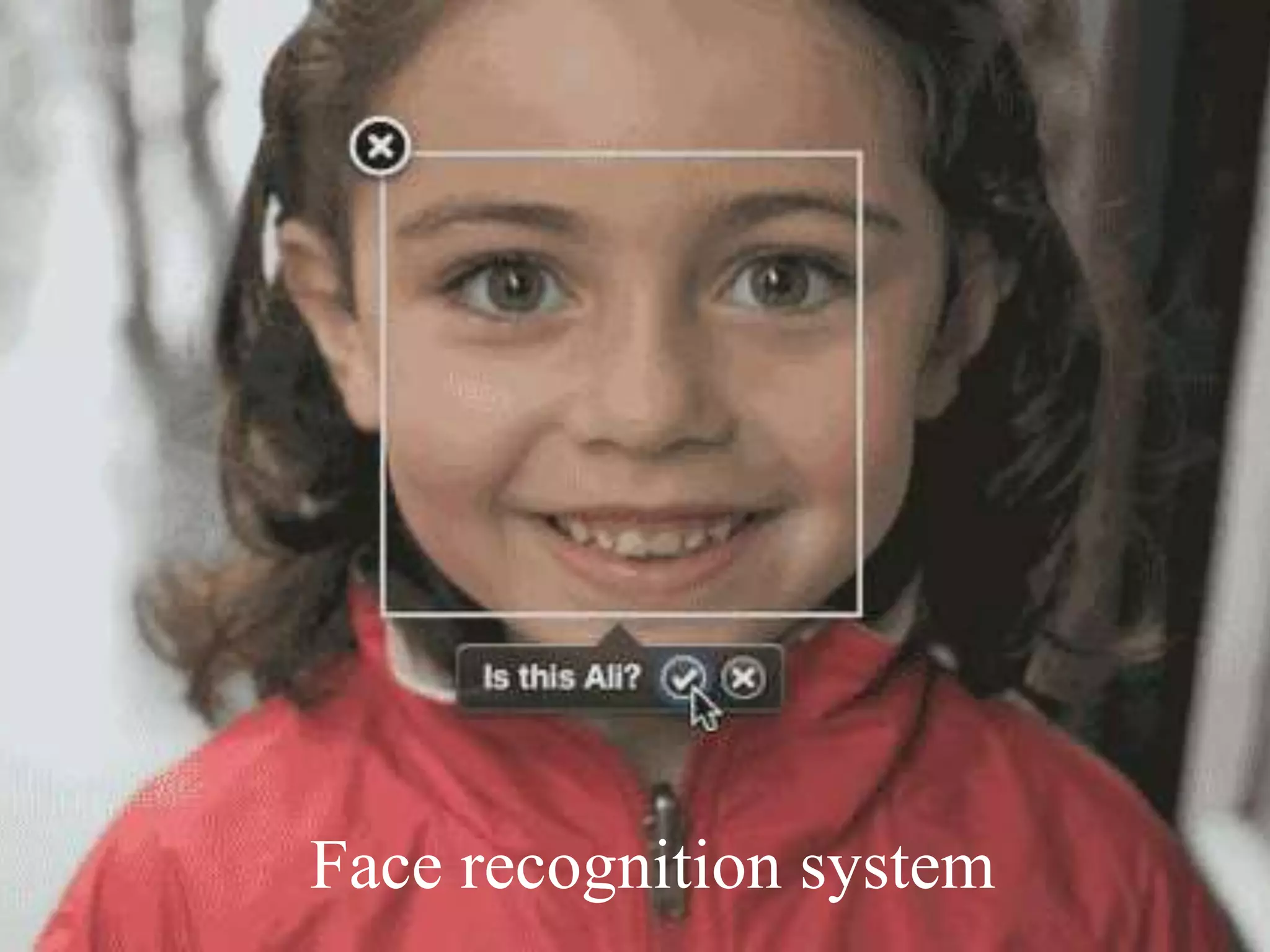
Face recognition system
Introduction
5 Methodology
4 Face Recognition
3 Why we choose face recognition over other biometric ?
2 What is Biometrics ?
1
Contents
6
7
8
9
Implementation of Face Recognition Technology
How Face Recognition Systems Work
Entity – relationship (ER) diagram
Advantages and Disadvantages
10
11
Applications
Conclusion
Introduction
In today's networked world, the need to maintain the security of
information or physical property is becoming both increasingly important
and increasingly difficult.
Face recognition is one of the few biometric methods that possess the
merits of high accuracy.
Complex and largely software based technique
Analyze unique shape, pattern &positioning of facial features
It compare scans to records stored in central or local database or even on a
smart card.
What is Biometrics ?
It is a unique measurable characteristics of a human being used to
automatically recognize an individual’s identity.
Two types
1.physiological
2. behavioral characteristics
A “biometric system” refers to integrated hardware and software used to
conduct biometric identification
Why we choose face recognition over other
biometric ?
• It requires no physical interaction on behalf of the user.
• It is accurate and allows for high enrolment and verification rates.
• It does not require an expert to interpret the comparison result.
• It can use your existing hardware infrastructure ,existing cameras and
image capture devices will work with no problems.
• It is the only biometric that allow you to perform passive identification in a
one to many environments (Eg. Identifying a terrorists in a busy Airport
terminal)
Face Recognition
• The Face – unique part .
• For face recognition there are two types of comparisons.
1 . Verification
This is where the system compares the given individual with who that
individual says they are and gives a yes or no decision.
2. Identification
This is where the system compares the given individual to all the other
individuals in the database and gives a ranked list of matches .
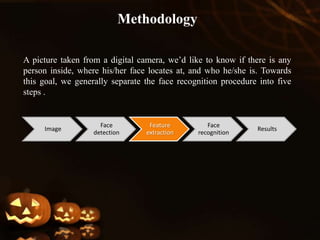
Image
Face
detection
Feature
extraction
Face
recognition
Results
Methodology
A picture taken from a digital camera, we’d like to know if there is any
person inside, where his/her face locates at, and who he/she is. Towards
this goal, we generally separate the face recognition procedure into five
steps .
Implementation of Face Recognition
Technology
2
1
3
4
Decision
making
Face images
classification
Input
processing
Data
acquisition
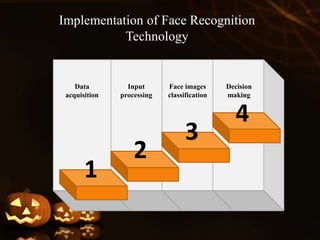
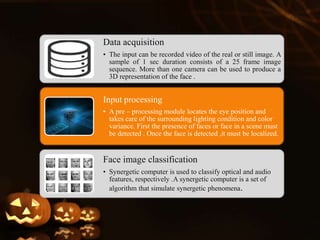
Data acquisition
• The input can be recorded video of the real or still image. A
sample of 1 sec duration consists of a 25 frame image
sequence. More than one camera can be used to produce a
3D representation of the face .
Input processing
• A pre – processing module locates the eye position and
takes care of the surrounding lighting condition and color
variance. First the presence of faces or face in a scene must
be detected . Once the face is detected ,it must be localized.
Face image classification
• Synergetic computer is used to classify optical and audio
features, respectively .A synergetic computer is a set of
algorithm that simulate synergetic phenomena.
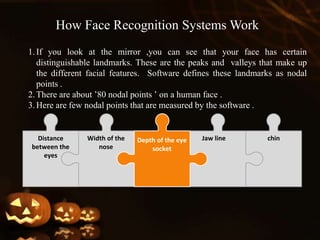
1.If you look at the mirror ,you can see that your face has certain
distinguishable landmarks. These are the peaks and valleys that make up
the different facial features. Software defines these landmarks as nodal
points .
2.There are about ’80 nodal points ’ on a human face .
3.Here are few nodal points that are measured by the software .
Depth of the eye
socket
Width of the
nose
Distance
between the
eyes
Jaw line chin
How Face Recognition Systems Work
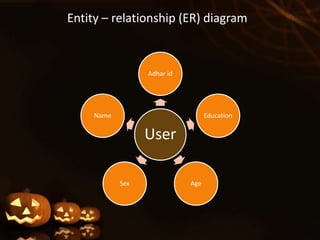
Entity – relationship (ER) diagram
User
Adhar id
Education
AgeSex
Name
Advantages
• Convenient, social acceptability
• More user friendly
• Inexpensive technique of
identification
Disadvantages
• Problem with false rejection when
people change their hair style,
grow or shave a beard or wear
glasses.
• Face recognition systems can’t tell
the difference between identical
twins
Applications
1 . Government Use:
a. Law Enforcement :Minimizing victim trauma verifying identify for
court records ,and comparing school surveillance camera images to know
child molesters .
b. Security/Counter terrorism :Access control ,comparing surveillance
images to know terrorist.
c. Immigration : Rapid progression through customs.
d. Voter verification : Where eligible politicians are required to verify
their identity during a voting process this is intended to stop ‘ proxy ’
voting where the vote may not go as expected.
2. Commercial Use :
a. Residential Security : Alert home owners of approaching personnel .
b. Banking using ATM :The software is able to quickly verify a customer’s
face.
c. Physical access control of building areas ,doors , cars or net access .
Conclusion
• Face recognition technologies have been associated generally with very
costly top secure applications. Today the core technologies have evolved
and the cost of equipment is going down dramatically due to the
integration and the increasing processing power . Certain applications of
face recognition technology are now cost effective , reliable and highly
accurate .As a result there are no technological or financial barriers for
stepping from the pilot project to widespread deployment .
Do you have
any questions?

Face recognition

  • 1.
  • 2.
    Introduction 5 Methodology 4 FaceRecognition 3 Why we choose face recognition over other biometric ? 2 What is Biometrics ? 1 Contents 6 7 8 9 Implementation of Face Recognition Technology How Face Recognition Systems Work Entity – relationship (ER) diagram Advantages and Disadvantages 10 11 Applications Conclusion
  • 3.
    Introduction In today's networkedworld, the need to maintain the security of information or physical property is becoming both increasingly important and increasingly difficult. Face recognition is one of the few biometric methods that possess the merits of high accuracy. Complex and largely software based technique Analyze unique shape, pattern &positioning of facial features It compare scans to records stored in central or local database or even on a smart card.
  • 4.
    What is Biometrics? It is a unique measurable characteristics of a human being used to automatically recognize an individual’s identity. Two types 1.physiological 2. behavioral characteristics A “biometric system” refers to integrated hardware and software used to conduct biometric identification
  • 5.
    Why we chooseface recognition over other biometric ? • It requires no physical interaction on behalf of the user. • It is accurate and allows for high enrolment and verification rates. • It does not require an expert to interpret the comparison result. • It can use your existing hardware infrastructure ,existing cameras and image capture devices will work with no problems. • It is the only biometric that allow you to perform passive identification in a one to many environments (Eg. Identifying a terrorists in a busy Airport terminal)
  • 6.
    Face Recognition • TheFace – unique part . • For face recognition there are two types of comparisons. 1 . Verification This is where the system compares the given individual with who that individual says they are and gives a yes or no decision. 2. Identification This is where the system compares the given individual to all the other individuals in the database and gives a ranked list of matches .
  • 7.
    Image Face detection Feature extraction Face recognition Results Methodology A picture takenfrom a digital camera, we’d like to know if there is any person inside, where his/her face locates at, and who he/she is. Towards this goal, we generally separate the face recognition procedure into five steps .
  • 8.
    Implementation of FaceRecognition Technology 2 1 3 4 Decision making Face images classification Input processing Data acquisition
  • 9.
    Data acquisition • Theinput can be recorded video of the real or still image. A sample of 1 sec duration consists of a 25 frame image sequence. More than one camera can be used to produce a 3D representation of the face . Input processing • A pre – processing module locates the eye position and takes care of the surrounding lighting condition and color variance. First the presence of faces or face in a scene must be detected . Once the face is detected ,it must be localized. Face image classification • Synergetic computer is used to classify optical and audio features, respectively .A synergetic computer is a set of algorithm that simulate synergetic phenomena.
  • 10.
    1.If you lookat the mirror ,you can see that your face has certain distinguishable landmarks. These are the peaks and valleys that make up the different facial features. Software defines these landmarks as nodal points . 2.There are about ’80 nodal points ’ on a human face . 3.Here are few nodal points that are measured by the software . Depth of the eye socket Width of the nose Distance between the eyes Jaw line chin How Face Recognition Systems Work
  • 11.
    Entity – relationship(ER) diagram User Adhar id Education AgeSex Name
  • 12.
    Advantages • Convenient, socialacceptability • More user friendly • Inexpensive technique of identification Disadvantages • Problem with false rejection when people change their hair style, grow or shave a beard or wear glasses. • Face recognition systems can’t tell the difference between identical twins
  • 13.
    Applications 1 . GovernmentUse: a. Law Enforcement :Minimizing victim trauma verifying identify for court records ,and comparing school surveillance camera images to know child molesters . b. Security/Counter terrorism :Access control ,comparing surveillance images to know terrorist. c. Immigration : Rapid progression through customs. d. Voter verification : Where eligible politicians are required to verify their identity during a voting process this is intended to stop ‘ proxy ’ voting where the vote may not go as expected.
  • 14.
    2. Commercial Use: a. Residential Security : Alert home owners of approaching personnel . b. Banking using ATM :The software is able to quickly verify a customer’s face. c. Physical access control of building areas ,doors , cars or net access .
  • 15.
    Conclusion • Face recognitiontechnologies have been associated generally with very costly top secure applications. Today the core technologies have evolved and the cost of equipment is going down dramatically due to the integration and the increasing processing power . Certain applications of face recognition technology are now cost effective , reliable and highly accurate .As a result there are no technological or financial barriers for stepping from the pilot project to widespread deployment .
  • 16.
    Do you have anyquestions?