Presented by : sandeep
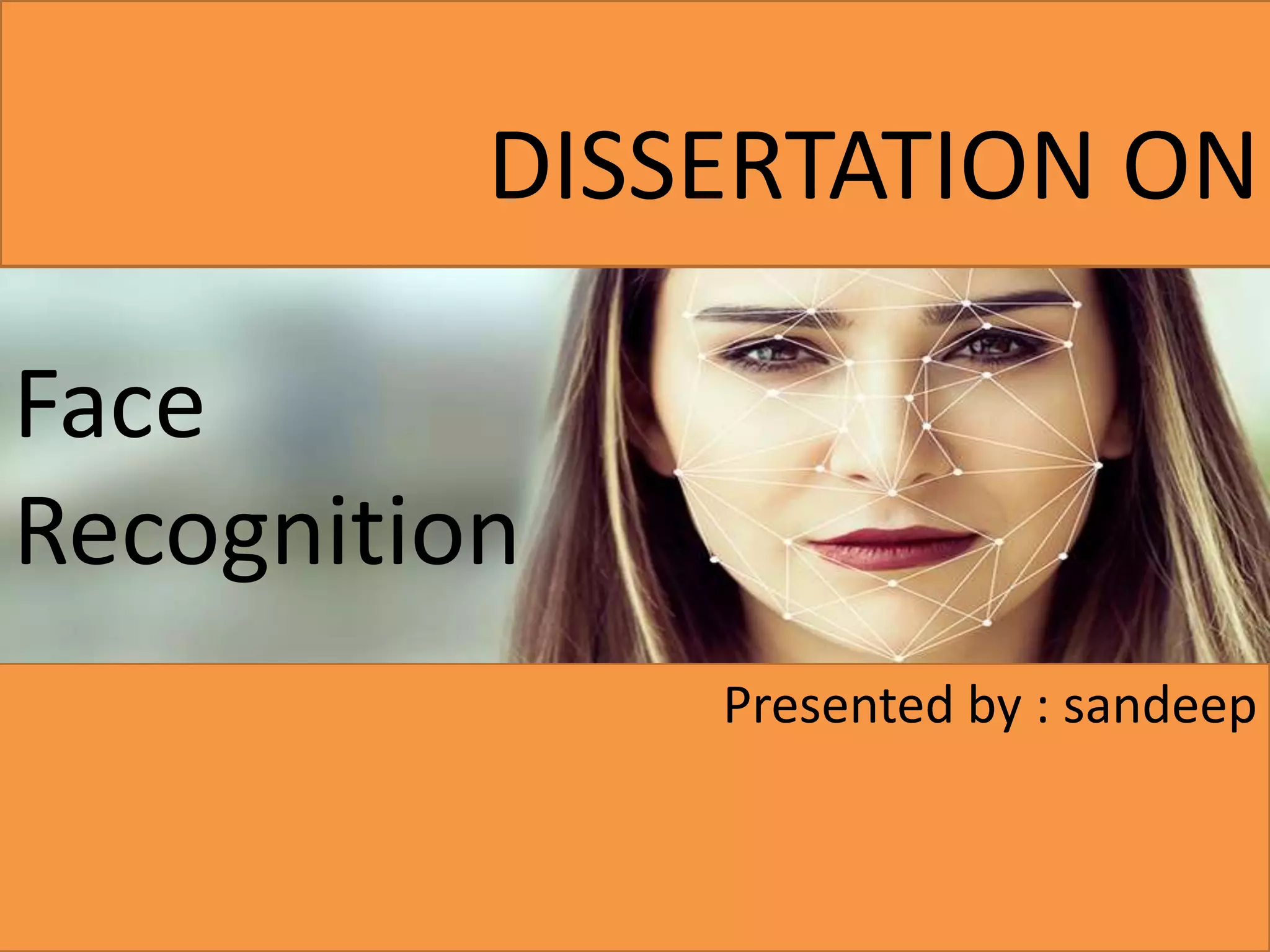
Face
Recognition
DISSERTATION ON
Information
• A face recognition system is a technology capable of identifying or
verifying a person from a digital image or a video frame from a video
source. There are multiple methods in which facial recognition
systems work, but in general, they work by comparing selected facial
features from given image with faces within a database.
• Biometric Artificial Intelligence based application that can uniquely
identify a person by analyzing patterns based on the person's facial
textures and shape.
• it has also become popular as a commercial identification and
marketing tool Other applications include advanced human-computer
interaction, video surveillance, automatic indexing of images, and
video database, among others.
Facial recognition or face recognition may refer to :
• Face perception, the process by which the human brain understands
and interprets the face.
• Pareidolia, which involves, in part, seeing images of faces in clouds
and other scenes.
• Facial recognition system, an automated system with the ability to
identify individuals by their facial characteristics.
HISTORY OF FACE RECOGNIGATION
TECHNOLOGY
• Pioneers of automated face recognition include Woody Bledsoe,
Helen Chan Wolf, and Charles Bisson. During 1964 and 1965, Bledsoe,
along with Helen Chan and Charles Bisson, worked on using the
computer to recognize human faces (Bledsoe 1966a, 1966b; Bledsoe
and Chan 1965). He was proud of this work, but because the funding
was provided by an unnamed intelligence agency that did not allow
much publicity, little of the work was published.
• Based on the available references, it was revealed that the Bledsoe's
initial approach involved the manual marketing of various landmarks
on the face such as the eye centers, mouth, etc., and these were
mathematically rotated by computer to compensate for pose
variation.
• The distances between landmarks were also automatically computed
and compared between images to determine identity.
• After Bledsoe left PRI in 1966, this work was continued at the
Stanford Research Institute, primarily by Peter Hart. In experiments
performed on a database of over 2000 photographs, the computer
consistently outperformed humans when presented with the same
recognition tasks (Bledsoe 1968).
• In 2006, the performance of the latest face recognition algorithms
were evaluated in the Face Recognition Grand Challenge (FRGC).
High-resolution face images, 3-D face scans, and iris images were
used in the tests. The results indicated that the new algorithms are
10 times more accurate than the face recognition algorithms of 2002
and 100 times more accurate than those of 1995.
Cont.
Traditional
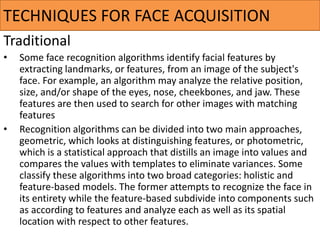
• Some face recognition algorithms identify facial features by
extracting landmarks, or features, from an image of the subject's
face. For example, an algorithm may analyze the relative position,
size, and/or shape of the eyes, nose, cheekbones, and jaw. These
features are then used to search for other images with matching
features
• Recognition algorithms can be divided into two main approaches,
geometric, which looks at distinguishing features, or photometric,
which is a statistical approach that distills an image into values and
compares the values with templates to eliminate variances. Some
classify these algorithms into two broad categories: holistic and
feature-based models. The former attempts to recognize the face in
its entirety while the feature-based subdivide into components such
as according to features and analyze each as well as its spatial
location with respect to other features.
TECHNIQUES FOR FACE ACQUISITION
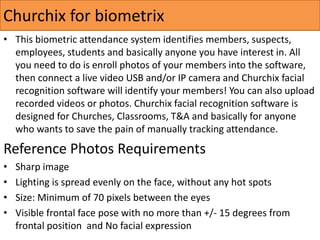
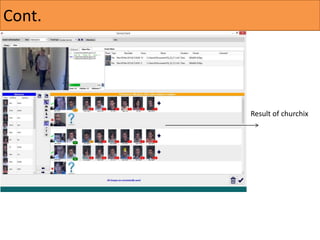
• This biometric attendance system identifies members, suspects,
employees, students and basically anyone you have interest in. All
you need to do is enroll photos of your members into the software,
then connect a live video USB and/or IP camera and Churchix facial
recognition software will identify your members! You can also upload
recorded videos or photos. Churchix facial recognition software is
designed for Churches, Classrooms, T&A and basically for anyone
who wants to save the pain of manually tracking attendance.
Reference Photos Requirements
• Sharp image
• Lighting is spread evenly on the face, without any hot spots
• Size: Minimum of 70 pixels between the eyes
• Visible frontal face pose with no more than +/- 15 degrees from
frontal position and No facial expression
Churchix for biometrix
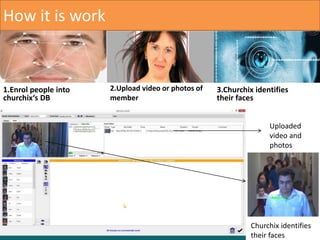
How it is work
2.Upload video or photos of
member
3.Churchix identifies
their faces
1.Enrol people into
churchix‘s DB
Uploaded
video and
photos
Churchix identifies
their faces
Cont.
Result of churchix
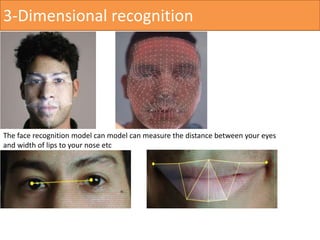
• Three-dimensional face recognition technique uses 3D sensors to
capture information about the shape of a face. This information is
then used to identify distinctive features on the surface of a face,
such as the contour of the eye sockets, nose, and chin.
• One advantage of 3D face recognition is that it is not affected by
changes in lighting like other techniques. It can also identify a face
from a range of viewing angles, including a profile view.
• The sensors work by projecting structured light onto the face. Up to a
dozen or more of these image sensors can be placed on the same
CMOS chip each sensor captures a different part of the spectrum.
• A new method is to introduce a way to capture a 3D picture by using
three tracking cameras that point at different angles; one camera will
be pointing at the front of the subject, second one to the side, and
third one at an angle. All these cameras will work together so it can
track a subject‘s face in real time and be able to face detect and
recognize.
3-Dimensional recognition
The face recognition model can model can measure the distance between your eyes
and width of lips to your nose etc
• Skin texture analysis
• Facial recognition combining different techniques
• 3.5 Thermal cameras
cont
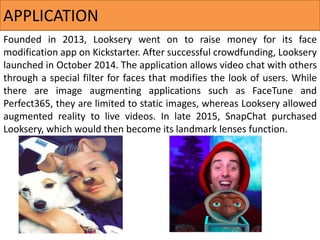
Founded in 2013, Looksery went on to raise money for its face
modification app on Kickstarter. After successful crowdfunding, Looksery
launched in October 2014. The application allows video chat with others
through a special filter for faces that modifies the look of users. While
there are image augmenting applications such as FaceTune and
Perfect365, they are limited to static images, whereas Looksery allowed
augmented reality to live videos. In late 2015, SnapChat purchased
Looksery, which would then become its landmark lenses function.
APPLICATION
ID Verification solutions
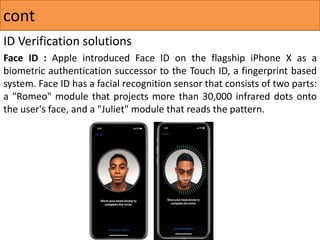
Face ID : Apple introduced Face ID on the flagship iPhone X as a
biometric authentication successor to the Touch ID, a fingerprint based
system. Face ID has a facial recognition sensor that consists of two parts:
a "Romeo" module that projects more than 30,000 infrared dots onto
the user's face, and a "Juliet" module that reads the pattern.
cont
• Face Detection: it has the objective of finding the faces (location
and size) in an image and probably extract them to be used by
the face recognition algorithm.
• Face Recognition: with the facial images already extracted,
cropped, resized and usually converted to grayscale, the face
recognition algorithm is responsible for finding characteristics
which best describe the image.
• The face recognition systems can operate basically in two
modes:
Verification or authentication of a facial image: it basically
compares the input facial image with the facial image related to
the user which is requiring the authentication. It is basically a 1x1
comparison.
Identification or facial recognition: it basically compares the input
facial image with all facial images from a dataset with the aim to
find the user that matches that face. It is basically a 1xN
comparison
FACE REGOGNITION ALGORRITHM
• Compared to the other biometric systems​
• weaknesses​
• Ineffrectiveness
ADVANTAGES AND DISADVANGES​
• Privacy Violations :Face recognition can be used not just to ident
ify an individual, but also to unearth other personal
data associated with an individual –
such as other photos featuring the individual, blog posts,
social networking profiles, Internet behavior, travel patterns, etc
all through facial features alone.
• Facebook DeepFace
• Imperfect technology in law enforcement
CONTROVERSIES​
Anti facial recognigation systems :In January 2013 Japanese
researchers from the National Institute of Informatics cre
ated 'privacyvisor' glasses that use nearly infrared light to
make the face underneath it unrecognizable to face
recognition software.
EMOTIONAL DETECTION
Face recognition systems are useful in law enforcement and
justice solutions by staying one step ahead of the world‘s
ever-advancing criminals. This includes acclaimed
CABScomputerized arrest and booking system and the
childbase protection which is a software solution for global
law enforcement agencies to help protect and recover missing
and sexually exploited children, particularly as it relates to
child pornography. It is also useful in Homeland defense
which includes everything from preventing terrorists from
boarding aircraft, to protecting critical infrastructure from
attack or tampering (e.g. dams, bridges, water reservoirs,
energy plants, etc.), to the identification of known terrorists.
CONCLUSIONS​
• https://www.youtube.com/watch?v=nT_PXjLol_8
• https://churchix.com/
• https://www.academia.edu/4870337/
• https://www.face-six.com/
• https://www.humanrecognitionsystems.com/product/mflow/
• https://www.dhs.gov/biometrics
• https://ieeexplore.ieee.org/document/4430529
• https://www.macworld.com/article/3225406/iphone-ipad/face-id-
iphone-x-faq.html
REFRENCES

Face Recognition Dissertation

  • 1.
    Presented by :sandeep Face Recognition DISSERTATION ON
  • 2.
    Information • A facerecognition system is a technology capable of identifying or verifying a person from a digital image or a video frame from a video source. There are multiple methods in which facial recognition systems work, but in general, they work by comparing selected facial features from given image with faces within a database. • Biometric Artificial Intelligence based application that can uniquely identify a person by analyzing patterns based on the person's facial textures and shape. • it has also become popular as a commercial identification and marketing tool Other applications include advanced human-computer interaction, video surveillance, automatic indexing of images, and video database, among others.
  • 3.
    Facial recognition orface recognition may refer to : • Face perception, the process by which the human brain understands and interprets the face. • Pareidolia, which involves, in part, seeing images of faces in clouds and other scenes. • Facial recognition system, an automated system with the ability to identify individuals by their facial characteristics.
  • 4.
    HISTORY OF FACERECOGNIGATION TECHNOLOGY • Pioneers of automated face recognition include Woody Bledsoe, Helen Chan Wolf, and Charles Bisson. During 1964 and 1965, Bledsoe, along with Helen Chan and Charles Bisson, worked on using the computer to recognize human faces (Bledsoe 1966a, 1966b; Bledsoe and Chan 1965). He was proud of this work, but because the funding was provided by an unnamed intelligence agency that did not allow much publicity, little of the work was published. • Based on the available references, it was revealed that the Bledsoe's initial approach involved the manual marketing of various landmarks on the face such as the eye centers, mouth, etc., and these were mathematically rotated by computer to compensate for pose variation. • The distances between landmarks were also automatically computed and compared between images to determine identity.
  • 5.
    • After Bledsoeleft PRI in 1966, this work was continued at the Stanford Research Institute, primarily by Peter Hart. In experiments performed on a database of over 2000 photographs, the computer consistently outperformed humans when presented with the same recognition tasks (Bledsoe 1968). • In 2006, the performance of the latest face recognition algorithms were evaluated in the Face Recognition Grand Challenge (FRGC). High-resolution face images, 3-D face scans, and iris images were used in the tests. The results indicated that the new algorithms are 10 times more accurate than the face recognition algorithms of 2002 and 100 times more accurate than those of 1995. Cont.
  • 6.
    Traditional • Some facerecognition algorithms identify facial features by extracting landmarks, or features, from an image of the subject's face. For example, an algorithm may analyze the relative position, size, and/or shape of the eyes, nose, cheekbones, and jaw. These features are then used to search for other images with matching features • Recognition algorithms can be divided into two main approaches, geometric, which looks at distinguishing features, or photometric, which is a statistical approach that distills an image into values and compares the values with templates to eliminate variances. Some classify these algorithms into two broad categories: holistic and feature-based models. The former attempts to recognize the face in its entirety while the feature-based subdivide into components such as according to features and analyze each as well as its spatial location with respect to other features. TECHNIQUES FOR FACE ACQUISITION
  • 7.
    • This biometricattendance system identifies members, suspects, employees, students and basically anyone you have interest in. All you need to do is enroll photos of your members into the software, then connect a live video USB and/or IP camera and Churchix facial recognition software will identify your members! You can also upload recorded videos or photos. Churchix facial recognition software is designed for Churches, Classrooms, T&A and basically for anyone who wants to save the pain of manually tracking attendance. Reference Photos Requirements • Sharp image • Lighting is spread evenly on the face, without any hot spots • Size: Minimum of 70 pixels between the eyes • Visible frontal face pose with no more than +/- 15 degrees from frontal position and No facial expression Churchix for biometrix
  • 8.
    How it iswork 2.Upload video or photos of member 3.Churchix identifies their faces 1.Enrol people into churchix‘s DB Uploaded video and photos Churchix identifies their faces
  • 9.
  • 10.
    • Three-dimensional facerecognition technique uses 3D sensors to capture information about the shape of a face. This information is then used to identify distinctive features on the surface of a face, such as the contour of the eye sockets, nose, and chin. • One advantage of 3D face recognition is that it is not affected by changes in lighting like other techniques. It can also identify a face from a range of viewing angles, including a profile view. • The sensors work by projecting structured light onto the face. Up to a dozen or more of these image sensors can be placed on the same CMOS chip each sensor captures a different part of the spectrum. • A new method is to introduce a way to capture a 3D picture by using three tracking cameras that point at different angles; one camera will be pointing at the front of the subject, second one to the side, and third one at an angle. All these cameras will work together so it can track a subject‘s face in real time and be able to face detect and recognize. 3-Dimensional recognition
  • 11.
    3-Dimensional recognition The facerecognition model can model can measure the distance between your eyes and width of lips to your nose etc
  • 12.
    • Skin textureanalysis • Facial recognition combining different techniques • 3.5 Thermal cameras cont
  • 13.
    Founded in 2013,Looksery went on to raise money for its face modification app on Kickstarter. After successful crowdfunding, Looksery launched in October 2014. The application allows video chat with others through a special filter for faces that modifies the look of users. While there are image augmenting applications such as FaceTune and Perfect365, they are limited to static images, whereas Looksery allowed augmented reality to live videos. In late 2015, SnapChat purchased Looksery, which would then become its landmark lenses function. APPLICATION
  • 14.
    ID Verification solutions FaceID : Apple introduced Face ID on the flagship iPhone X as a biometric authentication successor to the Touch ID, a fingerprint based system. Face ID has a facial recognition sensor that consists of two parts: a "Romeo" module that projects more than 30,000 infrared dots onto the user's face, and a "Juliet" module that reads the pattern. cont
  • 15.
    • Face Detection:it has the objective of finding the faces (location and size) in an image and probably extract them to be used by the face recognition algorithm. • Face Recognition: with the facial images already extracted, cropped, resized and usually converted to grayscale, the face recognition algorithm is responsible for finding characteristics which best describe the image. • The face recognition systems can operate basically in two modes: Verification or authentication of a facial image: it basically compares the input facial image with the facial image related to the user which is requiring the authentication. It is basically a 1x1 comparison. Identification or facial recognition: it basically compares the input facial image with all facial images from a dataset with the aim to find the user that matches that face. It is basically a 1xN comparison FACE REGOGNITION ALGORRITHM
  • 16.
    • Compared tothe other biometric systems​ • weaknesses​ • Ineffrectiveness ADVANTAGES AND DISADVANGES​
  • 17.
    • Privacy Violations:Face recognition can be used not just to ident ify an individual, but also to unearth other personal data associated with an individual – such as other photos featuring the individual, blog posts, social networking profiles, Internet behavior, travel patterns, etc all through facial features alone. • Facebook DeepFace • Imperfect technology in law enforcement CONTROVERSIES​
  • 18.
    Anti facial recognigationsystems :In January 2013 Japanese researchers from the National Institute of Informatics cre ated 'privacyvisor' glasses that use nearly infrared light to make the face underneath it unrecognizable to face recognition software. EMOTIONAL DETECTION
  • 19.
    Face recognition systemsare useful in law enforcement and justice solutions by staying one step ahead of the world‘s ever-advancing criminals. This includes acclaimed CABScomputerized arrest and booking system and the childbase protection which is a software solution for global law enforcement agencies to help protect and recover missing and sexually exploited children, particularly as it relates to child pornography. It is also useful in Homeland defense which includes everything from preventing terrorists from boarding aircraft, to protecting critical infrastructure from attack or tampering (e.g. dams, bridges, water reservoirs, energy plants, etc.), to the identification of known terrorists. CONCLUSIONS​
  • 20.
    • https://www.youtube.com/watch?v=nT_PXjLol_8 • https://churchix.com/ •https://www.academia.edu/4870337/ • https://www.face-six.com/ • https://www.humanrecognitionsystems.com/product/mflow/ • https://www.dhs.gov/biometrics • https://ieeexplore.ieee.org/document/4430529 • https://www.macworld.com/article/3225406/iphone-ipad/face-id- iphone-x-faq.html REFRENCES