Presented by :
Nikita Jadhav
8th
SEM ISE
SDMCET
1
1. Introduction
2. Biometrics
3. Implementation
4. Basic Block Diagram
5.How it works?
6.Applications
7.Refereces
2
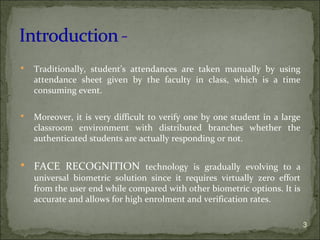
 Traditionally, student’s attendances are taken manually by using
attendance sheet given by the faculty in class, which is a time
consuming event.
 Moreover, it is very difficult to verify one by one student in a large
classroom environment with distributed branches whether the
authenticated students are actually responding or not.
 FACE RECOGNITION technology is gradually evolving to a
universal biometric solution since it requires virtually zero effort
from the user end while compared with other biometric options. It is
accurate and allows for high enrolment and verification rates.
3
4
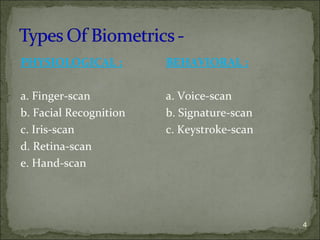
PHYSIOLOGICAL :
a. Finger-scan
b. Facial Recognition
c. Iris-scan
d. Retina-scan
e. Hand-scan
BEHAVIORAL :
a. Voice-scan
b. Signature-scan
c. Keystroke-scan
 A facial recognition is a computer
application for automatically identifying or
verifying a person from a digital image or a
video frame from a video source.
 One of the ways to do this is by comparing
selected facial features from the image and a
facial database.
5
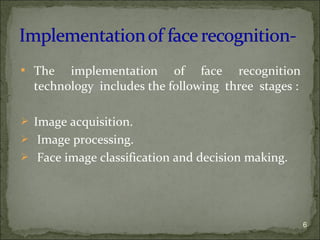
 The implementation of face recognition
technology includes the following three stages :
 Image acquisition.
 Image processing.
 Face image classification and decision making.
6
7
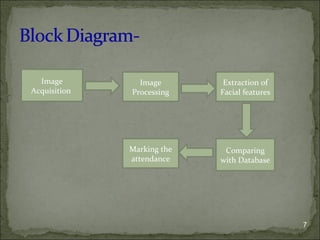
Image
Acquisition
Image
Processing
Extraction of
Facial features
Comparing
with Database
Marking the
attendance
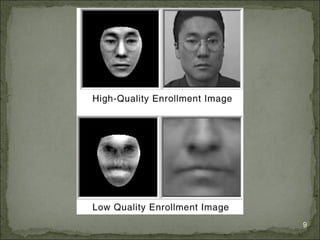
 Facial-scan technology can acquire faces from
almost any static camera or video system that
generates images of sufficient quality and
resolution.
 High-quality enrolment is essential to eventual
verification and identification enrolment images
define the facial characteristics to be used in all
future authentication events.
8
9
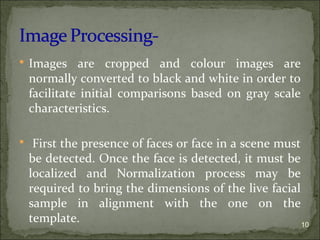
 Images are cropped and colour images are
normally converted to black and white in order to
facilitate initial comparisons based on gray scale
characteristics.
 First the presence of faces or face in a scene must
be detected. Once the face is detected, it must be
localized and Normalization process may be
required to bring the dimensions of the live facial
sample in alignment with the one on the
template. 10
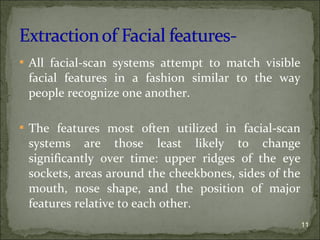
 All facial-scan systems attempt to match visible
facial features in a fashion similar to the way
people recognize one another.
 The features most often utilized in facial-scan
systems are those least likely to change
significantly over time: upper ridges of the eye
sockets, areas around the cheekbones, sides of the
mouth, nose shape, and the position of major
features relative to each other.
11
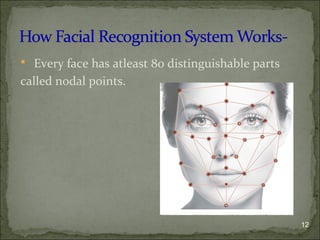
 Every face has atleast 80 distinguishable parts
called nodal points.
12
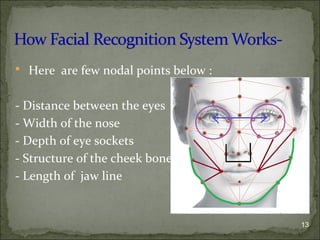
 Here are few nodal points below :
- Distance between the eyes
- Width of the nose
- Depth of eye sockets
- Structure of the cheek bone
- Length of jaw line
13
14
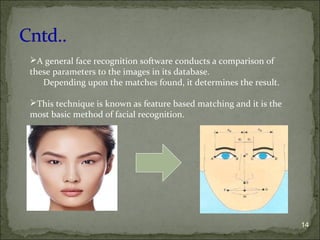
A general face recognition software conducts a comparison of
these parameters to the images in its database.
Depending upon the matches found, it determines the result.
This technique is known as feature based matching and it is the
most basic method of facial recognition.
 Primary application being used in classrooms to
take the attendance of the students.
 Decrease the false attendance.
 Security/Counterterrorism: Access control,
comparing surveillance images to know
terrorist.
 ATM: The software is able to quickly verify a
customer’s face.
 Healthcare: Minimize fraud by verifying
identity.
15
 Adrian Rhesa Septian Siswanto, Anto Satriyo Nugroho, Maulahikmah
Galinium,” Implementation of face recognition algorithm for
biometrics based time attendance system”, IEEE, ICT For Smart
Society (ICISS), International Conference ,January 2015.
 Brian C. Becker, Enrique G.Ortiz, “Evaluation of Face Recognition
Techniques for Application to Facebook ” IEEE, 2008.
 International Journal of Computer and Communication Engineering,
Vol. 1, No. 2, July 2012 - Study of Implementing Automated
Attendance System Using Face Recognition Technique by Nirmalya
Kar, Mrinal Kanti Debbarma, Ashim Saha, and Dwijen Rudra Pal.
 Real time face recognition system using PCA and various distance
classifiers byDeepesh Raj – IIT Kanpur.
16
17

Automatic Attendance system using Facial Recognition

  • 1.
    Presented by : NikitaJadhav 8th SEM ISE SDMCET 1
  • 2.
    1. Introduction 2. Biometrics 3.Implementation 4. Basic Block Diagram 5.How it works? 6.Applications 7.Refereces 2
  • 3.
     Traditionally, student’sattendances are taken manually by using attendance sheet given by the faculty in class, which is a time consuming event.  Moreover, it is very difficult to verify one by one student in a large classroom environment with distributed branches whether the authenticated students are actually responding or not.  FACE RECOGNITION technology is gradually evolving to a universal biometric solution since it requires virtually zero effort from the user end while compared with other biometric options. It is accurate and allows for high enrolment and verification rates. 3
  • 4.
    4 PHYSIOLOGICAL : a. Finger-scan b.Facial Recognition c. Iris-scan d. Retina-scan e. Hand-scan BEHAVIORAL : a. Voice-scan b. Signature-scan c. Keystroke-scan
  • 5.
     A facialrecognition is a computer application for automatically identifying or verifying a person from a digital image or a video frame from a video source.  One of the ways to do this is by comparing selected facial features from the image and a facial database. 5
  • 6.
     The implementationof face recognition technology includes the following three stages :  Image acquisition.  Image processing.  Face image classification and decision making. 6
  • 7.
  • 8.
     Facial-scan technologycan acquire faces from almost any static camera or video system that generates images of sufficient quality and resolution.  High-quality enrolment is essential to eventual verification and identification enrolment images define the facial characteristics to be used in all future authentication events. 8
  • 9.
  • 10.
     Images arecropped and colour images are normally converted to black and white in order to facilitate initial comparisons based on gray scale characteristics.  First the presence of faces or face in a scene must be detected. Once the face is detected, it must be localized and Normalization process may be required to bring the dimensions of the live facial sample in alignment with the one on the template. 10
  • 11.
     All facial-scansystems attempt to match visible facial features in a fashion similar to the way people recognize one another.  The features most often utilized in facial-scan systems are those least likely to change significantly over time: upper ridges of the eye sockets, areas around the cheekbones, sides of the mouth, nose shape, and the position of major features relative to each other. 11
  • 12.
     Every facehas atleast 80 distinguishable parts called nodal points. 12
  • 13.
     Here arefew nodal points below : - Distance between the eyes - Width of the nose - Depth of eye sockets - Structure of the cheek bone - Length of jaw line 13
  • 14.
    14 A general facerecognition software conducts a comparison of these parameters to the images in its database. Depending upon the matches found, it determines the result. This technique is known as feature based matching and it is the most basic method of facial recognition.
  • 15.
     Primary applicationbeing used in classrooms to take the attendance of the students.  Decrease the false attendance.  Security/Counterterrorism: Access control, comparing surveillance images to know terrorist.  ATM: The software is able to quickly verify a customer’s face.  Healthcare: Minimize fraud by verifying identity. 15
  • 16.
     Adrian RhesaSeptian Siswanto, Anto Satriyo Nugroho, Maulahikmah Galinium,” Implementation of face recognition algorithm for biometrics based time attendance system”, IEEE, ICT For Smart Society (ICISS), International Conference ,January 2015.  Brian C. Becker, Enrique G.Ortiz, “Evaluation of Face Recognition Techniques for Application to Facebook ” IEEE, 2008.  International Journal of Computer and Communication Engineering, Vol. 1, No. 2, July 2012 - Study of Implementing Automated Attendance System Using Face Recognition Technique by Nirmalya Kar, Mrinal Kanti Debbarma, Ashim Saha, and Dwijen Rudra Pal.  Real time face recognition system using PCA and various distance classifiers byDeepesh Raj – IIT Kanpur. 16
  • 17.