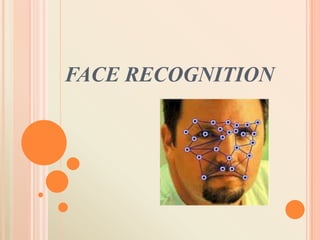
FACE RECOGNITION
TABLE OF CONTENTS
 Introduction.
 2D Facial Recognition.
 3D Facial Recognition.
 Working Steps.
 Hardware & Software
requirements
 Advantages &
Disadvantages.
 Applications of Face
recognition.
 Conclusion.
INTRODUCTION
• In 1960’s Scientists began work on using
the computer to recognize human faces
• Since then, face recognition software has
come a long way.
• Facial recognition software is based on
the ability to recognition a face and then
measure various features of the face.
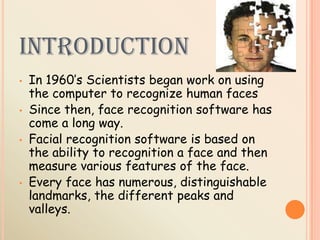
• Every face has numerous, distinguishable
landmarks, the different peaks and
valleys.
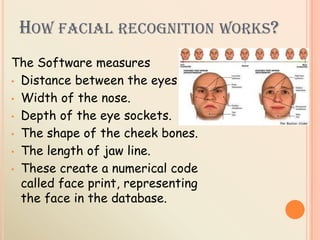
HOW FACIAL RECOGNITION WORKS?
The Software measures
• Distance between the eyes
• Width of the nose.
• Depth of the eye sockets.
• The shape of the cheek bones.
• The length of jaw line.
• These create a numerical code
called face print, representing
the face in the database.
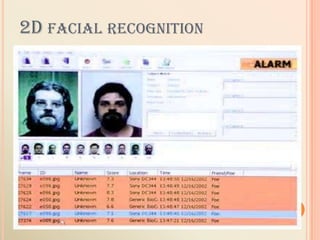
2D FACIAL RECOGNITION
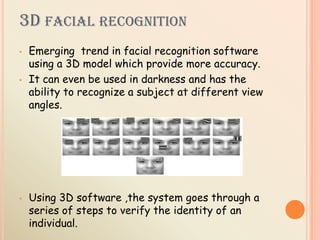
3D FACIAL RECOGNITION
• Emerging trend in facial recognition software
using a 3D model which provide more accuracy.
• It can even be used in darkness and has the
ability to recognize a subject at different view
angles.
• Using 3D software ,the system goes through a
series of steps to verify the identity of an
individual.
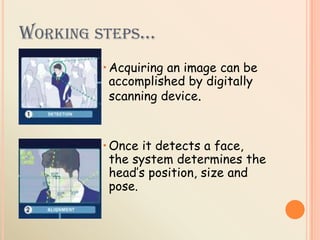
WORKING STEPS…
•Acquiring an image can be
accomplished by digitally
scanning device.
•Once it detects a face,
the system determines the
head’s position, size and
pose.
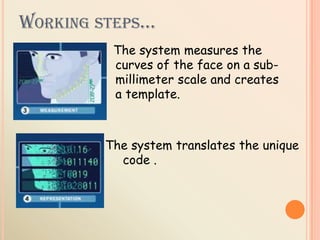
WORKING STEPS…
The system measures the
curves of the face on a sub-
millimeter scale and creates
a template.
The system translates the unique
code .
WORKING STEPS…
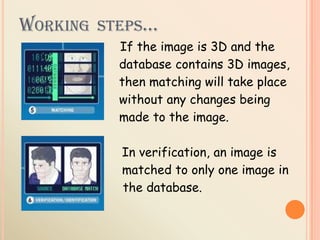
If the image is 3D and the
database contains 3D images,
then matching will take place
without any changes being
made to the image.
In verification, an image is
matched to only one image in
the database.
HARDWARE AND SOFTWARE
REQUIREMENTS
Hardware requirements
• Intel Pentium processor or any other
compatible processor,1 GHz or greater
• Minimum 128 MB of RAM capacity or
more
• Minimum of 32 MB Graphic Card RAM
capacities or more
• Recommended hard disk space of 1GB or
more
HARDWARE AND SOFTWARE
REQUIREMENTS
Software requirements
• Windows 2000/XP or above, Linux. Mac OS X,
Unix
• Python 2.5
• PyQt-Py 2.5
ADVANTAGES
• Repeat offenders are identified using
facial recovery.
• It has been used by Law Enforcement
Agencies to capture random faces in
crowd.
• It is used to verify that the person
received the visa is same person
attempting to gain entry.
• Easy way to access personal accounts
without remembering passwords.
DISADVANTAGES
• Variant Pose may occur because
people always don’t orient to camera
• Different lighting and quality of
camera may also effect recognition
• Invasion of privacy
• Too easy to misuse for wrong
purposes
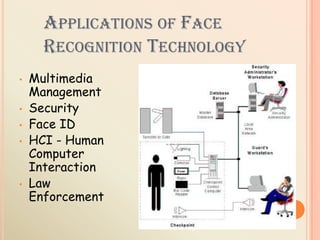
APPLICATIONS OF FACE
RECOGNITION TECHNOLOGY
• Multimedia
Management
• Security
• Face ID
• HCI - Human
Computer
Interaction
• Law
Enforcement
CONCLUSION
The computer based face
recognition industry has made
much useful advancement in past
decade however, the need for
higher accuracy systems remains.
Through the determination and
commitment the progress will
continue, raising the bar for face
recognition technology.
Face recognization

Face recognization

  • 1.
  • 2.
    TABLE OF CONTENTS Introduction.  2D Facial Recognition.  3D Facial Recognition.  Working Steps.  Hardware & Software requirements  Advantages & Disadvantages.  Applications of Face recognition.  Conclusion.
  • 3.
    INTRODUCTION • In 1960’sScientists began work on using the computer to recognize human faces • Since then, face recognition software has come a long way. • Facial recognition software is based on the ability to recognition a face and then measure various features of the face. • Every face has numerous, distinguishable landmarks, the different peaks and valleys.
  • 4.
    HOW FACIAL RECOGNITIONWORKS? The Software measures • Distance between the eyes • Width of the nose. • Depth of the eye sockets. • The shape of the cheek bones. • The length of jaw line. • These create a numerical code called face print, representing the face in the database.
  • 5.
  • 6.
    3D FACIAL RECOGNITION •Emerging trend in facial recognition software using a 3D model which provide more accuracy. • It can even be used in darkness and has the ability to recognize a subject at different view angles. • Using 3D software ,the system goes through a series of steps to verify the identity of an individual.
  • 7.
    WORKING STEPS… •Acquiring animage can be accomplished by digitally scanning device. •Once it detects a face, the system determines the head’s position, size and pose.
  • 8.
    WORKING STEPS… The systemmeasures the curves of the face on a sub- millimeter scale and creates a template. The system translates the unique code .
  • 9.
    WORKING STEPS… If theimage is 3D and the database contains 3D images, then matching will take place without any changes being made to the image. In verification, an image is matched to only one image in the database.
  • 10.
    HARDWARE AND SOFTWARE REQUIREMENTS Hardwarerequirements • Intel Pentium processor or any other compatible processor,1 GHz or greater • Minimum 128 MB of RAM capacity or more • Minimum of 32 MB Graphic Card RAM capacities or more • Recommended hard disk space of 1GB or more
  • 11.
    HARDWARE AND SOFTWARE REQUIREMENTS Softwarerequirements • Windows 2000/XP or above, Linux. Mac OS X, Unix • Python 2.5 • PyQt-Py 2.5
  • 12.
    ADVANTAGES • Repeat offendersare identified using facial recovery. • It has been used by Law Enforcement Agencies to capture random faces in crowd. • It is used to verify that the person received the visa is same person attempting to gain entry. • Easy way to access personal accounts without remembering passwords.
  • 13.
    DISADVANTAGES • Variant Posemay occur because people always don’t orient to camera • Different lighting and quality of camera may also effect recognition • Invasion of privacy • Too easy to misuse for wrong purposes
  • 14.
    APPLICATIONS OF FACE RECOGNITIONTECHNOLOGY • Multimedia Management • Security • Face ID • HCI - Human Computer Interaction • Law Enforcement
  • 15.
    CONCLUSION The computer basedface recognition industry has made much useful advancement in past decade however, the need for higher accuracy systems remains. Through the determination and commitment the progress will continue, raising the bar for face recognition technology.