FACE 
RECOGNITION 
TECHNOLOGY 
SHRAVAN HALANKAR 
GOA UNIVERSITY 
ELECTRONICS DEPT.
O U T L I N E 
1. Introduction 
2. Biometrics 
3. Why Face Recognition? 
4. Implementation 
5. How it works? 
6. Strengths & Weaknesses 
7. Major Challenges in FRT 
8. Applications 
9. Future of FRT………
I N T R O D U C T I O N 
 Everyday actions are increasingly being handled 
electronically, instead of ink and paper or face to face. 
 This growth in electronic transactions results in great 
demand for fast and accurate user identification and 
authentication. 
 Access codes for buildings, banks accounts and computer 
systems often use PIN's for identification and security 
clearances. 
 Using the proper PIN gains access, but the user of the PIN 
is not verified. When credit and ATM cards are lost or 
stolen, an unauthorized user can often come up with the 
correct personal codes. 
 BIOMETRICS technology may solve this problem .
BIOMETRICS? 
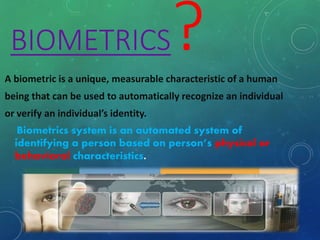
A biometric is a unique, measurable characteristic of a human 
being that can be used to automatically recognize an individual 
or verify an individual’s identity. 
Biometrics system is an automated system of 
identifying a person based on person’s physical or 
behavioral characteristics.
TYPES OF BIOMETRICS 
Fingerprints Hand Geometry Retina 
Signature Iris FACE RECOGNITION
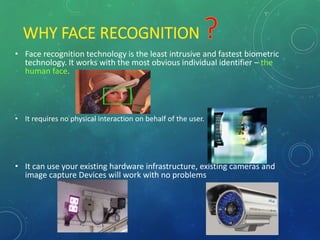
• Face recognition technology is the least intrusive and fastest biometric 
technology. It works with the most obvious individual identifier – the 
human face. 
• It requires no physical interaction on behalf of the user. 
• It can use your existing hardware infrastructure, existing cameras and 
image capture Devices will work with no problems
• It is only Biometric that allow you to perform passive identification in many 
environments. (e.g: Identifying terrorist in a busy Airport terminal.) 
• It does not require an expert to interpret the comparison result. 
ACCURATE!!
THE HUMAN FACE 
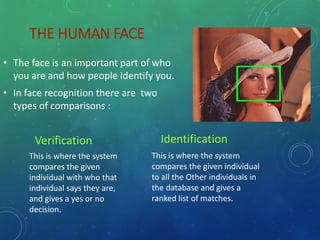
• The face is an important part of who 
you are and how people identify you. 
• In face recognition there are two 
types of comparisons : 
Verification Identification 
This is where the system 
compares the given 
individual with who that 
individual says they are, 
and gives a yes or no 
decision. 
This is where the system 
compares the given individual 
to all the Other individuals in 
the database and gives a 
ranked list of matches.
ALL IDENTIFICATION OR AUTHENTICATION TECHNOLOGIES OPERATE 
USING THE FOLLOWING FOUR STAGES: 
1)Capture 
A physical or behavioral sample is 
captured by the system during 
Enrollment and also in identification or 
verification process 
2)Extraction 
Unique data is extracted from the 
sample and a template is created. 
3)Comparison 
The template is then compared with a 
new sample stored in the data base 
4)Match /non match 
The system decides if the features 
extracted from the new Samples are a 
match or a non match 
IMPLEMENTATION 
Input face 
image(Capture) 
Face feature 
extraction 
Feature 
Matching Decision maker 
Output 
result 
Face 
database
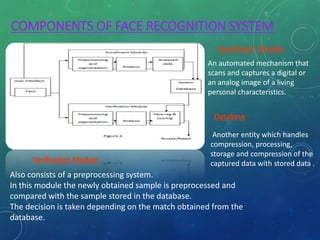
COMPONENTS OF FACE RECOGNITION SYSTEM 
Enrollment Module 
An automated mechanism that 
scans and captures a digital or 
an analog image of a living 
personal characteristics. 
Database 
Another entity which handles 
compression, processing, 
storage and compression of the 
captured data with stored data . 
Verification Module 
Also consists of a preprocessing system. 
In this module the newly obtained sample is preprocessed and 
compared with the sample stored in the database. 
The decision is taken depending on the match obtained from the 
database.
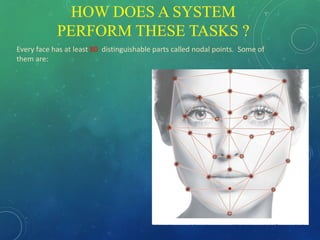
Every face has at least 80 distinguishable parts called nodal points. Some of 
them are:
Every face has at least 80 distinguishable parts called nodal points. Some of 
them are: 
1. Distance between the eyes
Every face has at least 80 distinguishable parts called nodal points. Some of 
them are: 
1. Distance between the eyes 
2. Width of the nose
Every face has at least 80 distinguishable parts called nodal points. Some of 
them are: 
1. Distance between the eyes 
2. Width of the nose 
3. Depth of eye sockets
Every face has at least 80 distinguishable parts called nodal points. Some of 
them are: 
1. Distance between the eyes 
2. Width of the nose 
3. Depth of eye sockets 
4. Structure of cheek bones
Every face has at least 80 distinguishable parts called nodal points. Some of 
them are: 
1. Distance between the eyes 
2. Width of the nose 
3. Depth of eye sockets 
4. Structure of the cheek bones 
5. Length of jaw line
A general face recognition software conducts a comparison of 
these parameters to the images in its database. 
Depending upon the matches found, it determines the result. 
This technique is known as feature based matching and it is the 
most basic method of facial recognition.
A 3D facial recognition model provides greater accuracy 
than the feature extraction model. 
It can also be used in a dark surroundings and has a ability 
to recognize the subject at different view angles. 
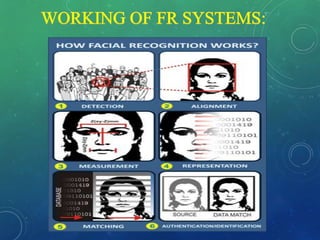
Using 3D software, the system 
Goes through a number of steps 
to verify the identity of an 
individual.
Acquiring an image can be done 
through a digital scanning device. 
Once it detects the face, the system 
determines heads position, size and 
pose.
The system then measures the 
curves of the face on a sub-millimeter 
scale and creates a 
template. 
The system translates this 
template into a unique code.
The image thus acquired will be 
compared to the images in the 
data base and if 3D images are 
not available to the database, 
then algorithms used to get a 
straight face are applied to the 
3D image to be matched. 
Finally in verification, the image 
is matched to only one image in 
the database and the result is 
displayed as shown alongside.
The most commonly used unique feature for facial 
recognition is iris of the eye. No two human beings, 
even twins have exactly similar iris.
FACE FEATURE EXTRACTION METHODS 
1. Eigen face or PCA (Principal Component Analysis) 
Other method; 
1. EBGM -Elastic Bunch Graph Method.-2D Image 
2. 3D Face Recognition Method 3D Image
EIGEN FACE OR PCA 
(PRINCIPAL COMPONENT ANALYSIS) 
• PCA, commonly referred to as the use of eigenfaces, 
this technique pioneered by Kirby and Sirivich in 
1988. 
• The PCA approach typically requires the full frontal 
face to be presented each time otherwise the 
image results in poor performance. 
• The primary advantage of this technique is that it can 
reduce the data needed to identify the individual to 
1/1000th of the data presented
PCA-PRINCIPAL COMPONENT ANALYSIS 
(EIGEN FACE METHOD) 
• 1.Create training set of faces and calculate the eigen 
faces ( Creating the Data Base) 
• 2. Project the new image onto the eigen faces. 
• 3. Check closeness to one of the known faces. 
• 4. Add unknown faces to the training set and re-calculate
CREATING TRAINING SET OF IMAGES 
• Face Image as I(x,y) be 2 dimensional N by N array of 
(8 bit) intensity values. 
• Image may also be considered as a vector of dimension N2. 
( 256x256 image = Vector of Dimension 65,536 ) 
y Image T1=I1(1,1),I1(1,2)…I1(1,N),I1(2,1)…….., I1(N,N) 
x
• Training set of face images T1,T2,T3,……TM.- 
• 1. Average Face of Image =Ψ = 1 ( ΣM Ti ) ; M –no. of images 
M i=1 
Ψ average face
• 2. Each Training face defer from average by vector Φ 
Φi Eigen face 
Φi =Ti - Ψ 
Each Image Average Image 
Ti Ψ
FACE IMAGES USING AS EIGEN FACES 
TRAINING IMAGES 
-IMAGE MUST BE IN SAME SIZE-Face 
database
Elastic Bunch Graph Matching 
(EBGM) 
• EBGM relies on the concept that real face images have many non-linear 
characteristics that are not addressed by the linear analysis 
methods . 
• Such as variations in illumination(outdoor lighting vs. indoor 
fluorescents), pose (standing straight vs. leaning over) and 
expression (smile vs. frown). 
• A Gabor wavelet transform creates a dynamic link architecture that 
projects the face onto an elastic grid. 
• The Gabor jet is a node on the elastic grid, notated by circles on 
the image below, which describes the image behavior around a 
given pixel.
Elastic Bunch Graph Matching 
(EBGM) 
• Recognition is based on the similarity of the Gabor 
filter response at each Gabor node. 
• The difficulty with this method is the requirement of 
accurate landmark localization.
STRENGTHS AND WEEKNESSES OF FRT 
STRENGTHS 
 It has the ability to leverage 
existing image acquisition 
equipment. 
 It can search against static 
images such as driver’s 
license photographs. 
 It is the only biometric able 
to operate without user 
cooperation. 
WEEKNESSES 
 Changes in acquisition environment 
reduce matching accuracy. 
 Changes in physiological 
characteristics reduce matching 
accuracy. 
 It has the potential for privacy 
abuse due to no cooperative 
enrolment and identification 
capabilities.
PERFORMANCE OF FRT 
False acceptance 
rates(FAR) 
• The probability that a system will 
incorrectly identify an individual 
or will fail to reject an imposter. 
• FAR= NFA/NIIA 
• Where FAR= false acceptance rate 
NFA= number of false acceptance 
NIIA= number of imposter 
identification attempts 
False rejection 
rates(FRR) 
• The probability that a system will 
fail to identify an enrollee. 
• FRR= NFR/NEIA 
• Where FRR= false rejection rates 
NFR= number of false rejection rates 
NEIA= number of enrollee 
identification attempt
The only way to overcome this challenge is 
better equipment, i.e. basically , use of high 
tech cameras. 
It is very much essential for the system to 
catch the image accurately.
The only way to overcome this challenge is better 
ALGORITHMS for facial recognitions. If the systems are 
programmed for every possible permutation and 
combination of the image, an accurate match can be 
achieved.
APPLICATIONS
It is being estimated that facial recognition technology 
will be the backbone of all major security, home and 
networking service. 
With the growth of social networking over the web, 
unbelievably accurate facial recognition algorithms and 
advanced equipment, a person’s face, no mater ageing 
or disguises or damage, can be recognized and data 
about that person can be produced. 
Twins Recognition.
QUESTIONS ?
1.www.biometrics.gov 
2.www.wikipedia.com 
3.www.howstuffworks.com 
4.www.face-rec.org 
5.www.facedetection.com 
6.Recognizing Face Images with 
Disguise Variations 
Richa Singh, Mayank Vatsa and Afzel Noore 
Lane Department of Computer Science & Electrical Engineering, West Virginia 
University,USA
Face Recognition Technology

Face Recognition Technology

  • 1.
    FACE RECOGNITION TECHNOLOGY SHRAVAN HALANKAR GOA UNIVERSITY ELECTRONICS DEPT.
  • 2.
    O U TL I N E 1. Introduction 2. Biometrics 3. Why Face Recognition? 4. Implementation 5. How it works? 6. Strengths & Weaknesses 7. Major Challenges in FRT 8. Applications 9. Future of FRT………
  • 3.
    I N TR O D U C T I O N  Everyday actions are increasingly being handled electronically, instead of ink and paper or face to face.  This growth in electronic transactions results in great demand for fast and accurate user identification and authentication.  Access codes for buildings, banks accounts and computer systems often use PIN's for identification and security clearances.  Using the proper PIN gains access, but the user of the PIN is not verified. When credit and ATM cards are lost or stolen, an unauthorized user can often come up with the correct personal codes.  BIOMETRICS technology may solve this problem .
  • 4.
    BIOMETRICS? A biometricis a unique, measurable characteristic of a human being that can be used to automatically recognize an individual or verify an individual’s identity. Biometrics system is an automated system of identifying a person based on person’s physical or behavioral characteristics.
  • 5.
    TYPES OF BIOMETRICS Fingerprints Hand Geometry Retina Signature Iris FACE RECOGNITION
  • 6.
    • Face recognitiontechnology is the least intrusive and fastest biometric technology. It works with the most obvious individual identifier – the human face. • It requires no physical interaction on behalf of the user. • It can use your existing hardware infrastructure, existing cameras and image capture Devices will work with no problems
  • 7.
    • It isonly Biometric that allow you to perform passive identification in many environments. (e.g: Identifying terrorist in a busy Airport terminal.) • It does not require an expert to interpret the comparison result. ACCURATE!!
  • 8.
    THE HUMAN FACE • The face is an important part of who you are and how people identify you. • In face recognition there are two types of comparisons : Verification Identification This is where the system compares the given individual with who that individual says they are, and gives a yes or no decision. This is where the system compares the given individual to all the Other individuals in the database and gives a ranked list of matches.
  • 9.
    ALL IDENTIFICATION ORAUTHENTICATION TECHNOLOGIES OPERATE USING THE FOLLOWING FOUR STAGES: 1)Capture A physical or behavioral sample is captured by the system during Enrollment and also in identification or verification process 2)Extraction Unique data is extracted from the sample and a template is created. 3)Comparison The template is then compared with a new sample stored in the data base 4)Match /non match The system decides if the features extracted from the new Samples are a match or a non match IMPLEMENTATION Input face image(Capture) Face feature extraction Feature Matching Decision maker Output result Face database
  • 10.
    COMPONENTS OF FACERECOGNITION SYSTEM Enrollment Module An automated mechanism that scans and captures a digital or an analog image of a living personal characteristics. Database Another entity which handles compression, processing, storage and compression of the captured data with stored data . Verification Module Also consists of a preprocessing system. In this module the newly obtained sample is preprocessed and compared with the sample stored in the database. The decision is taken depending on the match obtained from the database.
  • 12.
    Every face hasat least 80 distinguishable parts called nodal points. Some of them are:
  • 13.
    Every face hasat least 80 distinguishable parts called nodal points. Some of them are: 1. Distance between the eyes
  • 14.
    Every face hasat least 80 distinguishable parts called nodal points. Some of them are: 1. Distance between the eyes 2. Width of the nose
  • 15.
    Every face hasat least 80 distinguishable parts called nodal points. Some of them are: 1. Distance between the eyes 2. Width of the nose 3. Depth of eye sockets
  • 16.
    Every face hasat least 80 distinguishable parts called nodal points. Some of them are: 1. Distance between the eyes 2. Width of the nose 3. Depth of eye sockets 4. Structure of cheek bones
  • 17.
    Every face hasat least 80 distinguishable parts called nodal points. Some of them are: 1. Distance between the eyes 2. Width of the nose 3. Depth of eye sockets 4. Structure of the cheek bones 5. Length of jaw line
  • 18.
    A general facerecognition software conducts a comparison of these parameters to the images in its database. Depending upon the matches found, it determines the result. This technique is known as feature based matching and it is the most basic method of facial recognition.
  • 19.
    A 3D facialrecognition model provides greater accuracy than the feature extraction model. It can also be used in a dark surroundings and has a ability to recognize the subject at different view angles. Using 3D software, the system Goes through a number of steps to verify the identity of an individual.
  • 20.
    Acquiring an imagecan be done through a digital scanning device. Once it detects the face, the system determines heads position, size and pose.
  • 21.
    The system thenmeasures the curves of the face on a sub-millimeter scale and creates a template. The system translates this template into a unique code.
  • 22.
    The image thusacquired will be compared to the images in the data base and if 3D images are not available to the database, then algorithms used to get a straight face are applied to the 3D image to be matched. Finally in verification, the image is matched to only one image in the database and the result is displayed as shown alongside.
  • 23.
    The most commonlyused unique feature for facial recognition is iris of the eye. No two human beings, even twins have exactly similar iris.
  • 24.
    FACE FEATURE EXTRACTIONMETHODS 1. Eigen face or PCA (Principal Component Analysis) Other method; 1. EBGM -Elastic Bunch Graph Method.-2D Image 2. 3D Face Recognition Method 3D Image
  • 25.
    EIGEN FACE ORPCA (PRINCIPAL COMPONENT ANALYSIS) • PCA, commonly referred to as the use of eigenfaces, this technique pioneered by Kirby and Sirivich in 1988. • The PCA approach typically requires the full frontal face to be presented each time otherwise the image results in poor performance. • The primary advantage of this technique is that it can reduce the data needed to identify the individual to 1/1000th of the data presented
  • 26.
    PCA-PRINCIPAL COMPONENT ANALYSIS (EIGEN FACE METHOD) • 1.Create training set of faces and calculate the eigen faces ( Creating the Data Base) • 2. Project the new image onto the eigen faces. • 3. Check closeness to one of the known faces. • 4. Add unknown faces to the training set and re-calculate
  • 27.
    CREATING TRAINING SETOF IMAGES • Face Image as I(x,y) be 2 dimensional N by N array of (8 bit) intensity values. • Image may also be considered as a vector of dimension N2. ( 256x256 image = Vector of Dimension 65,536 ) y Image T1=I1(1,1),I1(1,2)…I1(1,N),I1(2,1)…….., I1(N,N) x
  • 28.
    • Training setof face images T1,T2,T3,……TM.- • 1. Average Face of Image =Ψ = 1 ( ΣM Ti ) ; M –no. of images M i=1 Ψ average face
  • 29.
    • 2. EachTraining face defer from average by vector Φ Φi Eigen face Φi =Ti - Ψ Each Image Average Image Ti Ψ
  • 30.
    FACE IMAGES USINGAS EIGEN FACES TRAINING IMAGES -IMAGE MUST BE IN SAME SIZE-Face database
  • 31.
    Elastic Bunch GraphMatching (EBGM) • EBGM relies on the concept that real face images have many non-linear characteristics that are not addressed by the linear analysis methods . • Such as variations in illumination(outdoor lighting vs. indoor fluorescents), pose (standing straight vs. leaning over) and expression (smile vs. frown). • A Gabor wavelet transform creates a dynamic link architecture that projects the face onto an elastic grid. • The Gabor jet is a node on the elastic grid, notated by circles on the image below, which describes the image behavior around a given pixel.
  • 32.
    Elastic Bunch GraphMatching (EBGM) • Recognition is based on the similarity of the Gabor filter response at each Gabor node. • The difficulty with this method is the requirement of accurate landmark localization.
  • 33.
    STRENGTHS AND WEEKNESSESOF FRT STRENGTHS  It has the ability to leverage existing image acquisition equipment.  It can search against static images such as driver’s license photographs.  It is the only biometric able to operate without user cooperation. WEEKNESSES  Changes in acquisition environment reduce matching accuracy.  Changes in physiological characteristics reduce matching accuracy.  It has the potential for privacy abuse due to no cooperative enrolment and identification capabilities.
  • 34.
    PERFORMANCE OF FRT False acceptance rates(FAR) • The probability that a system will incorrectly identify an individual or will fail to reject an imposter. • FAR= NFA/NIIA • Where FAR= false acceptance rate NFA= number of false acceptance NIIA= number of imposter identification attempts False rejection rates(FRR) • The probability that a system will fail to identify an enrollee. • FRR= NFR/NEIA • Where FRR= false rejection rates NFR= number of false rejection rates NEIA= number of enrollee identification attempt
  • 35.
    The only wayto overcome this challenge is better equipment, i.e. basically , use of high tech cameras. It is very much essential for the system to catch the image accurately.
  • 37.
    The only wayto overcome this challenge is better ALGORITHMS for facial recognitions. If the systems are programmed for every possible permutation and combination of the image, an accurate match can be achieved.
  • 38.
  • 39.
    It is beingestimated that facial recognition technology will be the backbone of all major security, home and networking service. With the growth of social networking over the web, unbelievably accurate facial recognition algorithms and advanced equipment, a person’s face, no mater ageing or disguises or damage, can be recognized and data about that person can be produced. Twins Recognition.
  • 40.
  • 41.
    1.www.biometrics.gov 2.www.wikipedia.com 3.www.howstuffworks.com 4.www.face-rec.org 5.www.facedetection.com 6.Recognizing Face Images with Disguise Variations Richa Singh, Mayank Vatsa and Afzel Noore Lane Department of Computer Science & Electrical Engineering, West Virginia University,USA